Battling failing lights caused by moisture1? You are worried about project callbacks and safety hazards. Understanding IP ratings2 correctly ensures you select the right downlight for every application.
To choose the right downlight, match the IP rating to the environment. Use IP44 for general indoor areas, IP54 for bathrooms and covered outdoor areas, and IP65 for places with direct water exposure like showers or exposed eaves. This protects against failure and ensures safety.
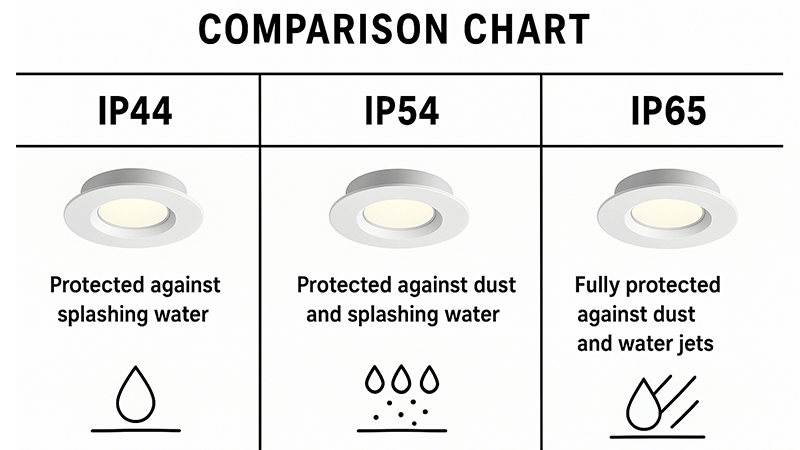
This simple guide is a great starting point. However, as someone who manages purchasing, you know that numbers on a specification sheet3 don't always tell the whole story. I've been in this industry for a long time, and I've seen firsthand how factors beyond the IP rating can make or break a project. The real-world performance of a downlight4 depends on much more than just a two-digit code. Let's explore the critical details that ensure your lighting investment5 is a lasting one.
What is the difference between IP44 and IP65 vs IP54?
IP ratings all look similar on paper, which can be confusing. You might worry about overpaying for protection you don't need or, worse, under-protecting a critical area and risking failure.
IP446 protects against objects larger than 1mm and water splashes. IP547 offers better dust protection plus water splashes. IP658 is fully dust-tight9 and withstands low-pressure water jets10. The main differences are the levels of defense against solids (dust) and liquids (water).
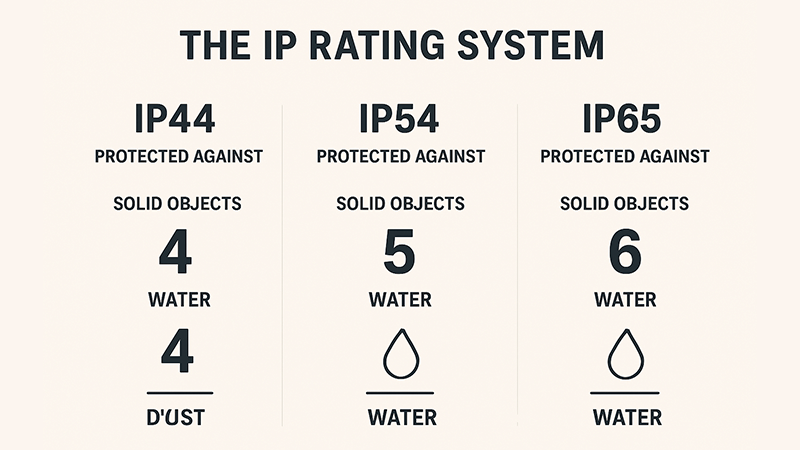
The IP (Ingress Protection) rating system is a standard used to define the sealing effectiveness of electrical enclosures. The two digits in the rating have specific meanings, and understanding them is key to making the right choice for your project. As a purchasing manager like Shaz in the UAE, you need to look past the surface level and understand what these numbers truly represent in a practical sense.
Breaking Down the IP Code
The first digit rates protection against solid objects, like dust and debris. The second digit rates protection against liquids, like water. A higher number means better protection.
| IP Rating | First Digit (Solids) | Meaning (Solids) | Second Digit (Liquids) | Meaning (Liquids) | Common Use Case |
|---|---|---|---|---|---|
| IP44 | 4 | Protected against solid objects >1mm (e.g., tools, wires) | 4 | Protected against water splashes from any direction | General bathroom lighting, Zone 2 |
| IP54 | 5 | Dust-protected (limited ingress, no harmful deposit) | 4 | Protected against water splashes from any direction | Covered outdoor areas, workshops |
| IP65 | 6 | Dust-tight (no ingress of dust) | 5 | Protected against low-pressure water jets from any direction | Shower enclosures (Zone 1), exterior walls |
The Problem of Misleading Ratings
Now, here is a crucial insight I've gained over the years: IP ratings on paper can be deceptive. Many manufacturers, especially smaller brands or those producing generic products, will stamp "IP65" on a downlight without ever conducting proper testing. The testing process is expensive and time-consuming, so they simply copy the design of a truly waterproof light and hope for the best. I once worked with a client who sourced "IP65" downlights for a coastal hotel project. They failed within six months. When we opened one up, the gasket was made of cheap foam that had completely disintegrated. A real IP65 light uses high-quality silicone11 gaskets that can withstand years of exposure. This is why it is so important to work with a reputable manufacturer12 who can provide legitimate testing reports. You are not just buying a product; you are buying the quality assurance that comes with it.
Where are IP65 downlights best used?
You specified IP65 downlights for a tough environment, but they failed anyway. You feel frustrated because you chose the highest protection, yet the project still has problems. The installation is the secret.
IP65 downlights are essential for areas directly hit by water jets. Think inside shower stalls, wet rooms, garden walls, exterior soffits, or any space cleaned with a hose. They offer total protection from dust and water, ensuring long-term reliability in wet conditions.
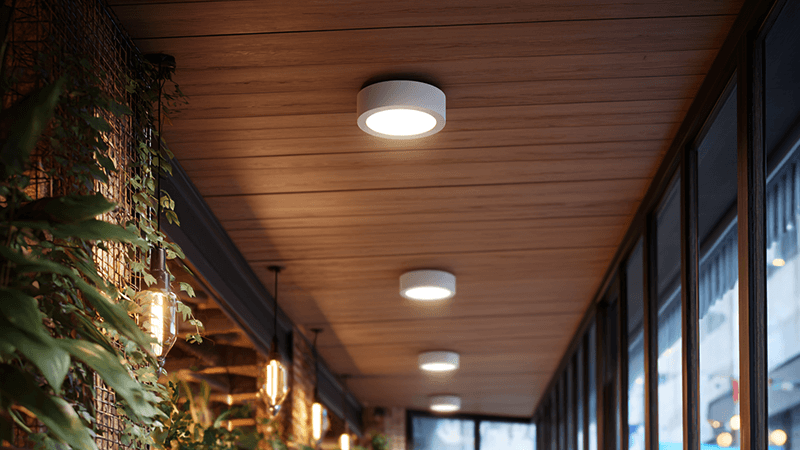
Choosing an IP65 downlight is the correct decision for any area that will face direct contact with water. Their "dust-tight9" and "water-jet-proof" ratings make them the go-to solution for the most demanding environments. However, as I've seen countless times, the performance of that downlight hangs on a single, often overlooked detail: the installation. A perfect IP65 luminaire is only half the equation.
The Installation Trap
The weak point is never the light itself, assuming you've sourced it from a reputable supplier. The weak point is the seal between the light fixture and the surface it's mounted on. A true IP65 downlight has robust silicone gaskets13 designed to create a perfect seal. But what if the ceiling surface is uneven? What if the hole was cut slightly too large or has a jagged edge? Any one of these small installation mistakes creates a micro-channel for water to creep in. Over time, moisture gets past the seal, causes a short circuit, and the light fails. The client then calls you, angry that the "waterproof" lights you supplied are broken. They blame the product, but the real culprit was the installation.
Waterproofing vs. Heat Dissipation: The Trade-off
There is another critical factor to consider with highly sealed units like IP65 downlights. This is the inherent conflict between waterproofing14 and heat dissipation15. To make a light waterproof, you have to seal it completely. But LEDs generate a lot of heat during operation, and that heat needs to escape. If it doesn't, the LED chip's temperature will rise, drastically shortening its lifespan and affecting its light output. This is a natural contradiction: perfect sealing traps heat, while good cooling requires airflow. A well-designed IP65 downlight solves this with a heavy-duty, oversized heat sink. The body of the luminaire itself is engineered to draw heat away from the LED chip and radiate it into the surrounding air, even without ventilation. When you are comparing IP65 products, always look at the physical construction. A light with a flimsy, undersized heat sink will not last, no matter what its IP rating is.
What is the difference between IP54 and IP65 lights?
You are deciding between IP54 and IP65 and the choice seems unclear. You are worried that picking IP54 might not be enough, but IP65 could be overkill and unnecessarily expensive.
The main difference is water protection. IP54 handles splashes from any direction, making it fine for damp areas. IP65 withstands direct low-pressure water jets10, making it necessary for areas that will be hosed down or exposed to heavy rain.
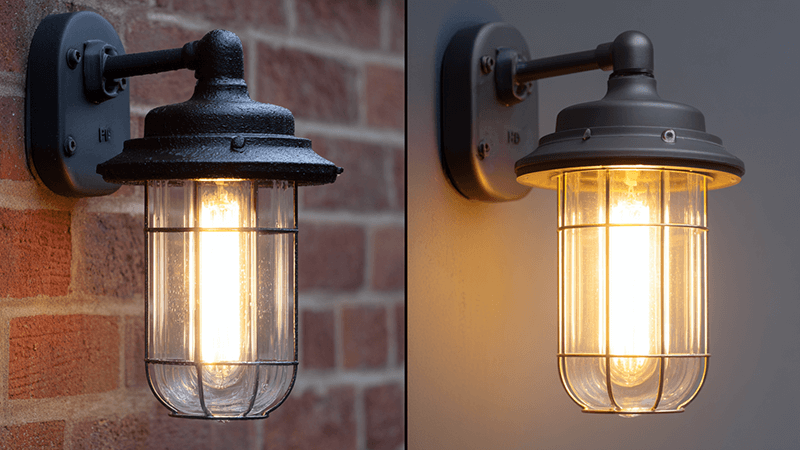
When I consult with purchasing managers like Shaz, the IP54 vs. IP65 question comes up frequently, especially for large-scale commercial or residential projects in regions with varied weather. Both ratings offer good protection, but they are designed for distinctly different scenarios. Choosing the correct one is a matter of balancing cost against risk. Using an IP65 light where an IP54 would suffice is a waste of money. But using an IP54 light in a space that needs IP65 is a guarantee for premature failure and costly replacements.
Protection Level Deep Dive
Let's look at the numbers again. Both ratings have a different first digit. IP54 is "dust-protected," while IP65 is "dust-tight." For most applications, this difference is minor. A small amount of dust might get into an IP54 fixture over many years, but it is not enough to cause damage. The real story is in the second digit.
- Second Digit '4' (Splashes): An IPx4 rating means the product was tested by splashing it with water from all directions. Think of it as being able to withstand rain coming in from the side under a covered porch or steam in a large bathroom. It is not designed to be hosed down.
- Second Digit '5' (Jets): An IPx5 rating means the product was tested by spraying it with a low-pressure water jet from a nozzle. This simulates being cleaned with a hose or being exposed to driving rain on an exterior wall.
The "Waterproof" vs. "Corrosion-Proof" Mistake
Here is an advanced tip for professionals. For projects in coastal areas like the UAE or in industrial zones with chemical exposure, a high IP rating is not enough. "Waterproof" does not mean "corrosion-proof16." Salty air, humidity, and chemical fumes can attack a light fixture in ways that pure water cannot. I've seen IP65 fixtures fail in these environments not because water got inside, but because the housing itself corroded. The powder coating flaked off, the aluminum body oxidized, and the screws rusted away.
For these harsh environments, you need to ask your supplier about more than just the IP rating. You should ask about:
- Surface Treatment: Is the aluminum body just powder-coated, or is it anodized first for superior corrosion resistance? Is the paint a special anti-UV formula to prevent fading and chalking under intense sun?
- Gasket and Seal Material: Are the seals made from standard rubber or high-grade silicone? Silicone is far more resistant to heat, UV degradation, and chemical corrosion, ensuring the seal remains flexible and effective for years.
Asking these deeper questions shows a supplier that you are an expert, and it ensures you get a product truly fit for its purpose.
Is IP54 good for light rain?
Your project has a covered outdoor area that might get wet from light rain17. You wonder if IP54 is enough or if you need to spend more on a higher rating.
Yes, IP54 is generally sufficient for areas exposed to light rain, especially if they are partially sheltered. It protects against water splashes from all directions, which is adequate for most covered balconies, porches, and walkways where direct water jets are not a concern.
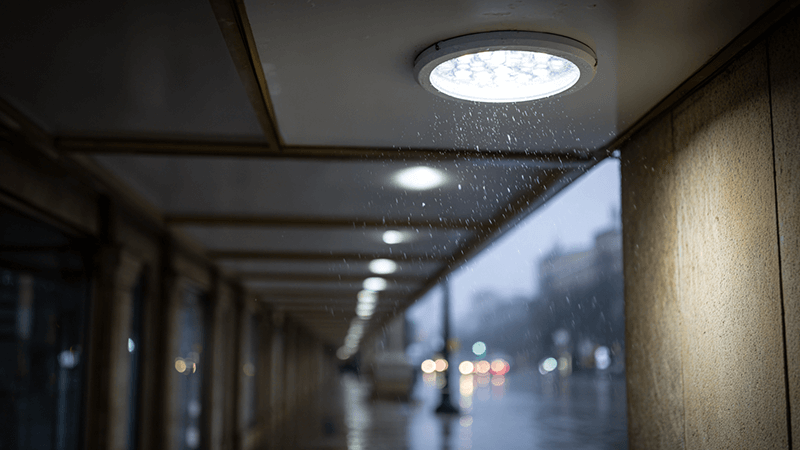
This is a very practical question I get all the time. For many semi-outdoor applications, IP54 strikes the perfect balance between performance and cost. It is designed to handle exactly this kind of scenario: incidental exposure to moisture, not sustained, direct streams of water. For a covered residential balcony or the walkway of a commercial building, IP54 will perform reliably. The seals are more than capable of preventing ingress from rain that might be blown in by the wind or from सामान्य humidity.
The Real-World Test
Think about the environment over the long term. Is the "light rain" sometimes accompanied by strong, driving winds that push water horizontally? Is the area ever cleaned with a pressure washer? If the answer to either of these is "yes," then you should upgrade to IP65. The extra cost of an IP65 fixture is minor compared to the cost of renting scaffolding and labor to replace a failed IP54 light a year down the line. A good rule of thumb I tell my clients is: if the water can hit the light with any force, choose IP65. If the water is just splashing or dripping, IP54 is fine.
The Hidden Danger: Condensation
There is one more factor to consider, and that is condensation18. In climates with high humidity and large temperature swings between day and night, moisture can form inside a light fixture. This happens when warm, humid air gets inside the housing during the day. As the fixture cools down at night, the air temperature drops below the dew point, and the moisture condenses into liquid water on the internal components. An IP54 rating, which allows for limited dust ingress, can also "breathe" more than a fully sealed IP65 unit. This can sometimes lead to condensation issues over time. A well-designed IP54 luminaire from a quality manufacturer will often include features like breathing vents with membranes (which let air out but not water in) to help manage this. This is another example of where looking beyond the IP number and at the actual product design quality is so important.
Conclusion
Choosing the right IP rating is a balancing act. It's about matching the downlight's protection level to the real-world environment, considering installation, heat, and even corrosion for long-term project success.
Understanding moisture's impact can help you make informed decisions about lighting in humid environments. ↩
Understanding IP ratings is crucial for selecting the right lighting for various environments. ↩
Mastering specification sheets can help you make better purchasing decisions for lighting. ↩
Explore key factors beyond IP ratings that affect downlight performance and longevity. ↩
Explore the key factors that ensure your lighting investment pays off in the long run. ↩
Explore the specifics of IP44 to ensure you choose the right downlight for general indoor areas. ↩
Learn about IP54 to determine if it's suitable for your bathroom or covered outdoor areas. ↩
Discover why IP65 is essential for areas exposed to direct water, ensuring safety and reliability. ↩
Discover the significance of dust-tight ratings for ensuring the longevity of your fixtures. ↩
Understanding low-pressure water jets is essential for selecting appropriate lighting for wet areas. ↩
Learn about the advantages of high-quality silicone in ensuring effective seals for lighting fixtures. ↩
Choosing a reputable manufacturer ensures you get quality products backed by legitimate testing. ↩
Learn why silicone gaskets are crucial for maintaining the integrity of waterproof lighting. ↩
Learn about effective waterproofing techniques to enhance the durability of your lighting fixtures. ↩
Understanding heat dissipation is vital for ensuring the longevity of LED downlights. ↩
Explore the importance of corrosion resistance in lighting, especially in coastal or industrial areas. ↩
Find out if IP54 is adequate for your outdoor lighting needs in light rain conditions. ↩
Understanding condensation can help you choose fixtures that perform well in humid climates. ↩