Looking for trusted Chinese LED downlight suppliers but not sure where to start? You worry about receiving unsafe, low-quality products that could ruin your project and reputation. The biggest secret is a component they'll never mention.
To source LED downlights safely from China, you must demand to know if the driver is 'isolated' for maximum safety or 'non-isolated'. This single detail, along with verifying wattage, lumens, and color temperature with third-party reports, is the key to protecting your investment.
This sounds technical, but it's the most important question you can ask, and most suppliers hope you don't. I've built my career in this industry, and I've seen buyers get burned because they didn't know about this hidden choice. They focused on price and lumens1, but they missed the one thing that determines safety. Let's break down the critical questions you need to ask to source like a pro and avoid the common traps.
Are LED lights from China safe?
Worried that a "good deal" on Chinese LEDs could lead to a safety nightmare? A single shock incident can destroy your reputation. The secret to real safety isn't on the label.
Yes, they can be extremely safe, but only if you specify an 'isolated driver2'. This type of driver provides a physical electrical barrier, protecting users from shock. The cheaper 'non-isolated' alternative, which suppliers often quote by default, carries a risk if insulation fails.
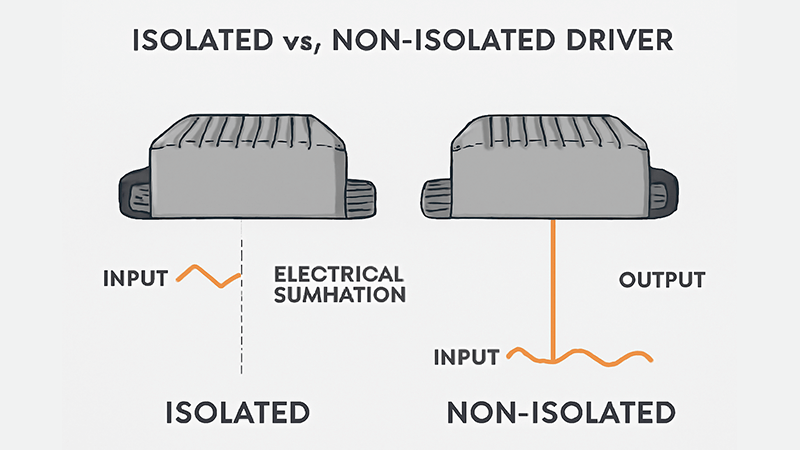
When a purchasing manager like Shaz evaluates a downlight, his first technical question is always about the driver. He knows that the light's performance and, more importantly, its safety, all come down to this one component. The driver's job is to convert high-voltage power to the low voltage the LED needs. How it does this is the difference between a safe product and a potential hazard.
The Most Important Secret: The Driver Type
Many suppliers will not volunteer this information because the safer option is more expensive. They will quote you a price based on a non-isolated driver3 to seem more competitive, without explaining the trade-off.
- Isolated Driver: This is the gold standard for safety. It uses a transformer to physically separate the high-voltage input from the low-voltage output. If there's a fault, the user is protected from the main power line. It's bigger and costs more, but for projects in homes, offices, and public spaces, the peace of mind is worth it.
- Non-Isolated Driver: This driver is cheaper and more compact because it has a direct electrical connection from input to output. It relies entirely on the fixture's plastic or metal housing and wire insulation to prevent electric shock. While fine in many applications if well-built, any breach in this insulation creates a direct path for a dangerous shock.
You must be the one to ask: "Does this price include an isolated or non-isolated driver?" Demanding an isolated driver shows the supplier you are a knowledgeable buyer who prioritizes safety over a few cents per unit.
| Feature | Isolated Driver | Non-Isolated Driver |
|---|---|---|
| Safety | Highest (Physical barrier) | Lower (Relies on perfect insulation) |
| Cost | Higher | Lower |
| Default | You must ask for it | Often the default quoted option |
| Best For | All applications, especially public | Extreme cost-sensitive projects |
Don't let the supplier make this choice for you. Always specify your requirement clearly.
How to import LED light from China?
You want to import directly but the process seems overwhelming. You're afraid of making costly mistakes with shipping, payments, or paperwork that will wipe out your savings and cause massive delays.
To import LED lights from China, you must systematically find a supplier, verify their claims, negotiate clear terms (including the driver type!), arrange payment, and manage logistics. Using a freight forwarder is highly recommended to handle shipping and customs smoothly.
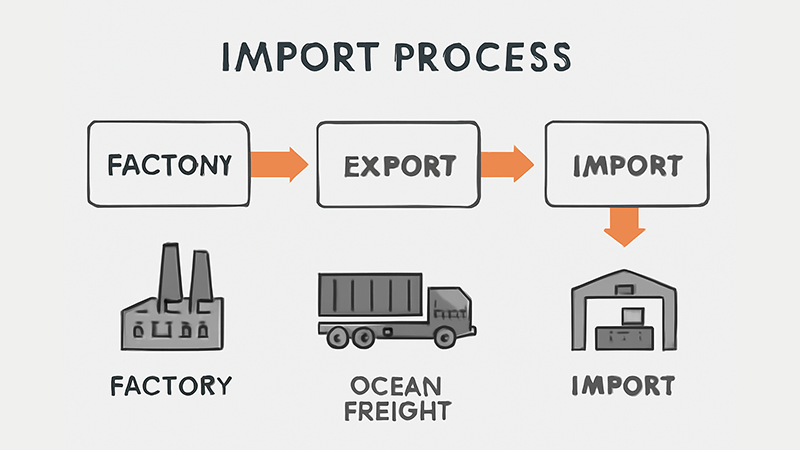
The import process itself isn't a secret, but a mistake at any step can be costly. For an experienced purchasing manager like Shaz in the UAE, this is a weekly routine, but for newcomers, it's a minefield. I've guided many clients through it, and the key is a disciplined, step-by-step approach. You can't assume anything. I once had a client who thought "FOB price" meant it was delivered to his door. He learned a hard lesson when the shipment arrived at the port with thousands in extra fees he hadn't budgeted for.
A Simple 4-Step Process
-
Sourcing & Verification: Find suppliers on platforms like Alibaba or at trade shows. But don't trust their profile page. Ask for their business license, ISO 90014 quality certificate, and product safety reports (like CE or UL). Crucially, ask for proof of a previous order that used the isolated drivers you require.
-
Negotiation & Sampling: Send a detailed Request for Quotation5 (RFQ). Go beyond just "10W downlight." Specify: "10W downlight with isolated driver, 900 lumens minimum, 4000K CCT +/- 150K." Always order and test samples before placing a bulk order. This is your only chance to confirm the specs are real.
-
Payment & Production: A 30% deposit to start production and a 70% balance before shipping is standard. Get a detailed Proforma Invoice6 (PI) that lists every single specification, including the driver type. This is your contract.
-
Logistics & Customs: Hire a freight forwarder7 in your home country. This is the best advice I can give. They will advise on the best shipping term (like FOB), handle the complex paperwork, clear your goods through customs, and arrange final delivery. They are worth every penny.
Can I import directly from China?
Tempted to buy directly from a Chinese factory to maximize your profit? It’s a great strategy, but you're worried about quality issues and performance claims that seem too good to be true.
Yes, you can and should import directly to get the best price and control. But you must be aware of the common "secrets" beyond just the driver. Suppliers often exaggerate wattage8, lumen output, and color accuracy to win your business. You must verify everything.
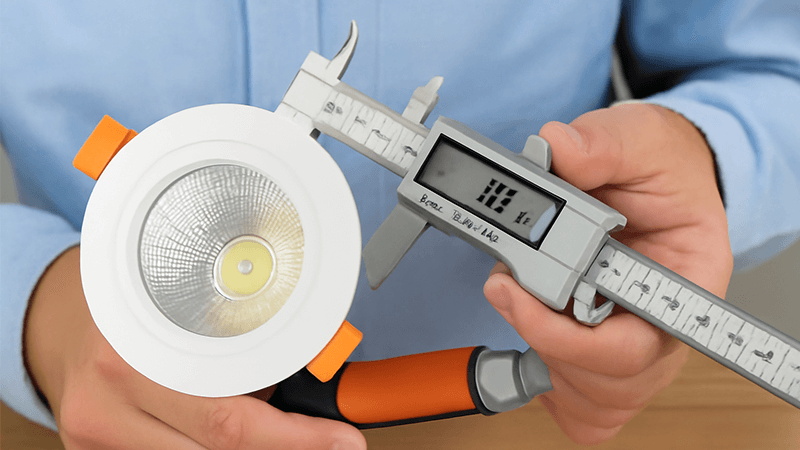
Going direct is how professionals like Shaz secure the best deals. It gives you maximum control. However, it also means you are the quality control manager. After you've settled the critical safety issue of the driver, you need to check the performance claims. This is where most factories cut corners to offer an attractive price, assuming you won't check the technical details. I've seen it hundreds of times.
The Performance "Secrets" You Must Uncover
After you've confirmed you're getting an isolated driver, you need to test for these three common deceptions.
- Secret #1: Exaggerated Wattage: A downlight is advertised as 10W, but your power meter shows it only draws 8W. The factory saves money on the driver and LED chips, but you get 20% less light than you paid for. For a large project, this is a disaster.
- Secret #2: Inflated Lumens: This is the biggest lie in the industry. Light output (lumens) is easy to fake on a spec sheet. They'll claim 1000 lumens, but when tested in a proper integrating sphere9, it only produces 700. The luminous efficacy10 (lumens per watt) is a key measure of quality.
- Secret #3: Inconsistent Color Temperature: You order 500 units of 4000K "Neutral White" light. When installed, some look yellowish (~3600K) and others look stark and bluish (~4400K). This happens when factories use cheap, poorly sorted LED chips. It makes any professional installation look cheap and messy.
Always test your samples for these three things. This knowledge protects you from being cheated.
What is the import duty on LED lights from China?
Trying to calculate your final costs? You're unsure what taxes and duties apply, and you're afraid these "hidden" government fees could make your import unprofitable.
Import duty on LED lights from China is determined by your country's specific tariff schedule, found using the product's HS Code (usually 9405.42). You must research this rate to calculate your true 'landed cost' and avoid financial surprises upon arrival.
Your total cost is not just the price you pay the factory. Smart importers like Shaz always calculate the "landed cost" for every shipment. This means adding the cost of shipping, insurance, and—most importantly—import duties to the product price. Forgetting about duties is a rookie mistake that can destroy your profit margin. Some countries even have special anti-dumping duties on top of regular tariffs for Chinese LEDs, which can be shockingly high.
Calculating Your True Cost
To find your profit, you need to know your real cost. Here’s a simple framework to calculate your landed cost11.
- Find the HS Code12: The international Harmonized System (HS) Code for LED lighting is typically 9405.42. Confirm this with your local customs authority or freight forwarder.
- Look Up the Duty Rate: Go to your government's customs or trade website and use the HS code to find the duty percentage for goods from China.
- Calculate the Total: Use a simple formula to see the full picture.
| Cost Component | Example (USD) | Notes |
|---|---|---|
| Product Cost (FOB) | $20,000 | The price on your supplier's Proforma Invoice. |
| Freight & Insurance | $1,500 | The cost to get it to your country's port. |
| Customs Value | $21,500 | (Product Cost + Freight & Insurance) |
| Import Duty (e.g. 10%) | $2,150 | (Customs Value x Duty Rate) |
| Local Port/Broker Fees | $500 | Fees for customs clearance13, handling, etc. |
| Total Landed Cost | $24,150 | This is your real cost of the goods. |
Running these numbers before you place an order removes the guesswork and ensures your import project is profitable from the start.
Conclusion
Sourcing from China is smart, but requires diligence. Prioritize safety by demanding isolated drivers, verify all performance claims with testing, and calculate your full landed cost to ensure true profitability.
Understanding lumens helps you choose the right brightness for your space, ensuring optimal lighting. ↩
Understanding isolated drivers is crucial for ensuring safety in LED downlights, protecting users from electrical shocks. ↩
Learn about the potential dangers of non-isolated drivers to make informed decisions for your projects. ↩
ISO 9001 certification indicates quality management standards, ensuring supplier reliability. ↩
An effective RFQ can lead to better pricing and terms from suppliers, maximizing your investment. ↩
A detailed Proforma Invoice is crucial for clarity in transactions and avoiding disputes. ↩
Understanding the role of freight forwarders can streamline your import process and save costs. ↩
Discover methods to accurately verify wattage in LED downlights to avoid underperformance. ↩
An integrating sphere provides accurate measurements of light output, ensuring product quality. ↩
Luminous efficacy measures the efficiency of light output, crucial for energy-saving decisions. ↩
Calculating landed cost ensures you understand the total expenses involved in importing. ↩
Knowing the HS Code for LED lights helps in understanding tariffs and import regulations. ↩
Understanding customs clearance is vital for smooth import operations and avoiding delays. ↩