Confused by luminous efficacy1 specs? Choosing based on the highest number can cost you in quality and performance. Let me show you what really matters for your projects.
Luminous efficacy is the measure of how well a light source, like an LED downlight, converts electricity (watts) into visible light (lumens). A higher efficacy, expressed in lumens per watt (lm/W), means more light output for less energy consumed, making it a key indicator of efficiency.
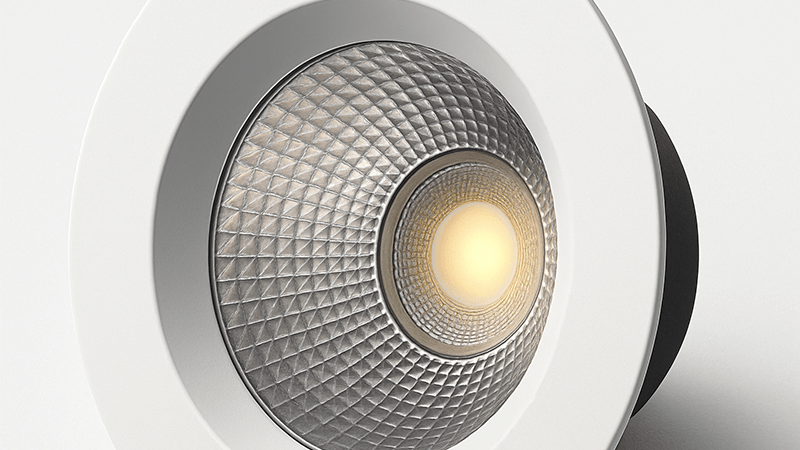
I have seen many purchasing managers, even experienced ones, fixate on that single lm/W number on a spec sheet2. They think "higher is always better." And while efficiency3 is important, this single number doesn't tell the whole story. In my years of manufacturing and helping clients like you, I've learned that true understanding comes from looking deeper. It's about knowing what factors influence that number and how it balances with other critical aspects of light quality. Let’s break it down so you can make smarter, more confident decisions.
What is the luminous efficacy of an LED?
Struggling to tell if a supplier is presenting the chip's efficacy or the fixture's? This confusion can lead to products that underperform once installed. Let's clarify the difference.
Luminous efficacy in an LED fixture represents the final efficiency of the entire system. It measures the light output (lumens) you actually get from the downlight divided by the total electrical power (watts) it consumes. It’s the true measure of performance, not just the LED chip’s potential.
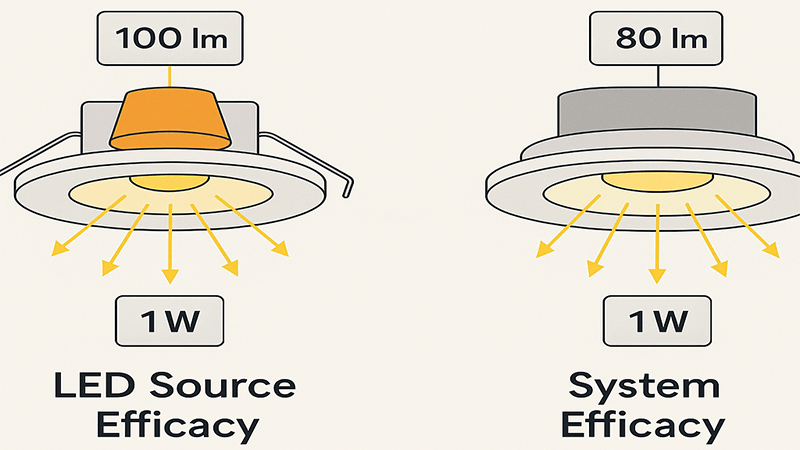
When I started in this industry, a common sales tactic was to highlight the "source efficacy4." This is the lumens per watt5 of the LED chip itself, operating under perfect lab conditions. But a downlight is a complete system, not just a chip. That LED chip gets put into a housing, placed behind an optic or a lens, and powered by a driver. Each of these components introduces losses. This is the difference between "source efficacy" and "system efficacy," and it's a critical distinction. For a purchasing manager like you, the only number that matters is the system efficacy. A supplier I once evaluated boasted about a 180 lm/W chip, but their final downlight only delivered 110 lm/W. Why? Because of losses from heat and the diffuser they used. Heat, or thermal loss6, reduces the chip's efficiency. The driver isn't 100% efficient either; it consumes power just to operate. And optical losses occur when light is absorbed or scattered by lenses, reflectors, and diffusers. It’s essential to always ask for the system efficacy, which is tested using a complete luminaire.
| Efficacy Type | What It Measures | Why It's Misleading/Important |
|---|---|---|
| Source Efficacy | Efficiency of the single LED chip in a lab | Misleading. Does not account for real-world losses in the fixture. |
| System Efficacy | Efficiency of the complete downlight fixture | Important. This is the true performance you are paying for. |
How many lumens is a good LED light?
Are you focused only on getting the most lumens per watt? You might be sacrificing the color quality that makes a space look vibrant and appealing. Let's find the right balance.
A "good" LED light is not about having the maximum possible lumens. It's about having the right amount of lumens for the application, delivered with excellent color quality (CRI) and reliability. The goal is effective illumination, not just raw brightness. The most efficient lights are not always the best.
<sup id=](http://zsupward.com/wp-content/uploads/2025/08/LE3.png) 7 lighting and one with low CRI, showing the difference in product appearance" title="Comparing High CRI Lighting to High Efficacy Lighting" />
7 lighting and one with low CRI, showing the difference in product appearance" title="Comparing High CRI Lighting to High Efficacy Lighting" />
There's an inherent trade-off in LED technology between luminous efficacy1 (lm/W) and Color Rendering Index8 (CRI). I call it the "quality tax." To achieve a higher CRI, which makes colors appear more natural and vibrant, manufacturers often use phosphors that are slightly less efficient at converting energy to light. So, a 95 CRI downlight will almost always have a lower lm/W than an 80 CRI downlight, even if they use the same base LED chip. For a project like a high-end retail store or a gallery, a lower efficacy is a price worth paying for superior color rendition. The products on display simply look better. This leads to the idea of "application efficacy9." The best light for an office (where task visibility is key) is different from the best light for a hotel lobby (where ambiance is paramount). You have to ask, "What is this light for?" Pushing for the highest lm/W in a situation that demands high CRI7 is a common mistake. I worked with a client on a boutique hotel project. They were initially fixated on 140 lm/W downlights. I showed them a side-by-side comparison with a 115 lm/W, 95 CRI option. The moment they saw how much richer the fabrics and wood tones looked under the high CRI light, the decision was easy. They understood that the quality of the lumens was more important than the quantity of lumens per watt.
| Application | Recommended CRI | Typical System Efficacy (lm/W) | Why It's a Good Balance |
|---|---|---|---|
| Warehouse / Parking | 70-80 CRI | 130-160 lm/W | Efficiency is the top priority; color is less critical. |
| Office / School | 80+ CRI | 110-140 lm/W | A good balance of efficiency for long operating hours and good visual clarity10. |
| Retail / Hospitality | 90+ CRI | 95-120 lm/W | Color quality is crucial for experience and sales; a lower efficacy is acceptable. |
| Museum / Gallery | 95+ CRI | 80-110 lm/W | Maximum color accuracy is the goal; efficiency is a secondary concern. |
How is luminous efficacy calculated?
The formula seems straightforward, but are you using the right numbers? An error here can completely change your product evaluation and cost projections. Let's get the calculation right.
Luminous efficacy is calculated by dividing the total light output of the fixture in lumens (lm) by the total power it consumes in watts (W). The key is to use the system wattage, which includes the power consumed by the LED driver11, not just the LEDs themselves.
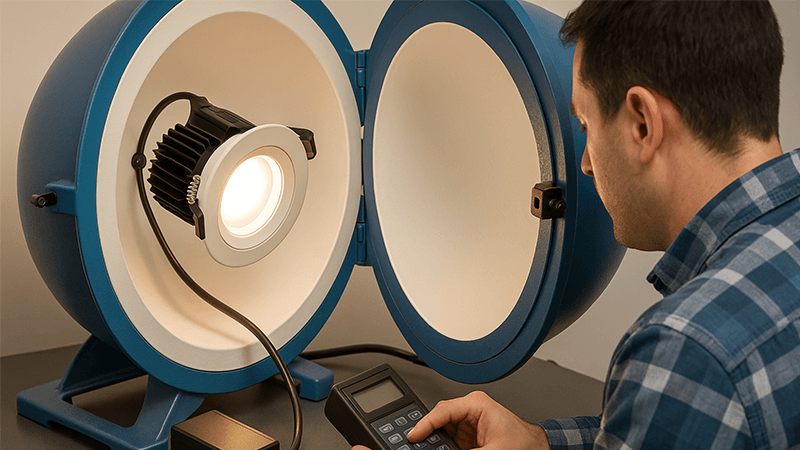
The formula is simple: Efficacy (lm/W) = Total Lumens / Total System Watts. But the devil is in the details of those two variables. "Total Lumens" is the light output measured from the complete, assembled luminaire. This measurement is typically done in an integrating sphere12, a special piece of equipment that captures all light emitted from the fixture in every direction. It gives you the real, usable lumens. "Total System Watts" is where purchasing managers often get tripped up. It's not the wattage of the LED module. It's the total power drawn from the wall, which includes the power consumed by the LED chips and the power consumed by the driver. LED drivers are not 100% efficient; they can have an efficiency of anywhere from 85% to 95%. This means a driver might consume 2-3 extra watts just to function. Forgetting to include this driver loss in your calculation will give you an inflated and inaccurate efficacy value. Let me show you a practical example I often share with my clients.
| Component | Measurement | Impact on Calculation |
|---|---|---|
| LED Module Power | 18W | A misleading number if used alone. |
| Driver Loss | 2W | This power is consumed but produces no light. It must be included. |
| Total System Watts | 20W (18W + 2W) | This is the correct value for the denominator. |
| Measured Lumen Output | 2200 lm | The true light output of the complete fixture. |
| Final Calculation | 2200 lm / 20W = 110 lm/W | This is the actual System Efficacy. |
If you had mistakenly used the 18W module power, you would have calculated 122 lm/W, a number that looks much better on paper but is completely wrong. Always confirm with your supplier that their quoted wattage is for the entire system.
How is luminous efficacy expressed?
You see "lm/W" on every spec sheet, but what does it signal beyond efficiency? Misreading this unit can mean you overlook better, more suitable products for your project.
Luminous efficacy is always expressed in lumens per watt (lm/W). This unit directly tells you how much visible light you get for each unit of electrical energy you put in. A higher number signals greater energy efficiency, but it doesn't represent overall quality.
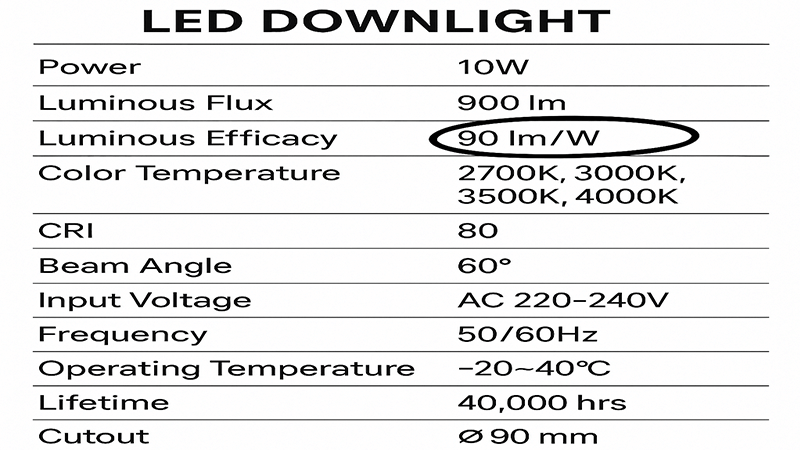
In today's market, efficacy has become more of a gating factor than the ultimate goal. What does that mean? It means leading specification standards, like DLC (DesignLights Consortium) or Energy Star, set a minimum lm/W requirement for a product to even qualify for their list. For example, a standard might require a downlight to have at least 100 lm/W. This sets a baseline for performance. Efficacy is the ticket to the game, but it doesn't determine the winner. This is because of the law of diminishing returns. Pushing for extremely high efficacy, say from 150 lm/W to 160 lm/W, often requires compromises. It might mean using cooler, less pleasant-looking CCTs (Correlated Color Temperature), accepting a lower CRI, or using components that are so new they haven't been tested for long-term reliability. The small energy savings13 might not be worth the drop in light quality or the risk of premature failure. I once had a project contractor who insisted on finding a downlight with the absolute highest lm/W he could find for an office building. He found one at 165 lm/W. Six months after installation, we got a call. The light was efficient, but the employees complained about the harsh, bluish tint (a high CCT14) and poor color rendering, which made the office feel sterile and uncomfortable. We ended up replacing them with a 120 lm/W, 90 CRI solution that dramatically improved the working environment. The lesson is clear: use efficacy to filter out inefficient products, but make your final choice based on a holistic view of quality, including CRI, CCT, glare control15 (UGR), and reliability.
Conclusion
Luminous efficacy is a critical metric, but it should be a starting point, not the final word. True quality lies in balancing efficiency with color rendition, application needs, and overall system design.
Understanding luminous efficacy helps you choose the right lighting for efficiency and quality. ↩
Learn how to interpret lighting spec sheets for informed purchasing decisions. ↩
Explore the various factors that influence the efficiency of LED lighting systems. ↩
Understand the difference between source efficacy and system efficacy for better decisions. ↩
Learn how lumens per watt affects lighting choices and energy consumption. ↩
Explore how thermal loss affects the efficiency of LED lighting systems. ↩
Explore the advantages of high CRI lighting for enhancing color appearance. ↩
Learn how CRI impacts the appearance of colors in your space. ↩
Find out how application efficacy influences lighting choices for different environments. ↩
Discover the importance of visual clarity for effective task lighting. ↩
Understand the importance of LED drivers in overall lighting performance. ↩
Learn how integrating spheres measure light output accurately for better evaluations. ↩
Explore how LED lighting can lead to significant energy savings in various applications. ↩
Learn how CCT affects the color appearance of light in different settings. ↩
Understand the importance of glare control for comfortable and effective lighting. ↩