Struggling with complex and inflexible lighting controls on large projects? It leads to high energy bills and unhappy clients. Smart, app-integrated lighting1 offers a powerful, simplified solution you can manage easily.
App-integrated lighting benefits large projects by centralizing control, enabling dynamic scene adjustments, and automating schedules for massive energy savings. This simplifies management, enhances building functionality, and significantly reduces long-term operational costs, providing a robust return on investment for contractors and owners.
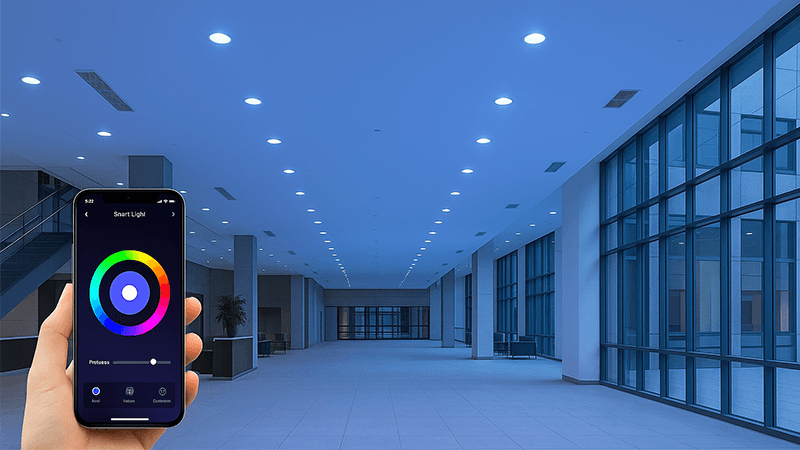
When I first started in lighting manufacturing, control systems were a maze of wires. Every group of lights needed its own switch leg, and changing a room's layout meant calling an electrician. I saw how much time and money this cost my clients, especially on big commercial jobs. It became clear to me that the future wasn't in the light itself, but in how we control it. This is where smart, app-integrated systems change the game completely. They move the complexity from the wall into a simple app, giving people like you, who manage huge projects, the power and flexibility you need. Let's break down exactly what that means for your bottom line and your clients.
What are the benefits of smart lighting systems?
Trying to justify the higher initial cost of a smart system can be tough. You might get stuck with old, inefficient lighting that costs more over time. Smart systems change this with real benefits.
Smart lighting systems provide huge energy efficiency through scheduling and dimming. They lower maintenance costs with remote diagnostics. They also improve the user experience with custom scenes and provide data on space use, which helps manage the entire building better.
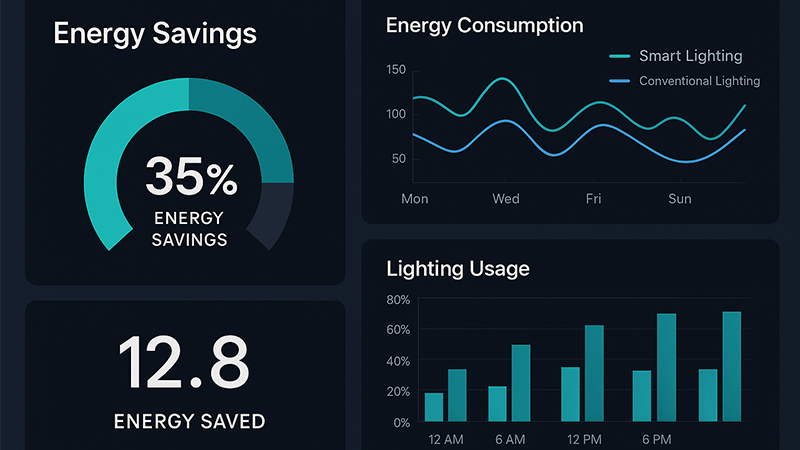
The most obvious benefit everyone talks about is energy savings2. That’s a given. When you can schedule lights to dim or turn off in unused areas, the savings on a large project are massive. But the real value I see goes much deeper. It’s about creating better spaces for people and making buildings easier to manage. This is where the true revolution is happening.
Beyond Energy Savings: The Human Element
We now know that lighting affects people's productivity and well-being. This is called Human-Centric Lighting3 (HCL). It’s not just about changing the color of the light. It's about granular control. You need to be able to create different lighting "zones" within a single open-plan office. The area by the windows needs different light than the cubicles in the center. With traditional wiring, this would be a nightmare. With a smart system, you just draw a circle on a tablet and create a new group. I’ve worked with clients who use this to create "focus zones" with cooler, brighter light and "collaboration zones" with warmer, more inviting light. This level of control used to be reserved for billion-dollar headquarters, but now it's accessible for many more projects. You're no longer just selling a light fixture; you're selling an environment that can make people happier and more effective.
Operational Efficiency and Data
Think of a smart downlight as more than just a light. It's a data point. Each fixture is a small computer on the building's network. It is the new nervous system of the building. It can tell you if a room is occupied, how much energy it's using, and even when it's about to fail. For a purchasing manager like Shaz, this transforms your conversations with facility managers. You can offer them a system that provides predictive maintenance alerts4, reducing downtime and labor costs. You can provide data that shows how an office space is actually being used, helping companies make better decisions about their real estate. The light is just a byproduct; the real product is the data and control.
| Feature | Traditional Lighting | Smart Lighting System |
|---|---|---|
| Control | Manual Switches (On/Off) | App-based, Automated, Zoned |
| Energy Use | Fixed, High Consumption | Optimized, Low Consumption |
| Maintenance | Reactive (replace when fails) | Predictive (alerts for issues) |
| User Experience | Static, One-size-fits-all | Dynamic, Human-Centric |
| Data | None | Occupancy, Energy usage |
What are intelligent LED lighting systems and how do they work?
The term "intelligent lighting" can sound very technical and complex. This might make you stick to what you already know, causing you to miss out on huge advantages. It is actually much simpler than you think.
Intelligent LED lighting links fixtures, sensors, and apps to a network. The fixtures get commands through wireless or wired systems like Bluetooth Mesh5 or DALI6. This allows them to adjust brightness and color to create automated and dynamic lighting.
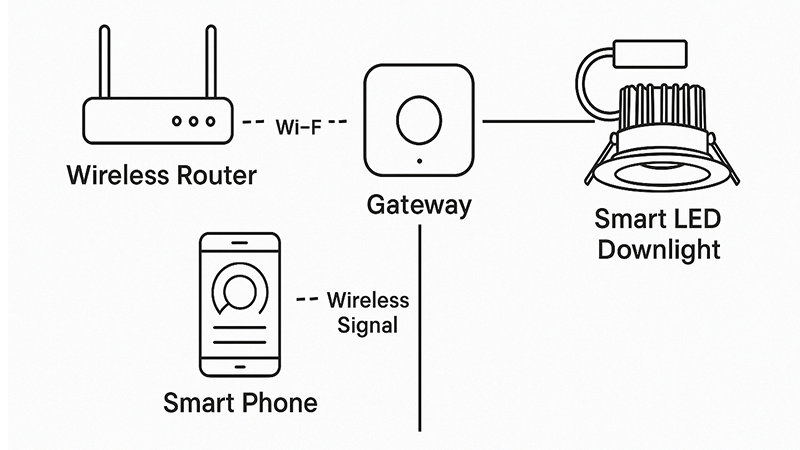
At its heart, an intelligent lighting system has a few simple parts that work together. You have the LED fixtures themselves—the downlights. Then you have inputs, like sensors that detect motion or daylight levels, and user interfaces, like a smartphone app or a wall-mounted tablet. And finally, you have the network that connects them all. This network is what tells the lights what to do based on the information it gets from the inputs. It is the language they use to talk to each other.
The Communication Backbone
The way these devices talk is through something called a protocol. You've probably heard of them: Bluetooth Mesh, Zigbee7, Wi-Fi, or DALI. Each has its strengths. Bluetooth Mesh is fantastic because the lights can talk directly to each other and to your phone, which is great for smaller or mid-sized commercial spaces. DALI is a wired system that is incredibly reliable, making it a standard for large, critical projects where you can't have any failures.
The conversation in the industry is changing. A few years ago, everyone was arguing about which wireless protocol was best. Now, the focus is shifting. We understand that reliability is what matters most. For a project manager, the important question isn't just "What protocol do you use?" It should be "How reliable is your system from installation to daily operation?" I remember a large office project in the UAE where the client was worried about wireless signals being blocked. We proposed a hybrid system using wired DALI for the main areas and Bluetooth Mesh for the smaller, reconfigurable meeting rooms. This showed we understood their real concern: reliability. It's about choosing the right communication tool for the job.
The Flow of Information
The process is straightforward.
- An input occurs. A person enters a room, and a motion sensor detects them. Or, you open an app on a tablet and press a button for a "Presentation" scene.
- The input device sends a signal over the network.
- A central controller or gateway (or the network itself in a mesh system) processes this signal.
- A command is sent to the specific light or group of lights.
- The smart driver8 inside the downlight receives the command and tells the LED to turn on, dim to 20%, or change its color temperature.
This all happens instantly. It is this simple, reliable communication that makes the entire system "intelligent."
Are smart downlights worth it?
Smart downlights cost more upfront, which can be a problem. This makes it difficult to convince clients and stay within budget. But the total cost of ownership9 shows their real value over time.
Yes, for large projects, smart downlights are absolutely worth it. The higher initial cost is recovered through major energy savings, lower maintenance, and increased property value. Their flexibility and future-proofing10 make for a powerful return on investment.
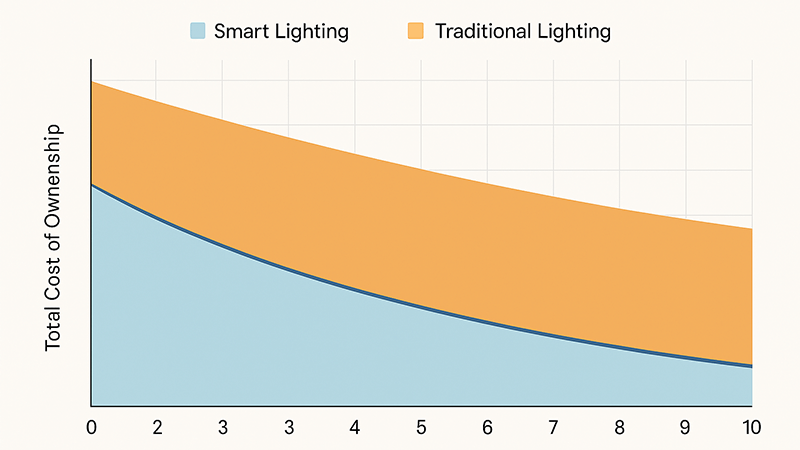
When you look at the price tag of a single smart downlight versus a standard one, the choice seems obvious. The standard one is cheaper. But on a large project with thousands of fixtures, the true cost isn't just in the hardware. It's in the labor, the copper wiring, and the cost of future changes. This is where smart lighting totally flips the equation and proves its worth.
Shifting Costs from Wiring to Programming
With traditional lighting, if you want five different zones of control in a large room, you need five separate runs of wire from the lights all the way back to the switches on the wall. That is a lot of copper and a lot of expensive time for an electrician. I call the traditional installation process the "wiring bottleneck."
Smart lighting creates a new model. I call it the "digital bottleneck11." All the downlights can be installed on a single, simple power circuit. The complexity moves from the physical world of wires to the digital world of software. An installer can then use a tablet to group the lights. They can draw a circle around the first 20 lights and call it "Zone 1." They can draw another circle and call it "Zone 2." The commissioning, which used to take days of complex wiring, can now be done in hours. A contractor friend in the UAE was hesitant at first. On his first big smart project, he told me he saved nearly 30% on electrical labor costs. That saving covered the extra cost of the smart fixtures, and then some. Now, he won't go back.
Future-Proofing the Building
Think about how modern offices work. Today, a space might be an open-plan office. In two years, the tenant might move out and the new one wants to build individual offices. With a traditionally wired system, you have to tear open the ceiling and run new wires. It is expensive and disruptive. With a smart downlight system, you just open the app. You delete the old zones and create new ones to match the new floor plan. It takes minutes. This flexibility is incredibly valuable to building owners. You are selling them a lighting system that can adapt to any future need without expensive renovations. This ability to change and adapt makes the building more valuable and easier to rent. That is a powerful argument that goes way beyond the initial cost of a downlight.
How do smart LED downlights work?
It can feel overwhelming to understand the technology inside a smart downlight. This lack of knowledge can make you feel less sure when you are choosing or buying them. The truth is, it's just a few key parts.
A smart LED downlight has a normal LED and driver, but it also has a communication chip12 inside. This chip gets signals from an app or hub using Bluetooth or Zigbee. It then tells the driver to change the light's brightness or color.
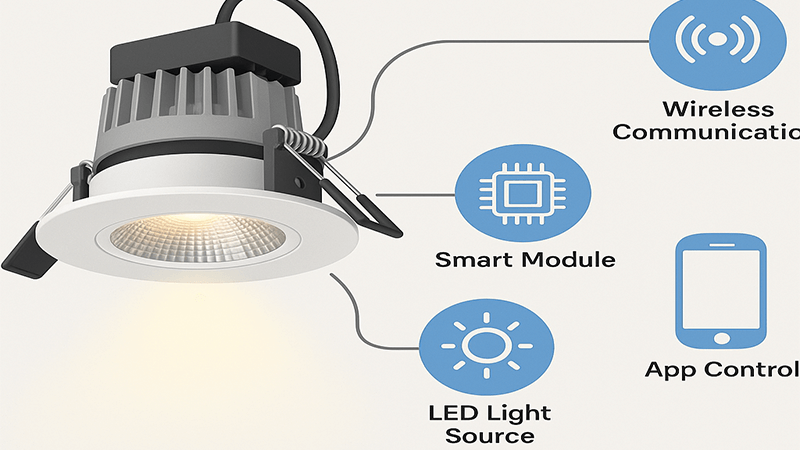
When you get down to it, a smart downlight isn't magic. It's just a standard, high-quality LED downlight with one extra piece of technology inside. As a manufacturer, I focus on making sure every single one of these components is perfect, because the entire system is only as strong as its weakest link. For a purchasing expert like Shaz, understanding these components helps you ask the right questions and choose a supplier that delivers true quality, not just a list of features.
Inside the Smart Fixture
Let's look at what's inside the housing. You have four key parts that work together as a team.
- The LED Engine: This is the part that actually creates the light. The quality of the LED chip determines the light's color accuracy, brightness, and lifespan.
- The Driver: This is the power supply. It takes the high-voltage AC power from the building and converts it to the low-voltage DC power the LED needs. In a smart fixture, this driver is special. It can interpret digital commands to dim the light smoothly or change its color.
- The Communication Module: This is the brain. It is a tiny radio receiver and transmitter on a chip. It's programmed to listen for commands on a specific protocol, like Bluetooth Mesh or Zigbee. This is the part that connects the downlight to the larger network.
- The Firmware: This is the software that runs on the communication module. It tells the module how to understand commands and how to talk to the driver. Good firmware13 is what makes a smart light reliable and easy to use.
This is why, at iPHD, we control the design and manufacturing of all these parts. A poor-quality driver can cause flickering. A cheap communication module might drop its connection. We ensure they all work together perfectly.
The communication module is also a two-way street. It doesn't just receive commands. It can send data back. It can report how long it's been on, its current operating temperature, and its energy consumption. This is how the fixture becomes a data host14. It's an active part of the building's IT infrastructure, providing information that helps manage the building more efficiently.
Conclusion
Smart downlights make controlling light simple. They offer great long-term value and turn your lighting into an intelligent building system, which is ideal for any large-scale project.
Explore how app-integrated lighting can simplify control and enhance energy efficiency in large projects. ↩
Learn about the significant energy savings smart lighting systems can provide for large commercial projects. ↩
Explore the concept of Human-Centric Lighting and how it enhances productivity and well-being. ↩
Learn how predictive maintenance alerts can reduce downtime and labor costs in facility management. ↩
Explore the advantages of Bluetooth Mesh technology in creating reliable smart lighting systems. ↩
Understand how DALI provides reliable communication for smart lighting in large projects. ↩
Learn about Zigbee technology and its effectiveness in smart lighting communication. ↩
Explore how a smart driver enhances the functionality of LED downlights. ↩
Learn how the total cost of ownership can demonstrate the value of smart lighting over time. ↩
Understand how smart lighting systems can adapt to changing needs without costly renovations. ↩
Explore how smart lighting shifts complexity from wiring to digital programming. ↩
Learn how the communication chip enables smart downlights to receive and execute commands. ↩
Learn about the role of firmware in ensuring reliable communication and performance of smart lights. ↩
Discover how smart downlights provide valuable data for building management and efficiency. ↩