Struggling to choose the right downlights for your hotel? The wrong choice ruins guest experience and inflates your costs. I'm here to guide you to the perfect lighting solution.
The best LED downlights for hotels offer high CRI (>90), consistent CCT (2700K-3000K), and low UGR (<19). They must be dimmable and built with superior heat dissipation to ensure the reliability and longevity that hospitality environments demand.
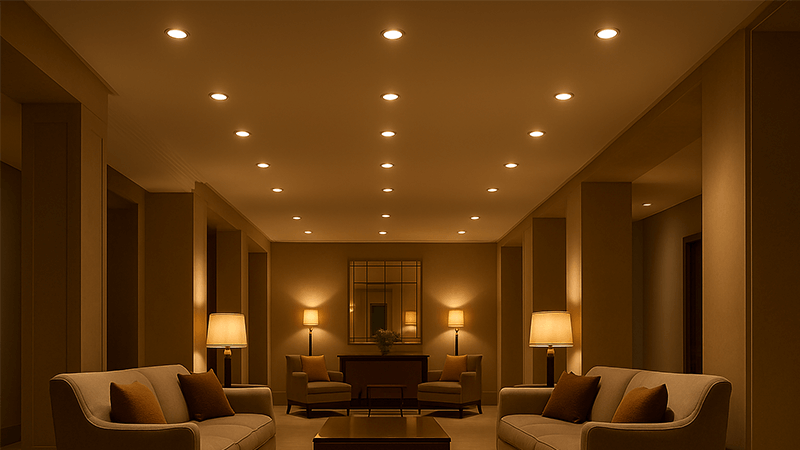
Choosing the right lighting is about more than just numbers on a spec sheet. It's about creating an atmosphere that makes guests feel welcome and comfortable the moment they step inside. After years of manufacturing lighting, I've seen first-hand how the perfect downlight can transform a space. But to make that choice, we first need to understand a hotel's specific needs. Let's look closer at those requirements.
What are the lighting requirements for hotels?
Finding the right lighting feels overwhelming. You want to create a luxury feel, but you also need to meet safety standards and control costs. This balance seems almost impossible to achieve.
Hotels need layered lighting that is visually comfortable (UGR<19), renders colors accurately (CRI>90), and has a warm, consistent color temperature (CCT 2700K-3000K). The lighting must also be energy-efficient, long-lasting, and dimmable to create different moods.

When a purchasing manager like Shaz from the UAE sources lights for a new hotel project, he's not just buying a product. He's building an experience. The lighting in different areas of a hotel serves very different purposes, and understanding this is key. You need a flexible and layered approach.
Ambient, Task, and Accent Lighting
A successful hotel lighting plan uses three main layers. Ambient lighting provides the general, overall illumination for a space, like the lobby or hallways. It sets the base level of light. Then, you add task lighting1 for specific activities. This includes lights over a reception desk or a reading lamp by a bed. Finally, accent lighting2 draws attention to features like artwork, architectural details, or restaurant tables. Using a mix of downlights, spotlights, and decorative fixtures creates a rich, dynamic environment that avoids the flat, boring look of a single-type lighting scheme.
Technical Specifications for Hospitality
The technical details are where quality really shows. For hotels, these numbers are not negotiable.
| Specification | Recommended Value | Why It Matters for Hotels |
|---|---|---|
| CRI (Color_Rendering_Index) | >90 | Makes food, decor, and people look natural and appealing. |
| CCT (Correlated_Color_Temperature) | 2700K - 3000K | Creates a warm, inviting, and relaxing atmosphere. |
| UGR (Unified_Glare_Rating) | <19 | Ensures visual comfort for guests, preventing harsh glare. |
| Longevity (L70) | >50,000 hours | Reduces maintenance costs and disruptions in a 24/7 environment. |
| Dimming | Smooth, flicker-free | Allows staff to adjust lighting for different times of day or events. |
I always tell my clients, don't just look at the price. Look at the value these specs bring. A light with a CRI of 80 might be cheaper, but it will make a five-star meal look dull and unappetizing. Investing in high-quality specs is an investment in the guest experience.
What is the difference between cheap and expensive LED downlights?
You see two downlights that look identical. One costs a fraction of the other. It's tempting to go for the cheaper option to save budget, but you worry about hidden problems later.
The key difference lies inside the fixture. Expensive downlights use high-grade LED chips3, superior heat sinks, gold-wire bonding4, and stable drivers. Cheaper lights cut corners on these components, leading to poor performance, color shifts, and a much shorter lifespan.
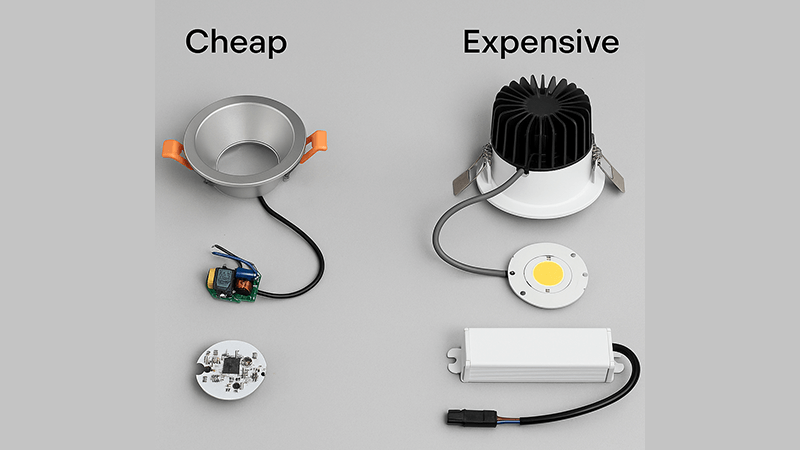
I’ve spent my career in LED manufacturing, and I can tell you the differences are not just small details. They are fundamental to how the light will perform and how long it will last. Many suppliers use confusing terms to hide low-quality parts. It's my job to make these differences clear, so you know exactly what you are paying for.
The Heart of the Light: LED Chips
The LED chip is the engine of the downlight. Sellers often say they use "imported chips" to suggest high quality. This can be misleading. An "imported chip" could be a rejected batch from a top brand like Bridgelux, which is actually lower quality than a top-grade chip from a reputable Chinese manufacturer like San'an. The real measure is the chip's grade and binning, not just its country of origin. Better chips provide higher efficiency (lumens per watt) and more consistent color from light to light.
The Lifeline: Bonding Wires and Substrate
The tiny wire connecting the chip to the circuit is critical.
- Gold Wire: The best choice. It's extremely durable and resistant to heat and corrosion. It ensures a stable connection for the entire life of the LED.
- Copper Wire: A cheaper alternative. It works, but it's more prone to oxidation and failure over time, especially in high-heat conditions.
- Aluminum Wire: The lowest quality option. It breaks easily and is the main reason for "dead lamps," where the light suddenly fails.
The chip sits on a substrate, which draws heat away. A good aluminum or ceramic substrate is essential for cooling. Poor-quality lights use cheap iron or even plastic, which traps heat. This causes the chip to overheat, leading to a rapid drop in brightness and eventual failure. A great downlight is really a great heat management system5.
What feature should hotel guest rooms have for controlling lighting?
Guests check into their room and can't figure out the complex light switches. They get frustrated trying to create a comfortable setting, which hurts their overall impression of the hotel.
Hotel guest rooms should have a master switch at the entrance that controls all lights. Bedside controls for lamps and key overhead lights are also essential. Using simple, intuitive dimmers allows guests to easily adjust the room's ambiance to their personal preference.
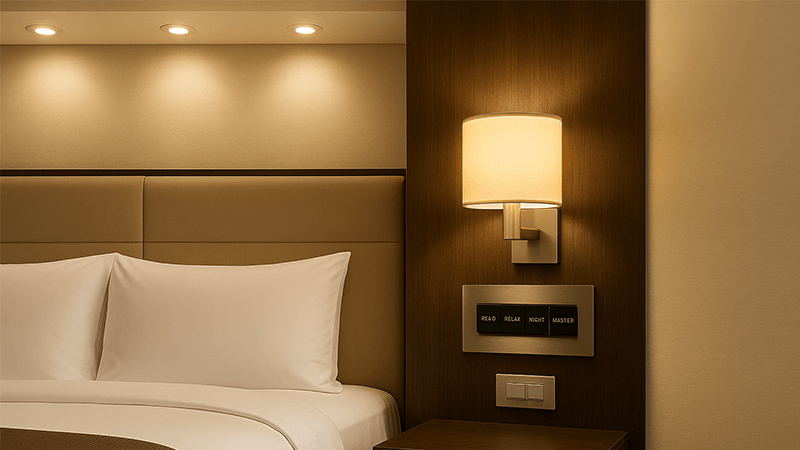
Guest experience is everything in the hospitality industry. Control is a big part of that. When a guest walks into a room, they want to feel in control of their environment immediately. Complicated systems create stress, which is the last thing you want. From my experience working with hotel projects, the most successful ones prioritize simplicity and intuition in their control systems. They understand that ease of use equals luxury for the modern traveler.
Master Switches and Bedside Controls
A master light switch located right next to the door is a must-have. When guests enter, they can light up the whole room with one touch. When they leave, they can turn everything off just as easily, which also helps save energy. I remember one hotel manager telling me how guest complaints about lighting dropped significantly after they installed master switch6es.
Equally important are controls at the bedside. Guests shouldn't have to get out of bed to turn off the main lights. A simple panel that controls the reading lamps and at least one main ambient light source is the standard for a reason. This small convenience makes a huge difference in guest comfort and satisfaction.
The Importance of Simple Dimmers
Every guest has a different idea of the perfect lighting level. Some want it bright for reading or working, while others prefer a soft, dim glow for relaxing. Dimmers are the solution. However, they must be simple. A straightforward slider or rotary knob is much better than a multi-button digital system that requires instructions. The goal is to let guests create their desired mood effortlessly. Flicker-free dimming is also crucial. A light that buzzes or flickers when dimmed feels cheap and can be very annoying for guests, completely undermining the sense of quality you want to project.
How many downlights can go on one circuit?
You're planning the electrical layout for a new hotel wing. You need to install dozens of downlights, but you're unsure how to calculate the circuit load7, raising safety and compliance concerns.
To determine how many downlights can go on one circuit, divide the circuit's maximum wattage by the wattage of a single downlight. A standard 15-amp circuit provides 1,440 watts. So, you can safely run 144 ten-watt downlights on it (1440 / 10 = 144).

This calculation is one of the most practical questions I get from project contractors. Getting it right is not just about functionality; it's about safety. Overloading a circuit is a serious fire hazard and will not pass inspection. As a manufacturer, I feel a responsibility to provide clear information so that my clients can plan their installations safely and efficiently. The good news is that with modern, energy-efficient8 LED technology, you can fit more lights on a single circuit than ever before.
Calculating the Safe Load
Here is the simple, safe formula that electricians use.
- Find Circuit Amperage: Look at the circuit breaker. It will be labeled with its amperage, typically 15A or 20A in commercial buildings.
- Calculate Max Wattage: Multiply the amperage by the voltage (usually 120V in the US or 230V in Europe/UAE) and then by 0.8. This 80% rule is a safety standard to prevent overloading.
- 15A Circuit: 15A x 120V x 0.8 = 1,440 watts
- 20A Circuit: 20A x 120V x 0.8 = 1,920 watts
- Divide by Downlight Wattage: Divide the max wattage by the wattage of each LED downlight.
Let's use a practical example for a hotel hallway renovation.
| Circuit Type | Max Safe Wattage | Downlight Wattage | Max Number of Downlights |
|---|---|---|---|
| 15-Amp | 1,440 W | 9W | 160 (1440 / 9) |
| 15-Amp | 1,440 W | 12W | 120 (1440 / 12) |
| 20-Amp | 1,920 W | 9W | 213 (1920 / 9) |
| 20-Amp | 1,920 W | 12W | 160 (1920 / 12) |
It's always smart to consult with a qualified electrician to confirm your calculations and ensure compliance with local electrical codes. They can account for other factors, like wire gauge and circuit length, that might affect the final number.
Conclusion
Choosing the right LED downlight for hotels means focusing on quality components, meeting key performance specs like high CRI and low UGR, and ensuring simple, intuitive controls for guests.
Task lighting supports specific activities, improving functionality in hotel rooms. ↩
Accent lighting highlights features, adding visual interest and luxury to hotel decor. ↩
Different LED chips affect performance and longevity, impacting overall lighting quality. ↩
Gold-wire bonding enhances durability and performance, ensuring long-lasting lighting solutions. ↩
Effective heat management prevents overheating, ensuring consistent performance and longevity. ↩
A master switch simplifies control, enhancing guest convenience and satisfaction. ↩
Understanding circuit load is crucial for safety and compliance in hotel electrical systems. ↩
Energy-efficient lighting reduces costs and environmental impact, aligning with sustainability goals. ↩