Struggling to make sense of lighting terminology1? Selecting the wrong fixture can completely ruin a project's ambiance and budget. Let me help you understand exactly what a downlight2 is.
A downlight is a light fixture installed into a hollow opening in a ceiling. It directs light in a downward direction. Its main purpose is to provide focused or ambient light while remaining discreet, often appearing flush with the ceiling for a clean, modern look.

Understanding this basic definition is the first step. But as a professional, you know the real value lies in the details. The real challenge is understanding their proper use, their differences from other fixtures, and what truly defines them from a manufacturing perspective. Let's dig deeper into the questions I get asked all the time. This knowledge will help you source a better product and achieve a better outcome for your clients.
What is a downlight used for?
Are you unsure where to use downlights? Placing them incorrectly creates poor lighting patterns3 and wastes money. Let's look at their ideal applications for perfect illumination.
Downlights are extremely versatile. They are primarily used for three types of lighting: general ambient lighting for an entire room, focused task lighting over a specific area like a kitchen counter, and dramatic accent lighting to highlight artwork or architectural features.

The function of a downlight is almost entirely decided by its beam angle4. I remember a hotel project where the lobby felt dim and spotty, despite having dozens of expensive downlights. The problem wasn't the quality of the lights; it was the wrong beam angle. They used a narrow 24-degree beam for general lighting, creating harsh a "Swiss cheese" effect of bright spots and dark patches on the floor. It's a classic mistake.
There's an inverse relationship people often miss: the wider the application, the wider the beam angle. Think of it like a showerhead. A wide, gentle spray covers your whole body—that's your general lighting (a wide beam angle >60°). A focused, powerful jet is for a specific spot—that's your accent lighting5 (a narrow beam angle <24°). Task lighting for a kitchen counter falls somewhere in between. For accenting, the goal is contrast; you want the highlighted object to be 3-5 times brighter than its surroundings. You can't achieve that if the beam is too wide. Getting this simple detail right is the difference between a professional lighting design6 and an amateur mistake.
Beam Angle and Application
| Lighting Type | Typical Beam Angle | Purpose & Example Use Case |
|---|---|---|
| General | > 60° | Illuminate an entire room evenly. (e.g., Hallways, Lobbies) |
| Task | 24° - 40° | Light a specific work area. (e.g., Kitchen counters, Desks) |
| Accent | < 24° | Highlight a specific object. (e.g., Artwork, Sculptures) |
What is the difference between a ceiling light and a downlight?
Do downlights and ceiling lights seem the same to you? Confusing them can lead to major installation headaches and ruin your design. Let's clear up the difference.
The main difference is in the installation and appearance. A downlight is typically recessed into the ceiling, so only the trim is visible. A ceiling light is mounted onto the surface of the ceiling, making the entire fixture a visible design feature.
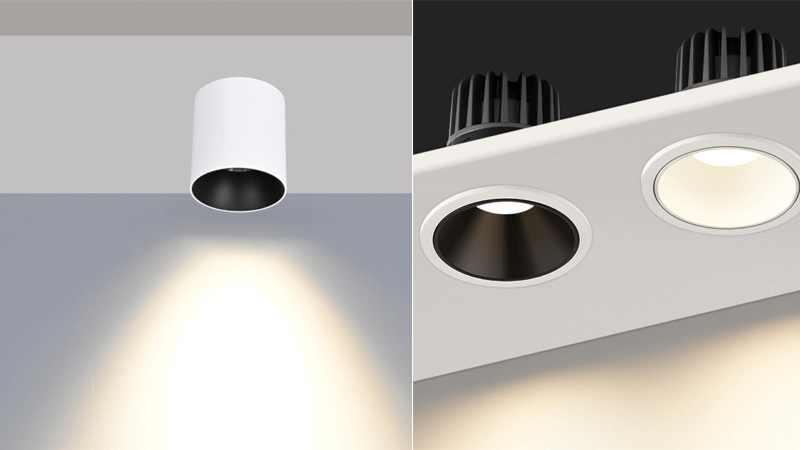
When I consult with designers, we talk about "ceiling integration." It's a concept that goes far beyond the cut-out size. A downlight is meant to become part of the ceiling architecture, to disappear. A ceiling light is meant to be a statement piece, like furniture for the ceiling. This has huge practical implications. To install a downlight, you need a ceiling void, and you have to plan for it from the start. We often get asked about IC-ratings (Insulation Contact). A downlight with an IC rating7 can be safely covered with thermal insulation, which is critical in many modern buildings. A non-IC rated fixture requires a clearance of several inches, complicating installation.
Furthermore, the style of integration matters. A standard 'trim' downlight has a visible lip that covers the edge of the cutout. A 'trimless' downlight is plastered directly into the ceiling, creating a perfectly seamless, 'punched-in' look. This is highly desirable in minimalist designs but requires a much higher level of skill from the installer. A ceiling light, by contrast, is far simpler. It attaches to a standard junction box on the surface. It’s an easy choice for retrofits, while a recessed downlight is an integral part of new construction.
Downlight vs. Ceiling Light
| Feature | Downlight | Ceiling Light |
|---|---|---|
| Installation | Recessed into the ceiling (requires void) | Mounted on the surface of the ceiling |
| Appearance | Discreet, integrated into architecture | Visible, a decorative element |
| Planning | Requires architectural planning, IC-rating considerations | Attaches to a standard junction box |
What is considered a downlight?
Does the term "downlight" seem a bit too broad? This ambiguity can cause real confusion when you're trying to source the right product. Let's define the core parts of a downlight.
Any light fixture that is installed in or on the ceiling and directs its light vertically downwards is considered a downlight. This includes recessed "can" lights, adjustable gimbal fixtures, and even some surface-mounted cylinders. The key is the directional, downward light output.

In my years of manufacturing, I've seen a huge paradigm shift in what a downlight is. In the past, a downlight was a single, inseparable unit. Today, the best products have a modular design8: a separate "light engine" and "optic." This changed everything. The light engine is the heart of the fixture. It holds the LED chip9, the driver, and the all-important heat sink10. The optic is the visible part—the reflector or lens that shapes the light, and the trim that finishes the look.
For a purchasing manager like Shaz, this modular system is a game-changer for inventory management. Instead of stocking 50 entirely different downlights, you can stock just 5 light engines (with different wattages and color temperatures) and 10 different optics (with various trims, colors, and beam angles). From just 15 SKUs, you can create 50 unique combinations. This massively reduces your capital tied up in slow-moving stock and gives you incredible flexibility to meet project demands. From our side as a manufacturer, it allows us to perfect a few core engines and innovate rapidly on the aesthetics and optical performance. It also simplifies maintenance for the end-user, as a failed engine can be swapped out without replacing the entire fixture.
Core Components of a Modern Downlight
- The Light Engine: The functional core. Contains the LED, driver, and thermal management system. Its quality dictates performance and lifespan.
- The Optic System: The visible part. Includes the lens/reflector for beam control and the trim/bezel for the finished aesthetic.
What is the difference between downlights and spotlights?
Are you confusing downlights with spotlights? Using the wrong one can completely miss the intended lighting effect. Let's look at the key difference in their design and function.
The primary difference is flexibility. Downlights typically provide a fixed, downward wash of light for general or task illumination. Spotlights offer a more focused, narrow beam of light that is often adjustable, designed to highlight specific objects or areas with precision.

I use a simple rule: a downlight illuminates where you stand, while a spotlight illuminates what you look at. This functional difference dictates their design, especially their thermal management11. Heat is the number one enemy of LEDs. A simple rule of thumb in our industry is that for every 10°C increase in an LED's junction temperature, its lifespan can be cut in half. That’s a real, measurable cost.
I once worked with a client on a high-end retail project. They had sourced cheap spotlights that looked great. Six months after the grand opening, over 30% of them were flickering or had failed completely. When we analyzed them, the cause was clear: the heat sinks were just thin pieces of stamped metal, completely inadequate for the powerful LEDs. The chips essentially cooked themselves. A quality fixture uses a substantial, die-cast aluminum heat sink with a large surface area to dissipate heat effectively. When I review a new sample, the first thing I do is feel its weight. A surprisingly heavy fixture often means the manufacturer invested in proper thermal management. Whether recessed in a hot ceiling void (downlight) or packed into a compact housing (spotlight), how a fixture handles heat is the single biggest predictor of its long-term reliability.
Downlight vs. Spotlight
| Aspect | Downlight | Spotlight |
|---|---|---|
| Primary Use | General, ambient, or task lighting | Accent lighting, highlighting objects |
| Beam | Wider, fixed | Narrow, often adjustable/directional |
| Key Challenge | Heat dissipation within a ceiling void | High heat density in a compact housing |
| Design Focus | Blending into the ceiling | Directing attention to a focal point |
Conclusion
A downlight is a versatile fixture defined by its ceiling integration, modular parts, and downward light. Understanding its core traits separates it from other lights and ensures professional results.
Familiarize yourself with lighting terminology to improve your communication and understanding in the field. ↩
Explore this link to gain a clear understanding of downlights and their applications in modern lighting design. ↩
Explore different lighting patterns to enhance the ambiance and functionality of your spaces. ↩
Understanding beam angle is crucial for effective lighting design; explore this resource for insights. ↩
Find out how accent lighting can transform your space by highlighting key features and artworks. ↩
Gain insights into the principles of lighting design to create functional and aesthetically pleasing spaces. ↩
Learn about IC ratings to ensure safe installation of downlights in insulated ceilings. ↩
Discover how modular design can simplify inventory management and enhance flexibility in lighting solutions. ↩
Learn about LED chips to understand their role in lighting performance and efficiency. ↩
Discover the importance of heat sinks in maintaining the performance and lifespan of LED fixtures. ↩
Understanding thermal management is key to ensuring the longevity and performance of LED fixtures. ↩