Having trouble picking the right downlight? The wrong beam angle1 can wreck your design—causing harsh glare or unwanted dark zones. Choosing correctly the first time makes all the difference.
The beam angle of an LED downlight determines the spread of the light cone. A narrow angle creates a focused spotlight for accenting objects, while a wide angle produces a broad flood of light for general illumination. Choosing correctly is crucial for achieving the desired lighting effect.
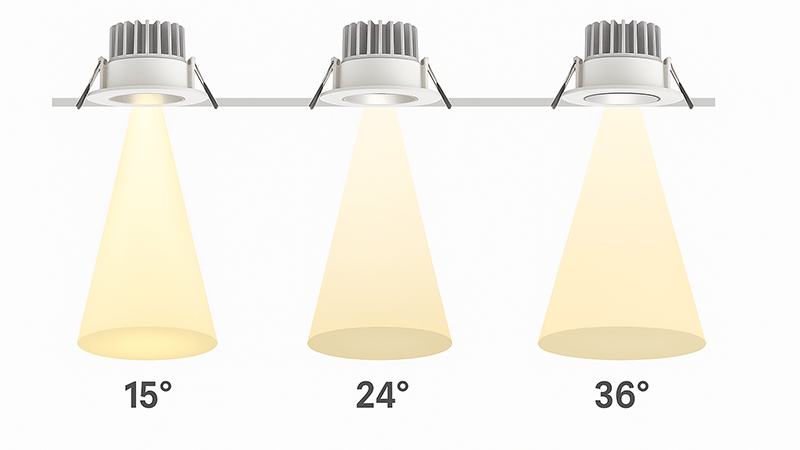
Choosing a downlight seems simple until you're faced with a list of beam angles. Suddenly, you're faced with numbers like 15°, 24°, 36°, and 60°. Many people just guess, but this number is one of the most critical factors in lighting design2. It decides if a room feels spacious and welcoming or dramatic and focused. As a manufacturer, I've seen how this single specification can make or break a project. Understanding it is key to buying the right product and creating the perfect atmosphere for your space. It's the difference between a lighting installation3 that looks amateur and one that feels professionally designed. Let's dig into what these numbers really mean and how to use them properly.
What is the best beam angle for downlights?
Picking the "best" beam angle feels like a high-stakes decision for your project. Choose the wrong one, and you're stuck with a space that's either poorly lit or uncomfortably bright.
There is no single "best" beam angle for all situations. The ideal choice depends entirely on your ceiling height and what you want to light. For general lighting, use a wide angle (36°-60°). For task or accent lighting, a narrower angle (15°-24°) is better.
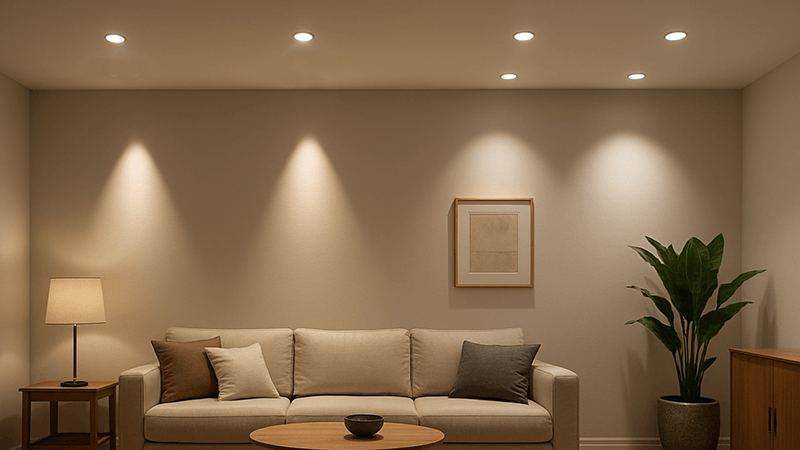
Over my years in the lighting business, I've seen many clients, even experienced ones like Shaz, get overly focused on the beam angle. Yes, it's important, but a more critical, and often overlooked, factor for visual comfort4 is the cutoff angle5. The beam angle tells you how wide the light spreads on the floor, but the cutoff angle determines when the light source itself becomes visible to your eye. A deep cutoff angle, typically 30 degrees or more, means the LED chip is recessed far back into the fixture's housing. This design is sometimes called a "darklight reflector6" because when you look at the ceiling, the fixture itself appears dark, not like a bright, glaring dot. It shields your eyes from the intense point source of the LED, which is the primary cause of visual discomfort. You can have a perfect 24° beam spread to highlight artwork, but if the glare is bad, looking at the ceiling will be painful, and the entire room will feel cheap and poorly executed. A well-designed downlight with a good cutoff lets you see the effect of the light, not the source. It’s this focus on visual comfort4 that separates premium architectural lighting from basic commodity products. It's the first thing I check when evaluating a competitor's sample.
What does 15 / 24 / 36 degree beam angle mean?
You see numbers like 15°, 24°, and 36° on specification sheets. These abstract degrees can be confusing, making it hard to visualize how the light will actually look in a room.
These numbers define the angle of the light cone. It's measured at the point where the light's intensity drops to 50% of its brightest point in the center. A smaller number means a tighter, more focused spot of light, while a larger number means a wider, softer spread.
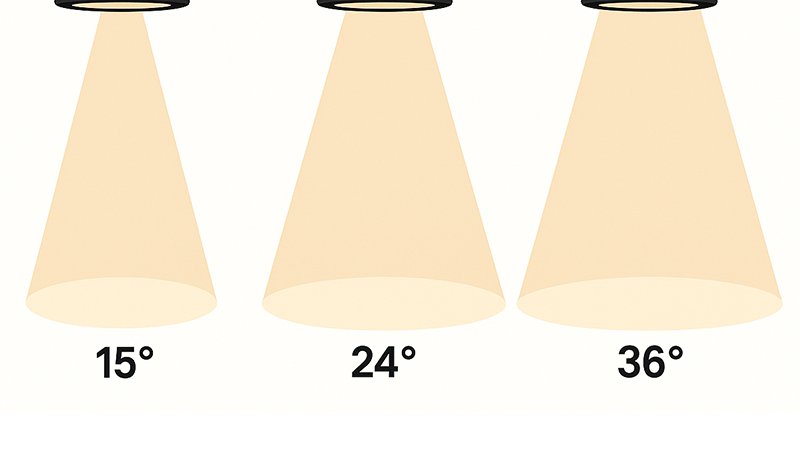
Let’s break down what these numbers mean in practice. When my team and I design the optics for our downlights, we are essentially sculpting the light to perform a specific job. Think of it like choosing the right lens for a camera.
Understanding the Degrees
| Beam Angle | Name | Best Used For | Practical Effect |
|---|---|---|---|
| 10° - 15° | Spot | Highlighting small objects, creating drama, very high ceilings. | Creates sharp-edged, high-contrast pools of light. |
| 24° - 25° | Narrow Flood | The most versatile choice. Good for accent and task lighting7. | A focused beam with slightly softer edges. Great for kitchens. |
| 36° - 38° | Flood | General lighting in standard rooms, task lighting over large areas. | A balanced spread of light that covers a good area. |
| 60°+ | Wide Flood | Washing walls with light, illuminating large, open spaces. | Creates broad, soft illumination with minimal shadows. |
From a manufacturing perspective, a very narrow beam of 15° is a technical challenge. It demands incredible precision in both the LED and the optical lens. This is where a hidden problem, which I call the "Color Over Angle" phenomenon, can show up. With very tight beams, even tiny imperfections in how the phosphor coating is applied to the LED chip, or slight variations in the lens molding, can cause the color of the light to separate at the edges. You might see a faint yellowish or bluish ring around the main spot of white light. This happens because the lens acts like a prism, refracting the different wavelengths of light at slightly different angles. For wider beams like 36° or 60°, the light is so well-mixed that this effect is completely invisible. But in a narrow, highly-focused beam, it can be a giveaway of lower-quality components. That's why at iPHD, we use premium LEDs and conduct 100% goniophotometer testing on our narrow-beam optics to ensure perfect color uniformity8.
How do you choose beam angle?
You know what the angles mean, but how do you apply that to a real project? Choosing between a 24° and a 36° can feel like a random guess, risking uneven lighting or wasted money.
Choose your beam angle based on ceiling height and the lighting's purpose. Use a simple formula: Beam Diameter = 2 x Ceiling Height x tan(Beam Angle / 2). This helps you calculate coverage and space the lights correctly for an even effect.
The decision process is simple if you answer two questions: How high is my ceiling? And what do I want this light to do?
A Practical Guide to Choosing
1. Consider Ceiling Height: The distance from the fixture to the surface it's lighting is your most important variable.
| Ceiling Height | Recommended Beam Angle for General Lighting |
|---|---|
| < 2.4m (8 ft) | Wide (36° to 60°) to ensure the pools of light overlap. |
| 2.4m - 3m (8-10 ft) | Medium (24° to 38°) is a very flexible choice for most rooms. |
| > 3m (10 ft+) | Narrow (15° to 25°) to effectively push light down to the floor. |
2. Define the Lighting Purpose:
- Ambient Lighting (General): You want broad, even light. Go for wider angles (36°-60°) and space them so their calculated beam diameter9s overlap by about 30-50%.
- Task Lighting (Work Areas): You need focused light on a kitchen counter or desk. A medium angle (24° or 36°) is perfect. It gives you concentrated light without being too narrow.
- Accent Lighting (Highlights): You want to highlight a painting or sculpture. Use a narrow, sharp beam (15° or 24°) to create strong contrast and draw the eye.
When I discuss projects with clients, I always bring up the inherent trade-off between optical control10, efficacy (lumens per watt), and glare. It's easy to make a wide-beam downlight efficient; you just let the light spill out. But to create a very controlled, narrow beam, you have to actively shape and direct the light. This often means using sophisticated TIR (Total Internal Reflection) lenses or deep, faceted reflectors. These components work by capturing stray light rays that would otherwise cause glare or spill, and redirecting them into the main beam. However, every time light is reflected or refracted, a tiny amount of energy is lost. Therefore, a high-quality 15° downlight might have a slightly lower lumen-per-watt rating than its 60° counterpart from the same product family. This isn't a sign of a bad product; it's a sign of good engineering. It’s prioritizing light quality and control over raw, uncontrolled output.
How will beam angle affect home lighting?
You bought the downlights, but how will this technical choice actually translate to the feeling and atmosphere of your home? The wrong angle can make a cozy living room feel like a sterile office.
Beam angle is the primary tool for creating mood. Narrow beams (15°-24°) produce distinct pools of light, creating drama, depth, and intimacy. Wide beams (36°-60°) wash a room in soft, even light, making it feel open, airy, and welcoming.
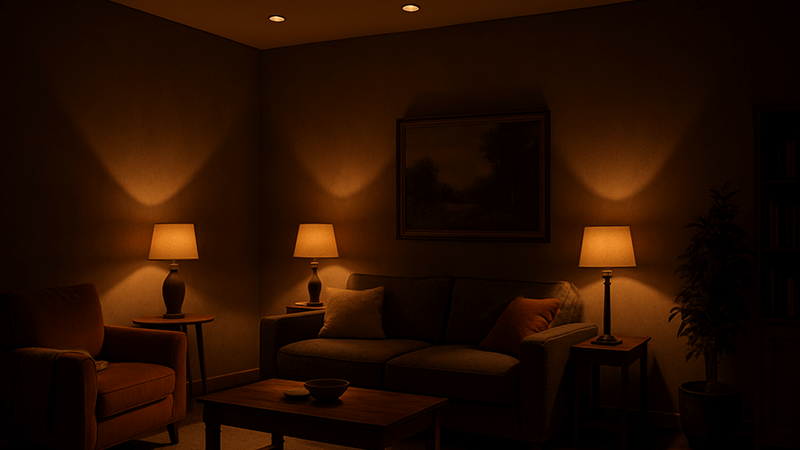
Let's visualize this in a typical home. In a living room, you use a layered lighting strategy11. Your foundation is general ambient light from 38° or 60° downlights, spaced for even coverage. But over a textured stone fireplace or a favorite painting, you'll use a tight 15° beam to make it pop. In the kitchen, 24° or 36° beams are workhorses over the island and counters, providing crisp, focused task light right where you need it. In a hallway, you can create a beautiful scalloped effect on one wall with a series of 24° adjustable downlights, or create a simple, safe path with a few 60° wide-beam fixtures.
Beyond the immediate visual effect, there is a critical long-term factor that I always stress with discerning buyers like Shaz: the direct link between narrow beams and the potential for accelerated lumen and color depreciation. An LED chip produces an immense amount of light and heat from a tiny surface. To create a very narrow beam, an optical system must collect and concentrate this energy intensely. This intense focal point puts a huge thermal and photon stress on the phosphor—the thin yellow layer on the LED that converts blue light into usable white light. Over time, this concentrated energy can degrade the phosphor more quickly, causing the light to lose brightness (lumen depreciation12) and shift in color, usually becoming more bluish. It's the lighting equivalent of using a magnifying glass to focus sunlight. That's why the heatsink design on a narrow-beam downlight is more critical than on any other type. At iPHD, we over-engineer our thermal management13 systems, especially for our spotlight products, to draw that heat away from the LED chip as efficiently as possible. This ensures that our fixtures not only look great on day one but maintain their quality and performance for their entire rated lifespan.
Conclusion
Mastering beam angle is about transforming light from a simple utility into a design tool. It empowers you to shape spaces, create moods, and ensure lasting quality and visual comfort.
Understanding beam angle is crucial for achieving the desired lighting effect in any space. ↩
Mastering lighting design principles transforms spaces and enhances functionality and aesthetics. ↩
Avoiding common installation mistakes ensures optimal lighting performance and visual appeal. ↩
Proper lighting design enhances visual comfort, reducing eye strain and improving the overall atmosphere. ↩
Cutoff angle affects visual comfort by reducing glare from light sources, enhancing the overall experience. ↩
Darklight reflectors help minimize glare, making lighting more comfortable and aesthetically pleasing. ↩
Task lighting focuses light on specific areas, improving functionality in workspaces and kitchens. ↩
Achieving color uniformity is essential for creating a cohesive and visually pleasing lighting effect. ↩
Calculating beam diameter ensures even light distribution, preventing dark spots in your design. ↩
Optical control shapes light effectively, reducing glare and improving the quality of illumination. ↩
A layered lighting strategy enhances depth and functionality, creating a well-balanced atmosphere. ↩
Understanding lumen depreciation helps in selecting quality lighting that maintains performance over time. ↩
Effective thermal management prolongs the lifespan of LED fixtures, ensuring consistent performance. ↩