Choosing the wrong light can make products look dull and unappealing, hurting sales. Discover which industries truly need high-CRI COB downlights to elevate their spaces and avoid this costly mistake.
Industries like high-end retail, art galleries, museums, luxury hospitality, and specific healthcare settings require high-CRI COB LED downlights the most. These lights render colors with exceptional accuracy, which is crucial for enhancing product appeal, ensuring guest comfort, and improving diagnostic precision.
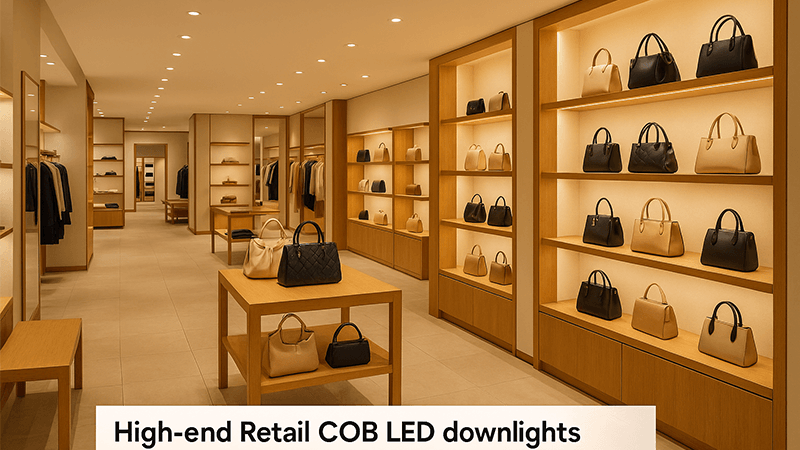
But simply knowing which industries need them is not enough. As a purchasing manager like Shaz, you know that the details matter. Just seeing a "high-CRI" label on a spec sheet doesn't guarantee quality or performance. The true value lies in understanding what that specification means for the entire lighting system1 and why it's a non-negotiable feature for certain applications. Let's dig deeper into what makes a light truly exceptional and how to select the right one for your projects.
What is a good CRI for LED lights?
You see CRI numbers everywhere, but they can be confusing and even misleading. Choosing a light based on a poor understanding of CRI can ruin your project's color quality.
A Color Rendering Index (CRI)2 above 80 is considered good for most commercial spaces. However, for color-critical applications like retail or art galleries3, a CRI of 90 or higher is essential. It's also vital to check the R9 value, which dictates how well reds are rendered.
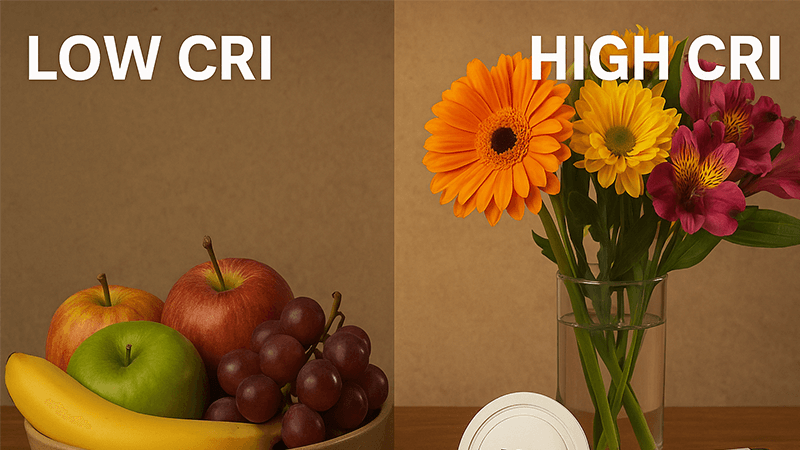
When I first started in this industry, a lot of focus was just on brightness and energy savings. But CRI, or Color Rendering Index, is where the quality of light truly shines. Think of CRI as a measure of how "true-to-life" colors appear under a light source compared to natural daylight. The scale goes up to 100, which is the score of natural sunlight.
Many manufacturers only talk about the general CRI value, often called "Ra." This Ra is an average of the first eight color samples (R1-R8) on the test. While an Ra of 80+ is fine for general office or hallway lighting, it doesn't tell the whole story. The most important, and often overlooked, value is R9. R9 measures how accurately the light renders deep, saturated red.
Why is red so important? It's a key color in so many things: fresh produce in a supermarket, skin tones in a clinic, the rich fabrics in a fashion boutique, or the warm wood tones in a hotel lobby. I once worked with a client who ran a high-end butcher shop. He had 85 CRI lights, but his prime cuts of meat looked brownish and unappetizing. We swapped them for 95 CRI downlights4 with a high R9 value5. The change was immediate. The meat looked fresh, vibrant, and appealing. His sales went up that same week.
Here’s a simple table to guide you:
| CRI Value (Ra) | Light Quality | Common Applications |
|---|---|---|
| CRI 90-100 | Excellent | Art galleries, museums, high-end retail6, medical exams |
| CRI 80-90 | Good | Offices, schools, homes, general commercial spaces |
| Below CRI 80 | Poor | Warehouses, parking lots, non-critical areas |
So, when you source lights, don't just ask for the CRI. Ask for the full test report. Look at the R9 value. For any application where appearance matters, a high R9 is not a luxury; it's a necessity.
What is the demand for LED lights?
The lighting market is constantly changing. Falling behind on current trends means losing your competitive advantage and missing out on key opportunities for your projects and clients.
The global demand for LED lights7 is surging. This growth is driven by government energy-efficiency mandates, falling costs, and much longer product lifespans. The market is now shifting towards smarter, higher-quality lighting, including high-CRI and tunable white LEDs, especially in commercial sectors.
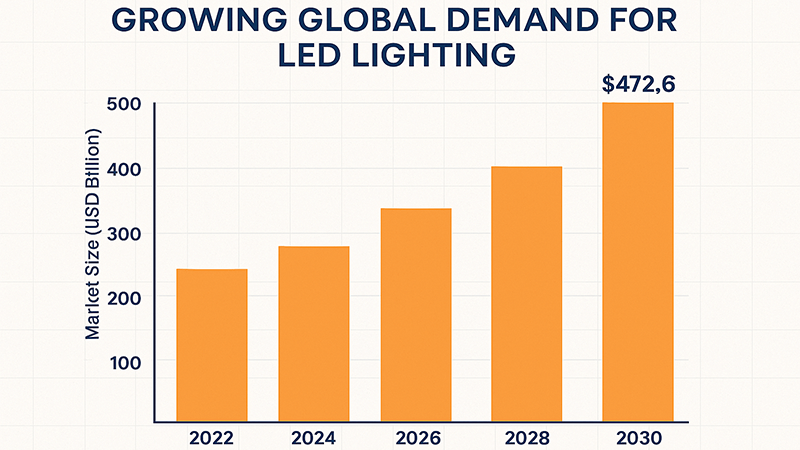
I have seen the lighting industry transform completely in my career. The first big wave was the massive shift from old technologies like incandescent and halogen bulbs to LEDs. The main drivers were obvious: energy savings and longer lifespans. Governments around the world created regulations that pushed businesses and consumers toward LED technology. Early on, the demand was simple: people just wanted a basic LED bulb that worked and saved money. As a purchasing manager, your job was to find the cheapest option that met basic specs.
But the market has matured. The demand today is much more sophisticated. It's no longer just about saving energy. It's about the quality of the light. My clients, who are often distributors and project contractors like yourself, are no longer asking for just any LED. They are asking for specific solutions. They want lights that make a retail space feel more inviting, an office more productive, or a hotel room more comfortable. This is where demand for high-CRI lighting has exploded. People have realized that good lighting directly impacts business outcomes.
Another growing demand is for "smart" or "human-centric" lighting. This includes things like tunable white technology8, which allows you to change the color temperature of the light from a warm yellow to a cool white. It also includes integrated control systems that can dim lights or change them based on the time of day. This is a huge area of growth, especially in offices, schools, and healthcare facilities, where the goal is to create an environment that aligns with our natural circadian rhythms. For a purchasing expert like Shaz, staying on top of these trends is crucial for sourcing products that will be in demand not just today, but for years to come.
What are COB lights used for?
You see Chip-on-Board, or COB, technology everywhere, but what makes it special? Using the wrong type of LED for an application can lead to poor performance and unhappy clients.
COB LEDs are primarily used for applications requiring a powerful, uniform beam of light from a single point source. This makes them perfect for directional lighting like downlights, spotlights, and track lights in retail stores, galleries, hospitality venues, and architectural applications.
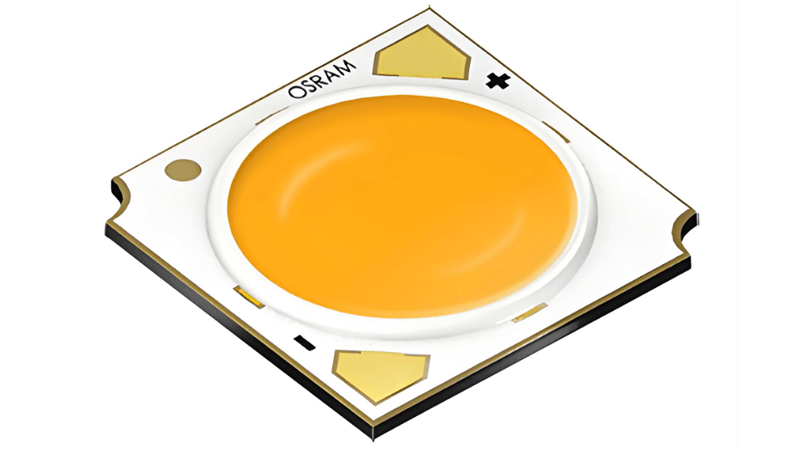
From a manufacturer's perspective, COB technology9 was a game-changer. Before COB, to get a bright light, we had to cluster many individual LED chips (called SMD, or Surface Mount Device) together on a board. This worked, but it created multiple shadows and a dotted, less uniform look, especially in a reflector. It was difficult to control the light beam precisely.
Then came Chip-on-Board (COB). As the name suggests, it involves mounting a dense array of LED chips directly onto a single substrate. Think of it as taking many tiny light sources and packing them into one powerful module. This creates a single, intense point of light. The result is a smooth, high-quality light beam that looks very similar to a traditional halogen lamp, but with all the benefits of LED technology.
This single-point source is why COB is the go-to choice for directional lighting10. In my factory, we produce thousands of COB downlights and track lights every month. They are perfect for:
- Retail: Highlighting merchandise with a focused punch of light. A COB spotlight can make a handbag or piece of jewelry stand out.
- Art Galleries & Museums: Precisely aiming light to illuminate artwork without spilling onto the surrounding walls.
- Hospitality: Creating dramatic accent lighting in hotel lobbies, restaurants, and bars. A narrow-beam COB downlight over a table creates an intimate dining atmosphere.
- Architectural Lighting: Emphasizing architectural features on building facades or in high-ceiling spaces.
There's a critical point here that connects back to quality. Because a COB packs so much power into a small area, it generates a lot of heat. This is where my insight about the "complete system" comes in. A cheap COB light might have a good chip, but if it's paired with a poor heat sink11, its performance and lifespan will suffer dramatically. The heat will cause the light output and CRI to degrade quickly. So, when sourcing COB lights, always look at the quality of the heat sink—a well-designed aluminum body is essential for longevity.
What is the most common commercial lighting?
So many lighting options exist for commercial spaces. Choosing the most suitable and future-proof type can be a major challenge, impacting everything from budget to building maintenance.
The most common commercial lighting fixtures are LED panels and downlights. Panels provide uniform, general illumination for offices and large open areas, while downlights offer versatile general and accent lighting for retail, hospitality, and a wide variety of other commercial environments.
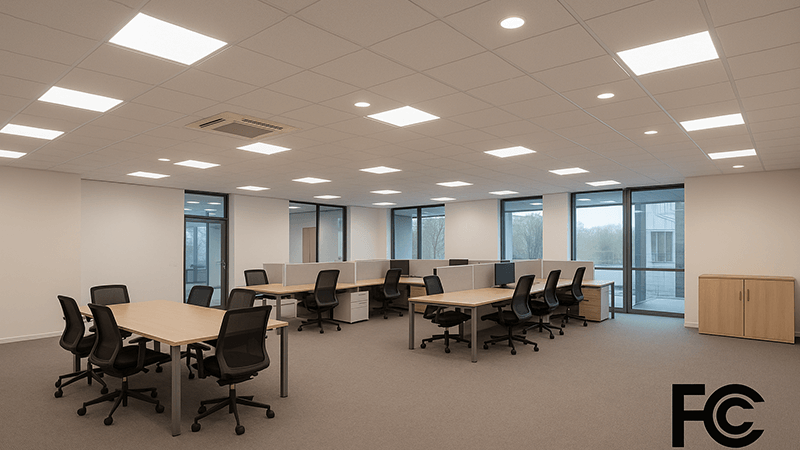
If you walk into any modern office, school, or retail store, you are almost certain to see LED panels12 and downlights. They have become the workhorses of the commercial lighting13 world, and for good reason. They replaced the old fluorescent troffers and compact fluorescent downlights that used to dominate these spaces.
LED panels are typically square or rectangular and are designed to fit perfectly into standard suspended ceiling grids. Their main job is to provide smooth, even, glare-free light over a large area. This makes them ideal for open-plan offices, classrooms, hospitals, and big-box retail stores where you need consistent ambient light. From my experience, the demand for panels is steady, but the focus is shifting towards better quality and features like flicker-free drivers and options for UGR<19 (Unified Glare Rating), which is important for office comfort.
LED downlights, on the other hand, are incredibly versatile. While they can be used for general lighting, their strength is in their flexibility. They come in countless sizes, beam angles, and power levels. This is why you see them everywhere from a supermarket aisle to a five-star hotel lobby. Because of this versatility, I've seen COB LED downlights become a standard for any project that requires a bit more punch or focus than a panel can provide.
This brings me back to my core belief: a light fixture is a complete system. When a client like Shaz orders a high-CRI COB downlight, he's not just buying a chip. He's buying a system that includes:
- The COB Light Source: The engine that produces the light. Quality here means high CRI, high R9, and consistent color.
- The Driver (Power Supply): The heart that powers the engine. A quality driver ensures stable, flicker-free light and a long lifespan. A cheap driver is the first thing to fail.
- The Heat Sink: The body that protects the engine. As I mentioned, effective thermal management is crucial for COB LEDs to maintain their performance.
- The Optics (Lens/Reflector): The eyes that shape the light. The optics control the beam angle and reduce glare, ensuring the light goes exactly where it's needed.
Cutting corners on any of these four parts to save a small amount of money will always lead to a poor experience and a shorter product life. As a manufacturer, my reputation is built on delivering a complete, reliable system every time.
Conclusion
In summary, high-CRI COB downlights14 are essential for industries where color matters. For a truly great result, always evaluate the downlight as a complete system: source, driver, heat sink, and optics.
Learn about the essential components that make up a reliable lighting system. ↩
Understanding CRI is crucial for selecting the right lighting for color-critical applications. ↩
Discover the critical role of lighting in showcasing artwork effectively. ↩
Explore the versatility and effectiveness of downlights in various environments. ↩
Learn how R9 value affects the rendering of reds and overall light quality. ↩
Explore how effective lighting enhances customer experience and product visibility. ↩
Discover why LED lights are becoming the preferred choice for energy efficiency and longevity. ↩
Discover how tunable white technology enhances comfort and productivity in spaces. ↩
Understand how COB technology improves light quality and performance in various applications. ↩
Learn about the importance of directional lighting in retail and hospitality settings. ↩
Understand how a heat sink affects the performance and lifespan of LED lights. ↩
Discover how LED panels provide uniform illumination for large areas. ↩
Get insights into the various lighting options available for commercial spaces. ↩
Explore the advantages of high-CRI COB downlights for enhancing product appeal and comfort. ↩