Choosing the wrong light color can ruin a space's mood and function. This mistake can make a cozy room feel cold or an office feel sleepy. Understanding Kelvin is key.
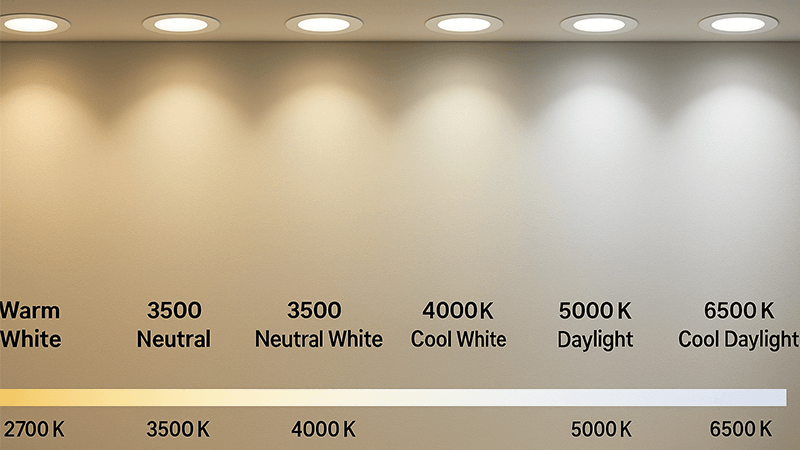
The best LED downlight color temperature depends entirely on the space's purpose. Generally, use Warm White (2700K-3000K) for relaxation areas, Neutral White (3500K-4000K) for active/work areas, and Cool White (5000K+) for industrial or high-detail task lighting.
It’s about more than just picking a number on a spec sheet. As someone who has built a business on lighting quality, I've seen firsthand how color temperature can make or break a project. I remember working with a hotel client who insisted on 5000K downlights for their guest rooms, thinking "brighter is better." We had to replace them all because guests complained the rooms felt like a hospital, not a relaxing retreat. This experience taught me a valuable lesson: the right light creates the right feeling. So, let’s go deeper and make sure you get it right every time.
What is the best color temperature for downlights?
Are you feeling overwhelmed by all the Kelvin1 options for downlights? Picking the wrong one can lead to unhappy clients and expensive rework. Let's simplify the choice for you.
The "best" color temperature for downlights is not one-size-fits-all. It's determined by the room's function. Use 2700K-3000K for living rooms and bedrooms, 4000K for kitchens and offices, and 5000K for garages or commercial spaces requiring high alertness.
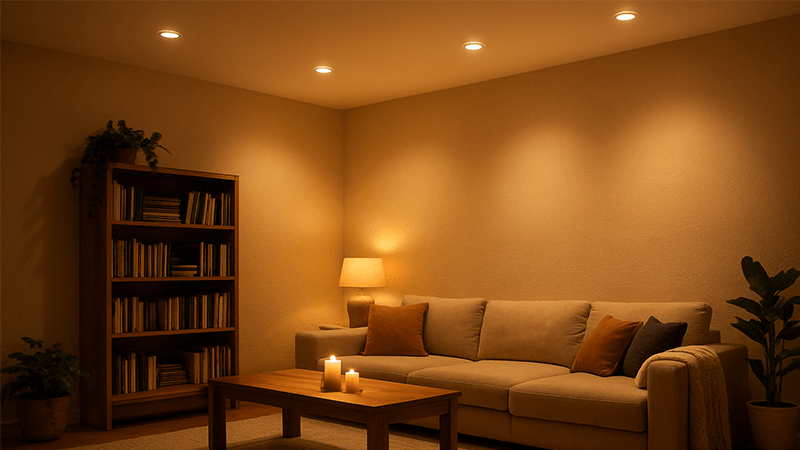
Choosing the right color temperature, or Correlated Color Temperature (CCT)2, is one of a lighting designer's most important decisions. It directly impacts how people feel and perform in a space. You wouldn't want the same harsh, blue-toned light of a workshop in a tranquil bedroom. The goal is to match the light to the human experience you want to create. Let me break down how to think about this choice in a more structured way.
The Foundation: The Kelvin Scale
First, you need to understand the Kelvin (K) scale. Think of it as a thermometer for light color. Lower numbers on the scale produce a warmer, yellowish light, similar to a candle or a traditional incandescent bulb. As the number increases, the light becomes whiter and eventually takes on a bluish tone, like daylight.
Matching the Space to the Light
The key is to match the Kelvin temperature to the activities that happen in a room. I always advise my partners, like Shaz, a purchasing manager I work with in the UAE, to categorize their projects by application first.
| Application Area | Recommended CCT Range | Feeling / Purpose | Why it Works |
|---|---|---|---|
| Residential (Relaxation) | 2700K - 3000K | Cozy, Intimate, Relaxing | Mimics the warm glow of sunset and firelight, promoting relaxation. Perfect for bedrooms, living rooms, and dens. |
| Residential (Active) | 3500K - 4000K | Clean, Bright, Focused | A more neutral light that renders colors accurately without being harsh. Ideal for kitchens, bathrooms, and home offices. |
| Commercial (Retail/Hospitality) | 3000K - 4000K | Welcoming, Vibrant | Balances comfort with clarity. 3000K creates a premium, inviting feel, while 4000K makes products look crisp and true-to-color. |
| Commercial (Office/Education) | 4000K - 5000K | Alert, Productive, Clean | A neutral to cool white light that helps reduce eye strain and increases focus and productivity during daytime hours. |
| Industrial / Task-Oriented | 5000K - 6500K | High-Alertness, Detailed | Simulates bright daylight. Used in warehouses, hospitals, and workshops where maximum visibility and precision are critical. |
Getting this right prevents basic mistakes and ensures the lighting enhances the space instead of detracting from it.
Is 4000K or 5000K better for offices?
Choosing between 4000K and 5000K for an office seems like a small detail. But the wrong choice can affect employee comfort and productivity all day long. Let's make this decision clearer.
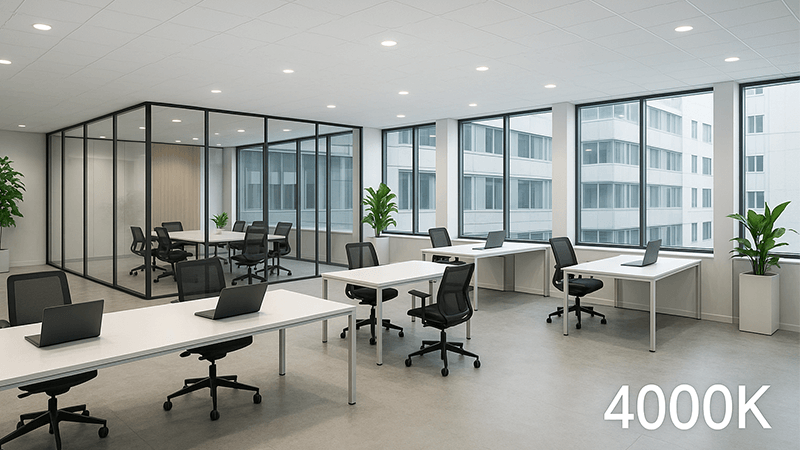
For most office environments, 4000K is the better choice. It provides a clean, neutral white light that promotes focus without being sterile or harsh. 5000K can feel too clinical and may increase eye strain over a full workday.
This is a question I discuss frequently with project contractors. While both 4000K and 5000K fall into the "cool white" category, the psychological and physiological effects are quite different, especially over an eight-hour workday. The choice isn't just about brightness; it's about creating a sustainable and comfortable work environment. As a manufacturer, I have to consider not just the technical specs, but how the human eye and brain will react to my products.
Deeper Dive: The Human Factor in Office Lighting
The debate between 4000K and 5000K is about balancing alertness with comfort. Both have their place, but for general office use, the evidence points towards the more moderate option.
The Case for 4000K (Neutral White): This is often called the "goldilocks" of commercial lighting. It's white enough to feel clean and professional, helping employees stay alert and focused. It renders colors accurately, which is important for design work or any task where color perception matters. Most importantly, it avoids the harsh, blue-tinged quality of higher Kelvin temperatures. This reduces the feeling of being in a sterile, clinical environment and can lower complaints of headaches and eye fatigue.
The Case for 5000K (Daylight White): 5000K light closely mimics natural daylight at noon. This can be beneficial for boosting alertness and energy levels, which is why it's often used in high-intensity work areas like workshops or design studios where precision is key. However, for a general office, this constant high-energy light can become overwhelming. It can feel stark and impersonal. More importantly, and this is a key insight from my years in the industry, exposure to high blue-light content in 5000K lighting, especially from lower-quality LEDs, can increase eye fatigue. Also, if employees are working late, this "daylight" signal can interfere with their natural sleep cycles by suppressing melatonin production.
Making the Final Call
Here is a table to help you decide based on the specific office area:
| Office Area | Recommended CCT | Justification |
|---|---|---|
| General Open-Plan Office | 4000K | The best all-around choice for focus, color accuracy, and long-term comfort. |
| Conference / Meeting Rooms | 4000K | Neutral light is great for presentations and video conferencing, ensuring people and materials look natural. |
| Break Rooms / Kitchenettes | 3000K - 3500K | A slightly warmer tone can help employees relax and recharge during their breaks. |
| Graphic Design / Print Areas | 5000K | For specific task areas where perfect color matching to daylight is critical. Use it sparingly. |
For a purchasing manager like Shaz, the safest and most effective specification for a full office project is 4000K. It delivers the productivity benefits without the potential downsides of 5000K.
What is the best color temperature for LED lights?
You see LED lights everywhere, but the color is often inconsistent. This makes choosing the right one for your goals feel like a gamble. I can help you understand the options.
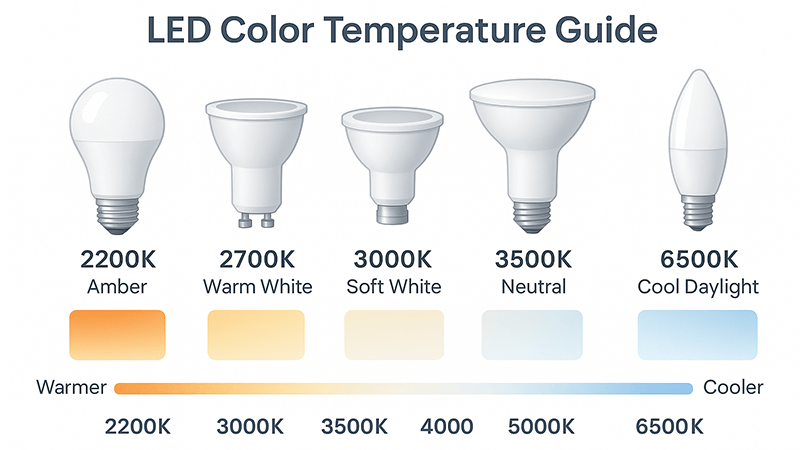
There is no single "best" color temperature for all LED lights. The ideal choice is tied to the application: warm (2700-3000K) for comfort, neutral (3500-4000K) for general activity, and cool (5000K+) for high-detail tasks or industrial use.
This question is broader than just downlights, but the principle is exactly the same. The beauty of LED technology3 is its versatility. We can manufacture LEDs to produce almost any color temperature. The challenge for you as a buyer or designer is to harness that versatility correctly. I've learned that educating my clients on these fundamentals builds trust and leads to better project outcomes. Let’s look beyond just the Kelvin number and consider other critical factors that I check in my own factory.
Beyond Kelvin: Quality Factors to Consider
Choosing the "best" LED goes beyond CCT. Two 4000K downlights can look and perform very differently. As a manufacturer, quality control is everything. Here's what you should look for besides the Kelvin number.
1. Color Rendering Index (CRI)4: CRI measures how accurately a light source reveals the true colors of objects, on a scale of 0 to 100. For most applications, you should look for a CRI of 80 or higher. For retail or art galleries where color is critical, a CRI of 90+ is necessary. A low CRI light will make everything look dull and washed out, no matter the color temperature.
2. Anti-Glare Design5: This is a huge factor in comfort. Glare, both direct and indirect, can cause headaches and eye strain. A well-designed LED fixture uses deep-set light sources, quality reflectors, or specialized lenses to control the light and prevent it from shining directly into people's eyes. I've seen offices where poor glare control from downlights made entire sections of the space unusable. This is where quality manufacturing makes a huge difference.
3. The Blue Light Hazard6: There's a lot of talk about the dangers of blue light. While quality, certified LED products are safe, prolonged exposure to poor-quality LEDs with excessive blue light spikes can increase eye fatigue. At night, exposure to any cool, blue-toned light (like from a 5000K lamp) can disrupt sleep by telling your brain it's still daytime. For evening use, always stick to warmer color temperatures.
What is each LED light color best for?
Seeing all the different light colors can be confusing. You worry that if you choose the wrong one, you'll have to live with a bad atmosphere. Let's create a simple guide.
Each LED light color is best for a specific mood and task. Warm colors (2700K) are for relaxing. Neutral colors (4000K) are for activity and work. Cool, daylight colors (5000K-6500K) are for high-detail tasks and industrial settings.
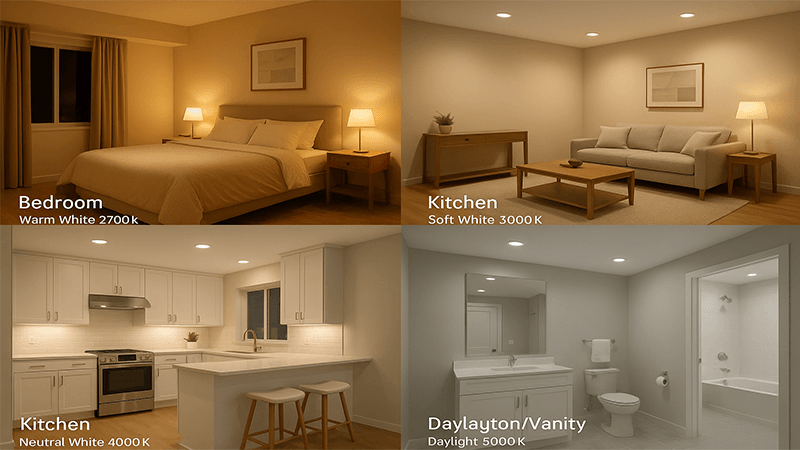
Let’s put everything we've discussed into a final, easy-to-use guide. Think of this as your cheat sheet for specifying lighting. As a factory owner, I think in terms of systems and applications. This structured approach ensures consistency and quality. A poor lighting choice can have subtle but significant negative effects. For example, installing a grid of intense, cool-white downlights can create multiple harsh shadows, which can be disorienting and even cause anxiety for some people. The right light should feel natural and easy on the eyes.
A Practical Room-by-Room Guide
Here is a comprehensive breakdown of which color temperature to use in common spaces to achieve the best results. This is the exact advice I give to my clients to help them plan their projects.
| Room / Space | Best CCT | Why It Works Best |
|---|---|---|
| Living Room7 | 2700K - 3000K | Creates a warm, inviting, and comfortable atmosphere for socializing and relaxing with family and friends. |
| Bedroom8 | 2700K | The warmest option promotes relaxation and a healthy sleep-wake cycle by limiting blue light exposure before bed. |
| Kitchen9 | 4000K | Provides a clean, bright light that is excellent for food preparation, cooking, and cleaning. It renders the color of food accurately. |
| Bathroom10 | 3000K - 4000K | 3000K is flattering for vanities. 4000K provides crisp, clean light for tasks like shaving or applying makeup. Dual CCT options are great here. |
| Home Office11 | 4000K | A neutral white light that helps maintain focus and productivity during the day without causing the eye strain a cooler light might. |
| Retail Store12 | 3000K - 4000K | 3000K creates a warm, premium feel. 4000K makes products pop and colors look vibrant. The choice depends on the brand's image. |
| Restaurant13 | 2700K - 3000K | Warm lighting is essential for creating an intimate and comfortable dining experience that encourages guests to stay longer. |
| Garage/Workshop14 | 5000K | A bright, clear light that improves visibility and safety for detailed work on projects or vehicles. |
| Hospital15 | 4000K - 5000K | Clinical areas need bright, clear light (5000K) for examinations, while patient rooms benefit from warmer, more calming light (4000K). |
By following this guide, you can confidently select the right LED lighting to not only illuminate a space but to truly enhance it.
Conclusion
The right LED color temperature is vital. Match warm tones to relaxation areas, neutral tones to work areas, and cool tones to task areas for perfect results every time.
Understanding the Kelvin scale is essential for selecting the right color temperature for your lighting needs. ↩
CCT is crucial for understanding how different light colors affect mood and functionality in spaces. ↩
LED technology offers versatility and energy efficiency, making it a popular choice for various applications. ↩
CRI measures how accurately colors are displayed under light, essential for tasks requiring color precision. ↩
Anti-Glare Design enhances comfort by reducing eye strain and headaches caused by harsh lighting. ↩
Understanding the Blue Light Hazard helps in choosing safe lighting options that minimize eye fatigue. ↩
Choosing the right color temperature for your living room can create a warm and inviting atmosphere. ↩
The right color temperature in a bedroom promotes relaxation and supports a healthy sleep cycle. ↩
A well-lit kitchen with the right color temperature enhances food preparation and cooking experiences. ↩
Choosing the right color temperature in a bathroom ensures flattering light for grooming tasks. ↩
Proper lighting in a home office boosts productivity and reduces eye strain during long work hours. ↩
The right color temperature in retail can enhance product visibility and create a welcoming environment. ↩
Warm lighting in restaurants encourages guests to relax and enjoy their dining experience longer. ↩
Bright, clear lighting in garages and workshops improves safety and visibility for detailed work. ↩
Hospitals require different lighting for clinical areas and patient rooms to balance functionality and comfort. ↩