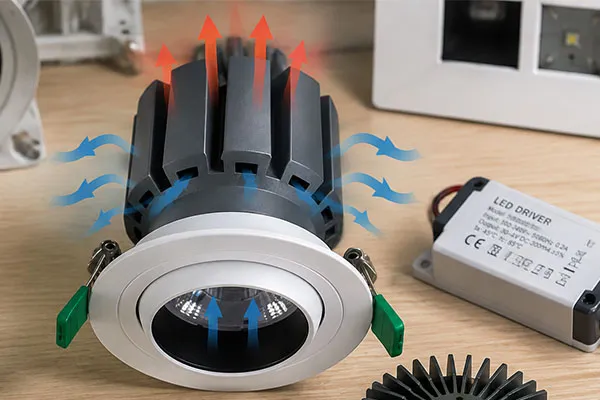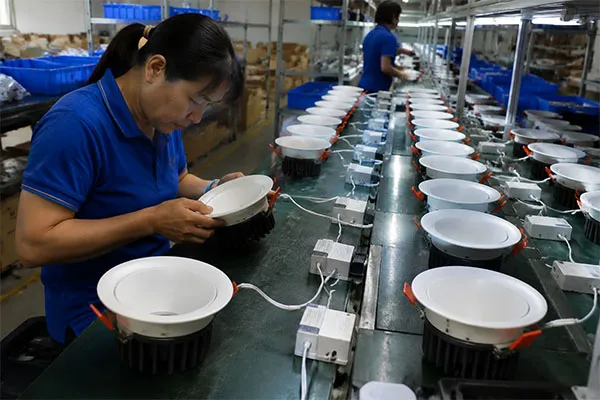

A reliable LED downlight supplier can be difficult to identify when several factories offer similar photos, samples, and prices. The real risk often appears later, when the approved product does not match mass production, delivery changes without warning, or quality issues lack a clear owner. I recommend evaluating the supplier’s working system, not only its quotation.
A reliable LED downlight supplier is one that can convert your application requirements into documented specifications, connect approved samples to mass production, explain its quality controls, quote the full deliverable, communicate delivery risks early, and manage after-sales issues with defined responsibilities. Buyers should verify these processes before placing a production order, especially for OEM, ODM, distribution, and project purchases.
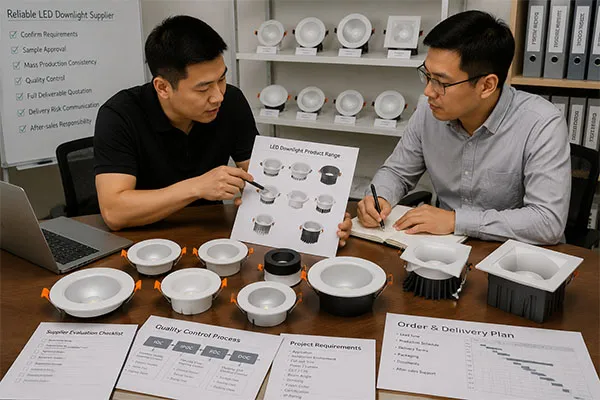
A downlight may look simple, but it combines optical performance, thermal design, electrical components, installation dimensions, surface appearance, packaging, and production control.1 From my experience in LED lighting manufacturing, the gaps between these steps are where avoidable procurement risks usually develop.
1. Does the LED Downlight Supplier Clarify Your Application Before Quoting?
A generic quote can create a false sense of progress. Buyers may compare wattage and price while overlooking cutout size, beam angle, dimming requirements, ceiling conditions, or local market preferences. These missing details can become expensive once samples, packaging, or production have already started.
A reliable LED downlight supplier should ask how and where the product will be used before giving a final quotation. The supplier should translate the application into written requirements, including wattage, CCT, CRI, cutout size, beam angle, finish, installation method, and any project-specific expectations. This reduces the risk of comparing prices for different products.
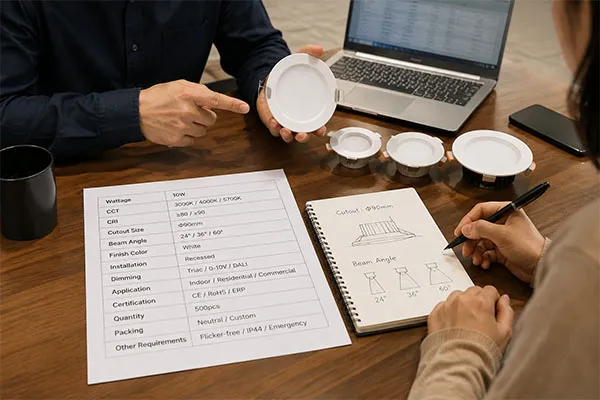
Why application details affect procurement risk
I have seen that buyers often begin with a familiar request such as “10W recessed downlight” or “black anti-glare downlight.” That is a useful starting point, but it is not always enough for a production-ready specification.
For example, two 10W LED downlights may differ in ways that matter to installers, distributors, and end users:
- One model may require a 75 mm cutout, while another needs 90 mm.
- One may use a 24-degree beam angle, while another uses 60 degrees.
- One may target 3000K residential lighting, while another is intended for 4000K commercial interiors.
- One may have a deep anti-glare structure, while another has a shallow trim.
- One may use a white powder-coated finish, while another uses black, gold, or custom surface treatment.
- One may be supplied with a non-dimmable driver, while another needs compatibility with a specified dimming system.
A supplier does not need to know every application better than the buyer’s lighting designer or electrical consultant. However, the supplier should be able to identify unclear requirements and request confirmation before treating a quote as final.
Questions I recommend asking before quotation
Buyers should ask a potential supplier to confirm the following points in writing:
| Evaluation point | What buyers should confirm | Procurement risk if unclear |
|---|---|---|
| Installation | Ceiling cutout, recessed depth, mounting method | Products may not fit the site opening |
| Light output | Wattage, lumen target, efficiency expectation | Brightness may not match the intended application |
| Light quality | CCT, CRI, beam angle, glare preference | Appearance and lighting effect may differ |
| Electrical setup | Input voltage, driver type, dimming need | Compatibility issues may arise |
| Appearance | Trim color, housing finish, logo, packaging | Brand or project requirements may be missed |
| Compliance documents | Required market documents and markings | Market-access requirements may be incomplete |
I recommend treating early clarification as a practical supplier-selection signal. A low price is not automatically a warning sign. However, a low quote without a clear scope can be difficult to evaluate because it may exclude important configuration, packaging, testing, or service requirements.
2. Can the LED Downlight Supplier Make Sample Approval Traceable to Mass Production?
A good-looking sample can be persuasive, especially when buyers need to move quickly. Yet a sample by itself does not define a repeatable order. Without written approval records, different teams may interpret the approved product differently once bulk production begins.2
A reliable LED downlight supplier should link the approved sample to a documented production specification. This record should identify the product model, key components, appearance standard, performance expectations, approved tolerances, packaging details, and any customized features. Buyers should confirm what the sample represents before authorizing mass production.
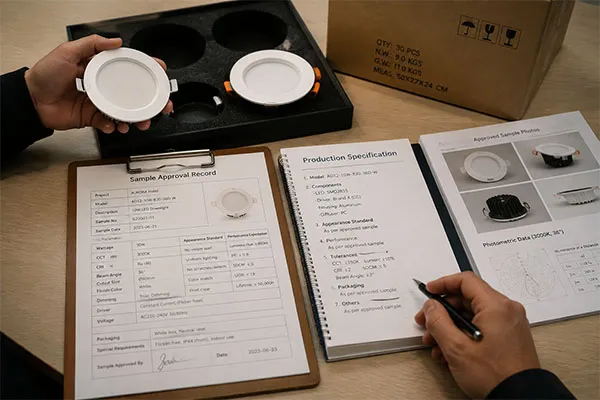
A sample should be more than a reference object
In my view, sample approval is one of the most important control points in OEM and ODM downlight purchasing. The buyer may approve a physical sample, but production teams need more than a verbal instruction such as “make it like this.”
A useful sample approval process creates a reference that can be checked later. It can include photos, drawings, labels, packaging artwork, and a written list of essential product requirements.
What should be documented after sample approval?
I recommend buyers ask for a mass-production confirmation sheet or equivalent document that covers:
-
Product identity
Confirm the model number, wattage, voltage, CCT, CRI, beam angle, trim type, and cutout size. -
Appearance reference
Record the housing color, reflector color, texture, logo position, labeling, and any acceptable visual variation. -
Performance expectations
Note the agreed electrical and lighting requirements. If the buyer requires specific test methods or reports, these should be agreed before production. -
Component or configuration changes
Identify whether substitutions are allowed. This is especially relevant for drivers, LED sources, optics, connectors, and packaging materials. -
Packaging and shipment details
Confirm inner box design, master carton quantity, barcode requirements, manuals, labels, and pallet requirements when applicable. -
Approved tolerances
Some production variation can occur in color, surface finish, dimensions, and other characteristics. The buyer and supplier should clarify which variation is acceptable for the intended market.
Why traceability matters
A supplier may make a sample using available materials, manual assembly, or a preliminary configuration. Mass production may involve larger purchasing batches, different assembly timing, and more people handling the order.3 This does not mean bulk production will necessarily differ, but it means the approved requirements need to be carried forward carefully.
I recommend that buyers avoid relying only on “same as sample” in a purchase order. A written, checkable approval record gives both sides a clearer basis for production and later issue review.
This process can reduce disagreement if questions arise during pre-shipment inspection or after delivery. It also helps distributors and local lighting brands maintain a more consistent product range across repeat orders.
3. Can the LED Downlight Supplier Explain How Production Consistency Is Controlled?
Many suppliers say they have “strict quality control.” That phrase alone does not help a buyer assess actual risk. A more useful question is whether the supplier can explain what is checked, when it is checked, and how issues are handled before shipment.
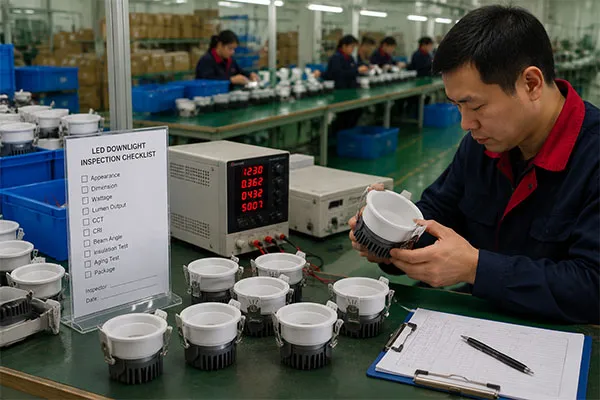
A reliable LED downlight supplier should be able to describe its production controls, including incoming material checks, assembly inspection, aging procedures, functional testing, appearance checks, and pre-shipment review. These processes can reduce risk, but buyers should recognize that no quality system guarantees zero defects in every shipment.4
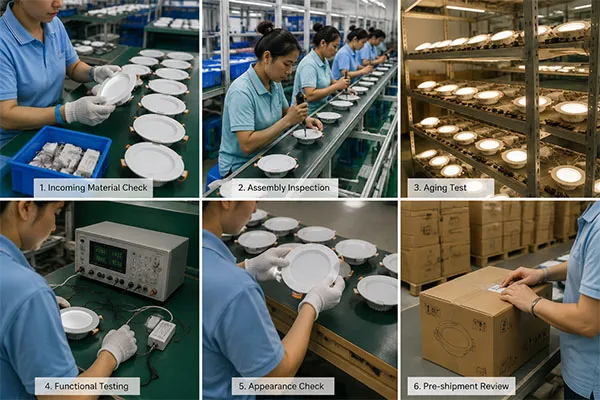
Look for understandable controls, not broad promises
From my manufacturing experience, a credible explanation is usually specific but not exaggerated. A supplier should be able to describe the main checkpoints without claiming that every product or project outcome is guaranteed.
For LED downlights, buyers can ask about controls across the production flow:
| Production stage | Example buyer question | Why it matters |
|---|---|---|
| Incoming materials | How are LED components, drivers, housings, and optics checked? | Component variation can affect consistency |
| Assembly | What checks are performed during assembly? | Wiring, fit, and physical damage risks can be identified |
| Aging test5 | Is the finished product aged before shipment, and for how long? | Early-life electrical issues may be more likely to appear |
| Functional test | Are switching, lighting, and basic electrical functions checked? | Helps identify obvious non-functioning units |
| Appearance review | How are scratches, coating defects, and trim differences checked? | Surface quality affects retail and project acceptance |
| Packing inspection | How is labeling and carton quantity verified? | Reduces shipment and warehouse handling errors |
Our own downlight and outdoor lighting production processes include 100% aging tests before shipment, typically for 4 to 8 hours depending on the product arrangement and order requirements. I present this as a risk-control practice, not as proof that a shipment cannot have defects. Buyers should still define their own inspection expectations and consider third-party inspection where the order value, application, or contract requires it.
What buyers should verify
I recommend that buyers request practical evidence appropriate to the purchase stage, such as:
- Product inspection records or checklists for the order
- Photos or videos of production and packing, when appropriate
- Confirmation of the aging-test arrangement
- Sample-based pre-shipment inspection access
- Agreed acceptable quality limits, if the buyer uses them
- A process for isolating nonconforming goods before packing
Certifications such as CE or RoHS may be relevant for market requirements6, and buyers should verify the applicable documents for the exact product and target market. However, certification documents alone do not demonstrate that each production batch will match the approved sample or arrive on schedule. Production consistency must be assessed through the supplier’s actual controls and communication.
4. Does the LED Downlight Supplier Quote the Deliverable, Not Only the Unit Price?
A unit price is easy to compare, but it is often an incomplete purchasing tool. A cheaper quote may reflect a different driver, lower specification, different packaging, limited customization, or an excluded testing requirement. This can create confusion after the buyer has already selected a supplier.
A reliable LED downlight supplier should provide a quotation that clearly describes what the buyer will receive. The quotation should state the product configuration, quantity basis, customization scope, packaging, testing expectations, lead time, payment terms, and key exclusions. Buyers should compare quoted scope before comparing unit prices.
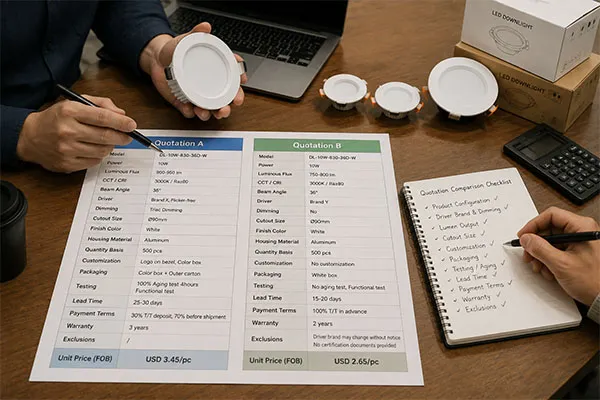
Compare like with like
I recommend using a quotation comparison table when evaluating two or more LED downlight suppliers. This prevents the purchasing team from treating apparently similar products as directly equivalent when important details differ.
| Quotation item | Supplier A | Supplier B | Buyer action |
|---|---|---|---|
| Wattage and CCT | Stated | Stated | Confirm identical configuration |
| CRI and beam angle | Not stated | Stated | Request clarification |
| Driver specification | Generic | Identified | Confirm electrical requirements |
| Housing finish | White | White matte | Approve appearance reference |
| Packaging | Standard export carton | Custom color box | Compare full delivered scope |
| Lead time | “Fast delivery” | 30 days after deposit | Ask for defined production timeline |
| Testing | Not stated | Aging test stated | Define order-specific expectations |
| Warranty/service terms | General statement | Written process | Confirm responsibilities |
Important quotation items
A dependable quotation does not need to be excessively long. However, it should avoid leaving critical matters open to assumption. I recommend confirming:
- Incoterms and destination basis: EXW, FOB, CIF, DDP, or another agreed term.
- MOQ: Standard MOQ and any small-batch order conditions.
- Customization: Logo, CCT, wattage, CRI, beam angle, trim color, body dimensions, and packaging.
- Tooling or sample charges: If applicable, state whether they are refundable or credited against bulk orders.
- Lead time trigger: Clarify whether lead time begins after deposit, artwork approval, sample approval, or all of these.
- Documents: Identify requested certificates, product labels, packing list, invoice, test reports, or other shipment documents.
- Service boundary: Define what the supplier will investigate or support if there is a quality claim.
A transparent quote protects both sides. It gives the buyer a more accurate landed-cost view and gives the supplier a clearer production instruction. The goal is not to select the highest price. The goal is to understand what each price includes.
5. Does the LED Downlight Supplier Communicate Delivery Risks Early?
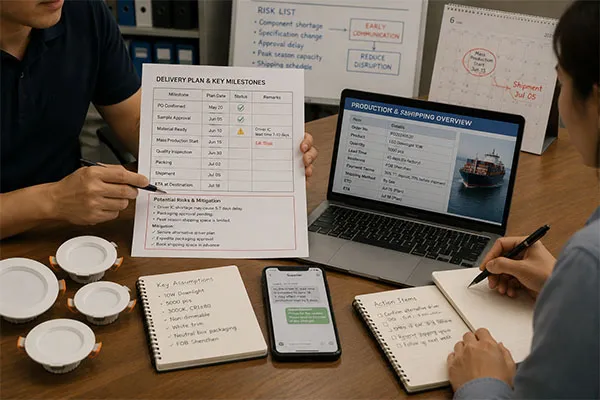
Fast replies during quotation are useful, but they are not the same as dependable delivery communication. Production schedules can be affected by component availability, specification changes, packaging approvals, peak-season capacity, and shipping arrangements.7 The key issue is whether the supplier raises these risks early enough for the buyer to respond.
A reliable LED downlight supplier should communicate schedule changes, material constraints, approval delays, and production exceptions before they become shipment failures. Buyers should ask for clear lead-time assumptions, production milestones, and an escalation contact for time-sensitive orders. Early communication can reduce disruption, even when delays cannot be fully avoided.8
Delivery reliability is a management behavior
I have found that many delivery issues begin before production. A buyer may request a short lead time while the order still has unresolved matters, such as a final CCT decision, packaging artwork, carton marks, or a customized trim color. If these items are not tracked, the supplier and buyer may have different expectations about the actual production start date.
A stronger supplier should identify dependencies and communicate them clearly.
Delivery questions buyers should ask
Before placing a purchase order, I recommend asking:
- What is the expected lead time for the exact product configuration?
- What approvals must be completed before production can begin?
- Which components have the longest procurement cycle?
- When will the supplier confirm the production schedule?
- When will packing be completed and shipment readiness be confirmed?
- Who will notify the buyer if the schedule changes?
- What options exist if a specification change is requested after production starts?
A simple milestone approach
For larger orders or project orders, buyers can request milestones such as:
- Deposit received and order released
- Technical specification confirmed
- Artwork or packaging approved
- Key materials prepared
- Assembly completed
- Aging and inspection completed
- Packing completed
- Shipment booking or container loading arranged
This does not mean every order needs complex project management. However, a milestone plan can be valuable when the downlights are tied to a construction schedule, retail launch, tender deadline, or distributor inventory replenishment.
I recommend judging a supplier by how it communicates bad news, not only good news. A supplier that reports a realistic risk early may give the buyer time to adjust shipping, inventory, or installation plans.
No supplier can control every external factor. Still, transparent communication helps buyers manage the consequences before they affect contractors, distributors, or end users.
6. Does the LED Downlight Supplier Offer a Defined Path for Quality Claims?
After-sales support is easy to promise and harder to evaluate before an order. Buyers should not wait for a problem to ask who will receive evidence, how the issue will be assessed, or how corrective action will be communicated. A clear claims process is part of procurement risk management.
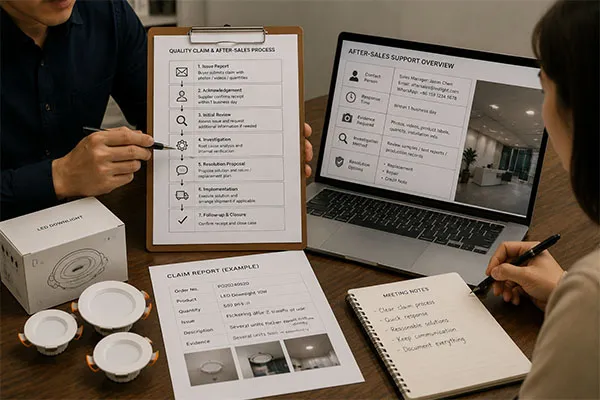
A reliable LED downlight supplier should provide a defined process for handling quality claims and after-sales issues. Buyers should know the contact person, required evidence, response timeline, investigation method, and available resolution options. A structured process supports accountability, although the final outcome should depend on verified facts and agreed commercial terms.
What a useful claims process includes
From my perspective, an after-sales process should be practical and evidence-based. The supplier needs enough information to understand whether the issue involves product configuration, installation conditions, transport damage, storage, electrical compatibility, or a potential manufacturing concern.9
Buyers should ask a supplier to define:
- The main quality-claim contact person
- The preferred evidence format, such as photos, videos, carton labels, product labels, and quantity details
- The requested information about installation conditions and input power
- The expected initial response period
- The investigation and feedback process
- The corrective-action communication method
- The commercial resolution framework under the agreed terms
Evidence helps both parties reach a better answer
A useful quality claim file may include:
| Evidence type | Why it is useful |
|---|---|
| Product model and label photos | Confirms product identity and production traceability |
| Quantity affected | Helps assess the scale of the issue |
| Clear photos or videos | Shows visible defects or operating symptoms |
| Installation details | Helps review compatibility and environment |
| Input voltage information | Supports electrical troubleshooting |
| Carton and shipping condition photos | Helps distinguish handling damage from other causes |
| Timeline of discovery | Helps identify where further checks may be needed |
I recommend avoiding vague reports such as “many lights failed.” A structured report helps the supplier investigate more efficiently and helps the buyer document the issue internally.
A responsible LED downlight supplier should not dismiss a claim without review. At the same time, buyers should be cautious of suppliers that promise an automatic outcome before seeing the evidence. Accountable support means investigating the facts, communicating clearly, and agreeing on an appropriate next step according to the order terms.
7. Does the LED Downlight Supplier Treat Reliability as a Repeatable Collaboration System?
Some buyers focus heavily on one signal: a low price, a factory video, a certificate, a sample, or a fast salesperson. Each signal can be useful, but none independently proves that the supplier can support repeat orders. Reliable purchasing depends on continuity across the full order cycle.
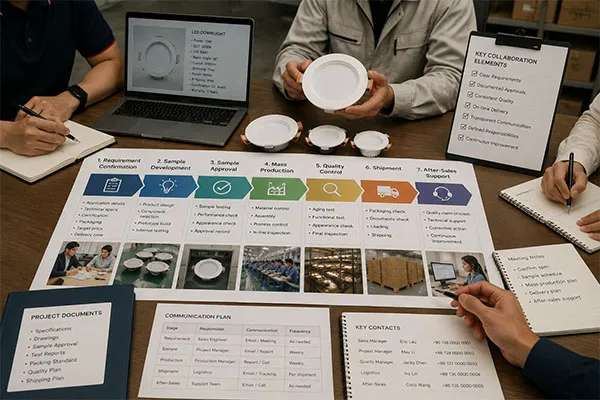
A reliable LED downlight supplier should operate as a repeatable collaboration system from requirement confirmation through sampling, production, shipment, and after-sales support. Buyers should look for consistent documentation, named responsibilities, realistic communication, and a willingness to make key decisions verifiable at each stage.
Evaluate the complete supplier journey
I recommend viewing supplier evaluation as a chain rather than a single event:
-
Requirement confirmation
The supplier identifies the intended product and application requirements. -
Quotation alignment
The commercial offer reflects the actual configuration, service scope, and delivery assumptions. -
Sample approval
The buyer approves a documented reference for product appearance and key specifications. -
Mass-production control
The supplier explains how it manages assembly, aging, inspection, and packing. -
Shipment communication
The supplier provides realistic schedule updates and raises risks early. -
Issue handling
The supplier has a defined route for evidence review, investigation, and corrective communication.
Why this matters for repeat buyers
Importers, wholesalers, distributors, and local lighting brands often need more than one successful order. They need a supplier relationship that can support product updates, recurring procurement, packaging changes, mixed containers, small-batch customization, and market feedback.
As a China-based LED lighting manufacturer, I see this as the practical difference between selling a product and supporting a procurement program. We may discuss customized CCT, wattage, CRI, beam angle, surface color, or downlight dimensions with buyers, but the important step is recording what was agreed and checking that the same understanding reaches production and shipment teams.
Buyers should also verify relevant documents, including CE and RoHS records where applicable to their market. These documents may support market-access assessment, but they should be reviewed alongside sample control, order documentation, manufacturing controls, delivery communication, and after-sales procedures.
A supplier does not need to be perfect to be dependable. The supplier should be transparent about limitations, responsive when conditions change, and willing to establish a process that both sides can check.
Frequently Asked Questions
How do I choose an LED downlight supplier for an OEM order?
I recommend starting with application requirements, then asking each supplier to provide a written quotation, sample specification, customization scope, lead time, and quality-control explanation. You should verify how the approved sample will be linked to mass production and how any quality claim would be handled.
Is the lowest LED downlight price a warning sign?
Not necessarily. A low price may reflect efficient sourcing, a simpler configuration, standard packaging, or a different service scope. Buyers should compare the full quoted deliverable, including driver, CRI, beam angle, finish, testing, packaging, lead time, and after-sales responsibilities.
Are CE and RoHS certificates enough to evaluate an LED downlight supplier?
No. CE and RoHS documents may be relevant for compliance review, and buyers should verify their applicability to the specific product and destination market. However, certifications alone do not confirm sample-to-production consistency, on-time delivery, or effective quality-claim handling.
What should I check when approving an LED downlight sample?
You should check product model, wattage, CCT, CRI, beam angle, cutout size, trim finish, housing appearance, driver configuration, packaging, labels, and required documentation. I recommend recording approved details in writing so the supplier can use them as a reference for mass production.
How can I reduce risk before placing a bulk LED downlight order?
Buyers can reduce risk by confirming specifications, approving a traceable sample, comparing complete quotations, agreeing on inspection expectations, requesting production milestones, and confirming the after-sales process. For significant project orders, independent inspection and qualified technical evaluation may also be appropriate.
Conclusion
A reliable LED downlight supplier is not defined by one attractive sample, one certificate, or one low quotation. I recommend evaluating whether the supplier can create a verifiable process from application requirements and sample approval to mass production, shipment, and issue resolution. Buyers should ask clear questions, document key decisions, and compare full deliverables rather than unit prices alone. If you are sourcing OEM or customized LED downlights, contact us to discuss your specifications, sample requirements, packaging needs, and procurement timeline.
"[PDF] LED LUMINAIRE LIFETIME: Recommendations for Testing and ...", https://www1.eere.energy.gov/buildings/publications/pdfs/ssl/led_luminaire-lifetime-guide.pdf. Technical guidance on LED luminaires identifies optical systems, electronic drivers, thermal management, and mechanical construction as interrelated elements affecting luminaire performance and reliability. Evidence role: general_support; source type: institution. Supports: That LED luminaires incorporate optical, electrical, thermal, mechanical, and control-related elements that affect performance and operation.. Scope note: Such guidance supports the general engineering context and does not evaluate any particular downlight design or supplier. ↩
"ISO and Quality Management | NIST", https://www.nist.gov/mep/iso-and-quality-management. Quality-management frameworks require organizations to maintain and control documented information needed to ensure that production and service provision conform to specified requirements. Evidence role: mechanism; source type: institution. Supports: That documented requirements, controlled production information, and change management are mechanisms for maintaining consistent realization of specified products.. Scope note: Conformity with a quality-management framework does not itself prove that a particular production batch will match an approved sample. ↩
"3.1.3.2. Process Variability - Information Technology Laboratory", https://www.itl.nist.gov/div898/handbook/ppc/section1/ppc132.htm. Manufacturing-quality literature recognizes that variation in materials, methods, equipment, operators, and process conditions can affect output consistency and therefore requires process control during production scale-up. Evidence role: mechanism; source type: research. Supports: That manufacturing variation can arise from materials, equipment, operators, methods, and process conditions, particularly when processes are scaled or transferred.. Scope note: This general evidence does not show that every transition from sample production to bulk production causes a difference in product quality. ↩
"[PDF] 6. Process or Product Monitoring and Control", https://www.itl.nist.gov/div898/handbook/toolaids/pff/pmc.pdf. Statistical quality-control methods are designed to monitor and reduce process variation and defect risk, but inspection and sampling provide assurance within defined limits rather than an absolute guarantee of zero defects. Evidence role: expert_consensus; source type: education. Supports: That inspection and process control manage and reduce quality risk but do not provide absolute assurance that every individual unit is defect-free.. Scope note: The extent of risk reduction depends on the inspection design, process capability, sampling plan, and corrective-action system used. ↩
"[PDF] A methodology for testing life-cycle performance of consumer products", https://nvlpubs.nist.gov/nistpubs/Legacy/IR/nbsir76-1157.pdf. Reliability engineering describes burn-in testing as controlled operation intended to screen some early-life electronic failures before products enter service. Evidence role: mechanism; source type: research. Supports: That burn-in or aging tests are used in electronics to screen for some early-life failures associated with the beginning of a product reliability curve.. Scope note: Burn-in testing cannot detect all latent defects or guarantee long-term field reliability. ↩
"RoHS Directive - Environment - European Commission", https://environment.ec.europa.eu/topics/waste-and-recycling/rohs-directive_en. European Commission guidance states that CE marking is used where EU product legislation requires manufacturers to declare conformity, while the RoHS Directive restricts specified hazardous substances in electrical and electronic equipment within its scope. Evidence role: definition; source type: government. Supports: That CE marking indicates declared conformity with applicable EU requirements and that the RoHS Directive restricts certain hazardous substances in electrical and electronic equipment.. Scope note: Applicability depends on the product, destination market, and relevant legislation; a document or marking alone does not establish batch-level production consistency. ↩
"Building Resilient Supply Chains: Strategies and Successes for ...", https://www.nist.gov/blogs/manufacturing-innovation-blog/building-resilient-supply-chains-strategies-and-successes. Supply-chain research identifies material shortages, production-capacity constraints, changes in requirements, and transportation disruptions as factors that can extend manufacturing and delivery lead times. Evidence role: general_support; source type: institution. Supports: That material availability, capacity constraints, design or specification changes, and logistics disruptions are recognized contributors to supply-chain and production delays.. Scope note: The relative importance of these factors varies by product, supplier network, season, and transport route. ↩
"Project success using no-nonsense risk management techniques", https://www.pmi.org/learning/library/event-based-risk-management-techniques-6223. Project and supply-chain risk-management literature treats early risk identification and communication as enabling mitigation actions before adverse events fully affect schedule or operations. Evidence role: mechanism; source type: research. Supports: That timely identification and communication of risks can permit mitigation actions such as replanning, sourcing alternatives, or stakeholder coordination.. Scope note: Early communication may reduce disruption but cannot eliminate delays caused by constraints that buyers and suppliers cannot control. ↩
"Proficiency Testing Follow Up Actions and Root Cause Analysis | NIST", https://www.nist.gov/news-events/events/2014/04/proficiency-testing-follow-actions-and-root-cause-analysis. Failure-analysis and corrective-action practices rely on traceable product information, observed symptoms, and relevant operating and handling conditions to determine the likely cause of a nonconformity. Evidence role: mechanism; source type: institution. Supports: That failure analysis and corrective action require evidence about product identity, operating conditions, handling history, and observed symptoms to distinguish among possible causes.. Scope note: Evidence collection improves diagnosis but may not yield a conclusive cause when products, records, or site conditions cannot be adequately examined. ↩