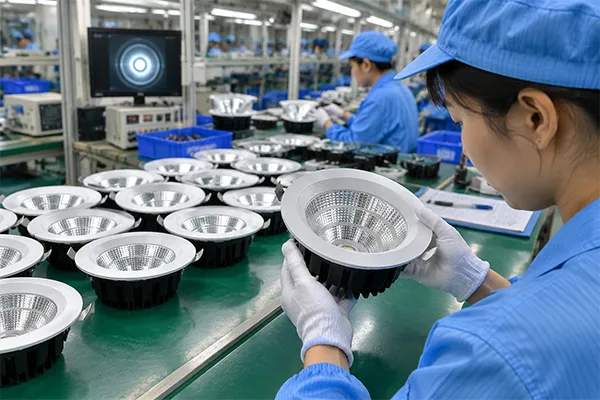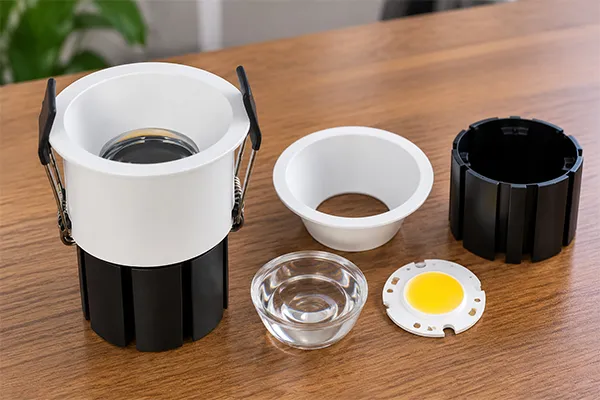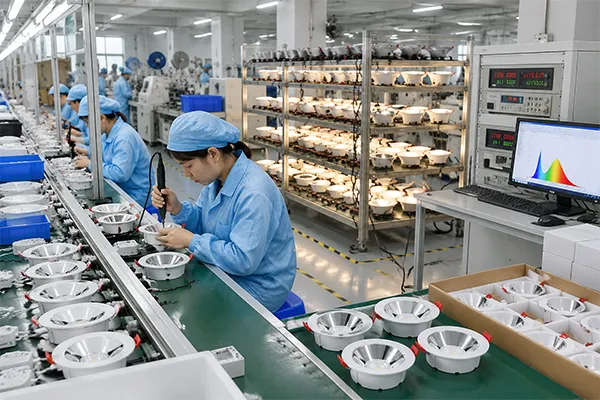

The LED downlight aging test process matters because early product failures can create costly returns, project delays, and damage to a lighting brand’s reputation1. A supplier may say that products are “aged,” but that statement alone leaves important questions unanswered. I recommend looking at what the test covers, how it supports release decisions, and how failures are handled.
An LED downlight aging test process is a factory quality-control step in which downlights are powered on for a defined period before shipment to help identify some early electrical, driver, assembly, or light-output issues.2 It reduces batch risk when it covers all units and includes clear inspection and failure-handling procedures, but it does not prove lifetime performance, replace compliance certification, or guarantee success in every installation environment3.
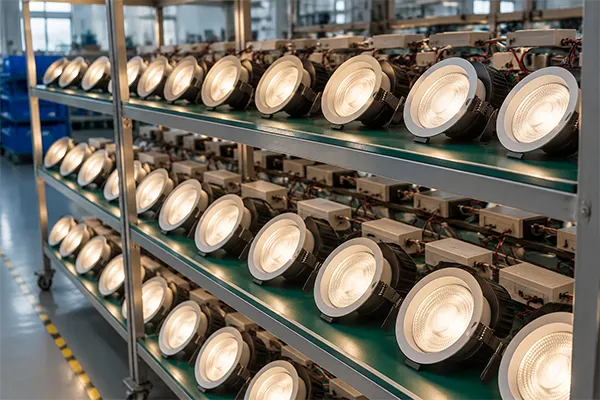
At Upward Lighting, we use a 100% pre-shipment power-on aging test for our LED downlights, typically lasting between 4 and 8 hours. From a buyer’s perspective, the useful question is not simply whether a factory performs aging. The better question is whether the process is documented, consistently applied, and connected to a meaningful shipment-release decision.
What Is an LED Downlight Aging Test Process?
An unclear quality-control claim can make purchasing decisions difficult. Buyers often hear phrases such as “full inspection,” “burn-in testing,” or “aging test,” yet they may not know what these terms mean in practice. This uncertainty can increase the risk of selecting a supplier whose testing does not match the project’s quality expectations.
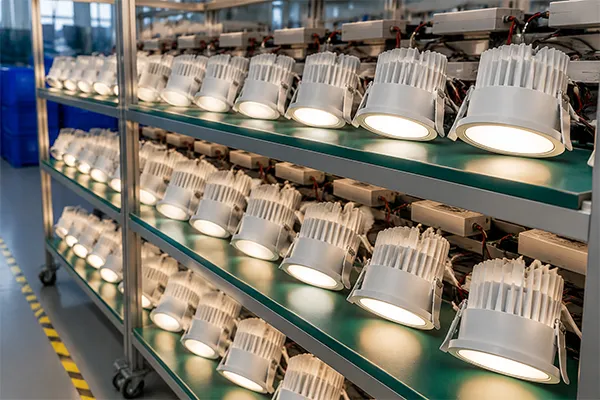
The LED downlight aging test process is a production-stage power-on test performed after assembly and before shipment. During this process, a factory operates the downlight for a specified period and checks for visible or functional early defects, such as units that do not illuminate, unstable operation, abnormal flicker, or obvious assembly problems.
Aging Testing Is a Screening Tool, Not a Lifetime Promise
In LED lighting manufacturing, “aging” generally refers to operating a completed product before it leaves the factory. The purpose is practical: identify products that may fail early under power before they reach a distributor, contractor, or end user.
This matters because some faults only appear after a fixture has been energized4. A visual inspection can confirm whether a housing, trim, lens, or cable appears correct. However, it cannot fully confirm that the LED module, driver, internal wiring, and connections will operate as expected once power is applied.
A factory aging process may help reveal issues such as:
- A downlight that does not power on
- Intermittent illumination
- Obvious flicker during operation
- Incorrect light color or inconsistent appearance
- Driver-related abnormalities that become visible during power-on
- Assembly defects that affect basic function
- Loose connections or component issues that present early in use
At Upward Lighting, we perform a 100% power-on aging test before shipment, generally for 4 to 8 hours. That means each shipped unit is powered on as part of our production quality-control process. However, I would not present this as proof that every downlight will achieve a particular lifetime in every project.
Real installations vary widely. A downlight installed in a well-ventilated office ceiling faces different conditions from a fixture installed in a hot commercial space, a humid coastal property, or a site with unstable electrical supply. Ceiling void temperatures, dimming compatibility, switching frequency, voltage conditions, installation quality, and maintenance practices can all affect real-world outcomes.5
A useful aging test helps reduce early-failure risk. It does not eliminate all product, installation, or environment-related risk.
What Buyers Should Ask
When I speak with importers or project buyers, I suggest moving beyond a simple yes-or-no question about aging tests. Buyers can ask:
- Is the test performed on 100% of units or only on samples?
- What is the typical test duration for this downlight model?
- At what stage does the aging test occur?
- What conditions are observed during the test?
- How are failed units identified, isolated, repaired, or rejected?
- Who authorizes product release after quality inspection?
- Can the supplier provide relevant quality records or inspection information for the order?
The answers help buyers compare suppliers more effectively. A stated test duration alone does not provide enough information for a sound procurement decision.
Why Does the LED Downlight Aging Test Process Matter to Buyers?
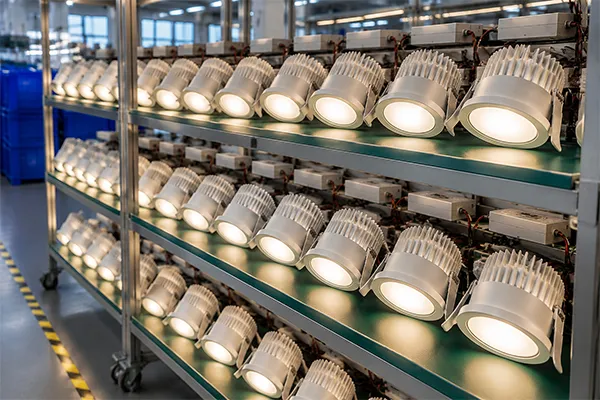
Early failures can create a chain of commercial problems. A single defective downlight may be inexpensive to replace, but the cost of labor, access equipment, site visits, customer complaints, and lost confidence can be much higher. These risks become more serious when a buyer is purchasing hundreds or thousands of fixtures.
The LED downlight aging test process matters because it can reduce the chance that some early functional defects reach the market.6 For importers, contractors, and lighting brands, a documented 100% power-on test can be one indicator that a supplier uses preventive quality-control steps before products are packed and shipped.
Early Defects Have Commercial Consequences
From a procurement perspective, downlight quality is not only a technical issue. It is also a supply-chain and reputation issue.
For example, a distributor may receive a shipment that looks correct on arrival. If a percentage of units later fail during installation, the distributor may need to sort stock, organize replacements, manage warranty communication, and protect its relationship with local resellers. A contractor may face even greater pressure because replacement often requires returning to the site after ceilings are complete.
I have seen buyers focus heavily on unit price during the quotation stage, which is understandable. Still, the lowest initial price does not always create the lowest total cost7. The more useful comparison includes quality-control coverage, communication speed, delivery reliability, packaging quality, documentation, and the supplier’s response when an issue is found.
Evaluating Aging Tests as Part of Supplier Selection
An aging test should be considered alongside other supplier controls. It should not be the only reason to approve a factory.
| Buyer Evaluation Area | Why It Matters | Questions to Ask a Supplier |
|---|---|---|
| Aging-test coverage | Indicates whether all units or only samples are powered on | Is testing 100% or sample-based? |
| Test duration | Provides context, but is not a standalone quality measure | How long is the product operated? |
| Observation process | Shows what the factory actually checks | What visible and functional conditions are inspected? |
| Failure handling | Reveals whether problems are contained before shipment | How are failed units recorded and segregated? |
| Incoming material control | Affects consistency of drivers, LEDs, housings, and cables | How are key materials evaluated? |
| Final inspection | Helps confirm labeling, appearance, packing, and quantity | What is checked before carton sealing? |
| Documentation | Supports traceability and internal buyer controls | What records can be shared for the order? |
A reliable supplier does not need to make unrealistic promises. In my view, a better supplier explains the limits of its process clearly. A factory can say that it performs 100% power-on aging while also acknowledging that this is not laboratory lifetime validation.
Why 100% Coverage Can Be Meaningful
A 100% test means every unit is included in the defined power-on procedure.8 This can be more relevant to early functional screening than a limited sample test, especially for buyers managing large orders or private-label programs.
Still, buyers should verify what “100% tested” means for the specific supplier and product. Different factories may use different test racks, operating durations, inspection methods, records, and release controls. I recommend asking for clarity rather than assuming that all aging programs are identical.
Does a Longer LED Downlight Aging Test Process Always Mean Better Quality?
Buyers sometimes assume that the factory with the longest advertised aging time must offer the best product. This is an understandable shortcut, but it can lead to poor comparisons. A long test period may sound impressive, yet duration alone does not explain the quality of the process or the quality of the components inside the downlight.
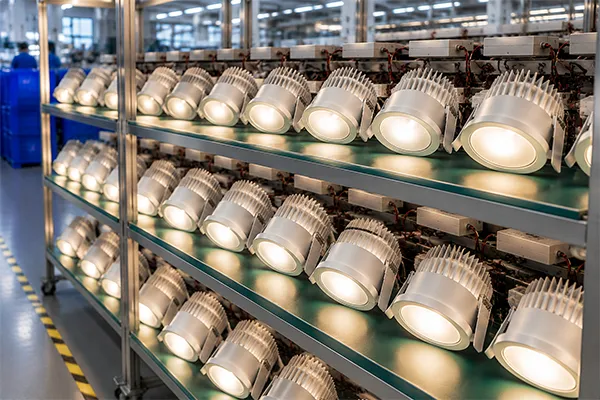
A longer LED downlight aging test process does not automatically mean better quality.9 Test duration is only one factor. Buyers should also assess unit coverage, operating conditions, inspection criteria, defect handling, component consistency, final inspection, and whether the supplier uses the results to control shipment release.
Duration Must Be Viewed in Context
A 4-hour, 8-hour, 12-hour, or longer aging claim does not tell the full story on its own. For example, a supplier may state a long testing time but provide no explanation of whether every unit is tested, what is checked, or what happens when a fault appears.
Conversely, a supplier with a shorter stated period may have strong coverage, disciplined final inspection, stable component sourcing, and fast containment procedures. Neither situation should be judged on time alone.
At Upward Lighting, our standard practice includes 100% power-on aging for 4 to 8 hours before shipment. We view this as a practical production-stage control for detecting some early operating issues. We do not position it as a substitute for long-term reliability testing or as evidence that a fixture will perform identically in every market and installation.
Better Questions Than “How Many Hours?”
I encourage procurement teams to use a broader checklist.
| Evaluation Factor | Why It Deserves Attention |
|---|---|
| Coverage | Testing all units provides a different level of screening from testing selected samples. |
| Product condition during testing | Buyers should understand whether the completed fixture is tested before packing. |
| Inspection criteria | Clear criteria help inspectors make consistent pass, hold, repair, or reject decisions. |
| Failure containment | A good process prevents suspect products from moving directly into packing. |
| Re-testing after correction | Repaired products may need re-evaluation before release. |
| Batch identification | Traceability can support investigation if a downstream issue occurs. |
| Final packing inspection | Product function is only one part of shipment quality. |
Avoid Overinterpreting Factory Claims
Buyers should be cautious when a supplier connects aging time directly to lifetime claims without supporting evidence. A power-on test is not the same as a complete long-term reliability program.10 It does not independently establish rated life, lumen maintenance, driver endurance, or suitability for every electrical and environmental condition.
Long-term lighting performance can involve many variables, including:
- LED and driver selection
- Thermal design of the luminaire
- Heat dissipation after installation
- Input voltage quality
- Dimming system compatibility
- Ambient temperature
- Moisture and dust exposure
- Switching cycles
- Installation workmanship
Application-specific decisions should involve qualified technical evaluation. For demanding projects, buyers may also need project specifications, samples, third-party test reports where applicable, and compatibility verification with the intended control system or installation environment.
How Should Buyers Verify an LED Downlight Aging Test Process?
A supplier’s aging-test claim may be useful, but procurement teams still need evidence that the process is real, relevant, and repeatable. Without verification, buyers may rely on marketing language rather than a meaningful quality-control practice. This gap can be especially risky for private-label programs and project orders with strict delivery requirements.
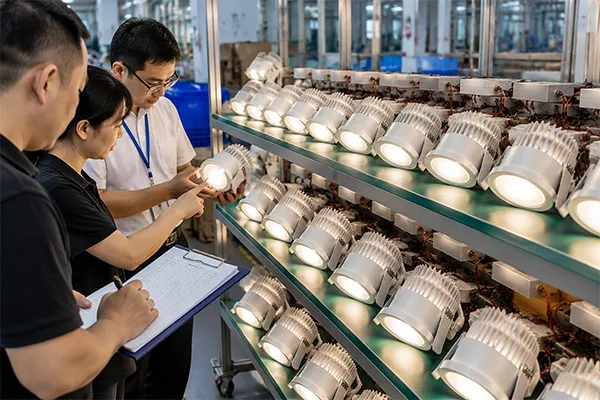
Buyers can verify an LED downlight aging test process by requesting clear process explanations, reviewing available inspection records, checking factory capabilities, evaluating samples, and confirming how failures affect shipment release. Verification should focus on whether the supplier’s stated process is consistently used, not on assuming that aging alone proves long-term reliability.
Practical Verification Steps
The level of verification should match the size, risk, and technical complexity of the order. A small trial order may require a simpler review than a major hospitality, retail, office, or residential development project.
Here is a practical approach I recommend.
1. Request a Clear Written Explanation
Ask the supplier to describe the process in plain language. The explanation should cover:
- Whether each unit is powered on
- The typical aging duration for the selected model
- When the test occurs in production
- What the inspectors observe
- How failed units are handled
- Whether products are re-tested after corrective work
- How shipment release is controlled
A supplier does not need to disclose every internal detail to provide a useful answer. However, vague responses should prompt further questions.
2. Review Product Samples
Samples remain important. Buyers can assess appearance, dimensions, trim quality, driver configuration, color temperature, beam angle, packaging, labeling, and basic functionality. For OEM or ODM programs, samples can also confirm custom requirements such as:
- Wattage
- Color temperature
- Color Rendering Index (CRI)
- Beam angle
- Surface finish color
- Branding and packaging
- Dimming or control requirements, where applicable
A sample cannot predict every future installation outcome. However, it helps align buyer expectations before mass production.
3. Consider a Factory Audit or Third-Party Inspection
For larger orders, buyers may choose to conduct a factory audit or appoint an independent inspection company. The inspection scope can include production controls, aging-test areas, final inspection, packing, labeling, and order quantity.
The goal is not to assume that every supplier uses the same equipment or documentation system. The goal is to verify whether the supplier’s stated controls exist and are reasonably connected to the order being shipped.
4. Align Quality Requirements Before Production
Clear requirements reduce disputes. I recommend putting key expectations into the purchase order, product specification sheet, approved sample record, or quality agreement.
The strongest quality-control process begins before production, when the buyer and supplier agree on what “correct” means.
For regulated markets, buyers should also verify the required compliance documents for the product, destination, and intended application. Documentation requirements can vary by market, product configuration, and sales channel.
What Is the Difference Between Aging Testing, Certification, and Lifetime Claims?
Lighting buyers can easily confuse three separate subjects: factory aging tests, market-access certification, and long-term reliability claims. When these categories are blended together, suppliers may appear to offer more assurance than their documents or processes actually support. A sound purchasing decision separates each claim and asks for the appropriate evidence.
Factory aging testing, compliance certification, and lifetime claims answer different questions. An aging test screens completed products for some early defects; certification documents may address defined safety, electromagnetic compatibility, or environmental requirements; and lifetime claims require separate technical evidence. Buyers should evaluate each category independently.
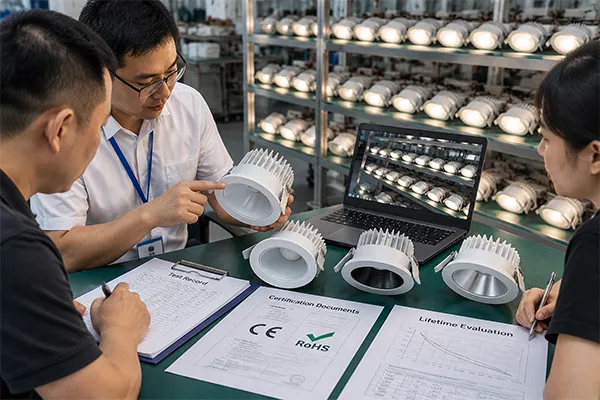
Factory Aging Testing
Factory aging testing is a manufacturing quality-control activity. It is performed to identify some issues before products are shipped.
At Upward Lighting, our 4–8-hour, 100% power-on process is intended as a pre-shipment screen. It can support early-defect detection, but it should not be interpreted as a universal prediction of field performance.
Compliance Certification
Certification and compliance documentation address a different question: whether a product meets specific requirements under the scope of the relevant standard, test report, declaration, or regulatory framework.11
Our products hold certifications such as CE and RoHS. Buyers should still verify the applicable documents, model coverage, destination-market requirements, and product configuration before placing an order. Certification needs may differ depending on the market and the intended use of the product.
Long-Term Lifetime and Reliability Claims
Long-term performance claims involve another category of evaluation. Rated lifetime, lumen maintenance, thermal performance, and other reliability statements should be supported by appropriate technical data and testing methods.12 Buyers should request relevant information for the specific product and should not treat a short factory power-on test as proof of long-term results.
| Claim Type | Primary Question It Helps Address | What It Does Not Automatically Prove |
|---|---|---|
| Factory aging test | Was the completed unit operated before shipment to screen for some early issues? | Lifetime, field suitability, or regulatory compliance |
| CE/RoHS documentation | Does the product have relevant documentation for defined market or environmental requirements? | That every unit is free from manufacturing defects |
| Lifetime claim | What performance may be expected under stated conditions and methods? | That a product will perform the same way in every installation |
| Final inspection | Does the shipment meet agreed visual, packing, labeling, and quantity requirements? | Long-term reliability in the field |
This distinction is important for responsible supplier communication. I believe buyers benefit when manufacturers explain what a control can do and what it cannot do.
Frequently Asked Questions
What is an LED downlight aging test?
An LED downlight aging test is a factory power-on procedure performed before shipment. It helps identify some early defects that may not be visible during a basic visual inspection, including non-functioning units, obvious flicker, or certain driver and assembly-related problems.
How long should LED downlights be aged before shipment?
There is no single aging duration that proves quality for every supplier or product. At Upward Lighting, we conduct 100% power-on aging for 4 to 8 hours. Buyers should assess duration together with test coverage, inspection criteria, failure handling, and final release controls.
Does aging testing prove an LED downlight’s lifetime?
No. A factory aging test does not prove rated lifetime, lumen maintenance, or long-term reliability. It is an early-defect screening process. Lifetime-related claims require separate technical support and should be evaluated for the specific product and intended operating conditions.
Is an aging test the same as CE or RoHS certification?
No. Aging testing is a factory quality-control process, while CE and RoHS relate to separate compliance requirements and documentation. Buyers should verify applicable certification documents for the exact model, destination market, and intended application rather than treating aging testing as equivalent.
Should I ask for 100% aging testing from a downlight supplier?
For many importers, distributors, brands, and project buyers, 100% power-on testing can be a valuable quality-control requirement because every shipped unit is included in the process. However, buyers should also ask how the test is conducted, observed, recorded, and used in shipment-release decisions.
Conclusion
The LED downlight aging test process is most valuable when buyers understand its proper role. It can help manufacturers identify some early functional defects before shipment, especially when every unit is powered on and failures are controlled before release. However, it is not a guarantee against all field failures, a replacement for compliance documentation, or proof of long-term lifetime. At Upward Lighting, we support buyers with 100% 4–8-hour pre-shipment aging tests, OEM/ODM customization, and responsive quotation support. Contact us to discuss your downlight specifications and quality-control requirements.
"Economic Impact of Inadequate Infrastructure for Supply ...", https://www.nist.gov/document/report04-2pdf. Product failures can create costs beyond the replacement item itself, including warranty handling, service activity, customer dissatisfaction, and reputational harm. Evidence role: general_support; source type: research. Supports: Research or institutional analysis showing that product failures can generate warranty, replacement, service, customer-satisfaction, and reputational costs.. Scope note: The source should support the general commercial mechanism; the size of these costs depends on the contract, installation setting, and failure rate. ↩
"Exploring the Mysteries of System-Level Test", https://par.nsf.gov/servlets/purl/10401355. In reliability engineering, burn-in involves operating products for a specified interval to expose certain early-life failures before release or service. Evidence role: definition; source type: paper. Supports: An engineering or reliability source defining burn-in as operating products to screen for early-life failures.. Scope note: General burn-in literature does not establish that any particular downlight test duration detects all relevant LED, driver, or assembly defects. ↩
"Lumen Maintenance Testing of the Philips 60-Watt ...", https://www.energy.gov/sites/prod/files/2018/06/f52/LPrize_60W-LumenMaintTesting_2016.pdf. Pre-shipment functional screening is distinct from the testing and documentation used to substantiate lifetime performance or conformity with applicable regulatory requirements. Evidence role: general_support; source type: government. Supports: Official guidance distinguishing product reliability or performance evaluation from conformity assessment and market-access documentation.. Scope note: The precise compliance obligations and test methods vary by jurisdiction, product design, and intended application. ↩
"Improving Efficiency of IC Burn-In Testing - ADS", https://ui.adsabs.harvard.edu/abs/2008imtc.conf..337N/abstract. Functional operation can reveal electrical and connection-related faults that may not be observable through visual inspection alone. Evidence role: mechanism; source type: research. Supports: Reliability evidence that electrical operation can reveal functional failures that are not necessarily apparent during visual examination.. Scope note: This principle does not show that a particular power-on test will detect every latent defect in a completed luminaire. ↩
"Understanding LED Color-Tunable Products", https://www.energy.gov/cmei/ssl/understanding-led-color-tunable-products. LED luminaire performance and service life are affected by operating conditions, including thermal environment, electrical supply characteristics, and control-system compatibility. Evidence role: mechanism; source type: government. Supports: Technical guidance that ambient temperature, electrical supply conditions, controls, and installation conditions can affect LED system performance or reliability.. Scope note: The influence of each factor depends on the specific luminaire, driver, control equipment, and installation. ↩
"A COMPARISON OF BURN-IN AND BAKE _' ...", https://ntrs.nasa.gov/api/citations/19650012068/downloads/19650012068.pdf. Burn-in screening can identify a subset of early-life failures before products are placed in service, thereby reducing the likelihood that those screened failures reach users. Evidence role: mechanism; source type: paper. Supports: Reliability research showing that burn-in or screening may identify and remove a portion of early-life failures before products enter service.. Scope note: Its effectiveness depends on the failure mechanisms, test stress, duration, inspection method, and production controls; it is not a guarantee of field reliability. ↩
"Impact of Life Cycle Costing in Procurement of Robotic Track ...", https://pmc.ncbi.nlm.nih.gov/articles/PMC10539050/. Lifecycle-cost and total-cost-of-ownership approaches evaluate purchasing decisions using costs beyond the initial price, such as operation, maintenance, failure, and replacement costs. Evidence role: general_support; source type: institution. Supports: Procurement guidance explaining that lifecycle or total-cost evaluation includes factors beyond acquisition price.. Scope note: The relevant cost categories and their monetary weight depend on the buyer's contract terms, application, and operating environment. ↩
"What kinds of Lot Acceptance Sampling Plans (LASPs) are ...", https://www.itl.nist.gov/div898/handbook/pmc/section2/pmc22.htm. In quality control, 100% inspection denotes examination or testing of every unit in the relevant production lot, rather than inspection of a selected sample. Evidence role: definition; source type: institution. Supports: A quality-control definition distinguishing 100% inspection from sampling inspection.. Scope note: Testing every unit does not by itself establish that the selected test method, conditions, or acceptance criteria are adequate. ↩
"Burn-In - Integration and Test > Thermal Testing - S3VI - NASA", https://s3vi.ndc.nasa.gov/ssri-kb/topics/47/. The effectiveness of burn-in screening depends on the applicable failure mechanisms and test conditions; duration alone is not a complete measure of product reliability or quality. Evidence role: general_support; source type: paper. Supports: Reliability literature showing that the value of burn-in depends on the product's failure mechanisms and the design of the screening process, not duration alone.. Scope note: A general reliability source cannot rank the quality of individual downlight factories or establish an optimal aging duration for a specific model. ↩
"Reading, Understanding and Applying the LM-80 Standard", https://www1.eere.energy.gov/buildings/publications/pdfs/ssl/2011msslsc_stalker_lm80.pdf. Short-duration functional operation is a screening activity, whereas long-term LED performance and reliability assessments use separate measurement, test, and extrapolation methods. Evidence role: definition; source type: research. Supports: Technical sources distinguishing short functional screening from long-term LED lumen-maintenance and reliability assessment methods.. Scope note: The applicable methods differ among LED packages, drivers, complete luminaires, and the performance claim being evaluated. ↩
"RoHS", https://en.wikipedia.org/wiki/RoHS. Conformity documentation addresses whether a product meets applicable specified requirements within the scope of the relevant legislation, standards, testing, and declaration procedures. Evidence role: definition; source type: government. Supports: Official guidance explaining that conformity assessment and declarations concern compliance with applicable requirements for products within the relevant regulatory scope.. Scope note: The existence of documentation does not, on its own, demonstrate that every production unit is free of manufacturing defects or suitable for every use case. ↩
"IESNA LM-80-08 and TM-21-11 - eere.energy.gov", https://www1.eere.energy.gov/buildings/publications/pdfs/ssl/msslc-sw2011_hodapp.pdf. LED lifetime and lumen-maintenance claims should be supported by relevant test data and recognized evaluation methods that state the conditions and basis of the claim. Evidence role: expert_consensus; source type: government. Supports: Authoritative lighting guidance on using standardized test data and methods to support LED lifetime and lumen-maintenance claims.. Scope note: Such evidence supports performance under stated test and operating conditions and does not guarantee identical outcomes in every installation. ↩