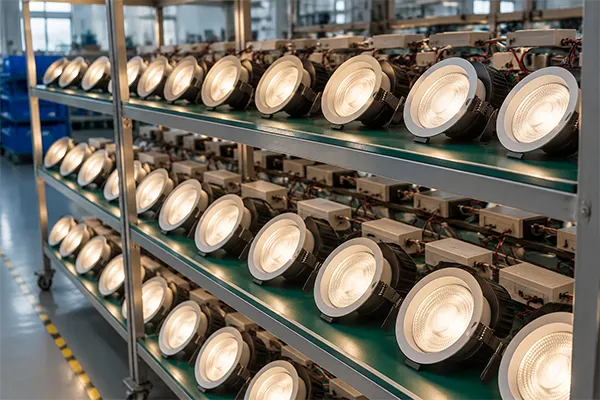

LED downlight factories can look reliable during supplier selection, yet a bright sample and a certificate do not always predict bulk-order consistency. This gap can lead to installation delays, customer returns, and costly rework. I evaluate quality as a documented production chain, not as one final inspection claim.
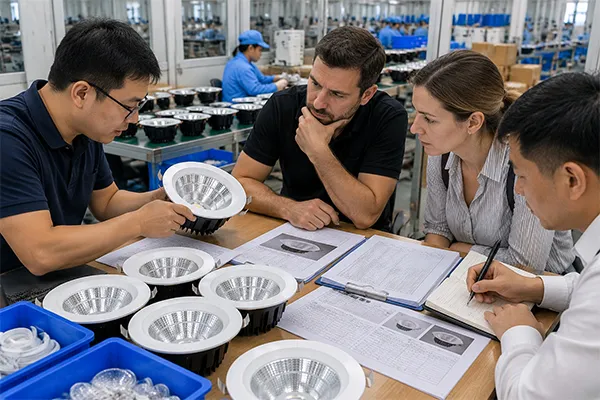
A dependable LED downlight factory performs quality inspections at multiple stages: incoming-material checks, specification confirmation, assembly control, functional and appearance inspection, aging, and final release. Buyers should ask what each stage checks, which items receive full inspection or sampling, how failures are isolated, and whether records can be linked to the production batch.
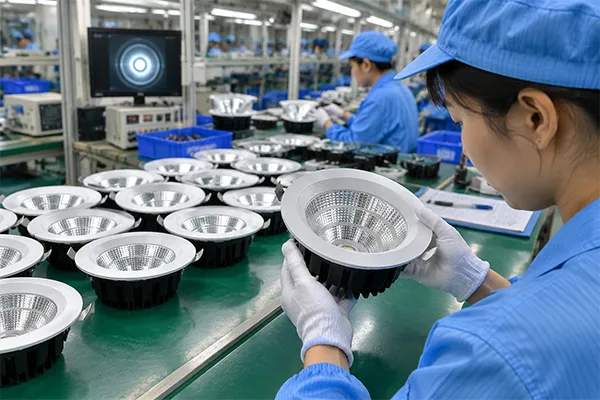
A factory’s quality process matters because different defects appear at different points in production1. I have found that buyers gain more confidence when they can review the inspection scope, acceptance criteria, and traceability process behind a supplier’s claims.
Why Do LED Downlight Factories Need a Multi-Stage Inspection Process?
A final inspection may find obvious issues, but it can arrive too late to prevent repeated defects from entering the assembly line. If materials, specifications, or workmanship vary early in production, one final check may not explain the root cause. I view multi-stage control as the more practical solution.
LED downlight factories need multi-stage inspection because product quality depends on more than whether a unit lights up at the end of production. Incoming components, correct specifications, assembly consistency, electrical function, appearance, aging performance, and final packaging should each be checked at suitable points in the manufacturing process.
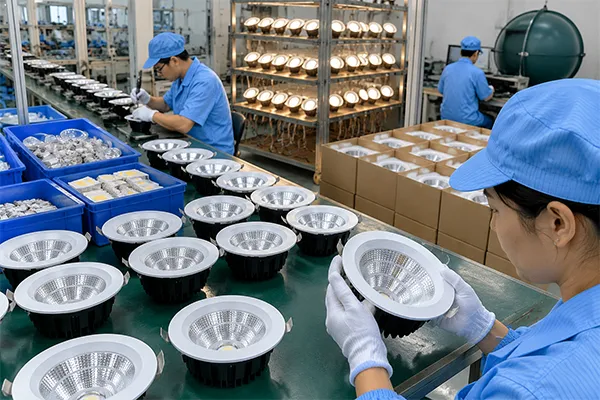
Quality Inspection Is a Chain, Not a Single Event
I describe LED downlight quality control as a chain of connected decisions. Each control point has a commercial purpose: it reduces the chance that an issue moves further downstream, where it becomes more expensive to correct2.
A typical quality-control flow may include the following stages:
-
Incoming material inspection
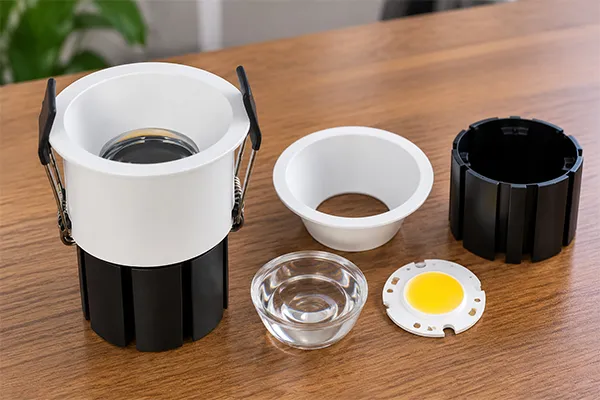
The factory checks whether key materials and components match the approved purchasing and product requirements. Depending on the product design, this may include housings, LED light sources, drivers, reflectors, diffusers, springs, cables, labels, and packaging materials. -
Specification confirmation
The production team confirms the order requirements before and during production. Buyers may require a specific wattage, color temperature, beam angle, CRI, finish color, input voltage, dimming method, or packaging format. -
Assembly process control
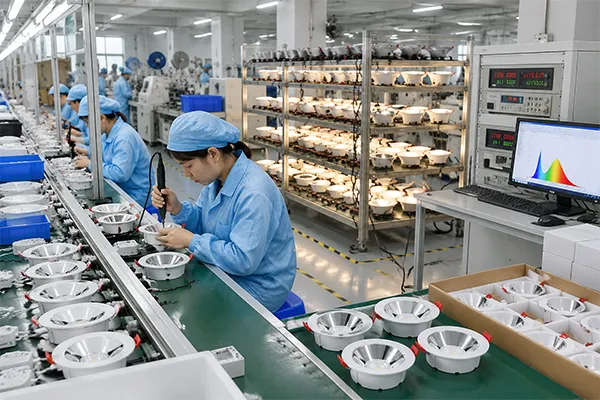
Workers and line supervisors inspect workmanship during assembly. They may look for loose wiring, incorrect component placement, poor fit, visible damage, inconsistent labeling, or incomplete assembly. -
Functional and appearance checks
The factory checks whether the LED downlight operates as expected and whether visible surfaces meet the agreed appearance standard. -
Aging test
The factory operates products for a defined period to help identify certain early-life failures. -
Final release inspection
The factory confirms that products, accessories, labels, and cartons match the purchase order before shipment.
At Upward Lighting, we conduct a 100% aging test before shipment for 4–8 hours, depending on the product and order arrangement. I consider this an important part of pre-shipment control, but I do not present aging alone as proof of long-term reliability.
Why Earlier Checks Protect Buyers Better
A problem discovered after products are packed is more difficult to manage than a problem found before full assembly. For example, an incorrect surface color may affect an entire batch. A driver mismatch may create functional or market-compliance concerns. Incorrect labels can complicate warehouse receiving, installation, and resale.
For importers, brands, contractors, and distributors, the goal is not simply to receive products that look acceptable in a carton. The goal is to receive products that are consistent with the approved specification and supported by a controlled process.
I recommend that buyers ask suppliers to map each inspection stage to a specific product risk. A useful quality process should show not only that inspection happens, but also why it happens.
What Should LED Downlight Factories Check Before Production Starts?
A product can fail customer expectations even when assembly workmanship is acceptable. The most common source of confusion is often the product specification itself. If the supplier, purchasing team, and production line do not work from the same confirmed requirements, bulk production can drift away from the approved sample.
Before production starts, LED downlight factories should confirm the approved product specification, bill of materials, cosmetic requirements, labeling, packaging, and order-specific customization. Buyers should ensure that the factory can identify the exact version being produced, especially when wattage, color temperature, beam angle, CRI, finish, or driver configuration differs.
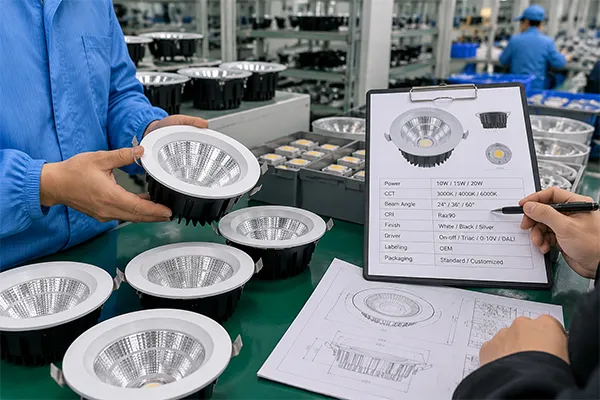
Confirming the Order Beyond the Sample
I have seen why buyers should treat an approved sample as a reference point rather than the entire quality system. A sample can demonstrate a design direction, a finish, or an initial lighting effect. However, a sample does not automatically prove that all future production will use the same materials, assembly controls, or documented requirements.
Before mass production, I recommend confirming details in a written product specification or purchase-order attachment.
| Item to Confirm | Why It Matters for Bulk Quality | Buyer Question |
|---|---|---|
| Model number | Prevents confusion between similar product versions | Is this model linked to a unique specification? |
| Wattage | Affects application suitability and product positioning | What wattage will be marked and supplied? |
| Color temperature | Supports visual consistency across a project or range | Which CCT is approved for this batch? |
| Beam angle | Affects lighting distribution and project design | Is the beam angle confirmed for this order? |
| CRI | May be important for retail, hospitality, and premium applications | What CRI requirement is documented? |
| Housing finish | Reduces cosmetic mismatch between installed fixtures | What color or surface finish is approved? |
| Driver and input configuration | Affects compatibility with the intended electrical system | What driver configuration will be used? |
| Labels and cartons | Supports receiving, resale, and compliance documentation | Can labels and packaging be reviewed before shipment? |
Incoming Materials Need Defined Controls
Incoming-material inspection is particularly relevant when components affect function, fit, appearance, or order configuration.3 I do not assume that every LED downlight factory checks every component in the same way. Buyers should ask the factory to confirm its actual process, inspection method, and sampling plan.
Useful buyer questions include:
- Are key incoming materials checked against an approved specification?
- Which components receive visual checks, dimensional checks, or functional checks?
- Are components identified by supplier lot or internal batch?
- How does the factory prevent a nonconforming component from entering production?
- Can the factory explain how it handles a material substitution?
For OEM and ODM LED downlight orders, this is especially important. At Upward Lighting, we can customize color temperature, wattage, beam angle, CRI, and surface finish colors. I believe every customized parameter should be confirmed clearly before production begins because customization creates more opportunities for order mix-ups if documentation is weak.
How Do LED Downlight Factories Control Assembly and Product Performance?
Assembly defects can be small at first and still create major commercial problems after installation. A loose connection, missing accessory, wrong label, poor trim fit, or visible scratch may cause a contractor to reject fixtures on site. I believe process control must focus on both operation and presentation.
LED downlight factories control assembly quality by checking workmanship, order-specific configuration, electrical operation, and visible appearance during and after production. A credible factory should define what is inspected, who makes the pass-or-fail decision, how nonconforming units are separated, and whether inspection records can be traced to the batch.
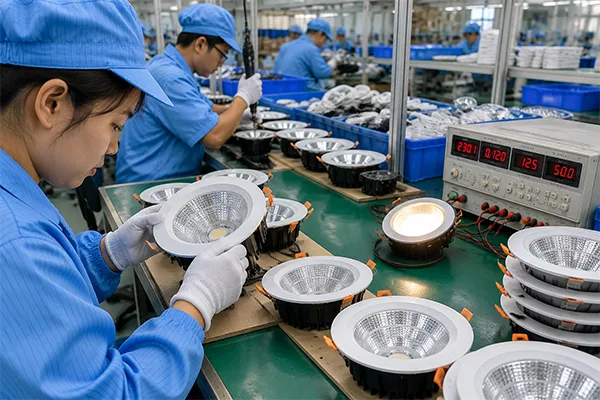
Functional Checks Should Match the Product Configuration
A functional inspection normally confirms that the product operates, but buyers should ask what “operates” means in the supplier’s process. A powered-on LED downlight may show that it lights up at one moment. It does not, by itself, confirm every relevant requirement for a project or sales channel.
Depending on the product and factory process, a supplier may check items such as:
- Light-on function
- Visible flicker or abnormal operation during the factory’s test process
- Basic driver connection and wiring condition
- Correct color-temperature designation
- Dimming configuration where it is part of the agreed product design
- Product marking and model identification
- Cable, spring, trim, and housing assembly
- Obvious physical damage or contamination
I recommend that buyers request clarity rather than assume universal testing standards. For example, a buyer can ask: “Which performance points are verified on every unit, and which are checked by sampling?” This question is more useful than asking only whether a factory conducts “100% inspection.”
Appearance Standards Must Be Defined
Appearance inspection can be highly subjective unless the buyer and factory agree on practical criteria. A white trim, black trim, brushed finish, painted housing, or reflector surface may need different acceptance rules.
A buyer should ask how the factory evaluates:
- Scratches, dents, marks, and coating defects
- Color variation between visible parts
- Gaps or misalignment around trims and diffusers
- Damage to springs, cables, and connectors
- Label placement and legibility
- Cleanliness before packaging
I often advise buyers to define the viewing expectation for premium visible fixtures. For instance, a downlight intended for a hotel lobby may require a different cosmetic standard than a concealed utility fitting. The supplier should document the agreed standard rather than rely on informal judgment.
Handling Failed Units Is Part of Quality Control
Inspection has limited value if failed units can return to the production flow without correction or identification. A stronger process includes clear segregation and disposition of nonconforming products.4
Buyers should ask:
- How are failed units marked and isolated?
- Who decides whether a unit is repaired, reworked, or rejected?
- Is the cause of repeated failure reviewed by production management?
- Can repaired units be rechecked before release?
- Are recurring issues connected to a batch, material lot, or assembly process?
These questions do not require a buyer to dictate a factory’s internal system. They help the buyer understand whether the supplier has a disciplined method for preventing repeated issues.
What Does an LED Downlight Aging Test Actually Prove?
Aging tests are often presented as a simple quality promise, which can create unrealistic expectations. Buyers may hear “aging tested” and assume it guarantees long service life. That assumption can lead to poor supplier comparisons. I consider aging valuable, but its value depends on the test scope and documentation.
An LED downlight aging test helps a factory identify certain early functional failures by operating products before shipment.5 However, an aging test does not alone guarantee lifetime reliability, prove material consistency, confirm every specification, or eliminate all field risks6. Buyers should ask how long products are aged, what conditions are monitored, and how results are recorded.
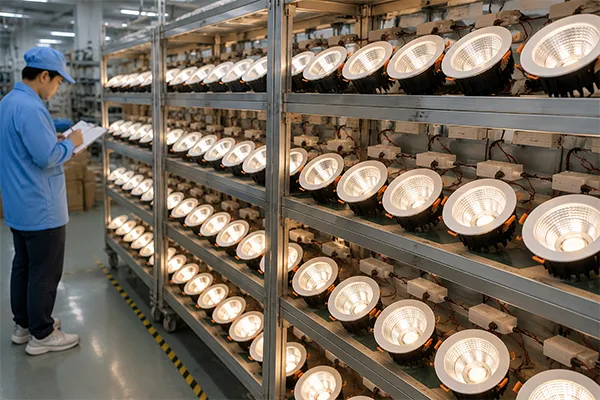
Our Confirmed Pre-Shipment Aging Practice
At Upward Lighting, every product undergoes a 100% aging test lasting 4–8 hours before shipment. I regard this process as a practical way to identify some early operational issues before goods leave our facility.
The commercial purpose is clear: early failures discovered before shipment are easier to isolate and address than failures discovered after an importer receives containers or a contractor installs fixtures.
Still, I use careful language when discussing this process. A 4–8 hour aging test does not establish the full operating life of an LED downlight. It cannot independently prove how every component will perform over years of use, under different ambient temperatures, voltage conditions, installation methods, or usage patterns.
Questions Buyers Should Ask About Aging
A useful aging claim should come with context. I recommend asking:
- Is aging performed on every unit or on a sample basis?
- How long is the aging period for this product?
- Is the stated aging duration the same for this order?
- What conditions are observed during aging?
- How are products that fail during aging isolated?
- Can the factory provide a batch-linked aging or inspection record?
- Is the aging process completed before final packaging and shipment release?
A buyer should also distinguish between operational aging and independent laboratory testing. If a project requires validated performance against a specific external standard, environmental condition, or application requirement, the buyer should request the relevant documents and arrange qualified professional evaluation where appropriate.
Aging, Certificates, and Batch Control Are Different Things
CE and RoHS documentation can be important for relevant market-entry, safety, and environmental requirements.7 However, I do not treat CE or RoHS certificates as evidence that every unit in every production batch has passed a factory inspection process.8
These controls answer different questions:
| Control | Main Purpose | What Buyers Should Verify |
|---|---|---|
| CE documentation | Relevant regulatory and conformity requirements | Scope, model coverage, issuing documents, and market applicability |
| RoHS documentation | Relevant restricted-substance requirements | Product coverage and current document validity |
| Aging test | Identifies certain early operational failures | Duration, scope, failure handling, and records |
| Final inspection | Confirms shipment readiness against order requirements | Inspection items, acceptance criteria, and batch linkage |
| Incoming control | Reduces risk from unsuitable materials or components | Component checks and material traceability process |
Buyers should verify certifications as documents and confirm whether they apply to the exact LED downlight model and destination market. Certification review and production batch quality control should work together, but neither replaces the other.
How Can Buyers Compare LED Downlight Factories Before Ordering?
Supplier comparisons often focus heavily on price, product photos, and certificates. These items matter, but they do not fully show whether the supplier can maintain consistency across repeat orders. I encourage buyers to compare quality evidence, communication discipline, and traceability alongside commercial terms.
Buyers can compare LED downlight factories by requesting a clear inspection flow, defined acceptance criteria, a distinction between full and sampled checks, failed-unit handling, and batch-linked records. Importers, brands, contractors, and distributors should prioritize the evidence that addresses their own risk of returns, installation failure, or inconsistency.
A Practical Supplier Quality Questionnaire
I recommend using the same questions with each prospective supplier. This gives purchasing teams a more consistent basis for comparison.
| Buyer Question | Why It Helps |
|---|---|
| What is checked at incoming-material stage? | Shows whether the factory controls risks before assembly |
| Which specifications are confirmed before production? | Reduces errors in customized and repeat orders |
| What items are checked during assembly? | Reveals process-level workmanship control |
| Which items receive 100% inspection, and which are sampled? | Clarifies the real scope of the inspection claim |
| What are the pass/fail criteria? | Turns vague quality language into measurable expectations |
| How are failed products isolated? | Indicates whether nonconforming units are controlled |
| Is a pre-shipment aging process used? | Helps assess early-failure screening practice |
| Can records be linked to a production batch? | Supports traceability if an issue occurs later |
| What compliance documents are available for this model? | Supports market and customer due diligence |
| How are product changes communicated? | Helps protect sample-to-mass-production consistency |
Match Inspection Priorities to Your Business Risk
Different buyers experience quality risk differently.
Importers and lighting brands need consistency between the approved sample and mass production. They should focus on controlled specifications, model identification, packaging accuracy, and repeat-order documentation.
Project contractors need to reduce installation delays and project acceptance disputes. They should focus on electrical configuration, physical fit, appearance consistency, delivery condition, and project-specific documentation.
Wholesalers and distributors need to protect their margins and reputation. They should focus on return risk, packaging resilience, model accuracy, product appearance, and practical after-sales communication.
At Upward Lighting, we support OEM and ODM requirements, small-batch orders, and product customization. I believe rapid quotations are valuable, but a fast quote should still lead to a careful specification confirmation process. The best supplier relationship balances response speed with documented control.
Frequently Asked Questions
Is a CE certificate proof that every LED downlight has been inspected?
No. CE documentation relates to relevant conformity requirements and should be verified for the specific product and market. It does not automatically show that every unit in a production batch received factory inspection.9 Buyers should request both compliance documents and batch-level quality-control information.
Does a 100% aging test guarantee LED downlight lifetime?
No. A 100% aging test can help identify certain early operational failures before shipment, but it does not guarantee long-term lifetime or eliminate all field risks. Buyers should ask about aging duration, inspection scope, failure handling, and the operating conditions relevant to their application.
What should I ask an LED downlight factory before placing a bulk order?
I recommend asking what is checked at each production stage, which items receive full inspection or sampling, how pass/fail criteria are defined, how failed units are isolated, and whether the factory can provide batch-linked inspection or aging records.
Why is an approved LED downlight sample not enough?
An approved sample shows a product concept or reference configuration, but it does not prove mass-production consistency. Buyers should confirm materials, specifications, labels, packaging, assembly controls, and batch traceability to reduce differences between the sample and bulk production.
Can a factory customize LED downlight specifications without increasing quality risk?
Customization can be managed effectively when requirements are documented before production.10 Buyers should confirm wattage, color temperature, beam angle, CRI, finish, driver configuration, labels, and packaging. The factory should identify the exact customized version throughout production and inspection.11
Conclusion
Reliable LED downlight factories do more than provide certificates, attractive samples, or broad inspection claims. They should be able to explain their quality-control chain, acceptance criteria, failed-unit handling, and batch traceability. At Upward Lighting, we apply pre-shipment 100% aging for 4–8 hours as part of our confirmed process, while recognizing that aging is only one control point. If you are sourcing LED downlights for import, distribution, branding, or projects, contact us to discuss your required specifications, documentation, and inspection expectations.
"Advanced Metrology for Defect Management in Ceramic ...", https://www.nist.gov/news-events/events/2026/06/advanced-metrology-defect-management-ceramic-additive-manufacturing. Quality-management guidance describes monitoring and controlling production processes at appropriate stages so that nonconforming outputs can be identified before they proceed further in the production chain. Evidence role: general_support; source type: institution. Supports: Quality-management guidance that process controls and inspections are applied at multiple production stages to detect and control nonconformities.. Scope note: The guidance supports the general process-control principle; it does not establish the defect profile of any particular LED downlight factory. ↩
"The Costs and Benefits of Advanced Maintenance in ...", https://nvlpubs.nist.gov/nistpubs/ams/NIST.AMS.100-18.pdf. Cost-of-quality literature explains that detecting nonconformities earlier can avoid additional processing, rework, and downstream costs that may arise when the same issue is discovered later. Evidence role: mechanism; source type: research. Supports: Research or quality-management literature explaining that late detection of nonconformities can increase rework, scrap, and downstream failure costs.. Scope note: The magnitude of the cost difference depends on the product, production system, contract terms, and point at which the defect is found. ↩
"Incoming Quality Control (IQC): Process & Best Practices", https://amrepinspect.com/blog/incoming-quality-control-process-best-practices. Supplier-quality and production-control guidance recognizes verification of purchased materials and components as a means of preventing unsuitable inputs from affecting product conformity, fit, function, or appearance. Evidence role: general_support; source type: institution. Supports: Quality-control guidance on verification of externally supplied materials and components before their use in production.. Scope note: Such guidance does not require identical inspection methods for every component; the appropriate controls are risk- and process-dependent. ↩
"NTEP Committee 2009 Interim Agenda", https://www.nist.gov/document/10-ntep-09-pub15-finalpdf. Quality-management standards require organizations to identify and control nonconforming outputs to prevent unintended use or delivery, with corrective action or disposition determined as appropriate. Evidence role: expert_consensus; source type: institution. Supports: Quality-system requirements or guidance for identifying, containing, correcting, and dispositioning nonconforming outputs.. Scope note: The precise marking, segregation, rework, and recordkeeping procedures are established by the organization's quality system and applicable requirements. ↩
"Burn-In - Integration and Test > Thermal Testing - S3VI - NASA", https://s3vi.ndc.nasa.gov/ssri-kb/topics/47/. Reliability engineering describes burn-in or operational screening as a process intended to precipitate and detect some early-life failures before products enter service. Evidence role: mechanism; source type: research. Supports: Reliability-engineering evidence that burn-in or operational screening is intended to expose some early-life or infant-mortality failures in electronic products.. Scope note: Its effectiveness depends on the stress conditions, duration, failure mechanisms, and screening design; it is not a direct measure of service lifetime. ↩
"A Methodology for Testing", https://nvlpubs.nist.gov/nistpubs/Legacy/IR/nbsir76-1157.pdf. Reliability-test literature distinguishes early-life screening from lifetime demonstration: a burn-in result may reveal certain latent failures but does not by itself validate all specifications or predict performance across all service environments. Evidence role: mechanism; source type: paper. Supports: Reliability literature explaining that burn-in screening addresses particular early failures and is not, by itself, a complete lifetime-reliability demonstration or product-conformity assessment.. Scope note: The conclusion is methodological and does not quantify the reliability of a specific downlight design or aging regimen. ↩
"CE marking", https://en.wikipedia.org/wiki/CE_marking. European Commission guidance explains that CE marking indicates conformity with applicable EU requirements, while the RoHS framework restricts specified hazardous substances in electrical and electronic equipment within its scope. Evidence role: definition; source type: government. Supports: European Commission information on CE marking obligations and the RoHS restrictions applicable to electrical and electronic equipment placed on the EU market.. Scope note: Applicability depends on the product, its intended market, and the specific EU legislation in force; documentation must be assessed for the exact model and circumstances. ↩
"CE marking", https://en.wikipedia.org/wiki/CE_marking. EU conformity guidance describes CE marking and related documentation as part of an applicable conformity-assessment and declaration process; these documents are not, in themselves, records showing that each individual unit in a production batch received a specified factory inspection. Evidence role: definition; source type: government. Supports: Official EU guidance distinguishing conformity assessment and technical documentation from evidence of unit-by-unit factory inspection.. Scope note: Some applicable legislation or a manufacturer's own quality procedures may impose additional production-control obligations, which must be assessed separately. ↩
"A guide to EU standards and conformity assessment", https://www.govinfo.gov/content/pkg/GOVPUB-C13-07a06d81c863b5241d6249891a51fb90/pdf/GOVPUB-C13-07a06d81c863b5241d6249891a51fb90.pdf. Official EU CE-marking guidance states that manufacturers assess conformity with applicable requirements and issue an EU declaration of conformity; this framework does not automatically constitute evidence of a documented inspection of every individual unit. Evidence role: definition; source type: government. Supports: Official explanation that CE marking is based on applicable conformity assessment and an EU declaration of conformity, rather than being a universal record of individual-product inspection.. Scope note: Specific directives, harmonised standards, notified-body involvement, and contractual inspection requirements can add controls beyond the general CE-marking framework. ↩
"Manufacturing and Quality | www.waru.edu", https://www.waru.edu/tools/dau-systems-engineering-brainbook/design-considerations/manufacturing-quality. Quality-planning principles call for customer and product requirements to be determined, reviewed, and controlled before production so that the intended configuration can be communicated and verified. Evidence role: general_support; source type: institution. Supports: Quality-planning guidance that documented customer and product requirements should be reviewed and controlled before production.. Scope note: Documentation reduces ambiguity but does not by itself prevent errors without effective change control, training, and production verification. ↩
"6.5 Configuration Management", https://www.nasa.gov/reference/6-5-configuration-management/. Configuration-management and quality-management guidance treats product identification and traceability as controls that help ensure the correct version and specified characteristics are maintained through production and verification. Evidence role: general_support; source type: institution. Supports: Configuration-management or quality-management guidance on identifying product versions and maintaining traceability through production and verification activities.. Scope note: The required level of traceability depends on product risk, regulatory obligations, customer contracts, and the manufacturer's control system. ↩