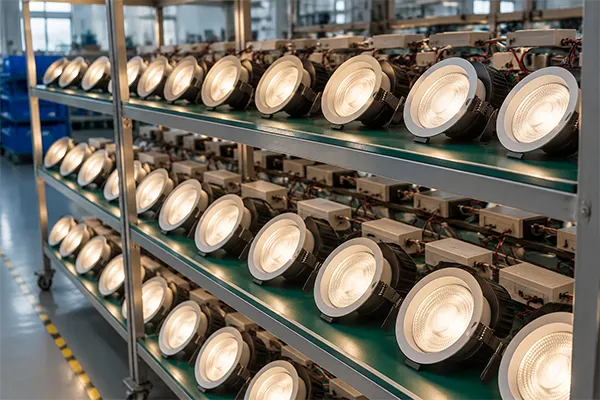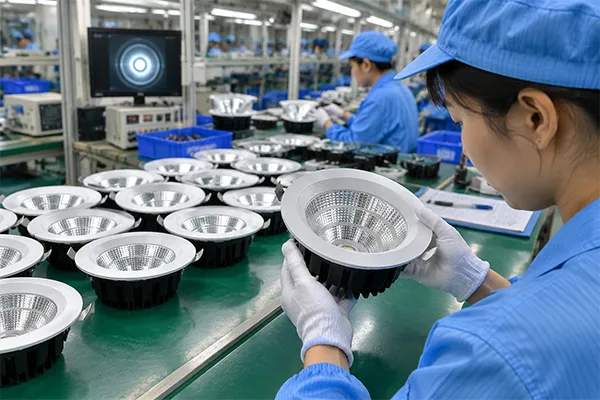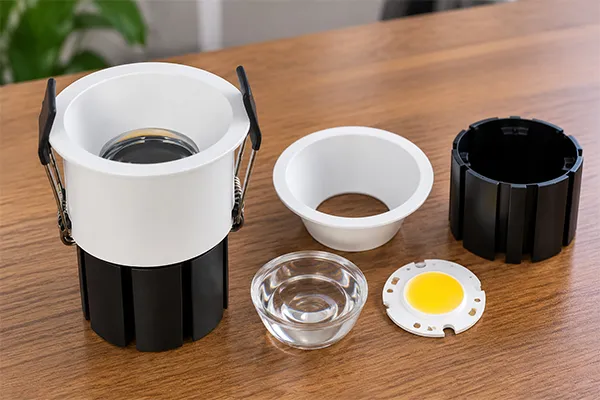

LED downlight manufacturing equipment can look impressive during a factory visit, yet a long machine list does not automatically protect buyers from inconsistent output, delayed shipments, or batch defects. We see this concern often: buyers need evidence that equipment supports a controlled process. The practical solution is to evaluate what each machine is designed to measure, prevent, record, or trace.
LED downlight manufacturing equipment used in professional factories includes assembly tools, aging lines, photometric and electrical test instruments, inspection stations, and packing equipment. However, buyers should evaluate the documented process behind each item—not the equipment alone. A capable factory connects equipment to quality standards, test records, material identification, failure handling, and batch traceability for consistent production.1
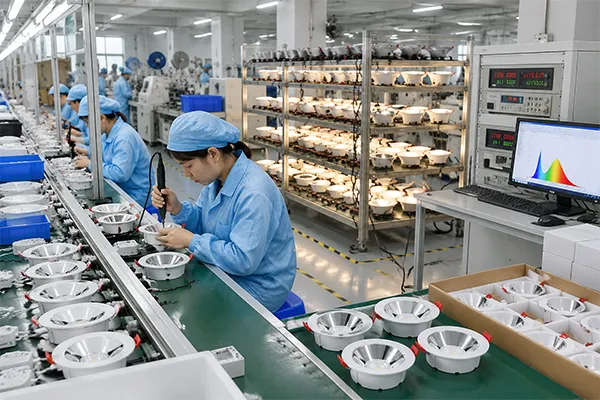
When we assess our own production workflow, we do not treat equipment as decoration or a sales claim. We treat each station as one part of a wider control system. This matters especially for importers, distributors, lighting brands, and project contractors ordering customized downlights at scale.
What Should LED Downlight Manufacturing Equipment Control?
Buyers often see LED downlight manufacturing equipment as proof that a supplier is professional. The risk is that equipment may exist without clear work instructions, trained operators, inspection criteria, or records. In that situation, the factory can still produce avoidable variation. We recommend asking what specific production risk each machine controls.
Professional LED downlight manufacturing equipment should control identifiable risks such as incorrect materials, poor assembly, inconsistent wiring, optical variation, insufficient aging, cosmetic damage, and batch mix-ups. Buyers should ask a supplier to connect every major machine or station to a written process, inspection point, acceptance standard, and record.
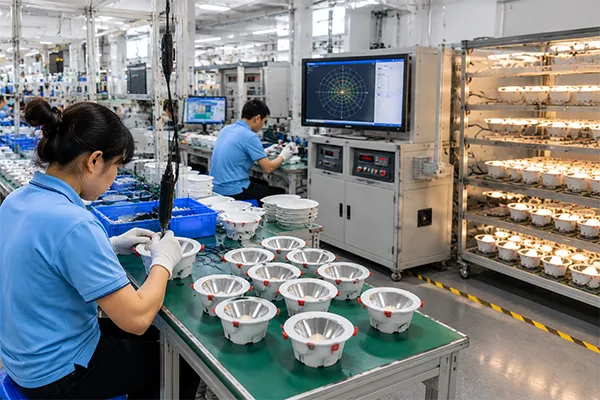
Equipment Is Only One Part of Process Control
In our process, a machine only creates value when it is connected to a defined operating method. For example, an electric screwdriver can control fastening consistency, but only if the operator follows a specified torque requirement and the production team verifies the result at appropriate intervals.2
The same principle applies across the factory floor. A professional-looking workshop may contain advanced equipment, but buyers should look beyond its appearance. We suggest that buyers ask four practical questions:
- What failure risk does this equipment address?
- What parameters does the operator control or measure?
- What result is considered acceptable or unacceptable?
- What happens when the result fails the requirement?
For LED downlights, common production risks include:
- Incorrect LED color temperature or wattage configuration
- Driver and light-engine mismatch
- Loose internal wiring or unreliable connections
- Inconsistent surface finish or visible housing damage
- Wrong trim color, beam angle, or reflector selection
- Incorrect labels, cartons, accessories, or country-specific packaging
- Mixed batches during OEM/ODM production
- Products passing through shipment without required aging or inspection
We find that buyers gain more useful information from these questions than from simply counting assembly lines. A factory may use manual, semi-automatic, or automated equipment depending on product design, order quantity, and customization needs. None of those approaches guarantees quality by itself.
Material Preparation and Identification Matter
Before assembly begins, material identification is essential.3 A downlight can contain similar-looking parts that differ in wattage, color temperature, dimming capability, driver specification, spring design, trim finish, or reflector geometry. A mix-up can create a major problem even when every individual part appears acceptable.4
For this reason, a reliable factory should be able to show how it identifies and separates materials. We commonly consider controls such as:
| Process area | Risk to control | Evidence buyers can request |
|---|---|---|
| Incoming materials | Wrong or unapproved components | Incoming inspection record, material labels, approved sample |
| Component storage | Similar parts becoming mixed | Location labels, batch labels, segregated storage |
| Production issue | Wrong parts reaching assembly | Work order, bill of materials, line-issued material record |
| Finished goods | Incorrect products packed together | Final inspection checklist, carton label, packing record |
In our experience, clear identification practices are particularly important for custom downlight orders. An OEM client may request 3000K, black trim, a specific beam angle, branded labels, and a particular driver. Another customer’s order may look similar while requiring a different configuration. Equipment helps production move efficiently, but disciplined material control helps prevent the wrong configuration from moving with it.
How Does LED Downlight Manufacturing Equipment Support Quality Testing?
Testing equipment can give buyers confidence, but it can also create false confidence when suppliers do not explain its use. An integrating sphere, aging rack, or electrical tester does not prove that every unit was tested correctly. We encourage buyers to verify testing scope, conditions, criteria, records, calibration practices, and failure handling.
LED downlight manufacturing equipment supports quality testing when a factory uses it under documented conditions and records the results. Buyers should verify whether electrical safety checks, optical checks, aging tests, appearance inspections, and functional tests apply to samples, batches, or every unit—and how nonconforming products are isolated and reviewed.
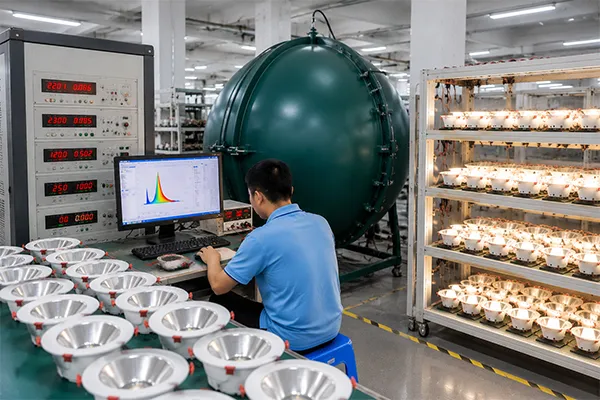
Aging Lines and Burn-In Controls
Aging lines are among the most visible types of LED downlight manufacturing equipment. They are also among the most misunderstood. Buyers sometimes assume that an aging line means the downlights are fully proven for long-term field use. We would not make that claim. Aging is a production-stage screening process, not a substitute for all long-term reliability evaluation or application-specific testing.5
At Upward Lighting, our products undergo a 100% aging test before shipment, generally lasting 4 to 8 hours. We use this stage to identify early functional failures that may appear after assembly.6 The exact setup can vary by product and order requirement, so buyers should discuss the applicable test conditions with us or another prospective supplier.
A buyer should ask for clear answers to questions such as:
- Is aging applied to every finished product or to selected samples?
- How long is the stated aging period?
- Under what electrical and environmental conditions is the product operated?
- Is the product checked before, during, and after aging?
- How are failures marked and segregated?
- Can the factory link a failure to a production batch or work order?
- Does the supplier analyze repeated failures and take corrective action?
We have learned that the most useful discussion is not “Do you have an aging line?” Instead, it is “What does your aging process detect, and what is your response when it finds a failure?”
Electrical and Optical Test Instruments
Electrical and optical testing equipment can help factories check whether a downlight performs within the agreed product specification. Depending on the factory’s process and product type, common instruments may include electrical safety testers, power meters, integrating spheres, photometric equipment, and color measurement tools.
However, we recommend that buyers avoid treating any instrument as automatic proof of compliance, photometric accuracy, or full inspection. The value lies in the complete control system around it.
| Test category | Potential issue identified | Buyer verification point |
|---|---|---|
| Electrical function test | No light output, unstable operation, incorrect power input | Test coverage and pass/fail limits |
| Hi-pot or insulation-related check7 | Electrical insulation concerns | Applicable standard, method, records |
| Ground continuity check | Grounding connection concerns on relevant products | Product applicability and test method |
| Integrating sphere test8 | Lumen output, color characteristics, power data | Sample plan, test conditions, report availability |
| Visual inspection | Scratches, coating variation, damaged springs or lenses | Appearance standard and inspector training |
For market-entry requirements, we recommend that buyers request relevant supporting test reports and certification documents rather than relying on verbal assurances. Our products hold certifications such as CE and RoHS, but buyers should verify the documents, product scope, destination-market requirements, and applicability to their intended sales channel or installation environment.
We view test equipment as a decision tool. It helps us identify whether a product or process needs attention. It does not remove the buyer’s need to review relevant reports, specifications, and regulatory documentation.
Which LED Downlight Manufacturing Equipment Matters for OEM and ODM Orders?
OEM and ODM downlight orders create more variables than standard catalog orders. A buyer may change color temperature, wattage, beam angle, CRI, trim color, driver type, logo, packaging, or accessories. Without disciplined controls, these changes increase the risk of errors, especially when several similar orders run close together.
For OEM and ODM projects, LED downlight manufacturing equipment matters most when it supports first-article confirmation, controlled parameter changes, material segregation, repeatable assembly, and accurate packing. Buyers should evaluate whether the supplier can prevent customized specifications from being mixed across production batches.
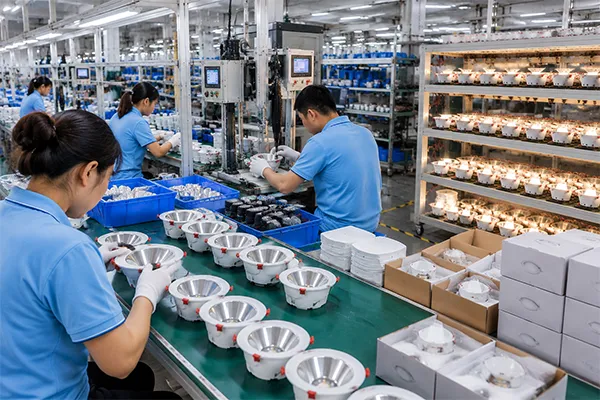
First-Article Confirmation Reduces Repeat Errors9
We consider first-article confirmation one of the most useful controls for a custom order. Before full production proceeds, the factory should confirm that the early production sample matches the agreed requirements as closely as possible. This process can cover physical appearance, key dimensions, lighting parameters, labels, packaging, and accessories.
A first article is not simply a sample placed on a desk. It should connect to the approved order details. For example, an OEM downlight order could involve:
- Color temperature: 3000K, 4000K, or 6500K
- Wattage: according to the customer’s target application
- Beam angle: narrow, medium, or wide distribution
- CRI: standard or higher-color-rendering requirement
- Surface finish: white, black, silver, or another agreed finish
- Driver: non-dimmable, dimmable, or market-specific requirement
- Branding: product label, carton artwork, instruction content, or logo
In our work with customized orders, we find that written confirmation is especially valuable when the product is visually similar to another model. It gives purchasing teams and production teams a shared reference before larger quantities move through assembly and packing.
Change Control Is More Important Than Machine Complexity
A supplier may have sophisticated assembly equipment, yet still make mistakes if a specification changes without clear communication. For this reason, we recommend that buyers ask how the factory manages changes after quotation, sampling, approval, and production release.
A controlled process should ideally identify:
- The original approved specification
- The requested change
- Who approved the change
- Which materials or documents were affected
- Whether a revised first article is required
- Which production batch uses the revised version
We have seen that small changes can have large consequences. A different driver, for example, can affect dimming compatibility, input requirements, physical fit, or labeling needs.10 A revised trim color may require separate material preparation and visual inspection. A new carton design can create shipping or customer-service problems if old packaging remains on the packing line.
The relevant question is not whether every operation is automated. The relevant question is whether the supplier can manage complexity without losing control of order-specific details.
How Can Buyers Audit LED Downlight Manufacturing Equipment and Factory Controls?
A factory audit can become unproductive when it focuses only on workshop size, machine brands, or display samples. Those details may be relevant, but they do not show whether the supplier can prevent recurring errors. We suggest that buyers audit the connection between LED downlight manufacturing equipment, written controls, real production activity, and records.
Buyers can audit LED downlight manufacturing equipment by tracing one actual order through material receipt, assembly, testing, aging, inspection, packing, and shipment. A reliable factory should be able to explain each control point, show relevant records where appropriate, isolate nonconforming goods, and identify the batch affected by a problem.
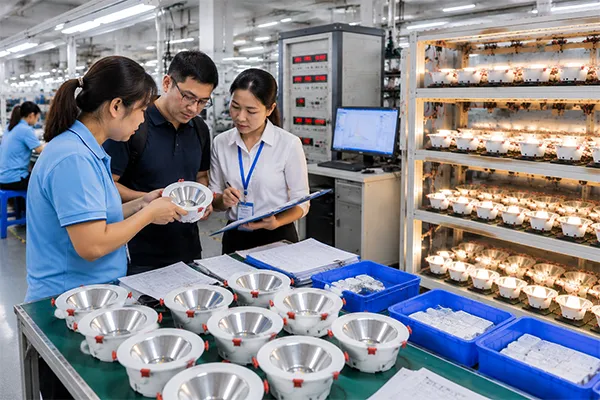
Follow One Order Instead of Taking a General Tour
We recommend that buyers select one recent or current production order and follow its journey. This method makes it harder for a supplier to rely on generic explanations. It also helps buyers understand whether daily practice matches the stated process.
During a supplier evaluation, we would expect questions like these:
| Production stage | What buyers should check | Why it matters |
|---|---|---|
| Order review | Approved specifications and work order | Confirms the factory understood the requirement |
| Material preparation | Labels, part numbers, batch identification | Reduces wrong-material and mix-up risks |
| Assembly | Work instructions and operator checks | Supports consistent construction |
| In-process inspection | Inspection points and records | Finds issues before final packing |
| Aging | Duration, scope, handling of failures | Screens for early functional issues |
| Final inspection | Sampling method or 100% checks, where applicable | Confirms release criteria |
| Packing | Label, accessory, and carton verification | Prevents shipment errors |
| Shipment | Batch or order traceability | Supports investigation if issues arise |
A buyer does not need access to sensitive operational data to ask meaningful questions. We believe a capable supplier can explain its workflow at a practical level while protecting confidential commercial information.
Nonconforming Product Handling Is a Strong Indicator
One of the clearest signs of process maturity is how a factory handles failed or questionable products. In our view, an effective system should avoid allowing failed units to return to normal production without identification and review.
Buyers should ask:
- Is there a designated area for rejected or pending-review goods?
- Are nonconforming products clearly marked?
- Who decides whether rework is allowed?
- Is rework inspected again before release?
- Can the factory identify the related order or batch?
- Does the factory look for root causes when the same failure repeats?
We do not believe any factory can responsibly promise that no issue will ever occur. Manufacturing involves materials, people, equipment, and handling steps. What separates a stronger supplier is its ability to identify issues early, contain them, correct them, and trace their origin.
Documentation Supports Better Procurement Decisions
Documents do not replace physical inspection, but they help buyers make decisions based on evidence. For downlight procurement, useful documentation may include:
- Product specification sheets
- Approved samples or signed sample records
- Production work orders
- Incoming inspection records
- Aging and functional test records
- Final inspection reports
- Packing lists and carton markings
- Relevant test reports and certification documents
- Records for corrective actions when relevant
For application-specific projects, we also recommend that buyers consult qualified electrical, lighting, or compliance professionals. The correct downlight depends on installation conditions, local regulations, control systems, ceiling construction, heat management, ingress-protection needs, and project performance expectations.
Frequently Asked Questions
What equipment is used to manufacture LED downlights?
LED downlight manufacturing equipment may include material preparation tools, assembly stations, fastening tools, soldering equipment where applicable, aging racks, electrical testers, optical test instruments, inspection stations, and packing equipment. We recommend evaluating how each item supports documented quality and traceability controls.
Is an aging line enough to prove LED downlight quality?
No. An aging line can help identify certain early functional failures, but it does not by itself prove long-term reliability, regulatory compliance, or performance in every installation. Buyers should verify aging duration, test conditions, coverage, records, failure handling, and relevant supporting documents.
How can I verify a downlight factory’s quality control process?
We suggest tracing one real order from incoming materials through packing and shipment. Ask to see how materials are labeled, how specifications are confirmed, how testing is performed, how failures are segregated, and how the factory identifies the affected batch.
Why is batch traceability important for OEM LED downlights?
Batch traceability helps a supplier investigate issues without affecting unrelated products.11 It is especially important for OEM orders with customized wattage, CCT, beam angle, CRI, trim color, drivers, labels, or packaging. We use traceability as a practical way to reduce confusion and support corrective action.
Do CE and RoHS documents guarantee a downlight is suitable for every market?
No. CE and RoHS documentation may be relevant to market requirements, but buyers should verify that documents apply to the exact product and target market. We recommend reviewing supporting test reports and consulting qualified professionals for project-specific compliance decisions.
Conclusion
LED downlight manufacturing equipment is valuable when it forms part of a controlled, traceable production process. We encourage buyers to look beyond machine quantity, automation claims, and showroom impressions. Instead, buyers should examine how a supplier controls materials, confirms custom specifications, performs aging and testing, manages nonconforming goods, and records each batch. At Upward Lighting, we support importers, brands, wholesalers, distributors, and project buyers with OEM/ODM customization, small-batch support, and practical production communication. Contact us to discuss your downlight specification and supplier evaluation requirements.
"Metrological Traceability: Frequently Asked Questions and ...", https://www.nist.gov/metrology/metrological-traceability. ISO 9001 describes a quality-management framework in which documented process controls, identification and traceability where needed, and control of nonconforming outputs support consistent conformity of production. Evidence role: general_support; source type: institution. Supports: ISO 9001 quality-management principles and requirements concerning controlled processes, identification and traceability where necessary, documented information, and control of nonconforming outputs.. Scope note: The standard establishes management-system requirements; certification or adoption does not itself prove the quality of a particular downlight batch. ↩
"Fastener Design Manual", https://ntrs.nasa.gov/api/citations/19900009424/downloads/19900009424.pdf. Engineering guidance on threaded fasteners explains that applied tightening torque is used to develop clamp load or preload, making specified and controlled torque relevant to repeatable joint assembly. Evidence role: mechanism; source type: government. Supports: Engineering guidance explaining that tightening torque is used to develop fastener preload and that torque control is relevant to repeatable bolted-joint assembly.. Scope note: Torque alone does not guarantee joint performance because friction, fastener condition, joint design, and measurement method affect achieved preload. ↩
"Quality Management System Regulation (QMSR)", https://www.fda.gov/medical-devices/postmarket-requirements-devices/quality-management-system-regulation-qmsr. Quality-system guidance treats identification of materials and product status during production as an important means of preventing mix-ups and maintaining traceability. Evidence role: general_support; source type: government. Supports: Quality-system guidance requiring or describing identification of product and materials throughout production to prevent mix-ups and enable traceability.. Scope note: The cited guidance may originate in a regulated sector; its relevance to LED-luminaire production is as a general manufacturing-control principle. ↩
"Quality Management System Regulation (QMSR)", https://www.fda.gov/medical-devices/postmarket-requirements-devices/quality-management-system-regulation-qmsr. Manufacturing quality guidance recognizes that use of an incorrect component or a product mix-up can make a finished item nonconforming even if the individual components are not visibly defective. Evidence role: mechanism; source type: government. Supports: Manufacturing quality guidance showing that incorrect component selection or product mix-ups can result in nonconforming finished products.. Scope note: The nature and severity of a mix-up depend on the product design, component compatibility, and intended application. ↩
"NASA Reliability Practices for Desi", https://ntrs.nasa.gov/api/citations/19920003068/downloads/19920003068.pdf. Reliability-engineering guidance distinguishes burn-in screening, which may reveal some early-life defects, from qualification and life testing used to assess longer-term reliability under defined conditions. Evidence role: mechanism; source type: government. Supports: Reliability-engineering guidance explaining that burn-in or environmental screening is intended to expose certain early-life defects and differs from reliability qualification or lifetime testing.. Scope note: The effectiveness of an aging regime depends on its duration, load, temperature, failure mechanisms, and the product design. ↩
"Screening Electronic Components", https://www.fda.gov/inspections-compliance-enforcement-and-criminal-investigations/inspection-guides/screening-electronic-components. Studies of electronic burn-in and screening report that controlled post-manufacture operation can reveal some early-life or latent functional defects before field deployment. Evidence role: mechanism; source type: paper. Supports: Research on electronic burn-in or screening indicating that controlled operation can expose some early-life or latent defects after manufacture.. Scope note: Such screening cannot detect every defect and does not establish the service life of a specific LED downlight. ↩
"Dielectric withstand test", https://en.wikipedia.org/wiki/Dielectric_withstand_test. Electrical-safety guidance defines dielectric-withstand testing as applying a specified voltage to assess whether insulation can withstand electrical stress without breakdown. Evidence role: definition; source type: institution. Supports: Electrical-safety standards or technical guidance defining dielectric-withstand testing as an assessment of insulation's ability to withstand a specified test voltage.. Scope note: A successful dielectric-withstand test is only one element of product safety evaluation and must be applied using the relevant product standard and test conditions. ↩
"Total Luminous Flux Calibrations of LEDs at NIST", https://www.nist.gov/publications/total-luminous-flux-calibrations-leds-nist. Photometric guidance describes integrating-sphere systems as a standard approach for measuring total luminous flux and, when paired with suitable instrumentation, spectral and colorimetric characteristics of LED light sources. Evidence role: definition; source type: government. Supports: Photometric guidance describing integrating spheres as instruments used to measure total luminous flux and, with appropriate spectroradiometric systems, colorimetric characteristics of light sources.. Scope note: Power measurements and the validity of reported results depend on the complete test setup, stabilization, calibration, and applicable test method. ↩
"First article inspection", https://en.wikipedia.org/wiki/First_article_inspection. First-article inspection guidance describes early-production verification as a means of confirming that the production process can make an item conform to specified requirements before full-scale manufacture. Evidence role: general_support; source type: institution. Supports: First-article inspection guidance stating that early production verification is used to confirm that the manufacturing process can produce an item meeting specified requirements before full production.. Scope note: First-article approval reduces risk but does not eliminate later variation caused by process changes, material changes, or inadequate ongoing controls. ↩
"Purchasing Energy-Efficient Light Bulbs", https://www.energy.gov/cmei/femp/purchasing-energy-efficient-light-bulbs. LED system guidance explains that driver electrical characteristics and control interfaces affect compatibility with the LED load and dimming system, so a driver substitution can require renewed system verification. Evidence role: mechanism; source type: government. Supports: Technical guidance explaining that LED-driver electrical characteristics and dimming interfaces must be compatible with the LED load and control system for expected operation.. Scope note: Physical fit and labeling consequences are product-specific and are not established solely by general driver-compatibility guidance. ↩
"FSMA Final Rule on Requirements for Additional ...", https://www.fda.gov/food/food-safety-modernization-act-fsma/fsma-final-rule-requirements-additional-traceability-records-certain-foods. Traceability guidance explains that lot or batch identification linked to production records can help organizations identify affected product and conduct targeted investigation or corrective action rather than treating all output as affected. Evidence role: general_support; source type: government. Supports: Traceability guidance explaining that lot or batch identification and associated records help identify affected product and support targeted investigation, containment, or recall actions.. Scope note: The usefulness of traceability depends on the completeness, accuracy, and retention of the underlying records. ↩