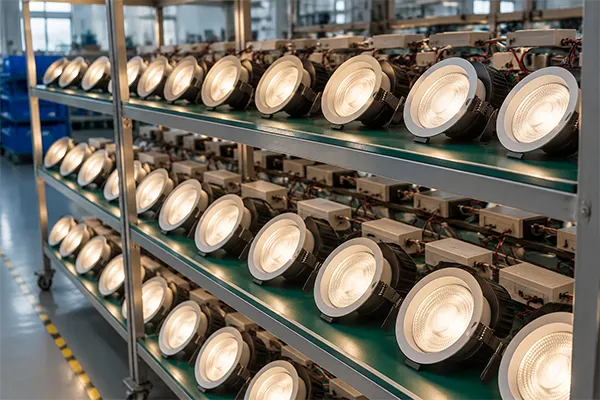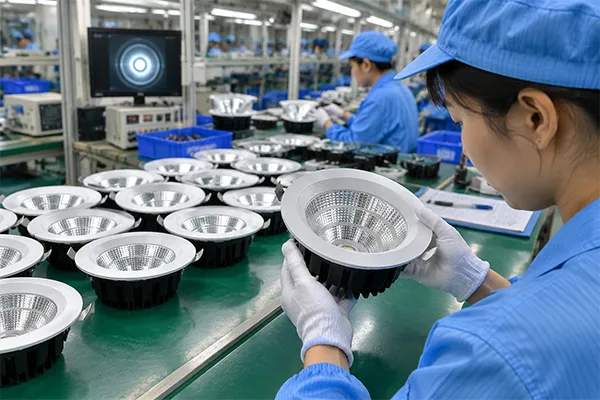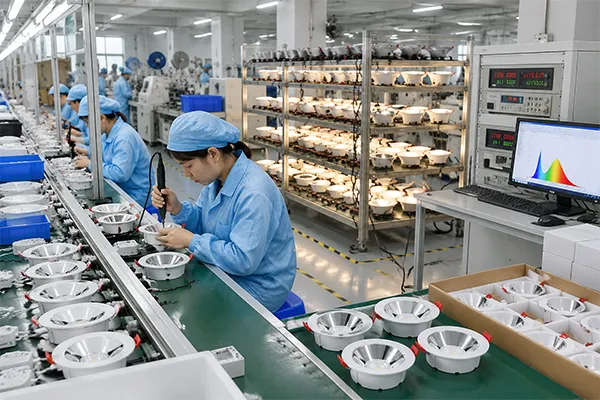
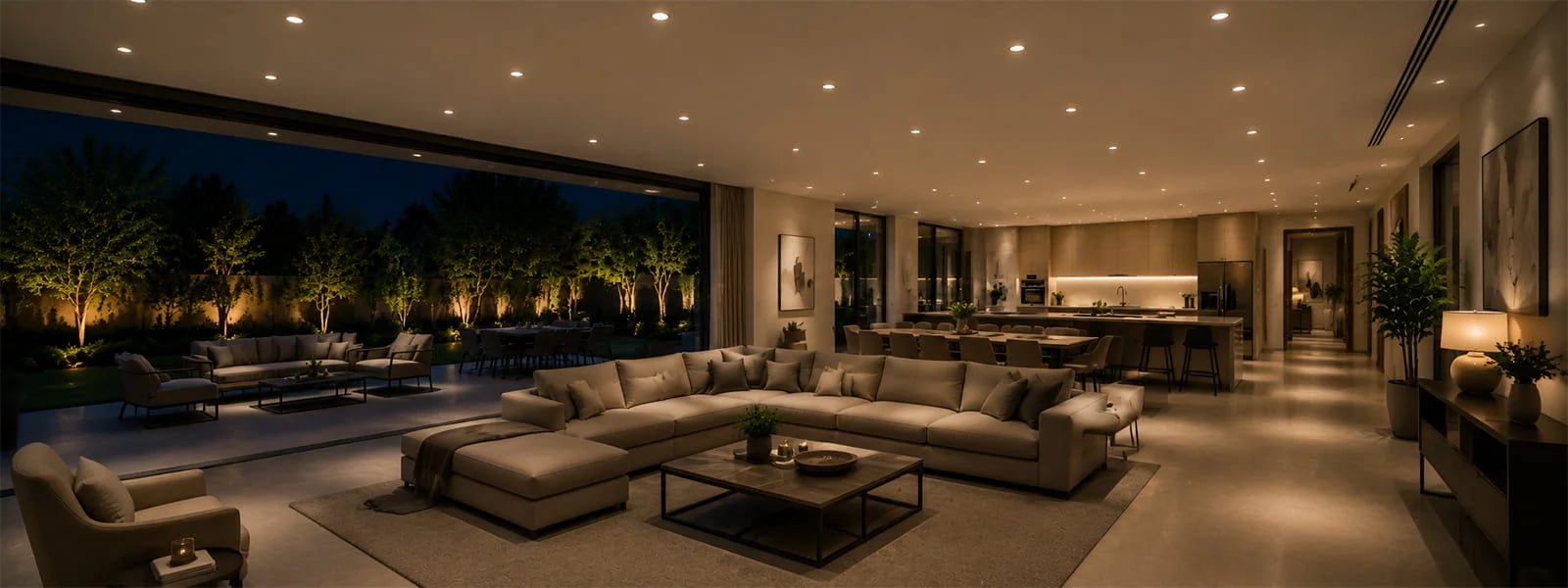
LED downlight optical components can create costly surprises when buyers approve products based only on wattage, lumen output, and a listed beam angle. I have seen samples look acceptable on a desk but perform poorly after installation, with uneven beams, excessive glare, or an appearance that does not match the project. I recommend evaluating the whole optical system before approving production.
An LED downlight’s optical performance depends on the matched relationship between the LED source, lens or reflector, diffuser, heat sink, housing geometry, and installation environment. Two products can share the same wattage, lumen claim, CCT, CRI, and beam-angle label while producing noticeably different light distribution, glare control, beam edges, and visual comfort. Buyers should confirm the intended application, request relevant sample or distribution evidence, and approve the complete optical configuration before placing an order.
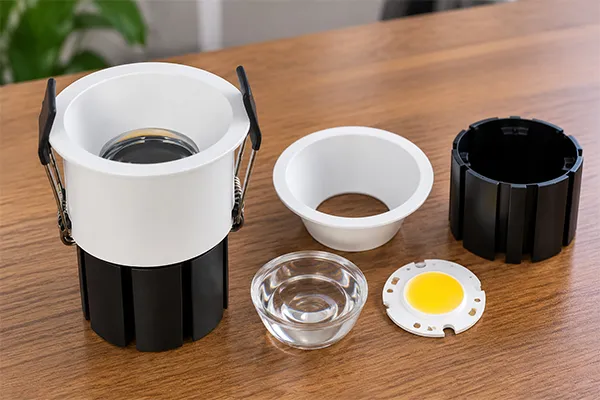
In our OEM and ODM discussions, I find that the best questions are often asked before a customer selects a bezel color or confirms a wattage. A downlight is not simply an LED module inside a round housing. Its optical result comes from several parts working together. Below, I explain how I approach optical specification confirmation with lighting brands, importers, and project buyers.
Why Must LED Downlight Optical Components Be Evaluated as a System?
A buyer may focus on a reflector, lens, or diffuser because it is the most visible optical part. That approach can create problems because a good individual component may still perform poorly in an unmatched fixture. I have seen customers compare optics separately, then discover that the assembled downlight produces a different result than expected.
LED downlight optical components should be evaluated as one system1 because the LED source, optic, diffuser or reflector, housing depth, aperture size, and thermal structure jointly affect light distribution2. A lens or reflector cannot be judged in isolation. Buyers should assess the finished downlight under the intended mounting, ceiling, and viewing conditions.
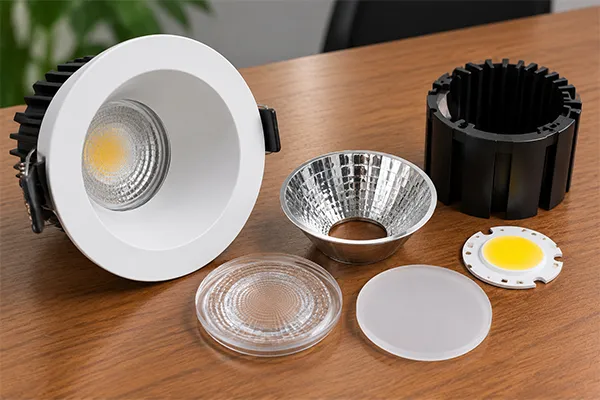
The main parts that influence optical performance
A typical LED downlight may include a COB LED, SMD LED board, lens, reflector, diffuser, trim, heat sink, driver, and outer housing. Not every design uses every component in the same way. For example, one recessed downlight may use a deep reflector to create a controlled visual aperture. Another may use a frosted diffuser to create a soft, broad light-emitting surface.
From a procurement perspective, I encourage buyers to think in terms of system matching, not component preference.
| System element | Main influence on the finished downlight | Buyer question to ask |
|---|---|---|
| LED source | Emitting area, luminous flux, color consistency potential | Which LED package and binning approach are proposed? |
| Lens | Beam control, center intensity, beam edge | Is the lens designed for this LED source and target beam? |
| Reflector | Directional control, visual depth, glare perception | What reflector finish and geometry are used? |
| Diffuser | Softness, uniformity, visible LED-point control | Does the diffuser reduce output or change beam softness? |
| Housing geometry | Cut-off appearance, aperture depth, trim style | Does the housing support the desired anti-glare effect? |
| Thermal structure | LED operating conditions over time | Is the heat-management design matched to the wattage and installation method? |
A practical example from sample discussions
In one anonymized OEM discussion, a customer requested a narrow-beam recessed downlight for a retail display area. The original brief listed only 12 W, 3000 K, CRI 90, and a 24-degree beam angle. Those details were useful, but they did not answer several important questions:
- What was the mounting height?
- How far was the fixture from the merchandise?
- Was the target a vertical display, shelf, table, or floor area?
- Did the customer want a sharp spotlight effect or a softer accent effect?
- Would shoppers look directly toward the fixture?
- Did the ceiling design require a deep black anti-glare trim or a white trim that visually disappears?
The customer later clarified that the downlights would be installed above eye level in a boutique with dark ceiling details. That information changed the discussion. We compared optical samples with different aperture depths and reflector appearances rather than treating the 24-degree label as the full specification.
Why the housing matters too
A deep-set LED can reduce direct visibility of the light source from some viewing angles.3 However, the real result depends on the aperture, reflector, trim, ceiling position, and observer location. I do not describe any one housing as universally “glare-free,” because glare performance depends on the complete product and actual installation conditions.
Buyers should request finished-product samples whenever possible. They should also define the ceiling cut-out, recessed depth, tilt requirement, trim color, and surrounding interior style. These details affect both visual comfort and the perceived quality of the finished installation.
Why Can Similar LED Downlight Specifications Produce Different Results?
Many purchasing teams receive quotations with similar headline specifications. A 10 W downlight with 900 lumens and a 60-degree beam angle can look comparable on paper to another 10 W, 900-lumen, 60-degree product. The risk is that paper specifications may hide differences that become obvious once the lights are installed.
Two LED downlights with the same wattage, lumen claim, and nominal beam angle can still create different results because beam-angle labels do not fully describe intensity distribution, beam uniformity, beam-edge softness, center brightness, aperture brightness, or glare perception4. Buyers should compare complete samples and relevant test information under defined conditions.
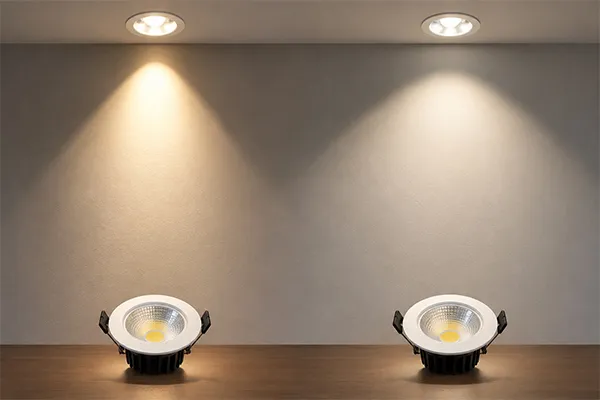
Beam angle is useful, but incomplete
A beam angle generally describes the spread of light based on a specified intensity criterion. It is an important starting point, but it does not explain everything that people see in a room.
For example, two nominal 60-degree downlights may differ in:
- Center intensity: One may create a brighter central pool of light.
- Beam-edge transition: One may fade softly into the surrounding area, while another may create a more visible edge.
- Uniformity: One may appear smooth, while another may show uneven brightness or visible optical patterns.
- Aperture brightness: One fixture may look brighter when viewed from below or across the room.
- Stray light: One design may send more light outside the intended target area.
- Visual glare: One may make the LED source or reflector more visually prominent from normal viewing positions.
A nominal beam angle is therefore not a substitute for a photometric report5, installed sample comparison, or professional lighting calculation when an application requires precise performance.
Compare the effect, not only the label
I often suggest a structured sample comparison. Buyers can install samples at the intended mounting height and assess them on the actual surface where possible. If a site mock-up is unavailable, a controlled sample setup can still help identify visible differences.
| Comparison point | What buyers should observe | Why it matters |
|---|---|---|
| Target area | Size and shape of the illuminated area | Confirms whether the beam suits the task or accent target |
| Beam edge | Sharp, soft, irregular, or visibly patterned | Influences visual style and spacing decisions |
| Center brightness | Strong hotspot or balanced distribution | Affects perceived brightness and accent effect |
| Viewing comfort | Direct source visibility from normal angles | Helps assess potential glare concerns |
| Ceiling appearance | Bright aperture, dark aperture, or trim contrast | Influences interior design consistency |
| Color consistency | Visible difference between units | Matters for grouped installations |
Verify claims under defined conditions
Lumen output, beam distribution, and color properties are test-dependent.6 A buyer should ask what conditions apply to any stated figure, such as input voltage, ambient temperature, CCT, driver option, and the particular optic configuration. A 3000 K version, for example, may not have exactly the same output as a 4000 K version.7
I also recommend asking whether the reported beam angle applies to the exact LED source, reflector, lens, trim, and diffuser proposed for the order. Small configuration changes can affect the final result.
A practical rule I use is simple: if the project outcome depends on beam appearance, do not approve a downlight from a specification sheet alone.
For high-value projects, professional lighting design and application-specific verification are appropriate. Manufacturers can provide product information and samples, but project designers and qualified professionals should evaluate final compliance, spacing, illuminance, and visual-comfort requirements.
How Should Buyers Separate Optics, CCT, and CRI?
Buyers sometimes combine beam control, warm light, and high color rendering into one general idea of “light quality.” This can make supplier communication unclear. A customer may request “a soft, comfortable 3000 K CRI 90 downlight,” but the supplier still needs to understand the required optical distribution and glare expectations.
Optics, CCT, and CRI describe different aspects of LED downlight performance.8 Optical components control where light goes and how the beam appears; correlated color temperature influences whether light appears warmer or cooler; CRI indicates aspects of color-rendering capability. Buyers should specify all three separately when confirming an LED downlight.
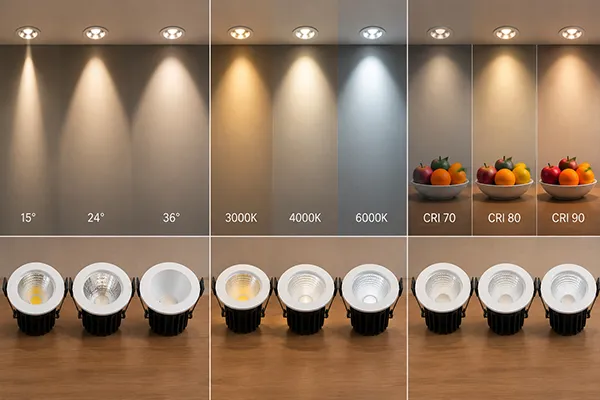
What optical components control
The optical system primarily influences the distribution and visual presentation of light. This includes beam spread, beam shape, central intensity, beam-edge transition, source shielding, and the appearance of the aperture.
For example, a 36-degree optic may be considered for accent lighting, but the buyer should still define whether the desired effect is a crisp spot, a smooth highlight, or a quieter beam with less visible contrast. A diffuser may help create a more uniform appearance in some designs, but it may also influence transmission and perceived brightness.9 The correct choice depends on the product design and application.
What CCT controls
CCT, usually expressed in kelvin, describes the apparent warmth or coolness of white light.10 Typical commercial requests include:
- 2700 K: Often selected for residential or hospitality-style warmth.
- 3000 K: Common for warm commercial, retail, and hotel environments.
- 4000 K: Frequently used for neutral white task and general lighting.
- 5000 K–6500 K: Often considered for cooler, more functional environments, subject to market preference and project design.
CCT does not determine whether a beam is narrow, wide, soft, or glare-controlled. A 3000 K downlight and a 4000 K downlight can use the same optical structure, although output and visible appearance should be verified for the selected configuration.
What CRI controls
CRI is commonly used as one indicator of how a light source renders colors relative to a reference illuminant.11 Higher CRI is often requested for retail, hospitality, residential, and display applications where color appearance matters. However, CRI does not describe beam distribution or glare performance.
A CRI 90 downlight can still have an unsuitable beam for a particular shelf, corridor, hotel room, or office. Likewise, a well-controlled optic does not automatically provide the color-rendering characteristics required for merchandise or finishes.
A clearer specification format
I encourage customers to separate the requirements in their RFQ or product brief:
- Optical requirement: Beam option, desired beam appearance, glare sensitivity, aperture style, reflector or diffuser preference.
- Color requirement: CCT, color tolerance expectation where relevant, and market preference.
- Color-rendering requirement: CRI target and any application-specific color-rendering expectations.
- Mechanical requirement: Cut-out, trim, IP rating if relevant, housing color, depth, and installation method.
- Electrical requirement: Wattage, input range, dimming requirement, driver brand or specification, and safety documentation needs.
This format helps us reduce misunderstandings during OEM/ODM development. It also helps buyers compare supplier quotations on a like-for-like basis.
What Should an LED Downlight Optical Component Supplier Checklist Include?
A supplier may offer several beam angles, reflector colors, diffuser options, and LED packages. That range can be helpful, but it can also create confusion if the supplier does not clearly connect each option to the intended application. Buyers need a repeatable way to assess whether the proposed configuration is suitable.
A strong LED downlight optical component supplier checklist should confirm the application, installation height, target area, beam effect, glare sensitivity, LED-and-optic matching, housing configuration, and sample approval process. Buyers should request evidence relevant to the exact proposed configuration rather than relying on general catalog claims.
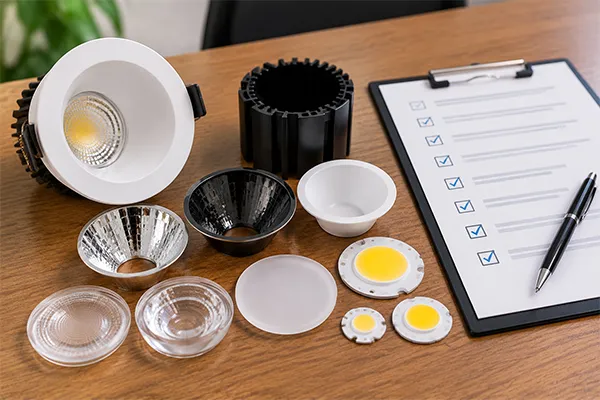
Questions to ask before selecting an optic
Before I recommend a beam option or build an OEM sample, I try to collect a practical project brief. Even a short set of answers can prevent a costly wrong selection.
| Buyer question | Why the answer matters |
|---|---|
| What is the installation height? | It affects beam spread and target illumination |
| What should the downlight illuminate? | A corridor, artwork, shelf, desk, wall, and floor need different effects |
| Is the target horizontal or vertical? | Beam direction and optic selection may change |
| What beam effect is preferred? | Buyers may want a narrow accent, general wash, or soft ambient distribution |
| Is glare a key concern? | It affects aperture depth, shielding, trim, and viewing-angle priorities |
| What is the interior style? | White, black, gold, silver, and other finishes affect visible appearance |
| Is dimming required? | Driver compatibility and low-level dimming behavior require confirmation |
| Will products be grouped together? | Color and appearance consistency become more important |
| Is a small trial order needed? | It helps buyers validate the configuration before volume purchasing |
Documentation and evidence to request
I recommend that buyers request information specific to the proposed model and option combination. Not all documents are automatically transferable between wattages, LED versions, optics, drivers, or market variants.
A practical request list can include:
- Product specification sheet for the exact model
- Beam-angle options and corresponding configuration details
- Photometric or distribution information, where available and relevant
- Sample photographs or videos from a defined setup
- Information on LED source, reflector, lens, diffuser, and trim options
- Dimensional drawing and cut-out requirements
- Driver specification and dimming compatibility details
- Aging-test process description
- Certification documents relevant to the target market
- Packaging, labeling, and OEM branding requirements
At Upward Lighting, we perform a 100% aging test before shipment, typically lasting 4 to 8 hours according to the product arrangement. Buyers should still clarify what the process covers, which configuration is being supplied, and what incoming inspection standards they will use. Aging is one quality-control step; it does not replace application-specific optical evaluation.
Our products may be supplied with documents such as CE and RoHS for applicable configurations and markets. However, I always recommend that buyers verify current documentation, scope, model coverage, and destination-market requirements with qualified compliance professionals before importation or project submission.
Use samples as a decision tool, not just a formality
A sample should answer a defined question. I have found that random sample approval often leads to later disagreement because the customer and supplier looked for different things.
For example, a buyer can create a sample approval record with:
- Exact model number and revision
- Wattage and input requirement
- CCT and CRI target
- Beam option and optic description
- Reflector, trim, and housing finish
- Driver and dimming requirement
- Installation height used for evaluation
- Target surface and viewing observations
- Approved visual appearance standard
- Required packaging and logo details
This record is especially useful for lighting brands that need repeatable products across several purchase orders. It also supports clearer communication when small-batch customization is needed before larger production volumes.
Frequently Asked Questions
Are beam angles enough to compare LED downlights?
No. Beam angle is useful, but it does not fully explain beam uniformity, center intensity, beam-edge softness, aperture brightness, glare perception, or stray light. I recommend comparing finished samples and requesting relevant optical information for the exact product configuration.
Does a higher CRI improve glare control in a downlight?12
No. CRI relates to aspects of color rendering, while glare control is mainly influenced by optical design, source position, reflector or lens design, aperture depth, housing geometry, and installation conditions. Buyers should specify CRI and visual-comfort requirements separately.
Is a lens better than a reflector for LED downlights?
Neither is universally better. A lens and a reflector can support different beam-control and appearance goals. The right choice depends on the LED source, housing design, desired beam distribution, target area, glare sensitivity, and aesthetic requirements.
What information should I provide for an OEM LED downlight sample?
I suggest providing the installation height, target area, desired beam effect, wattage, CCT, CRI, dimming requirement, cut-out size, trim color, housing finish, target market, and expected order volume. These details help the supplier recommend a more suitable configuration.
How can importers verify LED downlight optical performance?
Importers can request samples, product-specific distribution information, and a clear configuration record. They should evaluate samples under representative installation conditions where possible. For critical applications, they should use qualified lighting professionals for calculations, compliance review, and final project decisions.
Conclusion
LED downlight optical components should never be evaluated as isolated parts or reduced to a beam-angle label. I recommend that buyers assess the complete relationship between the LED source, lens or reflector, diffuser, housing, thermal structure, and installation scenario. Clear specifications for optics, CCT, CRI, finish, and appearance make supplier comparison more reliable. If you are developing an OEM or ODM downlight range, we can help you organize the required optical questions, prepare suitable samples, and confirm a practical production specification before ordering.
"2019 Solid-State Lighting R&D Opportunities", https://www.energy.gov/sites/prod/files/2020/01/f70/ssl-rd-opportunities2-jan2020.pdf. LED luminaire performance is determined by the combined optical, mechanical, electrical, and thermal design rather than by an optical component considered independently. Evidence role: mechanism; source type: research. Supports: That LED luminaire output and distribution arise from interactions among the LED source, optical elements, mechanical geometry, and thermal design.. Scope note: This supports the general engineering principle; the performance of a particular downlight still requires product-specific photometric testing. ↩
"Impact of Thermal Dissipation on the Lighting Performance ...", https://pmc.ncbi.nlm.nih.gov/articles/PMC8776062/. Studies of LED luminaires show that optical geometry controls angular light distribution, while junction-temperature changes can affect LED luminous output and spectral characteristics. Evidence role: mechanism; source type: paper. Supports: That optical geometry and LED temperature-dependent behavior can alter luminous intensity distribution, flux, and emitted-light characteristics.. Scope note: The relative contribution of each element varies with the specific LED package, optic, driver, and luminaire construction. ↩
"The Effect of Nighttime Lighting Systems on Workers' Visibility ...", https://swzdi.intrans.iastate.edu/research/completed/the-effect-of-nighttime-lighting-systems-on-workers-visibility-and-safety/. Lighting research treats source shielding angle and luminaire geometry as factors that influence direct source visibility and discomfort-glare evaluation. Evidence role: mechanism; source type: research. Supports: That luminaire shielding geometry and source position influence source visibility and direct-glare assessment at specified viewing angles.. Scope note: A deeper aperture alone does not establish a glare rating, because observer position, background luminance, intensity distribution, and installation geometry also matter. ↩
"Understanding LM-79 Reports", https://betterbuildingssolutioncenter.energy.gov/sites/default/files/attachments/understanding_lm79_reports.pdf. Beam angle is a defined angular measure based on a specified luminous-intensity criterion; it is not a complete description of a luminaire's intensity distribution, spatial uniformity, or visual-comfort performance. Evidence role: definition; source type: institution. Supports: That beam angle is conventionally derived from an intensity threshold and does not by itself provide the complete luminous-intensity distribution or glare evaluation.. Scope note: The exact beam-angle convention and reporting method should be confirmed in the applicable photometric standard or product documentation. ↩
"Understanding LM-79 Reports", https://betterbuildingssolutioncenter.energy.gov/sites/default/files/attachments/understanding_lm79_reports.pdf. Standard luminaire photometry provides angular luminous-intensity and flux data that permit application analysis beyond the single spread value reported as beam angle. Evidence role: general_support; source type: institution. Supports: That standardized luminaire photometry reports include measurements beyond nominal beam angle, including angular luminous-intensity data and total luminous flux.. Scope note: A photometric report must correspond to the exact tested configuration and does not alone predict every visual outcome in a completed interior. ↩
"Solid-state lighting metrology", https://www.nist.gov/programs-projects/solid-state-lighting-metrology. LED luminaire photometric and colorimetric values are obtained under defined measurement procedures and environmental conditions and therefore apply to the tested configuration. Evidence role: general_support; source type: government. Supports: That LED photometric and colorimetric measurements are made under specified procedures and conditions, and reported values apply to the tested product.. Scope note: The extent to which a changed driver, optic, CCT, or trim changes a result must be established by testing that altered configuration. ↩
"Understanding LED Color-Tunable Products", https://www.energy.gov/cmei/ssl/understanding-led-color-tunable-products. The luminous efficacy and flux of phosphor-converted white LEDs can vary with spectral design and correlated color temperature, so CCT variants need not have identical output. Evidence role: mechanism; source type: research. Supports: That LED spectral design and phosphor conversion associated with different white-light CCTs can produce different luminous efficacy and flux values.. Scope note: Actual differences are manufacturer- and product-specific and should be verified using data for the exact LED and luminaire configuration. ↩
"Color rendering index", https://en.wikipedia.org/wiki/Color_rendering_index. Light distribution, correlated colour temperature, and colour-rendering measures characterize different attributes of emitted light and should not be treated as interchangeable specifications. Evidence role: definition; source type: institution. Supports: That light distribution, correlated colour temperature, and colour rendering are separate measured or specified attributes of lighting products.. Scope note: CRI is one color-rendering metric and may not capture all application-specific judgments of color appearance. ↩
"1 DIFFUSERS IN COHERENTLY ILLUMINATED, WIDE FIELD ...", https://repository.arizona.edu/bitstream/handle/10150/620709/azu_etd_14743_sip1_m.pdf?sequence=1. Diffusing materials scatter incident light, which can improve apparent luminance uniformity while reducing direct transmission and redistributing luminous intensity. Evidence role: mechanism; source type: paper. Supports: That diffusing optical materials redistribute light through scattering and can trade optical transmission for improved spatial luminance uniformity.. Scope note: The magnitude and direction of the effect depend on the diffuser material, thickness, surface treatment, source spacing, and luminaire geometry. ↩
"Color temperature", https://en.wikipedia.org/wiki/Color_temperature. Correlated color temperature, expressed in kelvin, describes the chromatic appearance of white light along a warm-to-cool continuum. Evidence role: definition; source type: government. Supports: That correlated color temperature is expressed in kelvin and is used to describe the chromatic appearance of white light.. Scope note: CCT does not by itself specify color rendering, tint deviation, luminous output, or optical beam distribution. ↩
"Color rendering index", https://en.wikipedia.org/wiki/Color_rendering_index. The general color-rendering index is a comparative measure of how a test light source renders specified color samples relative to a reference illuminant of similar correlated color temperature. Evidence role: definition; source type: institution. Supports: That the general color-rendering index compares a source's rendering of test color samples with that under an appropriate reference illuminant.. Scope note: CRI is not a measure of glare, beam control, or every aspect of preferred color appearance. ↩
"Color rendering index", https://en.wikipedia.org/wiki/Color_rendering_index. Color-rendering metrics describe color fidelity or rendition, whereas discomfort-glare assessment is based on the luminance, size, position, and surrounding visual context of light sources. Evidence role: definition; source type: institution. Supports: That color rendering and glare are distinct lighting concepts, with glare assessment based principally on luminance distribution, source geometry, viewing direction, and background conditions.. Scope note: Spectral characteristics can affect visual impressions in some settings, but a higher CRI rating is not itself a glare-control measure. ↩