Adjustable LED downlight vs fixed LED downlight is a common decision point for contractors, but the wrong choice can create uneven illumination, missed focal points, and costly rework after ceiling installation. We help customers avoid this problem by starting with the lighting task, not simply wattage, lumen output, or unit price.
An adjustable LED downlight is best when light must be directed toward a changing or specific target, such as merchandise, artwork, walls, or display zones. A fixed LED downlight is usually the more practical choice for stable general lighting, repeated ceiling layouts, and consistent beam distribution. The right option depends on where the light needs to land, whether that target may change, and how the ceiling layout supports the intended lighting effect.
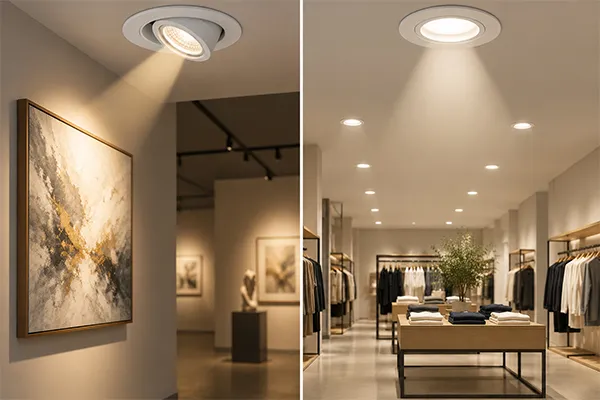
When we discuss adjustable LED downlight vs fixed LED downlight with contractors, we often find that the product question is actually a project-planning question. The fixture type matters, but beam angle, target distance, ceiling cutout, color temperature, and installation layout matter just as much.
Adjustable LED Downlight vs Fixed LED Downlight: What Is the Structural Difference?
A ceiling plan can look correct on paper while the installed lighting performs poorly in practice. This often happens when buyers assume that an adjustable fitting is always more flexible or that a fixed fitting is always more basic. We see this assumption create confusion during sample confirmation.
The main difference in adjustable LED downlight vs fixed LED downlight construction is the direction of the light engine. Adjustable models use a tilting or gimbal-style mechanism that allows the beam to move toward a target. Fixed models keep the light source and beam direction stable, typically pointing straight downward for repeatable general illumination.1
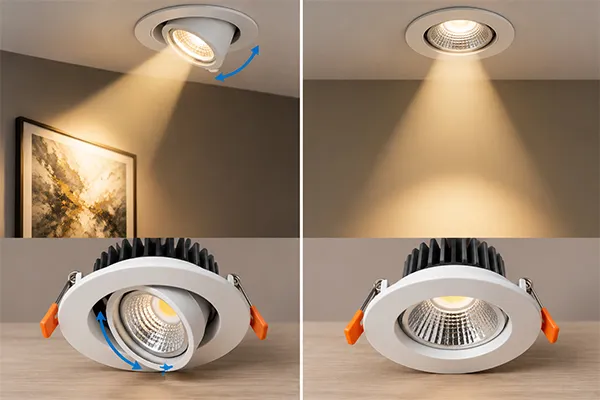
How adjustable downlights direct light
An adjustable LED downlight normally includes a movable inner module, gimbal ring, or tilting reflector structure. The installer or end user can direct the light away from the vertical axis within the fixture’s specified adjustment range.
This structure can be useful when a ceiling point does not sit directly above the target. For example, we may suggest reviewing an adjustable option when a retail shelf, wall picture, reception logo, or architectural texture needs light from an offset ceiling position.
However, we encourage buyers to examine more than the presence of a tilting mechanism. They should also confirm:
- The maximum tilt angle
- The direction and rotation range of the adjustable module
- The beam angle available with the chosen optical design
- Whether the fixture will remain accessible after installation
- Whether the tilted beam may create unwanted brightness on adjacent surfaces
- Whether the ceiling depth supports the fixture body and adjustment mechanism
Aiming flexibility does not automatically create a better result. If the target position is uncertain or the beam is too wide, the light can still spread beyond the intended area. If the beam is too narrow, the target may receive a visible hotspot rather than balanced illumination.2
How fixed downlights maintain consistency
A fixed LED downlight has a stable, downward-facing optical system. Its reflector, lens, or diffuser remains in one position after installation. This simple principle is often valuable in corridors, offices, residential living spaces, hotel rooms, and other areas where the goal is broad, repeated ambient lighting.3
We do not view fixed models as lower-grade alternatives. In many projects, a fixed design is the more disciplined choice because it reduces variables after installation. It can help contractors maintain a consistent visual rhythm across a ceiling grid.
| Comparison point | Adjustable LED downlight | Fixed LED downlight |
|---|---|---|
| Beam direction | Can be tilted or aimed | Remains downward-facing |
| Typical lighting role | Accent, wall wash, display, focal area | General lighting, repeated layouts |
| Installation consideration | Requires aiming confirmation | Requires layout and spacing confirmation |
| Post-installation flexibility | Higher when accessible | Limited by design |
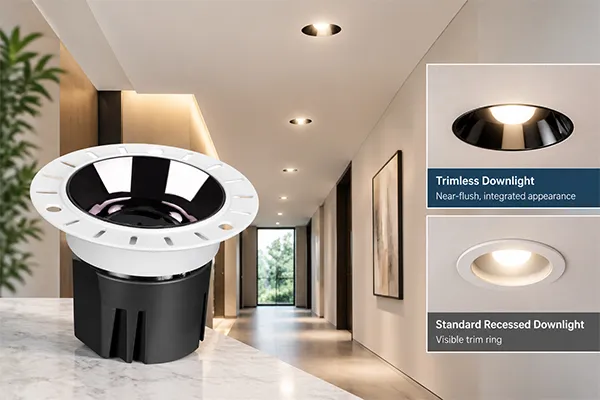
| Ceiling appearance | May show a visible tilted inner module | Usually provides a uniform repeated appearance |
| Selection risk | Incorrect aim or beam selection | Incorrect spacing or beam distribution selection |
In our experience as a Zhongshan LED lighting manufacturer, customers sometimes focus on the outer trim style first. The trim matters, especially when finish color must match the interior. Still, the light direction and optical purpose should be confirmed before appearance details are finalized.
Adjustable LED Downlight vs Fixed LED Downlight: Which Lighting Task Needs Each Type?
A fixture can meet its basic electrical specification and still be wrong for the room. The problem usually begins when every ceiling location receives the same downlight type without considering what each location is expected to illuminate. This can lead to dark vertical surfaces, poorly lit displays, or overly concentrated accent areas.
For adjustable LED downlight vs fixed LED downlight selection, adjustable units suit locations where light must be aimed at a specific object, wall, or flexible zone. Fixed units suit locations where the project needs repeatable, stable downward illumination. We recommend assigning each fixture type according to the lighting task rather than selecting one type for every ceiling position.
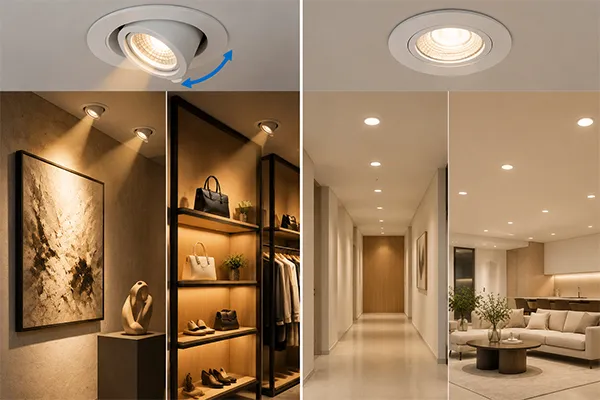
Use adjustable downlights for purposeful accent positions
Adjustable fittings are usually worth considering when the project includes a target that needs directional attention. Common examples include:
- Retail merchandise displays
- Wall-mounted signs and brand logos
- Artwork and decorative wall features
- Shelving or display cabinets
- Reception counters
- Feature walls with stone, timber, or textured finishes
- Residential paintings, niches, and selected kitchen surfaces
- Showroom products that may move over time
For these applications, we suggest that contractors identify the target before requesting a quotation. A simple ceiling plan with marked target areas is often more useful than a general request for “bright downlights.”
We also recommend asking practical questions:
- Where is the target located relative to the ceiling point?
- Will the target stay in the same position after handover?
- What is the mounting height?
- Does the project need a narrow, medium, or wider beam appearance?
- Will the fixture be adjusted once during installation, or regularly after installation?
- Could the aimed beam create unwanted brightness for occupants?
A customer once asked us for adjustable downlights throughout a small boutique because the project team wanted “more flexibility.” After reviewing the intended ceiling layout, we found that only the wall displays and center feature table needed directional lighting. The remaining ceiling positions were intended for general circulation lighting. A mixed approach was more logical than using adjustable units everywhere.
Use fixed downlights for stable ambient lighting
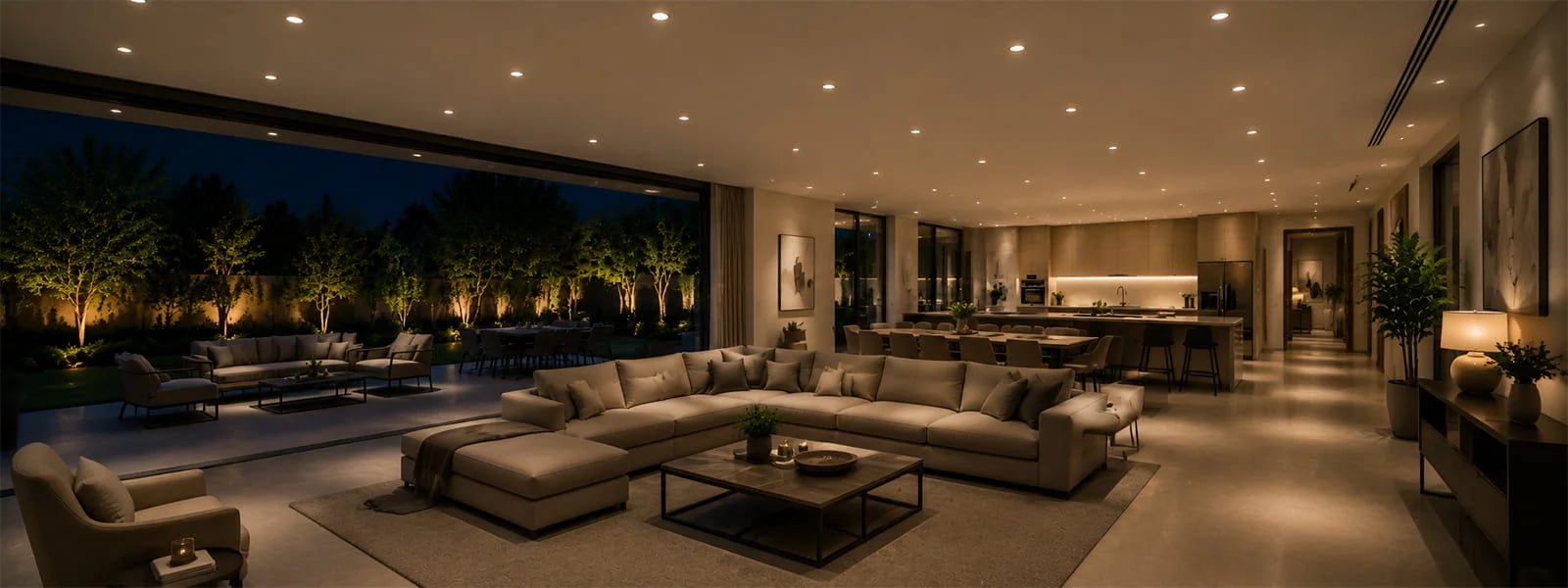
Fixed downlights usually fit projects that need a clean, regular lighting pattern. We often see them used in repeated layouts where the ceiling points are planned around furniture zones, walkways, work areas, or room geometry.
Typical uses include:
- Office circulation areas
- Residential bedrooms and living rooms
- Hallways and corridors
- Hotel guestrooms
- Apartment common areas
- Waiting areas
- General retail aisles
- Pantry, utility, and service spaces
- Repeated downlight grids in commercial ceilings
The value of a fixed downlight is not only its simpler physical direction. It also supports a clearer installation process. The contractor can concentrate on fixture spacing, beam selection, ceiling cutout consistency, driver placement, and electrical coordination rather than aiming every fitting individually.
Do not select only by wattage or lumens
We regularly receive inquiries that ask whether a 10 W, 12 W, or 15 W model should be adjustable or fixed. Wattage and lumen output are relevant specifications, but they cannot answer the fixture-type question by themselves.
The same wattage can create very different visual results depending on:4
- Beam angle
- Ceiling height
- Reflectance of walls, floor, and ceiling
- Surface colors and finishes
- Fixture spacing
- Mounting position
- Distance from the target
- Optical design
- Whether the light is aimed vertically or at an angle
We encourage project teams to use photometric files, layout review, and qualified lighting-design support when the application requires verified illuminance, glare evaluation, or compliance with a specific standard.5 We do not treat a catalogue wattage as a substitute for project-specific calculation.
Adjustable LED Downlight vs Fixed LED Downlight: What Should Contractors Confirm Before Ordering?
Ordering samples without confirming installation details can delay a project later. A fixture may look correct in a showroom but fail to match the site cutout, ceiling depth, target direction, or finish requirement. We see these issues most often when specifications are confirmed too late.
Before ordering adjustable LED downlight vs fixed LED downlight products, contractors should document the lighting purpose, ceiling position, target area, cutout size, beam angle, wattage, CCT, CRI, finish, and required compliance documents. A clear specification sheet reduces the risk of incorrect samples, installation changes, and inconsistent batches.
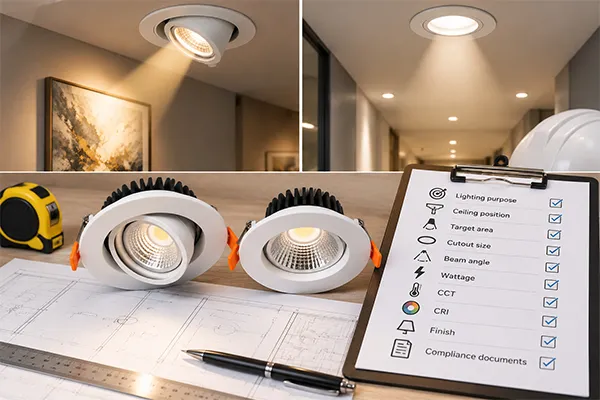
Start with the ceiling and target map
Before we prepare a quotation, we prefer to understand the basic installation context. A reflected ceiling plan is helpful, but even a marked drawing, room photo, or simple sketch can clarify the project.
For each downlight location, the contractor should identify whether it serves:
- General ambient lighting
- Accent lighting
- Wall-focused lighting
- Display lighting
- Task-area support
- A mixed lighting purpose
This step can reveal that the project needs both adjustable and fixed models. The two types do not need to compete. They can work together in the same interior when each serves a different role.
Confirm the specifications that affect compatibility
At Upward Lighting, we support OEM and ODM configuration for project requirements. However, customization should follow a clear project need rather than become an unnecessary source of variation.
We commonly discuss the following parameters with buyers:
| Specification | Why it matters | Questions to confirm |
|---|---|---|
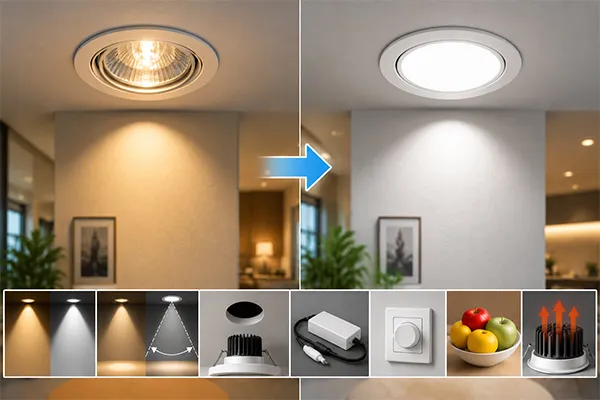
| Wattage | Affects power selection and output range | What lighting task and ceiling height apply? |
| Beam angle | Changes the spread and concentration of light | Is the goal ambient coverage or target emphasis? |
| CCT | Affects the visual atmosphere and material appearance | Does the project require 3000 K, 4000 K, 5000 K, or another option? |
| CRI | Affects color rendering quality | Are merchandise, finishes, food, or artwork involved? |
| Cutout size | Determines ceiling compatibility | What is the exact existing or planned cutout? |
| Trim finish | Supports interior coordination | Is white, black, gold, or another finish required? |
| Dimming or control | Affects driver and system compatibility | Which dimming protocol or control system is specified? |
| IP rating | Affects environmental suitability | Is the area dry, humid, or exposed to water? |
We also recommend confirming whether the requested model is integrated or uses a replaceable lamp format, depending on the product design and maintenance policy of the project.
Review samples as part of a controlled approval process
A sample is not only a visual reference. It should be used to verify practical compatibility before the full order is released.6
We suggest that buyers check:
- Ceiling cutout and trim coverage
- Fixture depth above the ceiling
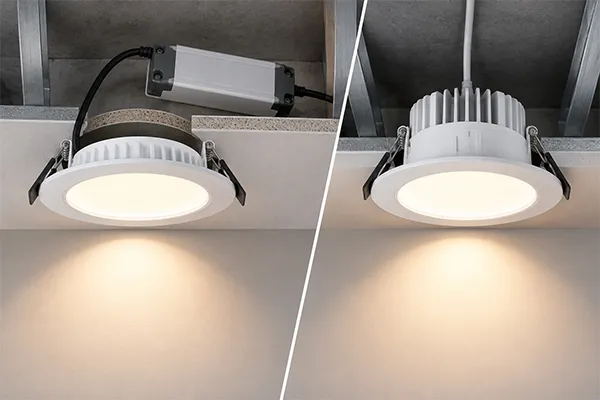
- Driver dimensions and access requirements
- Cable and connector arrangement
- Tilt range for adjustable units
- Beam appearance on the intended surface
- CCT consistency against approved interior materials
- Finish quality under site lighting conditions
- Packaging requirements for installation teams
- Label information and applicable market requirements
At our factory, we state that each product undergoes a 100% aging test of approximately 4 to 8 hours before shipment, based on the specified production process. Buyers should still define their own incoming inspection and sample approval requirements. Aging tests are one quality-control measure, not a replacement for application-specific verification on site.
Verify documents and supplier capability
For projects entering regulated markets, buyers should request and verify the relevant documentation for the exact product configuration. CE and RoHS documentation may be relevant for certain markets and product categories7, but the contractor or importer should confirm that the documents match the applicable destination-market requirements, model, driver, and order specification.
We believe a supplier evaluation should include more than certificates. Purchasing teams can also assess:
- Quotation response speed and clarity
- Ability to confirm technical details in writing
- Consistency between samples and production orders
- Customization capacity for wattage, CCT, CRI, beam angle, and finish
- Minimum order quantity and small-batch support
- Production lead time and communication process
- Packaging standards and export experience
- Quality-control records and inspection process
A dependable supplier should be willing to ask questions before confirming the order. In our view, a supplier who immediately recommends the highest-output or most expensive model without understanding the application is not helping the buyer manage risk.
Frequently Asked Questions
Is an adjustable LED downlight better than a fixed LED downlight?
An adjustable LED downlight is not automatically better. It is better suited to directional tasks, such as highlighting displays, artwork, or wall features. A fixed LED downlight is often the stronger choice for consistent ambient lighting and repeated ceiling layouts. We recommend choosing based on the target and lighting role.
Can I use adjustable and fixed downlights in the same room?
Yes. We often see both types used in one project. Fixed downlights can provide general ambient illumination, while adjustable models can highlight selected walls, merchandise, counters, or decorative features. The ceiling layout should clearly define the purpose of each fixture position.
What beam angle should I choose for LED downlights?
The right beam angle depends on the mounting height, target size, fixture spacing, and desired visual effect. Narrower beams can emphasize smaller targets, while wider beams can support broader coverage.8 We recommend reviewing samples, photometric information, and project-specific lighting calculations where required.
Which specifications should I send to a downlight supplier?
We recommend sending the ceiling plan, cutout size, wattage, CCT, CRI, beam angle, trim color, dimming requirement, quantity, target market, and delivery schedule. For adjustable models, you should also identify the target area and desired direction of light.
Are CE and RoHS certificates enough for every project?
CE and RoHS documentation may be relevant for some markets, but requirements vary by product type and destination. Buyers should verify that documents apply to the exact product configuration and confirm all applicable local regulations with qualified compliance professionals, importers, or project consultants.
Conclusion
The adjustable LED downlight vs fixed LED downlight decision should begin with the lighting task, not a simple comparison of wattage, lumens, or purchase price. We recommend adjustable models where the beam must reach a specific or changing target, while fixed models remain highly effective for consistent general lighting and organized ceiling layouts. Before ordering, contractors should confirm the target area, mounting position, beam angle, cutout, CCT, CRI, finish, and documentation needs. If you are planning a downlight project, we can help you review specifications and prepare an OEM/ODM quotation that matches your application requirements.
"Application Summary Report 14: - LED Downlight Retrofit Units", https://www1.eere.energy.gov/buildings/publications/pdfs/ssl/caliper_14_summary.pdf. Lighting guidance distinguishes fixed recessed downlights, which retain a set beam direction, from adjustable luminaires intended for directional aiming; fixed units are commonly applied to general downward illumination. Evidence role: definition; source type: institution. Supports: That fixed recessed downlights have a non-adjustable optical direction and are commonly used for general downward lighting.. ↩
"What Is Beam Angle? Guide to Light Distribution for Buyers", https://www.commercial-lighting.net/what-is-beam-angle-guide-to-light-distrubtion/. Illumination-engineering guidance explains that a narrow beam concentrates light on a smaller area, increasing local illuminance and potentially producing a conspicuous bright spot when the distribution is unsuitable for the target. Evidence role: mechanism; source type: education. Supports: That narrower light distributions concentrate luminous flux over a smaller area and can produce high local illuminance.. Scope note: Whether a hotspot is objectionable depends on the luminaire distribution, aiming, mounting distance, surface reflectance, and design intent. ↩
"Purchasing Energy-Efficient Light Fixtures (Luminaires)", https://www.energy.gov/cmei/femp/purchasing-energy-efficient-light-fixtures-luminaires. Professional lighting guidance characterizes ambient or general lighting as broad illumination for safe circulation and routine visual activity, a role commonly served by regularly spaced downward-facing luminaires. Evidence role: general_support; source type: institution. Supports: That general or ambient lighting is designed to provide broad, uniform illumination for circulation and occupied spaces.. Scope note: Appropriate luminaire type and spacing remain dependent on room geometry, reflectances, target illuminance, and glare criteria. ↩
"Understanding LM-79 Reports", https://betterbuildingssolutioncenter.energy.gov/sites/default/files/attachments/understanding_lm79_reports.pdf. Energy and lighting-design guidance indicates that wattage measures electrical input rather than the amount and distribution of useful light on a task plane; beam distribution, mounting geometry, spacing, and surface reflectance affect the resulting illumination. Evidence role: mechanism; source type: government. Supports: That electrical power alone does not determine delivered illuminance or visual performance, which also depend on luminaire distribution and installation conditions.. Scope note: Equal-wattage products may also differ in efficacy, luminous flux, color quality, and optical design. ↩
"Glare and Diffuse Sources", https://www.energy.gov/sites/prod/files/2021/02/f82/ssl-rd21-schwade-glare.pdf. Lighting-engineering practice relies on luminaire photometric data and calculation methods to predict illuminance and evaluate glare-related performance against project criteria or applicable standards. Evidence role: expert_consensus; source type: institution. Supports: That photometric data and calculation methods are used to assess illuminance and glare in lighting design.. Scope note: A photometric calculation supports design verification but does not by itself establish compliance with every jurisdiction-specific installation or product requirement. ↩
"LIGHTING DESIGN GUIDANCE", https://www.southandvale.gov.uk/app/uploads/2024/09/South-Vale-Lighting-Design-Guidance.pdf. Lighting-design guidance recognizes mock-ups and sample installations as methods for evaluating luminaire appearance, aiming, glare, and installation coordination under conditions closer to the intended project environment. Evidence role: general_support; source type: institution. Supports: That lighting mock-ups or sample installations are used to evaluate appearance, aiming, glare, and practical installation details before broader implementation.. Scope note: A limited sample installation may not capture all production, maintenance, control-system, or whole-space performance conditions. ↩
"CE marking", https://en.wikipedia.org/wiki/CE_marking. European Commission guidance states that CE marking is required only for products covered by applicable EU harmonisation legislation, while the RoHS framework restricts specified hazardous substances in electrical and electronic equipment within its scope. Evidence role: general_support; source type: government. Supports: That CE marking may be required under applicable EU harmonisation legislation and that RoHS restricts certain hazardous substances in covered electrical and electronic equipment.. Scope note: Applicability depends on the exact product, intended market, applicable directives or regulations, and the economic operator's legal role. ↩
"CALiPER Application Summary Report 20: LED PAR38 Lamps", https://www1.eere.energy.gov/buildings/publications/pdfs/ssl/caliper_20_summary.pdf. Optics and lighting references explain that beam angle defines the angular spread of emitted light: narrower distributions concentrate light over smaller areas, whereas wider distributions cover larger areas at the same mounting distance. Evidence role: mechanism; source type: education. Supports: That beam angle governs the angular spread of a luminaire and influences the area illuminated at a given distance.. Scope note: Actual coverage also depends on mounting height, luminaire intensity distribution, overlap with adjacent fixtures, and the chosen illuminance level. ↩