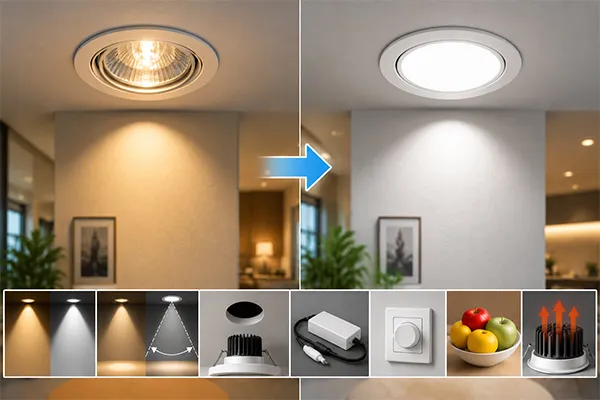
Trimless LED downlight design advantages can be appealing, but many buyers underestimate how early the decision must be made. A standard recessed light can often be selected late in the ceiling process, while a trimless model may require coordination before plastering, painting, and final ceiling finishing. We believe the right planning turns a design idea into a practical lighting solution.
Trimless LED downlight design advantages mainly come from their near-flush, integrated appearance. The fixture’s visible trim is minimized or concealed, helping the ceiling look cleaner and more continuous.1 However, trimless downlights require early confirmation of the ceiling type, installation structure, cut-out, finishing sequence, and lighting requirements. They are not automatically better than standard recessed downlights in output, heat control, lifespan, or overall quality.2
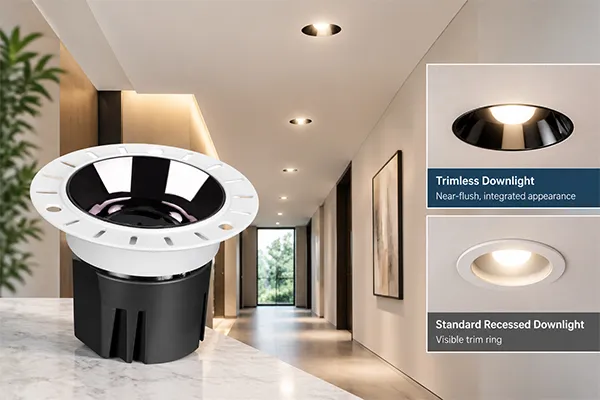
For contractors, lighting brands, importers, and project buyers, the key question is not simply whether trimless lighting looks premium. The more useful question is whether the project team can coordinate the product, ceiling system, and installation timing early enough to achieve the intended result.
What Are the Main Trimless LED Downlight Design Advantages?
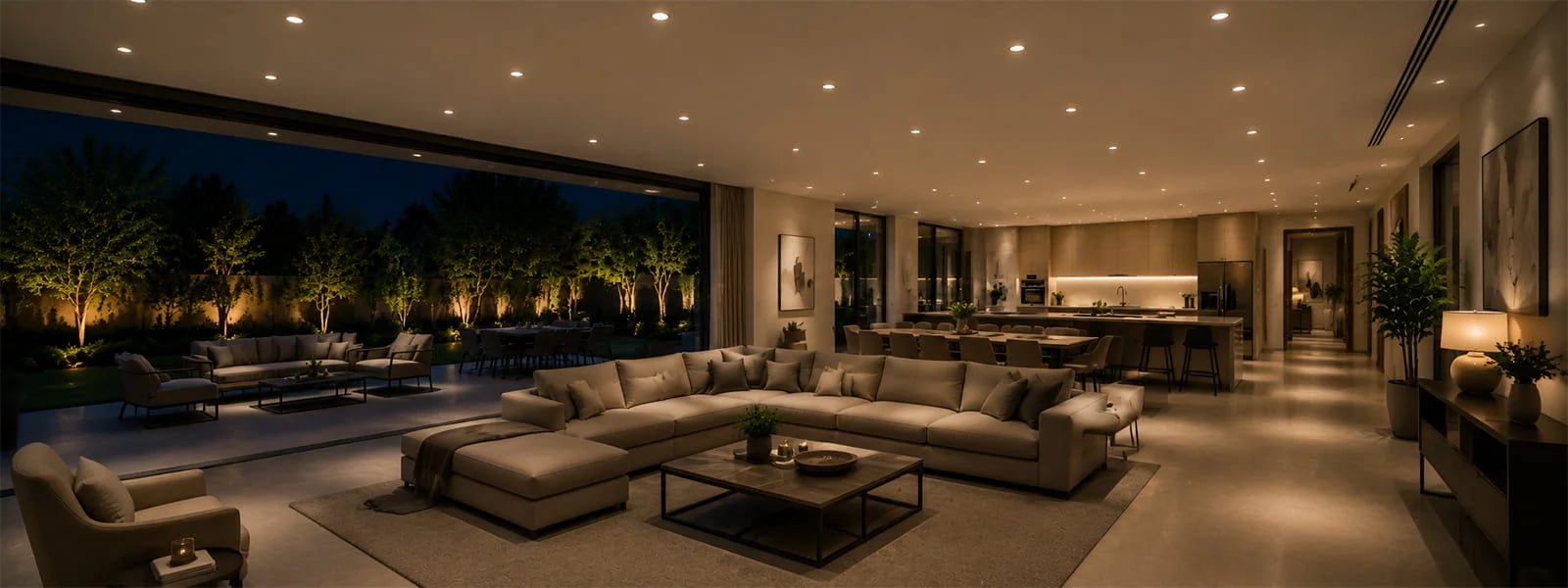
A visible ceiling trim can interrupt a minimalist interior, especially in hotels, galleries, offices, and modern residences. When a project uses many recessed fixtures, those rings can become a noticeable part of the visual field. A trimless solution can reduce that interruption, but only when the ceiling finish and fixture are compatible.
The main trimless LED downlight design advantages are a cleaner ceiling appearance, a more integrated architectural effect, and greater freedom to support minimalist lighting concepts. A trimless fixture is designed to sit close to the finished ceiling surface, with its plaster-in or trimless frame concealed during the finishing process.3
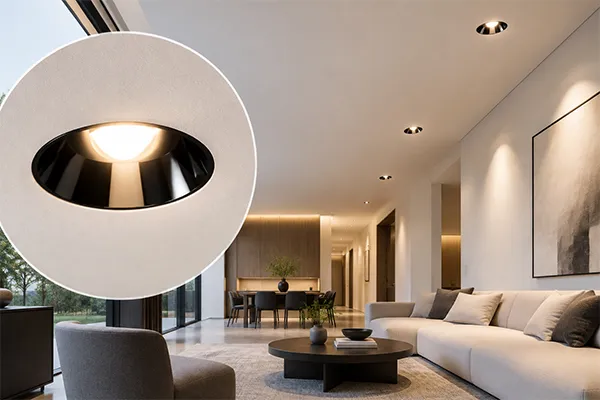
A cleaner visual transition
The most important benefit is visual. Standard recessed downlights usually have a visible bezel, trim ring, or flange around the opening. This is not necessarily a disadvantage. In many commercial projects, it is practical and appropriate.
However, a trimless LED downlight can create a more subtle transition between the luminaire and ceiling. The ceiling becomes the dominant surface, while the fixture appears less separate from the architecture.
In our customer discussions, this effect is often requested for:
- High-end residential interiors
- Hospitality corridors and guest rooms
- Retail display areas
- Showrooms
- Offices with contemporary interior concepts
- Lighting brand collections positioned toward architectural applications
Better alignment with minimalist project positioning
A trimless format can support a product line or project that emphasizes clean geometry and reduced visual clutter. This is especially relevant when a lighting brand wants a coordinated family of recessed products, such as fixed downlights, adjustable downlights, wall washers, and linear lighting with matching finishes.
Still, we recommend that buyers separate appearance value from technical performance value. A trimless construction does not inherently provide:
- Higher lumen output
- Better glare control
- Higher CRI
- Better driver reliability
- Longer lifespan
- Stronger heat dissipation
Those outcomes depend on the individual product design. Buyers should review the optical structure, LED source, heat sink material, driver specification, IP rating, test process, and production consistency for each model.
A focused lighting concept
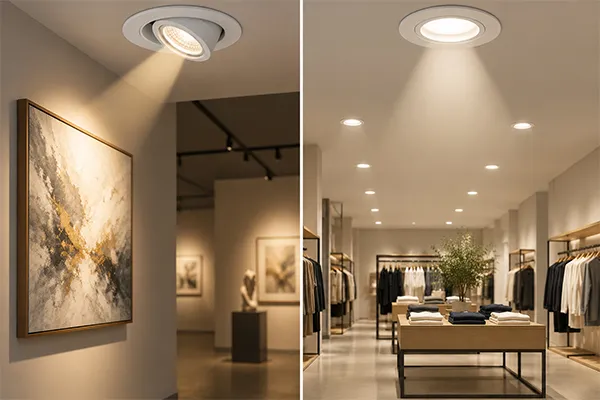
Trimless downlights can also make directional or accent lighting feel more intentional because the visible fixture body is reduced. This can be useful when the design goal is to highlight merchandise, artwork, wall textures, or circulation paths rather than the luminaires themselves.
We usually advise customers to evaluate the trimless appearance together with beam angle, glare control, and spacing. A clean ceiling does not solve an unsuitable lighting layout.
For procurement teams, the advantage is real, but it is specific: trimless products can help achieve a cleaner integrated ceiling design. They should not be marketed or specified as a universal upgrade over every standard recessed downlight.
Why Do Trimless LED Downlight Design Advantages Require Early Coordination?
A late lighting change can create avoidable questions for any project. If the ceiling cut-out, board thickness, plastering process, or mounting space has already been confirmed for a standard downlight, switching to trimless may introduce compatibility concerns. The visual benefit depends on installation details that must be checked before the ceiling is completed.
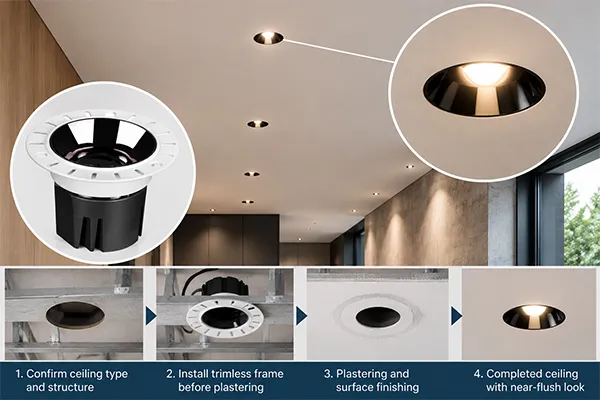
Trimless LED downlight design advantages require early coordination because the fixture frame, ceiling opening, plastering or finishing method, and installation sequence must work together. Before confirming a model, we typically verify the ceiling type, project stage, required cut-out, mounting structure, and expected finished appearance.
Trimless lighting is a system decision
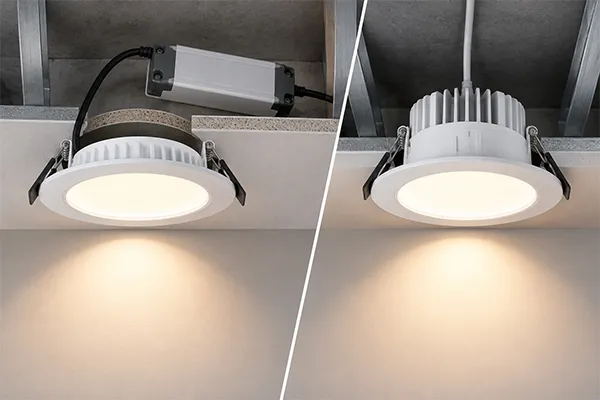
A trimless downlight is not only a product selection. It is part of a ceiling-and-lighting system.4 Depending on the model, the fixture may include a plaster-in frame, a recessed installation ring, spring clips, brackets, or another mounting structure. The ceiling contractor may need to install the frame before final plastering, joint treatment, sanding, or painting.5
The exact method varies by product and ceiling construction. We do not recommend assuming that one trimless model uses the same cut-out or finishing process as another.
Before quoting or specifying a trimless LED downlight, we typically ask:
-
What ceiling material will the project use?
Common examples include gypsum board, plasterboard, concrete, wood, or other decorative ceiling systems. -
What is the ceiling thickness?
The mounting structure and available recessed depth may depend on this dimension. -
What stage is the project at?
If the ceiling is already finished, trimless installation may be more limited or may require a different approach. -
What cut-out and installation space are available?
Buyers should confirm the model-specific cut-out, fixture height, driver space, and clearance requirements. -
Who will complete the finishing work?
The lighting installer and ceiling-finishing team may need to coordinate responsibilities. -
What lighting effect is required?
The project may need fixed general lighting, adjustable accent lighting, narrow beams, wide beams, warm dimming, or high-CRI light.
Installation timing matters
For a standard recessed downlight, installers can often make a ceiling opening and fit the fixture after more of the ceiling work is complete. A trimless product may require a different sequence. The frame may need to be positioned and secured before the final surface is finished.
This difference affects purchasing and project management. Buyers may need to order samples earlier, approve a model sooner, and provide installation information to contractors before site work reaches the ceiling-finishing stage.
| Evaluation point | Standard recessed downlight | Trimless LED downlight |
|---|---|---|
| Visible bezel | Usually visible | Minimized or concealed |
| Ceiling coordination | Often simpler | Usually requires earlier confirmation |
| Installation timing | May allow more flexibility | Often linked to finishing sequence |
| Cut-out requirements | Model-specific | Also model-specific and often more critical |
| Design intent | Practical or decorative | Integrated architectural appearance |
| Late project changes | May be easier | Can create finishing and compatibility risks |
Early coordination does not guarantee that every installation will be trouble-free. It can, however, reduce uncertainty by ensuring that the fixture selection is based on the actual ceiling conditions and project sequence.
How Should Buyers Evaluate Trimless LED Downlight Quality Beyond Appearance?
A smooth ceiling line can attract attention, but procurement decisions should go further. Buyers who focus only on the trimless frame may overlook the components that influence lighting performance, consistency, maintenance expectations, and market suitability. A well-presented housing alone does not define a well-specified luminaire.
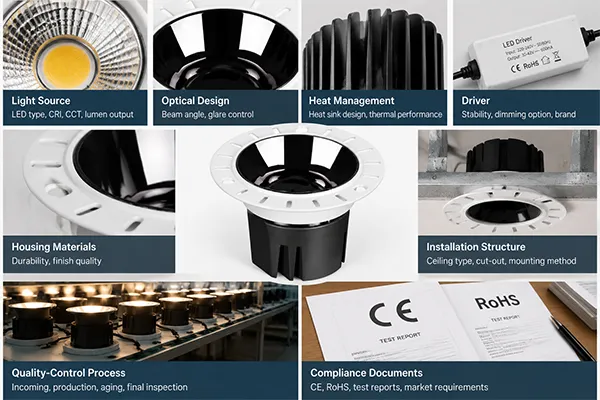
Buyers should evaluate trimless LED downlight quality by reviewing the complete product system: light source, optical design, heat management, driver, housing materials, installation structure, quality-control process, and applicable compliance documents. The trimless design should be one selection factor, not the only factor.
Review optical performance for the intended application
The desired lighting effect should guide product selection. A wide beam may suit general ambient lighting, while a narrow beam may work better for artwork, shelves, or display walls.6 An adjustable trimless downlight may suit accent applications, but buyers should still evaluate aiming range, glare visibility, and mechanical stability.
Useful optical questions include:
- What is the stated wattage and lumen output?
- What beam angles are available?
- Is the fixture fixed, adjustable, wall-washing, or anti-glare?
- What is the color temperature range?
- What CRI level is required for the project?
- Does the diffuser, reflector, or lens support the intended visual comfort?
For example, a retail brand may prioritize CRI 90 or above for merchandise presentation7, while a cost-sensitive corridor project may have different requirements. The correct choice depends on the application, not on whether the fixture is trimless.
Examine thermal and electrical design separately
We regularly remind customers that trimless does not automatically mean better thermal performance. Heat management depends on factors such as housing material, heat sink geometry, LED board design, ambient temperature, driver arrangement, and installation environment.8
A buyer can request product information covering:
| Product area | What buyers can ask suppliers to clarify |
|---|---|
| LED source | Brand or source option, CCT, CRI, color consistency |
| Heat sink | Material, structure, fixture dimensions, thermal design approach |
| Driver | Input voltage, dimming options, driver placement, replacement approach |
| Housing | Aluminum grade or other material, surface treatment, finish options |
| Optics | Reflector type, lens, beam angle, UGR-related design information where available |
| Installation | Cut-out, ceiling thickness range, mounting method, recessed depth |
| Quality process | Aging test, visual inspection, electrical test, packing inspection |
At Upward Lighting, we conduct a 100% aging test of 4 to 8 hours before shipment for our products as part of our standard quality-control process. This process supports shipment consistency, but buyers should still evaluate whether a specific model fits their own project requirements and local installation conditions.
Verify documents rather than assuming compliance
For projects entering regulated markets, buyers should request and verify the applicable documentation for the exact product configuration. CE and RoHS documents may be relevant for certain markets and product categories9, but customers should confirm current document validity, scope, and market requirements with qualified professionals where needed.
We recommend keeping a procurement file that includes:
- Product specification sheet
- Approved sample record
- Cut-out and installation drawing
- Driver specification
- Packing details
- Applicable certification documents
- Order-specific color temperature and finish confirmation
- Warranty and after-sales terms
This documentation becomes especially valuable when a buyer manages repeat orders, private-label programs, or multi-country distribution.
When Is a Trimless LED Downlight the Right Choice for a Project?
Many projects can benefit from trimless lighting, but not every project needs it. A standard recessed downlight may be a more efficient option when installation speed, maintenance access, budget, or late-stage project flexibility is the priority.10 The correct choice depends on the project’s design intent and execution capacity.
A trimless LED downlight is often the right choice when a project prioritizes a seamless ceiling appearance and can confirm product details early.11 It may be less suitable when the ceiling is already complete, the installation sequence is uncertain, the budget is highly constrained, or a standard trim offers sufficient visual and practical value.
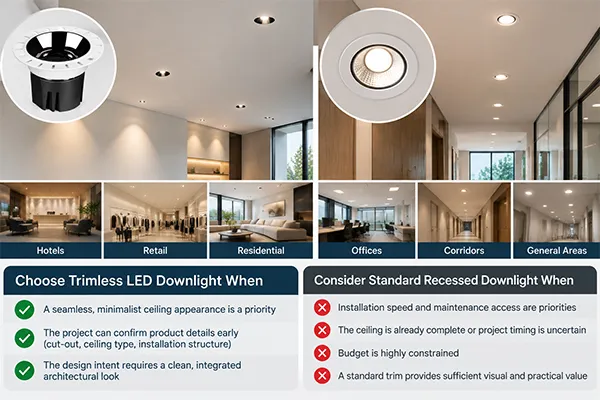
Projects that may benefit from trimless products
Trimless downlights may be worth evaluating for projects where the ceiling itself is a key design feature. These projects often use restrained materials, clean lines, concealed air-conditioning details, and carefully planned lighting positions.
Potential applications include:
- Boutique hotels and serviced apartments
- Premium residential developments
- Luxury retail and brand showrooms
- Galleries and reception spaces
- Modern offices and meeting rooms
- Lighting brand collections targeting architectural interiors
For importers and distributors, trimless products can also expand a catalog by offering a more design-led option beside conventional recessed downlights. The key is to provide clear product information rather than simply labeling the item as “premium.”
Situations that need more caution
We would encourage buyers to discuss alternatives if the project is already at a late construction stage or if the ceiling team cannot confirm the finishing process. A trimless product may not be the best fit when product substitution needs to happen quickly.
Caution is also sensible when:
- Ceiling thickness is unknown
- Recessed depth is limited
- The contractor has not reviewed the installation method
- The project needs immediate replacement fixtures
- Maintenance expectations require a particular access method
- The budget does not support additional coordination or finishing work
- The desired lighting effect has not been defined
Use samples and drawings before bulk purchasing
In our OEM/ODM selection discussions, a physical sample is often more useful than a catalog image. Buyers can inspect the trimless frame, finish quality, anti-glare structure, driver arrangement, and expected ceiling transition. The installation team can also review the model-specific drawing before large-scale ordering.
For private-label and project programs, we can support customization such as:
- Color temperature
- Wattage
- Beam angle
- CRI
- Surface finish color
- Packaging and branding requirements
However, customization should follow the same disciplined process. A customized trimless downlight still needs the ceiling conditions, installation structure, and final lighting objective to be confirmed before production.
Frequently Asked Questions
Are trimless LED downlights better than standard recessed downlights?
Trimless LED downlights are not automatically better. They offer a cleaner, more integrated ceiling appearance, but standard recessed downlights may be more practical for some budgets, ceiling types, installation schedules, and replacement needs. Buyers should compare the specific product design and project requirements.
Do all trimless downlights use the same cut-out size?
No. Cut-out dimensions, recessed depth, mounting methods, and plaster-in frames vary by model. Buyers should request the installation drawing and verify the exact product requirements before ceiling work begins. A general trimless downlight specification should never replace model-specific confirmation.
Can a trimless LED downlight be installed after the ceiling is finished?
Some situations may allow installation, but the answer depends on the fixture structure and ceiling condition.12 Many trimless systems need coordination before final plastering or painting. Buyers should consult the supplier’s installation information and a qualified installer for the specific application.
Does trimless design improve heat dissipation or lifespan?
Trimless design alone does not determine heat dissipation or lifespan. These factors depend on the heat sink, housing material, LED source, driver, operating environment, and manufacturing quality. Buyers should evaluate technical specifications and quality-control information for the individual model.
What should I ask a trimless LED downlight supplier before ordering?
Ask about ceiling compatibility, cut-out, fixture depth, mounting method, finishing sequence, wattage, lumen output, beam angle, CCT, CRI, driver options, dimming compatibility, sample availability, lead time, and applicable certification documents. These details help reduce avoidable procurement uncertainty.
Conclusion
The strongest trimless LED downlight design advantages come from a clean, near-flush ceiling transition that supports modern architectural interiors. Yet trimless lighting is a system decision, not an appearance-only decision. We recommend confirming the ceiling type, project stage, cut-out, mounting structure, finishing sequence, and lighting effect before selecting a model. If you are developing a trimless downlight range or sourcing for an upcoming project, contact Upward Lighting for product drawings, samples, OEM/ODM options, and a fast quotation.
"Appendix 1:", https://www.engr.psu.edu/ae/thesis/portfolios/2007/ARN118/appendix%201.pdf. Trimless recessed luminaires commonly use a plaster-in or mud-in frame that allows the visible flange to be concealed at the finished ceiling surface, producing a less interrupted ceiling plane. Evidence role: definition; source type: education. Supports: A technical lighting or architectural source should describe trimless recessed luminaires as systems designed to conceal the flange or trim at the finished ceiling plane.. Scope note: The visual result depends on the ceiling material, finishing quality, and the specific luminaire system. ↩
"LED Luminaire Reliability: Impact of Color Shift", https://www.energy.gov/sites/prod/files/2017/04/f34/lsrc_colorshift_apr2017.pdf. LED luminaire performance and useful life are principally affected by the thermal, electrical, optical, and environmental design of the product; a trimless mounting format alone does not establish superior output or longevity. Evidence role: mechanism; source type: government. Supports: An authoritative LED-lighting source should explain that lumen maintenance and service life are influenced by LED junction temperature, driver performance, optical and electrical design, and operating conditions rather than bezel style.. Scope note: This principle does not compare the measured performance of any two particular downlight models. ↩
"Cost of Recessed Lighting Install: What To Expect+", https://bigblue.atlantisuniversity.edu/how-much-would-it-cost-to-install-recessed-lighting/. Plaster-in recessed-light frames are typically fixed to the ceiling substrate before jointing, plastering, or final finishing so that the frame edge can be incorporated into the finished surface. Evidence role: mechanism; source type: institution. Supports: A ceiling-system or lighting-installation reference should document that plaster-in frames are installed before final finishing so their edges can be integrated into the ceiling surface.. Scope note: Required installation steps and compatible ceiling systems vary by manufacturer and product model. ↩
"END OF PROJECT NOTE", https://www.cps.edu/globalassets/cps-pages/services-and-supports/school-facilities/facilities-standards/cps-infrastructure-handbook/electrical-new/26-51-00-interior-lighting.pdf. Recessed luminaires must be compatible with the ceiling assembly and installed according to their specified mounting, clearance, and wiring requirements. Evidence role: general_support; source type: government. Supports: An installation-safety or building reference should show that recessed luminaires must be selected and installed with regard to the ceiling assembly, mounting method, clearances, and applicable instructions.. Scope note: Building and electrical requirements differ by jurisdiction and do not prescribe a single trimless installation method. ↩
"Things To Consider While Doing Drywall Finishing", https://ptt.edu/things-to-consider-while-doing-drywall-finishing/. Because plaster-in trim frames are intended to be finished into the ceiling plane, their installation generally precedes final joint treatment, sanding, and painting. Evidence role: mechanism; source type: education. Supports: A construction or lighting-installation source should explain that plaster-in trim frames are normally installed before compound, plaster, sanding, and paint are completed.. Scope note: The precise sequence depends on the frame design and the contractor's ceiling-finishing system. ↩
"Lighting Design for Interiors: Layers, Sources, and Strategies", https://www.idi.edu/blog/lighting-design-for-interiors. Lighting-design guidance generally uses wider beam distributions for broader-area illumination and narrower distributions to concentrate light on displays, artwork, or other visual focal points. Evidence role: general_support; source type: education. Supports: A lighting-design reference should distinguish broad distributions for general illumination from narrow distributions used to concentrate light on focal objects or surfaces.. Scope note: Appropriate beam angle also depends on mounting height, target size, spacing, reflectance, and illuminance objectives. ↩
"A two-metric proposal to specify the color-rendering properties of ...", https://ui.adsabs.harvard.edu/abs/2010SPIE.7784E..0VF/abstract. Higher color-rendering light can improve the fidelity with which illuminated objects and merchandise are visually assessed, making color quality an important consideration in retail lighting design. Evidence role: general_support; source type: research. Supports: Research or professional lighting guidance should support the relevance of high color-rendering light to color appearance and visual evaluation of merchandise.. Scope note: A CRI value of 90 is a design preference rather than a universal retail requirement, and CRI alone does not fully predict color preference or fidelity. ↩
"DOE Solid-State Lighting CALiPER Program 2009 Roundtable", https://www1.eere.energy.gov/buildings/publications/pdfs/ssl/2009_caliper_roundtableproceedings.pdf. The operating temperature of LEDs is governed by the complete thermal path from the LED package and circuit board through the heat sink and housing to the surrounding environment, with elevated temperature affecting performance and reliability. Evidence role: mechanism; source type: research. Supports: A technical study should explain that heat flow from LEDs depends on the package and board, heat sink and housing, ambient conditions, and the complete luminaire thermal path.. Scope note: The relative importance of individual thermal factors must be established through testing of the specific luminaire and installation condition. ↩
"RoHS Directive - Environment - European Commission", https://environment.ec.europa.eu/topics/waste-and-recycling/rohs-directive_en. Within their applicable scopes, European Union rules require relevant electrical and electronic products to meet the conditions for CE marking and restrict specified hazardous substances under the RoHS framework. Evidence role: historical_context; source type: government. Supports: Official European Commission material should explain the CE-marking framework and the RoHS restrictions applicable to electrical and electronic equipment within their respective scopes.. Scope note: Whether a particular luminaire, driver, or configuration falls within a requirement must be assessed against current legislation and the applicable market. ↩
"Fixture EPA: Optional Tenon: R 2 3⁄8"φ x 31⁄2"H GCO: R GFI", https://pages.uoregon.edu/moxoby/EMU/Documents/EMU_CD/50CD_RenovationandNewConstruction-LightFixtureCuts.pdf. Conventional recessed fixtures with separate visible trims can generally be installed or replaced without integrating a plaster-in frame into the finished ceiling surface, which may simplify some renovation and maintenance situations. Evidence role: general_support; source type: education. Supports: A construction or lighting-maintenance reference should show that conventional recessed fixtures with visible trims can avoid some of the finishing coordination associated with plaster-in systems.. Scope note: Ease of installation and maintenance remains model-specific and can be affected by driver location, ceiling access, wiring, and local code requirements. ↩
"Table of Contents", https://www.engr.psu.edu/ae/thesis/portfolios/2009/kvg5003/Glaewketgarn_Senior%20Thesis%20Final%20Report.pdf. Trimless recessed lighting is commonly selected where an integrated ceiling appearance is desired, but its concealed-frame detailing requires coordination with the ceiling construction and finishing sequence. Evidence role: general_support; source type: institution. Supports: An architectural-lighting reference should support the relationship between concealed trim appearance and the need to coordinate ceiling construction and finishing in advance.. Scope note: Project suitability also depends on cost, access, maintenance requirements, and the availability of qualified installers. ↩
"Recessed Lighting Installation Milton Ma - AdTech Windev", https://epm.cnc.stanford.edu/recessed-lighting-installation-milton-ma. Installing a recessed lighting system in an existing finished ceiling depends on available cavity access, the mounting arrangement, the ceiling material, and whether the installation requires subsequent surface repair or refinishing. Evidence role: general_support; source type: institution. Supports: An installation reference should support the proposition that retrofit feasibility depends on the mounting frame, ceiling construction, access, and extent of required refinishing.. Scope note: This does not establish that a particular trimless product can be retrofitted; the manufacturer's instructions and a qualified installer's assessment remain necessary. ↩