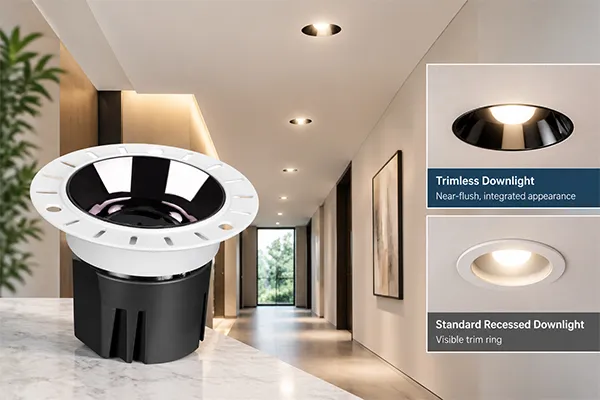
LED downlight vs traditional halogen lighting is a common comparison for retrofit projects, but the decision is often more complicated than it first appears. A low-wattage LED may reduce energy use, yet an incorrect replacement can create glare, uneven light, dimming faults, or installation rework. I recommend evaluating the full lighting system before selecting a replacement.
An LED downlight can be a practical replacement for traditional halogen lighting when its lumen output, beam angle, cutout, ceiling depth, driver arrangement, dimming compatibility, color quality, and thermal conditions suit the existing installation. Buyers should compare lighting performance and system compatibility—not wattage or appearance alone—to reduce retrofit risk and achieve the required visual result.
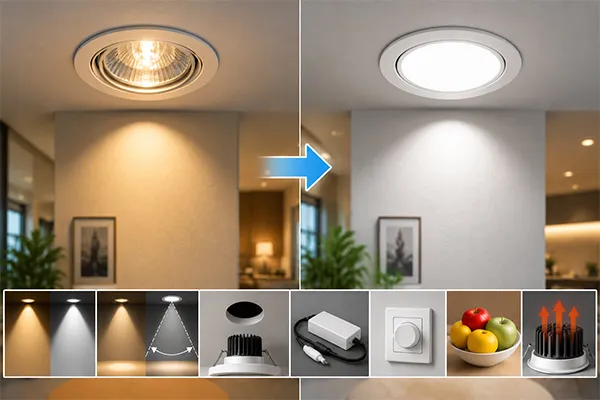
At Upward Lighting, we regularly receive questions from contractors, importers, and project teams replacing halogen fittings in homes, hospitality spaces, retail areas, and commercial buildings. The most successful projects start with measurements and lighting requirements. The difficult projects usually start with an assumption that every same-size LED downlight is a direct substitute.
How Does an LED Downlight Compare With Traditional Halogen Lighting?
A halogen fixture may still provide the familiar warm, focused light that many projects expect. However, its energy demand, operating temperature, and replacement frequency can create long-term concerns. An LED downlight can address some of these concerns, but only if the specification matches the task and installation conditions.
LED downlights generally use less electrical power than traditional halogen lamps for a comparable lighting task1, but the two technologies should be compared by delivered lumens, beam distribution, color rendering, dimming behavior, and system design. A lower-wattage LED does not automatically create the same brightness or visual effect as a halogen lamp.
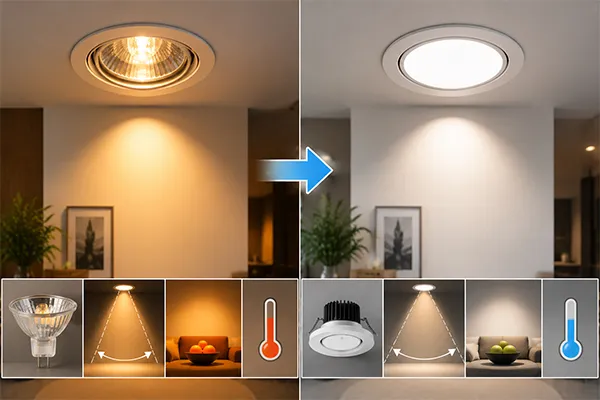
Wattage Is Not a Lighting Design Measurement
In many customer discussions, I see the same starting point: “We currently use a 50 W halogen lamp. Which LED wattage should we choose?” This question is understandable, but wattage only indicates electrical input2. It does not fully describe useful light on the working plane, beam spread, glare, or the mood in the room.
A traditional 50 W MR16 or GU10 halogen lamp often has a directional beam3. Its actual result depends heavily on beam angle, reflector design, transformer condition, and the fitting itself. An LED downlight may have an integrated optic, different beam control, and a larger luminous surface. These differences affect what people see in the space.
For procurement evaluation, I suggest that buyers begin with the lighting task:
- Is the fitting used for general ambient lighting, accent lighting, or task lighting?
- What is the ceiling height?
- What is the required illuminance level on the floor, counter, shelf, desk, or wall?
- What is the existing spacing between fittings?
- Does the design need a narrow spotlight effect or broad, even coverage?
- Is the current halogen result actually satisfactory, or is the retrofit an opportunity to improve it?
Practical Comparison Factors
| Evaluation factor | Traditional halogen lighting | LED downlight | Buyer consideration |
|---|---|---|---|
| Electrical power | Often higher for the same lighting task | Often lower, depending on specification | Compare lumens and light distribution, not watts alone |
| Heat at the light source | High operating temperature | Heat is still generated but managed through thermal design | Check ceiling void, insulation, and ventilation |
| Beam control | Often directional, especially MR16/GU10 lamps | Varies by optic, diffuser, and downlight design | Confirm beam angle and spacing plan |
| Maintenance | Lamp replacement may be more frequent | Driver and LED module reliability both matter | Evaluate accessible maintenance and warranty terms |
| Dimming | May be familiar with legacy dimmers | Compatibility depends on LED driver and dimmer | Test or verify dimmer compatibility |
| Color appearance | Often very warm and familiar | Available in multiple CCT and CRI options | Specify CCT, CRI, and binning requirements |
Evaluate Light Where It Is Needed
I recommend asking the supplier for a photometric report, such as an IES or LDT file where available, and then reviewing it with a qualified lighting professional for application-specific layouts. Buyers should verify report conditions, test methods, and whether the document applies to the exact proposed model, wattage, beam angle, and color temperature.
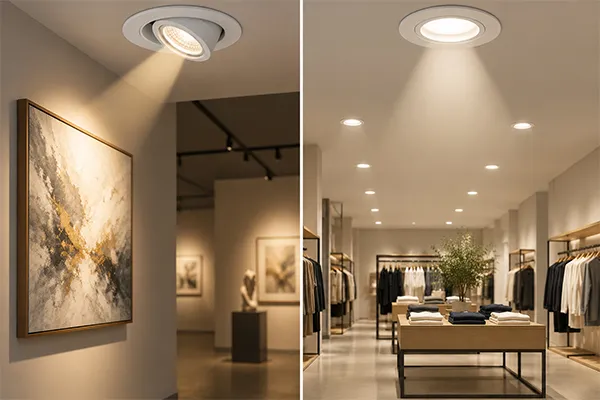
For example, a 36° halogen spotlight may illuminate a retail display from a 3 m ceiling very differently from a 90° LED downlight4. Even if their stated lumen outputs are similar, the LED may spread light across a much larger area. That may improve general brightness but reduce accent contrast.
A retrofit should reproduce or improve the lighting task, not merely replace the old fixture’s wattage label.
Is an LED Downlight a Direct Replacement for Halogen Fittings?
A matching cutout diameter can make a retrofit appear simple. Yet ceiling openings are only one part of the installation. The hidden space above the ceiling, the electrical circuit, the driver location, and the existing dimmer can all determine whether an LED downlight is a suitable replacement.
An LED downlight is not automatically a direct replacement for a halogen fitting5, even when the cutout size and visible trim are similar. Buyers should verify cutout range, ceiling thickness, recessed depth, wiring method, transformer or driver arrangement, dimmer type, heat dissipation clearance, and installation instructions before placing an order.
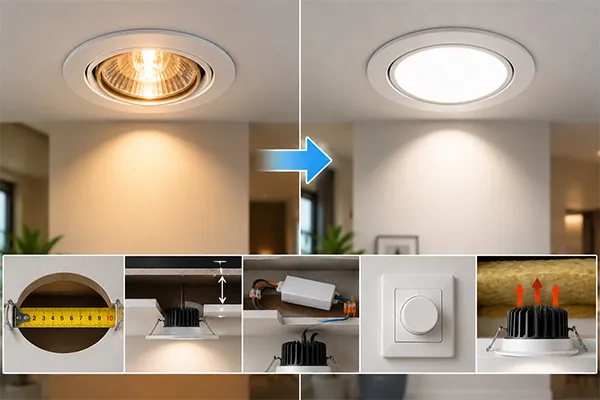
Check the Physical Installation First
At our factory, specification confirmation often begins with a simple request: “Please send a photo of the current fitting, the cutout measurement, and the ceiling depth.” These details can prevent an expensive mismatch.
A downlight may fit a nominal 75 mm, 90 mm, or 120 mm cutout, but the actual acceptable cutout range depends on the spring clips and trim design. Ceiling thickness also matters. A clip designed for plasterboard may not perform the same way in a thick wood panel, metal ceiling, or certain decorative ceiling materials.
Buyers should collect the following information before requesting a quotation:
- Existing cutout diameter in millimeters, measured at several points if the opening is irregular.
- Ceiling thickness and material.
- Available ceiling void depth, including obstructions such as ducts, pipes, joists, and insulation.
- External diameter required to cover the old cutout edge or marks on the ceiling.
- Installation type, such as recessed, surface-mounted, or adjustable gimbal.
- Access method for future servicing or driver replacement.
Electrical Compatibility Requires Separate Review
Traditional halogen installations may use mains-voltage GU10 lamps or low-voltage MR16 lamps with electronic or magnetic transformers. These systems should not be treated as identical.
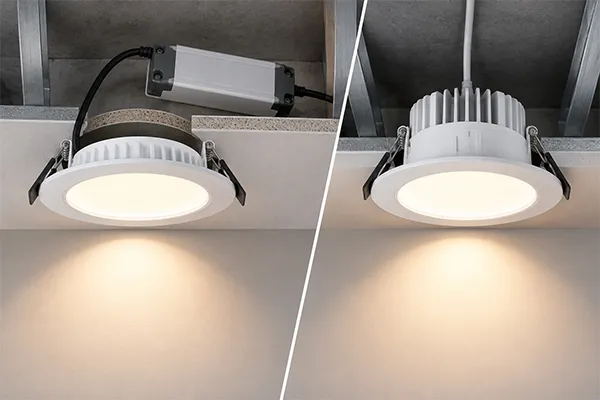
An integrated LED downlight commonly uses a dedicated driver. Depending on the model and local electrical requirements, the driver may be external, integrated, isolated, non-isolated, dimmable, or non-dimmable. A contractor should review the wiring diagram and installation instructions before installation. A qualified electrician should make application-specific decisions.
| Existing halogen arrangement | Potential LED retrofit consideration |
|---|---|
| GU10 mains-voltage lamp | A GU10 LED lamp may retain the fitting, but beam, heat, dimmer, and lamp quality still need review |
| MR16 low-voltage lamp with transformer | Transformer minimum load and output behavior may not suit an LED lamp6 |
| Recessed halogen fitting with separate transformer | An integrated LED downlight may require removal or bypassing of the existing transformer, subject to qualified electrical work |
| Dimmable halogen circuit | LED driver and dimmer compatibility must be verified, ideally through a documented compatibility list or site test |
I have seen buyers save time by ordering a small pre-production or sample batch first. A site trial can reveal issues that drawings do not show, including shallow ceiling voids, old dimmer behavior, trim coverage, or unexpected glare. Small-batch orders are particularly useful when a project contains several ceiling types or existing fittings from different installation periods.
What Should Buyers Check for LED Downlight Reliability and Maintenance?
Maintenance costs can motivate a halogen-to-LED project. However, it is not enough to focus on a claimed LED chip lifetime. The complete LED downlight system includes the light source, driver, heat sink, housing, wiring, connectors, and installation environment.
LED downlight reliability depends on the complete system7, especially driver quality, thermal design, operating hours, ceiling ventilation, input power conditions, and installation quality. Buyers should request product documentation, review the intended operating environment, and avoid treating a nominal LED lifetime claim as a guaranteed project lifespan.
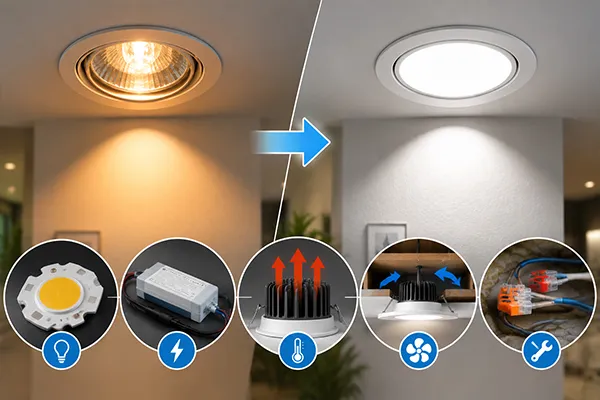
Why Thermal Design Matters
Every LED downlight generates heat. The difference is that LED performance and component life can be sensitive to junction temperature, driver temperature, and airflow around the fitting8. A recessed fixture installed in a restricted ceiling void may operate under different conditions from the same model installed in a ventilated mock-up.
In our production process, we conduct a 100% aging test for 4 to 8 hours before shipment. This process helps us identify certain early issues, such as obvious driver faults, unstable illumination, or assembly-related problems. However, I do not describe this factory check as independent laboratory validation or proof of long-term performance in every project environment. Site conditions remain important.
Ask Suppliers Better Reliability Questions
Instead of asking only, “What is the lifespan?” I recommend asking more specific questions:
- What is the LED driver brand, model, and input-voltage range?
- Is the driver replaceable, and can it be accessed after installation?
- What are the rated ambient temperature and installation limitations?
- Does the design require clearance from insulation or combustible materials?
- What is the heat-sink material and construction?
- Is the product intended for frequent switching or long daily operating periods?
- What ingress protection rating is required for the location?
- What warranty terms apply, and what is the supplier’s failure-handling process?
Procurement Documents Worth Reviewing
For market-entry and project compliance, buyers should request the documents relevant to the destination market and application. At Upward Lighting, our products can be supplied with documents such as CE and RoHS documentation for applicable product ranges. Buyers should independently verify that each certificate, declaration, test report, and marking applies to the exact product configuration and the applicable local regulations.
A practical review file may include:
- Product specification sheet
- Installation instructions
- Dimmer compatibility information, if applicable
- Photometric report for the exact configuration
- Electrical safety documents required for the destination market
- RoHS or other environmental compliance documents where relevant
- Warranty statement
- Production inspection and aging-test process information
- Approved sample confirmation record
This documentation process is less exciting than comparing wattages, but it reduces ambiguity between the purchaser, contractor, consultant, and supplier.
How Can an LED Downlight Match Halogen Light Quality?
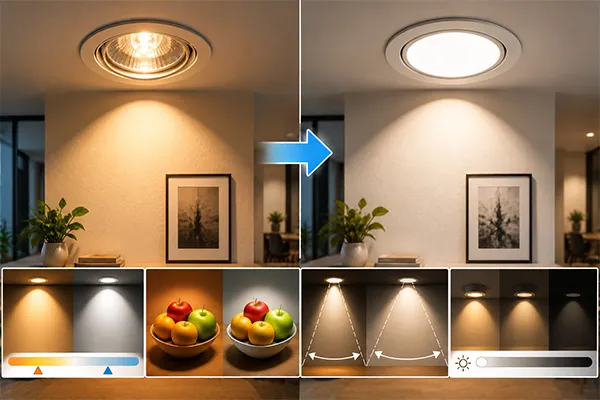
Many people associate halogen lighting with warm color, strong beam definition, and attractive color rendering. An LED downlight can be configured for many different visual requirements, but its output should be specified clearly. Buyers should not assume every LED option will match the familiar appearance or dimming response of halogen.
To match traditional halogen lighting with an LED downlight, buyers should specify color temperature, CRI, beam angle, glare control, lumen output, dimming range, and the intended room use. A sample installation is the most reliable way to judge visual equivalence because product data alone may not show every perceptual difference.
Specify Color Temperature and CRI
Halogen lamps typically produce a warm appearance, often perceived around 2700 K to 3000 K9, and their color quality is familiar in residential and hospitality applications. LED downlights are available in warm white, neutral white, and cool white options. Yet a “3000 K” label alone does not guarantee that two products will look identical10.
For a more controlled procurement process, I recommend confirming:
- Correlated color temperature (CCT): 2700 K, 3000 K, 4000 K, or another project requirement.
- Color rendering index (CRI): General CRI is useful, but high-color-fidelity applications may require more detailed color quality evaluation.
- Color consistency: Ask about binning practices and whether all fittings will be supplied from a controlled production batch.
- Trim finish: White, black, brushed metal, or custom finishes can influence the visual impression of the ceiling.
- Optical design: Reflector, lens, diffuser, deep anti-glare structure, and baffle design all affect comfort.
Our OEM/ODM discussions often include requests for customized CCT, wattage, beam angle, CRI, and surface finish. These options can help local brands and project buyers create a closer fit for the application. However, customization should be confirmed with approved samples and clear written specifications.
Beam Angle, Glare, and Spacing Work Together
A narrow beam can create contrast and focus. A wide beam can create smoother general illumination. Neither is universally better.
| Application | Common lighting priority | LED downlight selection questions |
|---|---|---|
| Hotel corridor | Comfortable wayfinding and uniformity | Is the beam wide enough to avoid dark gaps? Is glare controlled? |
| Retail display | Accent and color presentation | Does the beam create adequate contrast? Is CRI suitable for merchandise? |
| Residential kitchen | Task visibility and comfort | Does the layout provide sufficient light on worktops without harsh glare? |
| Office or meeting room | Visual comfort and consistency | Is the glare control appropriate for screen-based work? |
| Restaurant | Warm atmosphere and dimming control | Does the LED dim smoothly across the required range? |
Dimming Must Be Verified, Not Assumed
Dimming behavior is one of the areas where halogen and LED can differ noticeably. Halogen lamps often dim in a way that users recognize, including a warmer appearance at low levels11. Some LED downlights dim smoothly, while others may have limited dimming range, flicker, dropout, or incompatibility with a particular control system12.
I advise buyers to identify the dimmer make and model early. Then, ask the supplier whether the proposed LED driver has documented compatibility. If the project is important or large, a site test remains the safest approach. The contractor should also verify local wiring and control requirements with a qualified professional.
Frequently Asked Questions
Can I replace a 50 W halogen lamp with a 5 W LED downlight?
Not necessarily. A 5 W LED downlight may be suitable for some applications, but wattage alone does not confirm equivalent brightness or beam coverage. You should compare lumens, beam angle, mounting height, spacing, and the required lighting task before selecting a replacement.
Do LED downlights fit the same ceiling cutout as halogen fittings?
Some LED downlights can fit similar cutouts, but matching cutout size does not prove compatibility. You should also check ceiling depth, trim diameter, spring-clip range, ceiling thickness, wiring arrangement, driver space, and ventilation requirements.
Are LED downlights always better than halogen for dimming?
No. LED dimming performance depends on the driver, dimmer type, wiring conditions, and product design. Some LED downlights provide smooth dimming, while others may flicker or have a limited dimming range. Buyers should request compatibility information and test samples where possible.
How long will an LED downlight last in a retrofit project?
Actual service life depends on driver quality, thermal design, operating temperature, ventilation, daily operating hours, voltage conditions, and installation quality. A supplier’s nominal lifetime figure should be reviewed alongside warranty terms, product documentation, and the specific site environment.
What documents should I request from an LED downlight supplier?
You should request a specification sheet, installation instructions, photometric information, relevant safety and environmental compliance documents, warranty details, and dimming compatibility information where applicable. You should verify that every document applies to the exact proposed product and destination market.
Conclusion
The LED downlight vs traditional halogen lighting decision is a system-selection exercise, not a simple wattage swap. I recommend that contractors and project managers compare lumens, beam angle, cutout dimensions, ceiling depth, driver design, dimming compatibility, thermal conditions, CCT, CRI, and glare control before ordering. At Upward Lighting, we can support OEM/ODM LED downlight discussions with customized parameters, sample evaluation, quick quotations, and 4–8 hour pre-shipment aging tests. Contact our team to review your halogen retrofit requirements and develop a specification that reduces installation and lighting-performance risk.
"Saving American Families and Businesses Money through ...", https://www.energy.gov/cmei/articles/saving-american-families-and-businesses-money-through-lighting-efficiency. U.S. Department of Energy guidance describes LED lighting as using substantially less energy than halogen lighting for comparable lighting service. Evidence role: general_support; source type: government. Supports: Government energy-efficiency guidance should support that LED lamps typically use substantially less electricity than halogen lamps for comparable illumination.. Scope note: Actual savings depend on the selected lamp or luminaire, optical distribution, controls, and operating conditions. ↩
"Optical metrology for LEDs and solid state lighting", https://tsapps.nist.gov/publication/get_pdf.cfm?pub_id=840989. The International System of Units defines the watt as a unit of power, whereas lighting output is commonly expressed in lumens, the unit of luminous flux. Evidence role: definition; source type: government. Supports: An authoritative metrology source should distinguish watt, a unit of power, from lumen, a unit of luminous flux.. Scope note: Lumens alone do not characterize beam distribution, glare, or illuminance at a particular task plane. ↩
"Multifaceted reflector", https://en.wikipedia.org/wiki/Multifaceted_reflector. Lighting references describe MR16 and GU10 reflector lamps as directional sources whose beam angle and reflector geometry influence their distribution. Evidence role: general_support; source type: education. Supports: Lighting-education material should support that reflector-based MR16 and GU10 lamps are commonly used for directional or accent lighting and are specified by beam angle.. Scope note: The beam distribution of any individual lamp depends on its specific reflector and optical design. ↩
"2022 Solid-State Lighting R&D Opportunities", https://www.energy.gov/sites/default/files/2022-02/2022-ssl-rd-opportunities.pdf. Lighting-design guidance explains that a luminaire’s beam angle and mounting distance determine the spread of light and the resulting illuminance pattern on the illuminated surface. Evidence role: mechanism; source type: research. Supports: Lighting-design guidance should support that beam angle and mounting distance determine the area over which directional light is distributed and affect illuminance.. Scope note: A precise comparison requires the photometric file, aiming direction, and reflectance conditions for the actual luminaires. ↩
"Lighting Specification Guidance for Schools", https://www.energy.gov/sites/default/files/2024-12/lighting-spec-guidance-school_nov24.pdf. LED retrofit guidance notes that compatibility depends on the existing electrical equipment, controls, physical installation, and the replacement product’s instructions, not on visible fit alone. Evidence role: general_support; source type: research. Supports: Independent retrofit guidance should support that LED replacements require checks of electrical equipment, controls, physical installation, and product instructions.. Scope note: Applicable installation requirements vary by product design and local electrical code. ↩
"Performance of Halogen Incandescent MR16 Lamps and ...", https://www1.eere.energy.gov/buildings/publications/pdfs/ssl/mr16_benchmark_11-08.pdf. Technical guidance on low-voltage LED retrofits reports that electronic transformers designed for halogen loads may have minimum-load or output characteristics that cause incompatibility with LED lamps. Evidence role: mechanism; source type: research. Supports: Technical literature should support that some electronic transformers were designed for higher halogen loads and can operate improperly with low-load LED lamps.. Scope note: Compatibility must be determined for the specific transformer, LED lamp, and dimming configuration. ↩
"Impact of Thermal Dissipation on the Lighting Performance ...", https://pmc.ncbi.nlm.nih.gov/articles/PMC8776062/. LED reliability research identifies thermal conditions and the performance of supporting components, including drivers, as significant factors in luminaire light output and service life. Evidence role: mechanism; source type: research. Supports: LED reliability research should support that elevated temperatures and component-level design, including driver performance, influence luminaire performance and useful life.. Scope note: The relative importance of each factor varies with the product architecture, duty cycle, and installation environment. ↩
"Solar Energy Technology Multi-Year Technical Plan", https://www.nrel.gov/docs/fy04osti/33875.pdf. LED thermal-management research shows that elevated junction and driver temperatures can reduce luminous performance and accelerate component degradation, making heat dissipation conditions relevant to luminaire life. Evidence role: mechanism; source type: research. Supports: Research should support the relationship between elevated LED junction or driver temperatures and reduced performance or lifetime, and the role of thermal management.. Scope note: Measured effects depend on the LED package, driver components, current, ambient temperature, and fixture construction. ↩
"Understanding LED Color-Tunable Products", https://www.energy.gov/cmei/ssl/understanding-led-color-tunable-products. Lighting guidance characterizes tungsten-halogen lamps as warm-white sources, with common lamp color temperatures around 3000 K. Evidence role: general_support; source type: government. Supports: Authoritative lighting information should support that common tungsten-halogen lamps have warm color temperatures, commonly near 3000 K.. Scope note: Color temperature varies by lamp type, rated voltage, and operating conditions. ↩
"LED Color Characteristics", https://www.energy.gov/sites/prod/files/2016/08/f33/led-color-characteristics-factsheet.pdf. Color-science guidance explains that correlated color temperature alone does not fully specify a source’s chromaticity or spectral power distribution, so products labeled with the same CCT may differ in perceived color. Evidence role: mechanism; source type: research. Supports: Color-science sources should support that nominal CCT does not fully specify chromaticity or spectral distribution and that color variation can occur among LEDs with the same stated CCT.. Scope note: The visibility of a difference depends on chromaticity tolerance, surrounding materials, adaptation, and viewing conditions. ↩
"Color temperature", https://en.wikipedia.org/wiki/Color_temperature. Because tungsten-filament lamps emit thermal radiation, dimming lowers filament temperature and shifts their emitted light toward a warmer color appearance. Evidence role: mechanism; source type: education. Supports: A physics or lighting reference should support that reducing power to a tungsten filament lowers filament temperature and shifts emitted light toward a warmer appearance.. Scope note: The perceived change is affected by the dimming level, observer adaptation, and the surrounding illumination. ↩
"LED Dimming: What you need to know", https://www1.eere.energy.gov/buildings/publications/pdfs/ssl/dimming_webcast_12-10-2012.pdf. Research on LED controls reports that driver–dimmer interactions can affect dimming range and stability and may produce flicker, dropout, or other undesirable behavior when systems are incompatible. Evidence role: mechanism; source type: research. Supports: Independent LED-control research should support that dimming performance is determined by interactions among the LED driver, dimmer, wiring, and load and can produce undesirable effects when incompatible.. Scope note: Results are configuration-specific and should be verified using the exact driver, control, and installation conditions. ↩