LED downlight with external driver vs internal driver is a common comparison for contractors, importers, and lighting brands, but a quick choice can create installation delays or difficult maintenance later. A slim fitting may look ideal in a sample room, yet ceiling space, wiring access, dimming requirements, and future spare parts can change the real project outcome.
An LED downlight with an external driver is often suitable when the driver can remain accessible and a replacement strategy is practical, while an internal-driver downlight can simplify installation where ceiling-void space or wiring access is limited. Neither design is universally better. Buyers should compare the specific driver quality, thermal design, installation method, dimming compatibility, service access, and spare-part continuity before selecting a configuration.
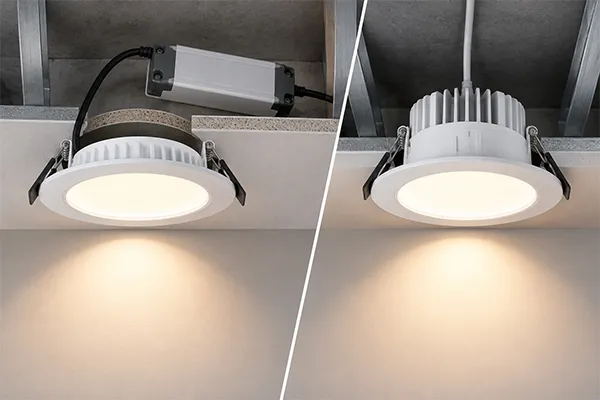
The physical position of the driver is only one part of the decision. In our pre-sales discussions, customers often ask which structure lasts longer. We usually start with different questions: How much ceiling space is available? Will the driver remain accessible? Is dimming required? Who will service the fitting after handover?
Is an LED Downlight with External Driver vs Internal Driver More Reliable?
Reliability concerns are understandable because a failed driver can make a complete lighting installation appear unreliable. However, buyers can create risk when they assume that a separate driver is automatically more durable, or that an integrated driver is automatically harder to trust. The actual answer depends on the product and the application.
An LED downlight with external driver vs internal driver cannot be ranked for reliability based on driver location alone. Product-specific reliability depends on driver component quality, thermal management, input-voltage conditions, operating hours, ambient temperature, installation method, surge protection, and compatibility with control systems. Buyers should request technical documents and evaluate samples in conditions that reflect the intended project.
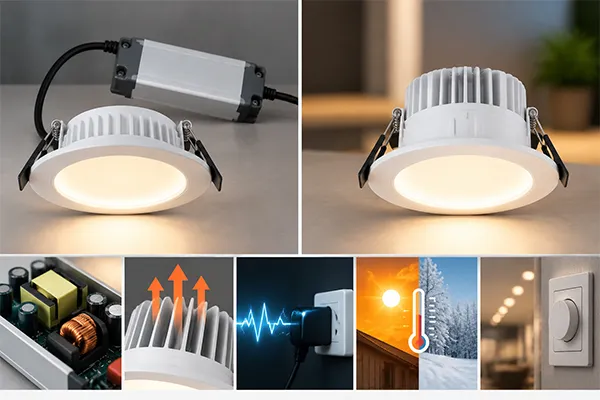
Driver location does not define driver quality
An LED driver converts incoming electrical power into a controlled output for the LED module.1 Its quality can vary significantly between suppliers and product ranges. The driver’s position—inside the luminaire body or in a separate enclosure—does not by itself prove the quality of its electronic components or circuit design.2
When we review project inquiries, we encourage buyers to look beyond descriptions such as “isolated driver,” “flicker-free,” or “replaceable driver.” These terms may be relevant, but they should be supported by product documentation and a clear definition of the proposed configuration.
A useful evaluation should include:
- Rated input voltage range: Confirm whether the driver suits the local electrical supply.
- Constant-current output: Verify that the output matches the LED module requirements.
- Power factor and total harmonic distortion3: Review these values when projects have technical electrical requirements.
- Dimming protocol: Confirm whether the driver supports Triac, 0–10V, DALI, PWM, or another system.4
- Surge protection information: Assess this carefully in regions with unstable grids or lightning exposure.
- Operating temperature information: Ask for the relevant ambient-temperature range and installation limitations.
- Safety and market-access documents: Buyers should verify CE, RoHS, and other applicable documentation for the target market.5
Thermal conditions need product-specific review
Heat can affect both LEDs and electronic drivers.6 However, it is too simple to claim that an external driver always runs cooler or that an internal driver always faces excessive heat. A well-designed integrated downlight may manage heat appropriately for its intended installation. A separate driver can also experience high temperatures if it is placed in an unventilated ceiling void, covered by insulation, or installed near other heat-producing equipment.7
We have seen product selections change after installers reviewed the ceiling cavity rather than the catalog page. A spacious office ceiling and a tightly packed residential ceiling can create very different conditions for the same downlight structure.
For procurement teams, the best approach is to request the supplier’s installation instructions and verify whether insulation contact, enclosed ceilings, high ambient temperatures, or restricted airflow affect the recommended use.
Reliability questions buyers should ask suppliers
| Evaluation question | Why it matters |
|---|---|
| What is the exact driver model used? | A generic description does not confirm component consistency. |
| Can the driver brand or component specification change without approval? | Uncontrolled substitution can affect performance and service continuity. |
| What are the installation restrictions? | Ceiling insulation, enclosed cavities, and ventilation can influence suitability. |
| Is the dimming driver tested with the proposed control system? | Dimming compatibility should be validated, not assumed. |
| What is the warranty process for driver-related claims? | A clear process reduces disruption after project handover. |
We recommend that buyers treat reliability as a system evaluation, not as a decision based only on “external” or “internal” driver placement.
How Does an LED Downlight with External Driver vs Internal Driver Affect Installation?
Installation problems can increase labor time, delay project handover, and create avoidable call-backs. A downlight may fit the ceiling cut-out but still be difficult to wire, position, or secure in the available ceiling void. This is why installation conditions should be reviewed before the purchase order is finalized.
For installation, an internal-driver LED downlight can offer a more consolidated fitting with fewer separate components to position, while an external-driver model requires room for both the luminaire and driver box.8 However, the easiest option depends on ceiling depth, access above the ceiling, cable routing, junction-box requirements, insulation conditions, and local installation practices.
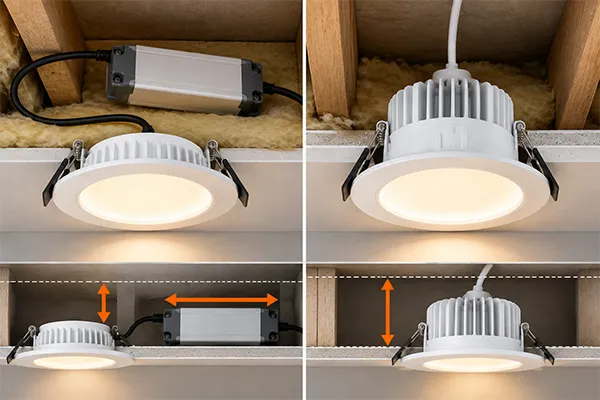
Internal-driver downlights: a compact installation format
An internal-driver downlight contains the LED module and driver within one luminaire assembly. This configuration can reduce the number of loose components that installers handle at the ceiling opening. For renovation work, hospitality projects, apartments, and spaces with limited ceiling voids, this can be useful.
However, buyers should not assume that every internal-driver model is thin or suitable for every shallow ceiling. The height of the fitting, spring-clip clearance, cable entry direction, and terminal arrangement all matter. A recessed downlight also needs adequate space around the body for proper installation according to the supplier’s instructions.
Internal-driver products may be appropriate when:
- The project needs a simpler, self-contained fitting.
- The ceiling void is restricted.
- Above-ceiling access is difficult after installation.
- The installation crew prefers fewer separate parts.
- The project uses standard non-dimmed switching or a confirmed compatible dimming system.
External-driver downlights: separate space and wiring considerations
An external-driver downlight places the power supply in a separate driver box connected to the light engine. This can support certain slim or low-profile luminaire designs. Yet the driver still needs somewhere to go.
Installers need enough space to place the driver without crushing cables, obstructing ceiling supports, or placing the unit where access becomes impossible. A crowded ceiling void may contain ducts, pipes, fire systems, cable trays, insulation, and structural members. In those conditions, a separate driver can become an installation challenge rather than a service advantage.
Installation comparison checklist
| Installation factor | Internal-driver downlight | External-driver downlight |
|---|---|---|
| Components handled at cut-out | Usually one main luminaire assembly | Luminaire plus separate driver enclosure |
| Ceiling-void planning | Requires space for the luminaire body | Requires space for both body and driver |
| Driver positioning | Fixed within fitting | Must be positioned safely in ceiling void |
| Access after installation | Often requires fitting removal | May be accessible if intentionally positioned near access |
| Wiring layout | Can be more consolidated | May require additional planning for driver placement |
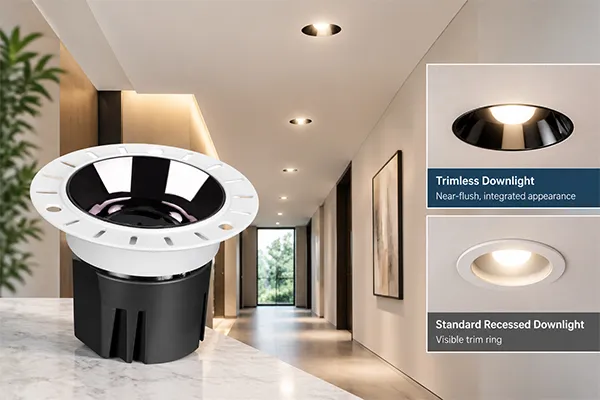
| Slim visible trim design | Depends on model | Often possible, but not automatically better |
In one type of inquiry we often receive, a contractor requests the thinnest possible recessed downlight for a finished ceiling. We would first ask for the available void depth and a ceiling section drawing. The thinnest face profile does not always mean the easiest installation. The driver box, wiring bend radius, and access route can determine whether the selected product works smoothly on site.
Is an External Driver Really Easier to Replace?
A replaceable driver can appear to offer a straightforward maintenance solution. Yet replacement is only practical when a technician can reach the driver, identify the correct specification, obtain a compatible spare, and reconnect it safely. Without these conditions, the theoretical benefit may not translate into lower maintenance effort.
An external driver is easier to replace only when the driver remains physically accessible and compatible spare parts are available.9 Buyers should confirm access space, output specifications, connector type, dimming method, driver dimensions, approved replacement options, and long-term SKU continuity. A separate driver does not guarantee easy service after the ceiling is closed.
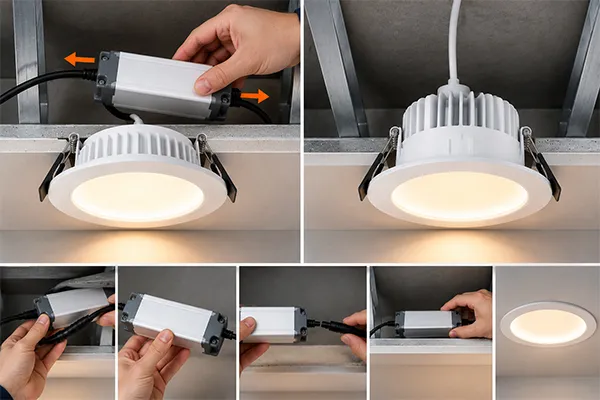
Accessibility is the first maintenance test
A driver located above a fixed gypsum ceiling may be separate from the downlight but still inaccessible. If a technician must remove the complete fitting, enlarge a ceiling opening, or enter the void from a distant access hatch, replacement can take more time than expected.
For projects where maintenance matters, we suggest that contractors map the service route before ordering. This does not need to be complicated. A simple ceiling layout can identify whether drivers will be reachable through the downlight cut-out, an access panel, or another approved route.
Compatibility is the second maintenance test
Not every LED driver can replace another driver.10 A compatible replacement should match the relevant electrical and control requirements. A physically similar driver may still be unsuitable.
Buyers should record:
- LED output current and voltage range
- Rated wattage
- Input-voltage requirement
- Dimming system and control compatibility
- Output connector and polarity
- Driver dimensions and mounting method
- Applicable safety and regulatory requirements
For example, a non-dimmable constant-current driver should not be replaced casually with a driver intended for a different LED load or dimming method. Qualified electrical professionals should evaluate replacement decisions for the specific installation.
Spare-part planning for importers and distributors
Importers, wholesalers, and distributors should consider service inventory as part of product selection. A product with an external driver may create a separate spare-driver SKU. This can be beneficial if the supplier maintains consistent specifications, but it can also create inventory complexity.
A practical spare strategy may include:
- Keeping a documented driver model list for each downlight series.
- Holding a reasonable service quantity based on installed volume and customer agreements.
- Confirming whether the supplier will maintain the driver specification for future orders.
- Requesting advance notice for component changes.
- Storing dimmable and non-dimmable drivers separately.
- Labeling cartons with output specifications and compatible downlight models.
At Upward Lighting, we support OEM and ODM discussions around wattage, color temperature, beam angle, CRI, and finish colors. For projects that require an external driver, we also encourage buyers to define the driver configuration clearly in the approved specification. Clear documentation helps reduce confusion when repeat orders or service requests arise.
Which LED Downlight with External Driver vs Internal Driver Fits Different Buyer Needs?
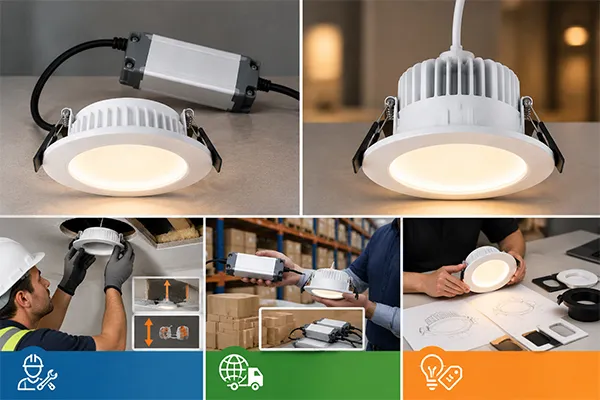
Different buyers carry different risks. A project contractor may focus on installation time and access for future service. An importer may focus on spare-driver availability and repeat-order consistency. A lighting brand may need an attractive form factor while protecting its after-sales reputation. A better decision starts with the buyer’s actual responsibility after delivery.
The best LED downlight with external driver vs internal driver choice depends on who installs, stocks, services, and warranties the product. Contractors should prioritize ceiling access and wiring practicality; importers and distributors should plan spare-part continuity; lighting brands should balance appearance, product positioning, configuration control, and serviceability.
For project contractors and project managers
Contractors usually benefit from a selection process that reduces uncertainty on site. We recommend checking physical samples against actual ceiling conditions before full-scale installation.
Key contractor questions include:
- Does the downlight fit the confirmed ceiling cut-out?
- Is there sufficient depth for the fitting and driver arrangement?
- Can electricians make connections safely and efficiently?
- Will the driver remain accessible if replacement is required?
- Does the selected dimming method work with the specified control equipment?
- Are installation instructions clear enough for the site team?
A mock-up area can be valuable for large projects.11 It gives installers, consultants, and owners a chance to review the appearance, glare control, color consistency, dimming behavior, and installation method before procurement is finalized.
For importers, wholesalers, and distributors
Distributors need a product range that can be explained, stocked, and supported consistently. An external-driver range may create opportunities for service sales or flexible configurations, but it also requires disciplined SKU management.
An internal-driver range may simplify the sales message for standard applications, especially where customers value quick replacement of a complete fitting. Still, the complete-product replacement model should be evaluated against local labor costs, waste expectations, and warranty policies.
We advise distribution partners to ask suppliers about:
- Minimum order quantities for standard and customized models.
- Lead times for repeat orders.
- Driver-brand options and approval procedures.
- Product labeling and traceability.
- Packaging protection for separate drivers and fittings.
- Documentation for CE, RoHS, and destination-market requirements.
Buyers should verify all certification documents and determine whether they apply to the exact product configuration, target market, and intended use.
For lighting brands and OEM/ODM buyers
Lighting brands often need more than a basic technical comparison. They may require a particular appearance, trim finish, wattage range, color temperature, or beam angle. They also need a service story that their sales teams can explain confidently.
Our team has found that an early specification review prevents many later issues. Instead of selecting an internal or external driver structure from a photograph, brands can define the project priorities first:
| Brand priority | Questions to ask |
|---|---|
| Slim product appearance | Is the driver configuration necessary to achieve the desired form factor? |
| Dimming product line | Which dimming protocol will customers use in each market? |
| After-sales positioning | Will the brand supply spare drivers, complete fittings, or both? |
| Private-label continuity | How will driver specifications be controlled across repeat orders? |
| Small-batch customization | Which parameters can be customized without creating excessive SKU complexity? |
A supplier that offers fast quotations and small-batch support can help brands test a configuration, but the final selection should still be based on documented project requirements rather than assumptions.
What Should Buyers Check Before Choosing a Driver Configuration?
Choosing based on a product photo, unit price, or the word “replaceable” can lead to gaps in the specification. A structured checklist helps procurement teams compare products consistently and gives suppliers a clearer brief for quotation.
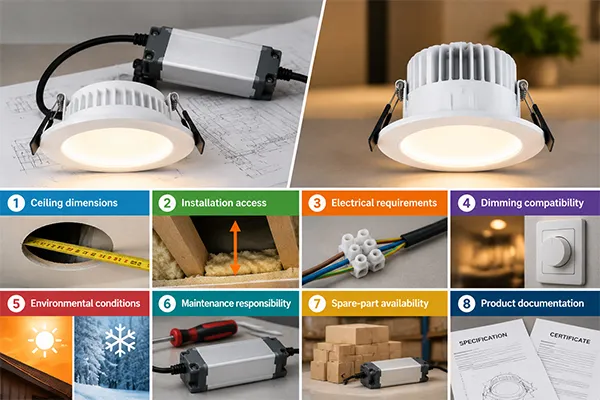
Before selecting an external-driver or internal-driver LED downlight, buyers should verify ceiling dimensions, installation access, electrical requirements, dimming compatibility, environmental conditions, maintenance responsibility, spare-part availability, and product documentation. This lifecycle checklist is more reliable than choosing only by price, thickness, or cut-out size.
Project-selection checklist
Use the following checklist before approving a downlight configuration:
1. Confirm the installation environment
- Measure the ceiling cut-out, void depth, and clearance around the fitting.
- Identify insulation, ducting, pipes, sprinkler systems, and cable trays.
- Check ambient temperature and moisture exposure.
- Confirm whether the installation is recessed, surface-mounted, or part of a renovation.
2. Define the electrical and control requirements
- Confirm local input voltage and frequency.
- Identify whether dimming is required.
- Specify the dimming protocol before ordering.
- Confirm whether surge protection or other electrical protection is needed.
- Ask qualified professionals to assess project-specific electrical requirements.
3. Plan maintenance before installation
- Identify who will service the fitting after handover.
- Confirm how a technician will reach an external driver.
- Decide whether complete fitting replacement is acceptable for internal-driver models.
- Define spare-driver quantities and storage requirements.
- Keep an approved specification sheet for each product SKU.
4. Control supplier and product consistency
- Approve samples before volume production.
- Confirm the exact driver model or approved equivalent process.
- Request notification procedures for material or component changes.
- Verify applicable certification documents for the destination market.
- Review warranty terms, claim procedures, and replacement lead times.
5. Evaluate total lifecycle risk
The lowest unit cost may not be the lowest total cost.12 A slightly higher-priced configuration may reduce installation complexity or future service disruption. Conversely, a replaceable-driver design may not provide value if the driver will be inaccessible or if compatible spares are not available.
We recommend comparing the options across the full lifecycle:
| Lifecycle stage | Internal-driver consideration | External-driver consideration |
|---|---|---|
| Procurement | Fewer separate components to specify | Driver model and spare strategy need clear definition |
| Installation | Consolidated fitting may simplify handling | Ceiling void and driver placement need planning |
| Operation | Performance depends on complete product design | Performance depends on complete product and driver placement |
| Service | Complete fitting may need replacement | Driver replacement may be possible if access and compatibility exist |
| Repeat orders | Confirm integrated design consistency | Confirm continued driver specification and availability |
Frequently Asked Questions
Is an external-driver LED downlight better than an internal-driver model?
An external-driver LED downlight is not automatically better. It may suit projects where the driver can be accessed and compatible spares are planned. An internal-driver model may suit shallow ceilings or installations where fewer loose components simplify work. Buyers should assess the specific product, environment, and maintenance plan.
Do external LED drivers last longer than internal drivers?
Driver location alone does not establish service life. Product-specific performance depends on component quality, thermal design, electrical conditions, operating environment, and installation method. Buyers should request technical documentation and review the supplier’s stated application limits rather than relying on a general rule.
Can I replace any external LED downlight driver?
No. A replacement driver must match the LED module’s electrical requirements and the project’s control system. Buyers should confirm constant-current output, wattage, voltage range, dimming compatibility, connectors, dimensions, and safety requirements. A qualified professional should assess application-specific replacement work.
Which downlight is easier for contractors to install?
The easiest downlight depends on the site. Internal-driver models can reduce the number of separate parts, while external-driver models require additional space and positioning for the driver. Contractors should check ceiling depth, cable routing, wiring access, and installation instructions using physical samples where possible.
Should distributors stock spare drivers for external-driver downlights?
Distributors should consider stocking spare drivers when they sell external-driver models into projects that require ongoing maintenance. The right quantity depends on installed volume, warranty commitments, lead times, and driver continuity. Each spare driver should be clearly labeled with compatible downlight models and electrical specifications.
Conclusion
The LED downlight with external driver vs internal driver decision should focus on lifecycle risk rather than a simple claim about which option is better. Internal-driver models can offer a consolidated installation format, while external-driver designs can support a planned replacement approach when access and compatibility are controlled. We encourage contractors, importers, distributors, and lighting brands to review ceiling conditions, dimming needs, maintenance responsibility, and spare-part strategy before ordering. Contact Upward Lighting to discuss an OEM/ODM downlight configuration, request a quotation, or review samples for your next project.
"LED Dimming: What you need to know", https://www1.eere.energy.gov/buildings/publications/pdfs/ssl/dimming_webcast_12-10-2012.pdf. LED drivers are power supplies designed to regulate the electrical current or voltage delivered to LED loads, whose operating characteristics require controlled drive conditions. Evidence role: definition; source type: government. Supports: An LED driver provides regulated electrical power, commonly constant current, to operate LED loads.. ↩
"Impact of Thermal Dissipation on the Lighting Performance ...", https://pmc.ncbi.nlm.nih.gov/articles/PMC8776062/. Research on LED-driver reliability identifies component selection, circuit topology, thermal stress, and electrical operating conditions as material determinants of failure behavior; driver placement alone is therefore not a sufficient reliability indicator. Evidence role: mechanism; source type: paper. Supports: LED-driver reliability is influenced by component stresses, circuit design, temperature, and operating conditions rather than enclosure location alone.. Scope note: This evidence supports the general engineering principle and does not compare every internal-driver and external-driver downlight design. ↩
"Lutron Electronics Co., Inc. ex-parte meeting at the U.S. ...", https://www.energy.gov/gc/articles/lutron-electronics-co-inc-ex-parte-meeting-us-department-energy. Power factor describes the relationship between real and apparent power, while total harmonic distortion characterizes waveform distortion; both are commonly used to assess the power-quality effects of electronic lighting drivers. Evidence role: definition; source type: government. Supports: Power factor and total harmonic distortion are standard measures used to characterize the power-quality behavior of electronic lighting equipment.. Scope note: The acceptable values are determined by the relevant project specification, grid rules, and applicable standards. ↩
"LED Dimming: What you need to know", https://www1.eere.energy.gov/buildings/publications/pdfs/ssl/dimming_webcast_12-10-2012.pdf. Lighting-control guidance explains that dimming systems use different interfaces and signaling methods, so an LED driver must be specified as compatible with the intended control method rather than assumed to work with all dimmers. Evidence role: mechanism; source type: institution. Supports: LED drivers must be designed and specified for the control method with which they are used, and dimming methods have distinct interface requirements.. Scope note: A stated protocol compatibility does not by itself establish compatibility with every individual dimmer or control device. ↩
"RoHS Directive - Environment - European Commission", https://environment.ec.europa.eu/topics/waste-and-recycling/rohs-directive_en. European Union guidance states that products covered by applicable harmonized legislation may require CE marking and that electrical and electronic equipment within the RoHS scope is subject to restrictions on specified hazardous substances. Evidence role: historical_context; source type: government. Supports: EU market-access rules may require CE marking and compliance with RoHS restrictions for electrical and electronic equipment within their scope.. Scope note: Whether a particular downlight configuration may be placed on a market depends on its classification, applicable legislation, and the responsible economic operator's conformity assessment. ↩
"LED Luminaire Reliability: Impact of Color Shift", https://www.energy.gov/sites/prod/files/2017/04/f34/lsrc_colorshift_apr2017.pdf. Thermal-management literature for solid-state lighting documents that elevated junction and component temperatures can affect LED performance and accelerate degradation mechanisms in associated electronic drivers. Evidence role: mechanism; source type: research. Supports: Temperature affects LED light output and lifetime and can accelerate degradation in electronic driver components.. ↩
"Light Fixtures (Downlights)", https://www.energystar.gov/products/light_fixtures. Installation and safety guidance for recessed lighting recognizes that restricted airflow, insulation contact, and nearby heat sources can increase equipment temperature, making the thermal environment of a separately located driver relevant to its use. Evidence role: general_support; source type: institution. Supports: Restricted ventilation, insulation contact, and surrounding heat sources can raise the operating temperature of recessed lighting equipment and its control gear.. Scope note: The applicable restrictions depend on the specific luminaire, driver listing, and manufacturer installation instructions. ↩
"Lighting Specification Guidance for Schools", https://www.energy.gov/sites/default/files/2024-12/lighting-spec-guidance-school_nov24.pdf. Luminaire terminology distinguishes integral control gear incorporated within the fitting from remote control gear installed separately, meaning remote-driver arrangements require accommodation for both the luminaire and its control gear. Evidence role: definition; source type: institution. Supports: Integral control gear is incorporated into a luminaire, while remote control gear is located separately and requires separate installation space.. Scope note: The resulting installation difficulty still depends on the dimensions, wiring method, and ceiling conditions of the specific product. ↩
"Upgrading Linear Fluorescent Fixtures to LED in Schools", https://www.energy.gov/eere/ssl/articles/upgrading-linear-fluorescent-fixtures-led-schools-guide-november-2024. Serviceability guidance for electrical equipment emphasizes accessible maintenance routes, while LED-driver guidance requires replacement units to match the relevant load and control characteristics; a remote driver is therefore easier to replace only when both conditions are met. Evidence role: general_support; source type: institution. Supports: Maintenance requires safe physical access, and replacement LED drivers must be electrically compatible with the load and control arrangement.. Scope note: Actual service procedures must follow the specific product instructions and applicable electrical rules. ↩
"Specifying LED in a World of Continuous Change", https://www.energy.gov/sites/prod/files/2014/11/f19/miller-hershman-yorgey-willcock_specifying_detroit2014.pdf. LED power-supply guidance distinguishes constant-current and constant-voltage operation and specifies matching the driver output to the LED load, so physically similar drivers are not necessarily interchangeable. Evidence role: mechanism; source type: government. Supports: Replacement LED drivers must be matched to the LED load's required drive characteristics and applicable control arrangement.. Scope note: Additional requirements, including connectors, enclosure ratings, and local electrical codes, may also govern a replacement. ↩
"Precomputed low-frequency lighting in cinematic volume ...", https://pmc.ncbi.nlm.nih.gov/articles/PMC11493242/. Architectural-lighting practice uses on-site mock-ups to review installed appearance and performance—such as glare, color, control response, and construction coordination—before wider implementation. Evidence role: general_support; source type: institution. Supports: Lighting mock-ups are used to evaluate installed lighting characteristics and design details before full project deployment.. Scope note: A mock-up informs project decisions but does not substitute for product testing, code compliance review, or complete commissioning. ↩
"Take Five: Life Cycle Costs for Acquisition", https://www.energy.gov/cmei/femp/articles/take-five-life-cycle-costs-acquisition. Life-cycle-cost methods evaluate an asset's economic cost over its service period by considering initial purchase costs together with installation, operation, maintenance, and replacement expenditures. Evidence role: general_support; source type: government. Supports: Life-cycle-cost analysis considers costs beyond acquisition price, including installation, operation, maintenance, and replacement.. Scope note: A lifecycle comparison requires project-specific assumptions about labor rates, operating hours, failure rates, energy prices, and service arrangements. ↩