
Aluminum material selection for LED downlight housing is often treated as a simple quality check, but that approach can create costly sourcing mistakes. A buyer may see an “all-aluminum” claim and assume reliable heat management, only to face performance concerns in high-wattage or enclosed-ceiling applications. The better solution is to evaluate the complete housing-and-structure design.
The right aluminum material selection for LED downlight housing depends on the downlight’s wattage, thermal path, installation environment, driver arrangement, housing process, and intended product position. Aluminum alone does not prove durability or thermal performance. Buyers should compare documented drawings, sample consistency, surface treatment, assembly design, and product-specific verification before approving a supplier or specification.
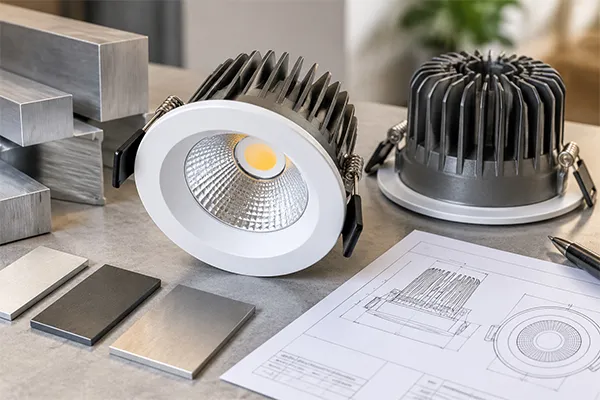
When we discuss housing options with lighting brands, importers, and project buyers, we try to move the conversation beyond a single material label. A housing is part of a larger product system. The practical question is whether that system can manage operating conditions without adding unnecessary material and process cost.
Why Does Aluminum Material Selection for LED Downlight Housing Matter?
Buyers often need a quick way to compare LED downlights from several suppliers. Material descriptions look easy to compare, but a basic “aluminum housing” statement can hide important differences in design, processing, and intended application. This can make procurement decisions harder, especially for project lighting.
Aluminum material selection for LED downlight housing matters because the housing can influence how heat moves away from the LED module and through the complete fixture structure1. However, the housing only performs well when its material, shape, wall design, LED contact area, driver location, installation environment, and assembly quality work together.
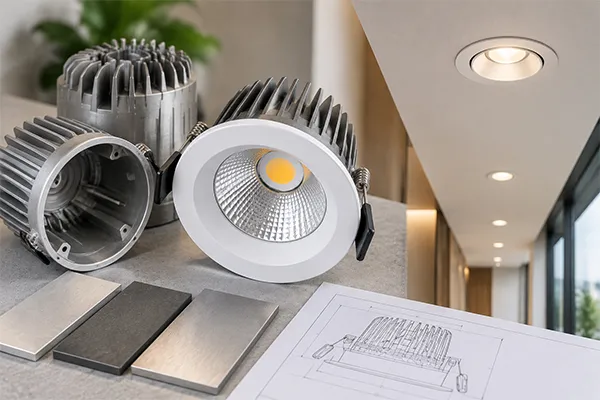
The Housing Is One Part of the Thermal Path
In our practical product-development discussions, we do not treat the housing as an isolated component. We look at the full path that heat may follow from the LED source through the mechanical structure and into the surrounding environment.
That path can be affected by:
- The LED module and its mounting arrangement
- The contact surface between the light source and the heat-dissipating structure
- Thermal interface materials, where applicable
- The geometry of the housing or heat sink
- Air movement around the fixture
- The driver’s placement and operating temperature
- Ceiling depth and insulation conditions
- The actual wattage and usage duration
A heavier housing may contain more metal, but weight alone does not confirm that the added material sits where it can support heat transfer2. Similarly, a thick wall may add strength or visual substance, but it may not improve the key thermal path if the internal structure is poorly designed.
We have seen early sample discussions where a buyer focused on housing weight, while our production team focused first on the LED board contact area, fin geometry, driver space, and installation condition. Those questions usually provide a more useful starting point.
Enclosed Ceilings Change the Procurement Risk
An LED downlight installed in an open ceiling void may operate under different conditions than the same model placed in a compact, insulated, or poorly ventilated ceiling cavity. This does not mean one installation is automatically unsuitable. It means the intended installation condition should be part of the product specification.
For example, buyers should clarify whether a downlight is intended for:
| Installation condition | Procurement question to ask | Why it matters |
|---|---|---|
| Open ceiling void | Is there reasonable airflow around the housing? | Airflow can affect operating conditions |
| Shallow ceiling cavity | Does the fixture fit without compressing wiring or driver space? | Limited space can affect installation and heat buildup |
| Insulated ceiling | Has the product been evaluated for this intended use? | Insulation can reduce airflow around the fixture3 |
| Commercial ceiling grid | What are the cutout, driver, and access requirements? | Service access and installation consistency matter |
| High-use retail or office areas | What is the expected daily operating pattern? | Long operating periods may require more careful validation4 |
We recommend that buyers discuss these conditions with qualified technical professionals for application-specific decisions. A product suitable for one project may require a different configuration for another.
Can Housing Weight, Thickness, or “Full Aluminum” Prove Quality?
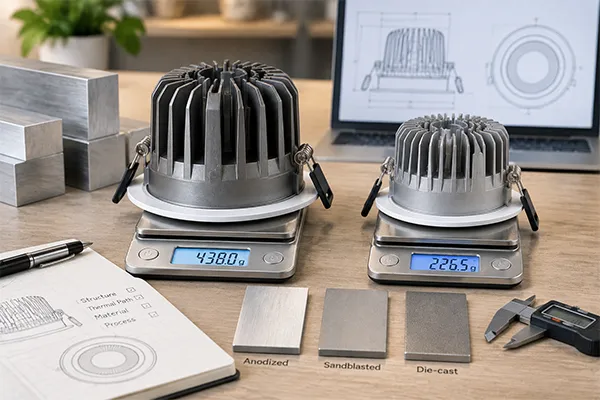
A buyer may compare two samples and naturally assume that the heavier unit is more reliable. That instinct is understandable, especially when product information is limited. Still, housing weight, thickness, and generic aluminum claims cannot independently prove durability, consistency, or heat-management capability.
Housing weight, wall thickness, alloy labels, and “full aluminum” descriptions are useful reference points, but they do not prove LED downlight quality by themselves. Buyers should use them alongside a verified product drawing, process description, thermal-path design review, installation requirements, sample inspection, and production consistency checks.
Why Simple Material Claims Can Mislead Buyers
“Full aluminum” is often used in market communication because it is short and familiar. Yet buyers should ask what the statement actually covers. Does it refer to the visible trim, the main heat-dissipating body, the back housing, or several components together? Is the driver enclosure included? Are there different material parts in different versions of the same model?
A clear supplier should be able to explain the mechanical construction without relying only on promotional wording.
We encourage buyers to separate the following questions:
-
What component is aluminum?
The front trim, heat sink, outer housing, reflector support, and driver box can use different structures. -
How is the part made?
A die-cast body, extruded profile, and stamped aluminum component each have different manufacturing characteristics. -
Where is the material located?
Material positioned around the LED module and designed for heat transfer may have a different function from decorative material at the front of the fixture. -
What is the intended wattage and installation condition?
A housing should be evaluated in relation to the specific fixture configuration, not as a standalone object. -
What can the supplier verify for the exact model?
Buyers should request available drawings, sample records, production specifications, and test documentation relevant to the purchased configuration.
A Better Comparison Method for Buyers
Instead of ranking samples by weight alone, we suggest a structured comparison.
| Comparison factor | What buyers should review | Common sourcing risk |
|---|---|---|
| Housing mass | Net weight and component breakdown | Assuming more weight always means better performance |
| Wall thickness | Drawing locations and tolerance expectations | Comparing one thick point rather than the full structure |
| Material statement | Which parts are aluminum and how they are processed | Accepting vague “all-aluminum” language |
| LED mounting area | Contact design and assembly arrangement | Ignoring the actual thermal path |
| Driver arrangement | Internal, external, or separated driver layout | Overlooking driver temperature and installation space |
| Surface finish | Powder coating, painting, anodizing, or other specified treatment | Treating finish as visual only |
| Sample consistency | Comparison across multiple samples | Approving one hand-finished prototype as production proof |
I remember a sample review where two recessed downlights looked nearly identical from the front. One had a more substantial body, while the other used a more optimized structural layout around the LED area. Neither sample could be judged responsibly from appearance alone. We needed the relevant drawings, wattage target, driver arrangement, and intended installation details before making a sourcing recommendation.
Which Housing Process Fits Your LED Downlight Product Position?
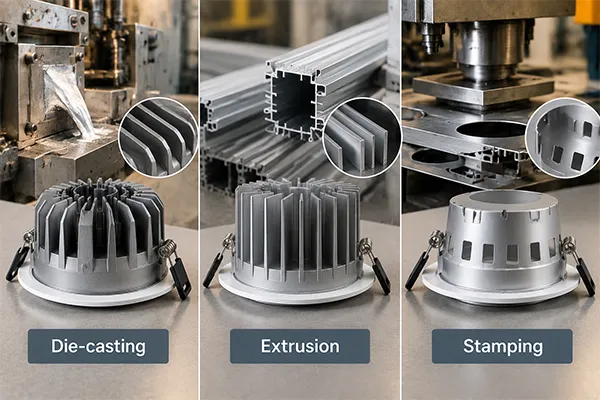
Buyers sometimes ask us whether die-cast aluminum, extruded aluminum, or stamped aluminum is the “best” choice. We do not believe there is one universal answer. Each process can be appropriate when it matches the product design, market segment, order volume, and performance requirements.
For aluminum material selection for LED downlight housing, die-casting, extrusion, and stamping should be treated as fit-for-purpose manufacturing options. Die-casting offers complex shapes, extrusion can suit profile-based structures, and stamping can support efficient sheet-metal designs5. The right option depends on the complete fixture design and commercial target.
Die-Cast Aluminum Housings
Die-casting can support detailed shapes, integrated features, and compact housing designs. It is commonly considered when a product requires more complex geometry, integrated heat-dissipating features, or a specific visual form.
From a procurement perspective, die-casting may involve tooling investment and careful process control6. Buyers should ask about tooling ownership, lead time, cosmetic requirements, dimensional tolerances, and how the supplier controls consistency after the initial sample stage.
Die-cast construction may be suitable when:
- The downlight needs a shaped body or integrated fins
- The product has a stable design and projected volume supports tooling
- The brand needs a more distinctive external appearance
- The design requires multiple functional features in one formed part
Still, a die-cast housing is not automatically superior. The fixture’s thermal design, LED assembly, and installation condition remain important.
Extruded Aluminum Housings
Extrusion can be useful for designs based on continuous profiles. This process may suit certain cylindrical, linear, or profile-driven lighting structures. It can provide a practical route when the cross-section supports the product’s mechanical and thermal objectives.
For downlights, extrusion may be considered where the design benefits from a consistent profile and where secondary machining, cutting, finishing, or assembly can create the final product form. Buyers should ask how the profile is cut, machined, finished, and inspected.
Extruded options may fit when:
- The product uses a profile-oriented housing concept
- The design requires repeatable cross-sectional geometry
- The brand has a family of products based on similar profiles
- The order plan can support profile tooling and secondary processing
Stamped Aluminum Housings
Stamped aluminum structures may be appropriate for cost-sensitive products, especially where the design can use formed sheet-metal components. A stamped solution can provide efficient production for suitable shapes, but buyers should review rigidity, joining methods, surface treatment, and the role of each metal component in the overall thermal path.
Stamped aluminum may fit when:
- The product targets a competitive price point
- The fixture geometry is suitable for sheet forming
- The design uses separate functional components
- The project does not require complex integrated forms
Process Comparison for Procurement Teams
| Process | Shape freedom | Potential production strengths | Key buyer checks | Typical positioning considerations |
|---|---|---|---|---|
| Die-casting | High for complex formed bodies | Integrated forms and detailed geometry | Tooling, porosity control, finish, dimensions, sample consistency | Mid- to higher-positioned designs, depending on specification |
| Extrusion | Strong for continuous profiles | Consistent profile geometry | Profile drawing, machining, cut quality, finishing | Profile-based product families and selected architectural styles |
| Stamping | Best for sheet-formable shapes | Efficient formed components | Thickness control, joining, rigidity, coating | Cost-conscious and fit-for-purpose designs |
We avoid declaring one process “best” because each project has different constraints. A high-wattage downlight for a constrained ceiling may need a different solution from a standard residential recessed product. The right decision is the one that manages avoidable risk without forcing the buyer to pay for unnecessary specification.
How Should Buyers Verify Aluminum Material Selection for LED Downlight Housing?
Material selection becomes less risky when buyers turn broad claims into specific supplier questions. This does not require every importer or distributor to become a materials engineer. It requires a repeatable procurement process that connects the housing specification to the intended product and application.
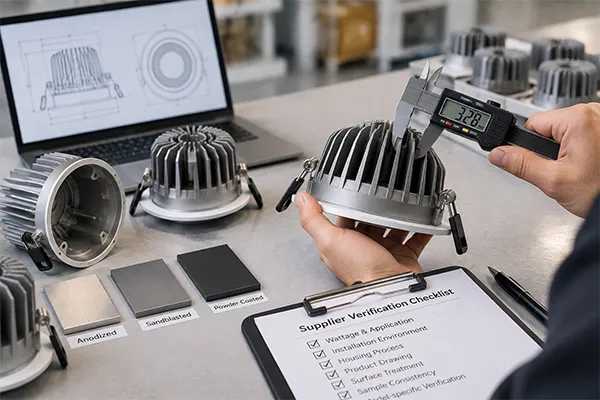
Buyers can verify aluminum material selection for LED downlight housing by confirming the intended wattage, installation environment, housing process, product drawing, surface treatment, sample-to-production consistency, and available model-specific verification. The goal is to validate the complete configuration rather than rely on a generic material claim.
Questions We Recommend Asking Suppliers
When we receive an OEM or ODM request, our team normally starts with the application and commercial target. We need to understand the desired wattage, cutout size, light output expectation, color temperature, beam angle, CRI, trim color, and target market before we can recommend a practical housing direction.
Buyers can use the following checklist during supplier evaluation:
-
What wattage range is this exact housing designed to support?
Ask for the product-specific configuration, not a broad statement covering multiple models. -
What installation environment is assumed?
Clarify whether the application involves shallow ceilings, enclosed cavities, insulation, long operating hours, or commercial use. -
What manufacturing process is used for the main housing?
Ask whether it is die-cast, extruded, stamped, or a mixed construction. -
Can the supplier provide a drawing or controlled specification?
A drawing should identify key dimensions, materials where relevant, finish requirements, and component relationships7. -
How is the LED module attached to the housing structure?
This question helps buyers understand the thermal path and assembly approach. -
Where is the driver located?
Confirm whether it is integrated, external, separated, replaceable, or located in a confined space. -
What surface treatment is used?
Surface finish can affect appearance, corrosion resistance, cleaning, and batch-to-batch consistency8. Buyers should confirm the required finish rather than assume all white, black, or metallic surfaces are equivalent. -
How does the supplier control sample-to-mass-production consistency?
Ask about incoming material checks, in-process inspection, dimensional control, aging procedures, and final inspection methods. -
What verification is available for this product?
Request available documentation that applies to the specific model and configuration. Test conditions should be defined and reviewed rather than assumed.
Review Certifications and Documentation Carefully
At Upward Lighting, we provide products with certifications such as CE and RoHS for applicable market-entry requirements9. However, we believe buyers should always verify the validity, scope, model coverage, and destination-market applicability of any certification document. A certificate associated with one product version should not automatically be assumed to cover every wattage, driver, housing, or customized configuration10.
For larger projects, buyers may also benefit from:
- Pre-shipment sample approval
- Golden-sample retention
- Signed technical specifications
- Dimensional inspection reports
- Third-party testing where required
- Independent professional review for installation-specific applications
Our own production practice includes a 100% aging test before shipment, typically lasting 4 to 8 hours depending on the product arrangement. That process is one quality-control step, not a substitute for application-specific thermal assessment or independent verification when a project requires it.
How Can Buyers Balance Reliability and Cost?
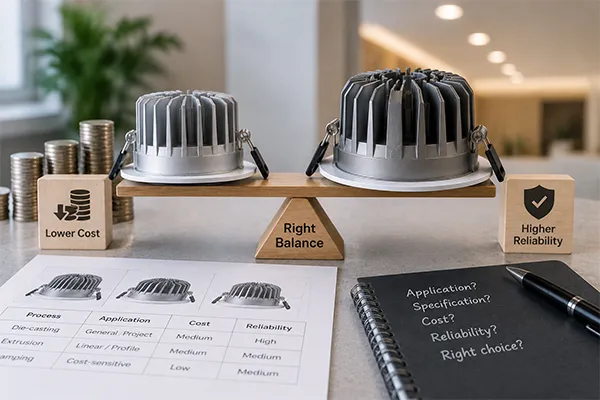
The pressure to reduce unit cost is real. Brand owners, distributors, and contractors must remain competitive, particularly in tender-driven or price-sensitive markets. Yet the lowest housing cost can become expensive if it leads to more field questions, inconsistent quality, or unsuitable use in demanding installations.
The best aluminum material selection for LED downlight housing balances reliability and cost by matching the housing process and structure to the real application. Buyers should avoid both extremes: under-specifying a high-risk installation and paying for premium material or complexity that does not add practical value.
Define the Product Before Negotiating the Price
A meaningful quotation needs a meaningful specification. If a buyer only asks for the lowest price for a “10W aluminum downlight,” suppliers may quote different housing processes, drivers, LED packages, finishes, and quality-control levels. The resulting prices may not be comparable.
We recommend that buyers build a quotation brief covering:
- Target wattage and voltage
- Cutout size and overall dimensions
- Ceiling type and installation restrictions
- Driver requirement and dimming need
- Housing process preference, if justified
- Trim color and surface finish
- CRI, color temperature, and beam angle
- Required documentation and market destination
- Order quantity and expected reorder pattern
- Packaging and branding requirements
Use Product Tiers Instead of One Overbuilt Specification
Many lighting brands benefit from defining product tiers. This approach allows the brand to match its cost structure to market needs without confusing customers.
| Product tier | Typical buyer priority | Housing selection approach |
|---|---|---|
| Entry-level | Competitive price and basic functionality | Use a fit-for-purpose structure with clear quality controls |
| Mainstream | Balanced quality, appearance, and reliability | Match process and design to common installation conditions |
| Project-oriented | Documentation, consistency, and defined application needs | Use controlled specifications and stronger verification steps |
| Premium or architectural | Visual finish, design differentiation, and customized details | Consider process flexibility, finish quality, and long-term consistency |
In our OEM/ODM work, we often find that the most useful commercial discussion is not “Can you use more aluminum?” Instead, it is “What risk are we trying to control, and what specification genuinely addresses it?” That question helps prevent unnecessary upgrades while protecting the areas that matter most.
Frequently Asked Questions
Is an all-aluminum LED downlight housing always better?
No. An all-aluminum claim does not automatically prove better heat management, durability, or manufacturing consistency. Buyers should assess the complete fixture structure, including wattage, LED mounting method, driver arrangement, installation environment, housing process, and available product-specific verification.
Is a heavier LED downlight housing more reliable?
A heavier housing may use more material, but weight alone does not confirm reliability. The location of the material, housing geometry, LED contact area, assembly quality, and intended installation conditions are more useful evaluation factors than weight by itself.
Which is better for LED downlights: die-cast or stamped aluminum?
Neither process is universally better. Die-casting can suit complex integrated shapes, while stamped aluminum can support efficient, cost-conscious designs. Buyers should select the process that fits the wattage, structure, product positioning, target order volume, and installation requirements.
What should I ask an LED downlight supplier about the housing?
Ask about the exact housing process, intended wattage, installation assumptions, product drawing, LED mounting arrangement, driver location, surface treatment, sample consistency, and available verification. You should also confirm whether documents apply to the exact model and customized configuration.
Can CE and RoHS documents confirm housing quality?
CE and RoHS documentation can be relevant to market-entry, safety, and environmental compliance requirements11, depending on the product and market. They do not independently prove that a housing is suitable for every installation. Buyers should verify document scope and review product-specific specifications separately.
Conclusion
Aluminum material selection for LED downlight housing should never be reduced to weight, thickness, alloy names, or an “all-aluminum” sales claim. We believe buyers make stronger decisions when they evaluate the full thermal path, intended wattage, ceiling condition, housing process, driver arrangement, finish, and production consistency. The right solution is not the cheapest or most expensive option. It is the configuration that manages real application risk without unnecessary cost. If you are comparing LED downlight housing options for an OEM, ODM, wholesale, or project requirement, we welcome a detailed specification discussion.
"[PDF] Advanced Materials for LED Lighting", https://www.energy.gov/sites/prod/files/2015/02/f19/haugaard_led-materials_sanfrancisco2015.pdf. Thermal-management literature describes the luminaire housing and heat-sink structure as part of the conductive and convective path that removes heat from LED packages and helps limit junction temperature. Evidence role: mechanism; source type: research. Supports: LED junction temperature and fixture reliability are affected by the thermal path from the LED package through mounting and heat-dissipating structures to the ambient environment.. ↩
"Multidisciplinary optimization of a pin-fin radial heat sink for LED ...", https://www.academia.edu/47977084/Multidisciplinary_optimization_of_a_pin_fin_radial_heat_sink_for_LED_lighting_applications. Studies of heat-sink design show that thermal performance is governed by thermal resistance, geometry, exposed area, airflow, and interface conditions; total component mass by itself is not a sufficient performance measure. Evidence role: mechanism; source type: paper. Supports: Heat-sink performance depends on thermal resistance, geometry, surface area, airflow, and interface quality rather than metal mass alone.. ↩
"Insulating and Air Sealing Existing Non-ICAT Recessed Lights", https://basc.pnnl.gov/resource-guides/insulating-and-air-sealing-existing-non-icat-recessed-lights. Building-energy and lighting guidance notes that insulation and confined recessed-light cavities can restrict airflow around a luminaire, which may alter the fixture's thermal operating environment. Evidence role: general_support; source type: government. Supports: Insulation and restricted ceiling cavities can limit ventilation around recessed luminaires and affect their operating conditions.. Scope note: The effect on a particular downlight depends on its listed installation rating, fixture design, insulation type, and actual ceiling construction. ↩
"[PDF] DEVELOPMENT OF A FULLY AUTOMATED LED LIFETIME TEST ...", https://tsapps.nist.gov/publication/get_pdf.cfm?pub_id=912240. LED reliability research finds that operating temperature is associated with degradation and lumen-maintenance behavior, supporting the need to evaluate thermal conditions for luminaires intended for sustained operation. Evidence role: mechanism; source type: research. Supports: Elevated LED operating temperature affects degradation mechanisms, light output maintenance, and component reliability, making thermal evaluation relevant to sustained-use applications.. Scope note: Operating duration alone does not establish failure risk; reliability also depends on drive current, ambient temperature, driver design, materials, and duty cycle. ↩
"[PDF] 2.008 (S25): Quiz 2 Solutions - MIT OpenCourseWare", https://ocw.mit.edu/courses/2-008-design-and-manufacturing-ii-spring-2025/mit2_008_s25_quiz2_sol.pdf. Manufacturing references distinguish die casting as a process for complex formed parts, extrusion as a process for continuous profile geometries, and stamping as a process for forming sheet-metal components. Evidence role: general_support; source type: education. Supports: Die casting is used for complex near-net-shape parts, extrusion produces continuous constant-cross-section profiles, and stamping forms sheet-metal components.. Scope note: These process descriptions establish general capabilities and do not determine which process is optimal for a specific luminaire design. ↩
"(PDF) Continuous Improvement of Quality at Die Casting Plant", https://www.academia.edu/92525915/Continuous_Improvement_of_Quality_at_Die_Casting_Plant. Die-casting research identifies dedicated die tooling and control of filling and solidification conditions as important factors in dimensional quality and in limiting defects, including porosity. Evidence role: mechanism; source type: research. Supports: Die casting uses dedicated tooling and requires control of filling, solidification, and related variables to manage dimensional quality and casting defects such as porosity.. Scope note: Actual tooling costs and defect rates vary with alloy, part geometry, die design, machine parameters, and production volume. ↩
"[PDF] Investigating the Role of Geometric Dimensioning and Tolerancing ...", https://tsapps.nist.gov/publication/get_pdf.cfm?pub_id=918538. Technical-product-documentation standards describe engineering drawings as controlled records for communicating dimensions, tolerances, material and finish requirements, and the relationships of parts in an assembly. Evidence role: definition; source type: institution. Supports: Engineering drawings and technical product documentation communicate dimensions, tolerances, material requirements, surface texture or finish, and assembly information.. Scope note: The exact content required in a drawing depends on the applicable standard, contract, product risk, and manufacturing process. ↩
"Study on the Influence of Surface Treatment Process on ... - PMC - NIH", https://pmc.ncbi.nlm.nih.gov/articles/PMC10488388/. Technical guidance on aluminum finishing explains that anodized and organic coating systems affect surface appearance and corrosion protection, while finish specifications also define process and visual-consistency requirements. Evidence role: general_support; source type: institution. Supports: Anodizing, paint, and powder-coating systems can alter aluminum surface appearance and corrosion protection, with performance depending on the specified finish and application conditions.. Scope note: Cleaning performance and batch consistency depend on the particular coating system, curing process, substrate preparation, and service environment. ↩
"CE marking – obtaining the certificate, EU requirements - Your Europe", https://europa.eu/youreurope/business/product-rules-compliance/general-product-compliance/ce-marking/index_en.htm. European Commission guidance states that CE marking applies where relevant EU harmonisation legislation requires it, and that the RoHS Directive restricts certain hazardous substances in electrical and electronic equipment within its scope. Evidence role: definition; source type: government. Supports: CE marking indicates conformity with applicable EU harmonisation legislation, while the RoHS Directive restricts specified hazardous substances in electrical and electronic equipment within its scope.. Scope note: Neither requirement applies identically to every product or destination market; applicability must be assessed for the exact product and legal framework. ↩
"General Use Products: Certification and Testing | CPSC.gov", https://www.cpsc.gov/Business--Manufacturing/Testing-Certification/General-Use-Products-Certification-and-Testing. EU conformity-assessment guidance requires manufacturers to maintain technical documentation and declarations that identify the product and demonstrate conformity with the applicable requirements, so document scope must be checked when product configurations change. Evidence role: general_support; source type: government. Supports: Conformity documentation and supporting technical evidence must correspond to the product placed on the market and to applicable legal requirements.. Scope note: Whether a particular change requires new testing or documentation depends on the applicable legislation, the nature of the change, and the conformity-assessment route. ↩
"CE marking", https://en.wikipedia.org/wiki/CE_marking. European Union guidance characterizes CE marking as a declaration of conformity with applicable legal requirements and RoHS as a substance-restriction regime, rather than as a general certification of product quality or application-specific performance. Evidence role: definition; source type: government. Supports: CE marking is a conformity mark for applicable EU rules, and RoHS is a hazardous-substances restriction; neither designation independently certifies all aspects of product quality or suitability for every use.. Scope note: Other legal requirements, test standards, and product-specific evidence may apply depending on the luminaire, its intended use, and the destination market. ↩