LED downlights for warehouses and commercial areas can look suitable on a quotation, yet the wrong fixture choice can create poor coverage, glare, difficult maintenance, or installation delays. When contractors ask us to quote by wattage or cut-out size alone, we first clarify the space, ceiling, controls, exposure, and visual task before confirming a workable option.
LED downlights for warehouses and commercial areas are best selected by task and installation conditions, not by a single specification. They can suit offices, receptions, corridors, meeting rooms, retail zones, and selected low-ceiling warehouse-adjacent spaces. However, they are not a universal replacement for high-bay fixtures in storage aisles, loading zones, or high-ceiling warehouse operations.
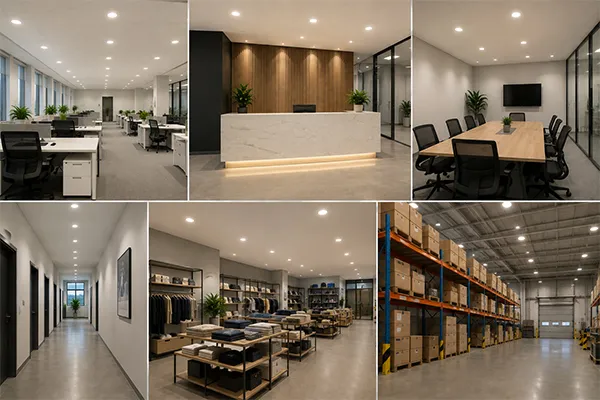
A warehouse facility often includes far more than storage racking. It may contain offices, staff rooms, customer reception areas, dispatch zones, corridors, showrooms, and technical rooms. Each area creates different requirements, which is why I recommend evaluating fixture fit before comparing a long list of electrical specifications.
Where Do LED Downlights for Warehouses and Commercial Areas Work Best?
A contractor may see “warehouse project” on a drawing and assume that every area needs the same type of industrial lighting. That assumption can lead to unsuitable fixture selection. The result may be weak illumination on the work plane, uncomfortable brightness, or fixtures that do not match the ceiling layout.
LED downlights for warehouses and commercial areas work best in enclosed, lower-ceiling, task-specific, or customer-facing zones where recessed or surface-mounted lighting supports the ceiling design. They are commonly considered for offices, meeting rooms, corridors, receptions, washrooms, retail sections, and selected low-ceiling support areas rather than high-rack warehouse floors.
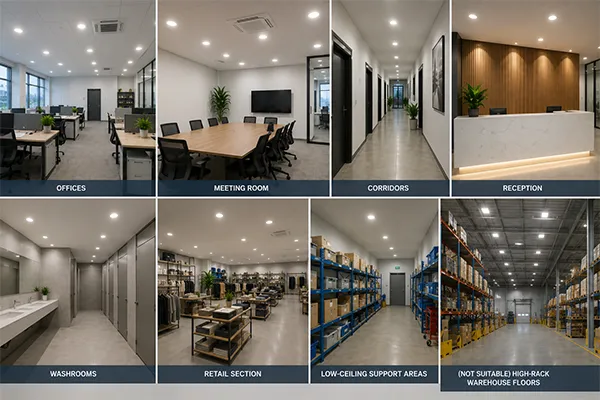
Separate the Building Into Lighting Tasks
In my pre-sales conversations, I often receive a request such as: “Please quote 20W downlights for our warehouse.” My first response is usually a set of questions, because the word warehouse does not identify the actual lighting task.
A logistics building can include several distinct environments:
- Main storage floor: Often has high mounting heights, racking, moving equipment, and broad-area illumination needs.
- Picking and packing areas: May need stronger vertical visibility and more controlled light distribution.
- Warehouse offices: Usually need comfortable general lighting for computer work, paperwork, and meetings.
- Reception or showroom areas: Often place more emphasis on visual comfort, color appearance, and ceiling aesthetics.
- Corridors and stairwells: Need reliable circulation lighting and practical maintenance access.
- Loading-adjacent rooms: May face dust, humidity, frequent door opening, or temperature variation.
LED downlights can be a practical fit for the office and support spaces within a warehouse property. They may also work in selected low-ceiling operational zones when the layout and required coverage have been reviewed. Still, I would not present a recessed downlight as an automatic substitute for high-bay lighting across a tall storage area.
Why High-Bay Areas Need a Different Discussion
High-bay fixtures are commonly evaluated for larger warehouse zones because they are designed around higher mounting positions and wider or more focused distributions. A downlight can deliver a stated lumen output, but that number alone does not confirm useful illumination at floor level or on vertical racking.1
Before a buyer selects a fixture for a high-ceiling warehouse area, a qualified lighting professional should review:
- Mounting height and fixture spacing
- Racking layout and aisle orientation
- Required illumination levels for the task
- Glare control for drivers and operators
- Shadowing from shelving, equipment, and structural elements
- Maintenance method and access equipment
- Local project requirements and applicable regulations
I encourage contractors to treat fixture type as the first decision. Once the suitable fixture category is clear, wattage, lumen package, beam angle, and control options become much easier to evaluate.
How Should Contractors Specify LED Downlights for Warehouses and Commercial Areas?
Many requests begin with a wattage, lumen output, or ceiling cut-out size. Those details are important, but they do not tell the full installation story. A fixture can match the requested dimensions on paper and still create problems when the ceiling depth, driver placement, or dimming requirement is discovered later.
To specify LED downlights for warehouses and commercial areas, contractors should confirm the installation location, ceiling type, mounting height, ceiling thickness, cut-out size, coverage target, glare expectation, driver access, and control compatibility. These details help suppliers recommend a fixture configuration instead of simply matching an incomplete list of numbers.
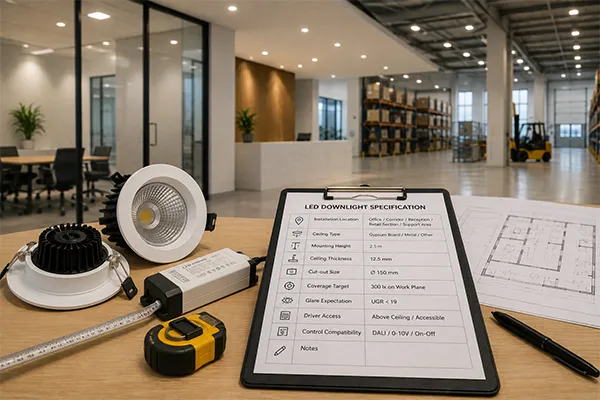
Start With the Ceiling, Not the Catalogue Page
A recessed LED downlight must physically fit the ceiling system. In practice, this means that cut-out diameter is only one part of the review. I also ask about ceiling thickness, available void depth, insulation or obstructions above the ceiling, and access to the driver after installation.
For example, a project may request a 90 mm cut-out LED downlight. That request does not show whether the ceiling has enough depth for the luminaire body and driver, whether the spring clips suit the board thickness, or whether future servicing is possible without removing finished ceiling panels.
| Specification Question | Why It Matters | Common Procurement Risk |
|---|---|---|
| Cut-out size | Confirms opening compatibility | Assuming all fixtures with similar cut-outs fit identically |
| Ceiling thickness | Affects spring-clip installation | Loose or unsuitable installation in thin or thick boards |
| Ceiling void depth | Confirms body and driver clearance | Driver cannot fit above the ceiling |
| Mounting height | Influences coverage and visual comfort | Selecting a narrow or wide beam without layout review |
| Driver access | Supports future maintenance | Removing finished ceilings for a simple driver replacement |
| Dimming protocol | Confirms control compatibility | Flicker, poor dimming range, or non-functioning controls |
Evaluate Wattage and Lumens as a Pair of Inputs
Wattage indicates electrical consumption, while lumens indicate stated light output.2 Neither figure independently proves that a fixture will perform correctly in a real project. Optical design, beam angle, diffuser type, mounting height, spacing, surface reflectance, and surrounding daylight all affect the final visual outcome.3
A 12W downlight and a 15W downlight may be available with different beam angles, color temperatures, driver options, and housing designs. The right choice depends on where the fixture will be installed and what the space must support.
When contractors request a quotation from us, I find that the most useful starting brief includes:
- Product type: recessed, surface-mounted, trimless, or adjustable
- Installation area: office, retail, corridor, reception, meeting room, or support space
- Ceiling height and ceiling material
- Required cut-out size or outer diameter
- Preferred color temperature
- Desired CRI requirement, if specified by the project
- Dimming or control system requirement
- Finish color, such as white, black, silver, or a custom color
- Expected order quantity and delivery schedule
At Upward Lighting, we can discuss OEM/ODM options such as wattage, color temperature, beam angle, CRI, and surface finish. However, I recommend that every application-specific decision is confirmed against the project drawings, site conditions, and qualified technical evaluation.
Which Downlight Specifications Matter Most in Commercial Spaces?
Commercial areas can appear similar on a floor plan while serving completely different visual purposes. A retail display, a staff corridor, a customer reception desk, and a back-office workstation do not necessarily need the same brightness distribution, color rendering, or control strategy. A uniform specification can simplify buying, but it may not support the intended use.
The most important commercial downlight specifications are the ones that match the visual task: color temperature, CRI, beam angle, glare comfort, dimming capability, housing finish, and maintenance access. Contractors should select these characteristics by area instead of applying one downlight specification across every commercial room.
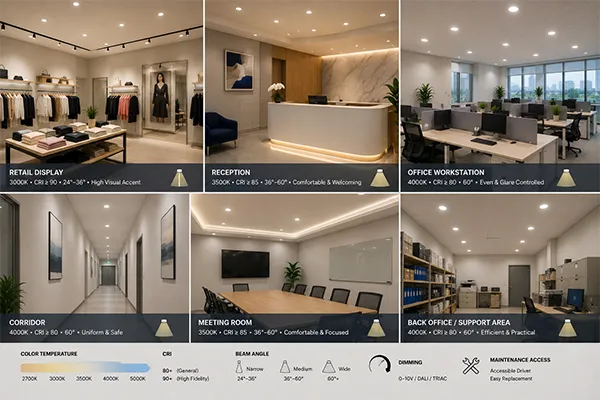
Match Light Appearance to the Space
Color temperature is often requested as a simple choice between warm white, neutral white, and cool white. Yet the preferred appearance depends on the interior design, materials, use of the area, and client expectations.
A project may consider:
| Commercial Area | Typical Selection Considerations |
|---|---|
| Reception area | Comfortable appearance, ceiling aesthetics, customer impression |
| Retail display | Color rendering, accent effect, product appearance, glare control |
| Office workspace | Visual comfort, general illumination, screen-related comfort, controls |
| Meeting room | Dimming, scene control, presentation use, uniformity |
| Corridor | Reliable circulation lighting, spacing, maintenance practicality |
| Pantry or staff room | Comfortable general light and easy cleaning |
| Back-of-house area | Functional output, durability, practical installation |
I avoid suggesting that one color temperature is automatically “best” for every commercial project. A local brand may prefer 3000K for a hospitality-oriented reception, while another buyer may request 4000K for an office or service area. The project documentation and interior concept should guide the final choice.
CRI and Beam Angle Are Not Decorative Details
CRI, or Color Rendering Index, is relevant when the accurate appearance of products, finishes, signs, or interior materials matters.4 A higher CRI requirement may be appropriate for some retail, showroom, hospitality, or design-focused settings. However, buyers should define the project requirement rather than assuming every room needs the same CRI level.
Beam angle also deserves attention. A narrow beam can create stronger visual focus, while a wider beam can support broader general coverage.5 Neither is universally superior.
For example:
- Narrower distributions may suit selected display features or focused architectural elements.
- Medium distributions may suit general lighting in meeting rooms, receptions, or smaller commercial zones.
- Wider distributions may be considered where broad, even coverage is needed from lower ceilings.
I have seen specification discussions become much clearer when a contractor shares a reflected ceiling plan, fixture spacing, and photos or drawings of the finished environment. Those materials do not replace a professional lighting design review, but they help us identify practical fixture questions before production begins.
How Do Moisture, Dust, and Controls Affect Downlight Selection?
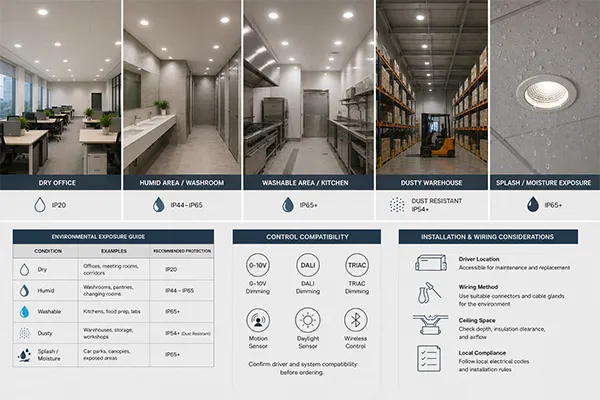
An LED downlight may look identical from the room side while having very different installation demands behind the ceiling. Humidity, cleaning practices, condensation, splashing, dust, and control systems can all change what a suitable product needs to handle. A standard indoor fixture should not be assumed suitable for a more exposed area.
Environmental exposure and controls affect LED downlight selection because the fixture, driver, wiring method, and installation location must suit actual conditions. Contractors should confirm whether the area is dry, humid, washable, dusty, or exposed to splashing, then verify protection requirements, control compatibility, and local installation rules before ordering.
Treat IP Ratings as One Part of the Review
A protection rating can be useful when comparing products, but it does not guarantee that a downlight is suitable for every damp, dusty, or cleaning-intensive environment.6 The actual exposure matters. A washroom ceiling, a covered loading-adjacent area, and a food preparation space may each involve different risks.
I recommend that buyers clarify:
- Is the space fully dry and indoors?
- Is there regular humidity, condensation, or steam?
- Can water splash directly onto the fixture?
- Are cleaners or chemicals used nearby?
- Is dust generated by warehouse operations?
- Is the ceiling sealed, ventilated, or exposed to temperature changes?
- Does the project specification require a particular protection rating?
- Do local regulations require a specific installation method?
Final suitability should be verified by the responsible project professionals against local rules, electrical requirements, and the site environment. This is especially important for areas near loading doors, washrooms, kitchens, utility rooms, and semi-enclosed spaces.
Confirm Dimming and Control Compatibility Early
Dimming is another detail that can create costly changes when discussed too late. A downlight described as “dimmable” may still require a compatible driver and a matching control method.7 The project may use phase-cut dimming, 0–10V, DALI, sensors, timers, or another building-control arrangement.8
Before confirming an order, I ask contractors to identify:
- Whether dimming is required at all
- The required dimming or control protocol
- The type of controller or system already specified
- Whether sensor control is planned
- Whether emergency lighting provisions are separate
- Whether drivers need to be accessible for maintenance
At Upward Lighting, our pre-shipment process includes a 100% aging test lasting 4 to 8 hours. This process is part of our manufacturing quality-control procedure. It does not replace project commissioning, on-site inspection, or application-specific testing after installation.
Buyers should also request and verify relevant certification documents for their destination market. We provide products with certifications such as CE and RoHS, but importers and project teams should confirm that the documents, product configuration, and market-entry requirements match the specific project and jurisdiction.
Frequently Asked Questions
Can LED downlights replace high-bay lights in a warehouse?
LED downlights can suit warehouse offices, corridors, meeting rooms, receptions, and selected low-ceiling support areas. They should not be assumed to replace high-bay fixtures throughout tall storage or racking areas.9 The mounting height, layout, task, coverage, and maintenance method should be reviewed first.
What information should I send when requesting a commercial downlight quote?
I recommend sending the installation area, ceiling type, ceiling height, cut-out size, ceiling thickness, required quantity, preferred wattage, color temperature, beam angle, CRI requirement, finish color, dimming requirement, and delivery location. Ceiling drawings and site photos can also help clarify the request.
Is a higher wattage LED downlight always better?
A higher wattage LED downlight is not automatically better.10 It may provide more output, but the correct fixture also depends on beam angle, mounting height, spacing, glare expectations, ceiling reflectance, and intended task. A higher-wattage unit can be unsuitable if the distribution does not fit the room.
What color temperature is suitable for commercial areas?
Commercial areas do not all need the same color temperature. Reception areas, retail spaces, offices, corridors, and back-of-house rooms may have different visual goals. Many projects consider warm, neutral, or cool white options depending on the design brief, user comfort, and required appearance.
Are CE and RoHS certificates enough for every market?
CE and RoHS documentation may be relevant for certain product and market requirements, but buyers should not assume that they cover every project or jurisdiction.11 Importers, contractors, and project teams should verify current local requirements, product documentation, testing needs, and installation rules before purchase.
Conclusion
LED downlights for warehouses and commercial areas should be selected as part of a broader fit-for-task review. I recommend separating warehouse storage zones from offices, receptions, corridors, retail areas, and other support spaces before choosing a fixture type. Contractors should then verify ceiling conditions, mounting height, beam distribution, controls, maintenance access, and environmental exposure. If you are sourcing configurable LED downlights for a commercial or warehouse-adjacent project, contact Upward Lighting with your drawings, specifications, and target market requirements for a practical OEM/ODM quotation review.
"[PDF] LED Lighting in a Performing Arts Building at the University of Florida", https://betterbuildingssolutioncenter.energy.gov/sites/default/files/attachments/2014_gateway_universityflorida.pdf. Photometric guidance distinguishes total luminous flux from illuminance at a target surface: the latter depends on the luminaire’s distribution and its geometric relationship to the task plane or vertical surface. Evidence role: mechanism; source type: government. Supports: Illuminance at a surface depends on more than total luminous flux, including luminaire intensity distribution, distance, orientation, and the surrounding geometry.. Scope note: The principle explains why lumen output is insufficient by itself, but it does not quantify illumination for a particular warehouse layout. ↩
"[PDF] Optical metrology for LEDs and solid state lighting", https://tsapps.nist.gov/publication/get_pdf.cfm?pub_id=840989. National metrology references define the watt as a unit of power and the lumen as the SI-derived unit used to express luminous flux. Evidence role: definition; source type: government. Supports: The watt is a unit of power and the lumen is a unit of luminous flux, used to describe emitted visible light.. ↩
"[PDF] No-Regrets Remodeling - eere.energy.gov", https://www1.eere.energy.gov/buildings/publications/pdfs/building_america/no_regrets_remodeling_ornl.pdf. Architectural-lighting teaching materials explain that luminaire photometry, mounting location, spacing, room reflectances, and daylight availability jointly influence illuminance distribution and perceived visual conditions. Evidence role: mechanism; source type: education. Supports: Interior illuminance and visual conditions are influenced by luminaire distribution and placement, room-surface reflectance, and daylight contribution.. Scope note: The relative importance of each factor varies with the room geometry, finishes, daylight openings, and selected luminaire. ↩
"Color rendering of light sources - NIST", https://www.nist.gov/pml/sensor-science/optical-radiation/color-rendering-light-sources. International Commission on Illumination materials describe colour-rendering measures as indicators of the fidelity with which a source renders object colours relative to an appropriate reference illuminant. Evidence role: definition; source type: institution. Supports: CRI is a measure intended to indicate how a light source renders object colors relative to a reference illuminant.. Scope note: CRI does not capture every aspect of preferred colour appearance, and it should not be treated as the sole indicator of visual quality. ↩
"[PDF] Round 7 of Product Testing - Department of Energy", https://www1.eere.energy.gov/buildings/publications/pdfs/ssl/caliper_round_7_summary_final.pdf. Lighting-design references explain that a luminaire’s beam spread governs the area over which its light is distributed, so narrower beams provide more concentrated emphasis while wider beams serve broader coverage. Evidence role: mechanism; source type: education. Supports: Beam spread describes the angular distribution of light, with narrower distributions concentrating light and wider distributions covering a larger area at a given mounting height.. Scope note: Beam angle alone does not determine useful coverage; mounting height, spacing, intensity distribution, and target illuminance also matter. ↩
"IP code", https://en.wikipedia.org/wiki/IP_code. IEC 60529 defines IP codes as classifications of enclosure protection against specified access, solid-body ingress, and water-ingress conditions; the code does not independently assess all chemical, thermal, installation, or application-specific hazards. Evidence role: definition; source type: institution. Supports: IEC 60529 classifies enclosure protection against specified access, solid-object, and water-ingress conditions.. Scope note: The complete suitability of a luminaire also depends on its instructions, materials, mounting arrangement, applicable product standards, and the actual site exposure. ↩
"[PDF] Specifying LED in a World of Continuous Change", https://www.energy.gov/sites/prod/files/2014/11/f19/miller-hershman-yorgey-willcock_specifying_detroit2014.pdf. U.S. energy-efficiency guidance notes that LED dimming behavior depends on compatibility between the LED driver and the dimming control, with incompatible combinations capable of causing poor dimming performance or operational problems. Evidence role: mechanism; source type: government. Supports: LED dimming performance depends on the compatibility of the driver, dimmer or control signal, and luminaire system.. Scope note: Compatibility must be verified for the particular driver, control device, load arrangement, and wiring configuration. ↩
"[PDF] Energy Conservation Standards for Fluorescent Lamp Ballasts", https://www.energy.gov/eere/buildings/articles/flb-nopd. Energy-efficiency guidance on commercial lighting controls identifies dimming interfaces, occupancy sensing, scheduling, and digital lighting-control systems as established methods for controlling electric lighting. Evidence role: general_support; source type: government. Supports: Commercial lighting controls include manual and automatic approaches such as dimming controls, occupancy sensing, scheduling, and digital control systems.. Scope note: This does not establish that every listed protocol is available or appropriate for every downlight product or building-control installation. ↩
"[PDF] APPENDIX A1 STUDY 1 - ALTERNATIVE STORAGE SYSTEMS ...", https://www.energy.gov/documents/to16-appendix-a1-final1pdf. Warehouse-lighting research and design guidance identifies mounting height, aisle and rack geometry, shadowing, and vertical illumination requirements as factors that affect lighting performance in storage areas. Evidence role: general_support; source type: research. Supports: Warehouse lighting design must consider aisle geometry, rack obstruction, mounting height, and illumination on relevant horizontal and vertical task surfaces.. Scope note: The evidence supports the need for application-specific design, not an absolute prohibition on any particular luminaire type. ↩
"LED Basics | Department of Energy", https://www.energy.gov/cmei/ssl/led-basics. Energy and metrology references distinguish electrical power from luminous efficacy and delivered illuminance, showing why a higher wattage rating alone is not a measure of suitability for a lighting task. Evidence role: mechanism; source type: government. Supports: Power consumption and lighting effectiveness are distinct: luminous efficacy relates luminous flux to electrical power, while task performance depends additionally on optical distribution and installation conditions.. Scope note: A higher-wattage product may be appropriate in some designs; the statement does not compare specific fixtures with verified photometric data. ↩
"EU - EU Legislation and CE Marking", https://www.trade.gov/country-commercial-guides/eu-eu-legislation-and-ce-marking. European Commission guidance states that CE marking concerns conformity with applicable EU product legislation, and the RoHS Directive imposes substance restrictions within its defined scope; neither designation alone establishes compliance with all non-EU, project-specific, or installation requirements. Evidence role: general_support; source type: government. Supports: CE marking indicates conformity with applicable EU harmonisation legislation, while RoHS restricts specified hazardous substances in electrical and electronic equipment within its legal scope.. Scope note: Applicable obligations depend on the product category, destination market, supply route, and current legal requirements. ↩