

A global LED downlight distribution network can look simple on a spreadsheet: find a factory, compare prices, place an order, and sell locally. In practice, inconsistent product quality, unclear specifications, delayed replenishment, and weak claim handling can quickly damage a distributor’s reputation. I believe the stronger approach starts with supplier validation, controlled testing, and gradual market development.
A global LED downlight distribution network is built by selecting suppliers that can support consistent product fit, verified documentation, stable quality, repeatable SKUs, and responsive communication—not simply the lowest unit price. I recommend that buyers validate samples, specifications, local compliance needs, replenishment capability, and after-sales processes before committing to large inventory or long-term channel expansion.

From my experience as a China-based LED lighting manufacturer, I have seen that most successful overseas discussions begin with practical questions rather than price alone. Buyers want to know whether a downlight range fits their local applications, whether key models will remain available, and whether the supplier can support growth after the first shipment.
Why Does a Global LED Downlight Distribution Network Need More Than a Low Factory Price?
A low purchase price can be attractive when a distributor needs to protect margin. However, a cheap downlight that creates callbacks, inconsistent color appearance, late deliveries, or difficult warranty conversations can cost far more than the initial saving. I see this concern often during early quotation discussions.
A global LED downlight distribution network needs more than a low factory price because distributors sell reliability, not only luminaires. Buyers should compare total supply risk, including product consistency, specification accuracy, packaging, delivery reliability, claim support, and long-term SKU availability, alongside the quoted price.

The real cost sits beyond the invoice
I encourage buyers to evaluate LED downlights through a total cost of ownership1 perspective. A factory quotation is important, but it is only one component of the commercial decision.
A distributor may face additional costs when products have inconsistent performance or when technical details were not confirmed before production. These costs can include:
- Local labor for replacing failed fittings2
- Freight for replacement products
- Time spent responding to installer or end-user complaints
- Discounting slow-moving or incorrectly specified stock
- Loss of confidence from contractors and retail customers
- Delayed project handover caused by product changes
- Inventory write-downs if a supplier discontinues a key SKU
For example, a recessed LED downlight may appear comparable based on wattage and cut-out size. Yet the products may differ in driver design, thermal management, lumen output, dimming compatibility, beam angle, glare control, CRI, trim finish, ingress protection, or color consistency3. These differences can matter significantly once the product reaches an electrical contractor or a local showroom.
| Evaluation area | Lowest-price focus | Distribution-focused evaluation |
|---|---|---|
| Unit price | Compares only initial cost | Compares price with service and failure risk |
| Product consistency | Often assumed | Checked through samples and repeat batches |
| SKU continuity | Rarely discussed | Confirmed for future replenishment planning |
| Technical documentation | Requested late | Reviewed before purchasing decisions |
| Claims process | Unclear until a problem occurs | Discussed before first order |
| Delivery planning | Based on one shipment | Based on repeat replenishment needs |
I do not suggest that a higher-priced supplier is automatically better. I suggest that buyers should understand what is included in the price and what risks remain with the importer or distributor.
At Upward Lighting, we discuss product parameters before quoting whenever possible. We can customize color temperature, wattage, beam angle, CRI, and surface finish colors for OEM/ODM requirements. We also perform a 100% aging test before shipment, generally lasting between 4 and 8 hours. However, I still recommend that each buyer define its own acceptance standards and verify product performance for the intended local application.
A sustainable distribution relationship should make local selling easier over time, not create hidden operational work after every shipment.
How Should Buyers Validate a Global LED Downlight Distribution Network Before Stocking at Scale?
Many buyers feel pressure to place a large first order to secure a better price or launch a complete range quickly. That approach can create unnecessary inventory risk when product-market fit has not been proven. I usually recommend a staged process that allows both sides to clarify expectations.
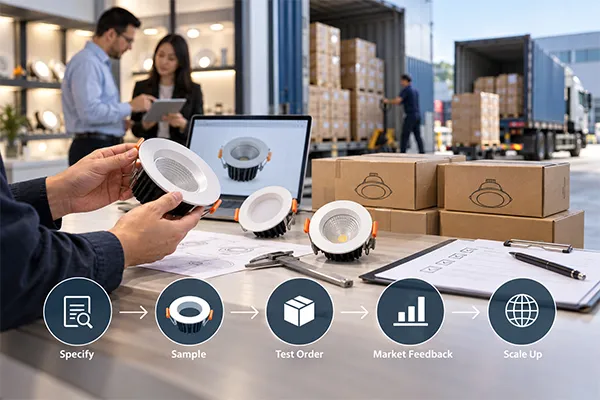
Buyers should validate a global LED downlight distribution network in stages: confirm specifications, review samples, test a limited order, collect market feedback, and then expand proven SKUs4. This process reduces the risk of overstocking products that do not match local installation methods, customer preferences, or compliance requirements.
Start with the application, not the catalogue
A supplier can offer many recessed downlight models, but a large catalogue does not automatically create a suitable local product range. I find that the first discussion should focus on where and how the fittings will be used.
Important questions include:
-
What is the target application?
Is the range intended for homes, hotels, offices, retail stores, corridors, apartments, or public spaces? -
Who will install the products?
Electrical contractors, developers, retail customers, and maintenance teams may have different expectations for wiring, cut-out tolerance, drivers, and installation speed. -
What are the local electrical requirements?
Voltage, frequency, plug or terminal arrangements, dimming systems, and local product documentation requirements should be checked for each country and product.5 -
Which color temperatures are commonly accepted?
A 3000K, 4000K, or 6500K preference can vary by market, project type, and customer segment.6 -
What is the desired channel position?
Is the buyer selling an entry-level range, a mid-market contractor range, a premium architectural range, or a private-label product line? -
What certifications or documents may be required?
Buyers should verify applicable market-entry, electrical safety, environmental, labeling, and testing requirements with qualified local professionals or relevant authorities.
Use a staged validation plan
I have found that a staged buying process creates more useful information than a large first order. A practical route may look like this:
| Stage | Buyer activity | Supplier support to request | Main risk reduced |
|---|---|---|---|
| 1. Requirement alignment | Define target market and application | Datasheets, drawings, parameter options | Incorrect product fit |
| 2. Sample review | Inspect and test selected models | Samples, packaging details, technical clarification | Quality and installation uncertainty |
| 3. Trial order | Purchase a controlled quantity | Production confirmation, aging-test process, shipment plan | Batch and delivery risk |
| 4. Market feedback | Gather installer and customer input | Fast response to questions or adjustments | Poor market acceptance |
| 5. Range expansion | Add proven models and variations | SKU planning, OEM/ODM discussions | Uncontrolled inventory growth |
Anecdotally, I often see buyers begin with a few core models rather than every available size and wattage. They may test a fixed recessed downlight, a dimmable option, and several popular cut-out sizes. Once they understand customer demand, they can add deeper anti-glare models, adjustable downlights, higher-output options, or customized private-label packaging.
This approach does not guarantee market success. However, it can help a distributor make decisions using actual installation and sales feedback instead of assumptions.
What Product Specifications Matter Most in a Global LED Downlight Distribution Network?
A downlight may look similar to another product in photographs, but the specification details determine whether it performs as expected in a local channel. If the specification is incomplete, installers and buyers may interpret the product differently. That can lead to avoidable disputes.
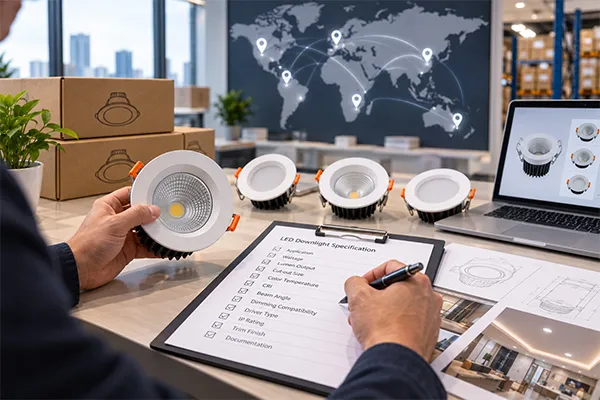
The most important specifications in a global LED downlight distribution network are application fit, wattage, lumen output, cut-out size, color temperature, CRI, beam angle, dimming compatibility, driver type, IP rating, trim finish, and supporting documentation. Buyers should confirm these details in writing before sampling or ordering.
Create a specification sheet that sales and technical teams can use
I recommend that distributors use a structured product specification sheet for each core SKU. This document should be clear enough for purchasing teams, sales teams, contractors, and suppliers to reference the same requirement.
A useful LED downlight specification checklist may include:
| Specification | Why it matters for distribution |
|---|---|
| Input voltage and frequency | Must match the intended electrical system |
| Rated wattage | Supports product positioning and energy-use comparisons |
| Lumen output | Helps buyers assess brightness for the application |
| Luminous efficacy | Provides a useful performance reference |
| Color temperature | Affects local preference and project design intent |
| CRI | Can be important for retail, hospitality, and premium interiors |
| [Beam angle | Influences spacing, glare, and visual comfort](https://www.energy.gov/sites/prod/files/2016/04/f30/miller-north-oledoffice-lightfair2016.pdf)%%%FOOTNOTE_REF_7%%% |
| Cut-out size | Affects compatibility with ceiling openings |
| Outer diameter and height | Affects installation clearance |
| Dimming method | Must be compatible with local control systems where needed |
| [IP rating | Helps assess suitability for damp or protected outdoor areas](https://en.wikipedia.org/wiki/IP_code)%%%FOOTNOTE_REF_8%%% |
| Driver configuration | Affects maintenance, replacement, and installation approach |
| Housing and heat sink material | Influences durability and thermal performance |
| Trim color and finish | Supports local design preferences and branding |
| Packaging method | Affects retail presentation, handling, and damage prevention |
Do not treat labels as full technical confirmation
A product label can provide a helpful overview, but it does not replace a detailed drawing, datasheet, sample evaluation, or agreed quality standard. I encourage buyers to confirm whether stated parameters refer to nominal values, tested values, or tolerance ranges. This is especially important when a buyer is comparing multiple factories.
For example, “12W, 4000K, 90 CRI” does not fully define a downlight. A buyer may also need to clarify:
- The target lumen output and acceptable tolerance
- The LED source and driver configuration, if relevant to the project
- The actual cut-out requirement
- Whether dimming is supported and by which method
- The intended ambient temperature conditions
- The desired color consistency standard
- The required housing finish and packaging language
- The sample approval process before mass production
At Upward Lighting, I support OEM/ODM discussions around parameters such as wattage, color temperature, beam angle, CRI, and surface color. Still, I advise buyers not to rely only on a verbal agreement. The approved specification should be included in a purchase order, pro forma invoice, technical drawing, or other mutually accepted document.
How Do Project Orders and Distribution Stocking Differ in a Global LED Downlight Distribution Network?
Project buyers and regular distributors may purchase the same LED downlight model, but they operate with different risks and buying cycles. When suppliers treat both models in the same way, misunderstandings can happen. I believe buyers should clearly state whether an order is project-driven or intended for ongoing stock.
Project procurement and ongoing distribution require different operating models within a global LED downlight distribution network. Projects depend on approved specifications, site requirements, and delivery milestones, while distribution depends on repeatable SKUs, batch consistency, inventory planning, replenishment speed, and product-line continuity.9

Project purchasing focuses on confirmation and timing
A project order usually begins with a defined scope. The buyer may have a lighting plan, required cut-out size, target brightness, finish requirement, and delivery deadline. A product change after approval can create serious problems, even if the alternative model has similar performance.
For project procurement, I recommend confirming:
- Approved sample and technical datasheet
- Quantity by model and color temperature
- Installation dimensions and ceiling depth
- Driver and dimming requirements
- Packaging and site delivery needs
- Delivery milestones and shipping schedule
- Required product documents for the market or project
- Procedures for handling approved changes
The main concern is usually whether the correct product will arrive at the right time and match the confirmed specification.
Distribution stocking focuses on repeatability
A regular distribution business has a different rhythm. The distributor needs to replenish popular SKUs without redesigning the range every time. Sales teams also need stable product names, photographs, datasheets, packaging, and pricing logic.
For stocking programs, the most important questions are often:
- Which 5 to 15 SKUs are likely to form the core range?
- Can the supplier maintain the model and key components over time?
- What is the expected lead time for repeat orders?
- How will the supplier communicate material or specification changes?
- Can packaging support local branding or language needs?
- Can the distributor start with small batches before increasing volume?
- What is the process for quality feedback and claims?
At Upward Lighting, I work with overseas customers who begin with inquiries, technical confirmations, quotations, and samples before discussing broader product-line expansion. I see this as a more practical path than assuming that one successful project order automatically creates a full distribution program.
A project can validate a particular specification. A distribution relationship must validate repeatability. The two activities can support each other, but they should not be confused.
How Should Buyers Assess Supplier Support and After-Sales Risk?
A supplier relationship is tested most clearly when something changes: a shipment moves later than expected, a specification needs clarification, packaging requires revision, or a quality concern appears after delivery. Buyers may overlook these questions during early price negotiations, but they become critical after market entry.
Buyers should assess supplier support by reviewing communication speed, quotation accuracy, sample handling, quality-control processes, documentation, change-management practices, and claim-response procedures. A reliable LED downlight supplier should help clarify issues early and provide traceable information rather than vague assurances.
Questions to ask before committing
I recommend that importers, wholesalers, contractors, and lighting brands ask direct operational questions before placing a major order.
Supplier communication
- Who will handle technical questions?
- How quickly can the supplier provide a quotation or revised drawing?
- Can the supplier communicate clearly in the buyer’s working language?
- Will the buyer receive confirmation before production begins?
Quality control
- What inspections occur before shipment?
- Does the supplier conduct aging tests or functional checks?
- Can the supplier provide relevant batch information if needed?
- What is the process when products do not meet the agreed specification?
Documentation and compliance
- Which documents can the supplier provide for the selected product?
- Are CE, RoHS, or other documents product-specific and current?
- Can the buyer verify the documents independently?
- What additional local testing, registration, labeling, or approval may be needed?
Upward Lighting holds certifications such as CE and RoHS for applicable products. However, I always recommend that buyers verify certification scope, document validity, and local regulatory suitability for the exact destination market and product configuration. Certifications should be reviewed as documents, not treated as automatic approval for every country or installation.
Build a claim process before the first claim
No manufacturer can responsibly promise that every product will be free from every issue in every installation environment.10 What matters is whether the buyer and supplier agree on a practical process before a problem occurs.
A basic claim process should define:
- The evidence required, such as photos, videos, installation details, batch references, and quantities.
- The response timeline for initial review.
- The method for technical assessment.
- The agreed remedy process, subject to the supply agreement.
- The communication route for future production improvements.
I believe this clarity protects both parties. The distributor can support local customers with a more organized response. The supplier can investigate issues using traceable information instead of assumptions.
Frequently Asked Questions
What is the first step in building a global LED downlight distribution network?
I recommend starting with a target-market and application review. Buyers should define their customer segment, common installation requirements, preferred color temperatures, target price level, and likely core SKUs before comparing suppliers. This makes supplier quotations more relevant and reduces the risk of ordering unsuitable stock.
Should I choose the cheapest LED downlight supplier?
I do not recommend selecting a supplier based only on the cheapest unit price. Buyers should compare product consistency, technical documentation, aging-test practices, communication, replenishment capability, packaging, and claim support. A slightly higher purchase price may reduce operational costs if it prevents local quality or service problems.
How many LED downlight models should a new distributor stock?
I usually suggest beginning with a controlled core range rather than a full catalogue. The right number depends on the market and sales channel, but buyers can often validate demand with a few common sizes, wattages, color temperatures, and trims before adding specialized models.
Are CE and RoHS documents enough for every LED downlight market?
No. CE and RoHS documentation may be relevant for certain products and markets, but they do not automatically confirm suitability for every country, project, or application.11 Buyers should verify the documents for the exact model and consult qualified local compliance professionals regarding applicable requirements.
Can a supplier customize LED downlights for a local brand?
Many manufacturers can support OEM/ODM customization, but the scope should be discussed early. At Upward Lighting, I can discuss options such as wattage, color temperature, beam angle, CRI, surface finish, and packaging. Buyers should confirm minimum quantities, technical feasibility, approval samples, and lead times before launch.
Conclusion
Building a global LED downlight distribution network requires more than sourcing a competitive quotation. I believe the most reliable route is to validate product fit, technical specifications, sample performance, documentation, supplier communication, and repeat-order capability before scaling inventory. Project orders and regular distribution programs should also be managed differently because their risks are not the same. If you are evaluating an LED downlight supplier for a new market, I invite you to contact Upward Lighting for specification discussions, samples, OEM/ODM options, and a practical quotation for your planned product range.
"[PDF] Life Cycle Cost Manual for the Federal Energy Management Program", https://nvlpubs.nist.gov/nistpubs/hb/2020/NIST.HB.135-2020.pdf. Life-cycle cost guidance treats the purchase price as only one element of ownership cost, alongside operating, maintenance, replacement, and related costs incurred over an asset's service life. Evidence role: definition; source type: government. Supports: A lifecycle or total-cost framework includes acquisition, operation, maintenance, replacement, and other ownership costs rather than initial purchase price alone.. ↩
"Purchasing Energy-Efficient Light Bulbs", https://www.energy.gov/cmei/femp/purchasing-energy-efficient-light-bulbs. Public-sector lighting life-cycle analyses include labor for maintenance and replacement among the costs associated with operating installed lighting systems. Evidence role: general_support; source type: government. Supports: Maintenance and replacement labor are recognized cost components in lighting life-cycle cost calculations.. Scope note: The source supports the general cost category and does not quantify replacement labor for a particular downlight, country, or distribution arrangement. ↩
"[PDF] CALiPER Application Summary Report 20: LED PAR38 Lamps", https://www1.eere.energy.gov/buildings/publications/pdfs/ssl/caliper_20_summary.pdf. LED-luminaire technical guidance identifies thermal design, optical distribution, color quality, control compatibility, and environmental rating as performance attributes that are not conveyed by wattage alone. Evidence role: mechanism; source type: research. Supports: LED luminaire performance and suitability depend on optical, electrical, thermal, color-quality, control, and environmental-protection characteristics in addition to nominal wattage.. Scope note: The source provides general technical context and does not establish that every listed attribute will be decisive for every installation. ↩
"A Better Way to Pilot Emerging Technologies", https://sloanreview.mit.edu/article/a-better-way-to-pilot-emerging-technologies/. Research and teaching on pilot implementation describe limited trials as a means of identifying operational and user-fit issues before committing resources to a larger rollout. Evidence role: general_support; source type: education. Supports: Pilot testing and phased rollout are established approaches for gathering feedback and reducing uncertainty before wider deployment.. Scope note: This evidence supports the general logic of phased validation rather than proving outcomes for LED-downlight distribution specifically. ↩
"Standards for Trade-Hong Kong & Macau", https://www.trade.gov/country-commercial-guides/standards-trade-hong-kong-macau. International trade and electrotechnical guidance notes that electrical characteristics and conformity-assessment requirements may differ by destination market, requiring product-specific assessment before placement on the market. Evidence role: general_support; source type: institution. Supports: Electrical systems, plugs, and conformity-assessment or documentation obligations can vary across jurisdictions and product categories.. Scope note: The applicable requirements depend on the jurisdiction, product design, intended use, and legal classification. ↩
"[PDF] Correlated Colour Temperature: use and limitations - ScholarSphere", https://scholarsphere.psu.edu/resources/aca1a9e3-9a20-4008-bfcc-68fd85d42eeb/downloads/19799. Lighting research reports that preferences for correlated color temperature are context dependent and can vary with the task, setting, and characteristics of the users or environment. Evidence role: general_support; source type: paper. Supports: Human preference and acceptance of correlated color temperature are influenced by application context and user or environmental conditions.. Scope note: Preference findings are population- and context-dependent and should not be interpreted as a universal market preference for a particular color temperature. ↩
"[PDF] OLED Lighting in the Offices of Aurora Lighting Design, Inc.", https://www.energy.gov/sites/prod/files/2016/04/f30/miller-north-oledoffice-lightfair2016.pdf. Lighting-design guidance explains that a luminaire's photometric distribution affects the spacing required for illumination uniformity and can influence glare and visual comfort. Evidence role: mechanism; source type: institution. Supports: Luminaire light distribution affects illuminance distribution, fixture spacing, and glare-related visual conditions.. Scope note: Beam angle alone does not determine glare or comfort; mounting geometry, luminance, shielding, surface reflectance, and the visual task also matter. ↩
"IP code", https://en.wikipedia.org/wiki/IP_code. IEC 60529 defines the IP Code as a classification of enclosure protection against access, solid foreign objects, and water ingress. Evidence role: definition; source type: institution. Supports: The IEC IP Code classifies enclosure protection against access, solid foreign objects, and water ingress.. Scope note: An IP rating addresses ingress protection only and does not by itself demonstrate suitability for every outdoor condition, installation method, temperature range, or corrosion environment. ↩
"Practicum Experience - Supply Chain Resource Cooperative", https://scm.ncsu.edu/industry-engagement/practicum-experience. Supply-chain literature distinguishes project or intermittent demand from recurring replenishment demand because their forecasting, inventory-control, and delivery-planning requirements differ. Evidence role: general_support; source type: education. Supports: Project-based demand and recurring replenishment demand require different forecasting, inventory, scheduling, and supplier-management approaches.. Scope note: The distinction is a general supply-chain principle and does not prescribe a single operating model for all lighting distributors. ↩
"[PDF] LED Luminaire Reliability: Impact of Color Shift - Department of Energy", https://www.energy.gov/sites/prod/files/2017/04/f34/lsrc_colorshift_apr2017.pdf. LED reliability research identifies thermal, electrical, component, and environmental conditions as factors that can affect luminaire performance and service life. Evidence role: mechanism; source type: government. Supports: LED and luminaire reliability is affected by operating temperature, electrical conditions, component design, and installation environment.. Scope note: This evidence explains why performance can vary by condition; it does not determine responsibility or remedy under any particular supply agreement. ↩
"CE marking - Internal Market, Industry, Entrepreneurship and SMEs", https://single-market-economy.ec.europa.eu/single-market/goods/ce-marking_en. European Commission guidance states that CE marking applies to products covered by relevant EU harmonisation legislation, while RoHS restricts specified hazardous substances in electrical and electronic equipment within its defined scope. Evidence role: definition; source type: government. Supports: CE marking and the EU RoHS framework have defined legal scopes and do not constitute universal approval for all jurisdictions or uses.. Scope note: Whether a specific product requires CE marking, falls within RoHS scope, or meets another market's requirements depends on the product and the applicable law. ↩