
An LED downlight product portfolio can become difficult to sell when it grows from a supplier catalogue instead of a clear customer need. Too many similar models create stock pressure, quotation confusion, and inconsistent positioning.1 We recommend building a focused range around the market, sales channel, and installation tasks you actually serve.
A successful LED downlight product portfolio is a manageable, commercially coherent range of products designed for a defined market, channel, and application. We believe buyers should begin with essential installation formats, performance requirements, compliance needs, and target price positions, then add variants only when repeat demand justifies them. Supplier capability, sampling, MOQ, customization, quality control, and lead time should all be evaluated as part of the portfolio decision.
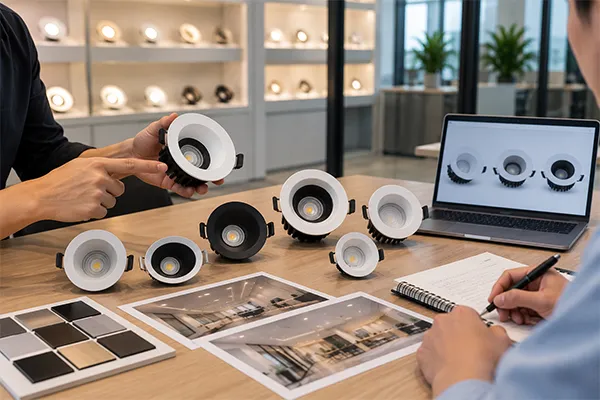
A broad range may look impressive in a presentation, but it can be expensive and difficult to manage in real purchasing. In our recurring discussions with importers, local lighting brands, wholesalers, and project buyers, we see that the strongest ranges usually begin with fewer products and clearer reasons for each one.
How Do We Define an LED Downlight Product Portfolio for the Right Market?
A poorly targeted LED downlight range often starts with a simple question: “Which models do you have?” That question can lead to dozens of options without a clear sales purpose. We encourage buyers to start with the people, projects, and channels they want to serve before selecting products.
An LED downlight product portfolio should be defined by the buyer’s target market, sales channel, and installation application. Retail distributors may need easy-to-explain core models, local brands may need differentiated finishes and packaging, while project buyers may need documented performance and consistent supply. Each channel requires a different balance of product breadth and variant depth.2
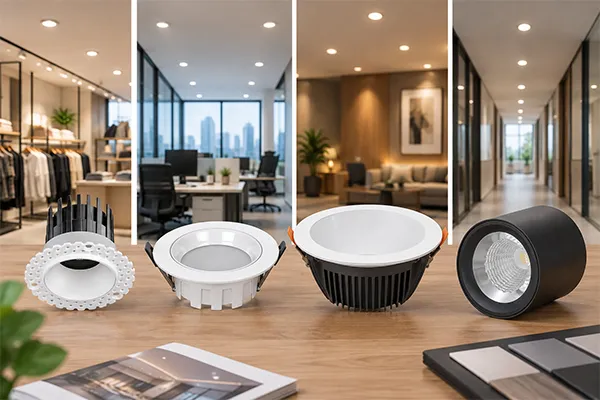
Start With the Customer, Not the Catalogue
We often receive inquiries that begin with a long list of cutout sizes, wattages, trim colors, and color temperatures. Those details matter, but they are not the first decision. We first try to understand what the buyer is selling and who will install the product.
For example, a building-material distributor may need a reliable set of recessed downlights that local electricians recognize and can replace easily. A hospitality project buyer may instead focus on visual comfort, beam control, color consistency, ceiling integration, and project documentation. A local brand may need a recognizable appearance, private labeling, and the flexibility to develop a price ladder.
We recommend asking these questions before building a range:
-
Who is the end customer?
Is the buyer selling to homeowners, electricians, contractors, architects, retailers, or commercial project teams? -
Which channel will sell the products?
Will the products move through wholesale counters, e-commerce, retail display, project tendering, or direct contractor relationships? -
Which applications matter most?
Residential corridors, kitchens, offices, hotels, retail spaces, and outdoor covered areas can require different product priorities. -
What installation habits are common in the target market?
Ceiling construction, cutout preferences, driver placement, wiring methods, and local installation expectations may affect the right product format. -
What market-entry or project documents are required?
Buyers should verify applicable safety, environmental, energy-efficiency, and local compliance requirements for each destination market and project.
Build Around Repeatable Demand
In our experience, a range becomes easier to manage when each core product answers a repeatable customer request. A model should not enter the line merely because it is available from a factory.
A practical portfolio may include:
- A mainstream recessed LED downlight for general residential and commercial use.
- A higher-output option for spaces with greater lighting demand.
- A premium visual-comfort option for customers who value lower glare, deeper anti-glare construction, or upgraded finish quality.
- A surface-mounted or adjustable format where recessed installation is not practical.
- A limited number of project-oriented variants where the buyer has confirmed recurring demand.
We generally find that a product range becomes stronger when every SKU has a defined sales role. If two models solve the same customer problem with no meaningful difference, one of them may only create purchasing complexity.
A well-defined LED downlight product portfolio does not need to cover every possible specification. It needs to cover the needs that the business can explain, quote, stock, and support consistently.
Which Specifications Should an LED Downlight Product Portfolio Cover First?
Many buyers feel pressure to offer every wattage, color temperature, beam angle, and trim style. That approach can create a fragmented product range with small order quantities and unclear demand. We suggest separating non-negotiable core specifications from optional variants that should be introduced only after demand appears.
An effective LED downlight product portfolio should first cover the specifications that directly affect installation compatibility, usable light output, visual result, and price position. Buyers should treat other options as controlled variants. A variant becomes valuable when it answers a recurring customer request and can be sourced, tested, documented, and delivered reliably.
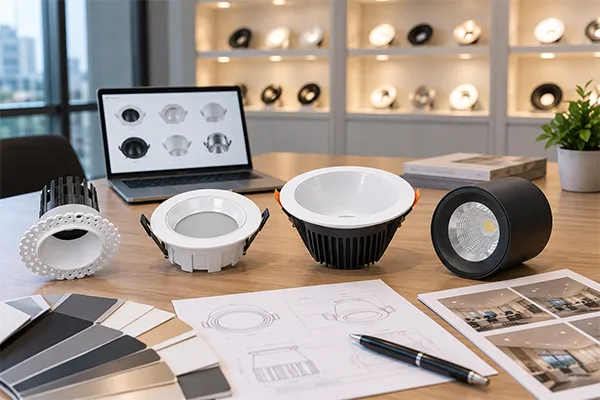
Define Must-Cover Specifications
The exact core specification set depends on the intended market. Still, when we assess a proposed range, we usually separate the decision into a few practical groups.
| Specification Area | Why It Matters | Portfolio Decision |
|---|---|---|
| Installation format | Determines ceiling compatibility and installer acceptance | Select the formats most common in the target channel |
| Cutout and outer diameter | Affects replacement demand and ceiling coordination | Limit sizes to practical, repeatable formats |
| Light output and wattage | Influences application suitability and price position | Build clear performance steps rather than overlapping options |
| [Beam angle | Affects spacing, brightness perception, and visual comfort](https://betterbuildingssolutioncenter.energy.gov/sites/default/files/attachments/understanding_lm79_reports.pdf)%%%FOOTNOTE_REF_3%%% | Include only the beam options needed for key applications |
| Color temperature | Shapes the appearance of the space | Prioritize locally relevant preferences and project requirements |
| [CRI | Matters where color appearance is important](https://www.nist.gov/pml/sensor-science/optical-radiation/color-rendering-light-sources)%%%FOOTNOTE_REF_4%%% | Offer suitable levels based on the product role |
| [Driver and dimming compatibility | Affects installation and control-system suitability](https://www1.eere.energy.gov/buildings/publications/pdfs/ssl/dimming_webcast_12-10-2012.pdf)%%%FOOTNOTE_REF_5%%% | Verify compatibility for each requested version |
| Trim and surface finish | Supports brand positioning and interior coordination | Keep standard finishes focused; add custom finishes selectively |
A retail-oriented line may require a simple explanation such as “standard,” “bright,” and “premium anti-glare.” A technical project line may require more detailed specification control, including dimming methods, driver configuration, ingress protection where relevant, photometric documentation, and project-specific samples.
Avoid Overlapping Performance Steps
We often see ranges with several products that appear different on a spreadsheet but look almost identical to the customer. For example, two downlights may have similar physical dimensions, similar light output, and similar appearance, but only a small price difference. If the sales team cannot explain why both products exist, the range may not be commercially clear.
We recommend using a simple test:
- Does this model solve a different installation problem?
- Does it provide a visibly different lighting result?
- Does it serve a different buyer segment?
- Does it meet a separate compliance or project requirement?
- Does it provide a meaningful quality, appearance, or control-system distinction?
- Can the supplier deliver it at a practical MOQ and lead time?
If the answer is “no” to most questions, the variant may not belong in the initial range.
Treat Customization as a Controlled Tool
At Upward Lighting, we discuss OEM and ODM requests involving color temperature, wattage, beam angle, CRI, surface finish, packaging, and other parameters. We view these choices as useful tools, but not automatic reasons to create more SKUs.
Customization works best when it supports a clear business objective, such as:
- A local brand needs a recognizable trim color or packaging identity.
- A contractor needs a particular color temperature for a repeat project type.
- A distributor needs a specific wattage position that aligns with its existing sales range.
- A buyer needs a sample configuration for an application-specific evaluation.
Buyers should confirm technical feasibility, sample approval requirements, MOQ, pricing impact, and documentation availability before adding a customized version to a permanent LED downlight product portfolio.
Should We Structure an LED Downlight Product Portfolio by Price Alone?
Price is important in every purchasing decision, especially for importers, distributors, and channel partners who need sustainable margins. However, a low, middle, and premium price ladder does not automatically create a useful product range. Products need distinct customer value, not simply different price tags.
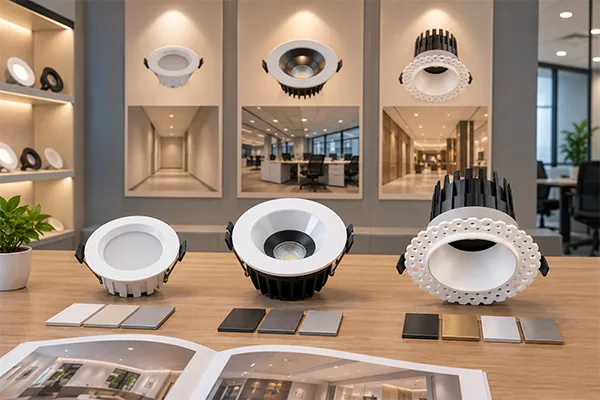
We do not recommend structuring an LED downlight product portfolio by price alone. A lower-priced, mid-range, and premium model should each have a clear installation, visual, performance, service, or compliance role. When price bands lack meaningful differentiation, buyers risk internal competition, customer confusion, and stock that moves slowly.6
Create a Clear Good-Better-Best Logic
A pricing structure can be useful when it reflects real product differences. The goal is not to make the premium option sound better through marketing language. The goal is to identify why a particular customer or application would reasonably choose it.
| Portfolio Tier | Typical Buyer Need | Possible Product Differentiators |
|---|---|---|
| Entry / value | Competitive pricing for common installations | Focused specifications, standard finishes, practical core performance |
| Mainstream | Reliable everyday product for repeat sales | Balanced output, appearance, product consistency, and common options |
| Premium / project | Visual, technical, or brand-specific requirements | Anti-glare design, upgraded finish, higher CRI options, control compatibility, tailored documentation where available |
These categories are examples, not universal rules. Buyers should verify which value drivers matter in their own market. In some channels, a compact low-profile design may justify a premium position. In others, fast delivery and replacement compatibility may matter more than decorative details.
Ask What Problem Each Price Tier Solves
A lower-cost downlight may suit a high-volume residential channel, but it may not be appropriate for a customer that expects a specific visual effect, dimming function, or documented project requirement. Likewise, a premium model may not move through a price-sensitive wholesale channel if the sales team cannot demonstrate its relevant benefits.
We advise buyers to write one sentence for each core SKU:
- “This model is for customers who need…”
- “This model differs from the previous tier because…”
- “This model should not be substituted when…”
That exercise often exposes gaps and duplication quickly.
For example:
“This anti-glare recessed downlight is intended for hospitality and higher-end residential spaces where visual comfort and trim appearance influence the purchase decision.”
This statement is clearer than simply calling a model “premium.”
Protect Margin Without Creating Complexity
We understand that buyers need competitive prices. Still, an overly broad price ladder can create hidden costs:
- More sampling and approval work7
- Higher inventory risk
- More complex packaging and labeling
- Smaller production quantities per model
- More quotation errors
- More difficulty forecasting demand
- More effort for sales staff and distributors
In recurring quotation discussions, we see that a smaller range with clear differentiation can be easier to purchase and present than a large range with minor cost differences. A focused LED downlight product portfolio can help buyers protect margin because it gives customers understandable reasons to trade up or choose a specific model.
How Do Supplier Capabilities Affect an LED Downlight Product Portfolio?
A product may look attractive in a catalogue and still become difficult to commercialize. If the supplier cannot support stable specifications, practical MOQ, sampling, customization, documentation, or realistic delivery planning, that SKU can weaken the entire range. We believe supplier capability is part of product strategy.
An LED downlight product portfolio should include only variants that the selected supplier can produce and support consistently for the intended order pattern. Buyers should evaluate quality-control processes, samples, production feasibility, certifications, MOQ, customization limits, communication speed, and delivery planning before presenting a product as a permanent offer.

Evaluate the Full Supply Process
We recommend evaluating more than the product sample. A sample shows what can be made once.8 A supplier assessment should also examine whether the supplier can manage repeat production under agreed specifications.
At Upward Lighting, our team discusses products through inquiry, quotation, OEM/ODM review, sampling, production feasibility checks, and delivery planning. Those conversations often reveal details that are not visible in a basic product sheet.
Buyers can use the following procurement checklist:
-
Specification control
Can the supplier confirm the requested configuration, including wattage, color temperature, beam angle, CRI, finish, driver type, and packaging? -
Sample process
What will the sample represent? Which details must be approved before bulk production? How are changes recorded? -
MOQ and order flexibility
Is the MOQ suitable for a new launch, a test order, or replenishment? Buyers should obtain supplier-specific confirmation because MOQ can vary by configuration. -
Quality-control practice
Ask how incoming materials, assembly, aging, inspection, and final packing are managed. At Upward Lighting, we conduct a 100% aging test before shipment, generally lasting 4 to 8 hours9, as part of our quality-control process. Buyers should still define their own acceptance criteria and inspection expectations. -
Certification documentation
We can provide products with certifications such as CE and RoHS for relevant configurations.10 However, buyers should verify that the documents, test reports, product markings, and applicable standards meet the specific requirements of their destination market or project. -
Lead-time planning
Ask about normal production timing, material availability, peak-season capacity, packaging requirements, and shipping coordination. A supplier should confirm lead time for the actual order, not only provide a general estimate.
Use a Supplier Scorecard
A scorecard can help purchasing teams compare suppliers objectively. We suggest scoring each supplier against the factors that matter most to the intended portfolio.
| Evaluation Factor | Questions for Buyers | Why It Matters |
|---|---|---|
| Product fit | Does the product match the intended segment? | Prevents irrelevant SKUs |
| Specification clarity | Are requested parameters documented clearly? | Reduces approval and production misunderstandings |
| Sample quality | Does the approved sample match the commercial requirement? | Supports controlled launch decisions |
| MOQ flexibility | Can the buyer test and replenish at practical quantities? | Helps manage inventory exposure |
| Customization capability | Can the supplier support useful differentiation? | Supports local-brand and project needs |
| Quality process | Are aging and inspection practices explained? | Supports procurement due diligence |
| Documentation | Can relevant documents be supplied and verified? | Helps with market and project review |
| Communication | Are quotations and technical responses timely and clear? | Reduces procurement delays |
Plan for Consistency, Not Perfection
No supplier should promise that every variant, order, or market requirement will be identical without a detailed review. We believe buyers should build a practical approval process that includes signed specifications, approved samples, packaging confirmation, labeling review, and pre-shipment inspection expectations.
A strong LED downlight product portfolio is not simply a collection of attractive models. It is a range that purchasing, sales, logistics, and technical teams can support repeatedly. That is why supplier selection should happen alongside portfolio planning, not after the product list is already fixed.
Frequently Asked Questions
How many SKUs should an LED downlight portfolio include?
We do not believe there is one correct number. We recommend starting with the smallest range that covers your main applications, price positions, and installation needs. Add new SKUs only when customer inquiries, sales patterns, or project requirements show repeatable demand.
What is the most important specification when choosing LED downlights?
The most important specification depends on the installation task. We usually begin with installation format, light output, beam angle, color temperature, and the intended sales position. Buyers should also verify control compatibility, compliance requirements, and product documentation for their specific market.
Should we offer multiple color temperatures in every downlight model?
Not necessarily. Multiple color temperatures can increase sales flexibility, but they can also create inventory complexity. We suggest offering the color temperatures that match verified local preferences or project needs, then adding alternatives when demand is consistent and sourcing remains practical.
How should importers verify LED downlight certifications?
Importers should request relevant certification documents, product markings, reports, and model references from the supplier. They should then verify that the documents apply to the exact product configuration and meet destination-market or project requirements. Professional compliance guidance may be appropriate for application-specific decisions.
Can OEM or ODM customization improve a downlight range?
OEM or ODM customization can improve differentiation when it supports a clear commercial purpose. For example, a buyer may need branded packaging, a specific surface finish, or an application-focused specification. Buyers should confirm feasibility, sample requirements, MOQ, pricing, and lead time before launch.
Conclusion
A successful LED downlight product portfolio is not the largest possible selection. It is a focused range that serves a defined market, channel, and installation need with clear product roles. We recommend prioritizing repeatable core specifications, meaningful differentiation, practical pricing logic, and supplier capabilities that can be verified before commitment. At Upward Lighting, we work with brands, importers, distributors, and project buyers on OEM/ODM discussions, samples, and sourcing evaluations. Contact us to discuss a manageable downlight range for your target market.
"Understanding the Dynamics of Value-Driven Variety Management", https://sloanreview.mit.edu/article/understanding-the-dynamics-of-valuedriven-variety-management/. Operations-management research reports that expanding product variety can increase inventory requirements, forecasting difficulty, and process complexity, particularly when demand is distributed across many low-volume SKUs. Evidence role: general_support; source type: research. Supports: Research on product variety and SKU proliferation showing that broader assortments can increase inventory, forecasting, and operational-management complexity.. Scope note: The magnitude of these effects depends on demand patterns, replenishment systems, and the specific distribution channel. ↩
"[PDF] Development of an Assortment-Planning Model for - VTechWorks", https://vtechworks.lib.vt.edu/bitstreams/020a17b3-782d-483e-98c5-ced810db5efd/download. Assortment research indicates that the appropriate breadth and depth of an offering vary with channel customer needs, purchasing behavior, and the level of product comparison or technical support required. Evidence role: general_support; source type: paper. Supports: Marketing and retail research describing how customer needs, information availability, and purchase behavior across channels influence assortment design.. Scope note: This literature generally addresses assortment strategy across sectors and does not prescribe a single LED-downlight assortment. ↩
"[PDF] Understanding LM-79 Reports - Better Buildings Solution Center", https://betterbuildingssolutioncenter.energy.gov/sites/default/files/attachments/understanding_lm79_reports.pdf. Lighting-design guidance explains that a luminaire’s beam angle determines the spread of its luminous intensity and therefore affects illuminated area, spacing between luminaires, and potential visual-comfort conditions. Evidence role: mechanism; source type: institution. Supports: Lighting-design guidance explaining that beam angle determines the angular distribution of luminous intensity and influences beam spread, spacing, and glare-related visual conditions.. Scope note: Visual comfort also depends on luminance, shielding, mounting geometry, room reflectances, and the observer’s position. ↩
"Color rendering of light sources - NIST", https://www.nist.gov/pml/sensor-science/optical-radiation/color-rendering-light-sources. The color rendering index (CRI) is a standardized metric used to characterize how faithfully a light source renders test colors relative to a reference source, making it relevant where color appearance is an important lighting criterion. Evidence role: definition; source type: government. Supports: Authoritative explanation of CRI as a measure used to compare how a light source renders object colors relative to a reference illuminant.. Scope note: CRI is not a complete measure of perceived color quality and should be interpreted with other color metrics and the intended application. ↩
"[PDF] LED Dimming: What you need to know - eere.energy.gov", https://www1.eere.energy.gov/buildings/publications/pdfs/ssl/dimming_webcast_12-10-2012.pdf. Technical guidance on LED controls notes that dimming performance depends on compatibility between the LED driver, the dimmer or control system, and the luminaire’s electrical design. Evidence role: mechanism; source type: government. Supports: Technical guidance showing that LED dimming performance depends on compatibility among the LED driver, dimmer or control protocol, and luminaire design.. Scope note: A compatible control method does not by itself establish performance for a particular product combination; configuration-specific testing may still be required. ↩
"Are Consumers Turned Off by Too Many Choices? Not Yet.", https://www.gsb.stanford.edu/insights/are-consumers-turned-too-many-choices-not-yet. Research on product-line cannibalization and assortment complexity indicates that closely overlapping offers can redirect demand among a seller’s own products and increase decision difficulty for customers. Evidence role: mechanism; source type: paper. Supports: Research on product-line cannibalization and choice complexity indicating that overlapping offerings can shift demand among a firm's own products and make customer decisions more difficult.. Scope note: Slow inventory movement is also affected by forecasting accuracy, pricing, seasonality, and distribution execution. ↩
"CIRP Annals - Manufacturing Technology - personal.umich.edu", https://www-personal.umich.edu/~ykoren/uploads/Product_variety_and_manufacturing_complexity_in_assembly_lines.pdf. Quality-management literature recognizes that each additional product configuration can add specification-control, validation, sampling, and approval activities before routine supply is established. Evidence role: general_support; source type: research. Supports: Quality-management and operations literature showing that additional product variants increase specification, validation, and change-control activities.. Scope note: The additional workload varies according to the extent of configuration change and the buyer’s quality-assurance process. ↩
"[PDF] Process Validation: General Principles and Practices | FDA", https://www.fda.gov/files/drugs/published/Process-Validation--General-Principles-and-Practices.pdf. Manufacturing-quality guidance distinguishes approval of an individual sample from process validation, which provides evidence that a production process can repeatedly deliver output meeting defined specifications. Evidence role: mechanism; source type: government. Supports: Manufacturing-quality guidance distinguishing an individual sample or prototype from evidence that a controlled process can repeatedly meet specifications.. Scope note: The applicable validation method and evidence level depend on the product, regulatory context, and contractual quality requirements. ↩
"[PDF] Stress Testing of Organic Light-Emitting Diode Panels and Luminaires", https://www.energy.gov/sites/prod/files/2018/05/f51/ssl_oled-stresstest_2018.pdf. Company quality-control records or an independent inspection report should document whether every unit undergoes the stated pre-shipment aging test and the recorded test duration. Evidence role: case_reference; source type: other. Supports: An auditable internal quality-control procedure, production record, or independent inspection report documenting the stated 100% aging-test practice and duration.. Scope note: General information on LED burn-in testing can explain the practice but cannot independently verify this company-specific procedure. ↩
"CE marking - Wikipedia", https://en.wikipedia.org/wiki/CE_marking. European Union guidance explains that CE marking requires applicable conformity assessment and documentation, while RoHS restricts specified hazardous substances in covered electrical and electronic equipment. Evidence role: definition; source type: government. Supports: Official European Union requirements for CE marking and RoHS compliance documentation applicable to electrical and electronic equipment placed on the EU market.. Scope note: Official regulatory guidance does not verify that a particular supplier’s documents apply to a specific downlight configuration; product-specific documentation must be reviewed. ↩