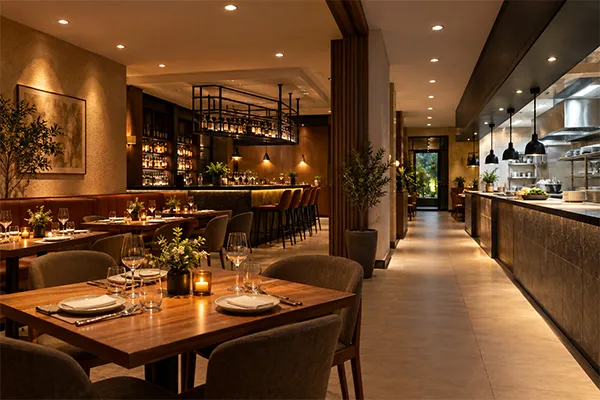
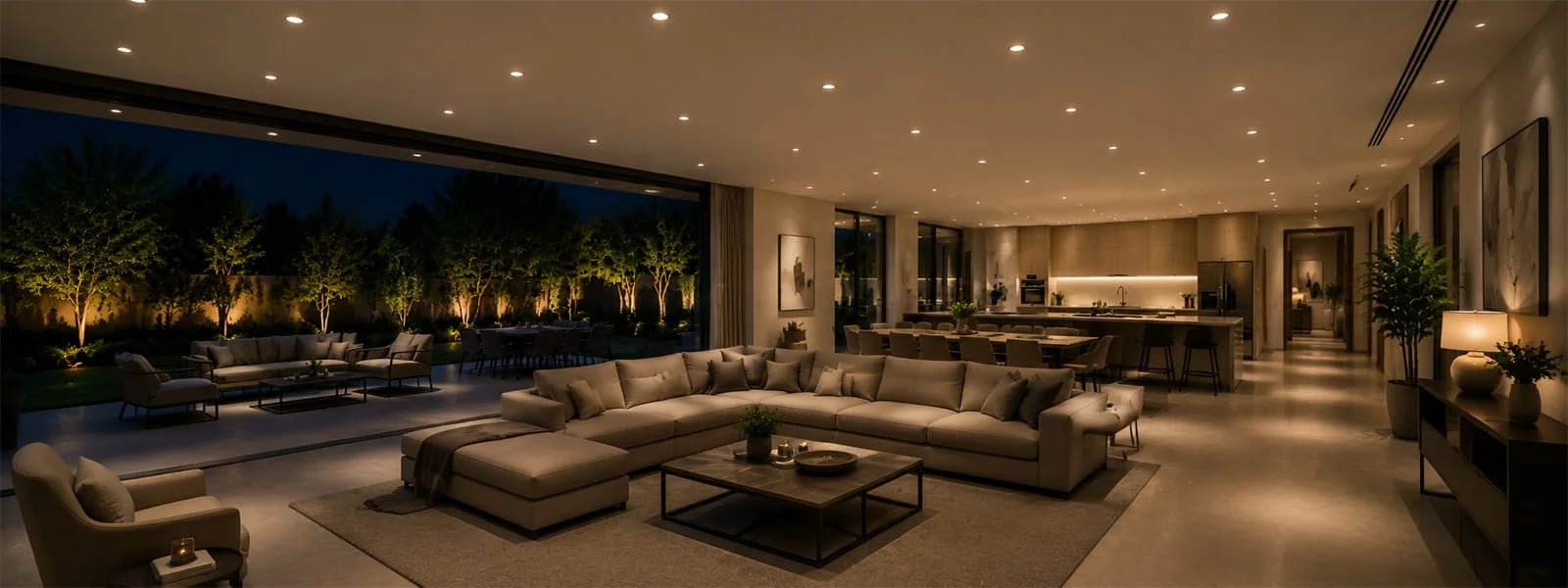
Professional LED downlights can either strengthen a lighting brand or quietly weaken it when the product definition, quality consistency, and supply support do not match the promise made to customers. A low initial purchase price may look attractive, but complaints about color differences, delayed replenishment, or unclear compliance documents can cost far more over time. We see stronger results when brands define their downlights around real applications and reliable delivery expectations.
Professional LED downlights build brand value by helping brands deliver consistent light quality, application-appropriate specifications, verified compliance documentation, and dependable supply. A logo or custom finish alone does not create meaningful differentiation. In our OEM/ODM experience, the strongest downlight ranges are designed around the target market, installation environment, customer expectations, and the brand’s ability to replenish the same product consistently.
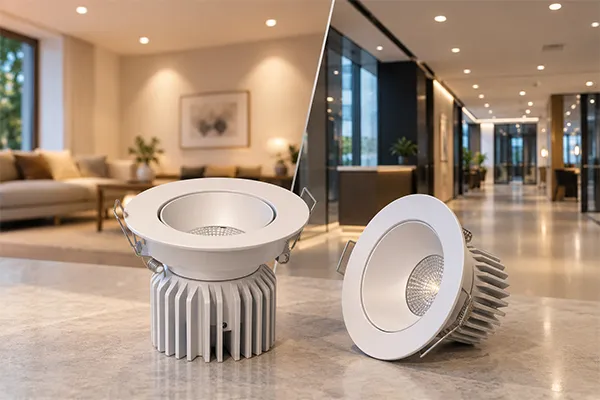
At Upward Lighting, we work with brands, importers, distributors, contractors, and channel partners that need more than a catalog item. They need a product range that supports a reputation. In this article, I will explain how buyers can use product definition, quality control, documentation, and supplier coordination to turn a downlight range into a long-term brand asset.
Why Do Professional LED Downlights Matter for Brand Positioning?
A lighting brand can lose its identity when every supplier offers what appears to be the same recessed fixture. The problem becomes more serious when the installed light does not reflect the brand’s stated quality level, visual style, or intended application. We help customers avoid this gap by defining professional LED downlights around a clear market position rather than a generic product description.
Professional LED downlights matter for brand positioning because their specifications can communicate a deliberate promise to installers, distributors, and end users. Wattage, color temperature, beam angle, CRI, housing finish, and installation fit should support the brand’s intended segment1, whether that segment is residential, retail, hospitality, office, or project supply.
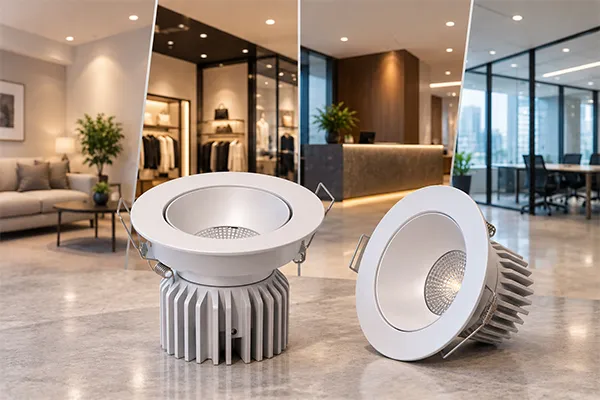
A product label is not a product strategy
I often see buyers begin with visible customization. They may request a printed logo, a private label box, or a different surface color. These options can be useful, especially when a brand is preparing for retail shelves or distributor presentation. However, visible branding has limited value if the underlying downlight is not designed for the buyer’s actual market.
For example, a brand that targets premium residential renovations may need a different product definition than a distributor that supplies fast-moving electrical wholesale channels. The residential brand may focus more on:
- Warm and consistent 2700K or 3000K light appearance
- Higher CRI requirements for interior finishes and furnishings2
- Low-glare visual comfort3
- Trim colors that coordinate with modern ceilings
- Dimming compatibility where relevant to the target channel
A commercial or retail-focused range may instead prioritize:
- Practical lumen output for the installation height
- Beam control for display areas or circulation spaces
- A consistent appearance across larger quantities
- Simple installation features for contractors
- Reliable availability for phased projects or replenishment orders
Neither approach is automatically better. The important point is that the specification should make sense for the promised use case.
Positioning starts with a defined buyer and space
When we prepare an OEM or ODM quotation, we find that the most useful early questions are not only “What is the price?” They are questions such as:
- Who will buy this downlight?
- Where will it be installed?
- What lighting problem should it solve?
- What price segment does the brand want to occupy?
- Will the product be sold as a stock item, a project item, or both?
- What level of customization can the purchasing volume support?
These questions help turn a product into a range with a purpose.
| Brand Positioning Goal | Product Definition Consideration | Buyer Risk if It Is Ignored |
|---|---|---|
| Entry-level electrical channel range | Practical wattage, standard CCT options, straightforward installation | Confusing assortment or insufficient value perception |
| Residential design-led range | Warm CCT, CRI, trim finish, glare control | Light appearance does not match marketing images |
| Retail and hospitality supply | Beam angle, color consistency, output, finish durability | Uneven lighting effect across the space |
| Contractor project range | Cutout size, driver arrangement, delivery continuity | Installation delays and difficult replacement sourcing |
| Private-label importer range | Packaging, labeling, documentation, replenishment plan | Brand identity without long-term supply support |
In our manufacturing work, I have learned that the best custom request is not necessarily the most complex request. It is the request that clearly supports a customer’s commercial promise.
A professional range gives buyers a reason to choose the brand again. It also gives sales teams a more credible story than “this downlight has our logo on it.”
How Do Professional LED Downlights Protect Product Consistency?
A quotation can list wattage, CCT, beam angle, and CRI, yet customers may still experience disappointment after installation if products do not appear or perform consistently from batch to batch. This is where brand damage often begins. We encourage buyers to assess professional LED downlights as repeatable manufactured products, not simply as individual samples that look acceptable on a desk.
Professional LED downlights protect product consistency when buyers evaluate the full supply process, including component control, production checks, aging procedures, sample approval, and repeat-order alignment. Consistent output and appearance help reduce channel disputes, installation concerns, and avoidable replacement requests4, although no manufacturing process can guarantee zero field failures.

Why the sample is only the beginning
A pre-production sample is important, but it does not answer every procurement question. A sample can confirm the visible design, general installation method, light effect, and requested parameters. However, buyers also need to ask how the supplier manages consistency when the order moves from one sample to hundreds or thousands of units.
At Upward Lighting, we support product customization across parameters such as:
- Color temperature
- Wattage
- Beam angle
- Color Rendering Index (CRI)
- Surface finish colors
Each choice needs a clear approved reference. If the product definition changes informally during production or across reorders, a brand may receive stock that is difficult to sell alongside earlier inventory.
For example, “3000K downlight” is a useful commercial description, but it should not be treated as the entire quality discussion5. Buyers may also need to review the visual consistency of the delivered range, especially when multiple fittings are installed together in a residential ceiling, retail area, or hospitality environment.
Evaluate the process, not only the specification sheet
We recommend that procurement teams ask for a practical quality-control discussion. The goal is not to demand impossible guarantees. The goal is to understand what the supplier checks, what documents are available, and how exceptions are handled.
Our own process includes a 100% aging test before shipment, normally lasting 4 to 8 hours. This is a quality-control step intended to identify issues before products leave the factory and to support industry expectations for lumen maintenance. It should not be interpreted as proof that every product will have zero defects, that every installation condition is suitable, or that a universal service life is guaranteed.
A useful supplier evaluation may include the following areas:
| Evaluation Area | What Buyers Can Ask | Why It Protects the Brand |
|---|---|---|
| Approved sample | Is there a confirmed reference for key parameters and finish? | Creates a shared basis for production review |
| Incoming components | How are major components managed and checked? | Supports repeatability across production |
| Aging process | Is aging conducted, and for how long? | Helps identify some early-stage issues before shipment |
| Appearance review | How are trim finish, housing condition, and labels checked? | Protects shelf presentation and installed appearance |
| Functional checks | What electrical and lighting-related checks are included? | Helps buyers understand the control process |
| Packaging | Can labels, manuals, cartons, and barcodes be customized? | Supports channel readiness and traceability |
| Reorder management | How is the approved specification retained for future orders? | Reduces avoidable product variation over time |
Batch consistency becomes visible after installation
I have seen many procurement decisions focus heavily on the unit price difference between two products. Price matters, especially for wholesalers and distributors working in competitive channels. Still, a small price saving may become less meaningful if the buyer later faces mixed stock, confusing replacement requests, or a distributor complaint about visibly inconsistent installed products.
Brand value is built through repeated positive experiences:
- The contractor receives the expected cutout and fit.
- The distributor receives the expected model and packaging.
- The showroom customer sees a consistent finish.
- The end user experiences the intended light appearance.
- The purchasing team can reorder without rebuilding the specification from the beginning.
These outcomes are not glamorous, but they are commercially important. Consistency gives a lighting brand the confidence to make promises that its supply chain can realistically support.
How Should Brands Select Professional LED Downlights for Different Applications?
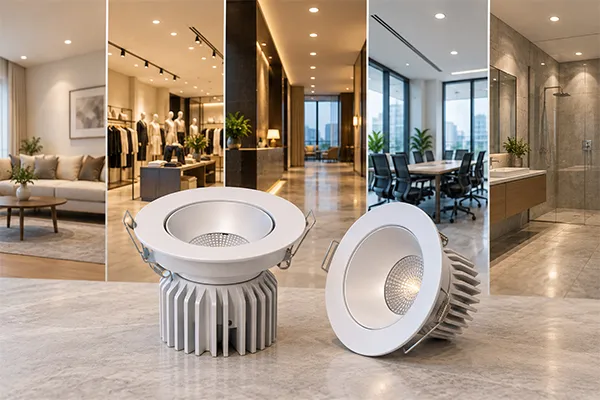
Many downlight ranges become difficult to sell because one model is expected to serve every ceiling, room type, and lighting task. This approach can create poor light distribution, unsuitable visual comfort, or installation problems. We advise buyers to select professional LED downlights according to the real environment rather than forcing a universal SKU into residential, retail, hospitality, and project applications.
Brands should select professional LED downlights by matching the fixture’s output, color temperature, beam angle, CRI, form factor, and installation conditions to the space and lighting task. A downlight intended for ambient residential lighting may not be the right choice for merchandise emphasis, high-ceiling circulation areas, or moisture-exposed locations6.
Start with the lighting task
A downlight is not simply a hole in the ceiling with a light source inside it. It influences how people perceive surfaces, products, pathways, food, interiors, and room scale. For that reason, we encourage product managers and buyers to define the lighting task before selecting a specification.
Common tasks include:
- Ambient lighting: General illumination for homes, corridors, offices, and common areas.
- Accent lighting: Focused light for products, wall features, artwork, or architectural details.
- Task-support lighting: Light that supports practical activities near counters, work areas, or display zones.
- Mood or hospitality lighting: Warm, controlled illumination that supports a desired atmosphere.
The same wattage does not always create the same commercial result. Beam angle, mounting height, room finishes, spacing, and surrounding lighting all affect the final experience7.
A practical application comparison
| Application | Common Product Priorities | Questions a Buyer Should Ask |
|---|---|---|
| Residential interiors | Warm CCT, suitable CRI, visual comfort, trim style | Does the light suit bedrooms, living rooms, kitchens, or corridors? |
| Retail stores | Beam angle, output, color quality, consistent appearance | Is the goal general light, product emphasis, or both? |
| Hospitality spaces | Warm ambience, glare management, finish coordination | Does the fixture support the intended guest experience? |
| Offices and commercial areas | Uniformity, practical output, installation efficiency | Does the layout support comfortable general illumination? |
| Electrical wholesale channels | Core SKU clarity, installation compatibility, repeatability | Can installers understand and reorder the range easily? |
| Project supply | Approved specification control, logistics, documentation | Can the supplier support phased deliveries and matching replenishment? |
Avoid overpromising from a catalog description
A product datasheet is useful, but it cannot replace an application-specific evaluation. Ceiling height, spacing, dimming system, ambient temperature, insulation conditions, local wiring practices, and project regulations can all affect selection. I recommend that contractors, project managers, and technical leads involve qualified lighting or electrical professionals when a project requires detailed photometric planning, safety review, or code-specific interpretation.
This point is especially important for brands selling into multiple regions. A model that is suitable for one channel may require a different configuration, document set, or installation review elsewhere.
We can help define manufacturing options, prepare product samples, and discuss practical product parameters. However, project-specific lighting design and compliance decisions should be verified by qualified professionals8 for the actual application and market.
A well-structured brand range does not need dozens of nearly identical models. In many cases, it is better to offer a smaller number of clearly positioned options. For example, a brand may create:
- A standard residential recessed downlight range.
- A higher-CRI range for design-conscious interiors.
- A narrow or medium beam option for retail and feature lighting.
- A project-oriented option with controlled specifications and repeat-order support.
This structure makes the range easier to explain, quote, stock, and replenish. It also helps customers choose with more confidence.
Can Supply Execution Increase the Value of Professional LED Downlights?
A carefully designed product can still damage a brand if the supplier cannot respond quickly, support trial quantities, maintain the agreed specification, or coordinate repeat deliveries. This problem often appears after the first order, when the brand begins receiving real channel feedback. We view professional LED downlights as both a product and a supply commitment.
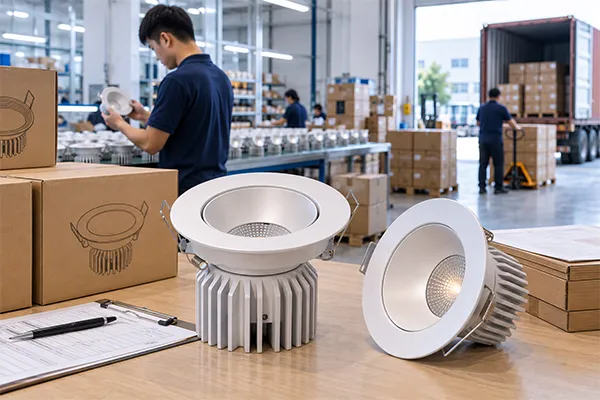
Supply execution increases the value of professional LED downlights because brands need reliable quotations, sample coordination, small-batch validation, customization support, documentation review, and replenishment planning. A supplier relationship should help the buyer launch and repeat the product with confidence, not only complete a single transaction.
Small-batch orders can reduce launch risk
For emerging lighting brands, a full container or very large first order may not be the best first step. A small-batch order can allow the buyer to evaluate packaging, customer response, installer feedback, product appearance, and sales velocity before expanding the range9.
At our factory in Zhongshan City, we support small-batch orders where practical, alongside OEM/ODM customization. This approach can help a customer validate a new product direction without committing immediately to a large inventory position.
A sensible launch process may look like this:
- Define the target application and channel.
- Confirm the essential specification and visible finish.
- Review a sample or pre-production reference.
- Verify market and customer documentation requirements.
- Place a controlled initial order.
- Collect feedback from installers, distributors, or end users.
- Refine the range before a wider rollout.
- Maintain the approved specification for replenishment.
This process does not remove commercial risk. It can, however, make that risk more visible and manageable.
Compliance documents require market-specific verification
Buyers often ask whether CE and RoHS10 are enough for their target market. Our products hold certifications such as CE and RoHS, which are relevant to safety, environmental protection, and market-entry expectations in many contexts. However, we always recommend that buyers verify the specific requirements for their destination country, sales channel, customer, and project.
A certification document should be reviewed as part of the procurement package, not treated as a universal passport for every situation11. Requirements can vary based on:
- Destination market
- Product category and configuration
- Customer procurement rules
- Local electrical regulations
- Project specifications
- Importer responsibilities
- Labeling and packaging requirements
Brands should also confirm whether the requested customized configuration remains aligned with the documentation they plan to use. This is particularly relevant when changes involve drivers, wattage, product construction, or market-specific labeling.
Reliable communication supports time to market
A slow quotation can slow a product launch12. An unclear technical response can create internal delays for a purchasing team. A supplier that cannot retain the approved product definition can complicate repeat business.
We aim to support rapid customer responses, quick quotation turnaround, and supply coordination because these operational details affect a buyer’s ability to sell. Our annual sales revenue is approximately US$5 million, and we serve customers in markets across Europe, the Middle East, Asia-Pacific, and other regions. That broad export experience helps us understand that different buyers need different levels of customization, packaging support, and document review.
Still, every relationship should be evaluated directly. I suggest that buyers assess a supplier with practical questions:
- How quickly does the supplier clarify a quotation?
- Can the supplier explain customization limits clearly?
- Can the supplier support a reasonable trial order?
- How are approved specifications recorded?
- What aging and inspection steps occur before shipment?
- What documents can the supplier provide for review?
- How does the supplier communicate about production and delivery timing?
- Can the supplier support future replenishment of the same range?
A supplier does not create brand value alone. The buyer still needs clear product strategy, realistic forecasts, and market knowledge. But a capable supplier can make it far easier to deliver the brand promise consistently.
Frequently Asked Questions
What makes a LED downlight professional?
A professional LED downlight is defined by more than its appearance or price. It should have specifications suited to the intended application, controlled manufacturing quality, appropriate documentation, and a supply process that supports consistent repeat orders. Buyers should assess the product and supplier together.
Are custom logos enough to create a private-label downlight brand?
A custom logo, label, carton, or finish can support private-label presentation, but it does not create meaningful differentiation by itself. A stronger brand strategy connects the product’s wattage, CCT, beam angle, CRI, housing style, and packaging to a defined customer segment and installation use.
Why is a 100% aging test important for LED downlights?
A 100% aging test helps manufacturers identify certain early-stage issues before shipment. At Upward Lighting, we conduct aging tests for 4 to 8 hours before shipment. This is a quality-control process, not a guarantee of zero defects, universal service life, or suitability for every installation environment.
Do CE and RoHS certifications cover every market requirement?
No. CE and RoHS documentation can be important for relevant market-entry and environmental requirements, but buyers should verify requirements for the target country, customer, product configuration, and project. Local regulations, importer responsibilities, and channel rules may require additional review.
Should a new lighting brand start with a small downlight order?
A small initial order can be a practical way to validate product appearance, packaging, sales demand, and installer feedback before expanding inventory. The best approach depends on the target channel, customization level, logistics costs, and forecast. Buyers should also plan for consistent replenishment if the launch succeeds.
Conclusion
Professional LED downlights build brand value when they help a business deliver the same promise from quotation to installation and repeat order. We believe brands should look beyond unit price and evaluate application fit, specification control, batch consistency, quality processes, compliance documentation, and supply responsiveness. A customized logo is useful, but dependable performance and repeatable supply create stronger long-term differentiation. If you are developing a private-label or project-focused downlight range, we invite you to contact Upward Lighting to discuss OEM/ODM options, small-batch validation, and practical supply planning.
"[PDF] CALiPER Application Summary Report 20: LED PAR38 Lamps", https://www1.eere.energy.gov/buildings/publications/pdfs/ssl/caliper_20_summary.pdf. Lighting-selection guidance identifies color appearance, color rendering, distribution, and installation conditions as factors that should be evaluated in relation to the intended space and visual task. Evidence role: general_support; source type: government. Supports: That correlated color temperature, color rendering, light distribution, and fixture characteristics are relevant factors in selecting lighting for particular spaces and visual tasks.. Scope note: This supports the general selection principle; it does not prescribe a single specification set for every market segment. ↩
"Understanding LED Color-Tunable Products | Department of Energy", https://www.energy.gov/cmei/ssl/understanding-led-color-tunable-products. Color-rendering guidance explains that a lamp's spectral output influences the perceived color fidelity of illuminated objects and materials, making color rendering relevant where material appearance is important. Evidence role: mechanism; source type: government. Supports: That color-rendering metrics describe how a light source affects the perceived colors of illuminated objects compared with a reference illuminant.. Scope note: CRI alone does not fully predict preference or the appearance of every material; spectrum, color temperature, and viewing conditions also matter. ↩
"[PDF] Glare and Diffuse Sources", https://www.energy.gov/sites/prod/files/2021/02/f82/ssl-rd21-schwade-glare.pdf. Indoor-lighting research and guidance recognize glare as a contributor to visual discomfort and identify luminaire luminance, shielding, and light distribution as relevant design variables. Evidence role: mechanism; source type: research. Supports: That glare can reduce visual comfort and that luminaire distribution and shielding affect glare in indoor environments.. Scope note: Perceived glare depends on the observer, viewing direction, room surfaces, and installation geometry, not solely on the fixture model. ↩
"[PDF] Quality and Consistency of Machined Components and Products", https://www.nist.gov/system/files/documents/oles/2-Donmez-Alkan-Manufacturing-2012-07-10-MSSFFA.pdf. Quality-management standards describe process control, conformity assessment, and corrective action as means of reducing nonconforming outputs and improving customer satisfaction. Evidence role: general_support; source type: institution. Supports: That controlling process variation and conforming production to defined requirements are core quality-management practices intended to reduce nonconformities and customer dissatisfaction.. Scope note: Such standards support the quality-management rationale but do not quantify the reduction in disputes or replacement requests for downlights specifically. ↩
"[PDF] LED Color Characteristics", https://www.energy.gov/sites/prod/files/2016/08/f33/led-color-characteristics-factsheet.pdf. Technical lighting guidance defines correlated color temperature as a measure of a source's apparent color appearance, rather than a complete measure of color rendering, distribution, or overall lighting quality. Evidence role: definition; source type: government. Supports: That correlated color temperature describes the apparent warmth or coolness of a light source and is distinct from color-rendering performance and other lighting characteristics.. Scope note: The source establishes the distinction between metrics but does not determine whether a particular 3000 K product is suitable for a given installation. ↩
"[PDF] Chapter 5: Lighting, HVAC, and Plumbing - eere.energy.gov", https://www1.eere.energy.gov/buildings/publications/pdfs/commercial_initiative/sustainable_guide_ch5.pdf. Lighting-design and electrical-safety guidance distinguishes between ambient and accent lighting tasks and requires luminaires in wet or damp locations to be selected according to their environmental rating and installation conditions. Evidence role: general_support; source type: education. Supports: That lighting tasks, mounting conditions, and wet or damp location ratings influence luminaire selection.. Scope note: Specific fixture suitability must still be established using the product rating, local code, and the actual site conditions. ↩
"[PDF] Understanding LM-79 Reports - Better Buildings Solution Center", https://betterbuildingssolutioncenter.energy.gov/sites/default/files/attachments/understanding_lm79_reports.pdf. Interior-lighting design guidance explains that luminaire distribution, mounting height, spacing, and surface reflectance interact to determine illuminance patterns and perceived visual conditions. Evidence role: mechanism; source type: government. Supports: That illuminance and visual conditions in an interior are influenced by luminaire distribution, mounting geometry, spacing, and room-surface reflectances.. Scope note: A site-specific photometric calculation is needed to predict performance for a particular room and layout. ↩
"3126.6. Lighting, Access, and Electrical Work.", https://www.dir.ca.gov/title8/3126_6.html. Professional and code-based guidance treats electrical and lighting compliance as dependent on applicable standards and site conditions, supporting review by competent professionals for project-specific decisions. Evidence role: expert_consensus; source type: institution. Supports: That electrical and lighting installations are subject to applicable codes, standards, and site-specific design considerations that require competent assessment.. Scope note: The required qualifications and governing rules vary by jurisdiction and project type. ↩
"[PDF] Comment Letter - Health and Human Services' Request for Information", https://advocacy.sba.gov/wp-content/uploads/2025/07/Comment-Letter_Advocacy-Comments-to-HHS-Deregulatory-RFI.pdf. Operations-management research on demand uncertainty describes pilot production and limited initial quantities as ways to gather market information before scaling inventory commitments. Evidence role: general_support; source type: research. Supports: That pilot launches and smaller initial production quantities can provide demand information before larger commitments under uncertainty.. Scope note: Smaller orders may increase unit costs and do not ensure that subsequent demand or replenishment requirements will be favorable. ↩
"CE marking – obtaining the certificate, EU requirements - Your Europe", https://europa.eu/youreurope/business/product-rules-compliance/general-product-compliance/ce-marking/index_en.htm. European Union guidance states that CE marking is required for products covered by applicable harmonized EU legislation, while the RoHS Directive restricts specified hazardous substances in electrical and electronic equipment within its scope. Evidence role: definition; source type: government. Supports: That CE marking applies when harmonized EU legislation requires it and that the RoHS Directive restricts specified hazardous substances in electrical and electronic equipment within its scope.. Scope note: Applicability depends on the product, its configuration, and the legislation in force; CE marking and RoHS do not by themselves establish compliance with every national, project, or customer requirement. ↩
"Preparing technical documentation - Your Europe - European Union", https://europa.eu/youreurope/business/product-rules-compliance/general-product-compliance/preparing-technical-documentation/index_en.htm. Regulatory guidance requires economic operators to maintain and assess product-specific conformity documentation under the applicable legal framework, rather than treating a document as universally transferable across products or markets. Evidence role: general_support; source type: government. Supports: That conformity assessment, technical documentation, declarations of conformity, and importer obligations are tied to applicable legislation and the product placed on the market.. Scope note: Documentation requirements differ across jurisdictions, product categories, and regulatory regimes. ↩
"[PDF] S ig n a tu re - DSpace@MIT", https://dspace.mit.edu/bitstreams/67e6a654-3141-439b-ad5a-c7159151321f/download. Supply-chain and new-product-development research links timely supplier coordination and information exchange with reduced development delays and improved product-introduction performance. Evidence role: mechanism; source type: paper. Supports: That supplier coordination and responsiveness can affect information flow, development lead time, and new-product introduction performance.. Scope note: Quotation speed is only one contributor to launch timing; internal approvals, testing, logistics, and regulatory review may also determine the schedule. ↩