

CE certification requirements for LED downlights can seem simple when a supplier sends a marked product or a document called a “CE certificate.” However, incomplete or mismatched files can create avoidable sourcing risk. I recommend that buyers review the product configuration, declaration, labels, and supporting evidence together before approving a supplier or placing an order.
CE certification requirements for LED downlights are best understood as a manufacturer documentation responsibility, not as one certificate to collect.1 Buyers should confirm that the supplier’s legal identity, LED downlight model, rated specifications, labeling, Declaration of Conformity, and relevant supporting test documents are consistent. Any meaningful change—such as wattage, driver, cutout, dimming option, or control method—should trigger a clarification request before procurement proceeds.
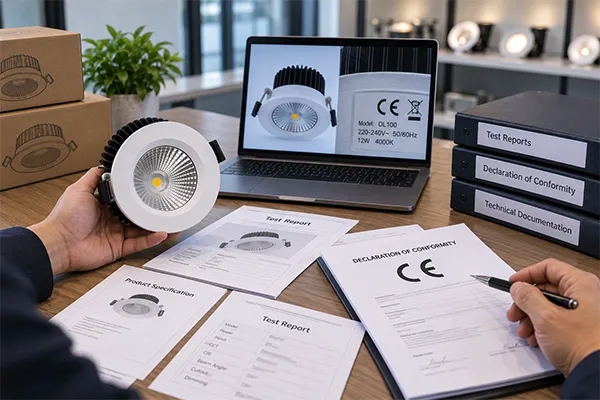
In our export documentation coordination, buyers often begin by asking us for “a CE certificate.” That request is understandable, but the more useful procurement question is whether the documents actually relate to the exact downlight configuration being quoted, labeled, private-labeled, and shipped. The sections below explain how I would screen this information before moving forward.
What Do CE Certification Requirements for LED Downlights Actually Mean?
CE certification requirements for LED downlights can be confusing because many buyers expect a single approval document from an outside organization. That expectation can lead to weak supplier screening. A supplier may provide an attractive-looking file, yet the named model, electrical rating, or product description may not match the item being purchased.
For LED downlights, CE-related compliance generally involves the manufacturer identifying applicable EU requirements, preparing a Declaration of Conformity, maintaining supporting technical documentation, and applying the CE marking where appropriate.2 Buyers should not treat a document titled “CE certificate” as complete proof on its own. Instead, they should review the declaration and supporting evidence for consistency with the proposed product.
CE Marking Is Not Simply a Certificate
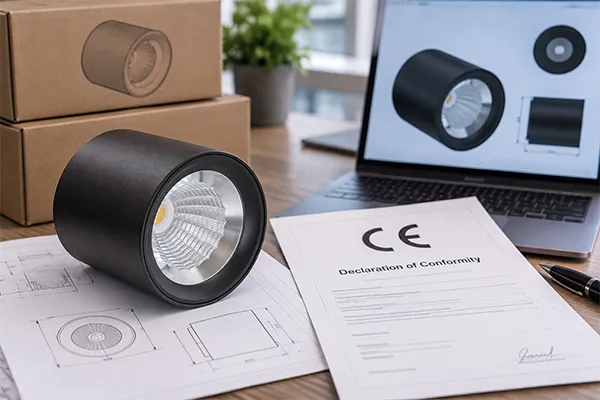
I find that the phrase “CE certificate” is widely used in global sourcing, even though it can oversimplify the buyer’s task. A CE mark is not automatically equivalent to a universal product approval issued through one standalone certificate.3 The relevant process and documentation depend on the product, its intended market placement, applicable requirements, and manufacturer responsibilities.4
For procurement purposes, I recommend separating the following items:
| Document or Item | Practical Purpose for a Buyer | What Buyers Should Check |
|---|---|---|
| CE mark on product or packaging | Indicates the product is presented as CE marked | Marking format, traceability, and alignment with product label |
| EU Declaration of Conformity | States the manufacturer’s declaration regarding applicable requirements | Manufacturer identity, model, product description, date, signature, referenced requirements |
| Test report | Provides technical evidence for a tested sample or product family | Exact model coverage, ratings, sample description, issue date, laboratory details |
| Product label | Identifies the actual supplied item | Model number, voltage, wattage, IP rating where applicable, manufacturer/importer details as required |
| Technical file | Internal manufacturer documentation supporting the declaration | Usually not fully handed over, but buyers can ask what evidence supports the model |
| RoHS documentation | Addresses restricted-substance considerations | Product scope, supplier identity, document type, material declarations where relevant |
A buyer does not necessarily need every internal technical file before making a sourcing decision. However, a buyer should be able to understand what files exist, which models they support, and whether they match the products in the quotation.
Why the Manufacturer Identity Matters
The legal entity named in the documentation is a basic but important checkpoint.5 In our own documentation work, I have seen buyers compare a quotation from one company with a declaration issued by another company. Sometimes there is a reasonable explanation, such as a manufacturing entity, trading entity, or authorized arrangement. However, the relationship should be clear rather than assumed.
I suggest that buyers ask:
- Is the company named on the Declaration of Conformity the manufacturer of record?
- Does the supplier explain any difference between the factory name, exporter name, and brand owner name?
- Will the product label and packaging carry the same model identity used in the documentation?
- If the buyer uses private labeling, who will maintain the relevant documentation and product traceability?
- Does the supplier have a clear process for document updates when the product changes?
In my experience, a supplier who can clearly explain document ownership and model scope is usually easier to work with than a supplier who only forwards a generic PDF without context.
Keep Regulatory Decisions Separate From Procurement Screening
This article is a procurement screening guide, not legal advice or a substitute for an application-specific review. Requirements can depend on the destination country, product characteristics, installation environment, sales channel, and project specification. Buyers should verify current official requirements and consult qualified compliance, legal, technical, or testing professionals when a decision is high risk.
Still, procurement teams can make better early decisions by refusing to accept vague documentation. That simple habit reduces the chance of finding a model mismatch after production, shipment, customs review, tender submission, or customer complaint.
How Can Buyers Check CE Certification Requirements for LED Downlights Against the Actual Product?
CE certification requirements for LED downlights become meaningful only when the paperwork matches the goods being ordered. Buyers can lose time when they review documents after a purchase order is issued, especially if the supplier has changed the driver, wattage, trim size, or dimming option during quotation. A structured consistency check can identify these issues earlier.
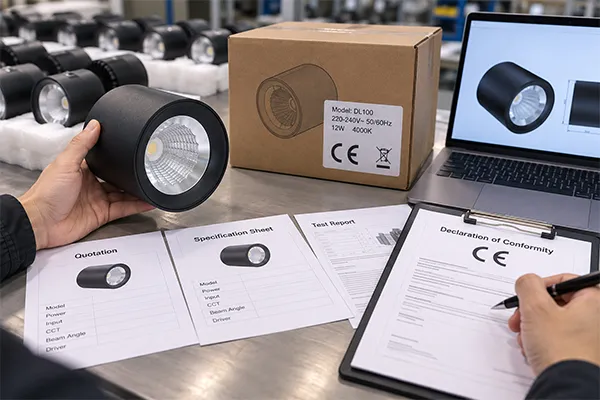
Buyers should compare the supplier name, model number, product description, rated voltage, wattage, driver type, and key configuration details across the quotation, specification sheet, product label, Declaration of Conformity, and relevant test reports.6 If any detail differs, buyers should ask the supplier to explain whether the documentation covers the proposed LED downlight configuration.
Use a Model Consistency Matrix
I recommend using a simple matrix before approving samples, artwork, or production. This process is not complicated, but it is much more reliable than checking whether a PDF includes a CE logo.
Here is a practical example:
| Checkpoint | Quotation | Product Label | Declaration | Test Documentation | Buyer Action |
|---|---|---|---|---|---|
| Supplier/manufacturer name | Upward Lighting | Upward Lighting | Upward Lighting | Laboratory client listed | Clarify any name differences |
| Model number | UL-DL12-15W | UL-DL12-15W | UL-DL12 series | UL-DL12-15W listed | Confirm series coverage |
| Input voltage | 220–240V AC | 220–240V AC | 220–240V AC | Same rating stated | Investigate a mismatch |
| Rated wattage | 15W | 15W | 12W/15W/18W series | 15W sample tested | Confirm exact variant |
| Driver type | Flicker-controlled driver | Driver code listed | Driver family stated | Driver model shown | Ask whether substitution is allowed |
| Dimming function | Triac dimmable | Dimmable | Dimmable version stated | Dimming configuration tested | Confirm control compatibility |
| Cutout size | 120 mm | Product packaging | Product drawing reference | Dimensional drawing available | Confirm physical model identity |
| Brand | Buyer private label | Buyer private label | Manufacturer model referenced | Factory model referenced | Maintain traceability link |
The objective is not to demand that every document uses identical marketing wording. The objective is to establish a traceable link from the order line to the specific product configuration.
Start With the Purchase Order, Not the Certificate
I often recommend that buyers begin with the commercial document that controls production: the quotation, proforma invoice, product specification, or purchase order. This is where the actual commercial configuration is defined.
For LED downlights, key details commonly include:
- Model number or internal SKU
- Power rating, such as 7W, 10W, 12W, 15W, or 20W
- Input voltage and frequency
- Color temperature, such as 3000K, 4000K, or 6500K
- Beam angle
- CRI requirement, such as CRI 80 or CRI 90
- Cutout diameter and outer trim diameter
- Driver brand, driver model, or driver performance requirement
- Dimming type, including non-dimmable, Triac, 0–10V, DALI, or other requested controls
- IP rating, if relevant to the intended installation
- Finish color, trim style, reflector, or anti-glare design
- Emergency or sensor options, where applicable
Once this baseline is fixed, the buyer can compare each CE-related file against it.
Ask Suppliers to Explain Differences in Writing
A mismatch does not always mean that the documentation is invalid or unusable. A series declaration may cover multiple variants, and a report may identify a family rather than every commercial SKU. However, buyers should not make that judgment without a supplier explanation.
I suggest asking direct, written questions such as:
- Does this Declaration of Conformity cover the quoted 15W, 4000K, 120 mm cutout model?
- Which driver model was used for the supporting test sample?
- Does the report cover the Triac-dimmable version, or only the non-dimmable version?
- Can you provide a model cross-reference between your factory code and our private-label SKU?
- Has the product structure, LED board, driver, housing, or rated wattage changed since the document was issued?
- Which files will be provided with the final shipment, and which model numbers will appear on labels and cartons?
A capable supplier should answer these questions with specific model references rather than general assurances.
Why Do Product Variants Affect CE Certification Requirements for LED Downlights?
CE certification requirements for LED downlights can become harder to assess when one product family includes many variants. Buyers may assume that a report for one downlight automatically applies to every wattage, size, driver, and control option. That assumption can create risk because meaningful changes may affect the relevance of existing supporting evidence.
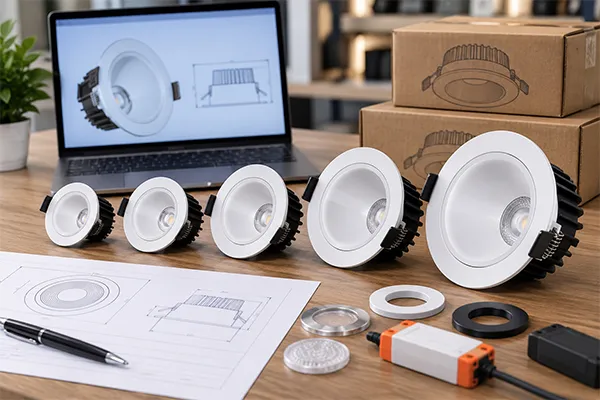
Buyers should treat changes in wattage, driver, dimming method, physical size, cutout, LED module, housing, IP construction, or intended use as review triggers.7 A supplier should clarify whether the existing declaration and supporting documents apply to the requested configuration, rather than expecting the buyer to assume that one test report covers the entire LED downlight range.
Not All Variants Carry the Same Documentation Risk
Manufacturers often offer LED downlight families with multiple commercial options. This flexibility helps brands and distributors serve different projects, but it also makes document control more important.
For example, a customer may request a standard 12W recessed downlight and later ask for:
- A 15W version for higher light output
- A different constant-current driver
- Triac dimming instead of non-dimmable operation
- A larger cutout for a renovation project
- CRI 90 instead of CRI 80
- A black trim instead of white
- A higher IP construction for a moisture-prone area
- A different LED color temperature or tunable option
Some changes may have limited impact on the relevant evidence, while others may be significant. I would not advise buyers to decide this independently from a product photo or a generic specification sheet. Instead, I recommend treating every material change as a question for the supplier’s technical and documentation team.
Focus First on Functional and Electrical Changes
From a buyer’s screening perspective, the following changes deserve particularly careful clarification:
| Variant Change | Why It Can Matter | Buyer Question |
|---|---|---|
| Wattage increase or decrease | Changes electrical and thermal operating conditions | Is this exact wattage included in the documented product scope? |
| Driver substitution | Can affect electrical performance, EMC behavior, dimming, and reliability | Which driver code applies to our order, and does the evidence reference it? |
| Dimming option | Adds a control function and may change the driver configuration | Is the report or declaration relevant to the requested dimmable version? |
| Input voltage change | Changes intended electrical use | Does the documentation identify the correct voltage range? |
| IP rating change | May affect enclosure construction and intended installation | Is the requested IP version separately identified? |
| Housing or heat sink change | Can affect thermal management and product construction | Has the mechanical structure changed from the documented sample? |
| LED board or module change | Can affect product performance and thermal operation | Is the LED source configuration the same as documented? |
| Cutout and size change | May indicate a different housing or product model | Is it a true variant or a separate model requiring separate review? |
A finish-color change may sometimes be less significant than a driver substitution, but buyers should still preserve traceability. A black-trim item with a different housing, coating process, or branded packaging may not be the same commercial model from a document-control standpoint.
Customization Requires Better Version Control
At Upward Lighting, we provide OEM/ODM options for color temperature, wattage, beam angle, CRI, and surface finish. I see customization as valuable for buyers, but it should be managed with disciplined documentation.
For a private-label project, I would encourage buyers to request a controlled product specification that includes:
- Factory model number
- Buyer SKU or brand model number
- Revision date
- Product photo or technical drawing
- Electrical ratings
- Driver code
- LED configuration
- Dimming option
- Label artwork reference
- Packaging reference
- Applicable document reference numbers
This approach creates a practical bridge between purchasing, quality control, and compliance coordination. It also helps prevent an accidental substitution during repeat orders.
A product family can be commercially similar without being documentation-identical. Buyers should ask for the link between the requested configuration and the supplied files.
Include Variant Review in Pre-Shipment Quality Control
Documentation review should not end when the buyer approves a sample. Before shipment, buyers can ask suppliers to verify that production labels, carton labels, and final specifications still match the approved configuration.
In our manufacturing process, we conduct a 100% aging test for 4 to 8 hours before shipment as part of our quality-control routine.8 That process is separate from CE documentation, but it illustrates an important procurement principle: product quality checks and documentation checks should support each other, not operate as disconnected tasks.
A pre-shipment review can include:
- Confirm the final production model and revision.
- Confirm the rated wattage and input voltage on labels.
- Confirm the driver model used in production.
- Confirm the required dimming or control option.
- Confirm CE-marking artwork where applicable.
- Confirm that shipping documents reference the correct product description.
- Archive the final Declaration of Conformity and supporting files with the purchase order.
How Should Buyers Separate CE, RoHS, UKCA, and Test Reports?
CE certification requirements for LED downlights are often mixed together with RoHS declarations, UKCA documents, and laboratory reports. This creates confusion because each document type serves a different purpose. A buyer who accepts any one of these files as a complete package may overlook important gaps in model coverage or market relevance.
Buyers should review CE, RoHS, UKCA, and third-party test reports as separate but related evidence categories. CE-related documentation concerns EU market responsibilities; RoHS addresses restricted substances; UKCA relates to Great Britain requirements; and test reports provide supporting technical evidence for defined samples or model scopes.9 Buyers should verify the current requirements for their destination market and sales channel.
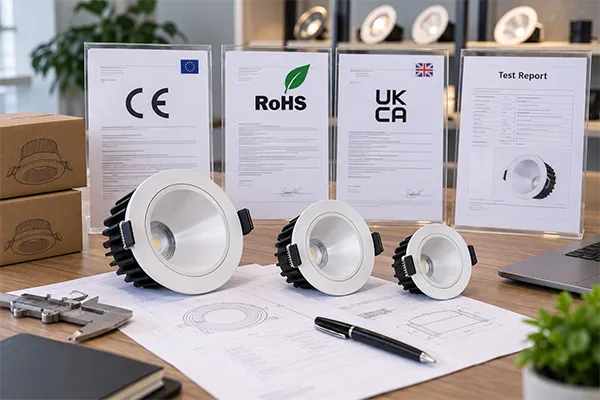
A Practical Document Comparison
The following table is a useful procurement reference. It is not a legal determination, and buyers should confirm current official requirements before relying on it for a market-entry decision.
| Document Type | Main Procurement Role | Common Buyer Mistake | Better Buyer Practice |
|---|---|---|---|
| CE-related Declaration of Conformity | Links the manufacturer and product to a declaration of applicable requirements | Treating it as interchangeable with a generic certificate | Check model, manufacturer, date, product description, and signature |
| RoHS declaration or related evidence | Supports restricted-substance screening | Assuming it proves all product safety or CE matters | Review it as a separate environmental-compliance document |
| UKCA-related documentation | Supports Great Britain market planning where applicable | Assuming CE and UKCA files always have the same scope | Confirm current UK requirements and exact destination |
| Third-party test report | Provides evidence concerning a sample, family, or stated configuration | Assuming one report covers every product variation | Read the report scope, model list, ratings, and sample description |
| CB report or certificate, where applicable | May support electrical safety evaluation in certain contexts | Treating it as automatic EU market authorization | Ask how it relates to the specific product and intended market |
| Supplier specification sheet | Defines commercial product details | Treating it as compliance proof | Use it to cross-check all other records |
Build a Supplier Documentation Pack
For importers, distributors, and lighting brands, I recommend requesting a basic documentation pack before final supplier approval. The exact contents should reflect the market and project, but a practical starting list includes:
- Company registration and supplier contact details
- Product specification sheet
- Product drawing or dimensional drawing
- Product label artwork or label sample
- EU Declaration of Conformity for the relevant model or family
- Available relevant test documentation
- RoHS-related declaration or supporting documents, if required
- IP-related evidence for products sold on an IP claim
- Driver specification and driver model identification
- Product photos showing the actual configuration
- Warranty terms and quality-control process summary
- Change-control commitment for drivers, LEDs, housings, and key components
For UK-focused supply, buyers should separately assess the documents and marking requirements relevant to Great Britain. For Northern Ireland, the EU, and other destinations, the applicable approach may differ.10 I recommend verifying this against current official sources or qualified advisers rather than relying on a supplier’s generic export statement.
Evaluate the Supplier’s Response Process
The quality of a supplier’s response often reveals more than the first PDF they send. I pay attention to whether a supplier can answer precise questions quickly and consistently.
Positive indicators include:
- The supplier identifies exact models rather than only product categories.
- The supplier explains document scope in writing.
- The supplier distinguishes between a standard version and a customized version.
- The supplier can provide a cross-reference for OEM or private-label SKUs.
- The supplier flags uncertainty rather than making unsupported promises.
- The supplier confirms whether a driver or component has changed.
- The supplier maintains organized revision records.
Warning signs include:
- The supplier refuses to identify the tested model.
- The report shows a different product type with no explanation.
- The quotation lists a different wattage from the declaration.
- The label has no traceable model code.
- The supplier says, “All products use the same certificate,” without model-level clarification.
- The supplier sends files with expired-looking, altered, incomplete, or unclear information.
- The supplier cannot explain who owns the declaration or technical documentation.
I would not automatically reject a supplier based on one inconsistency. However, I would pause approval until the supplier provides a clear, document-supported explanation.
Frequently Asked Questions
Is a CE certificate enough for LED downlights?
No. A document called a CE certificate should not be treated as complete evidence by itself. Buyers should also review the Declaration of Conformity, product label, quoted specifications, and relevant supporting test documentation. The key question is whether the files match the exact LED downlight configuration being purchased.
What should match across LED downlight CE documents?
Buyers should compare the manufacturer identity, model number, product description, input voltage, wattage, driver type, dimming option, and relevant physical configuration. Minor wording differences may be explainable, but meaningful differences should be clarified in writing before production or shipment.
Does one test report cover all LED downlight wattages?
Not necessarily. A report may cover a specific model, sample, or defined product family. Buyers should not assume that a report for a 12W non-dimmable downlight also covers a 15W dimmable version with a different driver. The supplier should explain the documented scope.
Are CE and RoHS the same for LED downlights?
No. CE-related documentation and RoHS documentation serve different purposes. RoHS concerns restricted substances, while CE-related obligations concern applicable EU product requirements and manufacturer documentation.11 Buyers should request and assess each document type separately for the intended market and product.
Should private-label buyers request new CE documentation?
Private labeling can require careful traceability, especially when the buyer changes model codes, labels, packaging, drivers, wattages, or other product details. Buyers should ask the supplier who will maintain the relevant documentation and how the buyer’s SKU links to the factory model and supporting evidence.
Conclusion
CE certification requirements for LED downlights should be approached as a practical document-matching exercise rather than a search for one impressive-looking certificate. I recommend that buyers compare the quotation, model number, label, Declaration of Conformity, driver details, and supporting reports before approving a supplier or customized order. Variants deserve extra attention because a change in wattage, driver, dimming, size, or construction may affect document relevance. If you are sourcing LED downlights for Europe, contact Upward Lighting to discuss your required specifications, OEM/ODM options, and product-documentation coordination needs.
"Signing an EU declaration of conformity - Your Europe", https://europa.eu/youreurope/business/product-rules-compliance/general-product-compliance/signing-declaration-conformity/index_en.htm. European Commission guidance explains that, for products subject to CE-marking legislation, the manufacturer is responsible for conformity assessment, technical documentation, the EU Declaration of Conformity, and affixing the CE marking where the applicable legislation requires it. Evidence role: general_support; source type: government. Supports: Official EU guidance on the manufacturer's role in assessing conformity, preparing technical documentation and an EU Declaration of Conformity, and affixing CE marking.. Scope note: The applicable conformity-assessment procedure depends on the specific EU harmonisation legislation and product category. ↩
"CE marking – obtaining the certificate, EU requirements", https://europa.eu/youreurope/business/product-rules-compliance/general-product-compliance/ce-marking/index_en.htm. EU CE-marking guidance describes a process in which the manufacturer identifies applicable requirements, compiles technical documentation, issues an EU Declaration of Conformity, and affixes CE marking when the relevant Union legislation applies. Evidence role: definition; source type: government. Supports: The required elements of CE-marking compliance, including applicable legislation, technical documentation, the EU Declaration of Conformity, and CE marking.. Scope note: This general process does not by itself establish which directives or regulations apply to every downlight configuration. ↩
"EU - EU Legislation and CE Marking", https://www.trade.gov/country-commercial-guides/eu-eu-legislation-and-ce-marking. European Commission CE-marking information states that CE marking signifies conformity with applicable EU requirements and that involvement of a notified body is required only where the relevant legislation prescribes it, rather than as a universal product-approval certificate. Evidence role: definition; source type: government. Supports: That CE marking is a conformity indication under EU product legislation and that third-party notified-body certification is required only in specified cases.. Scope note: Some product categories and conformity modules do require notified-body participation. ↩
"EU - EU Legislation and CE Marking", https://www.trade.gov/country-commercial-guides/eu-eu-legislation-and-ce-marking. The EU Blue Guide explains that obligations, conformity-assessment procedures, and documentation requirements must be determined under the Union harmonisation legislation applicable to the product concerned. Evidence role: general_support; source type: institution. Supports: That EU conformity assessment and documentation obligations are determined by the applicable Union harmonisation legislation and the characteristics of the product placed on the market.. Scope note: The guide provides horizontal interpretive guidance; a product-specific determination still requires analysis of the relevant legal acts. ↩
"Signing an EU declaration of conformity - Your Europe", https://europa.eu/youreurope/business/product-rules-compliance/general-product-compliance/signing-declaration-conformity/index_en.htm. EU product-legislation guidance identifies manufacturer name and contact information as core traceability information and requires the EU Declaration of Conformity to identify the manufacturer responsible for the declaration. Evidence role: general_support; source type: government. Supports: Requirements for identification of manufacturers and for manufacturer details in product conformity documentation under EU product rules.. Scope note: The precise label and documentation requirements vary among the applicable sectoral legal instruments. ↩
"COMMISSION NOTICE - The 'Blue Guide' on the ... - EUR-Lex", https://eur-lex.europa.eu/legal-content/EN/TXT/PDF/?uri=CELEX:52016XC0726(02). The EU Blue Guide states that technical documentation should make it possible to assess conformity and identify the product, supporting checks that model designation and relevant technical characteristics are traceable across associated records. Evidence role: general_support; source type: institution. Supports: That technical documentation and declarations must permit identification of the product and assessment of its conformity, making consistent model and rated-characteristic information material to traceability.. Scope note: The guide does not prescribe this exact buyer-side comparison matrix. ↩
"The Blue Guide on the implementation of the product rules ...", https://single-market-economy.ec.europa.eu/news/blue-guide-implementation-product-rules-2022-published-2022-06-29_en. The EU Blue Guide explains that a product modified after placement on the market may need to undergo a new conformity assessment when the modification is substantial and can affect compliance with applicable requirements. Evidence role: mechanism; source type: institution. Supports: That substantial modifications can affect a product's conformity status and can require a new conformity assessment or updated documentation.. Scope note: Whether an individual change in wattage, driver, dimensions, or enclosure is substantial depends on the applicable legislation and technical assessment. ↩
"Reliability test and failure analysis of high power LED ...", https://ui.adsabs.harvard.edu/abs/2011JSemi..32a4007Z/abstract. Reliability literature describes burn-in or aging tests as screening methods used to expose early-life failures in electronic and LED-related systems under defined operating conditions. Evidence role: general_support; source type: research. Supports: The general use of burn-in or aging tests in electronics and LED reliability screening.. Scope note: Such literature supports the general rationale for aging tests but cannot verify the stated 100% coverage or 4-to-8-hour practice at this manufacturer; that assertion requires auditable internal quality records. ↩
"European Union Reduction of Hazardous Substances ...", https://www.waru.edu/artifact/european-union-reduction-hazardous-substances-rohs-and-waste-electrical-and-electronic. Official EU and UK guidance distinguishes CE marking as an EU conformity-marking framework, RoHS as legislation restricting specified hazardous substances in electrical and electronic equipment, and UKCA marking as the Great Britain product-marking regime for applicable goods. Evidence role: definition; source type: government. Supports: The distinct purposes of CE marking under EU product law, RoHS restrictions on hazardous substances in electrical and electronic equipment, and UKCA marking for products placed on the Great Britain market.. Scope note: The exact obligations, accepted markings, and transition arrangements depend on product category, destination, and the rules in force at the time of placement on the market. ↩
"Placing CE, or CE and UKNI marked products on the market in Northern ...", https://www.gov.uk/guidance/placing-ce-or-ce-and-ukni-marked-products-on-the-market-in-northern-ireland. UK government guidance distinguishes the product-marking rules applicable in Great Britain from those applicable in Northern Ireland, where EU requirements continue to be relevant for many goods and UKNI marking may apply in specified notified-body circumstances. Evidence role: historical_context; source type: government. Supports: The differing product-marking arrangements for Great Britain and Northern Ireland, including circumstances in which CE and UKNI marking may be relevant.. Scope note: Rules and transition provisions can change, and this guidance must be checked against the current product category and supply route. ↩
"CE marking", https://en.wikipedia.org/wiki/CE_marking. Directive 2011/65/EU restricts the use of specified hazardous substances in electrical and electronic equipment, while EU CE-marking guidance addresses conformity with the requirements of the applicable Union harmonisation legislation. Evidence role: definition; source type: government. Supports: The subject matter of the RoHS Directive and the separate role of CE marking under applicable EU harmonisation legislation.. Scope note: RoHS can itself be among the legislation relevant to an electrical product's conformity obligations, so the regimes are distinct in purpose but may both apply to the same product. ↩