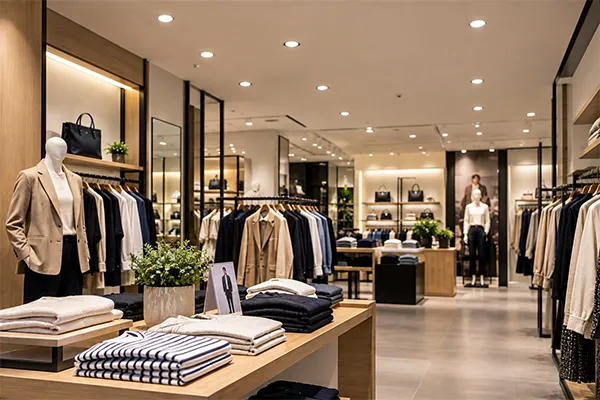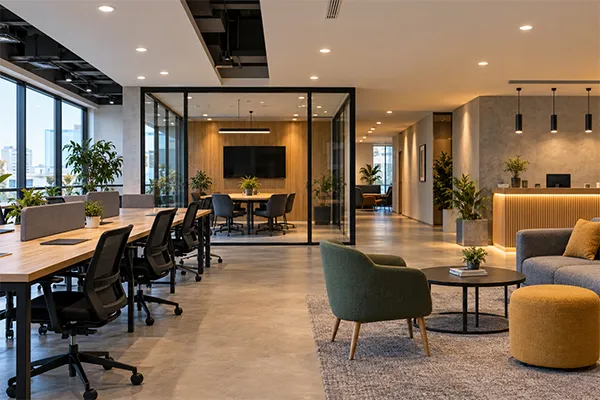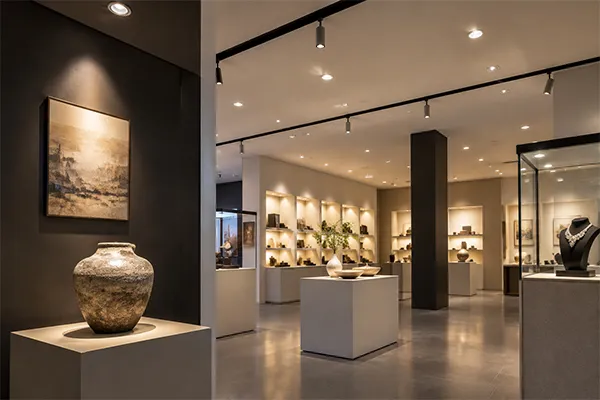
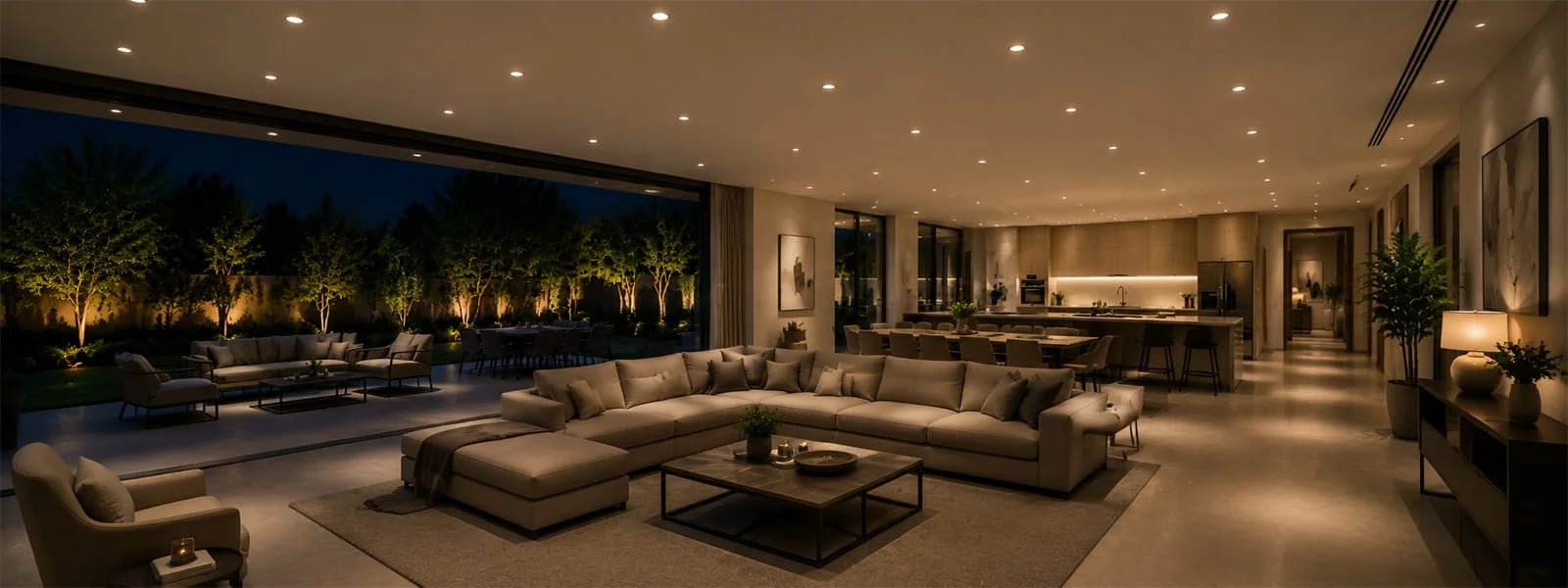
LED downlight selection for restaurants can become difficult when a single fixture specification is expected to serve every space. We often see buyers focus first on wattage, lumen output, or color temperature, only to discover later that tables feel glary, food looks flat, or maintenance becomes inconvenient. We can avoid these problems by selecting downlights zone by zone.
We should select restaurant LED downlights by first defining each zone’s visual task, atmosphere, mounting conditions, and maintenance needs. Dining areas, bars, circulation routes, and kitchens require different combinations of light distribution, color quality, glare control, output, and protection level.1 We should then verify the final layout, illuminance, and local compliance with a qualified lighting and design team.
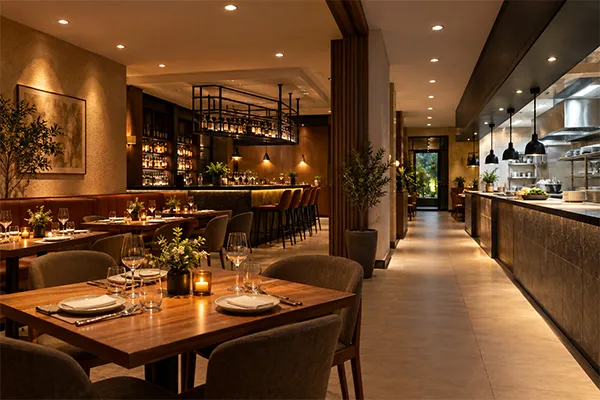
When we discuss restaurant projects with contractors, importers, and local lighting brands, we find that the best questions are rarely “Which wattage should we buy?” Instead, the useful questions involve where the fixture will be installed, what guests need to see, and how the operator will maintain the space over time.
How Does LED Downlight Selection Start With Restaurant Zones?
We can create an uncomfortable restaurant when we treat the whole site as one lighting zone. Guests may struggle to read menus, a bar display may lack emphasis, or a corridor may feel overly bright. We solve this by separating the restaurant into functional areas before comparing LED downlight specifications.
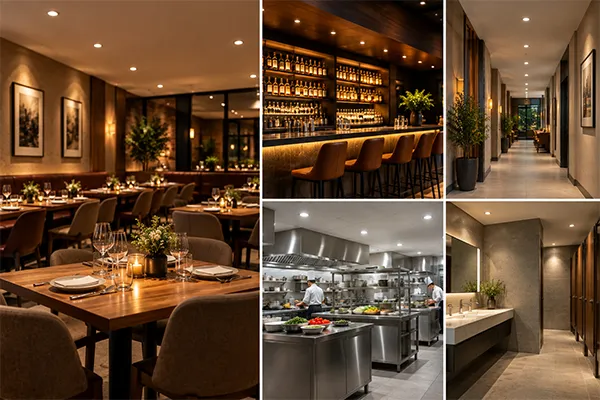
LED downlight selection should begin with a zone-by-zone review of the restaurant. We should define the purpose of each area—such as dining, waiting, bar service, circulation, food preparation, or washrooms—then match the downlight’s beam angle, output, color appearance, glare control, and mounting method to that purpose.
We Should Identify the Task Before We Select the Fixture
A restaurant uses lighting to support several different activities. Guests need enough visual comfort to navigate, read a menu, recognize food, and communicate across a table. Staff need practical visibility at service stations and in operational areas. Meanwhile, the brand may want a relaxed, premium, energetic, or highly theatrical atmosphere.
We have learned from project discussions that buyers sometimes begin with one universal request, such as “warm white recessed downlights for the whole restaurant.” That request can be a useful starting point, but it is not enough for a complete quotation. We need to clarify the spaces involved.
| Restaurant zone | Primary purpose | Typical selection priority | Procurement question we should ask |
|---|---|---|---|
| Dining tables | Comfortable dining and social interaction | Glare control, atmosphere, facial appearance | What is the ceiling height and table arrangement? |
| Bar or display area | Visual emphasis and merchandise presentation | Accent distribution, color quality, contrast | Which surfaces, bottles, food displays, or finishes need emphasis? |
| Entrance and waiting area | Orientation and first impression | Visual hierarchy, welcoming brightness | Is the area open to daylight or visually connected to the dining room? |
| Corridors and circulation | Safe movement and wayfinding | Uniformity, spacing, low glare | What are the corridor width and mounting positions? |
| Back-of-house | Practical staff tasks | Visibility, durability, serviceability | Are grease, humidity, heat, or frequent operating hours involved? |
| Washrooms | Comfort and basic grooming tasks | Even facial lighting, moisture suitability | What is the ceiling type and required ingress protection? |
Dining Areas Need Comfort, Not Maximum Output
For dining tables, we generally recommend that buyers evaluate comfort and visual balance before they pursue high lumen output. A downlight that is too intense, too narrow, or too exposed can create harsh pools of light on tabletops and direct glare in a seated guest’s field of view.2
The relationship between the fixture and the interior matters:
- Mounting height changes the spread of light on tables and floors.
- Beam angle affects whether light is concentrated or broadly distributed.
- Spacing influences dark gaps, overlap, and visual rhythm.
- Ceiling and wall reflectance affect how bright the room feels beyond the fixture’s direct output.
- Table layout determines whether a downlight lands centrally, between tables, or directly above a guest’s eye line.
We do not treat any one beam angle as correct for all restaurants. A compact restaurant with a low ceiling may need a different distribution from a high-ceiling restaurant with exposed services. The project design team should confirm the layout with actual dimensions and photometric data.
We see the strongest procurement decisions when buyers specify the zone and installation condition first, then compare wattage, lumens, beam angle, and color options within that context.
Why Are Wattage and Lumens Not Enough for Restaurant LED Downlight Selection?
We often receive requests that focus on replacing a certain wattage or purchasing the brightest possible downlight. This approach can lead to poor visual comfort and unnecessary energy use. We can make better choices when we understand that wattage and lumens describe only part of the lighting result.
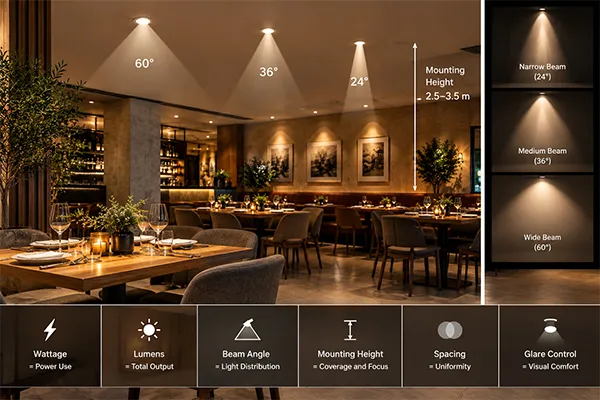
For restaurant LED downlight selection, wattage indicates electrical consumption and lumens indicate total light output3, but neither value alone predicts the lighting experience. Beam angle, mounting height, fixture spacing, optical design, surface reflectance, and glare control determine how useful and comfortable the delivered light will be.
We Should Separate Input Power From Delivered Light
Wattage tells us how much electrical power a fixture consumes. It does not tell us exactly how bright the restaurant will feel. Two downlights with the same wattage can produce different lumen outputs because their LED packages, drivers, thermal design, and optical systems differ.4
Lumens tell us the total light produced by the fixture, but they do not tell us where that light goes. A narrow beam can place a high concentration of light on a small target. A wider beam can spread similar output across a larger surface. Neither option is automatically better.
For example, we may compare two recessed downlights with similar nominal lumen packages:
| Selection factor | Narrower distribution | Wider distribution |
|---|---|---|
| Light effect | More focused visual emphasis | Broader general illumination |
| Suitable consideration | Bar feature, display, architectural detail | Dining circulation, open seating areas |
| Main risk | Bright spots and glare if poorly positioned | Flat appearance or insufficient contrast |
| Layout dependency | High | High |
| Verification needed | Aim, spacing, mounting height | Overlap, spacing, reflectance |
We should also ask whether the lumen figure is supported by a clear product specification and relevant test documentation. Buyers can request photometric files, lumen data, electrical ratings, and driver information as part of supplier evaluation. We should compare like with like: the same color temperature, beam angle, input voltage, and testing basis.
We Should Evaluate the Ceiling and Interior Materials
Restaurant interiors vary widely. Dark timber, black ceilings, textured walls, polished tiles, mirrors, brass finishes, and light-colored plaster all reflect light differently.5 A restaurant with dark finishes may feel dim even if the downlights have a relatively high nominal output. A light-colored ceiling may create a brighter perceived environment with lower output.
We therefore recommend that buyers provide suppliers and lighting designers with:
- Ceiling height and ceiling construction, including recessed depth restrictions.
- Reflected ceiling plan or basic layout, if available.
- Finish information, especially dark or highly reflective materials.
- Furniture and table positions, where known.
- Operating hours, including whether lights run from lunch through late evening.
- Target ambience, such as casual dining, fine dining, café, fast casual, or hotel restaurant.
At Upward Lighting, we use these questions to translate a general request into configurable product requirements. We can discuss wattage, beam angle, color temperature, CRI, trim color, and other parameters after we understand the intended use. We do not substitute this product configuration process for a project-specific lighting calculation or local code review.
How Do Color Temperature and CRI Affect Restaurant Atmosphere and Food Presentation?
We can make a restaurant look inconsistent when we choose warm color temperature or high CRI without considering the menu, finishes, surrounding light, and brand identity. Food presentation depends on more than a single specification. We can use color quality as a practical tool rather than a marketing shortcut.
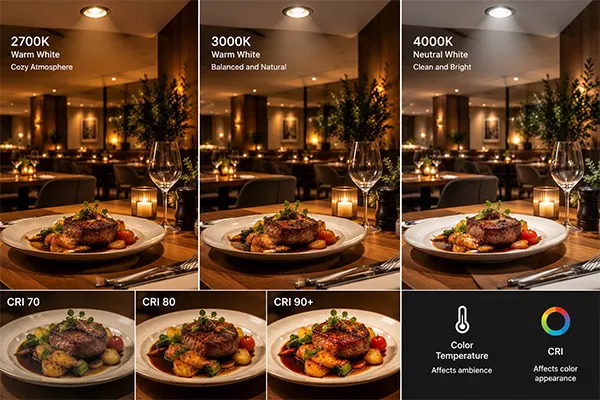
Color temperature and CRI influence restaurant ambience and perceived food appearance6, but we should evaluate them together with lighting direction, brightness, surrounding finishes, and product consistency. Warm light can support an intimate mood, while higher color rendering can improve color distinction, yet neither specification alone guarantees attractive food or a successful dining atmosphere.
We Should Use Warm Light Intentionally
Many restaurant buyers prefer warm white light because it can support a relaxed and welcoming setting. However, “warm” covers a range of appearances. The right selection depends on the restaurant concept, daylight exposure, materials, menu style, and the desired transition from daytime to evening service.
We may see different priorities across restaurant formats:
- Fine-dining venues may prioritize a more intimate appearance, visual layering, and low glare.
- Cafés may need a fresh but comfortable atmosphere that works during daytime trading.
- Quick-service restaurants may prioritize clear visibility, consistent brand presentation, and practical operations.
- Bars and lounges may combine general downlighting with accent lighting to create contrast and focal points.
- Open-kitchen concepts may need a stronger distinction between guest atmosphere and staff task lighting.
We should avoid assuming that the warmest available option is always best. If the light is excessively warm for the materials, menu, or adjacent daylight conditions, finishes can appear dull or overly yellow. Conversely, a cooler appearance may feel disconnected from a warm timber interior even when the fixture has strong technical specifications.
We Should Read CRI as One Part of Color Quality
CRI, or Color Rendering Index, helps buyers understand how faithfully colors may appear under a light source compared with a reference source.7 A higher CRI can be valuable when food, finishes, menus, and human skin tones need to look natural. Still, we should not rely on CRI alone.
Buyers should consider several questions:
- Does the supplier identify the CRI rating clearly on the specification sheet?
- Is the rating consistent across the required color temperature options?
- Does the restaurant need stronger red rendering for meats, sauces, produce, or warm décor finishes?
- Are the fixture samples visually consistent with the approved finish and LED bin?
- Will the restaurant use other light sources that may create visible color mismatch?
In supplier conversations, we often find that a buyer initially asks for “high CRI” without defining the restaurant’s lighting hierarchy. We would normally ask whether the goal is food presentation, premium material appearance, photography, staff visibility, or brand consistency. These objectives can overlap, but they should not be treated as identical.
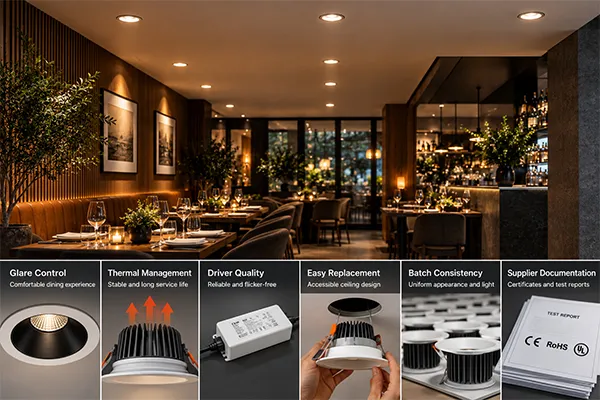
For chain operators and importers, batch consistency also deserves attention. A fixture sample can look acceptable, while a later batch may appear visibly different if color consistency controls are not clearly managed8. We recommend that buyers document approved color temperature, trim color, beam angle, driver specification, and sample reference before mass production. We also recommend that they agree on inspection criteria with the supplier.
How Can We Reduce Glare, Maintenance, and Replacement Risk?
We can lose long-term value when we select restaurant downlights on purchase price alone. A fixture may look acceptable during installation but create glare, overheat in a restricted ceiling void, or become difficult to replace after several years. We can reduce these operational risks before placing an order.
We can reduce restaurant downlight risk by evaluating glare control, thermal conditions, driver quality, access for replacement, batch consistency, and supplier documentation before purchase. Restaurant operators should treat maintenance planning and replacement compatibility as part of LED downlight selection, not as issues to solve after fixtures fail or interiors are complete.
We Should Consider Glare From the Guest’s Seated Position
Glare is often more noticeable in restaurants than in many commercial spaces because guests remain seated for extended periods. A fixture that looks acceptable when viewed from a standing position may be uncomfortable when viewed across a dining table.
We recommend that buyers assess glare-related details such as:
- Recessed depth and whether the light source is visually shielded
- Reflector or optical design
- Trim color and ceiling contrast
- Position relative to seating and sight lines
- Beam direction and overlap with table surfaces
- The relationship between downlights, decorative pendants, and daylight
A deep-recessed optical arrangement may help control the visual brightness of the light source in some applications. However, we should review the actual product construction and installation limitations rather than relying only on a product image.
We Should Verify Thermal and Installation Conditions
Thermal management affects LED output stability and component life.9 Ceiling cavities can contain insulation, HVAC equipment, ductwork, or limited airflow. Kitchen-adjacent areas may also face elevated temperatures, grease, moisture, or extended operating hours.10
Before selecting a recessed LED downlight, we should confirm:
| Operational issue | Why it matters | What buyers should verify |
|---|---|---|
| Ceiling void depth | Determines whether the fixture and driver can fit safely | Cutout size, fixture height, driver dimensions |
| Insulation and ventilation | Can affect thermal conditions | Installation instructions and permitted installation method |
| Driver access | Influences future maintenance time | Remote driver location, connector access, replacement method |
| Operating hours | Increases the importance of reliability and warranty terms | Expected daily operating schedule |
| Humidity or grease exposure | May affect fixture suitability | Installation zone, protection requirements, cleaning method |
| Dimmer compatibility | Affects ambience and operating control | Approved dimming protocol and compatible control components |
At Upward Lighting, we perform a 100% aging test lasting approximately 4 to 8 hours before shipment as part of our standard manufacturing process. We use this process to identify basic operational issues before products leave our facility. However, we do not present an aging test as a guarantee that a fixture will perform identically in every restaurant environment. Site temperature, installation practice, electrical conditions, controls, and maintenance all affect real-world outcomes.
We Should Plan for Replacement Before We Order
Replacement planning is especially important for restaurant chains, contractors managing phased projects, and distributors serving repeat customers. A downlight may be discontinued, a trim finish may change, or an approved driver may no longer match a future replacement.
We recommend that procurement teams retain:
- Approved product specification sheets.
- Cutout size and installation drawings.
- Color temperature and beam angle records.
- Driver model and dimming information.
- Trim finish sample references.
- Batch and purchase-order information.
- A small quantity of approved spare fixtures where appropriate.
We can support OEM and ODM requirements by configuring parameters such as color temperature, wattage, beam angle, CRI, and surface finish color. For buyers, customization should follow a documented approval process. A customized specification is useful only when it remains clear, repeatable, and practical for future ordering.
What Should We Ask a Restaurant Downlight Supplier Before Ordering?
We may receive a fast quotation, but a fast quotation alone does not prove that a supplier understands the project requirement. Missing information can lead to mismatched cutouts, inconsistent finishes, unsuitable drivers, or delayed installation. We can improve supplier selection by asking structured questions before confirming an order.
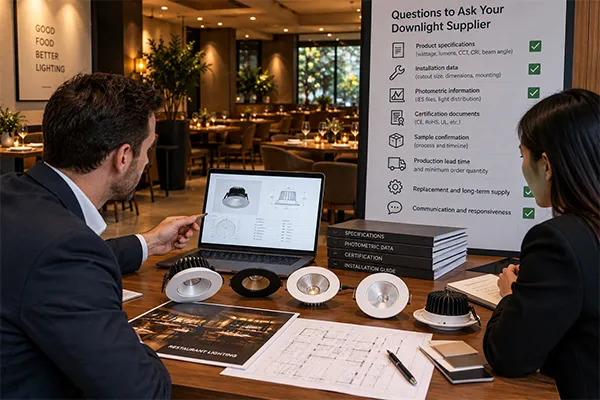
Before ordering restaurant downlights, we should ask suppliers for complete product specifications, installation data, photometric information where available, certification documents, sample confirmation procedures, production lead times, and replacement support. We should compare suppliers on clarity, consistency, responsiveness, and ability to meet the project’s approved configuration—not price alone.
We Should Request Evidence, Not Only Marketing Claims
A credible supplier evaluation process should include documents and samples that buyers can review. Certifications such as CE and RoHS may be relevant to market access and environmental requirements in applicable markets11, but buyers should verify the current documents, test scope, product model coverage, and destination-market requirements independently.
We suggest asking for:
- Product specification sheet with wattage, lumen output, CCT, CRI, beam angle, cutout, and dimensions
- Driver brand or driver specification, input voltage, and dimming option
- Installation instructions
- Photometric data or IES/LDT files when required for the design process
- Sample availability and sample lead time
- Quality-control process and aging-test information
- Packaging details for shipping and site handling
- Production lead time and minimum order quantity
- Warranty terms and after-sales communication process
- Certification documents applicable to the specified model
We believe response quality matters. In real project discussions, we often find that the most useful early supplier is not necessarily the supplier that gives the lowest initial price. It is the supplier that asks practical questions about cutout size, ceiling height, required CCT, dimming, trim color, and quantity breakdown before finalizing a proposal.
We Should Use Samples to Confirm the Approved Standard
We recommend that buyers evaluate samples in conditions that resemble the project as closely as practical. A sample viewed only in a warehouse or office may not reveal how the light interacts with restaurant finishes, ceiling color, or seating positions.12
A practical approval process may include:
- Reviewing the physical dimensions and cutout compatibility.
- Checking trim finish and visible build quality.
- Comparing color temperature with other installed lighting.
- Evaluating glare from normal guest and staff viewpoints.
- Confirming dimming behavior, if controls are used.
- Recording the approved model and configuration for repeat orders.
We support small-batch orders and customized configurations for eligible projects, which can help buyers validate a specification before scaling up. Still, the restaurant’s qualified design team should verify final illuminance, fixture layout, emergency-lighting requirements, and local regulatory compliance based on the actual site and applicable standards.
Frequently Asked Questions
What color temperature is best for restaurant LED downlights?
We should select color temperature based on the restaurant concept, materials, menu presentation, daylight, and desired atmosphere. Warm white is common in hospitality spaces, but it is not automatically right for every restaurant. We recommend reviewing physical samples alongside interior finishes before approving a final specification.
How many lumens do restaurant downlights need?
We cannot determine the correct lumen output from room type alone. We need to consider ceiling height, beam angle, spacing, surface reflectance, daylight, furniture layout, and the visual task in each zone. A qualified lighting professional should verify the final lighting calculation and layout.
Is high CRI important for restaurant lighting?
High CRI can be important when food, décor materials, menus, and skin tones should appear more natural. However, CRI alone does not guarantee attractive food presentation. We should also consider color temperature, light direction, brightness, contrast, and consistency with other light sources.
Should restaurants use the same downlight in every area?
We generally do not recommend assuming one downlight configuration will suit every area. Dining spaces, bars, corridors, washrooms, and back-of-house areas have different visual and operational requirements. A coordinated fixture family may work, but each zone should be reviewed separately.
What should we verify before buying recessed LED downlights?
We should verify cutout size, ceiling depth, driver location, beam angle, CCT, CRI, dimming requirements, certification documents, lead time, approved samples, and replacement planning. We should also confirm that the selected model suits the local installation conditions and applicable regulations.
Conclusion
Restaurant LED downlight selection works best when we move beyond simple wattage and lumen comparisons. We should begin with functional zones, then assess beam distribution, mounting conditions, glare control, color quality, thermal performance, maintenance access, and supplier consistency. We can configure downlights more effectively when the project requirements are documented early. If you are sourcing restaurant downlights for a project, we at Upward Lighting can help you review configurable product options, prepare quotations, and arrange samples for your team’s evaluation.
"Lighting Design: Techniques to Transform Interior Spaces", https://marymount.edu/blog/lighting-design-techniques-to-transform-interior-spaces/. Lighting-design guidance supports matching illumination, distribution, glare control, and environmental suitability to the visual tasks and conditions of individual areas rather than applying one specification throughout a building. Evidence role: general_support; source type: institution. Supports: Task-based lighting guidance distinguishes visual, safety, and environmental requirements across hospitality dining, circulation, and food-preparation areas.. Scope note: The source should inform zone-based design principles; final requirements depend on the site, applicable code, and lighting calculation. ↩
"(PDF) Lighting basics interior design - Academia.edu", https://www.academia.edu/7012552/Lighting_basics_interior_design. Visual-comfort research explains that perceived glare depends on source luminance, contrast, size, position in the field of view, and adaptation level; concentrated distributions can also create localized high-illuminance areas. Evidence role: mechanism; source type: research. Supports: Glare is associated with excessive luminance, contrast, source visibility, and viewing geometry, while narrow distributions can concentrate illuminance on small areas.. Scope note: This evidence establishes the optical mechanism, not a project-specific glare rating for a particular downlight or restaurant layout. ↩
"Realization of the lumen", https://www.nist.gov/pml/sensor-science/optical-radiation/realization-lumen. The watt denotes electrical power, whereas the lumen quantifies luminous flux—the total quantity of visible light emitted by a source as weighted for human visual response. Evidence role: definition; source type: government. Supports: A watt is a unit of power and the lumen is the SI-derived unit used to quantify luminous flux.. ↩
"[PDF] 2019 Solid-State Lighting R&D Opportunities - Department of Energy", https://www.energy.gov/sites/prod/files/2020/01/f70/ssl-rd-opportunities2-jan2020.pdf. LED-luminaire research shows that delivered luminous flux is influenced by LED efficacy, driver losses, thermal operating conditions, and luminaire optical efficiency, so equal electrical input does not ensure equal lumen output. Evidence role: mechanism; source type: research. Supports: LED-luminaire output and efficacy are affected by LED performance, driver efficiency, temperature-dependent light output, and optical losses.. Scope note: The evidence supports the general mechanism; measured output for a given product must be verified from its applicable test report. ↩
"(PDF) Effect of Surface Reflectance on Lighting Efficiency in Interiors", https://www.academia.edu/23934586/Effect_of_Surface_Reflectance_on_Lighting_Efficiency_in_Interiors. Interior-lighting principles identify ceiling, wall, floor, and furnishing reflectances as factors that alter interreflected light and room luminance, thereby affecting perceived brightness beyond direct fixture output. Evidence role: mechanism; source type: education. Supports: Surface reflectance affects interreflected light, room luminance, and the perceived brightness of interiors.. Scope note: Reflectance values vary by material color, texture, finish, aging, and viewing conditions; they do not by themselves predict the appearance of a completed restaurant. ↩
"Impact of Correlated Color Temperature on Red Meat ...", https://pubmed.ncbi.nlm.nih.gov/41246807/. Color-appearance research indicates that the chromaticity and spectral power distribution of illumination affect how object colors are perceived, while color-rendering metrics characterize fidelity relative to a reference illuminant. Evidence role: general_support; source type: paper. Supports: Color appearance under electric light is affected by a source's chromaticity and color-rendering properties, which can influence judgments of illuminated objects including food.. Scope note: Evidence on color perception does not establish that a particular CCT or CRI will produce a preferred dining atmosphere for every menu, interior, or customer group. ↩
"Color rendering index", https://en.wikipedia.org/wiki/Color_rendering_index. The general color-rendering index (Ra) is a standardized measure derived from the color shifts of designated test samples under a test light source relative to an appropriate reference illuminant. Evidence role: definition; source type: institution. Supports: The general color-rendering index evaluates average color fidelity for specified test samples under a test source relative to a reference illuminant.. Scope note: CRI is an average fidelity metric and does not fully describe gamut, preference, specific red rendering, or the appearance of all foods and materials. ↩
"[PDF] Color Stability of LEDs: Understanding the Basics - eere.energy.gov", https://www1.eere.energy.gov/buildings/publications/pdfs/ssl/royer_stability_lightfair2014.pdf. LED color-consistency standards use chromaticity tolerances and binning because variations in LED chromaticity may produce perceptible differences between luminaires or production batches. Evidence role: mechanism; source type: institution. Supports: LED chromaticity tolerances and binning are used to manage color consistency, and sufficiently large chromaticity differences can be visually perceptible.. Scope note: Whether a difference is visible depends on tolerance level, adaptation, spacing, background, and the observer; batch variation cannot be inferred without measurement. ↩
"[PDF] LED Luminaire Reliability: Impact of Color Shift - Department of Energy", https://www.energy.gov/sites/prod/files/2017/04/f34/lsrc_colorshift_apr2017.pdf. LED reliability research reports that junction temperature influences luminous flux and degradation rates, making thermal design and operating conditions relevant to lumen maintenance and component life. Evidence role: mechanism; source type: research. Supports: Higher LED operating temperatures can reduce instantaneous luminous flux and accelerate degradation processes that affect lumen maintenance and reliability.. Scope note: Actual lifetime depends on the complete luminaire, driver, duty cycle, ambient temperature, and installation conditions, not temperature alone. ↩
"[PDF] Town of Derry, NH Commercial Kitchen Construction Guide", https://www.derrynh.gov/public-health/files/town-derry-kitchen-construction-guide. Food-service facility and electrical-safety guidance recognizes that commercial kitchen environments can expose installed equipment to heat, moisture, grease, and cleaning-related conditions requiring suitable selection and installation. Evidence role: general_support; source type: government. Supports: Commercial food-preparation environments can involve heat, steam, moisture, grease aerosols, and cleaning conditions that affect electrical equipment suitability.. Scope note: The specific exposure level and required ingress or hazardous-location classification must be determined for the actual installation zone and local code. ↩
"CE marking - Internal Market, Industry, Entrepreneurship and SMEs", https://single-market-economy.ec.europa.eu/single-market/goods/ce-marking_en. European Commission guidance explains that CE marking indicates conformity with applicable EU product legislation, while the RoHS framework restricts specified hazardous substances in electrical and electronic equipment placed on the EU market. Evidence role: historical_context; source type: government. Supports: EU rules govern CE marking for products covered by relevant harmonized legislation and restrict certain hazardous substances in electrical and electronic equipment under RoHS.. Scope note: Applicability depends on the product, legal route, destination market, and current legislation; CE marking is not an independent quality certification. ↩
"LightBIM - A Building Interior Lighting Analysis and Evaluation Model", https://www.academia.edu/66118354/LightBIM_A_Building_Interior_Lighting_Analysis_and_Evaluation_Model_A_Qualitative_and_Quantitative_Approach. Architectural-lighting evaluation guidance uses representative mock-ups and viewing positions because glare, luminance balance, and color appearance depend on the installed geometry, surrounding finishes, and ambient conditions. Evidence role: general_support; source type: institution. Supports: Lighting mock-ups and on-site evaluations are used to assess luminance, color appearance, glare, and interactions with actual finishes under representative viewing conditions.. Scope note: A mock-up reduces uncertainty but does not replace a complete photometric calculation, commissioning process, or regulatory review. ↩