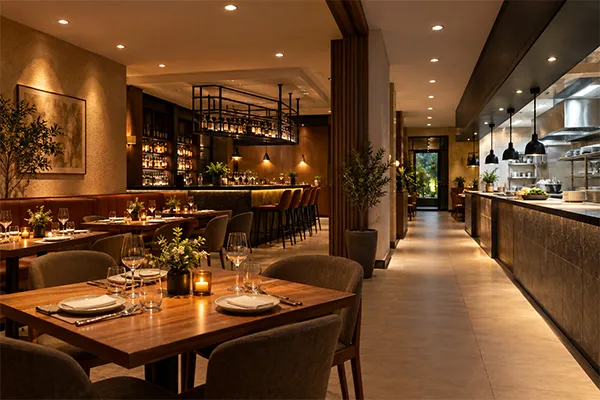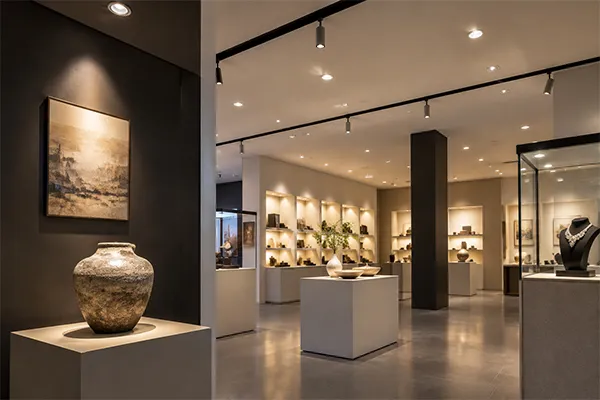
LED downlights for retail store lighting design can create procurement risks when buyers focus only on wattage or unit price. A poor match between the fixture, ceiling, merchandise, and display layout can cause glare, weak product visibility, installation rework, or an atmosphere that does not fit the brand.1 We recommend evaluating the whole retail task before selecting a downlight.
LED downlights can support retail store lighting design when buyers match ceiling height, cutout size, beam angle, color quality, spacing, and output to each area’s visual task. A single wattage or one universal fixture rarely suits every zone. Contractors and project managers should review lighting layers, product samples, photometric documents, and installation conditions before placing a production order.
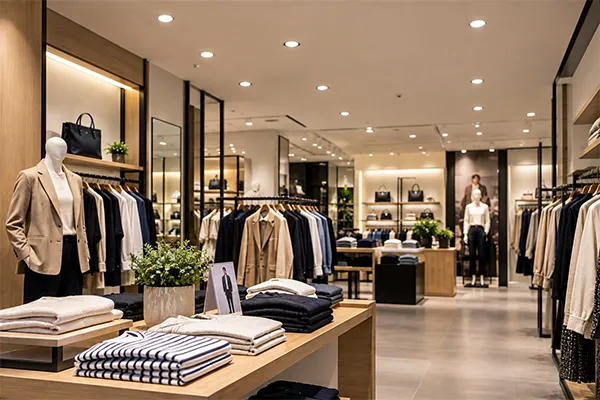
In our pre-sales conversations at Upward Lighting, we often see that the right questions come before the quotation. We ask about the ceiling plan, merchandise, display walls, desired mood, existing fixtures, and cutout dimensions. These details help buyers reduce avoidable risk instead of simply choosing the brightest available option.
How Should LED Downlights for Retail Store Lighting Design Match Ceiling and Installation Conditions?
Retail projects often face pressure to finalize fixtures before the ceiling plan is complete. This can create problems later. A downlight may look suitable in a catalog, but an incompatible cutout, shallow ceiling void, or unsuitable mounting method can delay installation and increase labor costs.
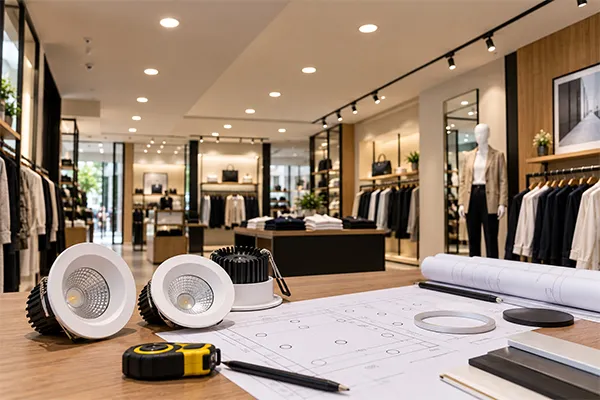
LED downlights for retail store lighting design should be selected around the actual ceiling height, available recess depth, cutout diameter, trim style, and spacing plan. These installation variables affect both appearance and light distribution. Buyers should confirm ceiling drawings and sample-fit dimensions before approving a final downlight specification.
Start with the Ceiling, Not the Fixture Image
Retail downlights are usually installed after several other project decisions have already been made. Ceiling grids, air-conditioning vents, sprinklers, signage, speakers, access panels, and decorative elements all compete for space. When a fixture is selected without checking these details, the project team may face awkward fixture placement or inconsistent spacing.
We regularly receive inquiries that begin with a simple request such as, “Please quote a 12W recessed downlight.” Our next questions are usually more important than the requested wattage:
- What is the finished ceiling height?
- What is the existing or planned cutout size?
- How much ceiling void depth is available?
- Is the ceiling gypsum board, metal, wood, or another material?
- Are insulation, drivers, or ventilation conditions relevant?
- Where are display racks, gondolas, shelving, and feature walls located?
- Is the store using a regular grid layout or a task-based lighting layout?
A smaller cutout does not automatically mean a lower-quality fixture, and a larger cutout does not automatically mean more useful light. The cutout must match the fixture construction and the ceiling plan. It also affects future replacement options. For renovation work, we suggest that buyers document the existing hole size and ceiling depth early. This simple step can reduce the risk of ordering a fixture that requires costly ceiling modifications.
Ceiling Height Changes What “Enough Light” Means
Ceiling height affects how a downlight performs in a store.2 A fixture installed in a lower ceiling may place light closer to the shopper and merchandise. The same unit installed several meters higher may produce a different visual result at the selling surface.
For this reason, wattage alone is not a reliable procurement shortcut.3 The project team should instead consider the relationship among:
| Selection factor | Why it matters in retail | Procurement risk if ignored |
|---|---|---|
| Ceiling height | Influences how light reaches shelves and displays | Merchandise may appear underlit or uneven |
| Beam angle | Controls spread and intensity on the target area | Glare, dark gaps, or wasted light |
| Fixture spacing | Determines uniformity across circulation and display zones | Patchy ceiling appearance or inconsistent illumination |
| Cutout size | Must fit the ceiling opening and trim design | Rework, delays, and damaged finishes |
| Recess depth | Affects whether the housing and driver can fit safely | Installation conflict with services above the ceiling |
| Trim finish | Contributes to ceiling appearance and brand presentation | Visible mismatch with interior finishes |
At Upward Lighting, we can discuss configurable parameters such as wattage, beam angle, color temperature, CRI, and surface finish. However, the specification should follow the project brief, not replace it. We encourage contractors to obtain qualified lighting design input when the project has demanding visual, safety, or compliance requirements.
Why Do LED Downlights for Retail Store Lighting Design Need Beam and Glare Control?
Retailers want merchandise to look visible and appealing, but excessive brightness can work against that goal. A fixture with uncontrolled distribution may create uncomfortable bright points, reflect off glossy packaging, or make shoppers avoid looking upward. The issue is not simply output; it is where the light goes.
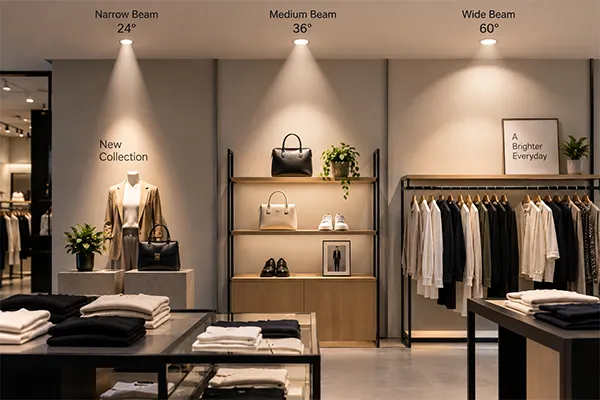
LED downlights for retail store lighting design need beam control because merchandise, aisles, counters, and walls require light in different directions. A suitable beam angle and controlled optic can help direct useful light toward visual tasks while reducing unnecessary spill light and potential glare in the shopper’s field of view.
Beam Angle Is a Distribution Decision
A downlight beam angle affects the diameter of light spread at a given mounting height.4 Narrower distributions can place more visual emphasis on a focused area, while wider distributions can cover a larger area. Neither option is universally better.
For example, a focused display table may need a different lighting approach than a broad circulation aisle. A feature wall may also need a different approach from fitting rooms or a cashier counter. If a buyer selects the same beam angle for every position simply to simplify the purchase order, some areas may receive too much or too little useful light.
We often encourage customers to identify the store’s visual tasks first:
- Circulation areas: Shoppers need comfortable orientation and safe movement.
- General merchandise zones: Shelves and racks need balanced visibility.
- Feature displays: Selected products, campaigns, or new collections may need stronger emphasis.
- Vertical displays: Wall-mounted merchandise, graphics, and shelving need attention beyond the floor plane.
- Service areas: Counters, payment points, and consultation spaces need suitable task visibility.
- Changing rooms or trial areas: Faces, fabrics, and finishes need careful color presentation.
A recessed downlight is primarily a downward lighting tool.5 It may contribute to several of these tasks, but it does not automatically replace track lights, wall washers, linear lighting, decorative fixtures, or other lighting layers. A complete retail lighting plan should consider the site and the intended visual hierarchy.
More Wattage Can Create More Problems
In procurement, buyers may ask for higher wattage because they worry about insufficient brightness. That concern is understandable, especially when store layouts or ceiling heights are not fully known. Yet higher wattage does not always produce a better retail environment.
Excessive output can lead to:6
- Bright pools of light that distract from product details
- Harsh contrast between illuminated and darker zones
- Reflections on glass, polished floors, screens, or glossy packaging
- Discomfort glare for staff and customers
- A flat visual environment where every display competes equally
- Higher energy use without a proportionate merchandising benefit
The more practical question is: What should shoppers notice first, and what should remain comfortably visible in the background? This question helps the contractor, lighting designer, and buyer decide where focused or broader distribution may be appropriate.
In many quotation discussions, we find that a store layout drawing reveals more than a wattage request. A simple marked plan showing shelves, key displays, and ceiling heights can help prevent a generic fixture selection.
Buyers should ask suppliers for relevant technical documents, including product dimensions, cutout range, input data, photometric information where available, and installation instructions. Any claimed optical, performance, or compliance characteristic should be checked against current supplier documentation and the project’s applicable requirements.
How Do Color Temperature and CRI Affect Retail Merchandise Presentation?
A retail space can have suitable brightness but still make products look unconvincing. This problem often appears when the chosen color temperature does not fit the brand atmosphere or when color rendering is not considered. Shoppers notice product color, texture, freshness, and finish even when they do not use technical lighting terms.
Color temperature and CRI affect retail lighting because they influence how shoppers perceive merchandise, materials, skin tones, packaging, and the overall brand environment.7 Buyers should choose these specifications according to the merchandise category, interior palette, and desired atmosphere rather than treating them as decorative afterthoughts.
Color Temperature Supports the Intended Store Atmosphere
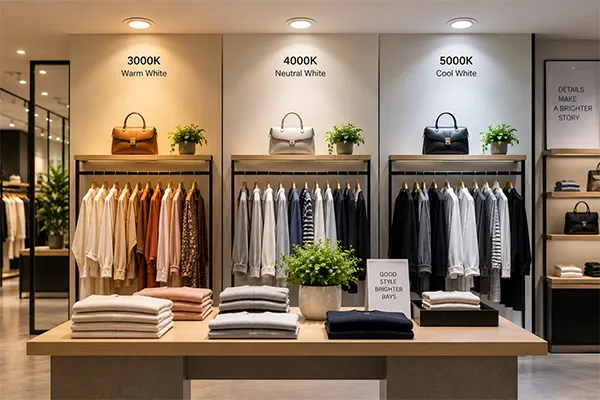
Color temperature is commonly expressed in kelvin (K). Lower-K light generally appears warmer, while higher-K light generally appears cooler.8 However, the right choice depends on the retail concept, finish materials, merchandise, surrounding daylight, and customer expectations.
A warm-looking environment may suit some hospitality-oriented, fashion, lifestyle, or premium retail concepts. A more neutral or crisp appearance may suit other product categories, brand identities, and task-focused spaces. Still, no single color temperature is correct for every store.
We ask customers questions such as:
- Does the brand want a warm, relaxed atmosphere or a clean, energetic appearance?
- Are the walls, ceilings, and fixtures warm-toned, neutral, or cool-toned?
- Does the store receive significant daylight?
- Are products highly color-sensitive, such as cosmetics, clothing, food, paint, jewelry, or textiles?
- Will the store use illuminated signage, window displays, or track lighting with different color characteristics?
If a project uses multiple fixture types, buyers should consider color consistency between them. A downlight that appears acceptable on its own may look mismatched next to linear fixtures, track heads, or decorative pendants with a visibly different tone.
CRI Is a Merchandising Consideration
Color Rendering Index, commonly called CRI, describes how a light source renders colors compared with a reference source under defined test conditions.9 In a retail context, CRI can influence how accurately shoppers perceive fabrics, cosmetics, wood grains, food packaging, printed graphics, and other colored materials.
A higher CRI figure may be relevant for color-sensitive applications, but buyers should not treat one number as the entire quality decision.10 The fixture’s optical design, color consistency, color temperature, driver quality, surrounding lighting, and store finishes also matter.
When evaluating CRI claims, we recommend that buyers request documentation and confirm that the specification aligns with the project requirement. A supplier’s product sheet, test report, or third-party documentation may be relevant depending on the market and purchase process. The buyer should verify which documents are current and applicable.
Use Samples Where the Decision Is Visual
For a large retail rollout, a physical sample review can be valuable. It does not replace a complete lighting calculation or on-site validation, but it can help project teams compare practical factors before mass production:
- Housing finish and trim appearance
- Cutout and spring-clip fit
- Light color relative to interior materials
- Visual comfort when viewed from normal shopper angles
- Product appearance under the proposed light source
- Consistency with other fixture families
I have seen buyers make faster decisions when they place sample lights near actual fabric swatches, packaging, or shelf materials. This is not a laboratory comparison, but it gives the team a more useful starting point than reviewing a catalog image alone.
Should Retail Stores Use One LED Downlight Specification in Every Zone?
Procurement teams often prefer one SKU because it simplifies ordering, inventory, installation, and future replacement. That approach can be sensible in some projects. However, a store has several visual tasks, and one universal downlight may force compromises in areas that need different light distribution or color presentation.
Retail stores can use a standardized LED downlight range, but they should not assume one specification fits every zone. A practical approach is to standardize the fixture family where possible while varying parameters such as wattage, beam angle, color temperature, trim, or placement for distinct retail tasks.
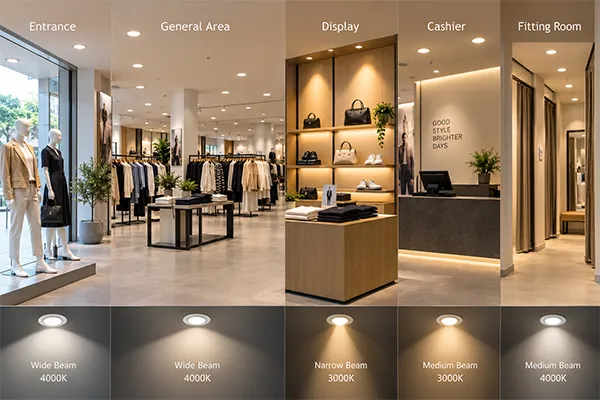
Standardize the Platform, Not Necessarily Every Parameter
For contractors and purchasing managers, SKU reduction has real benefits. Fewer models can simplify procurement, quality inspection, spare-part planning, and installation training.11 Yet a standardized platform can still offer controlled variation.
For example, a project may use the same downlight family and exterior finish while selecting different optical or output configurations for specific locations. This approach can preserve a consistent ceiling appearance without treating every retail task as identical.
| Retail zone | Primary visual task | Downlight selection discussion |
|---|---|---|
| Entrance | Create orientation and brand impression | Consider ceiling height, transition from daylight, signage, and first visual focus |
| Main aisles | Support comfortable movement | Consider broad, balanced coverage and visual comfort |
| General shelving | Make products easy to browse | Consider shelf layout, vertical visibility, and spacing |
| Feature display | Draw attention to priority merchandise | Consider targeted distribution and contrast with the surroundings |
| Cashier or service desk | Support staff and customer interaction | Consider task visibility, faces, screens, and reflective surfaces |
| Fitting or consultation areas | Support accurate product evaluation | Consider skin tone, fabric appearance, and customer comfort |
This table is a discussion framework, not a fixed design prescription. A qualified lighting professional should evaluate application-specific decisions, particularly for projects with detailed brand standards, energy requirements, emergency lighting obligations, or complex ceiling conditions.
Build a Better RFQ for Retail Downlights
A strong request for quotation gives the supplier enough information to offer relevant options. It also gives the buyer a clearer basis for comparing suppliers. Instead of sending only a wattage and quantity, we suggest including the following items:
- Project location and target market so the team can discuss applicable documentation and market-entry needs.
- Ceiling drawings or reflected ceiling plans with mounting heights and service conflicts.
- Cutout diameter and available recess depth for each ceiling type.
- Store layout showing racks, shelves, feature displays, counters, and wall displays.
- Merchandise category and the intended brand atmosphere.
- Requested color temperature and CRI, if defined by the lighting designer or brand standard.
- Beam angle preferences or the visual task for each zone.
- Required quantity by configuration, including pilot samples and spare units.
- Target delivery schedule, packaging requirements, and labeling needs.
- Required certificates or reports for the destination market.
At Upward Lighting, we provide OEM/ODM support for parameters such as color temperature, wattage, beam angle, CRI, and surface finish colors. We also support small-batch orders where practical for project evaluation and product development. Every product undergoes a 100% aging test before shipment, typically lasting 4 to 8 hours, according to our internal production process. Buyers should still define their own inspection requirements and verify agreed product documents before release.
Our products may be supplied with documents such as CE and RoHS documentation where applicable. However, buyers should verify the current certificate scope, report validity, product model coverage, and destination-market requirements. Documentation review is an important part of supplier qualification, not a checkbox to skip after the quotation stage.
Frequently Asked Questions
What wattage should I choose for retail LED downlights?
There is no universal wattage for retail LED downlights. The decision depends on ceiling height, beam angle, spacing, merchandise type, desired atmosphere, and the role of other lighting layers. We recommend reviewing a lighting plan, fixture photometric data, and sample installation conditions before finalizing the purchase.
Are LED downlights enough for a complete retail lighting design?
LED downlights can provide useful general or focused illumination, but they may not address every retail task alone. Feature walls, vertical shelving, window displays, signage, and decorative areas may require track lights, wall washing, linear lighting, or other fixture types depending on the store layout.
What CRI is suitable for retail stores?
The suitable CRI depends on the products being sold and the desired visual quality. Color-sensitive merchandise such as clothing, cosmetics, textiles, or printed materials may require closer evaluation. Buyers should request relevant product documentation and assess samples against actual merchandise whenever possible.
How do I avoid glare from recessed downlights in a store?
Buyers can reduce glare risk by considering beam angle, optic design, mounting height, fixture placement, ceiling reflectance, and viewing direction. They should avoid selecting higher output only to solve a perceived brightness issue. A lighting professional can help assess visual comfort for the specific layout.
What should I ask an LED downlight supplier before ordering?
Ask for dimensions, cutout size, recess depth, driver information, available beam angles, color temperature options, CRI documentation, photometric files where available, production lead time, warranty terms, inspection process, packaging details, and applicable certification documents. You should verify that all documents cover the exact proposed model.
Conclusion
Effective LED downlights for retail store lighting design are selected through risk management, not through wattage alone. Ceiling height, cutout compatibility, beam control, glare, merchandise color, CRI, color temperature, and zone-specific tasks all influence the final shopper experience. We recommend that contractors and project managers build a clear RFQ, review samples and documents, and validate the lighting approach for the actual site. Contact Upward Lighting to discuss configurable retail downlight options, small-batch evaluation needs, and OEM/ODM requirements for your next project.
"Influence of lighting on visual performance - PMC - NIH", https://pmc.ncbi.nlm.nih.gov/articles/PMC11627233/. Lighting-design research describes visual comfort and task visibility as outcomes of the interaction among luminaire distribution, surface geometry, viewing direction, and the visual task; it therefore supports evaluating fixtures in their installed retail context rather than by output alone. Evidence role: general_support; source type: research. Supports: That retail lighting quality depends on the relationship between luminaire distribution, layout, visual tasks, and the built environment, and that poor coordination can impair visual comfort and task performance.. Scope note: The evidence supports the general design principle; project-specific rework and brand-atmosphere outcomes depend on the site and procurement process. ↩
"The Inverse Square Law", https://neiloseman.com/inverse-square-law/. Lighting engineering guidance explains that the illuminated area expands with mounting distance while illuminance at the target decreases as distance increases, making ceiling height a material input to downlight selection and spacing. Evidence role: mechanism; source type: education. Supports: That mounting distance affects illuminance and the area covered by a luminaire beam, through geometric spread and distance-related reduction in illuminance.. Scope note: Actual results also depend on the luminaire photometry, beam shape, room reflectances, and obstructions. ↩
"LED Basics - Department of Energy", https://www.energy.gov/cmei/ssl/led-basics. Government energy guidance distinguishes electrical power in watts from light output in lumens and luminaire efficacy; these measures do not by themselves describe where light falls or whether a retail visual task is adequately lit. Evidence role: definition; source type: government. Supports: That watts measure electrical power, whereas lumens and photometric distribution describe light output and how light is delivered.. Scope note: Lumens and efficacy remain relevant selection inputs, but photometric files and layout calculations are needed for application-specific performance. ↩
"[PDF] Comments on Energy Star Program Requirements for Solid State ...", https://www.energystar.gov/ia/partners/prod_development/revisions/downloads/lighting/MathPath_Optics_(2)_OutdoorComments.pdf?16f6-f81c. Basic lighting geometry shows that, for a defined beam angle, the beam diameter on a target plane increases with mounting distance; beam angle is therefore a distribution parameter rather than merely a product label. Evidence role: mechanism; source type: education. Supports: That beam angle and mounting distance geometrically determine the approximate diameter of a beam on a target plane.. Scope note: A nominal beam angle does not fully predict field illuminance because real luminaires have nonuniform intensity distributions and different beam-angle conventions. ↩
"Recessed light", https://en.wikipedia.org/wiki/Recessed_light. Architectural-lighting references describe recessed downlights as ceiling-integrated luminaires that predominantly provide direct downward illumination, which explains why separate wall-washing, accent, decorative, or vertical-illumination systems may be needed. Evidence role: definition; source type: encyclopedia. Supports: That recessed downlights are generally direct-lighting luminaires intended to direct illumination downward from the ceiling.. Scope note: Some recessed products use adjustable, asymmetric, or wall-wash optics, so the exact distribution must be verified from the luminaire photometry. ↩
"Adaptive Lighting for Streets and Residential Areas", https://www.energy.gov/cmei/ssl/articles/adaptive-lighting-streets-and-residential-areas. Vision and lighting research identifies high source luminance, excessive luminance contrast, and veiling reflections as contributors to glare and reduced visual comfort; energy guidance further recognizes that overlighting increases lighting energy demand. Evidence role: mechanism; source type: research. Supports: That excessive luminance, contrast, and poorly controlled reflections can produce glare and visual discomfort, while unnecessary lighting load increases energy consumption.. Scope note: Whether a particular installation is excessive requires luminance, illuminance, reflectance, and viewing-angle assessment for that specific space. ↩
"Color-Light Influence on Brand Identity-Image Perception", https://www.academia.edu/65067267/Retail_Design_Color_Light_Influence_on_Brand_Identity_Image_Perception. Color-science literature shows that a light source's spectral power distribution and correlated color temperature affect color appearance and rendering, supporting their consideration when merchandise, skin tones, and interior materials are evaluated under retail lighting. Evidence role: general_support; source type: research. Supports: That spectral characteristics and correlated color temperature influence color appearance, color discrimination, and perceived ambience in illuminated environments.. Scope note: Consumer preference and brand perception are context-dependent and cannot be inferred from CRI or color temperature alone. ↩
"Color temperature", https://en.wikipedia.org/wiki/Color_temperature. Colorimetry standards define correlated color temperature in kelvin; in common lighting use, lower correlated color temperatures are described as warmer in appearance and higher values as cooler. Evidence role: definition; source type: institution. Supports: The definition of correlated color temperature and its expression in kelvin, including the conventional warm-to-cool appearance associated with lower and higher values.. Scope note: Perceived warmth also depends on surrounding colors, adaptation, illuminance, and the source spectrum. ↩
"Color rendering of light sources - NIST", https://www.nist.gov/pml/sensor-science/optical-radiation/color-rendering-light-sources. International colorimetry guidance defines the general color rendering index as a comparison of color rendering under a test illuminant with that under a reference illuminant using specified test color samples and calculation procedures. Evidence role: definition; source type: institution. Supports: That the general color rendering index is calculated by comparing color shifts of test samples under a test source and an appropriate reference illuminant.. Scope note: General CRI does not fully characterize all aspects of color preference, saturation, skin-tone rendering, or color fidelity for every product category. ↩
"Research Compares Measures of Average Color Fidelity", https://www.energy.gov/cmei/ssl/articles/research-compares-measures-average-color-fidelity. Lighting and color-science literature treats CRI as a useful but incomplete color-rendering metric: it indicates aspects of fidelity under prescribed conditions, while additional measures and application testing may be needed for color-sensitive evaluation. Evidence role: expert_consensus; source type: research. Supports: That CRI is one indicator of color fidelity but does not comprehensively predict visual preference, saturation, color gamut, or performance for all objects.. Scope note: The most appropriate metrics and acceptance criteria vary by merchandise, market standards, and the intended visual effect. ↩
"Role of practice standardization in outcome optimization for ...", https://pmc.ncbi.nlm.nih.gov/articles/PMC10961560/. Operations-management research generally finds that product and component standardization can reduce purchasing, inventory, maintenance, and training complexity by limiting variation in parts and procedures. Evidence role: general_support; source type: paper. Supports: That component standardization can reduce purchasing and inventory complexity and can simplify training and maintenance planning.. Scope note: The magnitude of the benefit depends on demand volume, supplier reliability, compatibility requirements, and whether reduced variety compromises functional performance. ↩