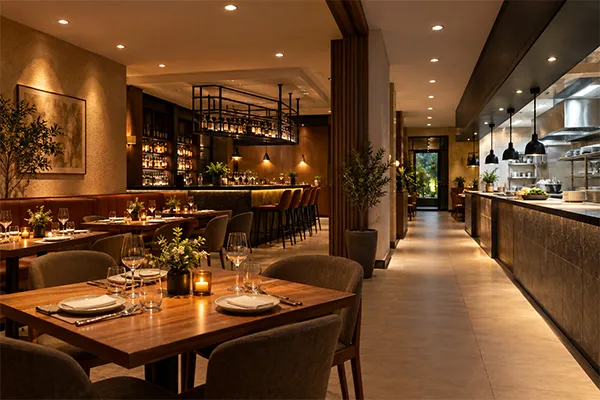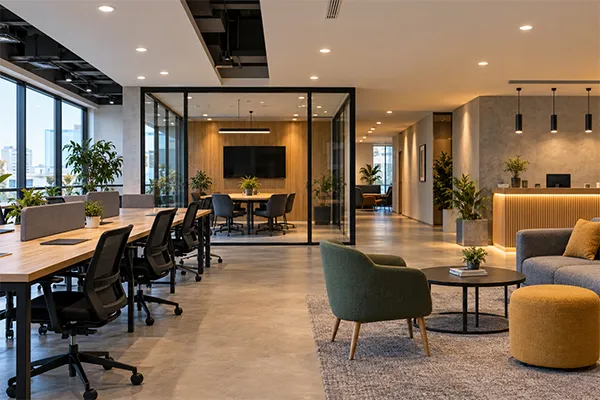
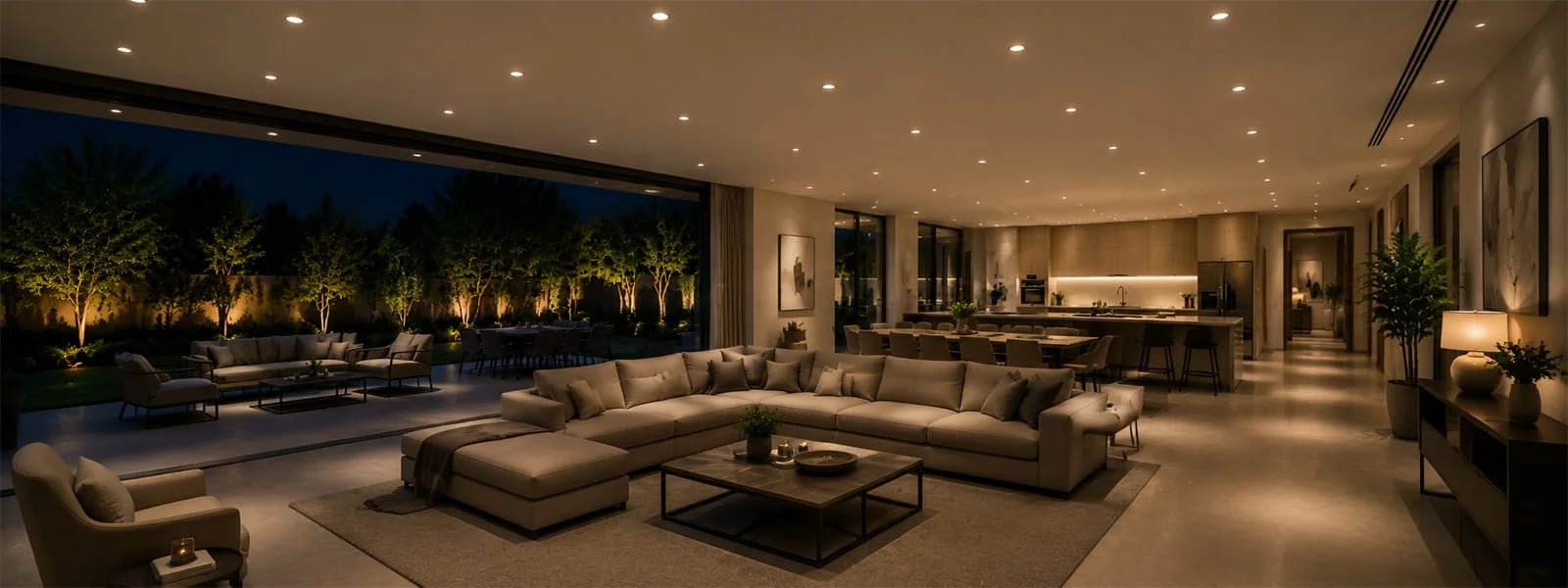
COB chip technology in modern LED downlights can look like a simple premium feature, but the label alone does not tell a buyer whether the fixture will perform well in a real project. A poor match can create glare, uneven lighting, installation issues, or costly product complaints. I recommend evaluating the complete luminaire, not only the LED package.
COB chip technology is a compact LED packaging approach that can support concentrated light output and controlled beam design in LED downlights. However, it is not automatically brighter, more efficient, longer-lasting, or better than other LED solutions. Buyers should assess the complete fixture, including optics, heat dissipation, driver quality, current setting, beam angle, installation height, and application requirements.
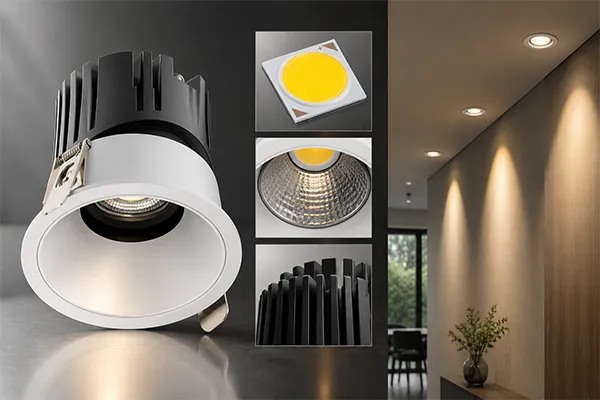
In my work with importers, lighting brands, and project buyers, I often see the same question: “Is COB the best choice?” The more useful question is whether a specific COB downlight meets the project’s lighting task, quality expectations, and commercial requirements better than the available alternatives.
What Does COB Chip Technology Mean for LED Downlights?
Buyers often see “COB” in a quotation or product catalog and assume that it defines the complete quality level of the downlight. That assumption can create problems because two COB downlights may have very different optical performance, thermal designs, drivers, and component specifications. The label needs context.
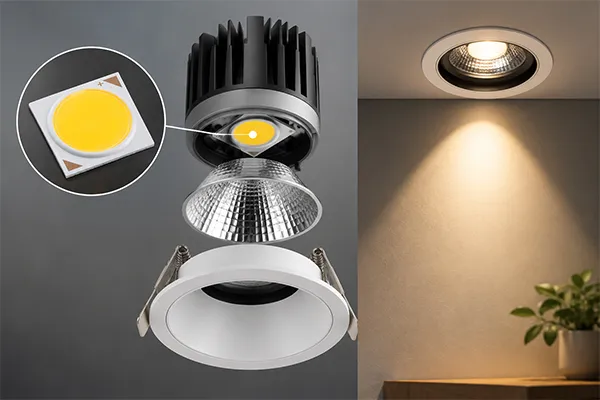
COB chip technology, or Chip-on-Board technology, places multiple LED chips closely together on a shared substrate to create a compact light-emitting surface1. In LED downlights, this format can support a focused, uniform-looking light source2, especially when paired with suitable reflectors or lenses. Its real performance depends on the complete luminaire design.
COB Is a Component Format, Not a Full Product Specification
I explain to buyers that a COB LED is only one part of a downlight. The finished fixture also includes the housing, heat sink, reflector, diffuser or lens, driver, trim, wiring, spring clips, and surface finish. Each part affects the final result.
For example, a compact COB source may help a manufacturer build a downlight with a defined beam pattern. Yet that benefit can be reduced if the reflector design is poor, the driver output is unstable, or the thermal path between the LED and heat sink is inadequate.
When I review an OEM or ODM request, I normally ask for more than wattage and color temperature. I need to understand how the buyer will use the product.
Key questions include:
- What is the installation height?
- Is the project residential, retail, hospitality, office, or corridor lighting?
- Does the customer need accent lighting, general lighting, or wall washing?
- What beam angle is required: narrow, medium, or wide?
- Is visual comfort a major concern?
- Does the project require a particular CRI, dimming method, trim color, or cutout size?
- Is the buyer building a retail product range or sourcing for one defined project?
A COB label does not replace a lighting specification. It starts the specification conversation.
Why the Optic Matters as Much as the COB LED
In many downlight projects, the visible lighting result comes largely from the optic. A reflector can create a narrower, more controlled beam3. A lens can change distribution and visual appearance. A deep anti-glare structure can reduce the direct view of the bright source4, although the final glare performance should be evaluated on the actual product and installation.
I have seen buyers compare two fixtures with the same nominal wattage and similar stated lumen output. One produced a comfortable, defined beam on the target surface. The other created a harsher visual effect because its optical system and source position were different. The buyers initially focused on the COB description, but the real decision came down to the lighting result.
| Downlight Decision Factor | Why It Matters | What Buyers Should Request |
|---|---|---|
| COB LED package | Influences source size and optical possibilities | Component information and product data |
| Beam angle | Determines coverage and light concentration | Beam angle options and photometric files where available |
| Reflector or lens | Shapes distribution and visual appearance | Optic material, finish, and beam pattern details |
| Driver | Affects electrical operation and compatibility | Driver specification, dimming option, input range |
| Heat sink | Supports thermal management | Housing material and thermal design information |
| Recessed depth | Can influence glare control and installation | Dimension drawing and cutout requirement |
| CRI and CCT | Affect color appearance and project suitability | Bin or tolerance requirements where applicable |
COB chip technology can be useful, but I encourage buyers to treat it as one design choice within a complete downlight system.
How Should Buyers Specify COB Chip Technology for a Project?
A downlight can fail a project even when its wattage, color temperature, and COB source look acceptable on paper. Buyers may order a narrow beam where broad coverage is required, choose excessive brightness for a low ceiling, or overlook the importance of glare control. These issues become expensive after installation.
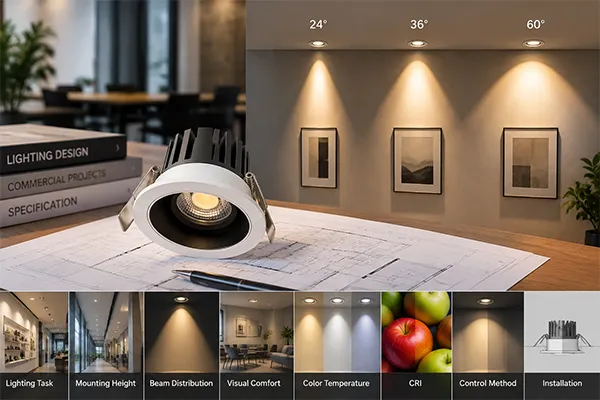
Buyers should specify COB chip technology by starting with the lighting task rather than the chip label. They should define the target area, mounting height, desired beam distribution, visual comfort level, color temperature, CRI, control method, and physical installation requirements before comparing downlight models.
Start With the Lighting Task, Not Watts
Wattage and nominal lumens are useful procurement data, but they do not answer whether the fixture works in the space5. A 10W downlight and a 10W downlight can produce noticeably different effects when their beam angles, optics, and installation locations differ.
For a retail display, the buyer may need directional light to emphasize products, wall textures, or feature areas. A COB downlight with a controlled medium or narrow beam may be considered. For general illumination in a corridor or residential room, a wider beam distribution may be more suitable. The correct answer depends on the layout and lighting design.
I remember supporting an inquiry from a buyer who wanted COB downlights for a hospitality renovation. The initial request only stated “warm white, black trim, high brightness.” After several discussions, we learned that the fixtures would be installed above dining tables at a relatively low ceiling height. The buyer then prioritized a more comfortable recessed visual design and a suitable beam distribution rather than simply increasing wattage.
Build a Practical Downlight Specification Sheet
For repeat orders, private-label programs, and project tenders, I suggest preparing a written specification sheet. This reduces confusion between the purchasing team, product manager, installer, and supplier.
A practical specification can include:
- Application: Residential, hotel, retail, restaurant, office, corridor, or public area.
- Mounting type: Recessed, surface-mounted, trimless, adjustable, or fixed.
- Installation dimensions: Ceiling cutout, fixture height, ceiling depth, and outer diameter.
- Wattage range: Based on the lighting plan or target performance.
- Color temperature: Such as 2700K, 3000K, 4000K, or another project requirement.
- Color rendering requirement: For example, standard CRI or a higher CRI requirement for retail and hospitality applications.
- Beam angle: Narrow, medium, wide, or adjustable, based on the lighting task.
- Glare and visual comfort expectations: Recessed source, deep reflector, honeycomb accessory, or other evaluated design features.
- Driver and controls: Non-dimmable, triac dimmable, 0–10V, DALI, or another required system.
- Finish color: White, black, gold, silver, or custom surface finish.
- Compliance documents: Required market documentation and product-specific verification.
Compare Samples in the Intended Installation
A sample review should go beyond switching the product on at a desk. I recommend that buyers install samples in a representative ceiling condition whenever possible. The test should reflect the approximate mounting height, surface colors, spacing, and control system expected in the project.
During a sample review, buyers can check:
- Beam shape on the floor, wall, or merchandise area
- Visible glare from normal viewing positions
- Consistency among several fixtures
- Color appearance against walls, furnishings, or products
- Driver behavior with the intended dimming system
- Installation fit, spring strength, trim appearance, and ceiling clearance
- Heat and operating behavior after a reasonable stabilization period
For a larger project, qualified lighting professionals should evaluate application-specific lighting calculations, safety requirements, control compatibility, and local code considerations. As a manufacturer representative, I can help clarify product options, but I do not treat a catalog description as a substitute for project-level design evaluation.
Is COB Chip Technology Automatically Brighter or More Reliable?
Marketing language can make COB sound like a universal upgrade. Buyers may hear that it is brighter, cooler-running, more efficient, or more durable. These claims can be misleading when they are presented without product-specific evidence, test conditions, and a comparison against a defined alternative.
COB chip technology is not automatically brighter, more efficient, or more reliable than other LED packaging approaches. Light output, efficacy, temperature behavior, color consistency, and expected maintenance depend on the specific LED, drive current, optic, heat sink, driver, assembly quality, and operating conditions6 of the finished downlight.
Brightness Depends on Delivered Light, Not the Label
The term “bright” can mean different things. Some buyers mean high total lumen output. Others mean strong illumination on a target surface. In a narrow beam, a fixture may appear intense because it concentrates light into a smaller area7. A wider beam can spread light more broadly and create a different visual impression, even if the total stated lumens are similar.
This is why I avoid telling customers that a COB downlight is simply “brighter.” I instead ask what the customer needs to illuminate. The relevant evidence may include product-specific photometric data, beam angle information, measured electrical input, and test conditions.
Reliability Is a System Question
Long-term performance is also a system question. The LED package matters, but the final luminaire must manage heat, electrical conditions, material quality, and assembly consistency. A driver that is not suitable for the application can affect the performance of an otherwise well-designed fixture. High ambient temperature, poor ceiling ventilation, incorrect installation, or unsuitable control equipment can also change real operating conditions8.
When buyers ask about lifetime, I recommend requesting documented product information with stated test methods and conditions. If a supplier provides lumen-maintenance or lifetime statements, buyers should ask:
- Which complete downlight model was tested?
- What ambient conditions and operating settings were used?
- Was the stated value measured, calculated, or based on component information?
- Which driver and LED configuration were included?
- Does the test reflect the intended installation environment?
- What warranty terms apply, and what exclusions are stated?
What Aging Tests and Outgoing Inspection Can—and Cannot—Show
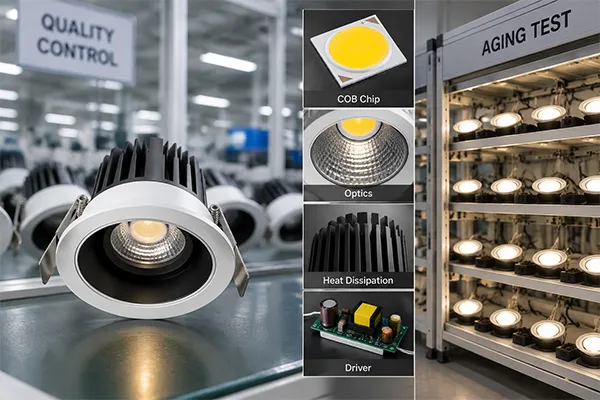
At Upward Lighting, we conduct a 100% aging test of 4 to 8 hours before shipment as part of our production process. We also carry out outgoing checks before packaging and shipment. These steps help us identify some early operating issues, assembly problems, and visible defects before products leave the factory.
However, I am careful not to describe aging tests as proof of universal lifetime or zero-failure performance. A short production aging test is a useful screening measure. It does not reproduce every possible field condition over years of use.9
| Quality-Control Activity | What It Can Help Identify | What It Does Not Prove |
|---|---|---|
| Incoming component check | Obvious material or specification issues | Long-term field reliability |
| Assembly inspection | Fit, wiring, finish, and visible assembly defects | Performance in every installation condition |
| 4–8 hour aging test | Early electrical or operating issues | Zero future failure rate |
| Outgoing inspection | Packing, appearance, labeling, and shipment readiness | Universal project suitability |
| Sample installation review | Project-specific visual and installation concerns | Lifetime performance under all environments |
I have found that experienced purchasing managers appreciate this distinction. They do not want unsupported promises. They want a supplier that can provide clear specifications, responsive communication, samples, reasonable documentation, and consistent production controls.
How Can Importers and Brands Choose a COB Downlight Supplier?
A supplier can offer an attractive COB downlight at a competitive quotation and still create risk if the specifications are unclear, components change without agreement, samples do not match production, or communication is slow when a project requirement changes. Supplier selection should be as disciplined as product selection.
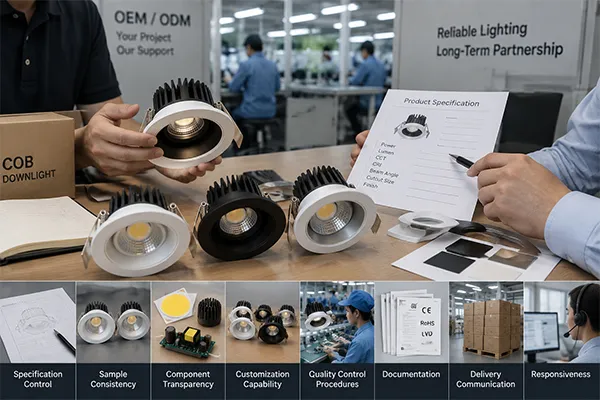
Importers and lighting brands should choose a COB downlight supplier by evaluating specification control, sample consistency, component transparency, customization capability, quality-control procedures, documentation, delivery communication, and responsiveness. The best supplier is not necessarily the one with the lowest initial unit price, but the one that can support repeatable commercial results.
Evaluate the Supplier’s Questions
A capable supplier should ask questions before issuing a final quotation. If a supplier only asks for wattage and quantity, the quotation may not reflect the actual project need.
In my experience, meaningful inquiries often involve trade-offs. A buyer may want a black COB downlight with 3000K light, a high CRI option, a specific cutout, and a dimmable driver, while also working within a target price. Each decision can affect material selection, lead time, minimum order quantity, and production planning.
A useful supplier conversation should cover:
- Target market and applicable regulatory requirements
- Required compliance documents for the destination market
- Product dimensions and ceiling cutout
- CCT, CRI, wattage, beam angle, and finish
- Dimming or driver requirements
- Packaging, branding, labels, and manuals
- Sample approval process
- Production lead time and shipment terms
- Small-batch or trial-order needs
- Change-control expectations for repeat orders
Verify Documents and Production Consistency
Buyers should verify certifications and reports as documents relevant to the actual product configuration and destination market. A CE or RoHS document should not be treated as a broad statement that every variation, driver option, or custom configuration has identical compliance status10. Buyers should confirm what the documents cover and obtain professional regulatory advice where application-specific requirements are uncertain.
At our factory in Zhongshan, we support OEM and ODM customization for parameters such as color temperature, wattage, beam angle, CRI, and surface finish. Still, customization should be controlled through approved samples and written specifications. A change in beam angle, driver, or wattage can affect more than price. It can change the lighting result and production configuration.
Use a Sample-to-Production Approval Process
For a private-label or project order, I recommend a simple approval sequence:
- Confirm the written specification and quotation.
- Review drawings, finish samples, and branding requirements.
- Approve a physical sample under representative conditions.
- Confirm packaging, labels, and carton marks.
- Agree on approved components or performance requirements.
- Conduct production and pre-shipment checks.
- Keep records for repeat-order reference.
This process may seem detailed for a standard COB downlight. Yet it often prevents the most common disputes: incorrect cutout sizes, wrong color temperature, unexpected beam appearance, mismatched trim colors, or incompatible dimming behavior.
Frequently Asked Questions
Is COB better than SMD for LED downlights?
COB is not universally better than SMD11. COB can be useful for compact, concentrated sources and controlled optical designs, while SMD-based designs may suit other distributions and product formats. Buyers should compare complete luminaires based on beam control, glare, thermal design, driver performance, installation, and project needs.
Are COB LED downlights suitable for retail lighting?
COB LED downlights can be suitable for retail lighting when the fixture provides the required beam angle, color rendering, visual comfort, and target illumination. Retail buyers should test samples on merchandise and displays because the right beam distribution matters more than the COB label alone.
Does a higher wattage COB downlight always provide better lighting?
No. Higher wattage does not automatically produce a better lighting result. It may increase output, but beam angle, mounting height, spacing, surface reflectance, glare control, and the lighting task all affect project performance12. Buyers should evaluate the delivered visual effect, not only nominal wattage.
What should I ask a COB downlight manufacturer before ordering?
You should ask about beam angle, CCT, CRI, driver type, dimming compatibility, dimensions, cutout size, heat-sink design, sample availability, production lead time, inspection procedures, packaging, and applicable documentation. You should also confirm whether custom options match the approved sample and written specification.
Does a 100% aging test guarantee a COB downlight will never fail?
No. A 100% aging test can help identify some early operating or assembly issues before shipment, which is valuable quality control. However, it cannot guarantee zero defects or predict performance under every installation environment and operating condition over the product’s full service life.
Conclusion
COB chip technology can be a practical choice for modern LED downlights, especially where a compact source and controlled beam design support the intended lighting task. However, buyers should not purchase based on the COB label alone. I recommend evaluating optics, glare control, thermal construction, driver selection, installation conditions, sample performance, and supplier quality controls. If you are sourcing a customized COB downlight for a project or product range, contact Upward Lighting to discuss your required wattage, CCT, CRI, beam angle, finish, and order volume.
"[PDF] Investigation of the Long-Term Aging Characteristics of Chip-On", https://www.energy.gov/sites/default/files/2021-10/ssl-rti-cob-benchmark-sept2021.pdf. Chip-on-board LED packaging commonly mounts multiple LED dies in close proximity on a shared substrate, producing a compact emitting area. Evidence role: definition; source type: education. Supports: The source should define chip-on-board packaging as mounting multiple semiconductor dies directly on a common substrate or board.. ↩
"[PDF] 2019 Solid-State Lighting R&D Opportunities - Department of Energy", https://www.energy.gov/sites/prod/files/2020/01/f70/ssl-rd-opportunities2-jan2020.pdf. The spatial extent of an LED source and the design of its secondary optics jointly influence the resulting beam distribution and apparent luminance uniformity. Evidence role: mechanism; source type: paper. Supports: The source should explain how LED source size and secondary optics influence beam shaping and apparent source uniformity.. Scope note: This supports the optical principle; the performance of a particular downlight still requires product-specific photometric testing. ↩
"Freeform Reflector Design With Extended Sources - ucf stars", https://stars.library.ucf.edu/etd/4283/. Reflector geometry is a principal means of redirecting luminaire output and controlling beam angle and distribution. Evidence role: mechanism; source type: education. Supports: The source should explain that reflector geometry is used to control luminaire light distribution and beam angle.. Scope note: Actual beam control depends on the complete optical system, including source position, reflector finish, and lensing where present. ↩
"[PDF] Introduction to Interior Lighting Design - OHIO Personal Websites", https://people.ohio.edu/ziff/ARTI%20288/Intro%20to%20Interior%20Lighting%20Design.pdf. Greater source shielding or recess can reduce direct visibility of high-luminance lamp or LED surfaces and can thereby contribute to glare control. Evidence role: mechanism; source type: institution. Supports: The source should describe how shielding angle or source recess affects direct source visibility and discomfort glare.. Scope note: Glare perception also depends on luminance, viewing direction, background luminance, room geometry, and installation conditions. ↩
"[PDF] Understanding LM-79 Reports - Better Buildings Solution Center", https://betterbuildingssolutioncenter.energy.gov/sites/default/files/attachments/understanding_lm79_reports.pdf. Lighting suitability is determined by delivered light on the task and visual environment, not by input power or rated lumens alone. Evidence role: general_support; source type: government. Supports: The source should show that lighting design requires consideration of task needs, room geometry, luminaire distribution, and delivered illuminance in addition to lamp output.. Scope note: Project-specific suitability requires a lighting calculation or representative installation assessment. ↩
"[PDF] 2019 Solid-State Lighting R&D Opportunities - Department of Energy", https://www.energy.gov/sites/prod/files/2020/01/f70/ssl-rd-opportunities2-jan2020.pdf. LED-luminaire performance and maintenance are system-level properties affected by drive conditions, thermal management, optical losses, driver behavior, and environmental operating conditions. Evidence role: general_support; source type: research. Supports: The source should document that LED luminaire performance and maintenance are system-level outcomes influenced by electrical drive, thermal conditions, optics, and driver components.. Scope note: The relative contribution of each factor varies by product design and must be verified for the specific luminaire. ↩
"ANALYSES OF ERRORS ASSOCIATED WITH PHOTOMETRIC ...", https://www.nist.gov/publications/analyses-errors-associated-photometric-distance-goniophotometry. For comparable luminous flux, concentrating output into a smaller solid angle increases luminous intensity and can increase illuminance over a smaller target area. Evidence role: mechanism; source type: government. Supports: The source should explain the relationship among luminous flux, luminous intensity, beam spread, and illuminance on a target surface.. Scope note: The perceived intensity of a fixture also depends on viewing conditions, distance, surface reflectance, and adaptation. ↩
"[PDF] LED Performance Under Tough Conditions - Department of Energy", https://www.energy.gov/sites/prod/files/2016/01/f28/dec2015_DOE_GATEWAY_roundup_0.pdf. Ambient temperature, thermal enclosure conditions, installation details, and control compatibility can materially affect the operating behavior of LED luminaires and drivers. Evidence role: mechanism; source type: institution. Supports: The source should establish that ambient conditions, thermal enclosure characteristics, installation practice, and control compatibility can affect LED luminaire operation.. Scope note: This does not establish the effect size or failure risk for a particular installation without product-specific evaluation. ↩
"[PDF] Towards Understanding Early Failures Behavior during Device Burn ...", https://tsapps.nist.gov/publication/get_pdf.cfm?pub_id=920388. Burn-in and production screening can identify some early-life or latent defects, but short-duration testing does not by itself establish long-term field reliability. Evidence role: mechanism; source type: paper. Supports: The source should explain that burn-in or screening is intended to detect early-life defects and is not equivalent to a demonstration of lifetime reliability.. Scope note: The value of a burn-in procedure depends on its duration, stress conditions, failure criteria, and the product population tested. ↩
"CE marking – obtaining the certificate, EU requirements - Your Europe", https://europa.eu/youreurope/business/product-rules-compliance/general-product-compliance/ce-marking/index_en.htm. EU conformity obligations require technical documentation and conformity assessment to correspond to the product placed on the market; changes in design or configuration may require reassessment of applicable compliance evidence. Evidence role: general_support; source type: government. Supports: The source should explain manufacturers' obligations to maintain conformity assessment and technical documentation for products placed on the market, including relevant changes or configurations.. Scope note: The precise documentation and reassessment requirements depend on the applicable legislation, product category, and nature of the modification. ↩
"[PDF] THERMAL ANALYSIS OF HIGH POWER LED ARRAYS", https://repository.gatech.edu/server/api/core/bitstreams/1aaf081e-ae9f-48be-8de9-ad3ee6fcd8ea/content. COB and surface-mount LED architectures involve differing packaging, thermal, optical, and manufacturing trade-offs; neither format is intrinsically superior for every luminaire application. Evidence role: general_support; source type: paper. Supports: The source should compare COB and surface-mount LED packaging characteristics and identify application-dependent trade-offs.. Scope note: A general comparison cannot determine which approach is preferable without the requirements and measured performance of the specific luminaire. ↩
"[PDF] Energy impact of human health and wellness lighting ...", https://www.energy.gov/eere/ssl/articles/energy-impact-human-health-and-wellness-lighting-recommendations-office-and. Lighting performance in an occupied space depends on task requirements, the reflective characteristics of surrounding surfaces, and the control of glare as well as luminaire output. Evidence role: general_support; source type: institution. Supports: The source should show that visual-task requirements, room-surface reflectances, and glare conditions are relevant inputs to lighting design and perceived performance.. Scope note: The appropriate levels and design criteria vary by application, occupant needs, and local standards. ↩