
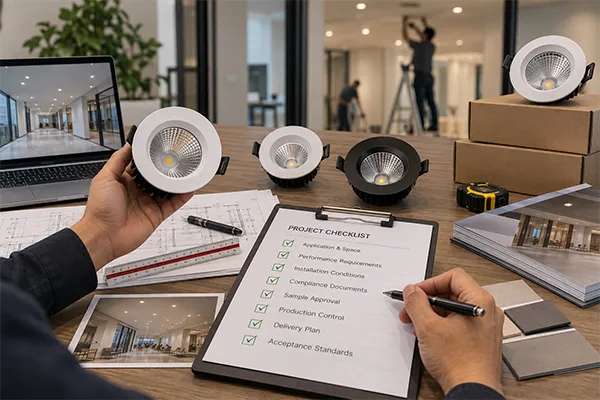
A commercial LED downlight project checklist helps buyers avoid a common problem: comparing quotations that look similar but cover very different products, services, and risks. A vague brief can lead to unsuitable beam angles, installation conflicts, missing documents, or batch differences. I use a structured checklist to turn project needs into clear, comparable supplier inputs.
A commercial LED downlight project checklist should define the lighting application, performance requirements, installation conditions, compliance documents, sample approval criteria, production controls, delivery expectations, and acceptance standards before an order is placed. This gives contractors, importers, and project teams a consistent basis for comparing suppliers and reducing avoidable specification, quality, and documentation disputes.
Many buyers begin with a wattage, a cut-out size, and a target price. Those details matter, but they do not form a complete commercial specification. In my pre-sales discussions, I often see that the most important questions appear only after a quotation, sample, or installation issue has already created pressure.
How Does a Commercial LED Downlight Project Checklist Start With the Lighting Task?
A commercial downlight project can go wrong when the buying team starts with “we need 12W” instead of asking what the light must achieve. The same wattage may perform differently in an office, hotel corridor, retail shelf, or reception area.1 I recommend defining the visual task first, then selecting the downlight parameters.
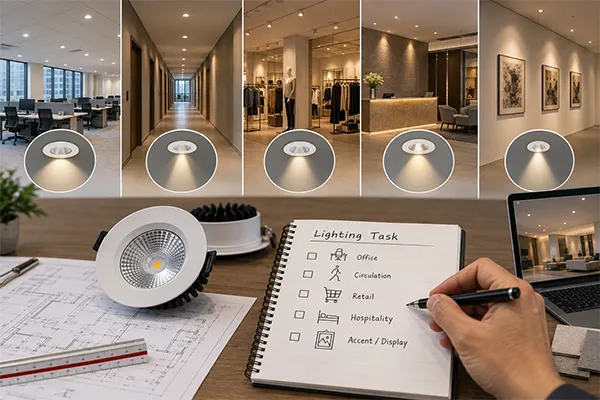
A commercial LED downlight project checklist should begin with the application, ceiling height, target lighting effect, and visual-comfort priorities. Buyers should specify whether the fixture is intended for general ambient lighting, circulation areas, vertical illumination, accent lighting, or display lighting. These details guide the selection of beam angle, lumen output, glare control, colour temperature, and CRI.2
Define the Intended Lighting Function
The phrase “commercial project” covers many different lighting environments. A downlight used in a hotel lobby may need a warm and welcoming appearance, while an office may prioritize visual comfort, uniformity, and a neutral colour temperature. A retail project may require stronger colour rendering and controlled beams to support merchandise presentation.
I usually ask buyers to clarify the following before we discuss a final model:
- What is the room type? Office, corridor, hotel room, lobby, retail area, supermarket, restaurant, showroom, or public facility.
- What is the mounting height? A 2.7-metre ceiling and a 5-metre ceiling may require different outputs and optical distributions.
- What is the lighting task? General illumination, task lighting, wall washing, display emphasis, or circulation lighting.
- What visual mood is required? Warm, neutral, cool, or a specific project-defined colour temperature.
- Does the project require glare control? Deep anti-glare designs, honeycomb accessories, recessed light sources, and lower UGR options may be relevant.
- What must look accurate under the light? Food, clothing, wood finishes, artwork, branded surfaces, or office documents may affect the required CRI and R9 expectations.
Avoid Treating Wattage as a Product Identity
Wattage is an electrical input value, not a complete statement of lighting performance or quality.3 Two 12W commercial LED downlights can use different LEDs, drivers, optical designs, heat-management structures, and output targets.4 They may also have different cut-out sizes, fixture depths, dimming compatibility, and colour consistency.
For this reason, I encourage buyers to compare a combination of values rather than a single headline number.
| Project input | Why it matters | Example question for a supplier |
|---|---|---|
| Wattage | Supports electrical-load planning | What is the rated input power and tolerance? |
| Lumen output | Indicates light output, but must be read with optics | What is the rated delivered lumen output for this CCT? |
| Beam angle | Affects spacing, uniformity, and visual focus | Is the beam 24°, 36°, 60°, or another verified option? |
| CCT | Influences visual appearance | Is 3000K, 4000K, or 5000K required? |
| CRI | Influences colour appearance | Is CRI 80, CRI 90, or another target required? |
| Glare control | Supports visual comfort | Is there a deep-recessed or anti-glare version? |
| Driver type | Affects control and maintenance | Is the driver on-off, triac dimmable, 0–10V, or DALI? |
In our own quotation discussions at Upward Lighting, requests such as “same wattage” or “high CRI” often need further clarification. I do not treat these phrases as complete specifications. A buyer may mean CRI 90, but another buyer may need a particular R9 value, a specific CCT bin, or a narrow beam for retail displays.
A commercial LED downlight should be selected for the lighting task and installation environment, not only for its wattage or advertised lumen figure.
The local lighting designer or qualified project engineer should still confirm final lighting calculations, spacing, glare performance, emergency-lighting coordination, and application-specific suitability. Manufacturer guidance can support procurement, but it does not replace a site-specific lighting design.
What Installation Details Belong on a Commercial LED Downlight Project Checklist?
A compatible ceiling cut-out can create false confidence. Buyers sometimes assume that a 90 mm hole means any 90 mm cut-out downlight will fit and perform correctly. In practice, ceiling thickness, fixture depth, driver space, heat dissipation, and maintenance access can all affect whether the installation is suitable.
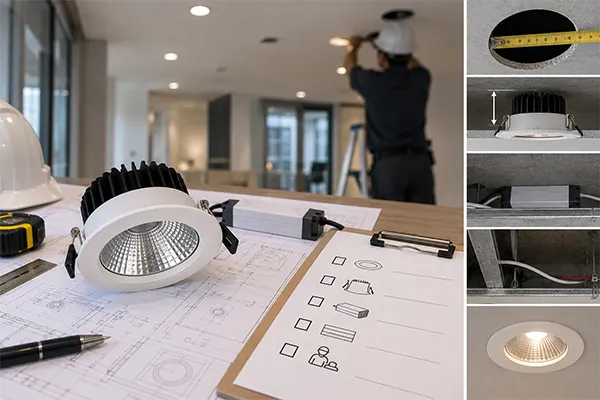
A commercial LED downlight project checklist should record the cut-out range, outer diameter, recessed depth, driver dimensions, ceiling construction, available void space, wiring arrangement, and maintenance access. The project team should also verify that the fixture’s thermal and installation requirements suit the actual site conditions before placing a volume order.
Check More Than the Cut-Out Diameter
The cut-out is only one physical dimension. A recessed fixture may also require adequate space above the ceiling for the heat sink, driver, cable connections, and any dimming-control equipment. A shallow ceiling void can make a standard recessed downlight unsuitable even when the hole diameter matches.5
I have seen pre-sales requests where buyers supplied only “cut-out: 95 mm.” My next questions are usually about ceiling depth, ceiling material, driver location, cable routing, and access. These points are not extra complications. They are necessary inputs for a meaningful quotation.
Installation Questions to Confirm Before Ordering
A practical checklist should include the following:
-
Ceiling type and material
Confirm whether the ceiling is plasterboard, gypsum board, metal panel, suspended grid, wood, concrete, or another construction. The mounting method and site preparation may differ. -
Cut-out diameter and tolerance
Ask for the actual site cut-out range, not only a nominal size. Spring clips must hold securely within the relevant ceiling thickness and opening tolerance. -
Available recessed depth
Confirm the full luminaire depth, including the driver and cable bend radius where relevant. -
Driver placement
Determine whether the driver will remain in the ceiling void, sit beside the fixture, or require a separate accessible location. -
Heat dissipation conditions
Identify insulation, restricted airflow, enclosed ceiling cavities, and other conditions that may affect thermal management. The local installer or qualified professional should evaluate site conditions. -
Service and replacement access
Consider how maintenance teams will access the driver and fixture after handover. A low initial price can become less attractive if replacement work requires opening finished ceilings. -
Control-system compatibility
If dimming is required, confirm the protocol and the control equipment. “Dimmable” alone is not sufficiently specific for many commercial installations.6
Build an Installation Comparison Table
When comparing suppliers, I recommend that buyers request dimension drawings and installation instructions in the same format. This makes differences easier to identify before samples arrive.
| Installation item | Supplier A | Supplier B | Buyer decision |
|---|---|---|---|
| Cut-out range | 90–95 mm | 92–100 mm | Confirm site opening |
| Outer diameter | 110 mm | 115 mm | Check ceiling appearance |
| Fixture depth | 58 mm | 72 mm | Check ceiling void |
| Driver dimensions | 95 × 35 × 25 mm | 120 × 42 × 28 mm | Check driver space |
| Ceiling thickness range | 3–20 mm | 5–25 mm | Match ceiling material |
| Dimming method | Triac | 0–10V | Match project controls |
| Driver replaceability | Separate driver | Integrated design | Review maintenance plan |
This level of detail is particularly useful for contractors managing multiple rooms or phased installations. It also helps importers and lighting brands avoid mixing superficially similar downlights that have different physical requirements.
Final site design, electrical connections, fire-safety considerations, and installation-code compliance should be confirmed by the local contractor, lighting designer, or qualified compliance professional.
Which Compliance Documents Should Buyers Verify for Commercial LED Downlights?
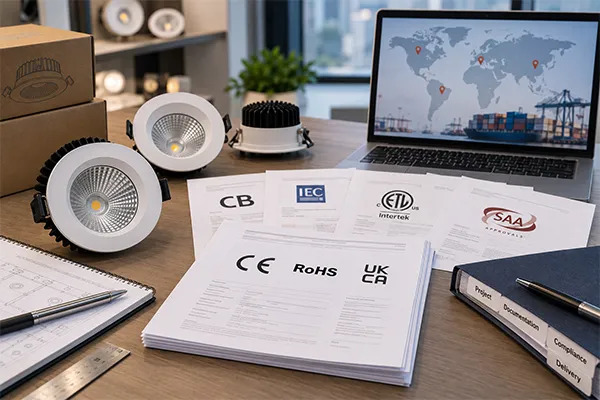
Documentation problems often appear late in the project, when a consultant, contractor, customs process, or client asks for evidence that was not listed in the original purchase brief. A supplier may provide CE or RoHS documents, but those documents alone do not automatically satisfy every market, tender, or project submission requirement.7
A commercial LED downlight project checklist should identify the target country, project-specific documentation requirements, required test reports, marking requirements, declarations, and submission deadlines. Buyers should verify that documents relate to the proposed product configuration8 and should not treat any single certificate as universal proof of complete compliance.
Match Documentation to the Target Market
Commercial lighting projects can involve several different documentation layers:
- Market-entry requirements
- Customer or tender requirements
- Electrical safety requirements
- Environmental-material requirements
- Product-labeling requirements
- Project consultant submittals
- Factory quality documents
- Shipment and packaging documents
At Upward Lighting, we can provide CE and RoHS documentation for applicable product ranges. However, I always encourage buyers to review the documents against their own destination market and project submission requirements. A CE or RoHS document should be assessed as part of the broader compliance file, not treated as a blanket approval for every country or installation.
Questions to Ask Before Including Documents in a Bid
Buyers should ask suppliers clear, product-specific questions:
- Does the document identify the same product family, model, input voltage, and driver configuration being quoted?
- Does the report cover the required CCT, wattage, control type, or IP rating where those details matter?
- Is the document current and issued by a recognizable testing or certification body where required?
- Does the project require a declaration, label artwork, technical datasheet, installation instruction, or packing information in addition to test documents?
- What documents will be available before production, before shipment, and with the shipment?
- Who is responsible for checking local market acceptance?
Use a Documentation Matrix
A simple matrix prevents important items from being left in email threads.
| Document or item | Why buyers request it | When to verify |
|---|---|---|
| Product datasheet | Confirms key technical parameters | Before quotation approval |
| Dimension drawing | Confirms installation fit | Before sample approval |
| CE documentation | Supports applicable market requirements | Before project submission |
| RoHS documentation | Supports environmental-material requirements | Before order confirmation |
| Test report references | Helps validate document scope | During technical review |
| Installation instructions | Supports contractor planning | Before site installation |
| Packing list and labels | Supports receiving and traceability | Before shipment |
| Quality inspection record | Supports agreed acceptance process | Before or at shipment |
I recommend that purchasers ask for documents early, especially when a project has a consultant approval stage. Late document requests can delay procurement even when the physical product is ready.
A qualified local compliance professional should confirm whether the proposed documentation meets local laws, building rules, electrical regulations, and project-specific approval requirements. I can flag relevant document categories as a manufacturer, but I cannot replace local regulatory interpretation.
How Should Buyers Control Samples, Mass Production, and Delivery Risk?
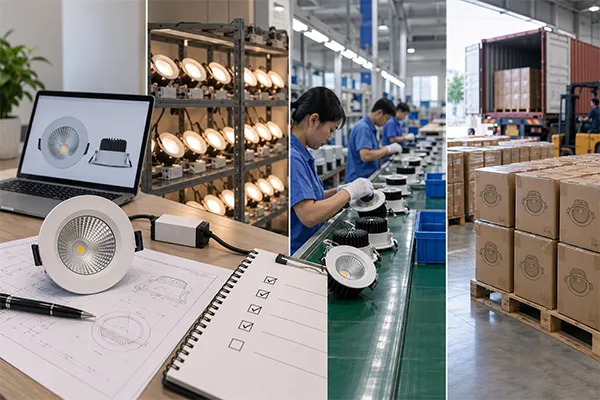
A good sample is useful, but it is not a complete guarantee that every unit in mass production will remain identical.9 The sample stage and the production stage are separate decision gates. Buyers need to lock the approved configuration, define measurable acceptance criteria, and understand how the supplier manages batch consistency.
A commercial LED downlight project checklist should separate sample approval from mass-production approval. It should record the approved model, wattage, CCT, beam angle, CRI target, finish, driver type, labels, packaging, ageing process, inspection points, production lead time, and responsibility for issues identified after delivery.
Lock the Critical Specification After Sample Review
A sample review should result in a written approval record. Without this record, buyers may later discover that the supplier interpreted “same as sample” differently from the project team.
The approval record can include:
- Product model number
- Rated wattage and input voltage
- Colour temperature
- CRI target
- Beam angle
- Trim colour and surface finish
- Cut-out and fixture dimensions
- Driver brand or agreed driver specification
- Dimming method
- Cable, connector, and labeling details
- Packaging method
- Required documents
- Approved sample date and photo references
For OEM/ODM projects, this step is especially important. At Upward Lighting, we can customize parameters such as colour temperature, wattage, beam angle, CRI, and finish colour. Those options can be valuable, but each approved variation should be documented carefully. A small change can affect pricing, lead time, labeling, testing scope, or component availability.10
Ask How the Supplier Controls Batch Consistency
Buyers should not assume that sample approval automatically controls production quality. Instead, they should ask what process links the approved sample to the batch.
Useful supplier questions include:
- How is the approved specification transferred to production?
- What incoming checks apply to LEDs, drivers, housings, optics, and trim components?
- Is there an in-process inspection procedure?
- Does the factory conduct ageing or burn-in testing?
- How are finished products checked before packing?
- What batch or order references support traceability?
- Can the supplier provide agreed inspection records?
- What happens if a discrepancy is found before shipment?
- What is the stated production lead time, and what could change it?
- What post-delivery communication process applies if the buyer identifies an issue?
Our stated internal process includes a 100% ageing test lasting 4 to 8 hours before shipment for applicable products. This process supports our quality-control workflow and helps us identify certain early failures before dispatch. However, buyers should still agree on their own application-specific acceptance criteria and inspection plan. An ageing test does not remove every possible project risk, and it should not be presented as a universal guarantee of field performance.11
Define Acceptance Criteria Before the Goods Leave the Factory
Clear acceptance criteria reduce disputes because both parties know what will be checked.12 These criteria should be practical and measurable.
| Acceptance area | Example criterion |
|---|---|
| Quantity | Delivered quantity matches purchase order |
| Model | Model number matches approved specification |
| Appearance | No visible scratches, finish inconsistency, or damaged trim |
| CCT | Matches agreed CCT range or approved sample reference |
| Function | Fixtures power on and operate as specified |
| Dimensions | Cut-out, trim, and depth match approved drawings |
| Packaging | Cartons, labels, and inner protection meet agreed format |
| Documents | Agreed documents are supplied on schedule |
| Traceability | Batch, order, or date identifiers are available as agreed |
I also advise buyers to include an inspection point before shipment for larger orders or higher-risk projects. This may involve factory inspection, third-party inspection, photo confirmation, video checks, or a documented final inspection process. The right method depends on order value, project timing, buyer capability, and the consequences of a delay.
Frequently Asked Questions
What is the most important item on a commercial LED downlight project checklist?
The most important item is the intended lighting application. Buyers should first define what the downlight must achieve in the space, such as general office lighting, hospitality ambience, corridor lighting, or retail display emphasis. This decision guides beam angle, output, CCT, glare control, and CRI selection.
Is the same cut-out size enough to confirm that a downlight will fit?
No. The same cut-out size does not confirm full installation suitability. Buyers should also check outer diameter, recessed depth, driver size, ceiling thickness, ceiling void space, wiring access, heat dissipation conditions, and maintenance access. A qualified installer should confirm final site compatibility.
Do CE and RoHS documents guarantee project compliance?
No. CE and RoHS documents may support applicable safety or environmental requirements, but they do not automatically guarantee compliance for every market, building, tender, or project. Buyers should verify document scope against the destination country and project submission requirements with qualified local professionals.
Does an approved sample guarantee mass-production consistency?
No. A sample confirms only the reviewed sample configuration. Buyers should separately define production specifications, quality controls, ageing procedures, inspection criteria, traceability, packaging requirements, and pre-shipment approval steps to better manage batch-consistency risk.
What should buyers ask a commercial LED downlight supplier before placing an order?
Buyers should ask about application suitability, dimensions, driver configuration, optics, CCT, CRI, dimming, required documents, sample process, production lead time, ageing tests, inspection methods, traceability, packaging, and post-delivery communication. Clear written answers make quotations easier to compare.
Conclusion
A commercial LED downlight project checklist gives buyers a stronger way to evaluate products and suppliers before price becomes the only decision factor. I recommend starting with the lighting task, then confirming installation conditions, documentation needs, sample approval details, production controls, and acceptance criteria. This process helps contractors, importers, distributors, and lighting brands compare quotations on a more consistent basis. If you are preparing a commercial downlight inquiry, contact Upward Lighting with your project brief for a faster, more structured OEM/ODM quotation review.
"[PDF] Round 7 of Product Testing - Department of Energy", https://www1.eere.energy.gov/buildings/publications/pdfs/ssl/caliper_round_7_summary_final.pdf. U.S. Department of Energy guidance explains that wattage measures electrical power consumption, whereas lumen output and efficacy are separate performance measures; optical distribution and application conditions further affect the illumination obtained from a luminaire. Evidence role: mechanism; source type: government. Supports: LED wattage is electrical input and does not alone determine delivered light output, efficacy, or optical distribution.. Scope note: This supports the technical distinction between wattage and lighting performance, not the suitability of a particular downlight model for a specific project. ↩
"[PDF] LED Lighting in a Performing Arts Building at the University of Florida", https://betterbuildingssolutioncenter.energy.gov/sites/default/files/attachments/2014_gateway_universityflorida.pdf. Professional lighting-design guidance treats the visual task, occupant needs, and characteristics of the space as inputs to selecting illumination levels, glare control, colour appearance, and colour-rendering properties. Evidence role: expert_consensus; source type: institution. Supports: Professional lighting guidance links task and space characteristics to illuminance, luminance distribution, glare limitation, colour appearance, and colour-rendering choices.. Scope note: The guidance establishes a design framework; final parameter values require a project-specific lighting calculation and applicable local standards. ↩
"Purchasing Energy-Efficient Light Bulbs", https://www.energy.gov/cmei/femp/purchasing-energy-efficient-light-bulbs. U.S. Department of Energy consumer and technical lighting guidance distinguishes input power in watts from light output in lumens and efficacy in lumens per watt, so wattage alone does not specify a lamp or luminaire's light output. Evidence role: definition; source type: government. Supports: Electrical wattage, luminous flux, and luminous efficacy are distinct quantities used to describe lighting products.. Scope note: The distinction does not by itself define product quality, which also depends on optical, electrical, thermal, reliability, and application-specific factors. ↩
"[PDF] Solid State Lighting LED Product Development and Manufacturing ...", https://www.energy.gov/documents/ledrtprdctmfg-reportoct2016pdf. Lighting research and U.S. Department of Energy materials describe LED luminaires as systems in which the LED source, driver, thermal path, and optical components influence light output, efficiency, colour behaviour, and reliability. Evidence role: mechanism; source type: research. Supports: LED luminaire performance depends on the LED package, driver, thermal management, and optical system, in addition to nominal input power.. Scope note: System-level evidence supports the possibility of differences among equal-wattage products but does not compare the specific downlights discussed in this article. ↩
"Recessed Lighting - Code Compliance Brief", https://basc.pnnl.gov/code-compliance/recessed-lighting-code-compliance-brief. Electrical-safety guidance for recessed luminaires requires installation consistent with the product instructions and relevant clearance, wiring, insulation, and enclosure conditions; a matching ceiling opening alone does not establish installation suitability. Evidence role: general_support; source type: institution. Supports: Recessed-luminaire installation depends on required clearances, enclosure and insulation conditions, wiring space, and the product's installation instructions, not solely on aperture size.. Scope note: Exact clearance and ceiling-void requirements are product-specific and must be taken from the applicable luminaire instructions and local electrical rules. ↩
"[PDF] Specifying LED in a World of Continuous Change", https://www.energy.gov/sites/prod/files/2014/11/f19/miller-hershman-yorgey-willcock_specifying_detroit2014.pdf. U.S. Department of Energy guidance on LED controls notes that dimming performance depends on compatibility among the LED driver, dimmer or controller, and control method, rather than on a generic dimmable designation alone. Evidence role: mechanism; source type: government. Supports: LED dimming performance and interoperability depend on the driver, dimming method, and control-system characteristics.. Scope note: Compatibility must still be verified for the specific driver, controller, wiring arrangement, and installed load. ↩
"CE marking – obtaining the certificate, EU requirements - Your Europe", https://europa.eu/youreurope/business/product-rules-compliance/general-product-compliance/ce-marking/index_en.htm. European Commission guidance states that CE marking indicates conformity with applicable EU requirements for a product placed on the EU market, while RoHS restricts specified hazardous substances in covered electrical and electronic equipment; neither instrument itself establishes compliance with unrelated national, contractual, or project-submittal conditions. Evidence role: definition; source type: government. Supports: CE marking and RoHS are EU regulatory mechanisms with defined scopes and do not replace other applicable legal, contractual, or project-specific requirements.. Scope note: The applicable obligations depend on the product, destination market, economic operator, and current legislation, and should be assessed by qualified local advisers. ↩
"Preparing technical documentation - Your Europe - European Union", https://europa.eu/youreurope/business/product-rules-compliance/general-product-compliance/preparing-technical-documentation/index_en.htm. Official conformity-assessment guidance requires technical documentation and declarations to identify the relevant product and demonstrate conformity with applicable requirements, supporting verification that model, configuration, and declared characteristics correspond to the item being placed on the market. Evidence role: general_support; source type: government. Supports: Conformity documentation should identify the product and provide evidence relevant to the product for which conformity is declared.. Scope note: Whether a particular report covers a variant such as a different driver, wattage, control mode, or IP rating depends on the report scope and applicable rules. ↩
"6.1.2. What are Process Control Techniques?", https://www.itl.nist.gov/div898/handbook/pmc/section1/pmc12.htm. National Institute of Standards and Technology resources on statistical process control explain that production processes vary and that process monitoring and inspection are used to assess and control conformity over time; an individual sample therefore cannot establish the condition of every production unit. Evidence role: mechanism; source type: government. Supports: Manufacturing processes exhibit variation, and production conformity requires ongoing process and inspection controls rather than reliance on a single sample.. Scope note: The evidence describes general manufacturing-quality principles and does not measure the consistency of any named supplier's production batches. ↩
"[PDF] Engineering Change Management Concepts for Systems Modeling", https://tsapps.nist.gov/publication/get_pdf.cfm?pub_id=913323. Quality-management and configuration-management guidance treats changes to product requirements and design as controlled activities because they may alter verification needs, technical documentation, production planning, and the availability of approved components. Evidence role: general_support; source type: institution. Supports: Configuration and design changes require controlled review because they can affect product documentation, verification activities, production planning, and supplied components.. Scope note: The magnitude of any effect on price, lead time, labels, testing, or supply depends on the specific change and supplier arrangements. ↩
"[PDF] A methodology for testing life-cycle performance of consumer products", https://nvlpubs.nist.gov/nistpubs/Legacy/IR/nbsir76-1157.pdf. Reliability-engineering guidance characterizes burn-in and screening as methods for detecting some early-life or latent defects; such tests do not constitute a universal prediction or guarantee of long-term performance in all operating environments. Evidence role: mechanism; source type: government. Supports: Burn-in and environmental-stress screening can identify certain early-life defects but do not establish lifetime reliability under every field condition.. Scope note: The effectiveness of an ageing test depends on its duration, electrical and thermal stresses, tested failure mechanisms, sample coverage, and the actual field environment. ↩
"[PDF] QUALITY AND CONFIGURATION MANAGEMENT REQUIREMENTS", https://www.nist.gov/document/qualityconfigmgtreqs-20061120pdf. Quality-management guidance describes documented requirements and acceptance criteria as the basis for verification, inspection, and decisions on whether supplied outputs conform to agreed specifications. Evidence role: general_support; source type: institution. Supports: Documented acceptance criteria provide a defined basis for inspection and determination of product conformity.. Scope note: Clear criteria can reduce ambiguity but cannot prevent all disputes, particularly where contractual interpretation, sampling plans, or remedial obligations are not agreed. ↩