LED downlights are easy to compare on price, wattage, and lumen output, which can make many product offers look almost identical. That comparison creates pressure on buyers and suppliers alike. We believe a more durable approach is to build a downlight range around a defined market, installation use case, and acceptable level of supply risk.
LED downlights create competitive advantage when brands and importers develop a coherent, repeatable product offer instead of competing only on entry-level specifications. The right combination of color temperature, wattage, beam angle, CRI1, finish, installation method, documentation, and supply consistency should reflect a clearly defined customer need. Customization matters when it supports that commercial purpose and can be manufactured reliably over time.
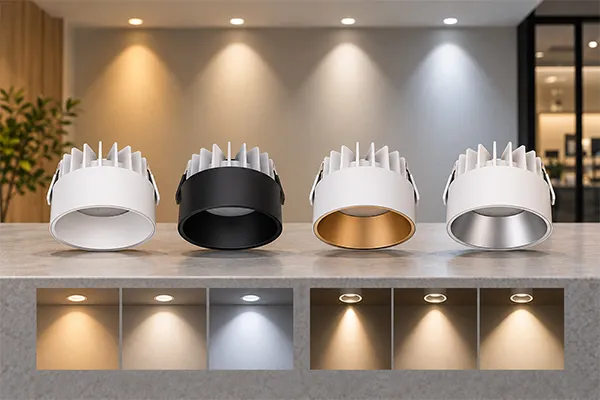
In our work as a Zhongshan-based LED lighting manufacturer, we often see buyers begin with a simple request: “Please quote your best price.” Price is important, but the questions that follow usually reveal whether a product can become a stable line or remain a short-term purchasing exercise. The details below explain how we approach that distinction.
Why Are Price, Wattage, and Lumens Not Enough for LED Downlights?
Buyers often need a fast way to screen LED downlights, so unit price, wattage, and lumen output become the first comparison points. The problem is that these figures rarely explain installation fit, visual comfort, consistency, or supply repeatability. A better evaluation starts by treating those numbers as filters, not as a complete strategy.
Price, wattage, and lumen output are necessary procurement comparison points, but they do not by themselves define a competitive LED downlight offer. Buyers should also compare optical configuration, driver specification, color consistency, thermal design, installation compatibility, quality-control process, documentation, and a supplier’s ability to reproduce the same approved configuration in future orders.
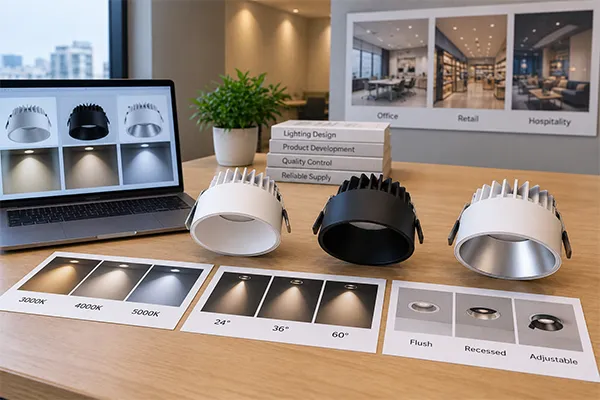
Entry-Level Specifications Still Matter
We do not suggest ignoring cost or performance data. Procurement teams need a practical starting point, especially when reviewing several supplier quotations. A buyer may reasonably compare:
- Unit price at a stated order quantity
- Rated wattage
- Nominal lumen output
- Cutout size and outer diameter
- Input voltage
- Driver type
- IP rating where relevant
- Lead time and packaging method
- Available compliance documents
However, these figures only become meaningful when the buyer knows what is being compared. For example, a 12 W downlight can have different lumen output depending on LED package selection, optical losses, driver efficiency, color temperature, and thermal conditions2. Two products with similar stated lumen figures can also create different visual results because of beam angle, diffuser design, glare control, and color rendering3.
Ask What the Specification Is Intended to Do
In quotation discussions, we often see a buyer request “high lumen, low price, and high CRI” in the same first message. Each goal can be valid, but the combination needs a defined application and target product tier. Otherwise, the requested configuration may not be commercially coherent.
For a basic residential retail range, a buyer may prioritize an accessible price, common color temperatures, and straightforward recessed installation. For a hospitality-oriented range, the buyer may place more emphasis on finish quality, warm color temperatures, visual comfort, and color rendering. For a contractor-focused line, consistency of cutout size, driver availability, delivery reliability, and carton protection may matter as much as headline efficacy4.
A number on a datasheet is useful only when it supports a repeatable installation and purchasing decision.
Build a Comparison Sheet That Reveals Trade-Offs
We recommend that importers and local lighting brands use a structured comparison sheet before finalizing a downlight range.
| Comparison area | Basic question | Why it matters |
|---|---|---|
| Product positioning | Who is the intended buyer and installation type? | Prevents a generic offer with unclear value |
| Wattage and output | Is the light level suitable for the intended category? | Supports a consistent product tier |
| Beam angle5 | Does the distribution fit the expected ceiling height and visual effect? | Affects spacing and perceived brightness |
| CRI | Is the color-rendering level appropriate for the application? | Influences appearance of finishes and merchandise |
| Color temperature | Which CCTs are standard for the target market? | Helps avoid unnecessary SKU complexity |
| Cutout and dimensions | Will the fitting match common installation expectations? | Reduces replacement and installation friction |
| Driver configuration | Is the driver specification stable and serviceable? | Influences long-term purchasing continuity |
| Quality control | What test process is used before shipment? | Helps buyers evaluate process discipline |
| Documentation | Which test reports and certificates are available for review? | Supports local market-entry verification |
At Upward Lighting, we can configure parameters such as CCT, wattage, beam angle, CRI, and surface finish. Still, we see configuration as a manufacturing tool rather than a substitute for product positioning. Buyers should confirm application-specific lighting performance with qualified professionals and verify all local compliance requirements independently.
How Can LED Downlights Be Customized With a Clear Purpose?
Many buyers ask for every available option because they want flexibility. That instinct is understandable. Yet excessive variation can create complicated purchasing, higher minimum-order requirements, slower replenishment6, and a product catalog that customers struggle to understand. Customization should solve a specific commercial or technical requirement.
LED downlights should be customized only when the selected parameter supports a defined market preference, product tier, brand identity, repeatable application, or installation requirement. Purposeful customization creates a clearer offer, while random variation can increase SKU complexity, procurement cost, and supply-chain risk7 without giving customers a meaningful reason to choose the product.
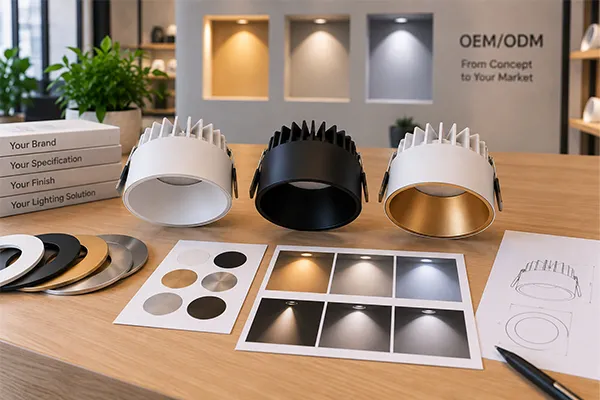
Start With the Reason for the Change
Before we quote a customized downlight, we try to understand why a buyer needs the change. This is not a sales tactic. It helps us identify whether the requested specification is technically feasible, commercially repeatable, and suitable for the order volume.
Useful clarifying questions include:
-
Which market will receive the product?
Local preferences for CCT, trim color, input voltage, plug type, and installation practice can differ.8 -
Who will install or purchase it?
An electrical contractor, retail consumer, property developer, and lighting showroom may evaluate the same product differently. -
Is this a standard catalog SKU or a project-specific item?
A recurring range needs stable, manageable specifications. A project item may need more focused configuration. -
What is the target price level?
The target should be realistic for the requested materials, driver, LED components, finish, packaging, and quality requirements. -
Will the buyer reorder the same configuration?
Repeatability affects material planning and the practicality of dedicated components or packaging.
Common Customization Choices and Their Commercial Roles
| Custom parameter | Potential commercial purpose | Procurement consideration |
|---|---|---|
| Color temperature | Match local preference or a defined ambience category | Limit standard CCTs to manageable SKUs |
| Wattage | Create a clear basic, standard, or premium product tier | Confirm thermal design and output expectations |
| Beam angle | Support a known ceiling or display-lighting use case | Verify layout needs with a lighting professional |
| CRI | Position a range for spaces where color appearance matters | Compare test conditions and documentation |
| Trim finish | Align with interior trends or brand styling | Confirm finish samples and batch consistency |
| Cutout size | Fit common retrofit or construction requirements | Check local installation standards |
| Branding and packaging | Improve identification in a distributor or retail channel | Consider MOQ, artwork approval, and replenishment |
| Driver option | Address dimming or electrical requirements | Confirm compatibility in the target installation |
I have seen buyers request black, white, silver, and gold trims in one initial order because they want to “cover the market.” Sometimes that works for a showroom-led brand with clear demand data. In other cases, it splits the order into too many small quantities and makes inventory harder to manage. A more controlled launch may use one or two core finishes, then add variants after the buyer has verified demand.
Treat Customization as a Controlled System
A customized product needs more than an approved sample. It needs a controlled specification. We encourage buyers to document the agreed configuration in a way that supports future purchase orders:
- Product model and revision reference
- Housing and trim finish
- LED color temperature and tolerance expectations
- Wattage and driver version
- Beam angle and reflector or lens type
- CRI requirement
- Cutout size and dimensions
- Dimming requirement, if applicable
- Packaging artwork and carton markings
- Required inspection points
- Applicable documents to be reviewed before shipment
This approach does not guarantee sales results or market share. It does help create a clearer basis for manufacturing, inspection, quotations, and repeat orders.
How Should a Brand Build a Coherent LED Downlight Product Range?
A single generic downlight rarely serves every region, channel, ceiling type, and customer preference. When a range tries to satisfy everyone, it often becomes difficult to quote, stock, explain, and replenish. We believe the stronger approach is to define a small number of product families with clear roles.
A coherent LED downlight range groups products around defined customer segments and installation needs rather than offering every possible specification in every model. Brands can create clearer product tiers by standardizing core configurations, limiting variations that lack a commercial purpose, and reserving special options for verified project or repeat-order requirements.
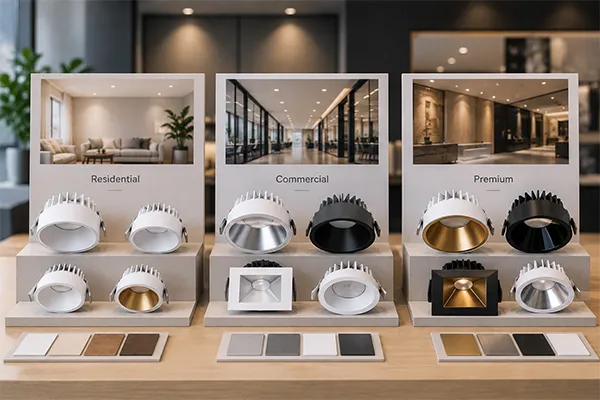
Define the Range Before Selecting Every SKU
The first question should not be, “How many downlights can we offer?” Instead, it should be, “What type of buyer should each product family serve?”
A practical LED downlight portfolio may include three controlled tiers:
| Product family | Typical positioning | Possible configuration approach |
|---|---|---|
| Essential range | Price-conscious residential and trade applications | Common wattages, white finish, selected CCTs, standard cutouts |
| Core range | Broad contractor, distributor, and local-brand demand | Better choice of beam angles, CCTs, CRI options, and driver configurations |
| Feature range | Design-led or application-focused requirements | Distinctive finishes, deeper anti-glare designs, higher CRI options, project-led specifications |
These are examples, not universal recommendations. Each buyer should validate the product mix against local demand, installation practice, competitor offerings, target pricing, and local regulatory requirements.
Reduce Complexity Without Making the Offer Generic
SKU control is not the same as limiting customer choice without reason. It means choosing where options create value and where standardization creates reliability.
For example, a local lighting brand may standardize:
- Three core wattages
- Two color temperatures
- One or two standard trim finishes
- A limited set of common cutout sizes
- One standard driver type for non-dimming models
- One controlled dimming option where the channel requires it
Then, the brand can maintain a separate process for project requirements or larger repeat orders. This distinction helps the buyer avoid mixing special configurations into standard inventory.
Consider Installation Expectations Early
In our quotation conversations, cutout size is sometimes mentioned late, after the buyer has already selected wattage and appearance. Yet installation compatibility can strongly affect the product’s practical value9. A downlight that does not fit common ceiling openings, ceiling depths, spring clip preferences, or local wiring practices may create avoidable friction.
Buyers should review:
- Ceiling cutout diameter and tolerance
- Overall product height
- Heat dissipation space
- Spring clip design and holding force
- Driver placement requirements
- Cable length and terminal method
- Accessibility for replacement or maintenance
- IP requirement for the intended zone
These points are not project-specific lighting design advice. A qualified lighting designer, electrical professional, or project engineer should assess the final installation, local code requirements, and lighting performance for each application.
What Should Buyers Evaluate in an OEM/ODM LED Downlight Supplier?
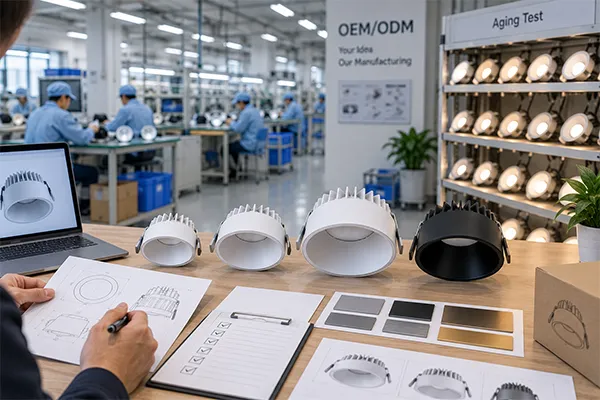
A supplier’s OEM/ODM capability is often described as a long list of options. In practice, the more important question is whether the supplier can convert an approved product concept into stable specifications, controlled production, and repeatable delivery. A wide menu means little if the process is unclear.
When evaluating an OEM/ODM supplier for LED downlights, buyers should assess specification control, quotation clarity, sample approval, quality-control procedures, component consistency, communication speed, documentation, and repeat-order capability. The supplier’s role is to manufacture an agreed product configuration reliably, while buyers remain responsible for market strategy, local compliance, and application-specific validation.
Look Beyond the First Quotation
A fast quotation is useful, especially when a buyer is developing a new range or responding to a tender. However, buyers should look at what the quotation actually defines. A quotation that lists only “12 W LED downlight” leaves too much open to interpretation.10
A more useful quotation identifies the core configuration, such as:
- Housing material and finish
- Wattage and rated electrical input
- LED type or performance category
- CCT and CRI
- Beam angle
- Driver specification
- Cutout and physical dimensions
- IP rating where applicable
- Packaging details
- MOQ and price basis
- Sample lead time and production lead time
- Included or excluded testing and documentation
At Upward Lighting, we work with OEM/ODM requirements across downlights and other LED lighting categories. We aim to ask clarifying questions early because a precise request supports a more useful quote. We also support small-batch orders where feasible, although practical MOQ requirements can still vary with materials, finishes, drivers, packaging, and custom components.
Evaluate Manufacturing Controls
Buyers should ask suppliers to describe their quality-control process in practical terms. They should not rely only on general statements such as “high quality” or “strict QC.”
Our own process includes a 100% aging test before shipment11, typically lasting 4 to 8 hours, to check that products meet our stated production controls for operating stability and lumen-maintenance expectations. This process is one useful manufacturing measure, but it does not replace independent application testing, incoming inspection, or local compliance review by the buyer.
A supplier evaluation checklist can include:
- Is there a documented sample-approval process?
- Can the supplier identify the approved driver, LED, housing, and finish configuration?
- How are changes communicated and controlled?
- Is 100% aging, functional testing, or other inspection performed?
- What records are available for batch traceability?
- How are packaging and labeling checked?
- How does the supplier handle nonconforming products?
- What is the normal response time for technical and quotation questions?
- Can the supplier support repeat orders with the same specification?
Verify Documentation Independently
Upward Lighting products may be supplied with documentation such as CE and RoHS materials, depending on the product and market requirement. Buyers should verify the validity, scope, product-model coverage, issuing body, and current relevance of any certificate or test report before using it for market entry, tender submission, or regulatory purposes.
This verification is especially important when a buyer changes a driver, wattage, housing, or other core component. A document that applies to one configuration may not automatically apply to every variation.12 Local regulations can also differ by destination market, so qualified compliance professionals should review the final requirement.
Frequently Asked Questions
How can LED downlights help a lighting brand differentiate its product line?
LED downlights can support differentiation when the range has a clear purpose, such as a defined installation type, finish preference, CRI level, or product tier. Differentiation does not come from adding options alone. It comes from offering specifications that are relevant, understandable, and repeatable for the intended market.
Is a higher wattage LED downlight always better?
A higher wattage LED downlight is not automatically better. The appropriate wattage depends on the intended application, ceiling conditions, beam distribution, desired light level, thermal design, and local installation requirements. Buyers should review lighting performance with qualified professionals for specific projects rather than selecting wattage alone.
Which LED downlight specifications should importers confirm before ordering?
Importers should confirm wattage, CCT, CRI, beam angle, cutout size, dimensions, trim finish, driver configuration, IP rating where needed, packaging, labeling, and required documentation. They should also approve samples and define inspection criteria before placing repeat or high-volume orders.
Does OEM/ODM customization guarantee better sales results?
No. OEM/ODM customization can help a buyer align LED downlights with a defined product concept or local requirement, but it does not guarantee sales, margin, or market share. Commercial viability depends on market demand, pricing, distribution, brand execution, compliance, and many factors outside manufacturing.
How should buyers verify CE and RoHS documents for LED downlights?
Buyers should check that documents match the exact product model and configuration, confirm the document scope and issue date, review the issuing party where relevant, and compare requirements with the destination market. A qualified regulatory or compliance professional should review application-specific obligations.
Conclusion
Creating competitive advantage with LED downlights requires more than selecting the lowest quoted price or the highest stated output. We recommend that brands and importers define their target customer, standardize the specifications that matter, use customization with a clear purpose, and evaluate suppliers for repeatable manufacturing control. At Upward Lighting, we support OEM/ODM discussions around manufacturable downlight configurations, samples, quotations, and controlled production. Contact our team to discuss a focused LED downlight specification for your next product range or sourcing review.
"Purchasing Energy-Efficient Light Bulbs", https://www.energy.gov/cmei/femp/purchasing-energy-efficient-light-bulbs. The Commission Internationale de l'Éclairage defines the general colour-rendering index as a metric comparing the color appearance of standard test samples under a test source with their appearance under an appropriate reference illuminant. Evidence role: definition; source type: institution. Supports: The definition and intended use of the general color-rendering index (CRI).. Scope note: CRI is a standardized indicator, but it does not fully predict all aspects of color preference, saturation, or visual quality. ↩
"[PDF] 2019 Solid-State Lighting R&D Opportunities - Department of Energy", https://www.energy.gov/sites/prod/files/2020/01/f70/ssl-rd-opportunities2-jan2020.pdf. Technical guidance on LED luminaires explains that delivered light output is determined by the combined performance of the LED source, driver, thermal system, and optical components rather than by rated wattage alone. Evidence role: mechanism; source type: government. Supports: That LED luminaire light output and efficacy depend on LED package performance, driver losses, optical efficiency, temperature, and operating conditions.. Scope note: The source may describe general luminaire behavior and not test the particular 12 W product referenced here. ↩
"[PDF] CALiPER Application Summary Report 20: LED PAR38 Lamps", https://www1.eere.energy.gov/buildings/publications/pdfs/ssl/caliper_20_summary.pdf. Lighting research distinguishes total luminous flux from visual performance, noting that distribution, glare control, and color-rendering characteristics affect how an illuminated space and its objects are perceived. Evidence role: mechanism; source type: research. Supports: That lumen quantity alone does not characterize visual performance, which is also influenced by light distribution, glare, and color-rendering properties.. Scope note: The evidence supports the general optical principle; the visual result in a specific installation also depends on room geometry, surface reflectance, and layout. ↩
"Impact of material supply chain on the productivity optimization for ...", https://pmc.ncbi.nlm.nih.gov/articles/PMC10853190/. Construction supply-chain research recognizes material compatibility, delivery reliability, and damage prevention during transport as factors that can affect installation continuity, rework, and project cost. Evidence role: general_support; source type: research. Supports: That installation compatibility, logistics reliability, and transit protection can affect construction-product performance and total procurement outcomes.. Scope note: The evidence is contextual to construction procurement and does not rank these factors against luminous efficacy for every contractor or lighting category. ↩
"[PDF] CALiPER Application Summary Report 20: LED PAR38 Lamps", https://www1.eere.energy.gov/buildings/publications/pdfs/ssl/caliper_20_summary.pdf. Lighting terminology defines beam angle as the angular width of a light beam at a specified fraction of its peak intensity, making it a key descriptor of a luminaire's directional distribution. Evidence role: definition; source type: government. Supports: That beam angle characterizes the angular distribution of a luminaire's output and is relevant to where light is delivered.. Scope note: Beam angle alone cannot determine spacing or perceived brightness, which also depend on mounting height, luminous intensity distribution, and the surrounding space. ↩
"Understanding the Dynamics of Value-Driven Variety Management", https://sloanreview.mit.edu/article/understanding-the-dynamics-of-valuedriven-variety-management/. Supply-chain research finds that product-variety expansion can increase forecasting, inventory, and replenishment complexity because demand and materials must be managed across more distinct stock-keeping units. Evidence role: general_support; source type: paper. Supports: That increased product variety and SKU counts can add forecasting, inventory, procurement, and replenishment complexity.. Scope note: The magnitude of the effect varies by supplier capabilities, demand volume, common-component use, and ordering policies; minimum-order requirements are not determined by SKU count alone. ↩
"Managing Product Variety: Supply Chain Segementation for Food ...", https://scm.mit.edu/news-and-events/managing-product-variety-supply-chain-segementation-for-food-and-beverage-retailers/. Operations-management literature reports that greater product variety may raise supply-chain complexity and associated inventory, coordination, and procurement costs when the added variants do not share sufficient demand or components. Evidence role: general_support; source type: paper. Supports: That product proliferation can increase operational complexity and inventory-related costs and expose firms to greater planning and supply risks.. Scope note: This literature provides a general operational relationship and does not establish that every customization option is commercially unjustified. ↩
"Mains electricity by country", https://en.wikipedia.org/wiki/Mains_electricity_by_country. International electrical references document national differences in nominal supply voltage, frequency, and plug-and-socket systems; lighting research further indicates that preferred color appearance may vary with user group and application context. Evidence role: general_support; source type: institution. Supports: That electrical supply systems and plug-and-socket arrangements differ by country or region, while lighting preferences can also vary by context and population.. Scope note: Electrical-system differences are directly standardized, whereas local preferences for trim colors and CCT require market-specific validation. ↩
"Compliance Guide - Texas Department of Licensing and Regulation", https://www.tdlr.texas.gov/electricians/compliance-guide.htm. Electrical-safety and luminaire-installation guidance requires recessed luminaires to be installed according to their specified mounting, wiring, and clearance conditions, demonstrating that compatibility with the installation environment is material to proper use. Evidence role: general_support; source type: institution. Supports: That recessed-luminaire installation depends on dimensional fit, clearances, wiring arrangements, and manufacturer instructions.. Scope note: Compliance with installation conditions supports safe and functional installation but does not by itself measure the product's commercial value. ↩
"Purchasing Energy-Efficient Commercial and Industrial ...", https://www.energy.gov/cmei/femp/purchasing-energy-efficient-commercial-and-industrial-led-luminaires. Public lighting-procurement and technical-specification guidance commonly identifies characteristics such as luminous flux, efficacy, color properties, distribution, electrical performance, dimensions, ingress protection, and documentation in addition to rated wattage. Evidence role: general_support; source type: government. Supports: That technical lighting specifications normally include multiple performance, construction, and electrical characteristics beyond input power.. Scope note: The required fields differ by jurisdiction, application, and procurement rules; no universal quotation template applies to all downlights. ↩
"[PDF] Stress Testing of Organic Light-Emitting Diode Panels and Luminaires", https://www.energy.gov/sites/prod/files/2018/05/f51/ssl_oled-stresstest_2018.pdf. Reliability literature describes burn-in and aging procedures as screening methods intended to expose some early-life defects under controlled operation before products enter service. Evidence role: mechanism; source type: paper. Supports: That burn-in or aging tests can serve as production screening for early-life failures and operational defects in electronic or LED products.. Scope note: A production aging test does not by itself demonstrate long-term lifetime, lumen maintenance, safety compliance, or failure-free field performance. ↩
"CE marking – obtaining the certificate, EU requirements - Your Europe", https://europa.eu/youreurope/business/product-rules-compliance/general-product-compliance/ce-marking/index_en.htm. European Commission conformity-assessment guidance states that technical documentation and declarations must support the conformity of the product placed on the market, and relevant product changes can require renewed assessment of applicable requirements. Evidence role: general_support; source type: government. Supports: That conformity assessment and technical documentation must correspond to the product placed on the market and may require reassessment after relevant changes.. Scope note: Whether a particular component substitution or variant requires new testing or documentation depends on the applicable legislation, harmonized standards, and the nature of the change. ↩