

EMC testing requirements for LED downlights can seem straightforward until a buyer needs to match a product’s documents to a specific market, driver, wattage, and installation plan. A generic claim of “CE compliant” may leave important questions unanswered. We help buyers reduce this risk by reviewing the evidence behind the exact downlight configuration they intend to source.
EMC testing requirements for LED downlights involve verifying both electromagnetic emissions and immunity1 for the intended market and final product configuration. Buyers should not treat a CE mark, Declaration of Conformity, and EMC test report as interchangeable documents. Instead, they should confirm that the model number, driver, wattage, dimming method, and relevant destination-market requirements align with traceable supporting evidence.
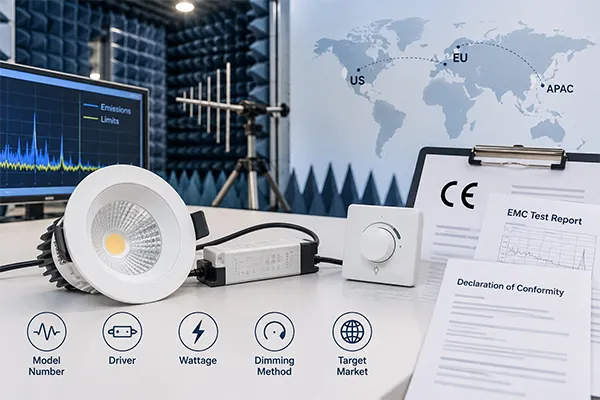
In our conversations with importers, contractors, and lighting brands, we often hear one short question: “Does this downlight have CE?” We understand why buyers ask it. However, responsible sourcing usually requires a few more practical checks before a product is specified, imported, or installed.
What Do EMC Testing Requirements for LED Downlights Mean?
EMC can sound like a laboratory-only subject, yet it has direct consequences for product selection and project reliability. A downlight that creates interference or reacts poorly to electrical disturbances may create avoidable customer complaints, installation delays, or documentation concerns. We encourage buyers to understand the basic purpose of EMC before comparing supplier files.
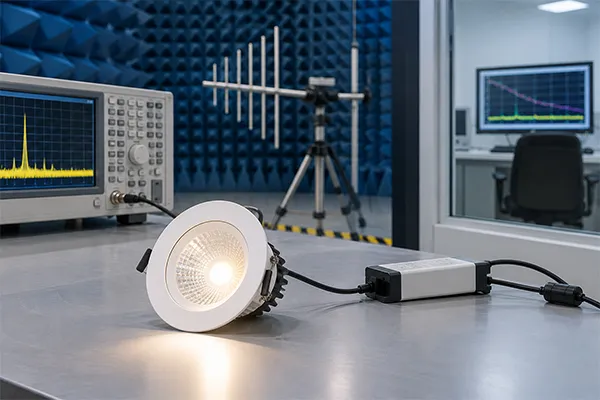
EMC testing requirements for LED downlights generally address two areas: the electromagnetic interference the product may emit and its ability to continue operating appropriately when exposed to electromagnetic disturbances. For buyers, the key action is to confirm that available EMC evidence is relevant to the actual downlight configuration and destination market.
EMC Has Two Practical Sides
EMC means electromagnetic compatibility. In buyer-friendly terms, it asks whether electrical equipment can operate in its intended environment without causing unacceptable interference to other equipment and without being unduly affected by surrounding electromagnetic disturbances.
For LED downlights, the LED driver is often a major consideration. The driver converts incoming power into the controlled output needed by LEDs. Because this process involves electronic switching, its design can influence electromagnetic behavior.2
The two broad EMC considerations are:
-
Emissions
Emissions concern the electrical or electromagnetic disturbance a downlight may produce. This may include conducted disturbance through the power supply wiring and radiated disturbance through the surrounding environment. -
Immunity
Immunity concerns how well the downlight continues to function when it experiences disturbances from the electrical environment. Depending on the product and market context, this can involve conditions such as electrical fast transients, voltage fluctuations, surge events, or electrostatic discharge.3
From a commercial perspective, buyers do not need to become test engineers to ask useful questions. They should understand that “EMC” is not simply a label on a carton. It relates to the interaction between a completed product, its electronics, its installation environment, and the applicable requirements of the destination market.
In our experience, the most productive buyer question is not “Do you have EMC?” It is “What evidence supports this exact model and configuration for my target market?”
Why LED Downlight Configuration Matters
A recessed LED downlight is rarely one fixed product forever. Buyers may request different wattages, correlated color temperatures, beam angles, trim colors, drivers, dimming options, or emergency-related accessories. Some changes are primarily optical or cosmetic. Others may affect the electrical construction and therefore may require closer review.
For example, a 12 W non-dimmable downlight using one driver may not be electrically identical to a 20 W TRIAC-dimmable version using another driver. Likewise, a DALI driver, 0–10 V driver, or sensor-compatible configuration may introduce different interfaces and operating conditions.
We do not make final laboratory or legal determinations. However, we believe buyers should flag changes that may need reassessment by qualified compliance professionals. This approach is more careful than assuming that one document automatically covers every possible variation in a product family.
Is a CE Mark the Same as EMC Test Evidence for LED Downlights?
Many buyers use “CE certificate” as shorthand for all European compliance paperwork. This wording is understandable in daily purchasing conversations, but it can create confusion when procurement teams need to verify real supporting evidence. A mark on the product is not the same thing as a technical test document.4
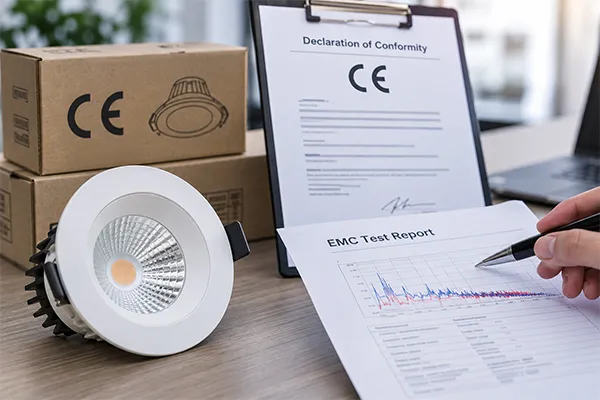
A CE mark is not automatically the same as EMC test evidence for LED downlights.5 The CE mark indicates that the responsible economic operator represents conformity with applicable EU requirements6, while a Declaration of Conformity and supporting technical evidence serve different documentation roles. Buyers should review each document separately and confirm relevance to the product.
The Different Roles of Common Documents
When we review customer questions about compliance files, we often separate three items that are mistakenly grouped together.
| Document or Mark | General Role | What Buyers Should Check |
|---|---|---|
| CE mark | A marking used for products placed on the EU market where applicable requirements are met. | Confirm it appears appropriately on the product, packaging, and documentation where required. Do not treat it as a test report. |
| EU Declaration of Conformity (DoC) | A declaration by the responsible party that a product conforms to applicable EU requirements. | Review the manufacturer or responsible party, product identification, relevant legislation, date, signature or authorized details, and traceability. |
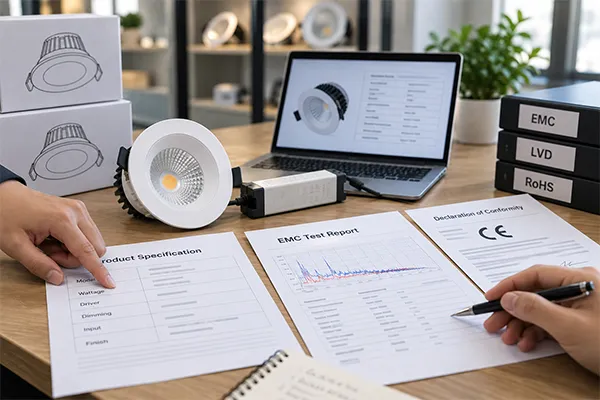
| EMC test report or supporting evidence | Technical evidence from testing or evaluation that may support EMC conformity claims. | Match the report to the exact model, electrical configuration, test scope, laboratory details, and relevant market requirements. |
| Product specification sheet | Commercial and technical product information. | Confirm that the stated wattage, input voltage, driver, dimming option, IP rating, and model identification match the purchase requirement. |
These items may relate to one another, but they are not interchangeable.
A CE mark does not, by itself, show which exact model was evaluated, which configuration was included, or which test conditions were used. A Declaration of Conformity is an important document7, but buyers should still assess whether its product description and cited requirements align with the sourced item. A test report can provide useful technical support, but it also needs to be reviewed for relevance and scope.
A Common Customer Conversation We See
A buyer may send us a message that says, “Please provide CE and EMC certificate for your 18 W dimmable downlight.” We usually respond with clarifying questions such as:
- Which country will receive the goods?
- What is the exact model number?
- Is the required version non-dimmable, TRIAC dimmable, 0–10 V dimmable, or DALI?
- Which wattage and input voltage are required?
- Is the product intended for a residential, retail, hospitality, or commercial project?
- Does the buyer need a document review before order confirmation?
- Is there a nominated third-party inspection, testing body, consultant, or project specification?
These questions are not intended to make procurement difficult. They help us avoid sending a document that looks relevant but does not adequately match the buyer’s requested version.
For EU-market projects, buyers should also remember that compliance responsibilities can involve more than the factory. Importers, brand owners, and other economic operators may have responsibilities depending on their role in placing products on the market.8 We recommend that buyers obtain qualified regulatory advice for their own supply-chain role and destination-market obligations.
Why Must EMC Testing Requirements for LED Downlights Match the Exact Product?
The greatest documentation risk often appears when a buyer assumes that a family-level report automatically applies to every version in a catalog. LED downlights can look nearly identical from the front while using different LED drivers, power levels, dimming circuits, housings, or cable arrangements behind the ceiling.
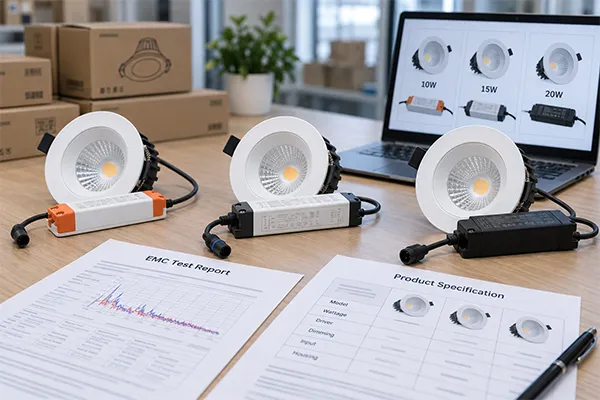
EMC testing requirements for LED downlights should be reviewed against the exact product configuration because changes to wattage, LED driver, dimming system, input arrangement, or related electronics may affect whether existing evidence remains relevant.9 Buyers should request traceable model-to-document matching before approving a purchase.
The Product-to-Document Matching Checklist
We recommend that buyers make a simple comparison table before placing an order. This does not replace professional testing or compliance advice. It does create a clear procurement record and helps identify gaps early.
| Item to Match | Why It Matters | Buyer Verification Action |
|---|---|---|
| Model number | Similar-looking products can have different internal constructions. | Match the purchase order, specification sheet, label, DoC, and test evidence. |
| Rated wattage | Wattage changes may correspond to different drivers or circuit designs. | Confirm the specific ordered wattage is identified or clearly covered. |
| Input voltage and frequency | Electrical input conditions differ across markets and applications. | Check that the evidence and product label reflect the required supply conditions. |
| LED driver | The driver can strongly influence EMC performance.10 | Request driver model, supplier information where available, and configuration confirmation. |
| Dimming method | TRIAC, 0–10 V, DALI, and non-dimmable versions may differ electrically.11 | Confirm the ordered dimming option is included in the documentation scope. |
| Installation method | Recessed, surface-mounted, insulated-ceiling, or accessory-based installation can affect product use. | Review installation instructions and seek qualified advice for unusual applications. |
| Product revision | A design update can change components or circuit layout. | Confirm document dates and revision control with the supplier. |
| Destination market | Applicable requirements and buyer obligations can vary. | Define the final sales country before requesting documents. |
Small Changes Can Have Bigger Effects Than Buyers Expect
We have seen buyers focus only on visible features: cutout size, bezel color, lumen output, or beam angle. These are important project details, but the less visible electrical configuration can matter just as much for EMC evidence.
Consider these examples:
- A buyer selects an 8 W fixed-output downlight for a distributor program, then later changes to a 12 W version to increase lumen output.
- A hospitality project changes from a standard driver to a TRIAC-dimmable driver because the site already has phase-cut dimmers.
- A local lighting brand requests a new driver to meet a preferred price point or to support a smart-control system.
- A contractor adds an external sensor or control accessory that was not part of the original product package.
- A customer requests an alternative input cable, connector, or remote driver arrangement for local installation practices.
None of these changes automatically means that the product is non-compliant. However, each change is a reason to review whether the current evidence remains applicable. This is where a supplier’s document-control discipline becomes valuable.
At Upward Lighting, we support OEM and ODM discussions involving wattage, color temperature, beam angle, CRI, and finish colors. When customers request electrical or control-related changes, we believe it is prudent to identify the final configuration early and discuss whether additional evidence review or qualified third-party evaluation may be needed.
Avoid “Close Enough” Documentation
A report for a product called “LED Downlight Series” may sound reassuring. Still, a buyer should look beyond the title page. The report may list specific models, variants, drivers, ratings, or test samples. The scope matters.
We suggest buyers ask suppliers to explain, in writing where possible:
- Which specific model numbers are included.
- Whether the report names the relevant driver configuration.
- Whether the ordered dimming version is represented.
- Whether the rated power and input conditions match.
- Whether the product has changed since the document date.
- Whether the report is directly applicable or is being used as supporting family evidence that needs further review.
This process reduces ambiguity. It also helps purchasing teams explain their supplier-selection decision internally.
How Can Buyers Verify EMC Testing Requirements for LED Downlights Before Ordering?
Procurement teams often face time pressure. They need quotations quickly, samples approved, and shipments scheduled. Yet a short verification sequence at the beginning can be far less costly than resolving a document mismatch after production, customs clearance, tender submission, or site installation.
Buyers can verify EMC testing requirements for LED downlights by defining the destination market and final product configuration first, then requesting traceable documents that match the model, wattage, driver, and dimming option. When uncertainty remains, buyers should seek advice from qualified testing, engineering, or compliance professionals.
A Practical Pre-Purchase Sequence
We recommend the following sequence for importers, wholesalers, local brands, and project buyers.
-
Define the destination market
Identify where the product will be imported, sold, and installed. A buyer shipping to one country may have different market-entry questions than a buyer shipping the same product to another country. -
Freeze the product configuration
Confirm the model, wattage, color temperature, beam angle, input voltage, driver type, dimming method, finish, and required accessories. For EMC review, the electrical configuration is especially important. -
Request a document pack early
Ask for the product specification sheet, available Declaration of Conformity where relevant, supporting EMC evidence, product labels, installation instructions, and any available component information needed for review. -
Match the documents to the purchase specification
Compare the documentation against the quotation, sample, purchase order, and final bill of materials or production confirmation where available. -
Ask questions about product revisions
Verify whether the production version uses the same driver and key electrical components as the evaluated configuration. Buyers should also ask whether there have been changes since the report or declaration was issued. -
Use qualified external review when needed
If the project is high-risk, the product has been customized, the destination requirements are unclear, or the documentation scope is uncertain, consult a qualified laboratory, compliance consultant, or appropriately experienced professional. -
Keep records with the order file
Store the final approved specification, documents, email confirmations, samples, inspection records, and shipping details. Good traceability supports future reorders and supplier management.
Procurement Questions That Produce Better Answers
The quality of a supplier’s response often depends on the quality of the request. Instead of asking only, “Can you send CE?” buyers can use a more specific message:
“Please provide the available EMC supporting evidence and relevant conformity documents for model DL-XX, 15 W, 220–240 V, TRIAC-dimmable configuration, for our intended destination market. Please confirm whether the production driver and product revision match the documented configuration.”
This type of request provides a supplier with the information needed to respond accurately. It also creates a useful written record.
What We Can Support as a Manufacturer
As a sales-facing manufacturing team, we can help buyers organize product information, confirm ordered configurations, provide available customer-facing documentation, and communicate production details. We can also discuss our standard quality-control process. For example, we conduct a 100% aging test for 4 to 8 hours before shipment as part of our internal production quality process.
However, aging tests are not EMC tests, and we do not present them as such. Likewise, product certifications and reports should be reviewed for the exact product and market context rather than treated as universal proof.
We encourage buyers to verify certification documents, test evidence, and market-entry requirements with appropriate qualified parties when application-specific decisions are involved.
What Should Buyers Ask an LED Downlight Supplier About EMC Documentation?
A supplier may have strong production capabilities but weak document traceability, or the reverse may be true. Buyers need both: a commercially suitable product and a supplier that can answer practical questions about its configuration, quality process, and available evidence.
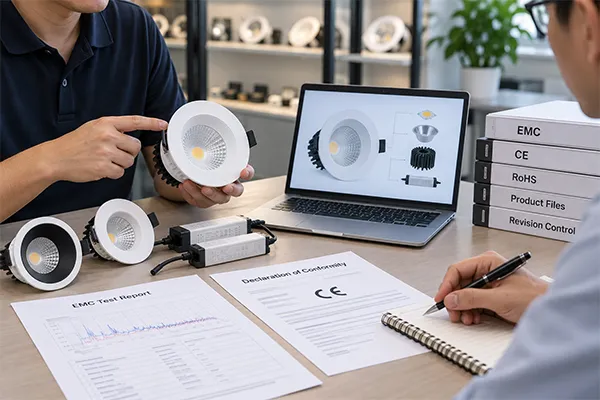
Buyers should ask LED downlight suppliers whether EMC documents can be traced to the final model, wattage, driver, and dimming configuration. They should also ask about revision control, destination-market experience, product labeling, and the process used when customization changes an electrical component.
Supplier Evaluation Questions
A structured supplier review can reveal more than a generic certificate request. We suggest asking the following questions before making a long-term sourcing decision.
Product and Configuration Questions
- What is the complete model number for the quoted product?
- Which driver is used in the standard version?
- Does the quoted unit have a non-dimmable, TRIAC, 0–10 V, or DALI driver?
- Is the requested wattage part of a documented product family?
- Has the driver, PCB, power rating, cable, or control interface changed recently?
- Can the supplier provide a clear specification sheet and product label artwork?
Documentation Questions
- Which documents are available for the selected market?
- Does the available EMC evidence identify the applicable model or configuration?
- Can the supplier explain the relationship between a test report, DoC, and CE marking without treating them as the same document?
- Who is responsible for maintaining technical files and declaration records?
- Can the supplier provide documents in a timely manner for tender, customs, or customer review?
Quality and Supply Questions
- What production inspection steps are used?
- Does the supplier conduct aging tests, functional checks, or incoming component inspection?
- Can the supplier support consistent driver sourcing for repeat orders?
- What happens if a specified component becomes unavailable?
- Can the supplier support small-batch samples before a larger order?
Why Documentation Discipline Supports Long-Term Sourcing
For distributors and lighting brands, documentation is not only a first-order task. It affects reorders, warranty handling, tender approvals, and customer confidence.
We have found that the best long-term buyer-supplier relationships start with a controlled reference sample and a written configuration. When the buyer later reorders, both sides can compare the new production order against the approved baseline.
This is especially useful for OEM and ODM programs. A private-label downlight may use a customer-specific carton, bezel color, CCT selection, or wattage. If the buyer later changes the driver or adds dimming, the product should not be treated as unchanged merely because the outer appearance remains similar.
At Upward Lighting, we work with global lighting buyers on customized LED downlights and other indoor and outdoor LED products. We aim to provide quick quotations, small-batch support, and clear communication. For compliance-related questions, our role is to help organize available product information and clarify the configuration—not to replace a qualified laboratory, certification body, engineer, or legal adviser.
Frequently Asked Questions
Does CE mean an LED downlight has passed EMC testing?
No. A CE mark, a Declaration of Conformity, and EMC test evidence have different roles. A CE mark should not be treated as a standalone EMC report. Buyers should request supporting documentation and verify that it relates to the exact LED downlight configuration and intended market.
Can one EMC report cover all LED downlight wattages?
Not automatically. Different wattages may use different LED drivers, PCB designs, electrical ratings, or dimming circuits. Buyers should confirm whether the report explicitly includes the ordered wattage and configuration. If product details have changed, qualified reassessment may be appropriate.
Does a dimmable LED downlight need separate EMC document review?
A dimmable version may require closer review because TRIAC, 0–10 V, DALI, and other control methods can change the electrical configuration. Buyers should confirm that the selected dimming driver and product model are covered by relevant supporting evidence for the intended market.
What EMC documents should an LED downlight importer request?
Buyers should request a specification sheet, relevant Declaration of Conformity where applicable, available EMC test evidence, product labeling details, installation instructions, and written confirmation of the final configuration. The buyer should compare these items against the quotation and purchase order.
Are 4–8 hour aging tests the same as EMC testing?
No. Aging tests are production quality-control activities used to check product operation over a defined period. EMC testing addresses emissions and immunity performance under specific methods and conditions.12 Both can be useful, but they serve different purposes and should not be confused.
Conclusion
EMC testing requirements for LED downlights are best handled as a product-verification process, not as a quick request for a CE logo. Buyers should define their destination market, lock in the exact model and electrical configuration, and review whether available evidence matches the wattage, driver, dimming option, and product revision. A careful document trail supports better supplier selection and lowers avoidable market-entry risk. If you are sourcing configurable LED downlights, contact Upward Lighting to discuss your specification and request available product documentation for review.
"List of common EMC test standards", https://en.wikipedia.org/wiki/List_of_common_EMC_test_standards. Electromagnetic compatibility comprises control of electromagnetic emissions and sufficient immunity so that equipment can operate satisfactorily in its electromagnetic environment. Evidence role: definition; source type: institution. Supports: EMC is concerned with limiting electromagnetic disturbances emitted by equipment and ensuring adequate immunity to disturbances in its environment.. ↩
"EMI Mitigation in LED Driver Design: A Technology Strategy for Business ...", https://www.academia.edu/126622354/EMI_Mitigation_in_LED_Driver_Design_A_Technology_Strategy_for_Business_Value. Studies of switched-mode LED drivers report that high-frequency switching and associated parasitic elements can contribute to conducted and radiated electromagnetic interference, making driver design relevant to EMC performance. Evidence role: mechanism; source type: paper. Supports: Switched-mode power-conversion circuits used in LED drivers can generate conducted and radiated electromagnetic interference, with performance depending on circuit and filter design.. Scope note: The precise EMC behavior of a particular downlight depends on its driver, layout, enclosure, cabling, and installation conditions. ↩
"Electrical Fast Transient (EFT) Test - Overview, Levels, & ...", https://transientspecialists.com/blogs/blog/electrical-fast-transient-burst-iec-61000-4-4?srsltid=AfmBOood1W93T4BgwENXPa0I_SW78ByY_4WLgaLpVM69DpFT-pqFEygs. The IEC 61000-4 series specifies immunity test methods for phenomena including electrostatic discharge, electrical fast transients, surge, and supply-voltage disturbances. Evidence role: general_support; source type: institution. Supports: IEC 61000-4 series methods cover immunity phenomena including electrostatic discharge, electrical fast transients, surges, and voltage dips or interruptions.. Scope note: The applicable tests, performance criteria, and severity levels depend on the product category, environment, and harmonized standard selected. ↩
"CE Marking", https://www.trade.gov/ce-marking. The European Commission's CE-marking guidance characterises the CE mark as a conformity marking affixed under the manufacturer's responsibility, while technical documentation provides the evidence supporting conformity. Evidence role: definition; source type: government. Supports: CE marking is a regulatory conformity marking rather than a certificate or test report.. Scope note: Some products may also be accompanied by voluntary certificates or third-party assessment records, but these are distinct from the CE mark itself. ↩
"Compliance FAQs: CE Marking", https://www.nist.gov/standardsgov/compliance-faqs-ce-marking. European Union guidance distinguishes the CE marking from the technical documentation and EU declaration of conformity that demonstrate and declare compliance with applicable Union requirements. Evidence role: definition; source type: government. Supports: CE marking is a conformity marking supported by required conformity assessment, an EU declaration of conformity, and technical documentation; it is not itself a laboratory test report.. Scope note: The documentation required and the conformity-assessment route vary by applicable EU legislation and product type. ↩
"Compliance FAQs: CE Marking", https://www.nist.gov/standardsgov/compliance-faqs-ce-marking. Under EU CE-marking rules, affixing the marking signifies that the manufacturer accepts responsibility for the product's conformity with all applicable requirements of the relevant Union harmonisation legislation. Evidence role: general_support; source type: government. Supports: By affixing CE marking, the manufacturer declares that the product meets all applicable requirements of the relevant Union harmonisation legislation.. Scope note: Responsibility may be assigned differently where an importer, authorised representative, or another actor assumes obligations under the relevant legislation. ↩
"Compliance FAQs: CE Marking", https://www.nist.gov/standardsgov/compliance-faqs-ce-marking. EU guidance describes the declaration of conformity as the document through which the manufacturer declares, under its responsibility, that an identified product meets the applicable Union requirements. Evidence role: definition; source type: government. Supports: The EU declaration of conformity is a document in which the manufacturer declares compliance and identifies the applicable legislation and product.. Scope note: Required declaration content and retention periods are determined by the specific EU legislation applicable to the product. ↩
"EU - EU Legislation and CE Marking", https://www.trade.gov/country-commercial-guides/eu-eu-legislation-and-ce-marking. EU harmonisation legislation assigns defined compliance and traceability obligations to economic operators, including importers and distributors, according to the role by which they make products available on the market. Evidence role: general_support; source type: government. Supports: EU product legislation assigns specific obligations to manufacturers, importers, distributors, and authorised representatives placing products on the Union market.. Scope note: The exact obligations depend on the applicable legislation, the product, and whether an operator places the product on the market under its own name or trademark. ↩
"Electromagnetic Compatibility (EMC) of Medical Devices", https://www.fda.gov/media/94758/download. EMC conformity-assessment guidance generally requires manufacturers to review product modifications, because changes to electrical components, operating modes, or installation arrangements may alter the basis on which prior compliance evidence was established. Evidence role: general_support; source type: institution. Supports: Changes to a product's electrical design, components, or operating modes can require an assessment of whether prior EMC conformity evidence remains applicable.. Scope note: Whether retesting or a documented engineering assessment is necessary must be determined for the specific change, applicable standard, and intended environment. ↩
"EMI Mitigation in LED Driver Design: A Technology ...", https://www.academia.edu/126622354/EMI_Mitigation_in_LED_Driver_Design_A_Technology_Strategy_for_Business_Value. Research on LED lighting electronics identifies the driver’s switching topology, filtering, and interconnection design as significant factors in the conducted and radiated EMC characteristics of a luminaire. Evidence role: mechanism; source type: research. Supports: The driver and its switching topology, filtering, grounding, and wiring are important contributors to luminaire electromagnetic emissions and immunity.. Scope note: A complete luminaire's result cannot be inferred from the driver alone because enclosure, cables, controls, and installation can also affect performance. ↩
"Digital Addressable Lighting Interface", https://en.wikipedia.org/wiki/Digital_Addressable_Lighting_Interface. Lighting-control references distinguish phase-cut dimming, analogue 0–10 V control, and DALI digital control as different electrical control methods with different interfaces and operating principles. Evidence role: general_support; source type: institution. Supports: Phase-cut, 0–10 V, and DALI dimming use distinct control approaches and electrical interfaces.. Scope note: Different control interfaces do not by themselves establish that separate EMC testing is legally required for every product variant. ↩
"EMC testing | Rohde & Schwarz", https://www.rohde-schwarz.com/us/solutions/electronics-testing/emc-testing/emc-testing_253441.html. Reliability references describe burn-in testing as operating equipment for a defined period to screen for early-life failures, whereas EMC standards assess emissions and immunity under prescribed electromagnetic test methods. Evidence role: definition; source type: education. Supports: Burn-in or aging tests are generally used for reliability screening or operational verification, whereas EMC tests measure emissions and immunity using specified methods.. Scope note: A manufacturer's particular aging-test duration, load conditions, and acceptance criteria are internal process details and are not established by this general distinction. ↩