
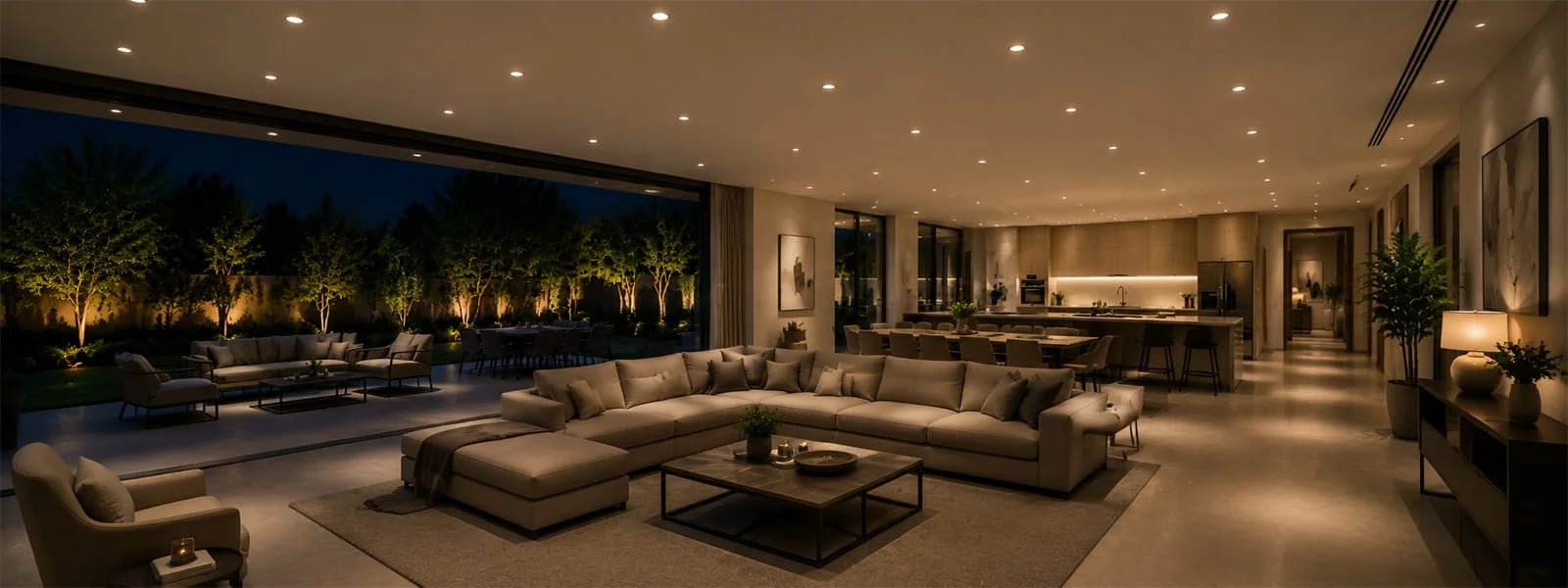
LED downlight importers often face a familiar problem: many suppliers can quote similar products, yet those products may not fit the intended channel, project, or customer expectation. This creates price pressure, slow-moving stock, and costly rework. I believe the stronger opportunity lies in selecting application-specific ranges that lower commercial and operational risk.
LED downlight importers can find better opportunities by matching product specifications, documentation, packaging, and customization options to a defined application and sales channel. Rather than importing the cheapest generic downlight, buyers should assess installation conditions, lighting comfort, compliance requirements, SKU complexity, and supplier execution before committing to volume orders.
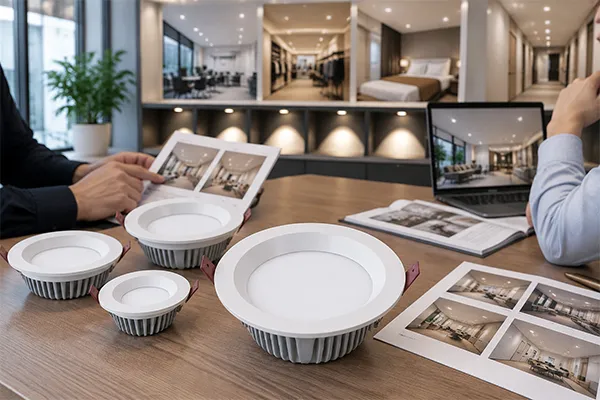
I have seen this pattern repeatedly in conversations with overseas buyers. A request may begin with “send your best price,” but the discussion usually becomes more detailed once samples, cut-out sizes, trim colors, beam angles, and local documentation needs enter the picture. The real work starts after the first quotation.
How Can LED Downlight Importers Define Opportunity by Application?
Many importers begin with a product list instead of an end-use case. That approach can make purchasing look simple, but it often creates a mismatch between the downlight and the buyer’s actual installation needs. I recommend starting with the application, because that is where product fit and repeat-order potential usually begin.
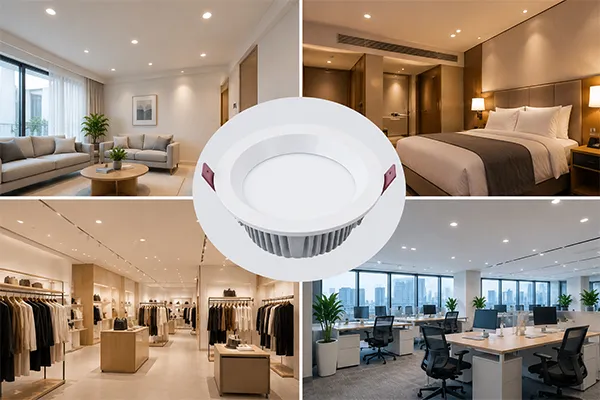
LED downlight importers should define an opportunity by identifying the installation environment, target buyer, expected lighting effect, and sales channel before selecting a specification. A downlight for a residential distributor, hospitality project, retail shop, or office renovation may require different wattage, beam angle, trim design, documentation, and packaging.
Start With the Installation Environment
I encourage buyers to ask where and how the product will be used. A recessed LED downlight is not simply a wattage and cut-out measurement. The ceiling type, ceiling depth, insulation conditions, humidity exposure, maintenance access, and expected operating hours can all affect the appropriate product choice.1
For example, a downlight intended for a decorative residential ceiling may prioritize:
- A slim body or shallow installation depth
- A clean trim appearance
- Warm or neutral color temperature options
- A compact assortment of popular sizes
- Retail-ready packaging
A commercial corridor, shop, or office installation may place more attention on:
- Consistent appearance across larger quantities
- Beam-angle consistency2
- Glare control
- Neutral white color temperature options
- Documented product parameters
- Delivery coordination for phased installation
I have seen buyers request a high-lumen model before providing details about the ceiling height or visual task. Once we discuss the application, they sometimes decide that a different beam angle, lower output, or more comfortable optical arrangement is the better commercial option.
Build an Application Brief Before Requesting Quotes
A useful sourcing inquiry does not need to be complicated. I suggest that buyers prepare a short application brief before asking suppliers for a quotation or sample.
| Evaluation Item | Questions to Ask |
|---|---|
| Application | Is the product for homes, retail, offices, hotels, corridors, or another setting? |
| Installation | What are the ceiling material, cut-out size, depth, and wiring conditions? |
| Lighting intent | Is the goal ambient light, accent lighting, task lighting, or general illumination? |
| Target customer | Is the buyer a contractor, distributor, electrical retailer, or local lighting brand? |
| Sales channel | Will the product be sold through projects, wholesale, retail, e-commerce, or a mixed route? |
| Range strategy | Is this a core stock item or a controlled test SKU? |
| Documentation | Which test reports, declarations, labeling details, or other documents must be reviewed? |
This type of brief gives a supplier more context. It also helps an importer compare quotations on more than unit price. I would not assume that a supplier understands the intended market simply because the product name is familiar. Buyers should describe the use case and verify what is included in the quoted configuration.
I have found that the best questions are usually specific: “Which cut-out will our installer use?” is more useful than “What is your best downlight?”
Look for Repeatability, Not Just a Single Sale
An opportunity becomes more valuable when the product can be reordered with stable specifications. This does not mean every importer needs a large universal range. It means the chosen range should be manageable.
I recommend that buyers identify a small group of core application-led SKUs first. For instance, a distributor may begin with a limited combination of popular cut-outs, color temperatures, and trim finishes. A local brand may add differentiated options only after samples and market feedback support the decision.
This discipline can reduce inventory fragmentation. It can also make future orders easier to forecast, pack, inspect, and promote.
Why Should LED Downlight Importers Look Beyond Wattage and Lumens?
A high wattage figure can appear attractive on a comparison sheet. However, I have seen that wattage alone does not explain whether a downlight will look right, feel comfortable, or meet the expectations of a particular customer. Buyers may face returns or dissatisfaction when they treat output as the only performance measure.
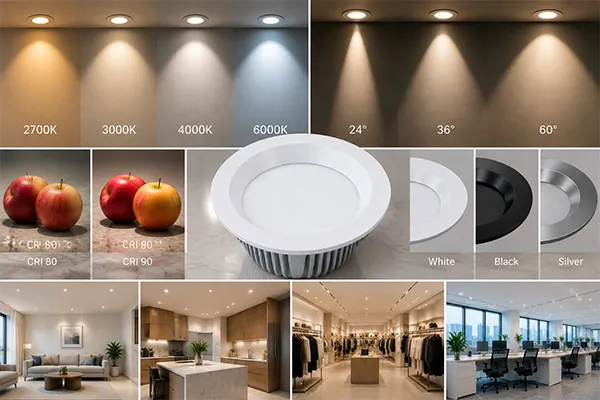
LED downlight importers should assess wattage and lumen output alongside color temperature, color rendering index, beam angle, glare control, trim appearance, heat management, and installation dimensions. A higher-output product is not automatically a better product if its lighting effect, visual comfort, or physical fit does not suit the application.3
Evaluate the Lighting Effect, Not Only the Output
A specification sheet can contain many numbers, but buyers should connect each number to an installation result. The correct specification depends on the use case and should be reviewed by a qualified professional where application-specific lighting design or electrical requirements apply.
Here are several factors I regularly see customers discuss during sampling and quotation:
| Specification | Why It Matters to Buyers | What Importers Should Clarify |
|---|---|---|
| Wattage | Influences energy use and output expectations | Is the wattage appropriate for the target application? |
| Lumen output | Indicates light quantity | What test conditions and tolerance are stated? |
| CCT4 | Changes the visual atmosphere | Which CCT options suit the target customer base? |
| CRI5 | Affects perceived color appearance | Does the intended application need a defined CRI level? |
| Beam angle | Influences light spread and spacing | Is the beam narrow, medium, or wide for the layout? |
| UGR or glare-related design6 | Influences visual comfort | What optical design information can the supplier provide? |
| Cut-out and outer diameter | Determines installation fit | Are dimensions consistent across production batches? |
| Trim finish | Affects ceiling appearance | Is white, black, brushed, or another finish required? |
CCT and CRI Can Influence Commercial Acceptance
I do not present one color temperature as universally correct. A warm tone may suit one residential or hospitality setting, while a neutral tone may be expected in another commercial environment.7 Local preference, existing lighting, interior colors, and project specifications can all influence the decision.
The same applies to CRI. A buyer may decide that a standard CRI option is appropriate for a price-sensitive distribution range, while another customer may request a higher CRI option for retail, display, or premium interior applications. The important point is that the specification should be intentional.
When I discuss custom orders, I ask buyers to confirm whether the color temperature and CRI are fixed requirements or marketing preferences. A small specification change can affect component sourcing, lead time, testing scope, and repeat-order consistency.
Treat Samples as Decision Tools
I consider samples a controlled validation step, not a formality. A sample should help the importer evaluate the product under conditions that resemble the intended sale or installation.8
During a sample review, buyers can check:
- Visual appearance: trim color, finish, size, and perceived build quality.
- Installation fit: cut-out, spring tension, driver placement, and ceiling clearance.
- Lighting effect: beam spread, brightness perception, color consistency, and comfort.
- Packaging suitability: carton strength, labeling, instructions, and retail presentation.
- Document alignment: model code, rated parameters, and documentation references.
I have watched buyers change their initial selection after placing two samples side by side in a mock-up ceiling. That does not mean the first product was defective. It means the application made the difference visible.
Which Sales Channels Create Different Opportunities for LED Downlight Importers?
A downlight range that works for a wholesale counter may not work for a project tender or a local lighting brand. The risk appears when an importer tries to serve every channel with the same SKU list, packaging format, and support model. I believe channel clarity is one of the most practical ways to improve buying decisions.
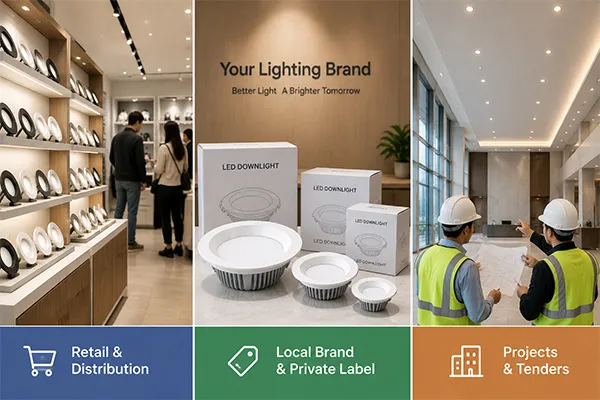
LED downlight importers should separate retail and distribution opportunities, local-brand opportunities, and project opportunities because each channel requires different SKU discipline, packaging, documentation, lead-time planning, and technical support. A single universal range can increase inventory and service risk when channel expectations differ.9
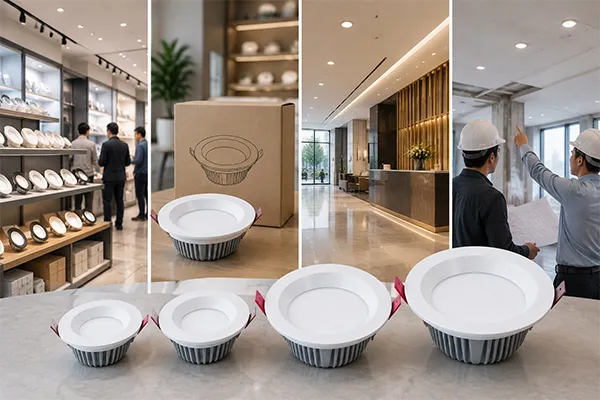
Retail and Distribution: Keep the Range Easy to Stock
Retail and distribution channels usually benefit from a focused range. Buyers in these channels often need products that are easy for sales staff, electricians, and end customers to understand.
I would typically recommend that importers consider:
- Clear product naming and model identification
- A limited number of core wattages and cut-out sizes
- Consistent retail carton design
- Barcode, label, and instruction requirements where needed
- Replacement availability for core SKUs
- Stock planning for faster-moving items
The commercial opportunity may come from reducing confusion. A distributor may sell more effectively when the range is easy to explain and reorder, rather than when it contains too many near-identical options.
Local Brands: Build Differentiation With Control
A local lighting brand may need more distinct product positioning. This can include customized trim colors, logo packaging, selected CCT options, a defined CRI target, or a branded model-number system.
However, I would not treat customization as free from risk. Each variant can create more purchasing complexity. Buyers should verify the minimum order quantity, component availability, packaging requirements, sample approval process, and expected production lead time.
At Upward Lighting, we receive requests for OEM and ODM adjustments such as color temperature, wattage, beam angle, CRI, and surface finish colors. I see the most effective projects begin with a controlled specification list rather than a broad request for “everything customized.”
Projects: Manage Documents and Delivery Coordination
Project opportunities may require stronger coordination. Contractors and project buyers can need more detailed product information, sample approvals, delivery schedules, and consistency across multiple shipments.
I suggest that project-focused buyers clarify these points early:
- Required model and specification schedule
- Product approval and sample approval process
- Installation timetable and delivery phases
- Carton labeling or project marking requirements
- Replacement quantity planning
- Required documents for review
- Change-control process if specifications are updated
Our products are offered with CE and RoHS documentation, but I always recommend that buyers verify the current documents, product-model coverage, destination-market requirements, and project-specific acceptance criteria. Documentation can support procurement review, but it does not automatically establish market entry or project approval in every case.
How Can LED Downlight Importers Use Customization and Small Batches Safely?
Customization can help importers test a product concept without immediately building a large inventory position. Yet a small batch does not remove all commercial risk. It can introduce variant complexity, supply constraints, and longer coordination time if the specification is not controlled from the start.
LED downlight importers can use customization and small-batch orders as structured validation tools by confirming MOQ, component availability, sample approval, documentation, lead time, and future reorder conditions. Buyers should scale only after they understand the cost and operational impact of maintaining each product variant.
Use a Controlled Test Sequence
I prefer a step-by-step approach when a buyer wants a differentiated LED downlight range. This approach can help reduce surprises before a larger purchase order.
-
Define the target application and channel.
I start with the intended buyer and installation scenario, not with a vague product description. -
Freeze the key parameters.
The buyer should confirm wattage, CCT, CRI, beam angle, trim finish, cut-out, driver arrangement, and packaging needs. -
Request a detailed quotation.
The quotation should identify the model configuration, unit price basis, MOQ, packaging, delivery term, and any customization cost. -
Approve samples and appearance details.
Buyers should keep an approval record for product appearance, labels, packaging artwork, and key parameters. -
Verify documents and market requirements.
The buyer should check which documents are needed for the intended market and whether they apply to the exact product configuration. -
Place a controlled initial order.
A first order can be used to assess market acceptance, logistics performance, and actual SKU management requirements. -
Review before scaling.
Buyers should assess sales feedback, return patterns, reorder frequency, and component availability before adding more variants.
Ask the Supplier Questions That Protect the Reorder
I have found that buyers sometimes focus heavily on the initial sample but do not ask enough about future production. A product can look good in a sample stage while still requiring careful planning for repeat orders.
Before confirming a customized or small-batch order, I recommend asking:
- What is the MOQ for this exact configuration?
- Which components are standard and which are customized?
- Are the LED source, driver, trim, and packaging materials readily available?
- What lead time applies to samples, first production, and repeat orders?
- Can the supplier maintain the same model code and parameter set?
- What changes could affect price or lead time in a future order?
- What quality-control process is applied before shipment?
- How are approved samples, artwork, and product specifications recorded?
At Upward Lighting, we conduct a 100% aging test before shipment, generally lasting 4 to 8 hours according to the product arrangement and production requirements. I would still encourage buyers to define their own inspection expectations and to verify how the supplier documents quality checks for the relevant order.
Avoid Variant Proliferation
A customized range can become difficult to manage when every buyer requests a slightly different combination. For example, five wattages, three color temperatures, two trim colors, and two beam angles can quickly create 60 possible variants10 before packaging differences are added.
| Range Strategy | Commercial Benefit | Main Risk |
|---|---|---|
| One generic model | Easy initial sourcing | Weak differentiation and poor application fit |
| Focused core range | Easier stock control and repeat ordering | May not serve every niche request |
| Controlled customization | Supports local-brand or project positioning | Requires clear MOQ and specification control |
| Large variant matrix | Can appear comprehensive | Higher inventory, forecasting, and replacement risk |
I believe most importers should establish core SKUs first. They can then add variants only when a customer segment, project pipeline, or repeat-order signal supports the additional complexity.
Frequently Asked Questions
What should LED downlight importers check before ordering samples?
I recommend that LED downlight importers confirm the intended application, cut-out size, wattage, CCT, CRI, beam angle, trim finish, driver arrangement, and packaging requirement before ordering samples. Buyers should also request model-specific documentation and clarify whether the sample matches planned production specifications.
Is higher wattage always better for an LED downlight range?
No. Higher wattage may provide more output, but it can also create an unsuitable lighting effect, unnecessary energy use, glare concerns, or a poor fit for the ceiling height and application.11 Buyers should evaluate wattage together with lumens, beam angle, CCT, CRI, and visual comfort.
Can a small-batch LED downlight order reduce import risk?
A small-batch order can help buyers validate product acceptance, packaging, supplier communication, and sales-channel response before scaling. However, buyers should still verify MOQ, component availability, customized-part cost, documentation needs, lead time, and future reorder conditions.
Are CE and RoHS documents enough for market entry?
CE and RoHS documents may be relevant to product compliance review, but they do not automatically guarantee market entry or project approval in every destination.12 Importers should verify the current documents, applicable regulations, product-model coverage, labeling requirements, and any local or project-specific requirements.
How can an importer avoid slow-moving LED downlight inventory?
I suggest starting with a limited range of application-led core SKUs. Buyers should avoid adding multiple wattage, CCT, finish, and beam-angle combinations without evidence of demand. Sample feedback, repeat inquiries, customer orders, and channel requirements can guide future SKU expansion.
Conclusion
Emerging opportunities for LED downlight importers are not limited to finding a lower unit price. I believe the more durable opportunity comes from selecting products that fit a defined application, channel, and customer expectation. Buyers should look beyond wattage, control SKU complexity, verify documentation, and use samples and small batches to test decisions before scaling. If you are building a focused downlight range, I invite you to discuss your application, target channel, and customization requirements with Upward Lighting for a practical quotation and sample review.
"[PDF] Are LEDs Ready for Recessed Downlight Applications", https://www1.eere.energy.gov/buildings/publications/pdfs/ssl/leds_may_applications.pdf. Recessed luminaires must be selected and installed for their specified environmental and enclosure conditions; insulation contact, damp or wet location rating, thermal conditions, and accessibility can affect safe and suitable application. Evidence role: general_support; source type: government. Supports: Authoritative lighting or safety guidance explaining that recessed-luminaire suitability depends on installation environment, including insulation contact, location rating, enclosure conditions, and service access.. Scope note: The applicable requirements depend on the destination jurisdiction, installation code, and the specific luminaire's listing or instructions. ↩
"[PDF] Examining Perceptual Luminance Uniformity of Simulated Luminaire ...", https://www.energy.gov/eere/ssl/articles/examining-perceptual-luminance-uniformity-simulated-luminaire-patterns. Luminaire beam distribution is a determinant of light spacing and illuminance uniformity, so consistent photometric performance is relevant when many units are used within one installation. Evidence role: mechanism; source type: institution. Supports: Lighting-design guidance defining beam spread and showing that luminaire photometric distribution affects spacing, illuminance patterns, and perceived uniformity.. Scope note: Beam-angle consistency alone does not establish overall uniformity, which also depends on mounting geometry, room surfaces, and layout. ↩
"[PDF] LED Color Characteristics", https://www.energy.gov/sites/prod/files/2016/08/f33/led-color-characteristics-factsheet.pdf. Total luminous output is only one attribute of lighting performance; distribution, glare, color quality, and the task and environment influence whether a lighting solution is suitable. Evidence role: general_support; source type: government. Supports: Lighting-quality guidance showing that useful lighting depends on distribution, glare, color qualities, and application needs in addition to total light output.. Scope note: This principle does not identify the optimum output or optical specification for a particular room without an application-specific lighting design. ↩
"Understanding LED Color-Tunable Products | Department of Energy", https://www.energy.gov/cmei/ssl/understanding-led-color-tunable-products. Correlated color temperature describes the chromatic appearance of white light; lower and higher CCTs are generally perceived as warmer and cooler, respectively. Evidence role: definition; source type: institution. Supports: A recognized definition of correlated color temperature and guidance that lower and higher CCT light sources are commonly perceived as warmer and cooler in appearance, respectively.. Scope note: Perceived atmosphere also depends on illuminance, surrounding colors, daylight, and individual or cultural preferences. ↩
"Purchasing Energy-Efficient Light Bulbs", https://www.energy.gov/cmei/femp/purchasing-energy-efficient-light-bulbs. Color-rendering metrics characterize how a light source affects the appearance of object colors relative to a reference illuminant, making color quality relevant to applications where color discrimination or presentation matters. Evidence role: definition; source type: institution. Supports: A technical definition of color rendering index and evidence that a light source's spectral properties influence the appearance of illuminated object colors.. Scope note: CRI is not a complete predictor of color preference or fidelity for all light sources and applications. ↩
"[PDF] Glare and Diffuse Sources", https://www.energy.gov/sites/prod/files/2021/02/f82/ssl-rd21-schwade-glare.pdf. Discomfort glare can reduce visual comfort, and the Unified Glare Rating is a standardized method used to evaluate glare from lighting installations under defined viewing conditions. Evidence role: mechanism; source type: institution. Supports: Lighting guidance explaining discomfort glare and the use of Unified Glare Rating as a method for evaluating glare in applicable interior lighting conditions.. Scope note: UGR is calculated for an installation and observer position; a product-level claim alone cannot determine the UGR of every completed space. ↩
"Understanding LED Color-Tunable Products | Department of Energy", https://www.energy.gov/cmei/ssl/understanding-led-color-tunable-products. Color-temperature selection is commonly considered in relation to the activity, visual task, interior environment, and desired appearance of a space rather than as a universally correct product attribute. Evidence role: general_support; source type: government. Supports: Neutral guidance describing how color-temperature selection is considered alongside the activity, interior context, and desired visual character of an indoor space.. Scope note: This contextual guidance does not establish that one CCT is mandatory for all residential, hospitality, or commercial projects. ↩
"[PDF] THE ABC's OF THE U.S. CONFORMITY ASSESSMENT SYSTEM", https://nvlpubs.nist.gov/nistpubs/Legacy/IR/nistir6014.pdf. Product evaluation is more informative when samples are assessed against documented requirements and, where feasible, under conditions representative of their intended use. Evidence role: general_support; source type: institution. Supports: Conformity-assessment or procurement guidance supporting evaluation against defined requirements and, where appropriate, testing under conditions representative of intended use.. Scope note: Sample assessment cannot alone demonstrate the consistency of later mass production without an appropriate quality-control and inspection process. ↩
"[PDF] A data-driven and context-aware approach for demand forecasting ...", https://dspace.mit.edu/bitstream/handle/1721.1/164786/A%20data-driven%20and%20context-aware%20approach%20for%20demand%20forecasting%20in%20the%20beverage%20industry.pdf?sequence=1&isAllowed=y. Operations research has found that expanding product variety can increase forecasting and inventory-management complexity, creating trade-offs between assortment breadth, stock levels, and service performance. Evidence role: mechanism; source type: paper. Supports: Operations-management research examining how product variety and SKU proliferation affect forecasting, inventory holding, replenishment complexity, and service performance.. Scope note: The scale of the effect varies with demand patterns, substitution between SKUs, replenishment lead times, and the firm's inventory policy. ↩
"Rule of product", https://en.wikipedia.org/wiki/Rule_of_product. Under the multiplication principle, five independent wattage choices, three CCT choices, two trim-color choices, and two beam-angle choices yield 5 × 3 × 2 × 2 = 60 possible configurations. Evidence role: mechanism; source type: education. Supports: The multiplication principle used to calculate the number of combinations when each choice can be combined independently with every other choice.. Scope note: The calculation applies only if every listed option is technically available and commercially offered in combination with every other option. ↩
"LED Basics - Department of Energy", https://www.energy.gov/cmei/ssl/led-basics. Electrical wattage measures power consumption rather than lighting suitability; light output, distribution, mounting geometry, and glare conditions must be considered together when designing illumination for a space. Evidence role: mechanism; source type: government. Supports: Energy and lighting-design guidance distinguishing electrical power from luminous output and explaining that light distribution and glare must be considered for the application.. Scope note: A higher-wattage luminaire may still be appropriate where a lighting calculation demonstrates that its output and distribution meet the application requirements. ↩
"CE marking - Internal Market, Industry, Entrepreneurship and SMEs", https://single-market-economy.ec.europa.eu/single-market/goods/ce-marking_en. CE marking is a manufacturer's declaration that a product meets applicable EU requirements, while RoHS establishes substance restrictions and associated compliance obligations; these measures do not replace destination-specific legal checks or purchaser and project acceptance procedures. Evidence role: historical_context; source type: government. Supports: European Commission guidance on CE marking, manufacturer conformity assessment and declarations, and the separate role of market surveillance and applicable product legislation; plus official RoHS compliance obligations.. Scope note: The exact obligations depend on the product category, applicable legislation, destination market, and any contractual or project specification. ↩