

LED downlight adoption is becoming a practical concern for importers, wholesalers, and lighting brands as energy-saving policies influence product expectations and purchasing decisions1. Many buyers worry about outdated assortments, uncertain compliance documents, and legacy stock exposure. I believe the best response is not panic replacement, but a structured product-line audit and supplier planning process.
Energy-saving policies are driving LED downlight adoption by encouraging buyers to review efficiency levels, market-access documents, product specifications, and legacy inventory before customer demand or local requirements change. However, policies differ by country and application2, so buyers should verify current official rules and use a phased upgrade plan rather than assuming every existing non-LED product must be replaced immediately.
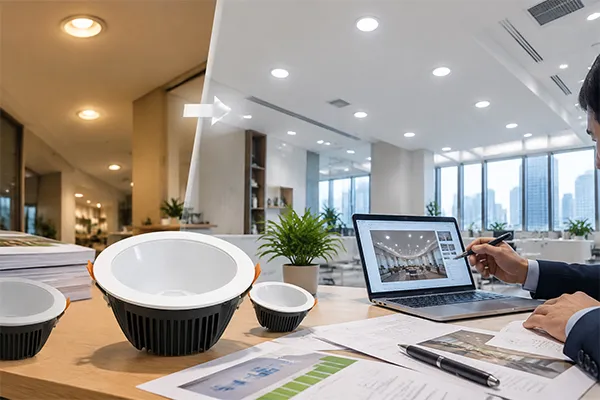
From my conversations with importers, lighting brands, and project buyers, I increasingly see attention shifting from simple unit price comparisons to broader questions about energy efficiency, certification evidence, and future product availability. That shift creates an opportunity for buyers who prepare early and evaluate suppliers carefully.
What Do Energy Saving Policies Mean for LED Downlight Adoption?
Energy-saving policies can sound like an urgent instruction to replace every older lighting product. That interpretation can lead to rushed purchasing, unnecessary write-downs, and poor assortment decisions. I recommend that buyers view policy developments as an early market signal instead of a blanket replacement order.
For most buyers, energy-saving policies influence LED downlight adoption by raising the importance of efficient products, clear technical files, and verified market suitability. The practical response is to identify affected markets and product categories, confirm the scope and timing of relevant rules, and plan upgrades around inventory cycles, customer requirements, and supplier lead times.
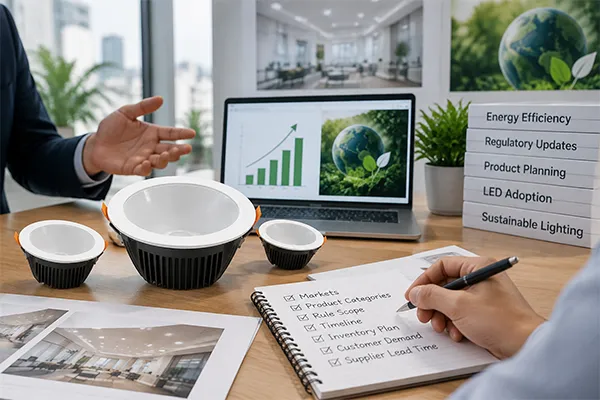
Policy pressure is usually a planning issue
I see a common misunderstanding in industry discussions: buyers often assume that a general policy announcement means all non-LED downlights must disappear from the market immediately. In reality, the scope of a requirement may depend on several factors:
- The destination country or region
- The product type and technical classification
- Whether the product is for residential, commercial, retail, or hospitality use
- The stated effective date
- Any transition period for existing stock3
- Project-specific specifications and tender rules
- Local importer, labeling, or documentation obligations
A buyer should therefore avoid making a portfolio decision based only on a headline, distributor rumor, or supplier statement. Official government sources, market regulators, and qualified local compliance advisers are better sources for market-specific interpretation.
Why LED products remain central to assortment planning
LED technology is already a major part of modern lighting portfolios4 because it offers flexible product design. Buyers can often select wattage, color temperature, beam angle, dimming compatibility, color rendering index, housing style, and trim finish5 according to market needs.
However, LED downlight adoption should not be based only on the word “LED.” Buyers should ask whether the proposed product matches the required application and sales channel. A recessed downlight for a retail renovation may need a different specification than a compact downlight for a residential distributor range.
| Procurement question | Why it matters | Suggested buyer action |
|---|---|---|
| Which markets are changing? | Requirements and timing vary by destination. | Create a country-by-country policy tracker. |
| Which SKUs are exposed? | Older halogen, CFL, or low-efficiency ranges may face lower demand. | Map current sales by product family and market. |
| Which customers are asking for upgrades? | Contractors and brands may move before regulations change. | Ask key accounts about upcoming projects. |
| What documentation is expected? | Project acceptance may require more than a product label. | Request product-specific files before ordering. |
| Can supply remain stable? | A rapid assortment change can create supply gaps. | Confirm samples, lead times, and MOQ options early. |
In my experience, the most prepared buyers do not wait until an existing range becomes difficult to sell. They review their catalogues while there is still time to compare alternatives, test samples, and sell remaining inventory responsibly.
Which LED Downlight Categories Should Buyers Audit First?
A large lighting portfolio can make product upgrades feel overwhelming. If buyers try to review every SKU at once, they may lose focus and delay the most important decisions. I suggest starting with categories that have the highest sales volume, strongest market exposure, or greatest technical risk.
Buyers should prioritize LED downlight adoption audits for high-volume recessed downlights, older non-LED or low-efficiency product lines, frequently specified commercial models, and products sold into markets with evolving energy or documentation expectations. A clear SKU ranking helps purchasing teams protect revenue while managing legacy inventory in a controlled way.
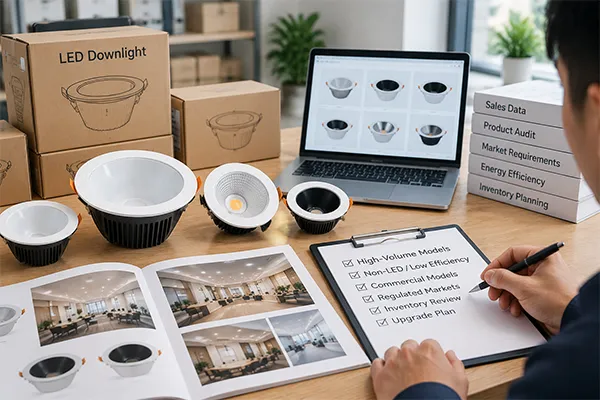
Build an exposure map before changing the catalogue
I would start with a simple inventory and sales review. This does not need to be a complex software project. A spreadsheet can reveal which products deserve immediate attention.
Buyers can group existing products into three practical categories:
-
Core growth products
These are high-volume downlights with stable demand. They may include common recessed LED models for residential, office, shop, and apartment projects. These products should receive early specification and documentation reviews. -
At-risk legacy products
These may include older technologies, slow-moving models, or products with unclear technical files. Buyers should assess whether to sell through, reposition, replace, or discontinue these lines. -
Specialty or project products
These products may have lower annual volume but higher technical importance. A special beam angle, trim finish, cutout size, dimming requirement, or high-CRI specification can make replacement more difficult.
Audit product specifications, not just technology type
A replacement decision should protect the needs of customers6. For example, a buyer cannot always substitute one downlight for another merely because both use LEDs. Installation dimensions, optical performance, driver arrangement, glare control, and ceiling compatibility can affect project acceptance.
I recommend reviewing at least the following items for each priority SKU:
| Specification area | Example procurement question |
|---|---|
| Wattage and output | Does the product meet the customer’s required performance range? |
| Color temperature | Is 3000K, 4000K, or another option required in the destination market? |
| CRI | Does the project need standard CRI or a higher color-rendering option? |
| Beam angle | Is the product intended for general lighting, accent lighting, or narrow display lighting? |
| Cutout and housing | Can installers use the new product without changing ceiling openings? |
| Driver and dimming | Does the driver suit the control method and electrical environment? |
| IP rating | Is the downlight intended for dry, damp, or more demanding locations? |
| Documentation | Are test reports, declarations, labels, and manuals available for review? |
At Upward Lighting, I have seen buyers use this type of matrix to avoid a common problem: selecting a visually similar replacement that later creates installation issues or customer complaints. Our OEM/ODM discussions often involve adjusting color temperature, wattage, beam angle, CRI, and surface finishes so a new product range better fits an existing brand catalogue.
Use sales data to guide phased upgrades
A phased approach can reduce unnecessary inventory pressure. I suggest that buyers consider:
- Replacing top-selling legacy lines first
- Maintaining controlled stock for customers with known ongoing requirements
- Introducing LED alternatives alongside current models during transition periods
- Using samples before committing to broad catalogue changes
- Communicating product changes early to distributors and contractor customers
This approach supports LED downlight adoption without treating every product as equally urgent. It also gives purchasing teams more time to validate product quality and documentation.
How Should Buyers Verify Compliance During LED Downlight Adoption?
Buyers may assume that an LED label or a familiar certificate logo settles every compliance question. That assumption can create risk, especially when products move across different countries, sales channels, or project types. I encourage buyers to evaluate documentation as carefully as they evaluate price and appearance.
LED downlight adoption requires product-specific compliance review because LED technology alone does not prove suitability for every market or project. Buyers should verify the current local requirements, check that supplied documents match the actual model and configuration, and use qualified professionals when application-specific interpretation is needed.
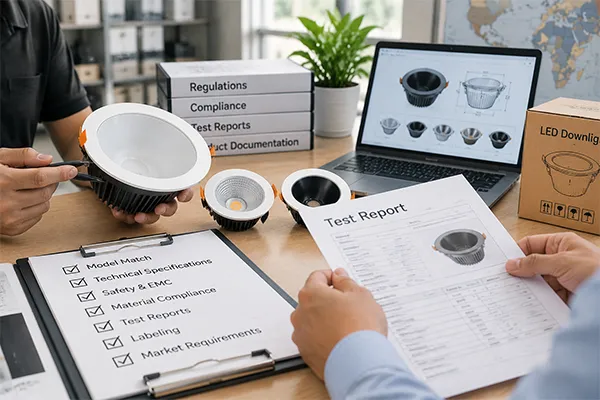
LED does not automatically mean compliant
This is one of the most important procurement points. A product can be an LED downlight and still be unsuitable for a particular market, installation, tender, or customer requirement. Compliance expectations may depend on electrical safety, electromagnetic compatibility, energy labeling, material restrictions, product marking, local registration, packaging information, or other market-specific rules7.
CE and RoHS documents are often relevant for certain product and market contexts, but they are not universal passports for every country or application8. Buyers should verify whether a document applies to:
- The exact product model
- The correct electrical configuration
- The correct driver and LED source arrangement
- The destination market
- The current version of applicable requirements
- The intended installation and end use
Ask suppliers for a document-control process
I recommend asking suppliers how they control technical and compliance information. A capable supplier should be able to identify the product model, version, and configuration connected to each document package.
A useful supplier review can include these questions:
- Can the supplier provide a specification sheet for the exact model?
- Does the product label match the model number and rating in the documents?
- Can the supplier explain which options change the product configuration?
- Are manuals, installation instructions, and packaging details available?
- Can the supplier provide samples for internal or third-party evaluation?
- Does the supplier have a process for updating documents when specifications change?
- Can the supplier support the buyer’s requested OEM branding or labeling requirements?
At Upward Lighting, our products are supplied with CE and RoHS documentation for applicable product and market contexts. However, I always recommend that buyers verify the relevance of any certification or test document for their own destination market, product configuration, and customer contract. A local compliance specialist or qualified testing professional can provide application-specific guidance.
Match quality control to the documentation review
Documentation alone does not replace quality control9. Buyers should also ask how the factory manages production consistency. For downlights, practical checks may include appearance, dimensions, wattage, lighting function, driver performance, packaging, and aging procedures10.
Our team performs a 100% aging test of 4 to 8 hours before shipment as part of our internal process. Buyers should still define their own acceptance criteria, inspection plan, and sample approval requirements. A factory process is useful evidence, but it should not be treated as a universal guarantee for every installation outcome.
I believe the strongest procurement decision combines document review, sample evaluation, factory quality controls, and market-specific verification.
How Can Suppliers Support Phased LED Downlight Adoption?
Many buyers understand that their product range needs updating, but they struggle with timing. They may have legacy stock, existing customer commitments, limited warehouse space, or uncertain demand forecasts. A supplier should help make the transition more manageable instead of forcing a one-size-fits-all product change.
Suppliers can support LED downlight adoption by offering clear product comparisons, flexible OEM/ODM options, samples, small-batch support, stable communication, and documented quality processes. Buyers benefit when suppliers help them build a phased assortment plan that balances new efficient models with responsible management of existing inventory.
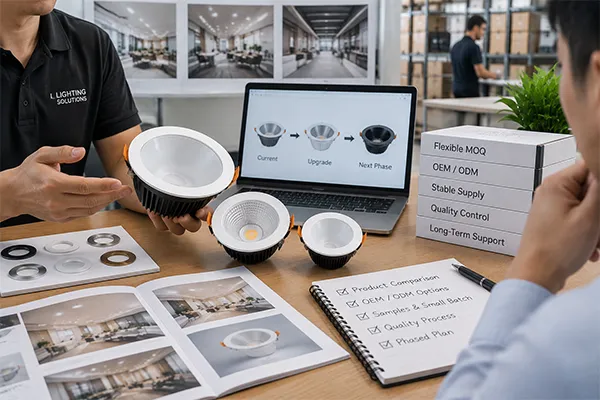
Start supplier discussions before the requirement becomes urgent
Early discussion gives both sides more options. When a buyer waits until a tender is active or existing stock becomes difficult to sell, the available choices may be limited by sampling time, production schedules, packaging changes, and document preparation.
In customer inquiries and industry discussions, I increasingly see buyers asking about upgraded downlight ranges before they finalize their purchasing plan. This earlier engagement allows teams to compare technical options rather than simply choose the fastest available substitute.
An effective early-stage supplier discussion should cover:
- Target country and sales channel
- Intended product application
- Required wattage, color temperature, CRI, and beam angle
- Cutout dimensions and installation constraints
- Desired finish colors and brand appearance
- Dimming or driver requirements
- Packaging, labeling, and instruction requirements
- Expected annual volume and initial test order quantity
- Required documents for buyer review
- Production lead time and supply continuity expectations
Use OEM and ODM options strategically
OEM/ODM flexibility can help a brand avoid competing only on price. A buyer may want a consistent product appearance across several downlight families, a signature trim color, a preferred color-temperature range, or a package design that supports a local brand position.
At Upward Lighting, we can customize parameters such as color temperature, wattage, beam angle, CRI, and surface finish colors. This flexibility can help buyers build a better-aligned LED range, but every customized specification should still be reviewed for technical suitability and applicable market requirements.
| Supplier capability | Benefit for buyers | Evaluation point |
|---|---|---|
| Small-batch order support | Enables sampling and lower-risk launches. | Confirm MOQ by model and finish. |
| Rapid quotations | Helps buyers compare options quickly. | Check whether the quote includes the full configuration. |
| OEM branding | Supports catalogue differentiation. | Review artwork, labels, and packaging approval steps. |
| Technical customization | Helps fit local customer needs. | Confirm whether changes affect documents or lead time. |
| Aging and inspection process | Provides visibility into factory controls. | Agree on buyer inspection and acceptance standards. |
| Supply chain management | Supports continuity across repeat orders. | Discuss key component availability and forecasts. |
Plan the transition with customers, not only suppliers
A buyer’s distributor and contractor network also needs clear communication. If a replacement downlight has a new wattage, cutout, driver, or visual appearance, customers should know before the previous SKU disappears.
I suggest that buyers prepare a simple transition sheet that includes:
- Old model number
- Recommended replacement model
- Key technical differences
- Installation differences, if any
- Available stock status
- Sample availability
- Documentation status
- Target launch date
- Customer communication notes
This type of preparation turns LED downlight adoption into a controlled commercial project. It also helps sales teams explain changes with confidence instead of reacting to objections after the catalogue has already changed.
Frequently Asked Questions
Do energy-saving policies require immediate replacement of all non-LED downlights?
No. Energy-saving policies do not automatically require every buyer to replace all non-LED downlights immediately. Requirements can vary by market, product type, effective date, transition period, and application. I recommend verifying current official requirements and creating a phased plan based on inventory, customer demand, and product exposure.
Is every LED downlight compliant for every export market?
No. An LED downlight is not automatically suitable for every country, project, or sales channel. Buyers should review product-specific documents, electrical configuration, labels, technical specifications, and local requirements. A qualified compliance professional should assess application-specific questions when needed11.
Which LED downlight specifications should importers review first?
Importers should review wattage, light output, color temperature, CRI, beam angle, cutout size, driver type, dimming compatibility, IP rating, and product documentation12. I also recommend checking packaging, labels, and installation instructions because these details can affect customer acceptance and market readiness.
How can wholesalers manage legacy downlight inventory during an upgrade?
Wholesalers can segment stock by sales rate, market exposure, and customer commitments. They can sell through stable lines, introduce LED replacements alongside older models, use targeted promotions where appropriate, and avoid abrupt discontinuation until they verify current local requirements and demand forecasts.
What should buyers ask an LED downlight supplier before placing an order?
Buyers should ask about exact specifications, sample availability, production lead time, MOQ, quality-control procedures, customization options, documentation, labeling, packaging, and supply continuity. I recommend comparing suppliers on their ability to support the full product transition, not only on quoted unit price.
Conclusion
Energy-saving policies are contributing to LED downlight adoption, but I do not see them as a reason for rushed, blanket replacement decisions. The better approach is to audit priority product lines, assess legacy inventory, verify market-specific requirements, review product documentation, and involve suppliers early. Buyers who plan ahead can protect customer relationships and develop stronger lighting assortments with less disruption. If you are reviewing an LED downlight range, contact Upward Lighting to discuss samples, OEM/ODM options, small-batch orders, and product-line planning for your target market.
"The next wave of LED lighting: Smarter, circular and more efficient", https://www.iea.org/commentaries/the-next-wave-of-led-lighting-smarter-circular-and-more-efficient. Energy-efficiency policies for lighting can alter product availability and procurement criteria by setting performance requirements for products placed on a market. Evidence role: general_support; source type: institution. Supports: Official or international analysis showing that lighting-efficiency policies and standards affect the products placed on the market and influence purchasing or replacement decisions.. Scope note: The precise commercial effect varies by jurisdiction, product category, enforcement, and buyer segment. ↩
"[PDF] Energy Conservation Standards for General Final Rule, issued on ...", https://www.energy.gov/documents/gsldefinitionfinalrule2016-12-29pdf-0. Lighting efficiency requirements are established by individual jurisdictions and commonly apply only to products within defined regulatory scopes and technical categories. Evidence role: general_support; source type: government. Supports: Regulatory sources describing the geographic scope and product-specific applicability of lighting energy-efficiency requirements.. Scope note: A general regulatory overview does not determine the current legal treatment of a specific downlight model in a particular destination market. ↩
"Energy Conservation Standards for General Service Lamps", https://www.federalregister.gov/documents/2022/05/09/2022-09477/energy-conservation-program-energy-conservation-standards-for-general-service-lamps. Some product regulations specify commencement and transitional provisions that distinguish newly placed products from stock already placed on the market. Evidence role: historical_context; source type: government. Supports: Official regulatory text or guidance showing that some lighting rule changes contain commencement dates, transitional provisions, or distinctions between placing products on the market and selling existing stock.. Scope note: Transition provisions are not universal and must be checked in the current rule applicable to the relevant market and product. ↩
"LED Adoption Report - Department of Energy", https://www.energy.gov/cmei/ssl/led-adoption-report. International energy analyses identify LEDs as the dominant technology in much of the modern lighting market because of their widespread adoption in general-lighting applications. Evidence role: statistic; source type: institution. Supports: Recent market or energy-agency data showing the substantial share of LED technology in lighting sales or installations.. Scope note: Market shares differ by country, building segment, product type, and year of measurement. ↩
"[PDF] Technical and Aesthetic Performance for Business District LED ...", https://www.energy.gov/sites/prod/files/2014/09/f18/rci_led_perf_pgh.pdf. LED luminaires are commonly specified by electrical power, light output and distribution, correlated color temperature, color-rendering characteristics, and control compatibility. Evidence role: definition; source type: education. Supports: Technical definitions of correlated color temperature, color rendering, beam distribution, electrical power, and dimming compatibility as relevant luminaire specification parameters.. Scope note: Housing style and trim finish are primarily design and installation attributes rather than universal measures of lighting performance. ↩
"[PDF] No-Regrets Remodeling - eere.energy.gov", https://www1.eere.energy.gov/buildings/publications/pdfs/building_america/no_regrets_remodeling_ornl.pdf. Luminaire replacements should be evaluated for physical installation, photometric distribution, glare, electrical characteristics, and control compatibility rather than appearance alone. Evidence role: mechanism; source type: research. Supports: Technical guidance explaining that luminaire replacement requires consideration of physical fit, photometric distribution, glare, electrical components, and controls compatibility.. Scope note: Project acceptance also depends on contract specifications, local codes, and the conditions of the particular installation. ↩
"Purchasing Energy-Efficient Light Bulbs", https://www.energy.gov/cmei/femp/purchasing-energy-efficient-light-bulbs. Depending on the jurisdiction and product scope, lighting products may be subject to separate requirements concerning electrical safety, electromagnetic compatibility, energy performance or labelling, marking, and restricted substances. Evidence role: general_support; source type: government. Supports: Official guidance identifying multiple legal frameworks that may apply to electrical and electronic lighting products, including safety, electromagnetic compatibility, energy-related requirements, and hazardous-substance restrictions.. Scope note: Not every listed requirement applies to every downlight, and registration, packaging, and labelling obligations are jurisdiction-specific. ↩
"CE marking – obtaining the certificate, EU requirements - Your Europe", https://europa.eu/youreurope/business/product-rules-compliance/general-product-compliance/ce-marking/index_en.htm. CE marking and RoHS obligations apply within defined European legal frameworks and product scopes; they do not by themselves demonstrate conformity with requirements in all export markets or all applications. Evidence role: definition; source type: government. Supports: European Commission guidance explaining CE marking obligations and RoHS restrictions within their applicable legal and product scopes.. Scope note: The applicable directives, harmonised standards, exemptions, and national requirements must be determined for the exact product and market. ↩
"[PDF] THE ABC's OF THE U.S. CONFORMITY ASSESSMENT SYSTEM", https://nvlpubs.nist.gov/nistpubs/Legacy/IR/nistir6014.pdf. Technical documentation records declared characteristics and conformity evidence, whereas production quality assurance requires controlled processes, inspection, and monitoring of manufacturing consistency. Evidence role: mechanism; source type: institution. Supports: Conformity-assessment and quality-management principles distinguishing technical documentation from ongoing controls over production consistency and product quality.. Scope note: The appropriate quality-control methods and acceptance thresholds depend on the product, supply contract, and applicable standards. ↩
"Metrics and Test Methods - Department of Energy", https://www.energy.gov/cmei/ssl/metrics-and-test-methods. LED luminaire evaluation commonly includes verification of physical construction and electrical operation, with driver performance and reliability testing used to assess risks not established by visual inspection alone. Evidence role: general_support; source type: research. Supports: Research or technical guidance addressing evaluation of LED luminaire physical attributes, electrical operation, driver performance, and reliability during product qualification or production inspection.. Scope note: Aging duration, sampling plans, photometric tests, and packaging checks should be defined by the applicable standard and buyer acceptance plan. ↩
"[PDF] THE ABC's OF THE U.S. CONFORMITY ASSESSMENT SYSTEM", https://nvlpubs.nist.gov/nistpubs/Legacy/IR/nistir6014.pdf. Conformity assessment relies on competent technical and regulatory evaluation when the applicability of requirements, test methods, or intended-use conditions cannot be established from generic product information alone. Evidence role: expert_consensus; source type: institution. Supports: Conformity-assessment guidance describing the need for competent testing, certification, or regulatory expertise where product requirements and intended uses require specialized interpretation.. Scope note: The required type of expert, laboratory, or notified body depends on the jurisdiction, product category, and legal conformity route. ↩
"[PDF] CALiPER Application Summary Report 20: LED PAR38 Lamps", https://www1.eere.energy.gov/buildings/publications/pdfs/ssl/caliper_20_summary.pdf. A downlight specification review commonly considers light output, colour characteristics, beam distribution, controls and driver compatibility, installation dimensions, ingress protection, and supporting technical documentation. Evidence role: general_support; source type: education. Supports: Technical lighting guidance defining the main optical, electrical, installation, environmental-protection, and documentation attributes used to compare luminaires.. Scope note: The priority of each attribute depends on the intended environment, local electrical rules, and the customer’s project specification. ↩