LED downlight manufacturing is changing because buyers must reduce quality, compliance, and after-sales risk while still meeting price and delivery targets. It is easy to focus on smart functions, higher lumen claims, or lower quotations. However, those choices can create installation, sourcing, and consistency problems if they are not evaluated carefully.
The future of LED downlight manufacturing is centered on reliable, application-specific product development rather than feature-heavy specifications alone. Buyers should select downlights by balancing light quality, glare control, thermal performance, driver reliability, smart-control requirements, compliance evidence, production consistency, and the needs of the destination market.
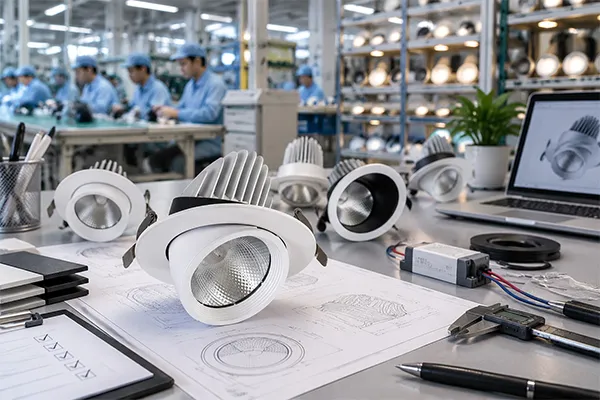
From my experience handling OEM/ODM inquiries in Zhongshan, I see that the most useful conversations start with the application, target customer, and market—not with a request for the highest wattage or the lowest possible price. The sections below explain how I believe buyers can evaluate future-ready LED downlight ranges more effectively.
How Will LED Downlight Manufacturing Become More Application-Focused?
Buyers often face an overwhelming number of similar-looking recessed downlights. A housing may look nearly identical across several quotations, yet the actual light output, glare performance, driver selection, installation method, and production controls can vary significantly. That uncertainty can lead to unsuitable product specifications and avoidable claims later.
LED downlight manufacturing will become more application-focused because buyers need products that match the task, ceiling condition, visual comfort target, operating hours, and local requirements. A better downlight is not automatically brighter or more powerful; it is one that provides appropriate illumination, stable operation, and practical installation for its intended environment.1
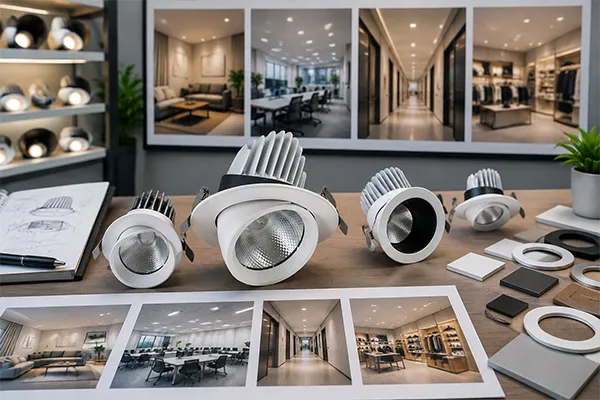
Start With the Space, Not the Specification Sheet
In OEM/ODM discussions, I often find that buyers first ask for a wattage, diameter, or lumen figure. Those details matter, but they do not provide enough information on their own. A downlight range should begin with basic application questions:
- Is the product intended for homes, retail stores, offices, hotels, corridors, or public areas?
- What ceiling type and cutout size will installers encounter?
- Does the application require fixed, adjustable, deep anti-glare, trimless, or surface-mounted designs?
- Will the fixture operate for a few hours each evening or for long daily commercial hours?
- Does the buyer prioritize visual comfort, accent lighting, general lighting, or maximum energy reduction?
- Does the destination market require particular documents, markings, or test evidence?
A 7 W downlight for a residential corridor may need a different optical design from a 20 W recessed fitting used in a retail environment. The retail application may require stronger vertical illumination or a narrower beam angle for merchandise.2 The corridor may benefit more from visual comfort, moderate output, and dependable operation over long periods.
Balance the Main Performance Variables
Future-ready product development requires buyers to consider the relationship between specifications. I recommend evaluating the following variables together rather than separately.
| Evaluation factor | Why it matters | Buyer question |
|---|---|---|
| Wattage | Affects energy use and thermal load | Is the wattage appropriate for the required lighting level? |
| Lumen output | Indicates delivered light, but should be verified consistently | What lumen tolerance and measurement basis apply? |
| Beam angle | Shapes light distribution and spacing | Does the beam suit ambient, task, or accent lighting? |
| [CRI | Influences color appearance](https://en.wikipedia.org/wiki/Color_rendering_index)%%%FOOTNOTE_REF_3%%% | Does the project need standard color rendering or enhanced color quality? |
| [UGR/glare control | Affects visual comfort in many indoor spaces](https://www.energy.gov/sites/prod/files/2021/02/f82/ssl-rd21-schwade-glare.pdf)%%%FOOTNOTE_REF_4%%% | Is a deep reflector or anti-glare design needed? |
| Driver quality | Influences dimming behavior and operating stability | Which driver configuration is specified and validated? |
| Thermal design | Supports component operating conditions | Does the housing and heat sink suit the intended operating profile?5 |
A long specification sheet can look attractive during procurement. Yet every additional claim should be connected to a real buyer need and a practical verification process. For example, high CRI can be valuable for hospitality, fashion, cosmetics, and premium retail applications. It may not be the main purchase factor for every basic residential range.
Consider Installation as Part of Product Quality
I believe installation experience will become more important in LED downlight manufacturing. Contractors and distributors do not only deal with light output. They also deal with cutout tolerance, spring strength, wiring space, driver placement, ceiling depth, and replacement access.
A product that performs well on paper can still create field difficulties if the driver is too large for the ceiling void or if the spring clips are difficult to install consistently. Therefore, I suggest that buyers request samples and review practical details before committing to mass production.
I have seen many sampling discussions become more productive once the buyer shares ceiling thickness, installation photos, cutout dimensions, and local wiring expectations.
This application-first approach does not mean that every project needs a fully custom product. It means buyers should build a focused range with clear use cases. That approach can simplify stocking, reduce specification confusion, and support more consistent purchasing decisions.
Should Smart Features Define the Future of LED Downlight Manufacturing?
Smart lighting can appear to be the obvious future direction, especially when buyers want a modern product range. However, connected functions can add compatibility questions, commissioning requirements, installation complexity, and maintenance responsibilities. If those issues are ignored, a smart feature can become a supply-chain or after-sales burden.
Smart technology will influence LED downlight manufacturing, but it should be selected as an application decision rather than treated as a universal upgrade. Buyers should assess control protocols, dimming compatibility, commissioning procedures, installer capability, maintenance expectations, and the actual value of connected lighting for the end user.
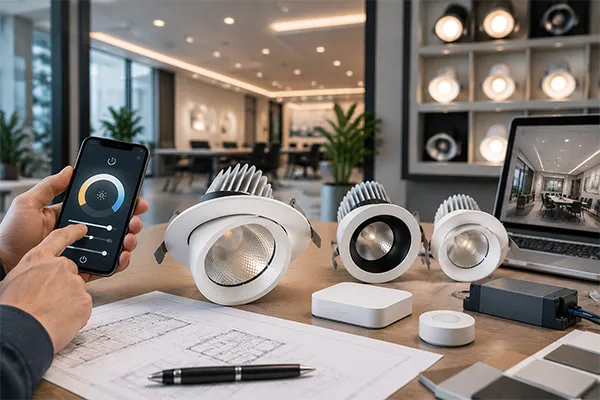
Smart Downlights Are Not One Product Category
The term “smart downlight” can describe very different products. Some options use simple remote control or Bluetooth mesh systems. Others may involve Wi-Fi, Zigbee, DALI, 0–10 V, TRIAC dimming, or project-specific building control arrangements. These systems are not interchangeable.
In my view, buyers should avoid treating connected lighting as a single checkbox. The practical questions are more important:
- Which control method does the end user already use or expect?
- Who will commission the system after installation?
- Can the installer connect and troubleshoot the product without specialized support?
- Will the project need grouping, scheduling, scene-setting, occupancy response, or only dimming?
- What happens if a driver, controller, gateway, or app changes later?
- Can the distributor support replacement and after-sales questions in the target market?
For example, a basic hospitality renovation may only require reliable dimming and warm color temperatures. A connected system could add cost without creating enough operational value. In contrast, a commercial project with centralized control requirements may benefit from a more structured lighting-control approach if the project team can specify, install, and maintain it properly.
Compare Control Choices Before Specification
| Control approach | Typical procurement advantage | Main evaluation concern |
|---|---|---|
| Non-dimmable | Simple sourcing and installation | Limited flexibility after installation |
| [TRIAC dimming | Familiar in some retrofit applications | Dimmer-driver compatibility must be checked](https://www1.eere.energy.gov/buildings/publications/pdfs/ssl/caliper_20_summary.pdf)%%%FOOTNOTE_REF_6%%% |
| 0–10 V dimming | Common in many commercial settings | Requires suitable wiring and control equipment |
| [DALI-based control | Supports more organized project control | Commissioning and system compatibility need review](https://en.wikipedia.org/wiki/Digital_Addressable_Lighting_Interface)%%%FOOTNOTE_REF_7%%% |
| Bluetooth or app-based control | Convenient for selected smaller systems | Device compatibility and user support matter |
| Wi-Fi connected control | Can offer direct user control | Network stability, setup, and data considerations apply |
Build a Support Plan, Not Just a Smart Product
A future-ready lighting range needs a clear support model. I recommend that importers and local brands define who will answer common questions about pairing, reset procedures, dimming behavior, firmware, replacement parts, and control compatibility.
During OEM/ODM development, smart functions may also affect driver sourcing, software configuration, packaging content, manuals, labeling, and sample validation. These factors can influence lead time and cost. A buyer should account for them early rather than adding smart control after the mechanical design is already confirmed.
I do not see smart lighting as a trend to reject. I see it as a feature that should solve a defined problem. When the application supports it, connected lighting can be a useful part of an LED downlight range. When the application does not support it, a well-made conventional downlight may be the more practical and lower-risk choice.
How Does Customization Change LED Downlight Manufacturing Risk?
Customization can help brands differentiate their product ranges and meet project-specific needs. At the same time, buyers may underestimate how one requested change can affect component sourcing, sample approval, cost, validation, and mass-production control. A simple request can become a new production path if it changes critical materials or electrical components.
In LED downlight manufacturing, OEM/ODM customization should be managed as a controlled development process. Changes to color temperature, wattage, beam angle, CRI, driver type, finish, packaging, or dimensions can affect supply availability, unit cost, lead time, consistency, and the documentation that buyers need to review.8
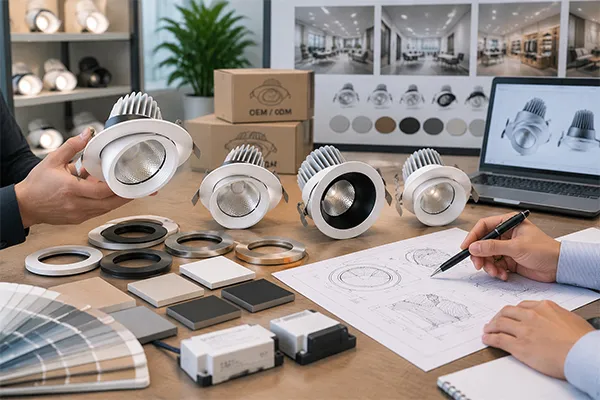
Understand the Difference Between Standard and Custom
Not every customization request carries the same level of risk. I find it useful to separate requests into three practical categories.
| Customization level | Examples | Typical buyer consideration |
|---|---|---|
| Standard configuration | Existing wattage, CCT, beam angle, or finish options | Usually the fastest route if components are already established |
| Semi-custom configuration | Branded packaging, selected driver, special CCT mix, alternate trim color | May require sample confirmation and updated material planning |
| Full ODM development | New housing, new cutout size, new optical design, special installation method | Requires more development time, tooling review, testing, and approval stages |
A standard product configured with an existing 3000 K or 4000 K option may be relatively straightforward. However, a request for a special color point, unusual beam pattern, custom trimless structure, or a specific branded driver may create additional work across the supply chain.
Use a Written Development Checklist
I recommend that buyers document key requirements before approving a sample. This reduces the risk of verbal assumptions being carried into mass production.
A practical checklist can include:
- Product model and mechanical drawings
- Cutout size and overall dimensions
- Wattage and input-voltage requirements
- Target color temperature and acceptable color tolerance
- CRI requirement
- Beam angle and reflector finish
- Dimming or control method
- IP rating requirement, if applicable
- Housing color and surface treatment
- Driver brand or driver specification
- Packaging artwork, barcode, manuals, and labels
- Required documentation for the destination market
- Sampling timeline, approval method, and change-control process
Treat Sample Approval as a Procurement Gate
A sample is not only a visual reference. It is a decision point for manufacturing. Buyers should inspect the sample against the approved specification and consider whether the sample reflects the intended mass-production configuration.
In my work with customer inquiries, I find that buyers often need to clarify whether a sample uses the same driver, LED source, reflector, cable, connector, and packaging arrangement planned for the order. This is especially important when a buyer has tight price targets or unique technical requests.
The same principle applies to color and finish. A black, white, gold, or custom-painted trim may have different surface-treatment requirements. A custom finish can affect minimum order quantities, material preparation, and production scheduling. It may also need visual approval under agreed lighting conditions.
Protect Consistency During Scale-Up
The future of LED downlight manufacturing is not only about creating a good sample. It is about repeating the approved product at scale. Buyers should ask suppliers how they manage incoming materials, assembly steps, inspection records, aging procedures, and final checks.
At Upward Lighting, we conduct a 100% aging test before shipment, typically lasting 4 to 8 hours, as part of our quality-control process. I view this as a useful production check for identifying certain early operational issues before shipment. However, I do not present an aging test as a guarantee of field lifetime. Actual service life depends on the installation environment, operating conditions, electrical system, thermal conditions, maintenance, and product configuration.9
A buyer should use aging-test information alongside sample review, documented specifications, inspection expectations, and qualified technical evaluation for the intended application.
What Should Buyers Verify When Selecting an LED Downlight Manufacturing Supplier?
Low prices and similar product photos can make supplier selection difficult. A buyer may receive several quotations that appear comparable, while the actual assumptions behind the price are not the same. Differences may involve driver quality, aluminum content, LED source selection, optical components, packaging, inspection steps, or documentation support.
Buyers should evaluate LED downlight manufacturing suppliers through production consistency, quality-control practices, response speed, traceable documentation, customization discipline, and delivery capability—not only by quotation price, baseline certificates, or product appearance. A reliable supplier should help buyers clarify specifications before mass production begins.
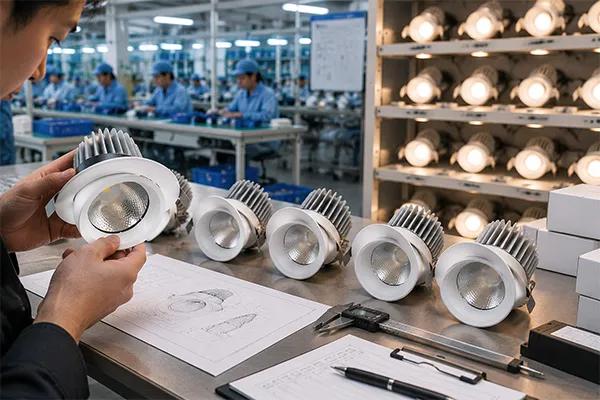
Compare Quotations on a Like-for-Like Basis
I suggest that purchasing managers compare quotations using a structured table instead of reviewing only the unit price. A lower price may be reasonable, but buyers need to understand what it includes.
| Supplier evaluation point | What buyers should request or clarify |
|---|---|
| Product configuration | Full specification, drawings, component assumptions, and approved sample reference |
| Quality control | Incoming inspection, in-process checks, final inspection, and aging-test process |
| Driver arrangement | Driver specification, dimming compatibility, and replacement approach |
| Production capacity | Normal lead time, peak-season planning, and minimum order requirements |
| Customization process | Sample lead time, change-control method, artwork approval, and MOQ impact |
| Documentation | Available declarations, reports, labels, manuals, and traceability information |
| Export coordination | Packing details, shipping marks, commercial documents, and communication process |
| After-sales support | Response process for defects, replacement discussions, and technical questions |
Verify Compliance for the Actual Destination Market
Compliance requirements are not universal. CE and RoHS documents can be relevant evidence for certain markets and product categories, but they should not be treated as automatic proof that a downlight is suitable for every country, project, or installation.10
Buyers should verify:
- The destination country and sales channel
- The product’s intended application
- Local electrical and safety requirements
- Required product markings and documentation
- Whether project consultants or authorities require specific reports
- Whether the selected driver and complete luminaire configuration match the documentation being reviewed
At Upward Lighting, our products hold CE and RoHS certifications, and we provide documentation support within the scope of the relevant product and market requirements. Still, I encourage buyers to verify applicability with qualified compliance professionals, local authorities, consultants, or testing organizations when a project has specific regulatory obligations.
Evaluate Communication Before the Purchase Order
Supplier responsiveness is not only a service issue. It can be an indicator of how efficiently problems may be handled during sampling, production, shipment, or after-sales communication.
I recommend that buyers observe how a supplier responds to detailed questions. Does the supplier clarify missing information? Does the quotation identify assumptions? Does the supplier explain which custom requests affect lead time or MOQ? Does the sample process have a clear approval path?
For importers, wholesalers, contractors, and local brands, this early communication can reduce surprises later. In my experience, stable long-term cooperation usually begins with careful specification alignment rather than rushed price negotiation.
How Can Buyers Build a Future-Ready LED Downlight Range?
A fragmented product range can create stocking pressure, confusing sales materials, inconsistent quality expectations, and difficult after-sales management.11 Buyers may be tempted to offer every possible wattage, size, color, and smart feature. However, a more focused portfolio can often be easier to sell, source, and support.
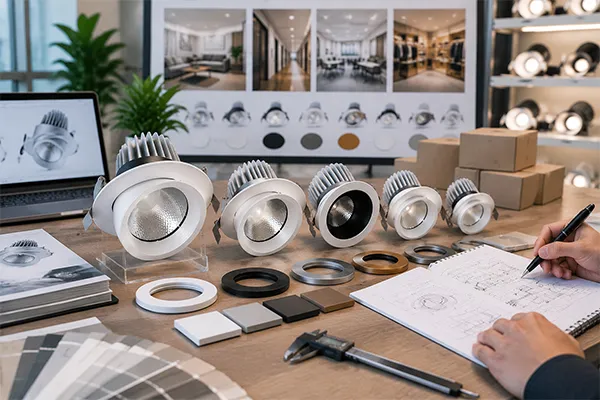
Buyers can build a future-ready LED downlight range by defining a small number of application-based platforms, standardizing critical components where possible, adding customization selectively, and reviewing supplier quality and compliance evidence before expanding the range. This approach supports better inventory control and more reliable mass production.
Create Product Platforms Instead of Isolated SKUs
I encourage buyers to organize their portfolio around product platforms. A platform can share a housing family, driver approach, packaging format, or installation method while offering selected variations such as CCT, wattage, beam angle, and trim color.
For example, a distributor may structure a range around:
- Economy residential downlights for standard replacement and building-material channels.
- Anti-glare residential and hospitality downlights for visual comfort and premium interiors.
- Commercial recessed downlights for offices, retail, corridors, and contractor projects.
- Adjustable or accent downlights for display areas and architectural applications.
- Project-control options only where dimming or connected functions are genuinely required.
This approach can reduce the number of unrelated components that a buyer needs to manage. It can also simplify sales training and technical documentation.
Standardize What Does Not Need to Change
Customization remains valuable, especially for private labels and project work. Still, I believe buyers should standardize non-essential variables where possible. Common driver arrangements, proven housing sizes, established packaging dimensions, and familiar installation methods can support procurement efficiency.12
A buyer can reserve customization for areas that add clear market value, such as:
- Private-label packaging
- Brand-specific trim finishes
- Regionally preferred color temperatures
- Selected beam angles
- Application-specific CRI levels
- Dimming options for a defined sales channel
- Project-specific wattage and cutout requirements
This method avoids turning every order into a separate engineering exercise.
Plan for Review, Not Permanent Assumptions
The lighting market will continue to change. Energy rules, buyer preferences, installation practices, and available components may evolve. Therefore, a future-ready range should have a review process.
I suggest reviewing a core downlight range at least periodically against:
- Sales performance by SKU
- Returns and customer feedback
- Sample and production consistency
- Lead-time stability
- Component availability
- Competitor positioning
- Updated destination-market requirements
- New control or dimming demand from actual customers
The goal is not to chase every trend. The goal is to make evidence-based updates that protect the buyer’s range, reputation, and supply continuity.
Frequently Asked Questions
What is the most important future trend in LED downlight manufacturing?
The most important trend is more disciplined product development. Buyers increasingly need downlights that are suitable for specific applications, consistently manufactured, properly documented, and practical to install. Smart features and higher specifications can be useful, but they should support a defined customer need.
Are smart LED downlights better than standard downlights?
Smart LED downlights are not automatically better. They can add value when users need scheduling, grouping, dimming, scene control, or centralized management. However, buyers should evaluate protocol compatibility, commissioning, installer capability, maintenance needs, and after-sales support before selecting connected products.
Does a higher wattage LED downlight provide better lighting?
A higher wattage LED downlight does not automatically provide better lighting. Buyers should assess lumen output, beam angle, glare control, color quality, thermal design, driver reliability, and the lighting task. The right specification depends on the space and the intended user experience.
What should buyers check before approving a customized LED downlight sample?
Buyers should verify dimensions, cutout size, wattage, CCT, CRI, beam angle, finish, driver type, dimming function, packaging, labels, and required documentation. They should also confirm whether the approved sample uses the same critical components planned for mass production.
Do CE and RoHS documents prove that a downlight is suitable for every market?
No. CE and RoHS documentation may be relevant for particular markets and requirements, but they do not automatically prove suitability for every country, project, or application. Buyers should verify destination-specific obligations with qualified compliance professionals, local authorities, or project consultants.
Conclusion
The future of LED downlight manufacturing is not simply about adding smart controls, increasing wattage, or offering the lowest price. I believe the strongest product ranges will combine suitable optical and thermal design, reliable drivers, realistic customization, controlled production, documented compliance evidence, and clear application positioning. Buyers should evaluate suppliers through samples, quality-control practices, aging-test processes, responsiveness, and destination-market requirements. If you are developing a private-label or project-based downlight range, we at Upward Lighting can help you review practical OEM/ODM options, sampling needs, and production considerations before you place an order.
"[PDF] Engineering Company Recognized for Advanced Use of Lighting ...", https://betterbuildingssolutioncenter.energy.gov/sites/default/files/attachments/ILC_Case_Study_IMEG-FINAL.pdf. Lighting-design guidance recognizes that appropriate illumination depends on the visual task, light distribution, glare, and the characteristics of the space; wattage alone is not a sufficient indicator of lighting suitability. Evidence role: general_support; source type: institution. Supports: Lighting design requires consideration of task needs, illuminance, visual comfort, luminaire distribution, and installation conditions rather than lamp power alone.. Scope note: Such guidance establishes general design principles and does not evaluate the suitability of any particular downlight model. ↩
"RETAIL LIGHTING DESIGN GUIDE", https://contechlighting.com/content/dam/contech/lliterature/Retail%20Lighting%20Guide.pdf. Research and professional guidance on retail lighting describe vertical illumination and directional accent lighting as relevant variables for making displayed merchandise visible and visually prominent. Evidence role: general_support; source type: research. Supports: Retail lighting design commonly considers vertical illuminance, accent lighting, and beam distribution in relation to merchandise display and visual attention.. Scope note: The appropriate illuminance and beam angle vary by merchandise, store layout, ambient light level, and the intended visual effect. ↩
"Color rendering index", https://en.wikipedia.org/wiki/Color_rendering_index. The color rendering index (CRI) is a measure of how faithfully a light source renders object colors in comparison with a reference illuminant, making it relevant to perceived color appearance. Evidence role: definition; source type: institution. Supports: The color rendering index is a measure used to characterize how a light source renders object colors relative to a reference illuminant.. Scope note: CRI does not fully characterize all aspects of color preference, saturation, or color fidelity, and additional metrics may be needed for detailed color-quality assessment. ↩
"[PDF] Glare and Diffuse Sources", https://www.energy.gov/sites/prod/files/2021/02/f82/ssl-rd21-schwade-glare.pdf. International lighting guidance identifies discomfort glare as a factor affecting visual comfort and defines the Unified Glare Rating (UGR) as a method for evaluating glare in indoor lighting installations. Evidence role: mechanism; source type: institution. Supports: Discomfort glare can reduce visual comfort, and UGR is a standardized method used to assess glare from indoor lighting installations.. Scope note: A calculated UGR depends on the complete installation, including room geometry, surface reflectance, observer position, and luminaire arrangement; it is not a property of a downlight in isolation. ↩
"[PDF] Investigation of the Long-Term Aging Characteristics of Chip-On", https://www.energy.gov/sites/default/files/2021-10/ssl-rti-cob-benchmark-sept2021.pdf. Technical guidance on solid-state lighting explains that thermal management is important because elevated operating temperatures can affect LED performance, color behavior, and long-term reliability. Evidence role: mechanism; source type: government. Supports: LED junction temperature and thermal management influence LED performance, degradation, and reliability.. Scope note: Thermal suitability must be assessed for the complete luminaire and installation environment, including ambient temperature, insulation, airflow, driver heat, and operating schedule. ↩
"[PDF] CALiPER Application Summary Report 20: LED PAR38 Lamps", https://www1.eere.energy.gov/buildings/publications/pdfs/ssl/caliper_20_summary.pdf. Studies of LED dimming systems show that phase-cut dimmers and LED drivers must be electrically compatible, as mismatched combinations can produce flicker, unstable operation, audible noise, or restricted dimming range. Evidence role: mechanism; source type: research. Supports: Phase-cut dimming performance depends on the interaction between the dimmer and LED driver, and incompatibility can cause flicker, limited dimming range, or instability.. Scope note: Compatibility outcomes depend on the specific dimmer, driver, load, wiring arrangement, and installation conditions. ↩
"Digital Addressable Lighting Interface", https://en.wikipedia.org/wiki/Digital_Addressable_Lighting_Interface. The DALI lighting-control standard provides digital addressing and communication for lighting devices; implementation commonly requires commissioning to assign, configure, and verify devices within the control system. Evidence role: definition; source type: institution. Supports: DALI is a standardized digital lighting-control system that supports addressed devices and requires system configuration or commissioning.. Scope note: The level of interoperability depends on the implemented DALI device types, control equipment, system design, and conformance of the installed products. ↩
"Supply Chain Management", https://www.nist.gov/mep/supply-chain. Quality-management guidance requires organizations to control design and production changes, assess their consequences, and maintain updated documented information so that product conformity can be preserved. Evidence role: general_support; source type: institution. Supports: Formal design and production change control is used to assess the consequences of changes, update documentation, and maintain conformity in manufactured products.. Scope note: This general quality-management principle does not quantify the cost, lead-time, or supply impact of a specific downlight modification. ↩
"[PDF] LED Luminaire Reliability: Impact of Color Shift - Department of Energy", https://www.energy.gov/sites/prod/files/2017/04/f34/lsrc_colorshift_apr2017.pdf. Solid-state-lighting reliability guidance indicates that LED lumen maintenance and product life depend on thermal conditions, drive current, component behavior, and the operating environment, rather than on a short production screening test alone. Evidence role: mechanism; source type: government. Supports: LED product lifetime and lumen maintenance are affected by temperature, drive conditions, component design, and operating environment.. Scope note: Lifetime projections based on LED-component test methods may not fully represent the reliability of the complete luminaire, including its driver and installation-specific thermal conditions. ↩
"Signing an EU declaration of conformity - Your Europe", https://europa.eu/youreurope/business/product-rules-compliance/general-product-compliance/signing-declaration-conformity/index_en.htm. European Union guidance states that CE marking signifies a manufacturer's declaration of conformity with applicable EU requirements, while the RoHS framework restricts certain hazardous substances in covered electrical and electronic equipment; these frameworks do not themselves determine compliance with non-EU national rules or project-specific installation requirements. Evidence role: definition; source type: government. Supports: CE marking indicates conformity with applicable EU requirements, while RoHS restricts specified hazardous substances in electrical and electronic equipment within its scope.. Scope note: The applicable EU legislation, conformity-assessment route, and national installation requirements depend on the product and its intended use. ↩
"Operations-driven Performance Measurement for Smart ...", https://www.nist.gov/programs-projects/operations-driven-performance-measurement-smart-manufacturing-systems. Operations-management research generally finds that expanding product variety can increase inventory, forecasting, manufacturing, and service complexity, creating trade-offs between assortment breadth and operational efficiency. Evidence role: general_support; source type: paper. Supports: Operations-management research links expanded product variety with increased inventory, forecasting, production, and service complexity.. Scope note: The magnitude of these effects varies with demand patterns, common-component use, inventory policy, and the firm's information and service systems. ↩
"Building Resilient Supply Chains: Strategies and ...", https://www.nist.gov/blogs/manufacturing-innovation-blog/building-resilient-supply-chains-strategies-and-successes. Research on product-platform design and component commonality indicates that standardizing shared components can reduce procurement and inventory complexity while supporting manufacturing efficiency across related products. Evidence role: general_support; source type: paper. Supports: Component commonality and product standardization can reduce purchasing, inventory, and production complexity.. Scope note: Standardization can limit product differentiation or technical optimization when market requirements genuinely require distinct components or designs. ↩