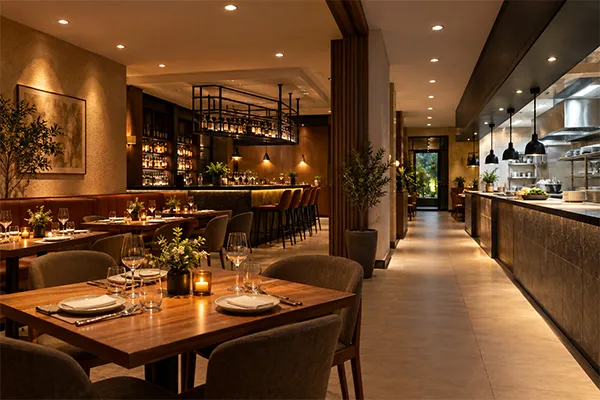
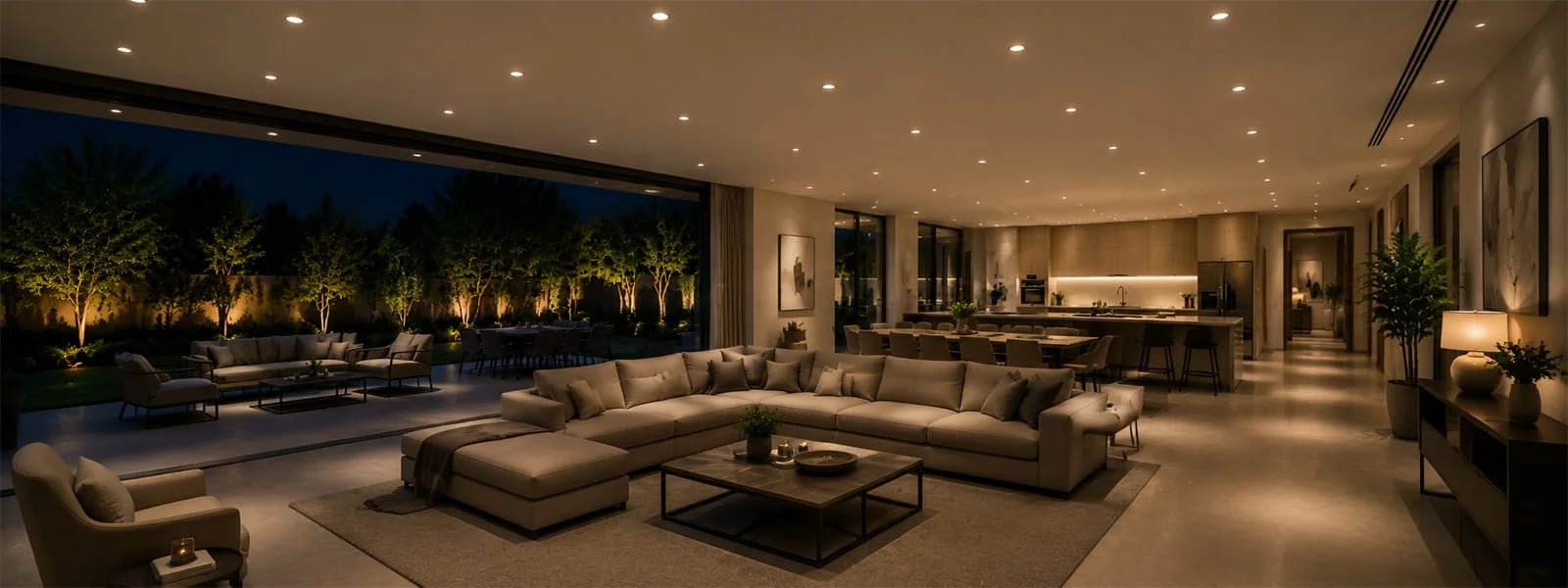
Professional LED downlights are no longer bought solely on price, wattage, or a country-level view of demand. Buyers face a harder problem: selecting products that fit local installation conditions, customer expectations, compliance needs, and supply models. A better sourcing approach starts with the application and the risks that a project, brand, or channel partner needs to control.
Professional LED downlights are in demand across many markets because commercial, residential, hospitality, retail, and public-space buyers need reliable recessed lighting that matches specific installation and operating requirements1. The most useful way to assess demand is not to ask which country buys the most, but to evaluate the end application, target price level, required specifications, compliance documents, order model, and supplier’s ability to deliver consistent batches.
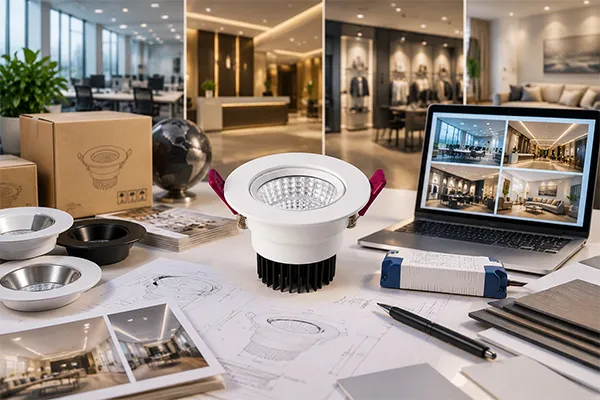
In recurring quotation and customization discussions, we often see that the same basic downlight category can mean very different things to two buyers. One may need an economical model for wholesale stock, while another needs a configurable recessed luminaire for a hotel renovation. Those differences shape real demand far more than a simple market ranking.
Why Should Buyers Assess Professional LED Downlights by Application Rather Than Country?
A buyer may hear that a particular region has strong lighting demand and assume that one product range will work across that market. That assumption can create slow-moving stock, specification mismatches, and avoidable project risk. I recommend that buyers begin with the installation and customer use case before making country-level sourcing decisions.
Buyers should assess professional LED downlights by application because each setting creates different requirements for lumen output, glare control, color quality, cutout size, IP rating, driver design, and price positioning2. Country information can guide market research, but application conditions and channel expectations should determine the product specification and supplier-selection process.
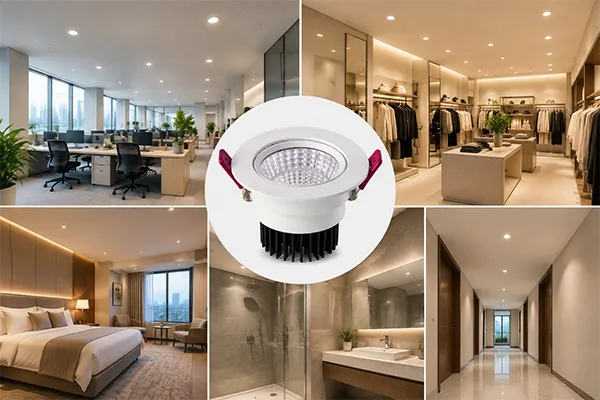
Application Defines the Real Product Requirement
A recessed downlight used in a residential corridor does not face the same expectations as one used in a retail store, office, restaurant, or high-end apartment lobby. The housing depth may differ. The ceiling material may differ. The operating hours may differ. The end user may care more about visual comfort, while the contractor may care more about installation speed and driver replacement.
When I review buyer inquiries, I find that the best starting questions are practical:
-
Where will the downlight be installed?
A home, hotel, shop, office, corridor, healthcare setting, or exterior covered area may require different performance priorities. -
What is the ceiling condition?
Buyers should confirm ceiling thickness, available void depth, cutout diameter, insulation conditions, and access for maintenance. -
How many hours will the luminaires operate?
Higher daily operating hours can make driver quality, thermal design, and batch consistency more important than a low initial unit price.3 -
What visual result is expected?
A retail brand may prioritize beam control and color consistency. A utility area may prioritize practical illumination and economical replacement. -
Who will install and maintain the product?
Contractors often value clear installation instructions, stable cutout dimensions, compatible drivers, and predictable lead times.
Typical Application Priorities
| Application | Common Buyer Priorities | Procurement Risk to Manage |
|---|---|---|
| Residential projects | Slim body, suitable color temperature, competitive cost, easy installation | Inconsistent cutout sizes or visible color variation |
| Retail stores | Focused beam options, visual comfort, strong product presentation | Poor beam distribution or inconsistent appearance |
| Offices | Comfortable illumination, low glare options, stable output | Inadequate lighting design for workspaces |
| Hotels and restaurants | Warm color tones, finish options, dimming compatibility, aesthetics | Mismatch between sample approval and delivered batches |
| Corridors and public areas | Reliable driver, practical output, repeatability | Maintenance burden from early failures |
| Wholesale channels | Standardized specifications, packaging, price stability, repeat orders | Slow-moving inventory or supplier discontinuity |
I do not treat these patterns as universal rules. Each project needs its own lighting evaluation. Still, they help buyers avoid an overly broad question such as, “Which market needs the most downlights?” The better question is, “Which professional LED downlight configuration solves the operating and sales problem in this channel?”
A professional product is not simply the model with the highest specification. It is the model that performs appropriately and consistently in its intended environment.
How Is Demand for Professional LED Downlights Becoming More Segmented?
Many buyers want a simple catalog with a few fast-selling models. That approach can work for certain wholesale channels, but demand is becoming more segmented as brands, contractors, and distributors serve more specialized projects. The challenge is to offer enough options without creating a difficult inventory position.
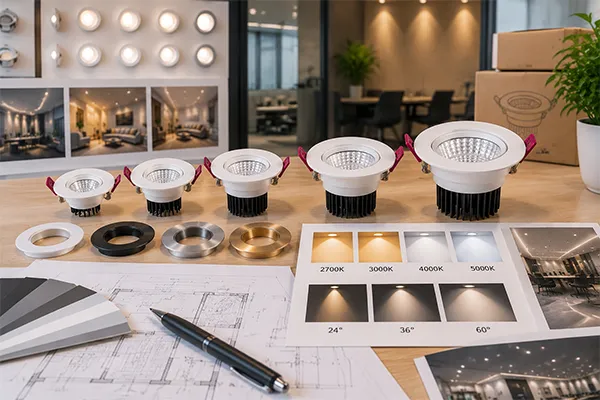
Demand for professional LED downlights is becoming more segmented because buyers increasingly require specification combinations that match particular projects and sales channels. Common variables include wattage, color temperature, beam angle, CRI, cutout size, dimming method, IP level, housing color, packaging, and branding. The right product range balances customization with manageable stock complexity.
Specification Combinations Matter More Than Isolated Features
A buyer may ask for a 10W or 12W downlight, but wattage alone does not define the product. The buyer may also need a particular color temperature, a narrow or wide beam angle, a white or black trim, a specific cutout, and a driver suited to the local electrical environment or dimming system.
For example, an importer developing a local brand might request:
- 3000K, 4000K, and 6500K options for different customer groups
- A high-CRI version for selected retail or hospitality projects
- White, black, and brushed-finish trim options
- Private-label packaging and product labels
- A standard model for stock plus a project model for special orders
- Small-batch testing before a broader roll-out
This does not mean every buyer needs a fully customized product. In fact, excessive customization can raise minimum order quantities, complicate quality control, and increase the chance of ordering errors. I usually see the strongest procurement programs divide products into core stock items and controlled project variations.
A Practical Range-Building Model
| Product Tier | Best For | Typical Approach |
|---|---|---|
| Core stock range | Wholesalers, electrical channels, repeat distributors | Limited wattages, standard color temperatures, stable packaging |
| Mid-range project line | Contractors, local brands, developers | More beam, trim, and driver options with planned lead times |
| Premium application line | Hospitality, retail, architectural interiors | Higher visual requirements, finish options, controlled sampling |
| OEM/ODM program | Established brands and importers | Customized labels, packaging, parameters, and product positioning |
At Upward Lighting, we support OEM/ODM discussions around color temperature, wattage, beam angle, CRI, and surface finishes. However, I believe customization should begin with a clear commercial reason. A unique finish may strengthen a local brand. A special beam angle may solve a display-lighting requirement. A different wattage may align with a project’s lighting plan. Without that reason, customization can become complexity without a sales benefit.
Channel Models Also Shape Demand
The same professional LED downlights may be sold through very different routes:
- Importers may prioritize container planning, document consistency, and a competitive landed cost.
- Wholesalers may prioritize easy-to-explain specifications and repeatable stock availability.
- Contractors may prioritize installation compatibility, delivery timing, and project documentation.
- Local lighting brands may prioritize product differentiation, packaging, and brand continuity.
- Distributors may prioritize a balanced portfolio that supports multiple customer types.
This is why I encourage buyers to share their intended channel model early. It helps the supplier recommend a range that fits the commercial reality, not only a technical data sheet.
What Makes Professional LED Downlights Fit for Purpose?
Some buyers assume that a professional-grade downlight must have the maximum wattage, the highest possible CRI, or every available function. That can lead to unnecessary cost and a product that does not suit the installation. The real concern is whether the luminaire delivers appropriate performance consistently over time.
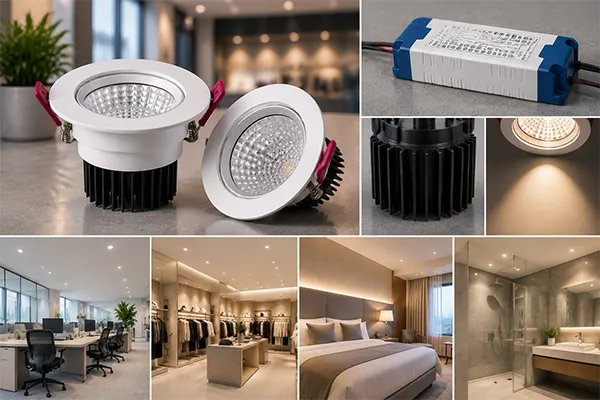
Professional LED downlights are fit for purpose when their light output, beam distribution, color quality, thermal design, driver reliability, installation format, and construction match the intended application. Higher wattage, higher CRI, or more features do not automatically make a downlight more professional; the correct specification depends on the space, operating hours, budget, and maintenance plan.
Evaluate the Full Lighting System, Not One Number
A downlight is a system. Buyers should consider the LED source, optical components, heat dissipation structure, driver, housing, wiring, mounting method, and final assembly. A specification sheet may list wattage and lumens, but buyers should also ask how the product will behave in the actual ceiling and operating environment.
Key procurement checks include:
- Lumen output and lighting layout: The selected output should support the lighting design rather than rely on wattage as a shortcut.
- Beam angle: A narrow beam can create focused accents, while a wider beam can support general illumination.4 Neither is universally better.
- Color temperature: Warm, neutral, and cool tones create different visual effects. The correct choice depends on the environment and local customer preference.
- CRI: Higher CRI may be valuable where color appearance matters5, but it should be selected based on the application rather than used as a generic premium label.
- Glare control: Trim design, reflector structure, and installation position can affect visual comfort.6
- Driver compatibility: Buyers should clarify input voltage, dimming requirements, flicker expectations, and replacement strategy.
- Thermal management: Recessed products need suitable heat dissipation in their intended installation conditions.7
- Batch consistency: Repeat orders should maintain agreed parameters, appearance, and installation dimensions.
Reliability Is a Supply-Chain Issue as Well as a Product Issue
For professional buyers, a failure may create more than a warranty claim. It can generate labor costs, access problems, reputational damage, and project delays. That is why a reliable driver and consistent production process can matter more than adding features that the end user will never use.
At our facility, every product undergoes a 100% aging test before shipment, typically lasting 4 to 8 hours. I present this as one manufacturing control measure, not as a substitute for a buyer’s own evaluation. Buyers should still request applicable test records, inspect samples, clarify warranty terms, and arrange qualified technical review where the application requires it.
I remember a recurring type of inquiry from project buyers: they first ask for the lowest price, then later ask whether the driver can be replaced without removing the whole fixture. That second question often reveals the more important issue. The buyer is managing future maintenance exposure. A lower purchase price may not be the lowest total cost when access to the ceiling is difficult.
How Should Buyers Verify Compliance for Professional LED Downlights?
Compliance questions can be confusing because buyers often need to meet several layers of requirements: destination-market rules, project specifications, customer standards, electrical installation rules, and shipping documentation. Treating one certificate as a universal approval can create serious procurement problems.
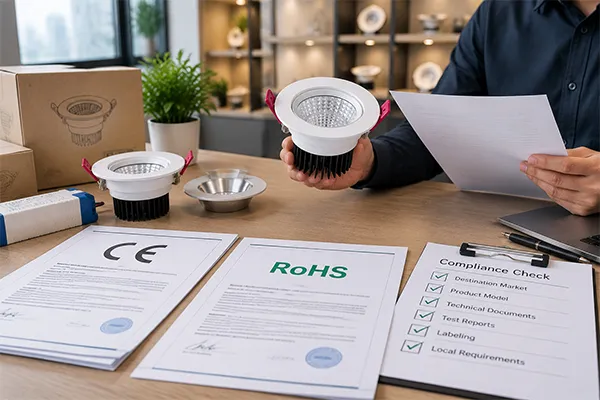
Buyers should verify compliance for professional LED downlights by matching supplier documents to the destination market, product configuration, and project requirements. CE and RoHS can be important market-entry foundations for relevant products and markets8, but buyers should confirm that documentation is current, applicable, traceable to the offered model, and sufficient for local regulations or project-specific requirements.
Ask for Documents That Match the Actual Product
A certificate or report is useful only when it relates to the model being purchased. If a buyer changes the driver, wattage, housing, or other significant components, the compliance position may need to be reviewed again.9 I recommend that purchasing teams avoid checking documents only at the first sample stage.
A practical document-verification process includes:
- Identify the destination market and project requirements.
- Confirm the exact model number and configuration.
- Request relevant certificates, declarations, test reports, and labeling information.
- Check dates, issuing bodies, report scope, and model coverage.
- Confirm whether any local registration, testing, importer marking, or installation requirement applies.
- Keep approved documents linked to the purchase order and final product specification.
CE and RoHS: Important, but Not a Complete Answer
At Upward Lighting, our products hold CE and RoHS documentation as part of our approach to relevant safety and environmental market-entry expectations. Buyers should verify these documents directly and should not assume that CE and RoHS alone meet every country’s legal requirement, customer requirement, or tender requirement.
For example, a contractor may need project-specific submittals. An importer may need local labeling details. A distributor may need documents in a specific format for its customers. A product manager may need consistency between packaging, product labels, instructions, and the approved specification.
| Buyer Question | Why It Matters |
|---|---|
| Does this document cover the exact model? | A similar-looking product may have a different driver or construction |
| Is the document current and traceable? | Outdated or unclear records increase approval risk |
| Does the destination market require additional steps? | Local rules may go beyond general market-entry documents |
| Does the project specify a standard or test method? | Tender and consultant requirements may be stricter |
| Does the label match the approved product? | Label consistency supports traceability and customs processes |
For complex applications, I recommend that buyers involve a qualified compliance professional, electrical engineer, or local regulatory adviser. A supplier can provide product information, but the buyer remains responsible for confirming that the final product is suitable and compliant for the intended destination and installation.
How Can Buyers Source Professional LED Downlights With Lower Supply Risk?
A strong downlight specification can still fail commercially if delivery becomes unstable, samples do not match production, or the supplier cannot support repeat orders. Many procurement teams focus heavily on the first quotation, but long-term supply performance deserves equal attention.
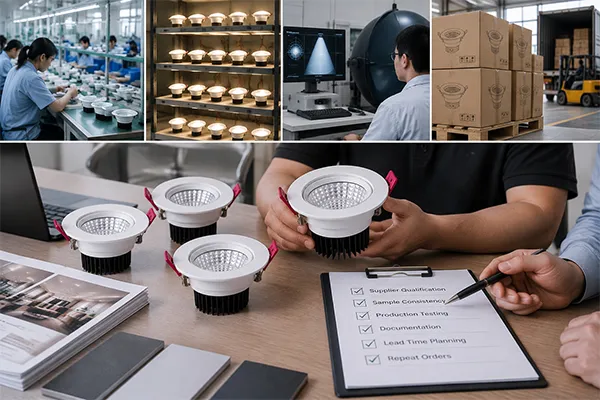
Buyers can lower supply risk for professional LED downlights by qualifying suppliers on product consistency, communication speed, sample control, production testing, documentation, lead-time planning, and repeat-order capability. The best sourcing decision considers total procurement risk, not only the lowest quoted unit price.10
Build a Supplier Evaluation Checklist
I suggest that buyers compare suppliers using a written scorecard. This method helps a purchasing team explain why a slightly higher-priced offer may create lower risk over repeated orders.
| Evaluation Area | Questions to Ask |
|---|---|
| Product range | Does the supplier offer the required sizes, wattages, trims, and driver options? |
| Sample control | Is the approved sample clearly identified and linked to the production specification? |
| Quality control | What incoming, assembly, aging, and final inspection controls are used? |
| Communication | Can the supplier answer technical and commercial questions clearly and quickly? |
| Customization | Can the supplier support OEM labels, packaging, and parameter changes when justified? |
| Order flexibility | Are small-batch orders possible for market testing or project needs? |
| Delivery planning | Are lead times realistic, and can the supplier communicate changes early? |
| Documentation | Can the supplier provide documents and product information in an organized way? |
| Repeat consistency | Can the supplier maintain key specifications across subsequent batches? |
Use Samples as a Procurement Tool
A sample should not be treated only as a visual confirmation. Buyers can use it to verify:
- Trim appearance and finish quality
- Cutout and installation fit
- Housing depth and ceiling compatibility
- Driver arrangement and wiring
- Product labeling
- Packaging protection
- Color temperature and beam appearance
- Basic consistency against the approved specification
For application-specific performance, buyers should use qualified lighting and electrical professionals. A sample review cannot replace proper project design, compliance assessment, or site testing.
Our role as a manufacturer is to provide clear product options and responsive quotation support. We also understand that importers and distributors may need to begin with small quantities before scaling. That approach can reduce risk when a buyer is testing a new professional LED downlight range, new brand position, or new customer segment.
Frequently Asked Questions
What are professional LED downlights?
Professional LED downlights are recessed lighting products selected for commercial, residential, retail, hospitality, or project applications where buyers need appropriate performance, installation compatibility, product consistency, and dependable supply. They are not defined only by high wattage or premium features.
Which specification matters most when sourcing LED downlights?
The most important specification depends on the application. Buyers should first confirm installation depth, cutout size, lighting purpose, operating hours, beam angle, color temperature, driver requirements, and compliance needs. A balanced specification is usually more valuable than maximizing one feature.
Are CE and RoHS enough for every LED downlight market?
No. CE and RoHS may be important documents for applicable products and markets, but they do not automatically satisfy every destination-country rule, installation standard, project specification, or customer requirement. Buyers should verify local and project-specific obligations before ordering.
Should wholesalers stock customized LED downlights?
Wholesalers can benefit from customized LED downlights when the changes support a clear sales strategy, such as private labeling, local color preferences, or a differentiated finish. However, buyers should keep core stock ranges controlled to avoid excessive inventory complexity and slow-moving items.
How can I reduce maintenance risk in a downlight project?
Buyers can reduce maintenance risk by evaluating driver reliability, thermal design, installation access, operating conditions, batch consistency, and supplier quality controls. They should also confirm warranty terms and use qualified professionals for application-specific lighting and electrical assessments.
Conclusion
Global demand for professional LED downlights is best understood through buyer needs rather than broad country comparisons. Importers, contractors, brands, and distributors should start with the application, installation conditions, required specifications, compliance checks, and channel model. I have seen that fit-for-purpose performance, reliable drivers, consistent production, and controllable delivery often matter more than maximum specifications. If you are building a stock range, planning a project, or exploring OEM/ODM options, contact Upward Lighting to discuss a downlight specification and sourcing plan suited to your market.
"Purchasing Energy-Efficient Light Fixtures (Luminaires)", https://www.energy.gov/cmei/femp/purchasing-energy-efficient-light-fixtures-luminaires. Lighting-design guidance recognizes that luminaire selection should reflect the building use, visual task, operating conditions, and installation environment rather than a single generic product criterion. Evidence role: general_support; source type: government. Supports: Guidance describing how lighting selection and performance requirements vary by building use, visual task, operating conditions, and installation context.. Scope note: Such guidance supports the general application-based approach but does not establish demand for any particular downlight model. ↩
"[PDF] A New Report on LED Downlights", https://www.energy.gov/sites/prod/files/2017/07/f35/postings_07-26.pdf. Lighting standards and technical guidance treat illuminance, glare, color rendering, environmental exposure, and installation constraints as application-dependent aspects of luminaire specification. Evidence role: general_support; source type: institution. Supports: Lighting standards and guidance distinguish application-dependent requirements for illuminance, glare, color rendering, environmental protection, and installation.. Scope note: Standards do not prescribe the article's commercial price-positioning choices, which remain procurement decisions. ↩
"[PDF] Life-Cycle Assessment of Energy and Environmental Impacts of LED ...", https://www.energy.gov/documents/lcafactsheetapr2013pdf-0. Research on LED systems identifies thermal and electrical stress as important contributors to driver and luminaire reliability, while lifecycle-cost analyses include maintenance and replacement costs in addition to initial purchase cost. Evidence role: mechanism; source type: research. Supports: Evidence that LED-driver and luminaire reliability are affected by thermal and operating conditions and that lifecycle costs include maintenance and replacement costs.. Scope note: The relative importance of these factors depends on the specific operating schedule, access conditions, product design, and labor costs. ↩
"[PDF] CALiPER Application Summary Report 20: LED PAR38 Lamps", https://www1.eere.energy.gov/buildings/publications/pdfs/ssl/caliper_20_summary.pdf. Lighting guidance generally characterizes narrower beam distributions as concentrating light on a limited area for emphasis and wider distributions as spreading light over a broader area for general illumination. Evidence role: definition; source type: education. Supports: Technical lighting guidance defining beam angle and explaining its relationship to accent and general illumination.. Scope note: Appropriate beam selection still depends on mounting height, spacing, target geometry, reflectances, and the lighting layout. ↩
"Color rendering of light sources - NIST", https://www.nist.gov/pml/sensor-science/optical-radiation/color-rendering-light-sources. The color rendering index is a measure used to characterize how a light source renders object colors relative to a reference illuminant, making color-rendering performance relevant where color appearance is important. Evidence role: definition; source type: government. Supports: An explanation of the color rendering index and its use in describing how a light source affects perceived object colors.. Scope note: CRI alone does not fully predict color preference or fidelity; spectral distribution and the specific visual task can also matter. ↩
"Discomfort Glare Models in Outdoor Environments After Dark", https://ies.org/fires/discomfort-glare-models-in-outdoor-environments-after-dark/. Lighting research identifies source luminance, optical shielding, viewing geometry, and luminaire placement as factors that influence discomfort glare and visual comfort. Evidence role: mechanism; source type: research. Supports: Evidence that source luminance, shielding or optical design, viewing geometry, and luminaire location influence discomfort glare and visual comfort.. Scope note: A specific downlight's glare performance requires application-specific photometric data and a completed lighting design. ↩
"[PDF] LED Performance Under Tough Conditions - Department of Energy", https://www.energy.gov/sites/prod/files/2016/01/f28/dec2015_DOE_GATEWAY_roundup_0.pdf. LED thermal-management research shows that elevated operating temperatures can affect light output, color stability, and the lifetime of LEDs and associated electronic components, making installed thermal conditions material to recessed-luminaire performance. Evidence role: mechanism; source type: paper. Supports: Research showing that LED junction temperature and luminaire thermal paths affect light output, color stability, and component lifetime.. Scope note: The thermal suitability of a particular product can only be determined from its design, rated ambient conditions, and actual ceiling installation. ↩
"CE marking – obtaining the certificate, EU requirements - Your Europe", https://europa.eu/youreurope/business/product-rules-compliance/general-product-compliance/ce-marking/index_en.htm. European Union guidance explains that CE marking applies where harmonized EU product legislation requires it, while the RoHS framework restricts specified hazardous substances in electrical and electronic equipment within its scope. Evidence role: definition; source type: government. Supports: Official European Union guidance on CE marking and the Restriction of Hazardous Substances framework for products within their respective scopes.. Scope note: Applicability depends on the product, its configuration, the applicable legislation, and the market in which it is placed. ↩
"CE marking - Internal Market, Industry, Entrepreneurship and SMEs", https://single-market-economy.ec.europa.eu/single-market/goods/ce-marking_en. Conformity-assessment guidance requires manufacturers to ensure that the product placed on the market conforms to applicable requirements and that supporting technical documentation reflects the product configuration. Evidence role: mechanism; source type: government. Supports: Official guidance explaining that manufacturers must assess conformity and maintain technical documentation for the product as placed on the market, including when changes affect compliance.. Scope note: Whether a particular component change requires new testing, a revised declaration, or another action depends on the applicable legislation, risk assessment, and technical change. ↩
"Implementing the OECD Recommendation on Public Procurement ...", https://www.oecd.org/en/publications/implementing-the-oecd-recommendation-on-public-procurement-in-oecd-and-partner-countries_02a46a58-en/full-report/implementation-of-the-oecd-recommendation-in-member-and-partner-countries_2305bb1b.html. Procurement guidance commonly treats price as one evaluation criterion among total cost of ownership, quality, delivery performance, technical compliance, and supply risk. Evidence role: expert_consensus; source type: institution. Supports: Procurement guidance supporting evaluation of total cost of ownership, quality, delivery, and risk alongside purchase price.. Scope note: The weighting assigned to price and non-price criteria should reflect the buyer's procurement rules, project risk, and market conditions. ↩