

OEM LED downlights can look interchangeable at first, yet many brands struggle when they launch a private-label range without a clear product plan. A poor specification, weak packaging, or an oversized first order can create expensive inventory and after-sales risk. I see stronger results when brands use OEM collaboration to turn market needs into a focused, testable downlight range.
Brands use OEM LED downlights to expand markets by building a first SKU range around a defined customer, installation setting, price tier, and sales channel. The most effective approach combines suitable specifications, verified compliance readiness, consistent quality control, practical packaging, samples, and small-batch validation before broader inventory commitments. OEM is therefore a product-market translation process, not simply logo printing.

In our day-to-day OEM and ODM discussions, I find that the best starting point is rarely “What is your lowest price?” A more useful conversation begins with where the brand intends to sell, who will install the product, and what the first range must achieve. Those answers shape every later decision.
How Do OEM LED Downlights Become a Market-Fit Product Range?
OEM LED downlights create problems when a brand starts with an existing factory model but has not defined its buyer or use case. The product may be technically acceptable, yet it can still feel misplaced in its target channel. A structured OEM brief helps a brand convert market goals into practical SKU decisions.
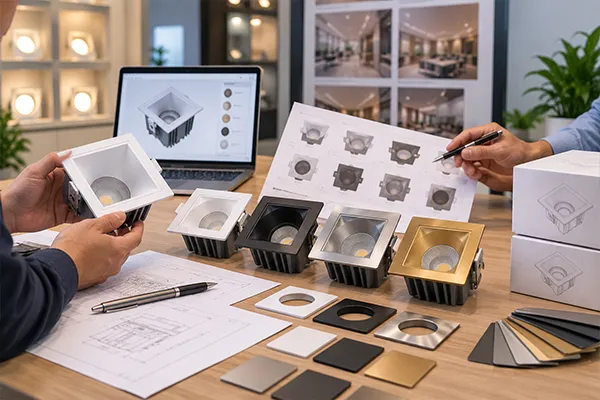
A market-fit OEM LED downlight range starts with the target market, customer type, installation context, and intended price position. These inputs guide decisions on wattage, cutout size, color temperature, beam angle, CRI, trim style, finish, packaging, and SKU count. A focused first range is usually easier to validate than a broad catalog.1
Start With the Buyer, Not the Product Catalog
I have seen recurring situations where a brand asks for “a complete downlight range” before deciding whether its core buyers are electrical wholesalers, contractors, retail consumers, hospitality projects, or building-material channel partners. That makes it difficult to choose the right product level.
For example, a contractor-focused offer may prioritize:
- Stable cutout dimensions
- Clear installation instructions
- Reliable lead times
- Practical driver options
- Easy replacement and reorder consistency
- Carton strength for site delivery
A decorative residential range may place more emphasis on trim appearance, finish colors, dimming compatibility, glare control, and retail-ready packaging. Neither approach is automatically better. The correct approach depends on the intended buyer.
Turn Commercial Requirements Into Specifications
A capable OEM supplier should ask questions before issuing a final quotation. In our own communication process, these questions often prevent avoidable revisions later:
- Which country or region is the first target market?
- Who is the intended customer: contractor, distributor, retailer, project buyer, or homeowner?
- Where will the downlight be installed?
- What price tier does the brand want to occupy?
- What does the first-order SKU plan look like?
- Does the customer need fixed, dimmable, CCT-selectable, or adjustable products?
- What packaging and branding information must appear on the product and carton?
These questions affect component selection and production planning. A 5W residential recessed LED downlight, for instance, may not need the same lumen output, thermal design, or carton configuration as a 15W commercial ceiling downlight.2
| Product Decision | Market Question Behind It | Potential OEM Response |
|---|---|---|
| Wattage | How high are the ceilings and how much light is expected? | 5W, 7W, 9W, 12W, or higher options |
| CCT | Does the market prefer warm, neutral, or cool lighting? | 2700K, 3000K, 4000K, 5000K, or CCT switching |
| Beam angle | Is the space residential, retail, office, or hospitality? | Narrower accent beams or wider general-lighting beams |
| CRI | Is color appearance important for the end use? | Standard CRI or higher-CRI options where appropriate |
| Trim finish | Is the product decorative or utility-focused? | White, black, silver, brushed, or custom finishes |
| Packaging | Will the product sell through retail, distribution, or project channels? | Plain export cartons, branded boxes, labels, inserts |
I recommend that brands treat the first OEM LED downlight range as a controlled market test rather than an attempt to serve every buyer. A smaller range can reveal which wattages, colors, and trims receive repeat interest. It can also make forecasting, inventory management, and reorder communication more manageable.
Why Is the Lowest OEM LED Downlight Price Not Always the Lowest-Risk Entry Strategy?
A low OEM LED downlight quotation can be attractive, especially for a new brand that needs room for distributor margins. However, the lowest unit price may create more exposure if specifications are unclear, quality consistency varies, or delivery performance is unreliable. The real decision should consider total launch risk, not only factory cost.
The lowest OEM LED downlight price is not always the lowest-risk option because a brand also absorbs costs from returns, damaged packaging, specification changes, delayed deliveries, inconsistent batches, and customer complaints.3 Buyers should compare quotations against documented specifications, test procedures, packaging details, lead times, and supplier communication quality.

Compare Like for Like
A quotation is only useful if the underlying product definition is clear. Two downlights may share the same wattage and diameter on paper, yet use different LEDs, drivers, heat-sink designs, optics, spring structures, cable lengths, carton materials, or testing requirements.4
I have found that purchasing teams get better comparisons when they request a specification sheet that identifies the key commercial and technical points. The goal is not to make procurement unnecessarily complicated. The goal is to avoid comparing incomplete information.
A practical comparison should include:
- Rated wattage and input voltage
- CCT and tolerance expectations
- Lumen output target
- CRI requirement
- Beam angle
- Cutout size and outside diameter
- Driver type and dimming requirement, if applicable
- Housing and trim materials
- IP rating, where relevant
- Product color and finish
- Brand label and packaging requirements
- Carton quantity and carton dimensions
- Sample lead time and production lead time
- Quality-control and aging-test process
Consider the Cost of Avoidable Problems
The unit price is visible. The cost of operational disruption is often less visible until after launch. A brand may lose time when it needs to clarify label content, update a carton, resolve a cutout mismatch, or explain a changed component to a distributor.
At Upward Lighting, we conduct a 100% aging test for 4 to 8 hours before shipment5 as part of our standard production process. Buyers should still ask what testing is performed, how test records are handled, and what product requirements are agreed in writing. A factory process is useful only when it aligns with the buyer’s own quality expectations.
I generally encourage buyers to view quality control as a shared system. The factory can inspect production, but the brand should also define what it considers an acceptable product, package, label, and shipment.
| Risk Area | Lowest-Price-Only Focus | Lower-Risk Procurement Focus |
|---|---|---|
| Product specification | Broad or incomplete description | Documented parameters and approved sample |
| Packaging | Minimal detail | Defined labels, inserts, inner boxes, and carton strength |
| Quality checks | General assurance | Agreed inspection points and aging-test discussion |
| Lead time | Assumed availability | Confirmed production schedule and reorder process |
| Supplier communication | Quote-only interaction | Responsive clarification before and after order |
| Inventory | Large initial commitment | Phased order plan where practical |
This does not mean that a competitive price is unimportant. It is very important in lighting markets. It means a buyer should seek competitive pricing with specification clarity and repeatable supply, rather than treating the lowest number as the whole decision.
How Should Brands Select OEM LED Downlight Specifications for Different Markets?
Brands often assume that one OEM LED downlight design can work in every export market. This assumption can create slow-moving inventory, unclear sales positioning, and unnecessary product revisions. Preferences for color temperature, trim style, installation methods, and price expectations vary by country, channel, and project type.6
Brands should select OEM LED downlight specifications after defining their first market and customer segment. The best first range matches local installation expectations, channel preferences, target price tier, and applicable requirements. A universal design may be efficient for production, but it is not always the best commercial fit.
Define the Installation Environment
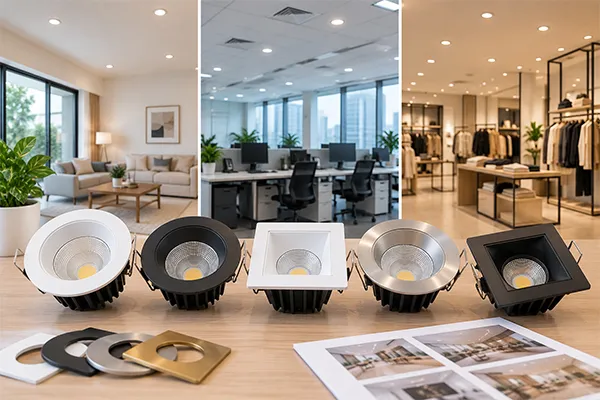
The installation environment is one of the most useful specification filters. A downlight for a dry residential ceiling differs from a fixture intended for a bathroom zone, retail display area, office corridor, or hospitality project.7
Brands should consider questions such as:
- Is the ceiling gypsum board, suspended ceiling, concrete, or another material?
- What cutout sizes are common in the target channel?
- Are ceilings low, standard, or high?
- Is the product intended for general lighting or accent lighting?
- Does the project require dimming?
- Are moisture resistance or IP considerations relevant?
- Does the buyer care more about low glare, high color rendering, compact depth, or low unit cost?
A brand that answers these questions can avoid a common issue: launching many similar downlights that confuse buyers but do not solve distinct installation needs.
Build a First SKU Ladder
For many private-label launches, I believe a narrow SKU ladder is more practical than an extensive catalog. The range should give buyers a reason to choose different models while keeping purchasing and stock planning manageable.
Here is an illustrative framework. It is not a universal product recommendation, because every application should be assessed on its own requirements.
| SKU Role | Example Specification Direction | Commercial Purpose |
|---|---|---|
| Entry SKU | Standard wattage, common trim, core CCT | Provides an accessible price point |
| Core SKU | Popular wattage and beam angle, dependable specification | Supports repeat channel demand |
| Premium SKU | Higher CRI, enhanced finish, dimming, or deeper glare-control design | Gives the brand an upgrade option |
| Project SKU | Application-specific output, IP level, driver, or installation feature | Supports contractor and project requests |
The first range should also match the brand’s operational capacity. If the brand has limited warehousing, a plan with dozens of combinations of wattage, CCT, trim color, and cutout size may create complexity before demand is proven.
Treat Certifications as Verification Points, Not Sales Guarantees
CE and RoHS documentation can be relevant to market-entry preparation for many products and destinations.8 Our products have CE and RoHS certifications, and we communicate related documents with buyers as part of the product discussion. However, I do not suggest that any certification automatically guarantees access to every market, channel, installation, or project.
Brands should verify:
- The specific regulations that apply in the destination country
- Whether the documentation corresponds to the exact product configuration
- Whether a local importer, retailer, project owner, or authority requires additional evidence
- Whether labeling, electrical, packaging, or recycling obligations apply
- Whether the application requires a particular standard, test, or third-party review
For application-specific decisions, brands should consult qualified regulatory, electrical, or technical professionals. Certification readiness is a foundation. It does not replace market research, channel fit, or correct product positioning.
How Can Samples and Small-Batch OEM LED Downlights Reduce Launch Risk?
A full-container or large inventory order can seem efficient because it reduces the unit cost. Yet brands that have not tested a supplier, product specification, packaging design, or sales response may take on more risk than necessary. Samples and smaller first orders can provide practical information before a wider rollout.
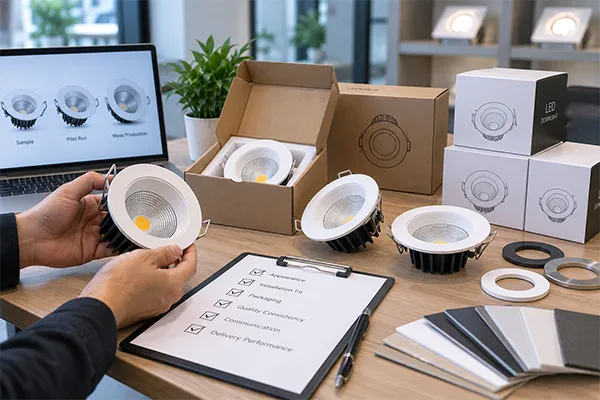
Samples and small-batch OEM LED downlights reduce launch risk by allowing brands to assess product appearance, installation fit, packaging, communication, quality consistency, and delivery performance before committing to larger inventory.9 They work best when the buyer uses a documented evaluation checklist and approves key details before production.
Use Samples as a Structured Evaluation Tool
A sample should not be treated only as a visual approval item.10 It is also an opportunity to test how the product behaves in the buyer’s expected sales and installation environment.
In recurring OEM discussions, I see stronger sample evaluations when the brand reviews the complete experience:
- Product appearance: Does the trim, finish, size, and labeling match the brand position?
- Installation: Does the cutout size, spring design, cable length, and driver arrangement suit the intended ceiling system?
- Light output: Does the CCT, beam distribution, and perceived brightness fit the application?
- Packaging: Does the box protect the product and communicate the correct information?
- Documentation: Are specifications, labels, and certification-related documents organized clearly?
- Communication: Does the supplier respond accurately when the brand asks detailed questions?
- Timing: Does the sample process reflect the supplier’s ability to coordinate future orders?
I remember an internal discussion where a sample review revealed that the product itself was acceptable, but the proposed retail box did not clearly distinguish the wattage and color temperature variants. That type of issue is much easier to correct before a large production run than after products reach distributors.
Plan a Small-Batch Order With a Learning Goal
A small-batch order should have a purpose beyond “buy less.” It should validate a specific assumption. For example, the brand may want to test whether 3000K or 4000K creates stronger distributor interest, whether black trims sell in a particular channel, or whether a dimmable variant justifies its higher cost.
A useful first-order review can track:
| Validation Area | Questions to Ask After the Order |
|---|---|
| Sales response | Which SKUs generated the most inquiries or reorders? |
| Product feedback | Did installers report issues with cutout, springs, drivers, or wiring? |
| Packaging | Did any cartons or product boxes arrive damaged? |
| Inventory movement | Which variants moved slowly? |
| Supplier execution | Were documents, quality checks, and delivery timing consistent? |
| Next-order plan | Which SKUs should be increased, removed, or adjusted? |
Small-batch support can be particularly useful for brands adding LED downlights to an existing lighting portfolio. It allows the team to learn without committing immediately to a wide range of slow-moving variants. Still, the buyer should confirm minimum order quantities, customization costs, production lead times, and packaging requirements early. Some custom features may require more volume or longer preparation.11
The long-term objective is not to remain permanently in test mode. The objective is to build enough evidence to make a more confident repeat-order decision.
Frequently Asked Questions
What is the difference between OEM LED downlights and private-label downlights?
Private-label downlights usually involve selling products under a brand’s own name. OEM LED downlights can include private labeling, but the process may also involve agreed changes to specifications, finishes, packaging, labeling, wattage, CCT, beam angle, and SKU structure.
How many downlight SKUs should a new brand launch first?
A new brand should usually begin with a focused SKU range that serves one defined market and buyer type. The right number depends on the channel, but a smaller group of clearly differentiated models is often easier to forecast, explain, stock, and evaluate than a broad catalog.
Do CE and RoHS certificates guarantee that LED downlights can be sold anywhere?
No. CE and RoHS documents may support compliance preparation, but they do not automatically guarantee market access, project approval, or sales in every country.12 Brands should verify destination-specific regulations, channel requirements, labeling obligations, and product-specific documentation with qualified professionals.
What should I check before approving an OEM LED downlight sample?
You should check dimensions, cutout size, trim finish, CCT, beam angle, light quality, driver arrangement, installation method, labels, packaging, and documentation. You should also assess how accurately and quickly the supplier handles technical questions and requested revisions.
Is a small-batch order always better than a large first order?
Not always. A larger order may make sense when demand is established and specifications are stable. However, a small-batch order can be a practical risk-management step when a brand is testing a new product category, supplier relationship, packaging format, or target market.
Conclusion
Brands can use OEM LED downlights to expand markets when they approach OEM as a structured product-development and supplier-management process. A logo alone does not create a sellable range. Brands need a clear target buyer, suitable specifications, verified compliance readiness, consistent quality expectations, practical packaging, and a disciplined sample or small-batch plan. At Upward Lighting, we help buyers translate those requirements into workable LED downlight specifications, samples, packaging, and repeat-order workflows. Contact us to discuss your first SKU plan and OEM/ODM requirements.
"[PDF] How Competition, Customization, and Niche Markets Have Affected ...", https://scholarcommons.sc.edu/cgi/viewcontent.cgi?article=1095&context=senior_theses. Research on product-line complexity indicates that expanding the number of SKUs can increase forecasting, inventory, and operational complexity, supporting the use of a more limited initial assortment while demand is being evaluated. Evidence role: general_support; source type: paper. Supports: Research on product-line complexity, SKU proliferation, and inventory management as they relate to forecasting, operational complexity, and product-launch evaluation.. Scope note: Such research supports the general operational rationale; it does not establish an optimal SKU count for every lighting brand. ↩
"Purchasing Energy-Efficient Light Fixtures (Luminaires)", https://www.energy.gov/cmei/femp/purchasing-energy-efficient-light-fixtures-luminaires. Lighting guidance and luminaire standards recognize that required illumination, product construction, and thermal performance vary by application and luminaire configuration, so residential and commercial downlights need not share the same design targets. Evidence role: general_support; source type: institution. Supports: Lighting-design and luminaire-performance guidance showing that output, thermal conditions, and design requirements depend on application and product configuration.. Scope note: This support is contextual and does not prescribe the exact lumen, thermal, or carton specification for either 5W or 15W products. ↩
"A multi-dimensional evaluation model for power enterprise ... - PMC", https://pmc.ncbi.nlm.nih.gov/articles/PMC12639062/. Total-cost-of-ownership frameworks in procurement treat purchase price as only one component of supplier cost and include quality, delivery, service, logistics, and failure-related costs when comparing sourcing options. Evidence role: general_support; source type: research. Supports: Procurement evidence that total cost of ownership incorporates quality, logistics, service, and failure costs in addition to purchase price.. Scope note: The framework supports the decision principle but does not quantify the downstream costs for a particular OEM downlight supplier. ↩
"[PDF] Solid State Lighting LED Product Development and Manufacturing ...", https://www.energy.gov/documents/ledrtprdctmfg-reportoct2016pdf. Technical guidance on LED luminaires explains that performance and reliability depend on the interaction of the LED source, driver, optical system, thermal design, and mechanical construction, not solely on nominal wattage or fixture diameter. Evidence role: mechanism; source type: government. Supports: Technical guidance describing how LED luminaires depend on multiple component and system-design factors, including drivers, optics, and thermal management.. Scope note: The source would support the general engineering principle rather than verify differences between any two specific quoted products. ↩
"[PDF] The challenges in understanding CIGS thin film cell and module ...", https://www.nist.gov/system/files/documents/el/building_materials/Sundaramoorthy2.pdf. Reliability literature describes burn-in or aging tests as a method that may screen for some early-life failures in electronic and LED products before release; verification of a manufacturer's stated test coverage and duration requires its own production records or audit evidence. Evidence role: mechanism; source type: research. Supports: Evidence on the role and limitations of burn-in or aging tests in identifying early-life failures in electronic or LED products.. Scope note: A general source cannot substantiate the stated 100% coverage or four-to-eight-hour practice at Upward Lighting. ↩
"Effect of warm/cool white lights on visual perception and mood ...", https://pmc.ncbi.nlm.nih.gov/articles/PMC8481791/. Studies of lighting preference and application-based lighting design report that preferred correlated color temperature and other lighting attributes can differ across user groups and settings, supporting market-specific specification review. Evidence role: general_support; source type: paper. Supports: Research showing that lighting preferences and lighting-design choices can vary with user population, cultural context, and application.. Scope note: Evidence on color-temperature preference does not by itself demonstrate variation in every listed factor, such as trim style or price expectation, in every country. ↩
"Prototype Models for Lighting Research | Department of Energy", https://www.energy.gov/cmei/ssl/prototype-models-lighting-research. Electrical-installation and lighting-design guidance distinguishes luminaire selection by environmental exposure and application, including moisture protection where relevant and different illumination objectives for residential, retail, office, and hospitality spaces. Evidence role: general_support; source type: institution. Supports: Standards and lighting-design guidance distinguishing environmental protection and lighting-performance requirements across installation settings.. Scope note: The applicable requirements depend on the jurisdiction, installation zone, and exact product classification. ↩
"RoHS Directive - Environment - European Commission", https://environment.ec.europa.eu/topics/waste-and-recycling/rohs-directive_en. European Union guidance explains that CE marking indicates conformity with applicable EU product requirements and that the RoHS framework restricts specified hazardous substances in covered electrical and electronic equipment, making these documents relevant to compliance preparation where the rules apply. Evidence role: definition; source type: government. Supports: Official EU information on CE marking and the restriction of hazardous substances for electrical and electronic equipment.. Scope note: CE and RoHS applicability depends on the product, its intended market, and the specific legislation in force. ↩
"(PDF) Lean Launch: Managing Product Introduction Risk Through ...", https://www.academia.edu/1578251/Lean_Launch_Managing_Product_Introduction_Risk_Through_Response_Based_Logistics. Research on staged investment and pilot testing under uncertainty supports using limited early commitments to obtain information about product performance, demand, and execution before scaling inventory exposure. Evidence role: general_support; source type: paper. Supports: Research on pilot production, staged commitment, and learning under demand or supplier uncertainty.. Scope note: This evidence supports the risk-reduction logic generally; it does not prove that every small OEM order will outperform a larger initial order financially. ↩
"[PDF] Packaging Supplier Inspection Guide - OSTI.GOV", https://www.osti.gov/servlets/purl/5786844. Quality-management principles require organizations to verify that supplied products meet defined requirements, which can encompass functional performance, installation compatibility, packaging, documentation, and supplier process controls rather than visual appearance alone. Evidence role: general_support; source type: institution. Supports: Quality-management guidance on verification, supplier evaluation, and inspection of product requirements beyond visual appearance.. Scope note: The principles do not prescribe a universal sample checklist for LED downlights. ↩
"A heijunka study for the production of standard parts included in a ...", https://pmc.ncbi.nlm.nih.gov/articles/PMC8638910/. Operations-management research explains that product customization can require additional engineering, tooling, setup, and material-planning activities, which may increase lead times or make larger production volumes more economical. Evidence role: mechanism; source type: research. Supports: Operations-management evidence that customization can introduce engineering, tooling, setup, and procurement requirements affecting lead time and economical batch size.. Scope note: The resulting minimum order quantity and preparation time vary by feature, supplier capacity, tooling needs, and material availability. ↩
"CE marking – obtaining the certificate, EU requirements - Your Europe", https://europa.eu/youreurope/business/product-rules-compliance/general-product-compliance/ce-marking/index_en.htm. Official conformity-assessment guidance states that CE marking is relevant only to products covered by applicable EU harmonisation legislation and does not substitute for other jurisdiction-specific legal, technical, or purchaser requirements. Evidence role: general_support; source type: government. Supports: Official guidance that CE marking applies within defined legal frameworks and does not replace other applicable market, national, or customer requirements.. Scope note: The exact additional obligations for a downlight depend on the destination country, sales route, and installation context. ↩