LED downlight investment decisions can become difficult when multiple suppliers offer similar wattage, lumen figures, and product photos at very different prices. A poor comparison can lead to specification mismatches, delayed projects, customer complaints, or costly replacement work. I recommend evaluating downlights as a managed procurement risk, not simply as a unit-price purchase.
A sound LED downlight investment decision compares application fit, verified specifications, bulk-production consistency, compliance requirements, customization feasibility, and supplier delivery capability. Buyers should define the required lighting result first, then assess whether a supplier can repeatedly deliver the agreed product across the required batch, timeline, and target market.
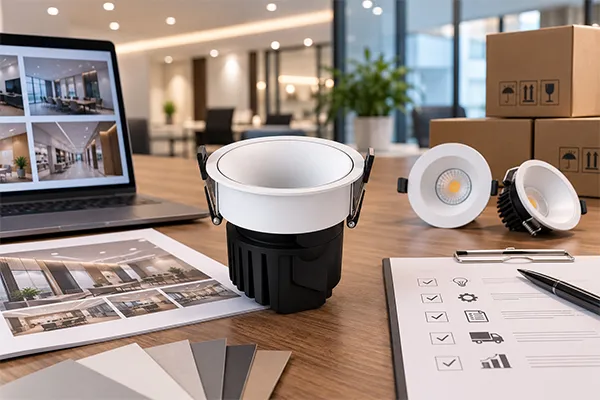
In repeated quotation and specification-confirmation discussions, I often see buyers start with a simple request: “Please quote your best price.” Price matters, of course. However, the better question is whether the proposed LED downlight can meet the actual application, commercial, and supply requirements without creating avoidable downstream risk.
Why Are LED Downlight Investment Decisions More Than a Price Comparison?
Many buyers face pressure to reduce purchase costs, especially when projects, distributors, or retail channels compare several quotations. The problem is that a lower quote can look attractive before the underlying specifications are aligned. If the products are not truly comparable, the apparent saving may disappear quickly.
LED downlight investment decisions should compare total procurement risk rather than only unit price. A lower-priced downlight may be appropriate if it meets the agreed application, quality, compliance, packaging, and delivery requirements. However, buyers should not assume that similar photos or headline specifications mean the products offer the same commercial value.
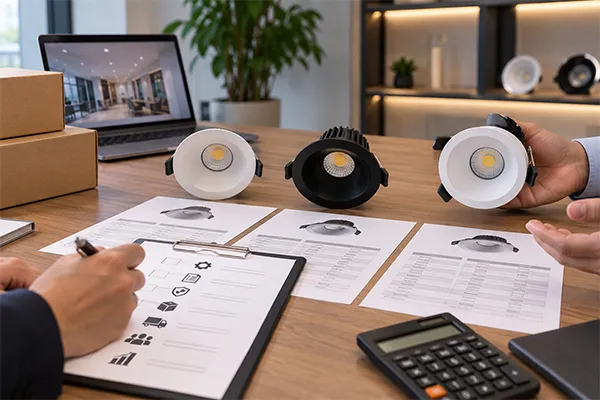
The “Same Specification” Problem
A quotation may list the same nominal wattage, color temperature, and cutout size as another quotation. Yet these details alone do not establish that two LED downlights are equivalent1.
For example, a 10W LED downlight may differ in:
- Driver configuration and expected operating conditions
- Housing material and heat-dissipation design
- Beam angle and optical distribution
- Cutout tolerance and ceiling installation fit
- Color consistency between production batches
- CRI option and color-temperature availability
- Dimming compatibility, if dimming is requested
- Packaging protection for export and local distribution
- Production controls and pre-shipment inspection process
From our quotation discussions, I have learned that buyers often need to turn a broad price request into a product comparison sheet. This step helps purchasing teams avoid comparing a basic non-dimmable model against a dimmable model, or an indoor product against a model intended for more demanding installation conditions.
Consider the Total Procurement Cost
The purchase price is visible. The cost of coordination, rework, replacement, freight, delayed installation, and customer communication is less visible2. Still, these costs can influence whether a purchase is commercially successful.
I do not suggest that every project needs the highest possible specification. That approach can also waste budget. Instead, I recommend matching the product to the project’s real requirements.
| Evaluation area | Price-only approach | Risk-managed procurement approach |
|---|---|---|
| Product comparison | Compares unit cost | Confirms comparable specifications |
| Application fit | Assumes wattage is enough | Reviews installation and lighting needs |
| Quality review | Approves one sample | Reviews batch controls and inspection |
| Compliance | Accepts a certificate image | Verifies market and project relevance |
| Delivery planning | Checks stated lead time | Confirms capacity, packaging, and shipment needs |
| Customization | Assumes all requests are simple | Reviews MOQ, validation, cost, and timeline |
A low quotation can be a good option only when buyers understand exactly what is included, what is excluded, and whether the product suits the intended use.
Questions I Encourage Buyers to Ask
Before finalizing a supplier comparison, I recommend asking:
- Which specifications are non-negotiable for this project or product line?
- Where will the downlight be installed?
- What cutout size, ceiling depth, beam angle, and color temperature are required?
- Is dimming required, and which dimming method is relevant?
- Which certifications or documents does the target market require?
- Can the supplier confirm the same configuration for the full batch?
- What inspection, aging-test, and packing controls apply before shipment?
These questions create a more reliable basis for LED downlight investment decisions than a lowest-price ranking alone.
How Should Buyers Match LED Downlights to the Actual Application?
A downlight can look correct on a specification sheet but still produce an unsuitable result after installation. This risk becomes more serious when a product is selected without enough information about ceiling conditions, room purpose, visual comfort, or installation method. Buyers need a clearer application brief before requesting final quotations.
Buyers should match LED downlights to the application by confirming the installation environment, cutout and ceiling constraints, required light distribution, color temperature, glare expectations, control requirements, and target output. Wattage and nominal lumen output are useful reference points, but they do not independently define a suitable lighting result.
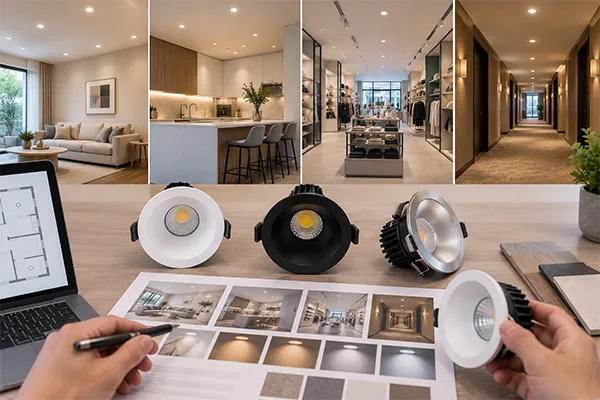
Start With the Installation Conditions
The installation environment affects which LED downlight design may be practical. Buyers should gather basic information before selecting a model.
Useful questions include:
- Is the ceiling gypsum board, metal, concrete, wood, or another material?
- What is the available ceiling void depth?
- What is the required cutout diameter?
- Is the installation location dry, humid, or exposed to unusual conditions?
- Will the downlight be recessed, surface-mounted, trimless, or adjustable?
- Is access available for maintenance or driver replacement?
- Does the project require a specific bezel finish or housing color?
A buyer who only sends “Need 12W, 4000K, white” may receive an incomplete recommendation because the supplier still lacks important installation details. In our experience, a drawing, reference image, cutout requirement, or ceiling photo can make specification confirmation much faster.
Understand Beam Angle and Lighting Distribution
Beam angle influences how light spreads across a surface3. A narrow beam can create stronger accents and more defined pools of light. A wider beam can support broader general illumination.4 Neither option is universally better.
For example:
| Application example | Typical evaluation priority | Buyer question |
|---|---|---|
| Retail display area | Accent effect and beam control | Does the beam create the intended focal effect? |
| Hotel corridor | Visual comfort and consistent spacing | Will the distribution support even corridor lighting? |
| Office area | Comfort, glare control, and uniformity | Does the fixture suit the ceiling layout and work environment? |
| Residential living space | Ambience and color preference | Which color temperature fits the design intent? |
| Building-material resale channel | Versatility and installation fit | Which cutout sizes and configurations sell consistently? |
I do not present our factory as a substitute for a qualified lighting designer or project engineer. Larger, regulated, or application-specific projects may require professional lighting calculations, local electrical review, and installation guidance.5 However, buyers can reduce early-stage risk by collecting the right project information before they request a final LED downlight proposal.
Define the Required Specification, Not Just the Desired Headline
A practical specification sheet should identify what truly matters. I suggest separating requirements into three groups:
Non-negotiable requirements
- Installation type and cutout size
- Target market compliance needs
- Voltage and frequency
- Color temperature
- Dimming or non-dimming requirement
- Required ingress protection level, where applicable
- Project delivery date
Preferred requirements
- Specific beam angle
- CRI target
- Surface finish
- Packaging format
- Branded label or instruction leaflet
Flexible requirements
- Alternative housing design
- Small differences in bezel shape
- Packaging artwork details
- Optional accessories
This process makes LED downlight investment decisions more efficient because it prevents teams from spending time negotiating small visual changes while major technical requirements remain uncertain.
Why Is a Sample Approval Not Enough for LED Downlight Investment Decisions?
A product sample can help buyers check appearance, installation fit, finish, and basic function. However, a sample is one checkpoint, not proof that a full production batch will remain consistent6. Buyers can face problems when sample approval is treated as the entire quality-control process.
A sample approval supports LED downlight investment decisions, but it should be followed by clear specification confirmation, production controls, aging tests, pre-shipment inspection, and agreed acceptance criteria. Buyers should ask how the supplier manages consistency between the approved sample and bulk production.
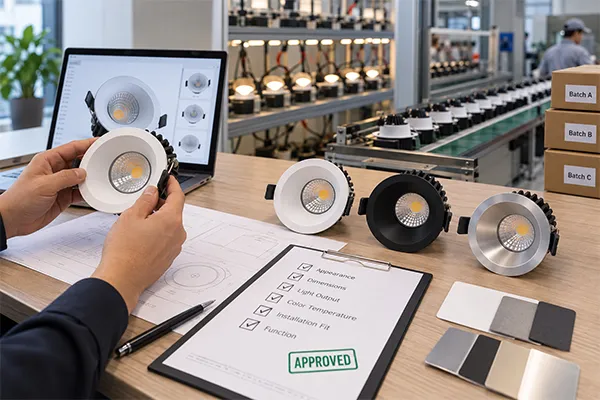
What a Sample Can Confirm
A sample can be valuable for confirming visible and practical details. It may help a buyer review:
- Housing appearance and finish color
- Cutout fit and spring mechanism
- Basic function and power connection
- Light color preference
- Beam appearance in a limited setting
- Packaging concept
- Logo, label, or branding placement
For a distributor building a private-label range, a sample can also help internal sales teams understand the product before launch. For a contractor, a sample can support mock-up installation and client discussion.
Still, a sample is normally produced in a small quantity. It cannot, by itself, demonstrate every aspect of a larger production run, shipping process, or future batch continuity.
What Buyers Should Confirm Before Mass Production
From production, aging-test, and pre-shipment inspection observations, I believe buyers obtain better control when they document key details before the production order begins.
A useful specification-confirmation checklist includes:
| Item | What buyers should clarify |
|---|---|
| Model number | Exact product version and configuration |
| Wattage | Rated wattage and permitted variation, if relevant |
| CCT | Required color temperature option |
| CRI | Required CRI level or product series |
| Beam angle | Exact optical option |
| Cutout | Ceiling opening dimension and tolerance expectations |
| Input | Voltage, frequency, and driver type |
| Dimming | Required dimming method and compatibility scope |
| Finish | White, black, silver, or custom surface finish |
| Labeling | Brand, model code, electrical markings, barcode |
| Packaging | Inner box, master carton, quantity, print requirements |
| Documentation | Required certification and market documents |
| Inspection | Agreed checks before shipment |
At Upward Lighting, we conduct a stated 100% aging test for 4 to 8 hours before shipment as part of our standard production process. Buyers should still discuss what this process means for the specific order and which additional checks, records, or inspection arrangements they require. Aging tests are an important quality-control step, but buyers should not interpret one process statement as a universal guarantee for every installation condition or project outcome.7
Ask About Batch Consistency
Consistency is especially important for importers, wholesalers, and local lighting brands that will reorder a model over time. They need to know whether the supplier can maintain key product characteristics as production continues.
I encourage buyers to ask suppliers:
- How are approved specifications recorded for repeat orders?
- How are incoming materials and production components managed?
- How is color-temperature consistency checked or controlled?8
- What happens if a component must be changed?
- Does the supplier notify the buyer before material or specification changes?
- What pre-shipment inspection steps apply?
- Can the buyer arrange third-party inspection if required?
One buyer once asked us for a “same as last order” quotation without attaching the previous specification sheet. We located the prior order details and reconfirmed the configuration before quoting. That small confirmation step can prevent a costly misunderstanding, especially when a product family includes multiple wattage, beam-angle, driver, and trim options.
How Do Certifications and OEM/ODM Affect LED Downlight Investment Decisions?
Buyers may see CE, RoHS, customized wattage, custom color, or private-label services listed on many supplier profiles. These terms are important, but they require careful verification. A certification document may not apply to every market, configuration, or project requirement.9 Likewise, customization may be possible but may affect cost, minimum order quantity, validation, and lead time.
For LED downlight investment decisions, buyers should verify that certifications match the target market and project requirements, then assess OEM/ODM requests against technical feasibility, MOQ, testing needs, production planning, and delivery timing. Certifications and customization should be documented, not assumed.
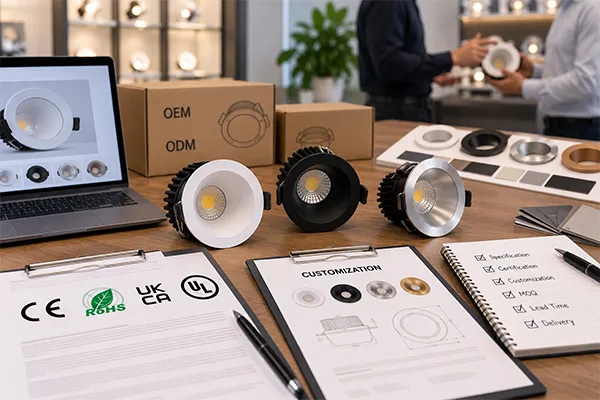
Verify Compliance Documents for the Target Market
At Upward Lighting, our products can be supplied with documents such as CE and RoHS for relevant product and market requirements. However, buyers should verify the relevance, scope, validity, product-model connection, and local acceptance of any certification or declaration before making purchasing or market-entry decisions.
Certification needs vary according to:
- Target country or region
- Product category
- Electrical configuration
- Project tender requirements
- Importer responsibilities
- Customer or retailer compliance policies
- Local regulatory interpretation
A buyer should request and review the relevant documentation with qualified compliance professionals, import specialists, testing bodies, or legal advisers when the application requires it. I do not recommend treating CE, RoHS, or any other document as a universal guarantee of market acceptance10.
Evaluate OEM and ODM Requests Realistically
OEM and ODM options can help brands and channel buyers create a more suitable range. Common requests include:
- Custom color temperature
- Wattage selection
- Beam-angle options
- CRI selection
- White, black, silver, or custom surface finish
- Private-label logo
- Customized labels and packaging
- Product manuals and carton artwork
However, not every combination is practical at every order quantity. A unique request may require new materials, artwork approval, sample validation, additional testing, production scheduling, or a higher MOQ.
| Customization request | Possible commercial consideration |
|---|---|
| Custom logo | Artwork approval and packaging MOQ |
| Special finish color | Surface treatment availability and lead time |
| [Non-standard wattage | Driver and thermal-design feasibility](https://www.energy.gov/sites/prod/files/2017/04/f34/lsrc_colorshift_apr2017.pdf)%%%FOOTNOTE_REF_11%%% |
| Custom beam angle | Optical component availability and validation |
| Higher CRI requirement | Cost and LED component availability |
| New packaging design | Artwork, carton MOQ, and proofing cycle |
| Market-specific documents | Model scope and document verification |
In recurring pre-sales conversations, we often see buyers benefit from prioritizing customization. A buyer may want five changes at once, but two changes may matter most for sales success. For example, branded packaging and a preferred color temperature may create more commercial value than a highly specific bezel variation.
Build a Supplier Evaluation Process
A supplier should be evaluated as a production and communication partner, not just as a catalog source. I recommend a structured review across several categories:
- Product fit: Does the downlight meet the intended application and installation needs?
- Specification clarity: Can the supplier provide a clear and consistent quotation?
- Quality process: What aging, inspection, and production controls are described?
- Compliance support: Can the supplier provide relevant documents for buyer verification?
- Customization capability: Which changes are feasible at the expected quantity and timeline?
- Communication: Does the supplier respond clearly to technical and commercial questions?
- Delivery planning: Can the supplier discuss lead time, packing, shipment, and reorder planning?
- After-sales process: Is there a defined approach for discussing product or project issues?
This approach supports better LED downlight investment decisions because it connects the product specification with the supplier’s ability to execute the order.
Frequently Asked Questions
What is the most important factor in LED downlight investment decisions?
The most important factor is application fit supported by clear specifications. Buyers should confirm where the downlight will be used, how it will be installed, what lighting result is needed, and which requirements are non-negotiable before comparing supplier quotations.
Are two LED downlights with the same wattage and lumen output equivalent?
No. Similar wattage and nominal lumen output do not prove equivalent performance or suitability. Beam distribution, driver design, housing construction, cutout fit, color consistency, dimming configuration, and quality controls can differ. Buyers should compare complete specifications and intended application conditions.
How should buyers evaluate an LED downlight sample?
Buyers should use samples to review appearance, installation fit, color preference, basic function, and packaging details. They should then confirm the bulk-order specification, quality-control process, aging test, inspection plan, and any acceptance criteria. Sample approval alone does not prove mass-production consistency.
Do CE and RoHS documents guarantee market acceptance?
No. CE and RoHS documentation should not be treated as universal guarantees. Buyers should verify whether documents apply to the specific model, target market, electrical configuration, and project requirement. Qualified compliance or regulatory professionals can help assess application-specific obligations.
Can OEM/ODM LED downlights be customized for small orders?
Some customization may be possible for small orders, but feasibility depends on the requested change.12 Logo printing, labels, color temperature, packaging, finish colors, wattage, and beam angles can involve different MOQs, costs, validation requirements, and lead times. Buyers should confirm these details before placing an order.
Conclusion
Strong LED downlight investment decisions begin with a clear application brief, not a search for the lowest unit price. I recommend that buyers compare complete specifications, installation fit, batch-consistency controls, compliance relevance, customization trade-offs, and supplier delivery capability. A sample remains useful, but it should form part of a wider approval process. If you are sourcing LED downlights for a project, distribution range, or private-label program, we can help you review practical specifications, OEM/ODM options, and order requirements before quotation.
"[PDF] Understanding Fixture Design Tools", https://www1.eere.energy.gov/buildings/publications/pdfs/ssl/bair_msslc-boston2012.pdf. U.S. Department of Energy guidance describes LED luminaires as systems whose light output, distribution, color quality, electrical performance, and lifetime depend on interacting optical, thermal, and electrical components; therefore, matching a few nominal specifications does not by itself establish equivalence. Evidence role: general_support; source type: government. Supports: LED luminaire performance is determined by multiple system-level factors, including optics, drivers, thermal management, and photometric distribution, rather than headline wattage alone.. Scope note: The guidance supports the general technical principle and does not compare the specific products quoted in the article. ↩
"Part 31 - Contract Cost Principles and Procedures | Acquisition.GOV", https://www.acquisition.gov/far/part-31. Public-procurement guidance on total cost of ownership recognizes that acquisition price may omit operational, administrative, logistics, quality-failure, maintenance, and replacement costs that affect the economic outcome of a purchase. Evidence role: general_support; source type: government. Supports: Total-cost-of-ownership approaches include costs beyond the acquisition price, such as logistics, administration, quality failures, maintenance, and disposal or replacement.. Scope note: The framework is general and does not quantify these costs for LED downlight procurement. ↩
"[PDF] CALiPER Application Summary Report 20: LED PAR38 Lamps", https://www1.eere.energy.gov/buildings/publications/pdfs/ssl/caliper_20_summary.pdf. Lighting-industry photometric guidance defines beam angle as the angular extent of a beam, commonly measured at a specified fraction of peak intensity, so a narrower or wider angle changes the area over which light is distributed. Evidence role: definition; source type: institution. Supports: Beam angle is a photometric measure describing the angular width of a luminaire's emitted light distribution.. Scope note: Beam angle alone does not predict illuminance or visual comfort without mounting height, spacing, intensity distribution, and surface conditions. ↩
"7+ Easy Recessed Light Layout Calculator & Guide - mabts.edu |", https://dev.mabts.edu/recessed-light-layout-calculator/. Lighting-design teaching materials generally associate concentrated beam distributions with accent or focal illumination and broader distributions with coverage of larger areas for general illumination. Evidence role: general_support; source type: education. Supports: Lighting-design references distinguish concentrated distributions used for emphasis from broader distributions used to cover larger areas.. Scope note: The appropriate beam angle still depends on fixture intensity, mounting geometry, reflectances, spacing, and the intended visual task. ↩
"[PDF] Commercial and Industrial Lighting Controls Evaluation Protocol", https://www.energy.gov/documents/53827-3pdf-1. Professional lighting guidance treats photometric calculations and coordination with applicable electrical and building requirements as relevant parts of designing and installing lighting systems, particularly where performance or code obligations are consequential. Evidence role: expert_consensus; source type: institution. Supports: Lighting design commonly uses calculations and applicable electrical or building requirements to assess illumination, safety, and installation suitability.. Scope note: Specific professional-review requirements vary by jurisdiction, building type, project scope, and applicable code. ↩
"6.2.1. What is Acceptance Sampling?", https://www.itl.nist.gov/div898/handbook/pmc/section2/pmc21.htm. Standards and statistical-quality guidance explain that acceptance sampling uses observations from a subset of units to make a decision about a lot; an approved sample therefore cannot demonstrate conformity of every unit in present or future production. Evidence role: mechanism; source type: government. Supports: Acceptance sampling estimates or controls lot quality using a sample and does not establish that every unit in a production lot conforms.. Scope note: The degree of assurance depends on the sampling plan, acceptance criteria, process capability, and whether ongoing production controls are applied. ↩
"[PDF] A methodology for testing life-cycle performance of consumer products", https://nvlpubs.nist.gov/nistpubs/Legacy/IR/nbsir76-1157.pdf. Reliability-testing literature describes burn-in and aging tests as methods for detecting or reducing early-life failures, while noting that test outcomes do not alone establish performance across all real operating environments and service conditions. Evidence role: mechanism; source type: research. Supports: Reliability and burn-in tests can screen for certain early failures, while field reliability remains affected by use conditions and failure mechanisms not fully represented by a test.. Scope note: The relevance of a particular aging test depends on its duration, electrical and thermal stress conditions, sample size, and the product's intended use. ↩
"[PDF] Color Stability of LEDs: Understanding the Basics - eere.energy.gov", https://www1.eere.energy.gov/buildings/publications/pdfs/ssl/royer_stability_lightfair2014.pdf. LED lighting guidance explains that color consistency is assessed through chromaticity tolerances and binning practices, since products with the same nominal correlated color temperature may still show perceptible color differences. Evidence role: mechanism; source type: government. Supports: LED color consistency is commonly managed through chromaticity specifications and binning because nominal correlated color temperature alone does not capture all visible color variation.. Scope note: Perceptibility depends on the chromaticity difference, viewing conditions, surrounding colors, and observer sensitivity. ↩
"EU - EU Legislation and CE Marking", https://www.trade.gov/country-commercial-guides/eu-eu-legislation-and-ce-marking. European Commission CE-marking guidance states that manufacturers must identify the EU requirements applicable to the particular product and carry out the relevant conformity assessment before affixing CE marking, so documentation cannot be assumed to cover unrelated products or markets. Evidence role: general_support; source type: government. Supports: CE marking and related conformity documentation apply only where relevant EU legislation applies and require assessment of the particular product's applicable requirements.. Scope note: CE marking is an EU conformity framework and does not by itself determine regulatory acceptance outside the EU. ↩
"EU WEEE_RoHS", https://www.trade.gov/eu-weeerohs. European Union guidance distinguishes CE marking as a conformity indication under applicable harmonised legislation and RoHS as a substance-restriction regime for in-scope electrical and electronic equipment; neither label alone establishes acceptance under every national, contractual, or project-specific requirement. Evidence role: definition; source type: government. Supports: CE marking indicates declared conformity with applicable EU harmonisation legislation, while RoHS restricts certain hazardous substances in electrical and electronic equipment within its scope.. Scope note: Additional obligations may arise from national implementation, importer duties, sector rules, tender specifications, or non-EU regulations. ↩
"[PDF] LED Luminaire Reliability: Impact of Color Shift - Department of Energy", https://www.energy.gov/sites/prod/files/2017/04/f34/lsrc_colorshift_apr2017.pdf. LED reliability research shows that drive current and thermal conditions influence junction temperature and thereby affect optical performance, electrical efficiency, and degradation, supporting the need to review driver and thermal design when rated wattage is changed. Evidence role: mechanism; source type: research. Supports: LED drive current, driver performance, and junction temperature affect LED system efficiency, light output, color behavior, and reliability.. Scope note: Whether a specific wattage change is feasible can only be determined from the particular luminaire design, components, test data, and applicable safety requirements. ↩
"Utilizing additive manufacturing and mass customization ...", https://pmc.ncbi.nlm.nih.gov/articles/PMC9813235/. Research on mass customization and production economics finds that the cost and feasibility of customization depend on the degree of product variation, process change, setup requirements, component availability, and production volume. Evidence role: general_support; source type: paper. Supports: Manufacturing customization can introduce setup, coordination, component, validation, and inventory costs that vary with the requested product change and production volume.. Scope note: Such research provides a general manufacturing principle and does not establish the MOQ or cost of any particular downlight supplier. ↩