
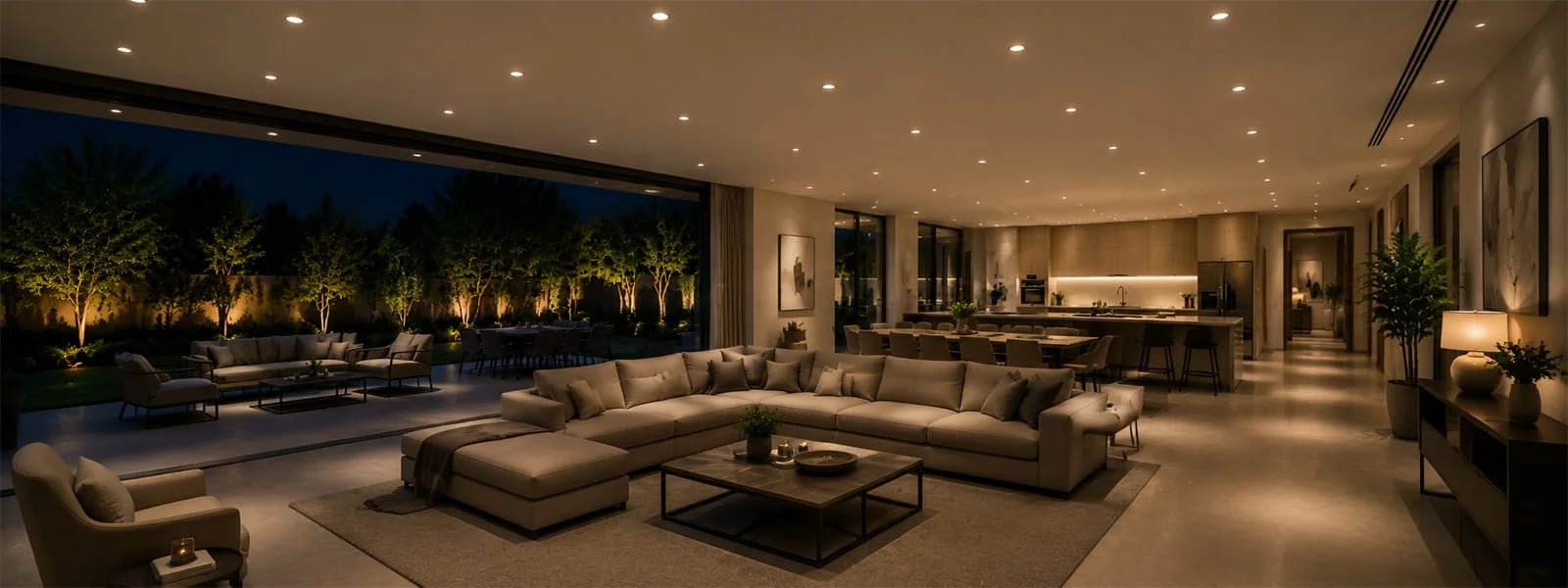
LED downlight quality can be difficult to judge before installation because many products look similar in a showroom or quotation sheet. A weak driver, poor thermal path, inconsistent optical parts, or unstable batch production can create failures and rework later. I recommend that contractors evaluate the complete product system and supplier controls—not one attractive specification.
Contractors evaluate LED downlight quality by checking whether the driver, heat dissipation, optics, housing, installation design, and production controls work together for the actual project. They should compare documented specifications, sample performance, batch consistency, quality-inspection methods, certifications, delivery capability, and replacement risk. The best choice is the downlight that fits the site, visual requirement, budget, and maintenance plan—not simply the highest-priced or highest-specification model.
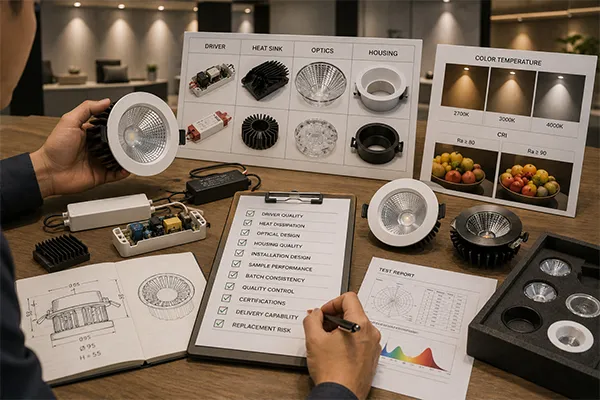
I have spoken with many contractors who start with questions about wattage, lumens, CRI, or unit price. Those questions matter, but they are only the start. The more useful procurement discussion is about what could happen after hundreds or thousands of fittings arrive on site.
Why Does LED Downlight Quality Depend on the Whole System?
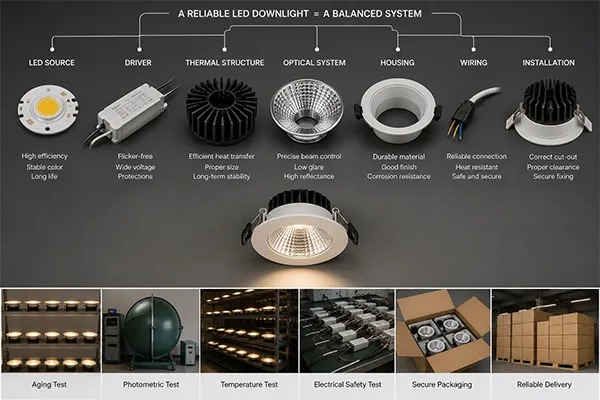
LED downlight quality becomes a project issue when a single weak component affects the entire fitting. A downlight may use a respectable LED source but still perform poorly if the driver overheats, the heat sink is undersized, or the optical assembly creates glare. Contractors need to look beyond one component claim.
A reliable LED downlight is a balanced system. Its LED source, driver, thermal structure, reflector or diffuser, housing, wiring, and installation method must be compatible. Contractors should assess how these parts work together under expected operating conditions, rather than treating lumen output, efficacy, or CRI as stand-alone proof of quality.
The driver affects stability
The LED driver converts incoming electrical power into the controlled output needed by the LEDs. Its design can influence dimming behavior, flicker characteristics, operating temperature, power factor, and long-term stability.1
I encourage contractors to ask practical questions:
- Is the driver integrated or external?
- Is the proposed driver compatible with the site voltage and frequency?
- Is dimming required, and if so, which dimming protocol will be used?
- Will the downlight be installed in enclosed ceilings, insulated spaces, or high-temperature areas?
- Can the supplier identify the driver model and provide relevant documentation?
- Is there a process for controlling driver changes between approved samples and mass production?
A driver is not automatically better because it is branded, external, or rated at a certain efficiency. The real question is whether it suits the application. For example, a simple non-dimmable downlight for a basic corridor may need a different configuration than a dimmable fitting for a hospitality lobby.
Thermal management protects the working system
Heat is a normal operating condition for LED lighting. However, excess heat can place stress on LED components, drivers, solder joints, and surrounding materials.2 Good thermal management depends on more than a heavy-looking aluminum body.
I look at the full thermal path:
- LED board design transfers heat away from the LEDs.
- Thermal interface materials connect the board to the heat sink.
- Heat sink geometry provides surface area for heat dissipation.
- Housing construction supports airflow and structural stability.
- Ceiling condition affects how much heat can escape after installation.
A sample can feel solid in the hand but still be unsuitable for a tightly enclosed ceiling void. Contractors should provide suppliers with installation details early, especially for projects with insulation, low ceiling cavities, humid areas, or long daily operating hours.
Optics and construction affect what occupants see
Reflectors, lenses, diffusers, trim rings, and anti-glare structures influence beam angle, light distribution, visual comfort, and perceived uniformity. Two downlights with similar lumen figures may create very different results on ceilings, walls, shelves, or work surfaces.3
A narrow beam can suit accent lighting. A wider beam may suit general lighting. A deep anti-glare structure may improve visual comfort in some settings, but it can also change the visual appearance and cost of the fitting. I recommend reviewing the lighting layout and mock-up area instead of selecting beam angle from a catalogue alone.
I once discussed a project where the buyer initially compared only wattage and lumen output. After reviewing the ceiling height and spacing, the contractor found that beam distribution and glare control mattered more than adding extra wattage.
Which LED Downlight Quality Specifications Matter for Each Project?
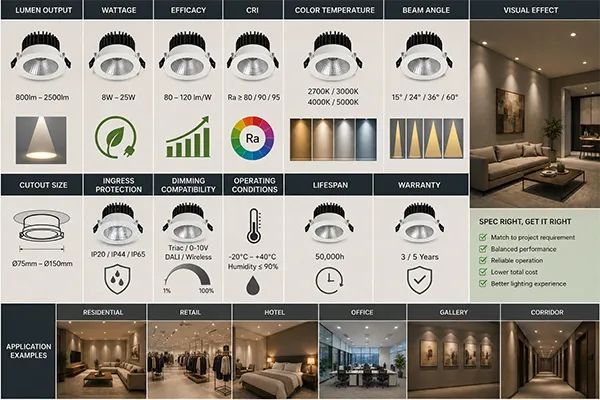
LED downlight quality cannot be reduced to the highest efficacy, highest CRI, or greatest lumen output. Contractors face problems when they select a strong-looking number without considering the task, mounting location, visual target, energy plan, and operating environment. The right specification is always application-specific.
Contractors should compare LED downlight specifications as a package: lumen output, wattage, efficacy, CRI, color temperature, beam angle, cutout size, ingress protection, dimming compatibility, and operating conditions. Each value should support the project design and documented requirements. A higher number is only useful when it solves a real project need.
Avoid using efficacy as the only shortcut
Efficacy, usually expressed in lumens per watt, can help contractors compare energy performance. However, efficacy does not describe everything that users experience after installation.
A high-efficacy product may involve trade-offs in color quality, optical control, glare management, housing design, or cost.4 Those trade-offs are not automatically negative. They simply need to be understood.
For a utility area with long operating hours, energy efficiency may be a major priority. For a retail display, restaurant, residence, gallery, or reception area, color rendering and visual comfort may carry more weight. For a renovation project, cutout compatibility and installation time may matter most.
Match CRI and color temperature to the visual task
CRI can be a useful indicator of color-rendering performance, but it should not become a universal purchasing rule.5 A high-CRI downlight may be suitable for applications where accurate color appearance is important. Yet contractors should still consider color temperature, beam control, lighting layout, surface finishes, and the client’s expected visual result.
For example:
| Project area | Typical selection priorities | Questions to confirm |
|---|---|---|
| Office corridors | Uniformity, efficiency, basic visual comfort | What is the ceiling height and operating schedule? |
| Retail displays | Color appearance, beam control, glare management | Which products or finishes must stand out? |
| Hotels and restaurants | Atmosphere, dimming, color consistency | Is dimming required throughout the space? |
| Residential projects | Appearance, cutout size, color temperature | Does the trim finish match the interior design? |
| Commercial renovations | Installation speed, cutout compatibility, supply continuity | Can the fitting match existing ceiling openings? |
Contractors should ask suppliers how color temperature and LED binning are controlled across an order. The answer should be supported by the supplier’s documented process, sample approval method, and batch-management approach.
Confirm physical and electrical compatibility
Many site delays happen because a fitting does not match the ceiling cutout, ceiling depth, wiring method, driver position, or dimming system.6 These are not minor details. They can create installation delays, ceiling damage, additional labor, and last-minute substitutions.
Before releasing a purchase order, I suggest confirming:
- Outer diameter and cutout diameter
- Recessed depth and driver dimensions
- Spring clip design and ceiling thickness range
- Input voltage and frequency
- Dimming protocol, if applicable
- IP rating required for the installation zone
- Trim color, finish, and visible appearance
- Required cable, connector, or terminal arrangement
- Packaging quantity and labeling requirements
Where a product claims CE, RoHS, IP performance, or other compliance status, I recommend that buyers request and verify the applicable documents for the exact product model and destination market. A certificate name on a brochure is not a substitute for procurement verification.7
How Do Contractors Check LED Downlight Quality Before Bulk Ordering?
LED downlight quality is often overestimated when a contractor sees one attractive illuminated sample. A sample can help evaluate light appearance and installation fit, but it cannot prove that a full production batch will match it.8 Contractors should assess both the product sample and the supplier’s repeatability.
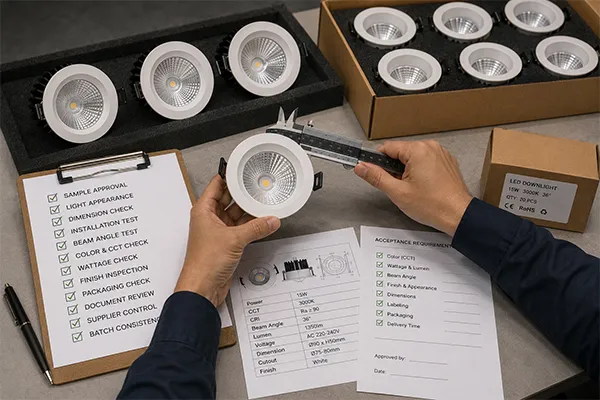
Before bulk ordering, contractors should approve samples, compare documentation, inspect key dimensions, test installation compatibility, and ask how the supplier controls batch consistency. They should also define acceptance requirements for color, wattage, beam angle, finish, labeling, packaging, and delivery. This reduces the risk that approved samples differ from delivered bulk goods.
Use samples as decision tools, not promises
A project sample is valuable because it lets contractors inspect visible quality and practical installation details. I recommend evaluating samples in conditions that resemble the final site whenever possible.
A useful sample review may include:
- Switching the fitting on and off repeatedly
- Checking visible flicker with an appropriate test method
- Reviewing beam shape on the intended ceiling and wall finishes
- Comparing color temperature beside approved materials
- Checking trim alignment and surface finish
- Measuring cutout and recessed depth
- Testing spring clips and wiring connections
- Confirming dimming behavior with the intended control system
- Reviewing packaging protection and product labeling
A sample should also be clearly identified. Contractors should record the model, wattage, color temperature, beam angle, trim color, driver arrangement, and revision date. This simple discipline makes it easier to prevent confusion if the supplier offers several similar versions.
Ask about production consistency
When I speak with project buyers, I encourage them to ask direct questions about the production process. A supplier should be able to explain how it controls incoming materials, assembly, testing, packaging, and traceability.
At Upward Lighting, we state that our products receive 100% pre-shipment inspection and an aging test lasting approximately 4 to 8 hours before shipment. I present these steps as manufacturing quality-control measures. They can help identify certain early defects before dispatch, but they do not guarantee lifetime performance or prove that zero failures will occur in field conditions.9
Contractors should ask suppliers:
- How do you identify production batches?
- What checks occur before and after assembly?
- How are drivers, LED boards, optics, and housings approved?
- What happens if a component becomes unavailable?
- Will the supplier notify the buyer before making a material substitution?
- Can the supplier retain approved samples or reference records?
- How are nonconforming goods handled before shipment?
Establish a written approval standard
The best procurement control is often a clear written specification. This does not need to be overly complicated. It should simply state what the project requires and how deviations will be handled.
| Control point | Example requirement | Project risk reduced |
|---|---|---|
| Model configuration | Approved wattage, CCT, beam angle, trim finish | Incorrect product substitution |
| Dimensional fit | Confirmed cutout and recess depth | Installation delay and ceiling rework |
| Visual appearance | Approved sample for color and trim appearance | Inconsistent ceiling appearance |
| Batch identification | Carton and product traceability labels | Difficult fault investigation |
| Packaging | Defined inner and outer carton protection | Damage during transport |
| Pre-shipment review | Agreed inspection or report process | Disputes after delivery |
For larger projects, an independent inspection provider or qualified lighting professional may be appropriate.10 The right approach depends on order value, project risk, technical complexity, and local compliance obligations.
How Does Supplier Selection Protect LED Downlight Quality on Site?
LED downlight quality can decline as a project progresses if the supplier cannot maintain specifications, respond to technical questions, or deliver replacement quantities promptly. Contractors should evaluate supplier capability because the commercial process affects installation schedules, client satisfaction, and long-term maintenance planning.
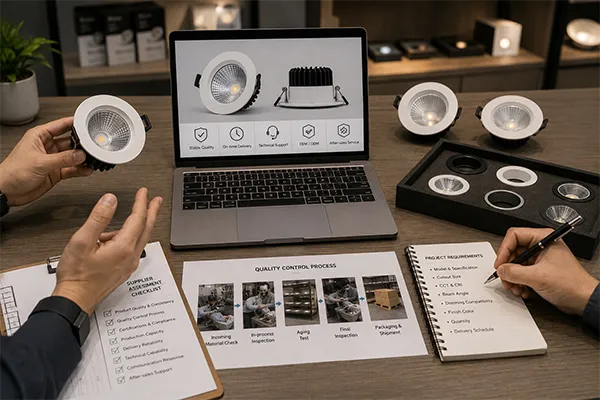
A suitable LED downlight supplier provides clear quotations, stable product information, documented quality controls, realistic delivery commitments, and responsive communication. Contractors should assess whether the supplier can support approved configurations, small replacement orders, OEM or ODM requirements, and project changes without creating avoidable inconsistency.
Compare suppliers on project risk, not only price
A low quotation can appear attractive, especially when project margins are tight. However, I believe contractors should connect each price difference to a specific project consequence.
For example, a lower-priced offer may be acceptable if it meets the required performance, documentation, installation, and supply criteria. It becomes risky when the saving depends on unclear drivers, uncontrolled substitutions, incomplete packaging, weak communication, or unreliable delivery planning.
A practical supplier comparison should include:
- Quotation clarity and configuration detail
- Response speed for technical and commercial questions
- Sample lead time and bulk production lead time
- Ability to supply the approved model consistently
- Support for customized wattage, CCT, beam angle, CRI, or finishes
- Minimum order quantity for replacement and follow-up orders
- Packaging and export experience
- Product documentation and certification verification process
- Communication process for engineering changes or component substitutions
Consider replacement and maintenance needs before installation
A contractor does not want to discover, after handover, that a matching replacement cannot be obtained.11 This is especially important for hospitality, retail, residential developments, offices, and chain-store projects where visual consistency matters.
I recommend asking suppliers whether they can support follow-up orders in the same configuration. No supplier should promise indefinite availability without qualification, because components and market conditions can change. However, a supplier should explain how it manages product revisions, component changes, and repeat-order requirements.
At Upward Lighting, I work with buyers who need OEM and ODM adjustments, including color temperature, wattage, beam angle, CRI, and surface finish. For contractors, this flexibility can be useful, but customization also increases the need for clear written approval. Every customized point should be documented before mass production begins.
The best supplier conversation is not “Can you make it cheaper?” It is “Can you deliver this approved configuration consistently, document it clearly, and support the project if a problem appears?”
Frequently Asked Questions
What is the most important factor in LED downlight quality?
No single factor defines LED downlight quality. Contractors should assess the complete system, including the driver, LED source, thermal design, optics, housing, installation compatibility, and batch consistency. The most important factor is whether the complete fitting meets the project’s actual technical and visual requirements.
Is a higher CRI always better for LED downlights?
A higher CRI can be valuable where color appearance is important, such as retail, hospitality, or display lighting. However, it is not automatically the best choice for every project. Contractors should balance CRI with efficacy, color temperature, glare control, budget, and the intended visual task.
Does a 100% aging test guarantee LED downlight reliability?
No. A 100% aging test is a manufacturing quality-control step that may identify certain early defects before shipment. It does not guarantee lifetime performance, eliminate all field failures, or replace proper product selection, installation, maintenance, and application-specific evaluation.
How should contractors evaluate LED downlight samples?
Contractors should inspect samples for dimensions, cutout fit, beam distribution, color appearance, trim finish, wiring, driver arrangement, dimming compatibility, and installation method. They should also document the approved configuration so that bulk production can be checked against the same reference.
Should contractors verify CE and RoHS documents?
Yes. Contractors, importers, and project buyers should request and verify applicable CE, RoHS, and other required documentation for the exact product model and destination market. Requirements vary by market and application, so qualified compliance and technical professionals should review project-specific obligations.12
Conclusion
LED downlight quality is a project-risk decision, not a competition for the highest lumen output, CRI, or efficacy figure. I recommend that contractors evaluate the entire downlight system, verify fit and documentation, approve samples carefully, and examine how suppliers control bulk-order consistency. These steps can reduce the risk of installation delays, visual mismatch, replacement work, and procurement disputes. If you are sourcing configurable LED downlights for a project, I invite you to share your specifications with Upward Lighting for a clear technical and quotation review.
"Flicker Research - Department of Energy", https://www.energy.gov/cmei/ssl/flicker-research. LED drivers regulate electrical power delivered to LED sources; their electrical design and compatibility can affect dimming performance, temporal light modulation, power factor, and operating reliability. Evidence role: mechanism; source type: government. Supports: That LED drivers regulate current supplied to LEDs and that driver characteristics can affect dimming operation, flicker, power quality, and system reliability.. ↩
"[PDF] Investigation of the Long-Term Aging Characteristics of Chip-On", https://www.energy.gov/sites/default/files/2021-10/ssl-rti-cob-benchmark-sept2021.pdf. Thermal-reliability research shows that elevated operating temperatures can accelerate degradation in LED packages, electronic drivers, and luminaire interconnects. Evidence role: mechanism; source type: research. Supports: That elevated junction and component temperatures accelerate degradation mechanisms in LED lighting systems, including effects on electronic drivers and interconnects.. ↩
"[PDF] Round 7 of Product Testing - Department of Energy", https://www1.eere.energy.gov/buildings/publications/pdfs/ssl/caliper_round_7_summary_final.pdf. Luminous flux measures total emitted visible light, whereas a luminaire’s photometric distribution determines how that light is directed onto surrounding surfaces and into viewers’ fields of view. Evidence role: definition; source type: education. Supports: That total luminous flux does not by itself specify the spatial distribution of light, illuminance on surfaces, or glare characteristics.. ↩
"[PDF] Top Efficacy Performers: Understanding Technology Tradeoffs", https://www.energy.gov/sites/prod/files/2018/10/f57/View%20the%20presentation%20slides.pdf. Studies of LED lighting performance describe efficacy, color rendition, optical distribution, and visual comfort as distinct design objectives that may require trade-offs in a given luminaire. Evidence role: general_support; source type: paper. Supports: That LED lighting design commonly balances efficacy against color-rendering quality and optical or visual-comfort objectives.. Scope note: The precise trade-off depends on the LED package, optic, thermal design, target application, and product cost structure. ↩
"[PDF] Impact of LED lighting on Worldwide Energy Saving and Role of ...", https://www.nist.gov/document/4ohnopdf. Color-science guidance recognizes CRI as a useful general measure of color-rendering performance but notes that it does not fully characterize color fidelity, gamut, or observer preference. Evidence role: expert_consensus; source type: institution. Supports: That the general color rendering index is an established measure but does not fully characterize all aspects of color fidelity, gamut, or preference.. Scope note: A supplementary metric does not establish which color-rendering specification is appropriate for every project or visual task. ↩
"[PDF] Energy Conservation Standards for Fluorescent Lamp Ballasts", https://www.energy.gov/eere/buildings/articles/flb-nopd. Construction-management literature identifies inadequate coordination between specified products, physical interfaces, and installation requirements as a recurring contributor to rework and schedule delay. Evidence role: general_support; source type: research. Supports: That incomplete coordination of product dimensions, interfaces, and installation requirements is a recognized source of construction rework and schedule disruption.. Scope note: This evidence is general to construction coordination and does not quantify delay rates for downlight installations specifically. ↩
"Manufacturers - Internal Market, Industry, Entrepreneurship ...", https://single-market-economy.ec.europa.eu/single-market/goods/ce-marking/manufacturers_en. European product-compliance guidance requires applicable conformity assessment and supporting documentation for CE-marked products and assigns verification duties to relevant economic operators; a marketing claim alone is not the required conformity documentation. Evidence role: general_support; source type: government. Supports: That CE-marked products require applicable conformity assessment and documentation, and that importers and distributors have verification responsibilities under EU product rules.. Scope note: The exact documents and obligations depend on the applicable EU legislation, product category, and the operator’s role in the supply chain. ↩
"What kinds of Lot Acceptance Sampling Plans (LASPs) are there?", https://www.itl.nist.gov/div898/handbook/pmc/section2/pmc22.htm. Acceptance-sampling principles distinguish examination of a sample from proof of conformity of every unit in a production lot; the confidence provided depends on the inspection plan and process controls. Evidence role: mechanism; source type: government. Supports: That product inspection based on samples provides evidence about sampled units or lots under a defined plan but does not guarantee every unit's conformity.. Scope note: The appropriate sampling plan, acceptance criteria, and inspection level must be defined for the particular product and procurement risk. ↩
"[PDF] TITLE OF ABSTRACT GOES HERE, TITLE OF ABSTRACT GOES ...", https://tsapps.nist.gov/publication/get_pdf.cfm?pub_id=935248. Reliability-engineering literature treats burn-in or screening as a means of detecting some early-life defects; such testing does not by itself demonstrate lifetime performance or eliminate all field failures. Evidence role: mechanism; source type: research. Supports: That burn-in and environmental screening are intended principally to detect some early-life defects and are not equivalent to a demonstration of field lifetime reliability.. Scope note: The defects detected and the predictive value of a burn-in test depend on its duration, load conditions, failure mechanisms, and the product design. ↩
"[PDF] construction supervision and quality assurance plan", https://openknowledge.worldbank.org/bitstreams/f08df5ed-da64-52e8-a578-0ee92d241654/download. Quality-assurance guidance recognizes independent inspection and competent specialist review as additional controls that may be used when project risk, technical complexity, or consequences of nonconformity are significant. Evidence role: general_support; source type: institution. Supports: That independent quality assurance or specialist review can provide additional oversight where project complexity, value, or risk warrants it.. Scope note: Independent inspection is not universally required; its scope and value depend on contractual requirements, local regulation, and project-specific risk. ↩
"Purchasing Energy-Efficient Commercial and Industrial LED ...", https://www.energy.gov/cmei/femp/purchasing-energy-efficient-commercial-and-industrial-led-luminaires. Lifecycle asset-management guidance treats maintainability and the availability of replacement components as relevant considerations in procurement because they affect continued operation and maintenance after handover. Evidence role: general_support; source type: government. Supports: That lifecycle procurement and asset-management practices consider maintenance, replacement parts, and continuity of service after installation.. Scope note: General asset-management guidance does not establish that an identical luminaire will remain commercially available throughout a project's service life. ↩
"CE marking", https://en.wikipedia.org/wiki/CE_marking. Official product-compliance guidance states that applicable conformity obligations depend on the relevant legislation, the product’s characteristics and intended use, and the market where it is made available. Evidence role: general_support; source type: government. Supports: That applicable product-compliance obligations are determined by the relevant legislation, product characteristics, intended use, and market in which the product is placed.. Scope note: This general principle does not replace legal, electrical, or compliance advice for a specific jurisdiction, installation, or contract. ↩