

LED downlight business opportunities can look simple from a catalog and quotation perspective, but many importers discover that low purchase prices do not always create profitable products. When product consistency, support costs, delayed deliveries, and channel expectations are overlooked, a seemingly attractive SKU can become difficult to sell. We believe the better opportunity is to build a practical, repeatable downlight range for a defined customer channel.
The best LED downlight business opportunities for importers come from selecting a channel-appropriate core SKU range, calculating landed profitability rather than unit price alone, and qualifying suppliers for consistent production. Importers should match downlight specifications, packaging, documentation, and customization options to their target market, whether they serve wholesalers, contractors, retailers, or building-material channels.
At Upward Lighting, we have seen this decision process from the manufacturer side during quotation, sampling, customization, pre-shipment inspection, aging-test, and shipment discussions. The importers who ask the best questions usually focus less on finding one “perfect” model and more on building a range that their customers can understand, reorder, and support confidently.
How Should Importers Evaluate LED Downlight Business Opportunities?
For many buyers, the initial problem is too much choice. Catalogs can contain recessed, surface-mounted, adjustable, trimless, COB, SMD, residential, and commercial downlights at many price points. This can make a low-cost offer feel like the safest starting point. However, a poorly matched product can create complaints, slow-moving stock, and costly replacement work.
Importers should evaluate LED downlight business opportunities by starting with their route to market, identifying the applications they can serve reliably, and choosing a focused SKU range that offers a credible balance of price, quality control, documentation, and repeat-order potential. The opportunity is strongest when the range fits a real channel need rather than a broad catalog gap.
Start With the Route to Market
We recommend that buyers define how they will sell before they define what they will import. A downlight suited to a contractor project may not fit an own-brand retail program. Likewise, a distributor that serves electrical installers may need a more standardized, readily available range than a buyer supplying decorative retail stores.
The main routes to market often include:
- Wholesale and distribution: Buyers often need dependable core models, competitive price bands, stable specifications, and simple reorder processes.
- Own-brand retail: Buyers may place greater value on packaging, visual consistency, product presentation, clear instructions, and differentiated finishes.
- Contractor and project supply: Buyers may need specific cutout sizes, wattages, CCTs, beam angles, drivers, and project documentation.
- Electrical and building-material channels: Buyers often need broad application coverage, practical installation features, recognizable specifications, and stable availability.
- Trading and export resupply: Buyers may prioritize flexible quantities, quick quotation support, workable consolidation options, and products that fit several destination markets.
In our own supplier communications, we often see an importer begin with a request such as, “Please send your best price for downlights.” That request is understandable, but it leaves too many commercial questions unanswered. We usually find that a better request includes the intended customer type, target retail or resale price, expected annual volume, preferred models, and destination market.
Build a Core Range Before Expanding
A core range does not need to be large. In fact, a smaller and more coherent product line can be easier to market, stock, and support. We suggest that importers begin with models that address their most frequent customer requests.
A practical initial range may include:
| Product decision | Why it matters to an importer | Questions to ask |
|---|---|---|
| Cutout size1 | Determines installation compatibility and replacement demand | Which existing ceiling cutouts are common in our market? |
| Wattage | Affects product positioning and perceived application fit | Do we need entry, mid-range, and higher-output options? |
| CCT | Influences customer preference and application suitability | Is 3000K, 4000K, 6500K, or switchable CCT most relevant? |
| Beam angle | Affects light distribution and end-user expectations | Is the product for general lighting, display lighting, or accent lighting? |
| Driver format | Affects installation, serviceability, and product configuration | Does our channel prefer external, integrated, dimmable, or isolated drivers? |
| Finish color | Supports interior design and brand positioning | Are white, black, silver, or custom finishes commercially justified? |
| Packaging | Supports retail presentation and damage control | Will products be sold individually, in contractor packs, or in bulk cartons? |
We do not view every variation as a necessary SKU. Each option should have a sales reason. A new finish, for example, may make sense for a design-focused retail range. It may add unnecessary inventory complexity for a price-sensitive wholesale program.
Why Is Landed Profitability More Important Than Unit Price?
The most common purchasing pressure in lighting is unit price. Importers need competitive buying terms, and we understand why. Still, the lowest ex-works or FOB price does not automatically produce the strongest commercial result. A cheap downlight can become expensive if it drives replacements, extra customer service work, unsellable stock, or disputes with channel partners.
Landed profitability measures the commercial value of an LED downlight after product cost, freight, duties, packaging, quality-control effort, warranty exposure, sales support, and inventory risk are considered.2 Importers should compare offers using the likely total cost of selling and supporting the product, not only the price per unit shown on a quotation.
Look Beyond the Quoted Unit Price
We encourage buyers to review cost in layers. The first layer is the quoted product price. The later layers are often where the real commercial difference appears.
A simple landed profitability review can include:
-
Product purchase price
This is the supplier’s quoted price at the agreed trade term. Buyers should confirm what is included, such as driver, accessory, label, inner box, master carton, and standard packaging. -
Freight and logistics cost
Carton size, carton strength, product protection, shipment method, and consolidation requirements can affect logistics cost. An unusually bulky package can reduce container utilization.3 -
Import and compliance-related costs
Duties, local testing, labeling, documentation, recycling obligations, and other destination-market requirements can vary.4 We recommend that buyers verify current requirements with qualified local professionals or relevant authorities. -
Inspection and quality-control cost
Third-party inspection, incoming checks, sample approval, and pre-shipment verification require time and budget. These activities can reduce risk when they are planned early. -
After-sales and replacement exposure
A product that is difficult to install, poorly packaged, or inconsistent between batches can create claims. The commercial cost may include replacement units, shipping, labor discussions, and reduced customer confidence. -
Inventory and slow-moving stock risk
Too many small variations can lock capital into items that customers do not reorder.5 Stock complexity can also create picking errors and confusing sales support.
Compare Offers on a Like-for-Like Basis
We have seen quotations that appear comparable until the details are reviewed. One downlight may include a specified driver configuration and reinforced packaging, while another price may be based on a different driver, lower specification, or a less complete accessory set.
When we prepare a quotation, we think it is useful for buyers to request a clear comparison sheet. This does not mean that every supplier must offer the same design. It means that the importer can understand the basis of each offer.
A low price is useful only when the product specification, packaging level, inspection approach, and support expectations are equally clear.
A practical comparison table may look like this:
| Evaluation point | Supplier A | Supplier B | Buyer decision note |
|---|---|---|---|
| Unit price | Lower | Higher | Confirm whether specifications are identical |
| Housing material | To verify | To verify | Request sample and specification details |
| Driver type | To verify | To verify | Confirm driver configuration and labeling |
| Aging test process | To verify | To verify | Ask for process details and records where available |
| Packaging | Basic | Reinforced | Review transport and retail needs |
| MOQ | Higher | Lower | Consider inventory risk and cash flow |
| Custom branding | Available | Available | Link decision to sales strategy |
| Documentation | To verify | To verify | Verify relevance to destination market |
At Upward Lighting, we conduct a 100% aging test of 4 to 8 hours before shipment as part of our stated production process. Buyers should still define their own acceptance criteria, inspection method, and documentation needs. A factory process can be helpful, but it does not replace an importer’s responsibility to evaluate the product for the intended market and application.
Which LED Downlight Specifications Affect Sellability and Support Risk?
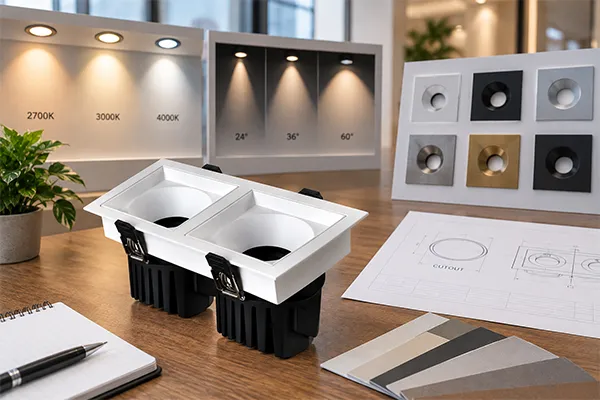
Importers can treat LED downlights as commodities only until their customers begin asking installation and performance questions. In practice, details such as cutout size, color temperature, beam angle, trim finish, and driver type influence whether a product fits the job. These details also influence whether a reseller can confidently recommend it.
The LED downlight specifications that most affect sellability and support risk are cutout dimensions, wattage, color temperature, beam angle, driver configuration, dimming compatibility, finish, installation method, and batch consistency. Importers should standardize the specifications that matter most to their channel before placing repeat orders.
Cutout Size Is a Commercial Specification
A downlight’s cutout size can determine whether it is useful for replacement work, renovation, or new construction. If an installer arrives on site and finds that the cutout does not match, the product may be rejected even if its appearance and price are otherwise acceptable.
Importers should ask:
- What ceiling cutout sizes are commonly used in our target market?
- Do our customers often replace halogen or older LED downlights?
- Can one model cover a useful cutout range, if that feature is genuinely needed?
- Are cutout dimensions consistently stated on product labels, cartons, manuals, and sales materials?
- Will the spring clips and installation method suit typical ceiling materials?
We recommend that buyers measure samples rather than relying only on catalog drawings. A sample review should include the actual opening requirement, visible trim size, driver dimensions, cable arrangement, and spring-clip behavior.
CCT, CRI, and Beam Angle Affect Product Positioning6
Color temperature is not just a technical field on a specification sheet. It is a visible product decision. Warm white may suit residential or hospitality-oriented applications, while neutral or cool white may be requested in commercial, utility, or regional markets. The correct choice depends on customer preference, application, and local buying habits.
Color rendering index, commonly called CRI, can also affect product positioning. Buyers may specify a CRI level to align with their product segment, but they should request relevant technical documentation and evaluate samples where appropriate. We recommend avoiding marketing claims that cannot be supported by the supplier’s product documentation and quality process.
Beam angle matters because customers may expect different light distribution from general downlighting, retail displays, corridors, or accent applications. A narrow beam can create a focused effect. A wider beam can support broader general illumination.7 Neither option is universally better.
Driver and Batch Consistency Need Attention
The driver is a major part of the product system.8 Buyers should clarify whether the driver is integrated or external, isolated or non-isolated where relevant, dimmable or non-dimmable, and compatible with the intended installation environment. Application-specific electrical decisions should be reviewed by qualified professionals.
Batch consistency is equally important. An importer may approve one sample, then face problems if later orders differ in finish, color appearance, packaging, labels, or component configuration without clear communication.
We encourage buyers to formalize:
- Approved sample reference
- Product drawings and specification sheet
- Label artwork and carton marks
- Permitted tolerances where applicable
- Packaging requirements
- Inspection requirements
- Change-notification expectations
- Reorder reference or internal SKU code
This simple discipline helps protect the importer’s product line and reduces confusion between sales, purchasing, warehouse, and supplier teams.
When Does OEM/ODM Add Value to an LED Downlight Range?
Customization can sound attractive because it helps a buyer create a different product. However, customization also increases decisions, approval time, tooling considerations, minimum order requirements, and inventory complexity. Without a clear sales rationale, a customized downlight can become harder to manage than a well-selected standard model.
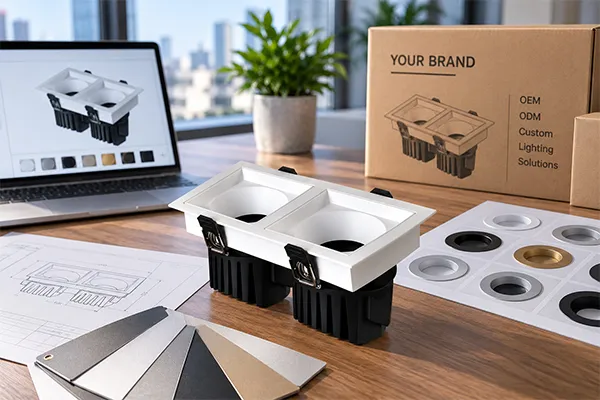
OEM/ODM adds value to an LED downlight range when it supports a defined channel strategy, such as own-brand packaging, a required cutout size, a preferred CCT range, a differentiated finish, or a project-specific specification. Importers should use customization to solve a commercial need, not simply to make a product look different.
Useful Customization Starts With a Customer Need
At Upward Lighting, we provide OEM/ODM support for items such as color temperature, wattage, beam angle, CRI, and surface finish colors. We also discuss packaging and branding requirements with customers. However, we believe each customization request should connect to a channel plan.
For example, customization may be commercially useful when:
- An own-brand retailer needs branded inner boxes, barcode labels, product manuals, and a consistent visual identity.
- A contractor-focused buyer repeatedly receives requests for a particular cutout size or wattage.
- A distributor needs black and white finish options because both are established demand points in its market.
- A buyer wants a simplified CCT selection that matches its sales team’s product training and stocking plan.
- A project customer requires a defined beam angle and trim appearance for a specific tender or installation concept.
- A lighting brand wants to create a coherent family across downlights, track lights, and linear office lighting.
Customization may be less useful when the buyer has no clear customer segment, no estimated sales volume, or no plan for packaging and inventory management. In those cases, a standard product can be the more responsible starting point.
Review MOQ, Sampling, and Change Control
Customization usually involves a sequence of approvals. The buyer should expect to discuss artwork, color samples, product specifications, packaging, order quantities, and lead-time expectations. The details depend on the product and requested change.
We recommend a staged approach:
-
Define the sales purpose
Identify the target customer, intended selling price, product segment, and expected order pattern. -
Confirm the technical baseline
Agree on the downlight model, cutout, wattage, CCT, beam angle, driver configuration, finish, and packaging. -
Request a formal quotation
Confirm trade terms, MOQ, sample charges where applicable, tooling implications, packaging details, and estimated production timing. -
Approve samples carefully
Review physical appearance, dimensions, labels, packaging, installation details, and documentation. Buyers should involve qualified technical reviewers when the application requires it. -
Document approved requirements
Keep an approved sample record, drawings, artwork files, and purchase-order requirements. -
Set pre-shipment expectations
Define inspection timing, acceptable quality levels where applicable, carton marking, shipment marks, and document requirements.
We have found that early clarification is usually faster than resolving mismatched expectations after production begins. Rapid quotations are useful, but a quotation should still be based on enough detail to support an informed buying decision.
How Can Importers Assess LED Downlight Suppliers Before Ordering?
A supplier may have a large catalog, attractive prices, and certificates available for review. Those factors can be relevant, but they do not tell the full story. Importers need to understand how the supplier communicates, controls production, handles samples, documents specifications, and prepares shipments.
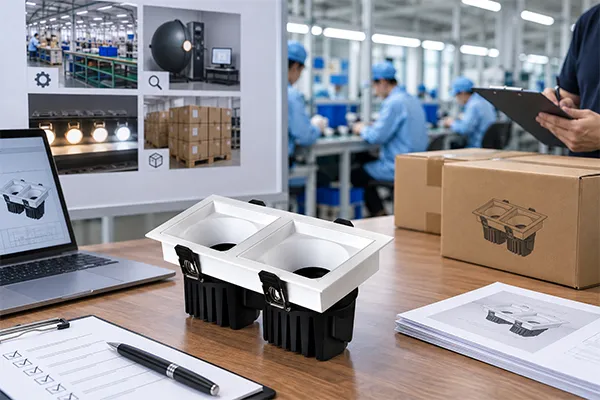
Importers can assess LED downlight suppliers by reviewing product samples, specification clarity, quality-control processes, communication responsiveness, production capability, customization discipline, packaging standards, and documentation relevant to the destination market. Certificates should be verified as documents, not treated as automatic proof of suitability for every market or application.9
Ask Questions That Reveal Process Quality
In our experience, buyer questions during sampling and quotation often reveal the maturity of the purchasing process. The following questions can help an importer evaluate a potential supplier more effectively:
- Can the supplier provide a clear specification sheet for the quoted model?
- Can the supplier identify the product’s cutout, wattage, CCT, beam angle, finish, and driver arrangement?
- What happens during production and pre-shipment quality checks?
- Does the supplier have an aging-test process, and what does it cover?
- Can the supplier support small-batch orders, if the buyer needs to test a range first?
- How are approved samples, carton artwork, labels, and specification changes controlled?
- Can the supplier provide relevant CE, RoHS, or other documentation for review?
- Does the supplier explain what the documents cover and what buyers must verify locally?
- How quickly and clearly does the supplier answer technical and commercial questions?
- How are packing lists, commercial invoices, carton marks, and shipment preparation handled?
At Upward Lighting, we work with global buyers across markets including the Middle East, Europe, Asia-Pacific, and the Americas. We recognize that different markets and channels have different requirements. For that reason, we encourage buyers to verify market-entry rules, product labeling requirements, electrical requirements, and certification relevance with qualified professionals in their own destination market.
Use Sampling as a Commercial Test
A sample is more than a visual approval item. We suggest that importers use samples to review the complete buying experience.
A useful sample evaluation can include:
| Area | What to review |
|---|---|
| Product appearance | Finish consistency, trim quality, visible construction, branding |
| Dimensions | Cutout size, outer diameter, height, driver dimensions |
| Installation | Spring clips, cable length, connector arrangement, instructions |
| Product information | Model number, wattage, CCT, labels, carton information |
| Packaging | Protection, inner box quality, master carton strength, barcode needs |
| Documentation | Specification sheet, test-related documents, declaration materials where relevant |
| Supplier communication | Accuracy, response time, willingness to clarify changes |
| Reorder readiness | SKU control, sample reference, quotation consistency |
A buyer should not assume that a sample alone proves long-term performance or destination-market compliance. However, sampling can help identify practical concerns before a larger order is placed. For project-specific, regulated, or technically complex applications, we recommend involving qualified engineers, testing bodies, or local compliance specialists as appropriate.
Frequently Asked Questions
Are LED downlights a good product category for importers?
LED downlights can be a viable category when an importer has a defined customer channel, realistic product positioning, and a supplier that can support consistent specifications. We do not consider them a guaranteed high-margin category. Commercial results depend on competition, landed cost, stock management, support requirements, and local demand.
What LED downlight SKUs should an importer start with?
We suggest starting with a focused range based on common local applications. Many buyers begin with a few practical cutout sizes, selected wattages, common CCT options, and standard white finishes. The final SKU plan should reflect the importer’s route to market, customer requests, and stocking capacity.
Should importers choose the cheapest LED downlight supplier?
We do not recommend choosing solely on the lowest quoted price. Buyers should compare product specifications, driver configuration, packaging, sample quality, supplier communication, quality-control processes, MOQ, and documentation. A lower unit price may not be the lowest total commercial cost after logistics, claims, and inventory risks are considered.
Is OEM/ODM customization necessary for an LED downlight brand?
OEM/ODM is not always necessary. It becomes useful when it supports a clear product-line strategy, such as branded packaging, a required finish, a specific CCT range, or a differentiated specification for a known customer segment. Standard models may be more suitable for initial market testing.
Do CE and RoHS documents guarantee market acceptance?10
No. CE and RoHS documents may be relevant to certain product and market requirements, but they do not automatically guarantee acceptance in every destination country, application, or sales channel. Importers should verify applicable regulations, test requirements, labeling rules, and documentation with qualified local professionals.
Conclusion
The most practical LED downlight business opportunities do not come from chasing the lowest possible unit price. We believe they come from building a focused core range that fits a specific channel, supports consistent repeat orders, and protects the importer from avoidable after-sales exposure. Buyers should review landed profitability, critical specifications, sample quality, supplier processes, and the real purpose of any customization. At Upward Lighting, we support importers, distributors, brands, and project buyers with OEM/ODM discussions, small-batch options, quotations, aging-tested production, and export preparation. Contact us to discuss a downlight range built around your market and purchasing goals.
"Tenmat FF135 Insulation Compatible Recessed Light Cover", https://reframedarchives.sandbox.library.columbia.edu/listing/tenmat-ff135-insulation-compatible-recessed-light-cover?srsltid=213660156. Technical guidance for recessed luminaires specifies a ceiling cutout or aperture dimension as part of installation, supporting the conclusion that a mismatch between the fixture and existing opening can prevent straightforward replacement or installation. Evidence role: mechanism; source type: institution. Supports: That recessed luminaires are installed in ceiling openings with specified dimensions, making cutout size a basic compatibility requirement.. Scope note: A specified cutout dimension alone does not establish compatibility with ceiling construction, clearance, wiring, or local electrical-code requirements. ↩
"Determine Total Export Price - International Trade Administration", https://www.trade.gov/determine-total-export-price. Government trade guidance defines landed cost as the aggregate cost of bringing imported goods to their destination, including the purchase price and applicable transport, insurance, customs, duty, and handling charges; seller-specific warranty and inventory costs require separate commercial estimation. Evidence role: definition; source type: government. Supports: That import landed cost includes the purchase price together with transport, customs duties, taxes, insurance, and other costs incurred in bringing goods to their destination.. Scope note: Official landed-cost definitions may not include every downstream cost, such as warranty claims or sales support. ↩
"Packing List - International Trade Administration", https://www.trade.gov/packing-list. Logistics research treats vehicle and container utilization as a determinant of transport efficiency, because larger package volume reduces the number of saleable units accommodated within fixed container capacity. Evidence role: mechanism; source type: research. Supports: That package volume affects the number of units that can be loaded into a freight container and therefore affects transport efficiency.. Scope note: The cost effect depends on freight rates, shipment mode, product weight, and the extent to which volume rather than weight constrains the shipment. ↩
"Import Regulations - International Trade Administration", https://www.trade.gov/import-regulations. World Trade Organization materials on technical barriers to trade recognize that product regulations, standards, testing procedures, and labeling requirements can differ among markets, while customs duties are determined by the importing jurisdiction's tariff regime. Evidence role: general_support; source type: institution. Supports: That governments may impose differing tariffs and technical requirements, including testing, labeling, and documentation, on imported goods.. Scope note: This general framework does not identify the current obligations for a particular LED product, tariff classification, or destination country. ↩
"Understanding the Dynamics of Value-Driven Variety Management", https://sloanreview.mit.edu/article/understanding-the-dynamics-of-valuedriven-variety-management/. Operations-management research finds that product variety can increase forecasting and inventory complexity because demand is fragmented across more stock-keeping units, potentially increasing inventory investment when replenishment and service levels are maintained. Evidence role: mechanism; source type: paper. Supports: That greater product variety can increase inventory-management complexity and inventory requirements when demand is distributed across more items.. Scope note: The magnitude of the effect depends on demand patterns, pooling opportunities, replenishment lead times, and the firm's inventory policy. ↩
"[PDF] CALiPER Application Summary Report 20: LED PAR38 Lamps", https://www1.eere.energy.gov/buildings/publications/pdfs/ssl/caliper_20_summary.pdf. U.S. energy and measurement authorities describe correlated color temperature as the apparent warmth or coolness of light, color rendering as the faithfulness of color appearance under a source, and beam angle as a descriptor of directional light distribution. Evidence role: definition; source type: government. Supports: The technical meanings of correlated color temperature, color rendering index, and beam angle in lighting.. Scope note: These technical measures inform product selection but do not by themselves determine customer preference or commercial positioning. ↩
"[PDF] CALiPER Application Summary Report 20: LED PAR38 Lamps", https://www1.eere.energy.gov/buildings/publications/pdfs/ssl/caliper_20_summary.pdf. Lighting-engineering educational materials explain that beam angle characterizes the angular spread of emitted light: narrower distributions concentrate luminous intensity on a smaller area, whereas wider distributions cover a larger area at a given mounting distance. Evidence role: mechanism; source type: education. Supports: That beam angle describes the angular spread of a luminaire's light and that narrower distributions concentrate illumination relative to wider distributions.. Scope note: Actual illumination also depends on mounting height, spacing, luminaire photometry, reflectances, and the surrounding space. ↩
"[PDF] LED Dimming: What you need to know - eere.energy.gov", https://www1.eere.energy.gov/buildings/publications/pdfs/ssl/dimming_webcast_12-10-2012.pdf. U.S. Department of Energy lighting materials describe LED drivers as power supplies that regulate the electrical current or voltage delivered to LED packages, making driver design relevant to the operation of an LED luminaire. Evidence role: mechanism; source type: government. Supports: That LED drivers provide regulated electrical power or current required for LED operation.. Scope note: The source establishes the driver's functional importance but does not prove that any particular driver configuration is suitable for a given installation. ↩
"CE marking – obtaining the certificate, EU requirements - Your Europe", https://europa.eu/youreurope/business/product-rules-compliance/general-product-compliance/ce-marking/index_en.htm. European Commission guidance states that CE marking and the EU declaration of conformity relate to compliance with applicable Union harmonisation legislation; the relevant legal requirements depend on the product and the legislation that applies to it. Evidence role: expert_consensus; source type: government. Supports: That conformity documentation must correspond to applicable product legislation and that responsible economic operators must assess compliance with relevant requirements.. Scope note: CE-marking guidance addresses the EU framework and does not determine requirements in non-EU destination markets. ↩
"CE marking – obtaining the certificate, EU requirements - Your Europe", https://europa.eu/youreurope/business/product-rules-compliance/general-product-compliance/ce-marking/index_en.htm. European Union guidance identifies CE marking as a declaration of conformity under applicable EU product legislation, while the RoHS framework concerns restrictions on certain hazardous substances in electrical and electronic equipment; neither framework functions as a universal approval for all jurisdictions or end uses. Evidence role: historical_context; source type: government. Supports: That CE marking is an EU conformity marking under applicable harmonised legislation and that RoHS restricts specified hazardous substances in electrical and electronic equipment.. Scope note: Market-access obligations may include additional national rules, product-specific legislation, labeling, importer duties, and sectoral requirements. ↩