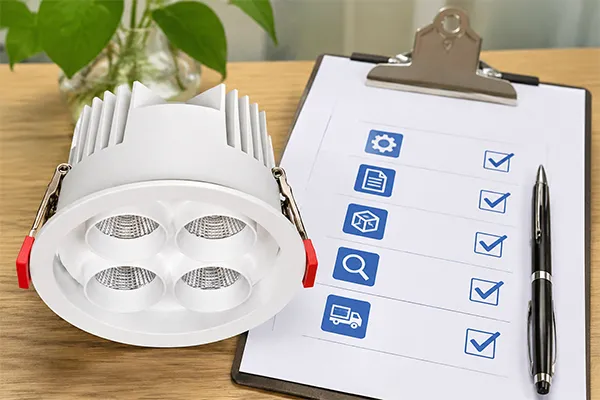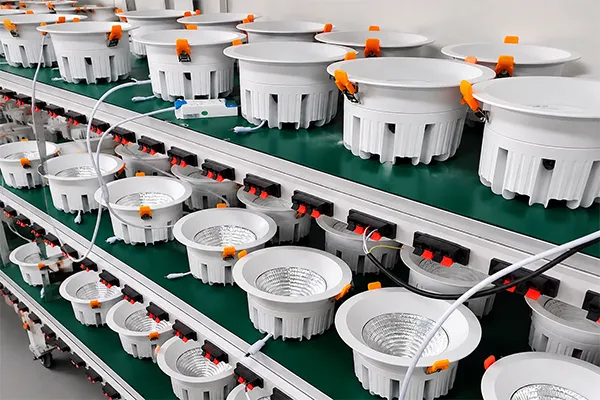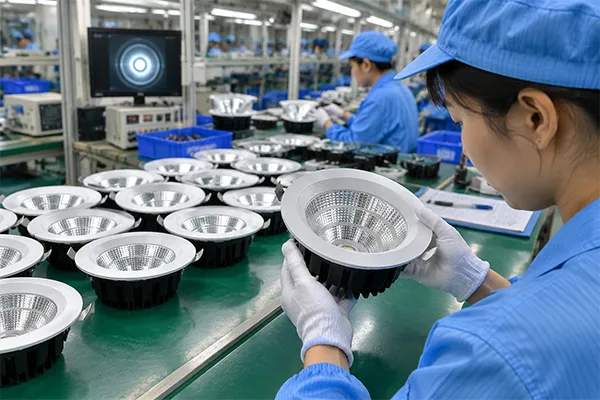

An LED downlight factory can look convincing online while still being a poor fit for your order. Buyers often face unclear quotations, mismatched certificates, and promises that do not connect to the requested model. I recommend a practical verification process that tests whether the supplier can support your real product, market, quality, and delivery needs.
To verify an LED downlight factory before cooperation, buyers should cross-check company information, product specifications, compliance documents, samples, quality-control procedures, quotations, factory access, and communication. The goal is not to prove that a supplier is “good” in general. The goal is to confirm that the supplier can responsibly deliver your specific LED downlight order under agreed technical, commercial, and delivery conditions.
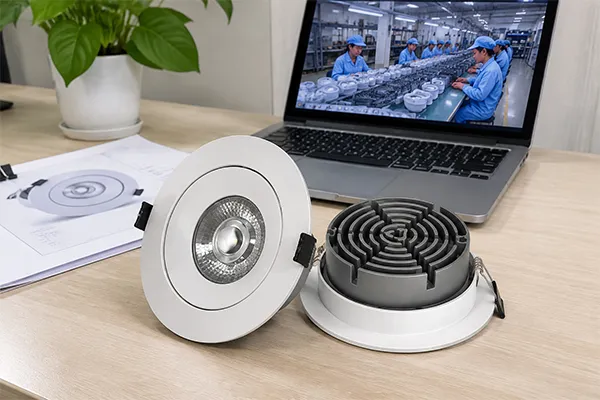
A useful supplier review does not depend on one impressive factory video or a low unit price. In my pre-sales communication with overseas lighting buyers, I have found that the best questions connect every piece of evidence to the same downlight model and cooperation scenario.
Why Should Buyers Verify an LED Downlight Factory Against Their Actual Order?
Many buyers start with a broad question: “Are you a real factory?” That question is understandable, but it does not fully address the commercial risk. A supplier may have production capability for one product line while lacking the process, components, documentation, or delivery planning needed for your requested recessed downlight.1
Buyers should verify an LED downlight factory against the exact cooperation scenario: stock purchase, small trial order, OEM development, project supply, or recurring distribution. Each scenario requires different evidence.2 A supplier’s business documents and factory presentation may be useful, but buyers should also confirm that the requested model, customization, order quantity, quality checks, packaging, and delivery responsibilities are clearly aligned.
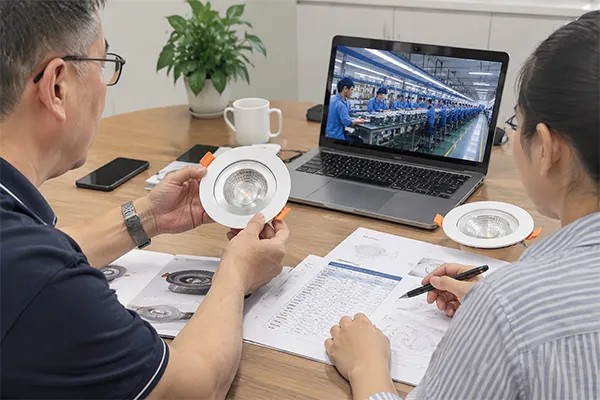
Start With the Cooperation Scenario
I usually encourage buyers to define the order before they begin comparing suppliers. This step prevents vague discussions and makes quotations more meaningful.
For example, a standard order for a 10W recessed LED downlight may require only confirmation of available color temperature, cutout size, packaging, and lead time. However, an OEM order may involve a custom bezel color, private label, different driver requirements, higher CRI, specific beam angle, or market-specific documentation.
The required verification evidence changes with the project.
| Cooperation scenario | What buyers should verify first | Typical follow-up evidence |
|---|---|---|
| Standard product purchase | Model, wattage, dimensions, color temperature, packaging | Product specification sheet, sample, quotation |
| Small trial order | Minimum order quantity, consistency, payment and shipping arrangements | Sample approval record, order confirmation |
| OEM/ODM development | Customization limits, tooling needs, artwork approval, component changes | Drawings, approved sample, written specifications |
| Contractor or project supply | Application requirements, schedule, batch consistency, technical support | Project quotation, test plan, delivery plan |
| Distribution program | Product range stability, repeat-order process, packaging, branding options | Product catalog, price framework, quality process discussion |
Check Whether the Supplier Asks Useful Questions
A reliable conversation should not begin and end with “We are factory direct.” I believe a supplier’s questions often reveal more than its slogans.
Before I prepare a detailed downlight quotation, I normally need to understand points such as:
- Target market: Where will the products be sold or installed?
- Application: Residential, retail, hospitality, office, or another setting?
- Product configuration: Wattage, diameter, cutout, color temperature, beam angle, CRI, IP rating, and dimming requirement.
- Order quantity: Is the buyer testing 100 pieces, purchasing for a project, or planning recurring orders?
- Customization needs: Does the buyer need branding, finish color, special packaging, or modified technical parameters?
- Compliance expectations: Which documents does the buyer need to review for the target market?
- Delivery expectations: Does the buyer need an urgent shipment, a fixed project date, or a flexible replenishment plan?
These questions do not guarantee successful cooperation.3 However, they show whether the supplier is trying to understand responsibility rather than simply issue a quick price.
A supplier should be able to explain what it can confirm now, what requires a sample or engineering review, and what depends on the final order specification.
In my experience, buyers should be cautious when a supplier confirms every request immediately without asking for market, quantity, or technical details. Fast communication is valuable, but unsupported confirmation can create problems later.
How Can Buyers Cross-Check an LED Downlight Factory’s Documents and Certifications?
Documents can help buyers identify a supplier and review product-related compliance information. Yet a business license, certificate image, test report, or product catalog does not independently prove that a specific LED downlight will be produced consistently for a future order.4 Buyers need to check relevance, validity, and connection to the quoted item.
Buyers should cross-check an LED downlight factory’s documents by matching the legal company name, product model, technical parameters, market requirements, and document scope. Certificates should be treated as documents to verify, not as automatic proof of product quality, shipment readiness, or ongoing compliance. When requirements are application-specific, buyers should seek qualified professional advice.
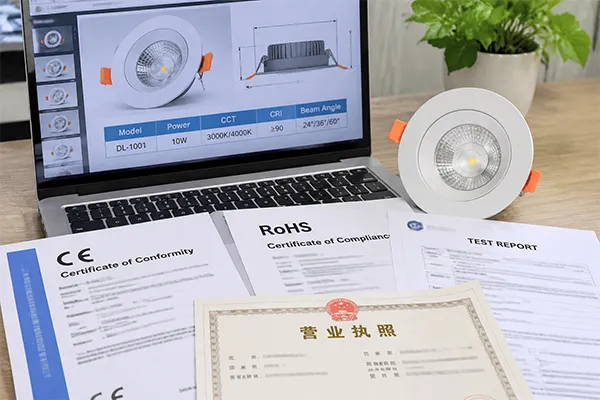
Review Documents as a Connected Set
I recommend that buyers compare several sources instead of accepting a single PDF or website claim. The basic purpose is consistency.
A buyer can ask for:
- Company information that identifies the contracting entity.
- Product specification sheet for the proposed LED downlight.
- Relevant product-related compliance documents for review.
- Quotation that names the model or describes the agreed configuration.
- Sample label or packaging information, where available.
- Factory or production presentation that shows the supplier’s operating environment.
- Written order confirmation before mass production begins.
At Upward Lighting, we can provide product-related information and explain the documents available for the products under discussion. Our products hold certifications such as CE and RoHS5, which buyers may review in relation to their market-entry and procurement requirements. However, I would not advise any buyer to assume that a certificate image alone covers every model, destination, application, modification, or commercial responsibility.6
Questions to Ask About Certificates and Reports
Buyers can make the document review more useful with direct questions:
- Which exact product model does this document cover?
- Does the wattage, driver, CCT, housing, and other configuration match the quotation?
- Who is named on the document?
- What is the issue date, and is there a stated validity period?
- Does the report apply to the target market and intended application?
- Will customization affect the document’s relevance?
- Can the supplier explain the difference between a product declaration, a test report, and a certificate?
I suggest that buyers retain copies of final documents with the approved product specification. This creates a clearer procurement record. It also reduces the risk that a sales conversation, an old catalog model, and a production order drift apart.
Use Third Parties Where They Add Value
Third-party inspections, testing organizations, sourcing agents, and local compliance advisers can all support the review process. I do not see them as substitutes for supplier communication. Instead, they provide an additional layer of evidence.
A third party can inspect a defined batch or assess a documented checklist. Still, the buyer must decide what the checklist should cover. If the purchase order does not define the downlight’s key requirements, even a careful inspection may not resolve ambiguity.
What Should Buyers Test Through Samples, Factory Visits, and Quality Control?
A sample gives buyers a physical reference point, while a factory visit or remote tour can show parts of the operation and communication process. These are valuable tools, but neither one can guarantee that every mass-produced unit will match expectations.7 Buyers need a documented bridge from the sample to production and shipment.
Buyers should use samples, factory visits, remote audits, and quality-control discussions to verify how an LED downlight factory converts an approved specification into repeatable production. The key questions are what sample was approved, what production standard will be followed, what checks will occur, how nonconforming products are handled, and who confirms release before shipment.
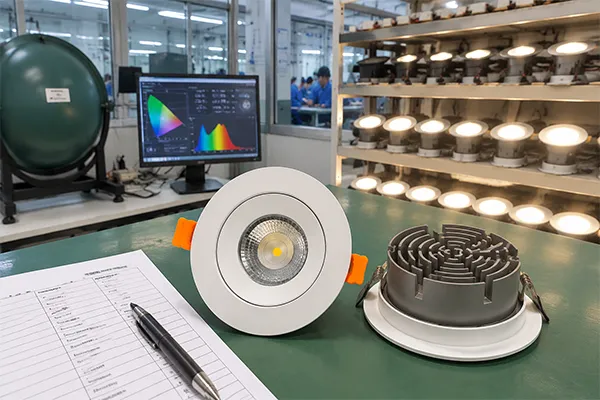
Evaluate the Sample Beyond Appearance
A downlight sample should be reviewed against the buyer’s real use case, not only against a photograph. The buyer may assess visible finish, dimensions, trim appearance, installation fit, light output characteristics, color consistency, driver behavior, and packaging.
For a project or branded product, I recommend creating a concise sample approval list. It can include:
- Product model and revision
- Wattage and input requirement
- Color temperature and CRI request
- Beam angle
- Cutout size and outer diameter
- Housing finish
- Driver and dimming requirement, if applicable
- Packaging and labeling
- Required documentation
- Approved sample date
- Any deviations accepted by the buyer
This record helps both sides identify the reference standard. Without it, the phrase “same as sample” can become unclear when the buyer later requests a different wattage, finish, driver, or package.
Ask How the Aging Test Fits the Process
At Upward Lighting, we arrange a 100% aging test before shipment, generally lasting 4 to 8 hours, as part of our internal pre-shipment process. I present this as a practical quality-control arrangement, not as a universal standard or absolute guarantee of future performance.
Buyers should ask any supplier clear questions about its process:
- Is aging performed on every unit or on a sampling basis?
- What is the stated duration for the proposed model?
- At which production stage does aging occur?
- What happens if a unit fails during the process?
- How are reworked products identified and checked?
- Is there a final appearance, function, labeling, and packaging inspection?
- Can the supplier share the QC checkpoints relevant to the order?
An aging test can identify certain early issues.8 However, it does not replace appropriate product design, component selection, production control, transport protection, installation practice, or application-specific evaluation.
Use Visits and Video Calls to Ask Better Questions
An onsite visit can be useful, especially for large programs or strategic supplier selection. A remote factory tour may also be practical when travel is difficult. During either format, I recommend asking the supplier to show relevant areas rather than relying on a general walk-through.
For example, buyers may request a view of:
- Incoming material handling
- Assembly stations relevant to the product
- Aging or burn-in arrangements
- Inspection points
- Packaging area
- Sample storage or approved-reference process
- Warehouse identification and shipment preparation
A remote tour has limits. The supplier controls the camera, timing, and areas shown.9 An onsite visit also has limits because it captures only a moment in time. A structured checklist and a follow-up sample or inspection plan make either method more useful.
How Should Buyers Compare LED Downlight Factory Quotations and Communication?
A low quotation can be attractive, particularly when buyers face price pressure from competitive lighting markets. However, a price comparison is valid only when each supplier quotes the same configuration and commercial scope.10 I have seen many discussions become difficult because two “10W downlights” were not actually equivalent products.
Buyers should compare LED downlight factory quotations only after confirming equivalent specifications, quality expectations, packaging, customization, documentation, trade terms, and delivery scope. Clear communication is also a verification tool: suppliers should identify assumptions, ask for missing details, and explain what is included instead of relying on vague factory-direct claims.
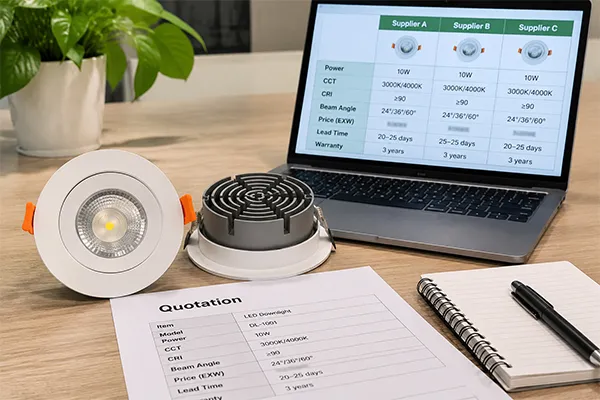
Normalize the Quotation Before Comparing Prices
I recommend that buyers use a quotation comparison sheet. This approach makes hidden differences easier to spot and gives internal purchasing teams a clearer basis for supplier selection.
| Comparison point | Questions for buyers to ask |
|---|---|
| Product model | Is the quoted item the same design, size, and cutout? |
| Electrical configuration | Are wattage, driver type, input range, and dimming options the same? |
| Light quality | Are CCT, CRI, beam angle, and stated lumen expectations comparable? |
| Material and finish | Are housing material, trim color, diffuser, and surface treatment aligned? |
| Quality process | Is aging included? What final inspection is described? |
| Packaging | Are inner boxes, master cartons, labels, and branding included? |
| Compliance documents | What product-related documents are available for the quoted configuration? |
| Quantity | Does the price apply to the same order volume and mix? |
| Trade terms | Are freight, duties, local delivery, and insurance included or excluded? |
| Lead time | When does the production timeline begin, and what assumptions apply? |
The lowest price may reflect a different driver, lower specification, simpler packaging, a different order quantity, or excluded services.11 That does not automatically make the supplier unsuitable. It means the buyer should understand what is being compared.
Treat Communication as Evidence of Process Discipline
I believe buyers should pay close attention to how a supplier responds when requirements change. Does the supplier update the quote? Does it explain cost or lead-time impact? Does it ask the buyer to reconfirm the revision? These habits matter because LED downlight orders often involve multiple variables.
For example, a buyer may begin with a standard 3000K model and later request 4000K, custom white trim, branded packaging, and a different dimming driver. Each change may affect materials, production planning, pricing, documentation, or minimum order quantity.
At Upward Lighting, we support specification-based quotations, small-batch discussion, OEM/ODM customization, and delivery coordination where feasible. I would still encourage buyers to request written confirmation of each agreed point. A fast quotation is helpful, but a complete quotation is more useful for stable cooperation.
Frequently Asked Questions
How do I know whether an LED downlight factory is suitable for my market?
I recommend that buyers first define the target market, product application, required technical configuration, and documentation needs. Then, buyers should ask whether the supplier can provide product-specific information for that configuration. A general catalog or certificate image is not enough to confirm suitability for every market or application.
Is a video factory tour enough to verify an LED downlight supplier?
A video tour can be useful evidence, especially when travel is not possible. However, it should complement samples, documents, specifications, quotations, and quality-process discussions. Buyers should use a checklist and ask to see areas related to the specific LED downlight model, such as assembly, aging, inspection, and packaging.
Should buyers always choose a direct LED downlight factory instead of a trader?
Not necessarily. A capable trader or sourcing agent may add value through local communication, product consolidation, inspection coordination, or logistics support.12 Buyers should verify the same core issues: product ownership, technical responsibility, documentation, quality control, pricing transparency, and delivery accountability.
What should be included in an LED downlight sample approval?
A sample approval should identify the model, wattage, CCT, CRI, beam angle, dimensions, cutout size, finish, driver, packaging, labels, and accepted deviations. Buyers should also record the sample date and link the approved specification to the production order. This reduces confusion between a trial sample and mass-production requirements.
Does a 100% aging test guarantee LED downlight performance?
No. A 100% aging test can be a useful pre-shipment quality-control step, but it does not guarantee all future performance outcomes. Buyers should also review product specifications, application conditions, production controls, packaging, installation requirements, and any needed third-party testing or professional evaluation.
Conclusion
Verifying an LED downlight factory is not about finding the largest building, the lowest quotation, or the most impressive certificate file. I recommend that buyers test alignment: the company, product model, sample, quality process, documents, quotation, and delivery plan should all support the same order requirement. If you are evaluating a standard downlight purchase, OEM/ODM program, small batch, or recurring supply arrangement, contact Upward Lighting to discuss your required specifications and request a clear, product-based quotation.
"Supplier Scouting", https://www.nist.gov/mep/supply-chain/supplier-scouting. Quality-management guidance treats supplier evaluation as an assessment of the supplier's ability to provide products and services meeting specified requirements, rather than as proof based solely on general manufacturing activity. Evidence role: general_support; source type: institution. Supports: Supplier evaluation should assess a supplier's ability to meet specified requirements rather than infer suitability from general business capability.. Scope note: This supports the procurement principle generally; it does not determine whether any particular downlight supplier can fulfill a particular order. ↩
"Managing risks in the public procurement of goods, services and ...", https://www.oecd.org/content/dam/oecd/en/publications/reports/2023/06/managing-risks-in-the-public-procurement-of-goods-services-and-infrastructure_b0d29f96/45667d2f-en.pdf. Risk-based supplier-management guidance recognizes that evaluation and control activities should be proportionate to the product, service, and risks involved in the purchasing arrangement. Evidence role: general_support; source type: institution. Supports: Supplier evaluation criteria may be selected according to purchasing risks, product requirements, and the nature of the supplied product or service.. Scope note: The guidance is not a prescriptive checklist for LED-downlight transactions. ↩
"CONTRACT MONITORING GUIDE", https://tsu.edu/about/administration/finance/departments/procurement-services/pdf/contract-monitoring-vendor-performance-guide.pdf. Public-procurement guidance distinguishes supplier due diligence before award from contract-management activities needed to monitor delivery and performance after award. Evidence role: general_support; source type: government. Supports: Pre-award supplier due diligence is distinct from ongoing contract management and does not eliminate the need to monitor performance.. Scope note: This supports the distinction between assessment and assurance; it does not quantify the likelihood of cooperation succeeding. ↩
"THE ABC's OF THE U.S. CONFORMITY ASSESSMENT ...", https://nvlpubs.nist.gov/nistpubs/Legacy/IR/nistir6014.pdf. Quality-management frameworks distinguish documented conformity information from the operational controls, monitoring, and corrective actions used to support consistent production. Evidence role: general_support; source type: institution. Supports: Documentation and test evidence are only part of conformity assurance; controlled production and monitoring are also needed to support consistent output.. Scope note: This is a general quality-management principle and does not establish that any individual document is inaccurate or that a particular supplier lacks control. ↩
"RoHS", https://en.wikipedia.org/wiki/RoHS. Under EU product rules, CE marking requires the manufacturer to establish conformity through the applicable assessment procedures and EU declaration of conformity; RoHS sets substance-restriction requirements for electrical and electronic equipment within its scope. Evidence role: definition; source type: government. Supports: CE marking is supported by an EU declaration of conformity and technical documentation, while RoHS restricts specified hazardous substances in electrical and electronic equipment within its scope.. Scope note: Official EU guidance explains the meaning and documentation of CE marking and RoHS but cannot verify this company's claimed compliance for any specific model. ↩
"A guide to EU standards and conformity assessment", https://www.govinfo.gov/content/pkg/GOVPUB-C13-07a06d81c863b5241d6249891a51fb90/pdf/GOVPUB-C13-07a06d81c863b5241d6249891a51fb90.pdf. EU product-compliance guidance explains that conformity assessment is tied to the product and applicable legislation, and that substantial modifications can create new conformity-assessment responsibilities. Evidence role: mechanism; source type: government. Supports: Conformity assessment and technical documentation apply to defined products and may need reassessment when a product is substantially modified or when different applicable rules apply.. Scope note: The guidance concerns EU regulatory compliance and does not determine the scope or validity of a particular certificate image. ↩
"Manufacturing", https://www.nist.gov/manufacturing. Manufacturing-quality literature describes process variation and shows why observations of samples or individual production conditions are not, by themselves, proof of conformance for all future units. Evidence role: mechanism; source type: research. Supports: Manufacturing processes exhibit variation, and a sample assessment or point-in-time observation cannot by itself establish conformance of every future production unit.. Scope note: The principle is general; the degree of variation depends on the particular product, process controls, and inspection plan. ↩
"Burn-in", https://en.wikipedia.org/wiki/Burn-in. Reliability literature describes burn-in as a screening process that can precipitate or reveal certain early-life electronic failures before field use. Evidence role: mechanism; source type: paper. Supports: Burn-in or aging is used as a reliability-screening method intended to expose some early-life failures in electronic products.. Scope note: Burn-in effectiveness depends on stress conditions and failure mechanisms and does not demonstrate a product's full service life or eliminate all future failures. ↩
"Managing Remote Work Quality: Evidence from Auditing ...", https://www.hbs.edu/faculty/Pages/item.aspx?num=64315. Research on remote auditing identifies constraints on observation and evidence collection when auditors rely on remotely provided video, documents, and access arrangements. Evidence role: general_support; source type: paper. Supports: Remote audits can constrain direct observation, access to evidence, and assessment of site conditions compared with onsite audits.. Scope note: The extent of these limitations varies with the audit design, technology, independence of the reviewer, and supplier cooperation. ↩
"MCC Procurement Guidance Note: Price-Reasonableness ...", https://www.mcc.gov/resources/doc/guidance-price-reasonableness/. Procurement guidance provides that bid evaluation should compare offers on a common basis, taking account of the specified requirements and applicable commercial terms rather than unit price alone. Evidence role: general_support; source type: government. Supports: Price evaluation requires comparison of bids on a common basis that accounts for specifications, scope, and relevant costs or terms.. Scope note: Such guidance does not prescribe the exact commercial comparison sheet needed for a specific lighting purchase. ↩
"Subpart 15.4 - Contract Pricing", https://www.acquisition.gov/far/subpart-15.4. Procurement evaluation guidance recognizes that price differences may reflect differing technical requirements, quantities, delivery conditions, and included lifecycle or ancillary services. Evidence role: mechanism; source type: government. Supports: Differences in specifications, quantities, delivery terms, and included services can affect quoted prices and must be considered in comparative evaluation.. Scope note: This establishes why quotations require normalization; it does not identify the reason for any particular supplier's lower price. ↩
"UN Trade and Development", https://en.wikipedia.org/wiki/UN_Trade_and_Development. International trade guidance describes intermediaries as entities that may coordinate transactions, consolidate goods, facilitate communication, and arrange quality-control or logistics services between buyers and producers. Evidence role: general_support; source type: institution. Supports: Trade intermediaries can perform market-access, coordination, consolidation, quality-control, and logistics functions between buyers and producers.. Scope note: The availability and quality of these services vary by intermediary and do not establish that a particular trader is competent or accountable. ↩