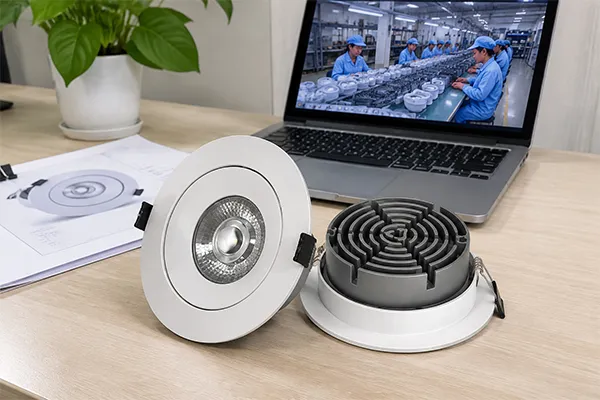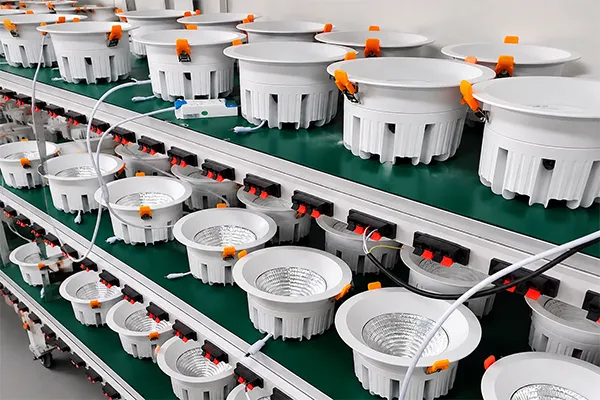

An LED downlight manufacturer can look reliable on a quotation, a product page, or even a sample shipment, yet importers still face risks when specifications, documents, and production details are unclear. I have seen buyers lose time comparing incomplete offers. I recommend using a structured evaluation process before price becomes the deciding factor.
An importer should evaluate an LED downlight manufacturer by comparing complete product configurations, verifying factory workflows and compliance documents, approving samples with controlled specifications, and checking production quality before shipment. I believe the strongest supplier choice is the one that can repeatedly deliver the agreed model, quality level, documents, packaging, and lead time at commercial scale—not simply the lowest quote or the best-looking sample.
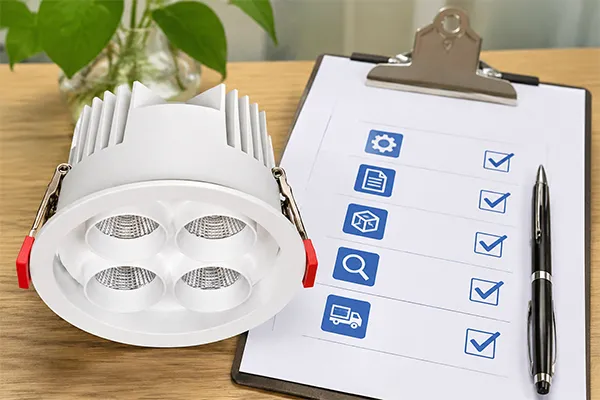
I work with importers, contractors, private-label brands, and channel partners who often ask the same question: “How do I know whether this supplier can deliver consistently?” I find that the answer rarely comes from one document, video call, or factory visit. It comes from verifying evidence at each stage of the sourcing process.
How Should I Compare LED Downlight Manufacturer Quotations?
A low quotation can attract immediate attention, especially when buyers are under pressure to hit a target retail price or project budget. However, I have often found that two prices cannot be meaningfully compared when the quoted downlights have different drivers, LED chips, finishes, certifications, packaging, or warranty terms1.
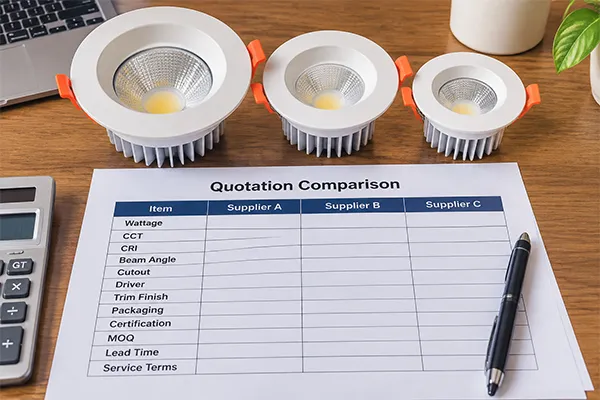
I recommend that importers compare LED downlight manufacturer quotations only after every supplier has quoted the same technical and commercial configuration. A comparable quote should state the wattage, CCT, CRI, beam angle, cutout, driver type, trim finish, packaging, certification scope, MOQ, lead time, and service terms. Price becomes useful only when these variables are clear.
Build a Like-for-Like Product Specification
In my experience, buyers sometimes send only a photo and a target price. I understand why this happens. A buyer may be testing the market quickly or building an initial supplier list. Still, a photo does not define the real product.
For example, two 12W recessed LED downlights may look almost identical from the front. Yet the internal and commercial details can be very different:
- One model may use a separate driver, while another uses an integrated driver.
- One model may offer CRI 802, while another offers CRI 90.
- One version may use a standard fixed output, while another may support dimming.
- One product may have a die-cast aluminum body, while another may use a thinner material construction.
- One quotation may include neutral export cartons, while another may include printed private-label boxes.
- One price may include a 3-year warranty, while another may be based on different service assumptions.
I recommend creating a quotation comparison sheet before negotiating. Buyers can use a format like the following.
| Evaluation Item | Supplier A | Supplier B | Buyer Verification Question |
|---|---|---|---|
| Model number | Does the model match the requested design? | ||
| Wattage | Is the stated wattage actual input power? | ||
| CCT | Is 2700K, 3000K, 4000K, or another option required? | ||
| CRI | Is CRI 80 sufficient, or does the project require CRI 90? | ||
| Beam angle | Does the beam suit the ceiling height and application? | ||
| Driver | Is the driver dimmable, isolated, or specified by brand? | ||
| Trim color | Is white, black, gold, or another finish required? | ||
| Certification scope | Does the document cover the exact model and target market? | ||
| MOQ | Does the MOQ apply per model, CCT, color, or carton? | ||
| Lead time | Does it start after deposit, sample approval, or artwork approval? | ||
| Packaging | Is private-label packaging included or extra? |
Look Beyond the Unit Price
I do not treat a low price as evidence of poor quality. Some suppliers may have better material purchasing, efficient production, or a product range that closely matches the buyer’s needs. However, I do recommend that buyers ask what the price includes.
A practical quote review should clarify:
- Product basis: exact model, cutout size, wattage, color temperature, and trim finish.
- Electrical configuration: input voltage, driver type, dimming option, and power factor where relevant3.
- Optical requirements: lumen output, CRI, beam angle, diffuser type, and color consistency expectations.
- Commercial terms: Incoterms, payment terms, sample charges, tooling charges, and validity period.
- Service scope: artwork support, customization, spare parts, warranty handling, and after-sales communication.
- Order conditions: MOQ by SKU, production lead time, packaging requirements, and inspection arrangements.
I have found that a clear quotation often prevents more sourcing problems than a long negotiation. It gives both sides a written starting point for sample approval and production confirmation.
What Should I Verify Before Choosing an LED Downlight Manufacturer?
Many buyers start by asking, “Are you a factory?” I understand the purpose of the question, but I do not think a simple yes-or-no answer is enough. I recommend that buyers verify how a supplier converts a quotation into a repeatable order process.
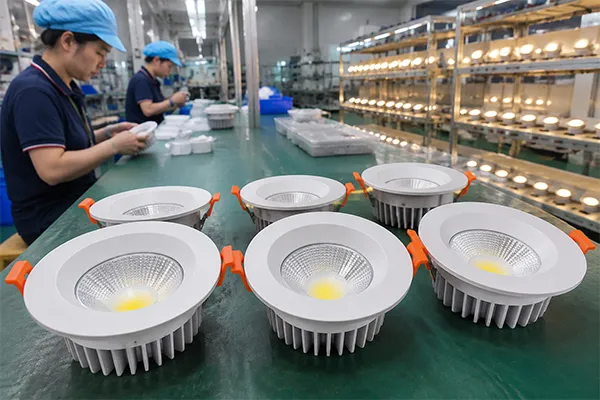
I believe importers should verify an LED downlight manufacturer through cross-checkable evidence of its quotation, sampling, production, quality-control, aging-test, packing, and shipment workflow. A factory claim, factory video, or online meeting can be useful, but none of these alone proves that the supplier can repeatedly manage the buyer’s specific order requirements.
Ask for Workflow Evidence, Not Just Marketing Materials
A supplier’s product catalog can help with initial screening. A factory video can also show equipment, assembly areas, warehouses, or test stations. However, I encourage buyers to ask operational questions that reveal how the supplier actually manages orders.
For example, I would ask:
- How is the approved quotation transferred to the production team?
- Who confirms changes to wattage, CCT, trim color, or packaging?
- Is there a signed or written sample approval record?
- How are incoming materials checked?
- At what point are electrical and appearance inspections performed?
- How are defective products identified and separated?
- How does the supplier record aging-test results, if aging is part of its internal process?
- Who confirms carton markings and shipping marks before loading?
- How does the supplier handle a quality claim after delivery?
At Upward Lighting, I see these topics arise regularly in importer conversations. Our team coordinates specifications from quotation through sample confirmation, production, aging, packing, and shipment documentation. We conduct a 100% aging test lasting approximately 4 to 8 hours before shipment4 as part of our internal process. However, I would not present this internal process as laboratory-grade proof or as a substitute for independent inspection. I recommend that buyers verify relevant procedures according to their own quality plan and project risk level.
Evaluate Communication as a Supply-Chain Capability
I believe supplier communication is part of manufacturing capability. A technically capable factory can still create problems if it responds slowly, does not clarify open points, or changes details without written confirmation.
During the early evaluation stage, I watch for several practical signals:
| Signal | Why It Matters to Importers |
|---|---|
| Fast but accurate quotation | It suggests the supplier can organize product data and commercial terms. |
| Questions about missing specifications | It may indicate that the supplier is trying to avoid assumptions. |
| Clear sample lead time | It helps buyers plan launch dates or project schedules. |
| Written confirmation of changes | It reduces confusion between sales, engineering, production, and buyers. |
| Transparent discussion of MOQ | It helps brands manage stock and cash flow. |
| Realistic production timing | It reduces the risk of missed shipment expectations. |
I have learned that a supplier should not simply agree with every request. I value a supplier that explains where a customization may affect tooling, MOQ, lead time, performance, or certification scope. That conversation can feel slower at first, but I believe it often prevents costly misunderstandings later.
Consider Third-Party Verification Where Appropriate
I recommend a staged approach rather than assuming every supplier needs the same audit level. A first small trial order may require different controls than a large retail rollout or a regulated project installation.
Buyers may consider:
- A video audit with a prepared question list
- A third-party factory audit
- Pre-production sample review
- During-production inspection for larger orders
- Pre-shipment inspection based on an agreed AQL plan5
- Product testing through an appropriately qualified laboratory when required
I encourage buyers to select verification activities based on order value, product application, destination market, and risk tolerance.
How Can I Use Samples to Evaluate LED Downlight Quality?
A sample can provide useful evidence about appearance, installation, light output, trim quality, packaging, and basic functionality. Yet I have also seen buyers assume that one approved sample automatically guarantees mass-production consistency6. I do not recommend that assumption.
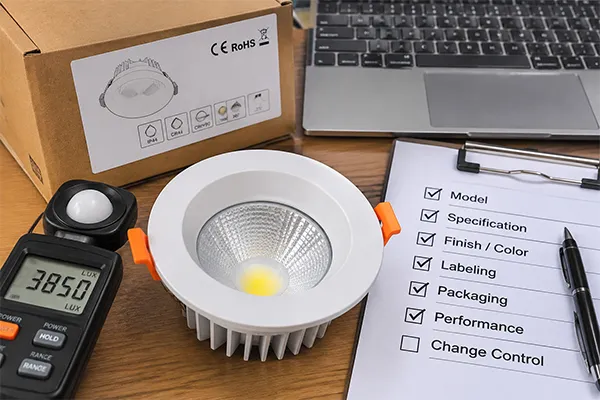
I treat an LED downlight sample as the starting point for supplier evaluation, not final proof of mass-production reliability. Importers should use the sample stage to lock the approved model, specifications, finish, labeling, packaging, performance expectations, and change-control process before placing a production order.
Turn the Sample Into an Approval Standard
I recommend that buyers document exactly what they approve. A verbal statement such as “sample is okay” can be too vague when the order includes multiple wattages, CCTs, colors, or branded cartons.
A sample approval record can include:
- Product model number
- Physical sample photo from multiple angles
- Wattage and input-voltage requirement
- CCT and CRI target
- Beam angle
- Cutout size and external dimensions
- Trim color and surface treatment
- Driver specification and dimming requirement
- Cable, connector, or terminal requirement
- Product label layout
- Carton artwork and shipping marks
- Instruction manual language
- Approved performance tolerances
- Agreed warranty and claim-handling terms
I recommend retaining one approved “golden sample” where practical. The buyer and supplier can each keep an identified reference sample. This does not eliminate quality risk, but it gives both parties a physical reference when questions arise.
Test the Sample for Its Intended Application
I always encourage buyers to test samples under realistic conditions. A downlight that looks good on a desk may perform differently after installation in a high ceiling, humid bathroom, hotel corridor, retail display, or residential kitchen.
For application-specific evaluation, buyers may wish to examine:
- Color appearance: Does the CCT match the design intent?
- Color rendering: Does the stated CRI suit merchandise, finishes, food, or interior materials?
- Glare control: Is the reflector, baffle, or diffuser suitable for the viewing angle?
- Cutout fit: Does the installation opening match the project ceiling plan?
- Heat behavior7: Does the product operate acceptably in the intended ceiling environment?
- Dimming behavior8: Does the downlight work with the proposed dimmer and electrical system?
- Visual finish: Does the trim color match the ceiling and interior design?
- Packaging protection: Does the carton protect the unit during transport and warehouse handling?
I recommend qualified technical evaluation when the product will be used in safety-sensitive, regulated, architectural, or unusual operating conditions. A manufacturer can provide product information, but the buyer, installer, consultant, or project engineer should evaluate application suitability.
Control Changes After Sample Approval
One recurring issue in sourcing is the unrecorded change. It may be a different driver, LED source, carton material, label design, or trim finish. Not every change is negative, but every material change should be reviewed.
I recommend that buyers establish a simple change-control expectation:
I ask suppliers to notify me in writing before changing any approved component, material, process, label, packaging detail, or specification that may affect compliance, performance, appearance, installation, or customer acceptance.
For private-label downlights, this discipline matters even more. Your customer sees your brand on the product and package. I believe that sample approval and change control are essential tools for protecting that brand.
How Do I Verify LED Downlight Certifications and Pre-Shipment Quality?
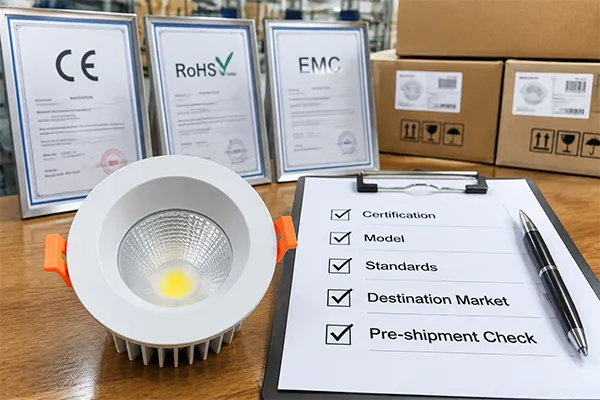
Certification images can be useful screening documents, but I do not consider an image alone sufficient evidence that the exact downlight model is appropriate for a specific destination. Market requirements vary, and certificate scope can vary as well9.
I recommend that importers verify LED downlight manufacturer compliance documents at the product-and-market level. Buyers should check the issuing body, document validity, model correspondence, applicable standards, and destination-market requirements, then arrange pre-shipment verification against the approved specification and packaging requirements.
Check Document Scope Carefully
At Upward Lighting, our products have documents such as CE and RoHS certificates10 for applicable product ranges. However, I always recommend that customers verify whether available documents apply to the exact model, variation, and intended market. I do not believe any certificate should be assumed to cover every version, every customization, or every country automatically.
Buyers should review:
| Compliance Check | What I Recommend Verifying |
|---|---|
| Manufacturer name | Does the company name match the supplier or product documentation? |
| Model number | Does the model on the document match the proposed downlight? |
| Product variation | Does the document cover the required wattage, driver, and configuration? |
| Standard reference | Is the stated standard relevant to the target market and product type? |
| Issuing organization | Can the document be checked with the issuing body where necessary? |
| Date and validity | Is the document current, and does it state any limitations? |
| Labeling requirements | Does the product label meet the target market’s requirements? |
| Destination requirements | Does the importing country require additional testing, registration, or marks? |
I recommend that buyers consult qualified compliance professionals, certification bodies, testing laboratories, or local authorities when regulations are unclear. This is particularly important for public projects, retail programs, and markets with specific electrical-safety requirements.
Use a Pre-Shipment Checklist
Pre-shipment verification should compare finished goods against the approved product and documents. I have seen buyers gain confidence when the inspection scope is agreed before production rather than discussed only after goods are packed.
A practical pre-shipment LED downlight checklist can include:
- Quantity verification: Confirm the order quantity by model, wattage, CCT, and finish.
- Appearance inspection: Check trim color, scratches, dents, lens condition, and assembly consistency.
- Label verification: Check model number, electrical ratings, branding, barcodes, and required markings.
- Function testing: Confirm power-on performance, dimming behavior if applicable, and basic electrical operation.
- Packaging inspection: Check inner boxes, master cartons, protective materials, artwork, and shipping marks.
- Carton drop or handling review11: Confirm that packaging appears appropriate for planned logistics conditions.
- Documentation review: Confirm packing list, invoice, carton details, and compliance documents requested by the buyer.
- Aging-test evidence: Review internal records if available, while recognizing that internal records should be independently assessed where required.
I recommend that buyers define acceptance criteria before inspection. If the buyer uses a third-party inspection company, the inspection agency should receive the approved sample details, specification sheet, and packaging artwork in advance.
Manage Issues With Evidence and Speed
Even strong preparation cannot remove every supply-chain issue. I believe a dependable long-term supplier relationship is partly defined by how both sides handle problems.
When an issue occurs, I recommend that buyers provide:
- Clear photos and videos
- Product model and batch information
- Quantity affected
- Description of the fault
- Installation or operating conditions
- Packaging condition on arrival
- Requested resolution and timeline
I find that detailed evidence helps a manufacturer investigate more efficiently. It also creates a factual record for deciding whether the issue relates to production, transport, installation, product selection, or another cause.
Frequently Asked Questions
What is the most important factor when choosing an LED downlight manufacturer?
I believe the most important factor is repeatability. A supplier should be able to deliver the same approved specification, documentation, packaging, quality standard, and lead time across production orders12. I recommend evaluating price, samples, compliance, communication, and quality control together rather than using one factor alone.
Should I choose the lowest LED downlight quotation?
I do not recommend choosing only by the lowest quotation. A lower price may reflect a different driver, CRI, housing, packaging, certification scope, or service level. I suggest comparing quotations only after each supplier confirms the same complete product and commercial specification.
Does a CE or RoHS certificate guarantee that I can import LED downlights into my market?
I would not assume that it does. Buyers should verify that the document applies to the exact model and configuration, then confirm destination-market requirements. CE and RoHS documents may be relevant, but market-specific compliance obligations can require additional checks.
Is one approved sample enough before placing a bulk order?
I do not consider one sample enough by itself. An approved sample is valuable, but buyers should also confirm labeling, packaging, production specifications, change-control expectations, and inspection requirements. I recommend keeping written approval records and, where practical, arranging pre-shipment inspection.
How long should LED downlights be aged before shipment?
Aging-test practices vary by supplier and product. At Upward Lighting, we conduct a 100% aging test of approximately 4 to 8 hours before shipment as part of our internal quality process. I recommend that buyers ask suppliers to explain their procedures and verify them independently if their project requires it.
Conclusion
I believe a dependable LED downlight manufacturer should be evaluated through evidence, not assumptions. Importers should first make quotations comparable, then verify production workflows, use samples to establish approved standards, review compliance documents carefully, and inspect finished goods before shipment. I have found that this staged approach helps buyers reduce avoidable quality, documentation, and delivery risks. If you are sourcing LED downlights for a project, private label, or distribution program, I invite you to send us your specifications so we can prepare a clear, comparable quotation and sample plan.
"MCC Procurement Guidance Note: Price-Reasonableness ...", https://www.mcc.gov/resources/doc/guidance-price-reasonableness/. Public-procurement guidance describes bid comparison as requiring common specifications and stated evaluation criteria, because prices for materially different deliverables or contractual terms are not directly comparable. Evidence role: general_support; source type: government. Supports: Procurement guidance should support comparing offers against common specifications and evaluation criteria rather than comparing prices for materially different goods or terms.. Scope note: Such guidance is generally written for formal procurement and may not prescribe procedures for every private import transaction. ↩
"Color rendering index", https://en.wikipedia.org/wiki/Color_rendering_index. The general color rendering index (CRI) is a standardized metric for describing how faithfully a light source renders specified test colors relative to an appropriate reference illuminant. Evidence role: definition; source type: institution. Supports: An authoritative lighting source should define the general color rendering index and explain that it characterizes how a light source renders test-color samples relative to a reference illuminant.. Scope note: CRI alone does not fully predict perceived color quality or suitability for every application. ↩
"Reducing Power Factor Cost", https://www.energy.gov/sites/prod/files/2014/04/f15/mc60405.pdf. Power factor expresses the ratio of real power to apparent power in an AC circuit and is commonly specified for lighting equipment because it affects the current drawn for a given real-power load. Evidence role: definition; source type: government. Supports: A technical authority should support that power factor expresses the relationship between real and apparent power and is a relevant performance parameter for connected lighting equipment.. Scope note: The required or desirable power factor depends on local rules, installation scale, and the electrical-system context. ↩
"Burn-In - Integration and Test > Thermal Testing - S3VI - NASA", https://s3vi.ndc.nasa.gov/ssri-kb/topics/47/. Reliability studies describe burn-in testing as a method intended to expose some early-life failures before field use; the method's effectiveness depends on the test conditions, duration, failure mechanisms, and quality controls used. Evidence role: mechanism; source type: paper. Supports: Reliability literature should support that burn-in or early-life testing may be used to screen some early failures in electronic and LED products.. Scope note: This evidence does not independently confirm the stated 100% coverage, four-to-eight-hour duration, records, or effectiveness of Upward Lighting's internal process. ↩
"What kinds of Lot Acceptance Sampling Plans (LASPs) are ...", https://www.itl.nist.gov/div898/handbook/pmc/section2/pmc22.htm. Acceptance-quality-limit sampling plans use specified sample sizes and acceptance numbers to determine whether an inspection lot is accepted or rejected under stated quality criteria. Evidence role: definition; source type: institution. Supports: A standards or statistical reference should support that AQL-based acceptance sampling uses defined sampling plans and acceptance criteria for inspection lots.. Scope note: Acceptance sampling does not prove that every individual unit in an accepted lot conforms, and the selected plan must fit the product risk and contract terms. ↩
"First Article Inspection Requirement Report Generation from ...", https://tsapps.nist.gov/publication/get_pdf.cfm?pub_id=919140. Quality-management principles distinguish approval of an initial article or sample from ongoing assurance of production conformity, which requires controlled processes, monitoring, and verification throughout manufacture. Evidence role: general_support; source type: government. Supports: Quality-management guidance should support that product approval at one point in time must be supplemented by controlled production processes, monitoring, and inspection to sustain conformity.. Scope note: The general principle does not establish the consistency of any particular manufacturer or product line. ↩
"Learn About LED Lighting", https://www.energystar.gov/products/learn-about-led-lighting. LED performance and reliability are temperature-dependent: elevated junction and driver temperatures can affect light output, color characteristics, and component lifetime, so luminaire thermal conditions are relevant to application evaluation. Evidence role: mechanism; source type: government. Supports: An authoritative source should support that LED and driver temperature affects light output, color behavior, and useful life, making thermal design and installation environment relevant.. Scope note: The source provides a general thermal mechanism and does not determine performance in a particular ceiling construction or installation. ↩
"LED Dimming: What you need to know", https://www1.eere.energy.gov/buildings/publications/pdfs/ssl/dimming_webcast_12-10-2012.pdf. LED dimming performance depends on compatibility among the LED driver, the dimming-control method, and the installed dimmer; unsuitable combinations can produce restricted dimming range, instability, or visible flicker. Evidence role: mechanism; source type: government. Supports: Lighting research or government guidance should support that LED dimming behavior depends on the interaction of the lamp or driver, control type, and dimmer.. Scope note: Compatibility must be assessed for the specific product, dimmer model, wiring arrangement, and installation conditions. ↩
"Subpart F—Accredited Conformity Assessment Bodies", https://www.ecfr.gov/current/title-15/subtitle-B/chapter-XI/part-1110/subpart-F. Conformity-assessment documents identify the product and applicable requirements assessed; therefore, model identity, variants, standards, and stated scope must be checked before treating a document as relevant to a supplied configuration. Evidence role: general_support; source type: institution. Supports: Conformity-assessment guidance should support that certificates and test reports identify the product, applicable requirements, and scope or conditions of assessment.. Scope note: The precise evidentiary value of a document depends on the applicable legal regime, the issuing body, and whether the product has changed since assessment. ↩
"RoHS", https://en.wikipedia.org/wiki/RoHS. In the European Union, CE marking indicates that a manufacturer declares conformity with applicable Union requirements, while the RoHS framework restricts specified hazardous substances in electrical and electronic equipment within its scope. Evidence role: definition; source type: government. Supports: European Commission material should explain CE marking as a manufacturer's declaration of conformity under applicable EU requirements and RoHS as restrictions on specified hazardous substances in electrical and electronic equipment.. Scope note: CE marking and RoHS status do not by themselves demonstrate compliance with all rules that may apply in another jurisdiction or to a modified product configuration. ↩
"Standard Test Method for Drop Test of Loaded Containers ...", https://www.astm.org/d5276-19.html. Transport-packaging test procedures evaluate whether a packaged product can withstand defined distribution hazards, such as handling shocks and drops, under specified test conditions. Evidence role: mechanism; source type: institution. Supports: Packaging-test guidance should support that distribution packaging can be evaluated using tests representing handling and transportation hazards, including drops and vibration.. Scope note: A visual review or a single drop test does not replicate every shipping route, stacking load, climate exposure, or handling event. ↩
"process approach in ISO 9001:2015", https://www.iso.org/iso/iso9001_2015_process_approach.pdf. Quality-management standards emphasize controlled and documented processes to support the consistent provision of products and services that meet customer and applicable requirements. Evidence role: expert_consensus; source type: institution. Supports: Quality-management standards should support that controlled, documented processes are intended to consistently provide products and services that meet customer and applicable requirements.. Scope note: A quality-management principle or certification does not guarantee that a particular supplier will meet every order's quality or delivery commitment. ↩