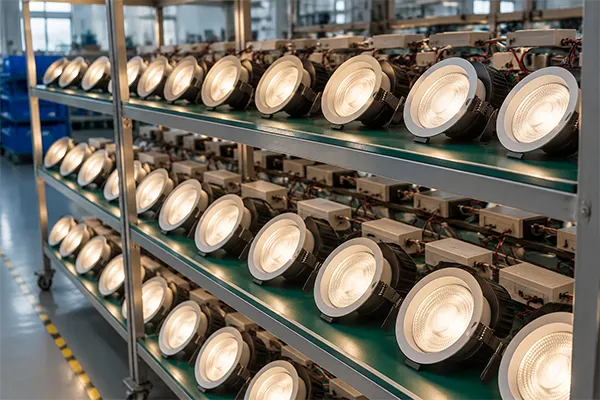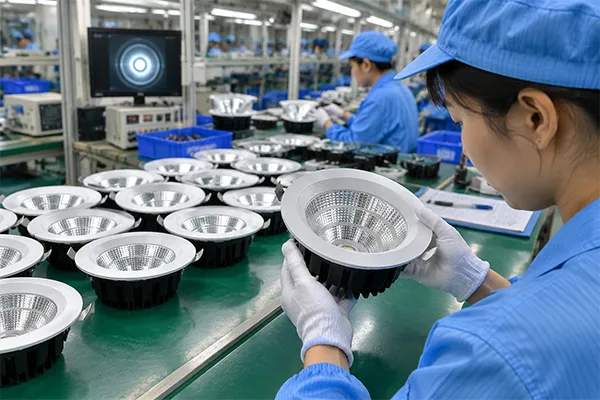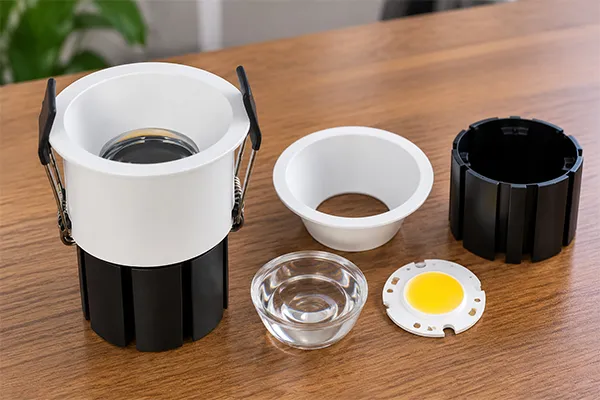

LED downlight manufacturers manage production quality by controlling each step that affects batch consistency, from incoming components and assembly to aging tests and shipment release. A downlight may look fine in a sample box, yet inconsistent materials or weak process control can create replacement costs, project delays, and customer complaints later. We reduce that risk through traceable production checks rather than relying on appearance alone.
LED downlight manufacturers maintain production quality through a connected control chain: approved materials, supplier consistency, in-process assembly checks, 100% aging tests, outgoing inspection, and records for nonconforming products. Buyers should evaluate whether a supplier can repeat the approved sample across mass production, not simply whether one unit turns on or holds a certificate.
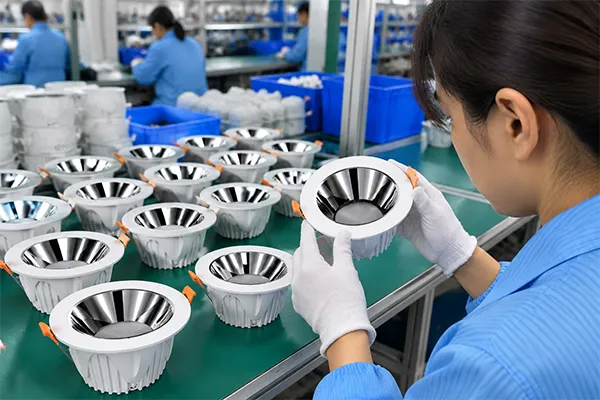
At Upward Lighting, we view quality as a repeatable manufacturing process, not a single final inspection. Our team works with importers, distributors, contractors, and lighting brands that need dependable batches for their markets and projects. Below, I explain the practical controls buyers can review when comparing LED downlight suppliers.
Why Do LED Downlight Manufacturers Focus on Batch Consistency?
A product sample can create a false sense of security. A buyer may approve its color, brightness, finish, and price, then discover differences after a larger shipment arrives. That gap creates pressure on installation schedules, inventory planning, and after-sales teams. We believe that batch consistency is the more useful definition of quality.
LED downlight manufacturers should focus on batch consistency because buyers need products that remain aligned with approved specifications across repeated orders. Consistent materials, controlled assembly, documented testing, and clear shipment-release rules help reduce variation between a sample, a production batch, and future replenishment orders.
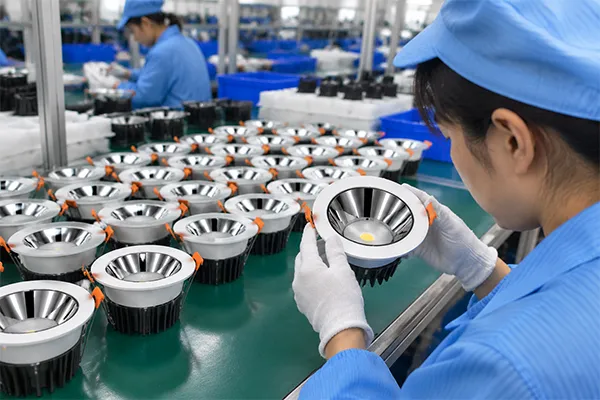
A Good Sample Is Only the Starting Point
When I speak with purchasing teams, I often notice that the first discussion centers on the approved sample. That is understandable. A sample lets buyers assess appearance, basic function, dimensions, color temperature, beam angle, and installation fit.
However, a sample is generally one unit or a small group of units. Mass production introduces a different question:
Can the supplier reproduce the approved configuration consistently when materials, production schedules, operators, and order quantities change?
For LED downlights, consistency can involve several visible and functional characteristics:
- Color temperature alignment between units and batches
- Wattage configuration according to the approved requirement
- Beam angle consistency for the intended lighting layout
- CRI specification matching the agreed product version
- Housing finish and color consistency
- Cutout size and external dimensions
- Driver selection and wiring configuration
- Packaging, labels, and market-specific markings
We do not consider a product “controlled” simply because it lights up at the end of the line. A unit can illuminate while still differing from the agreed bill of materials, finish standard, labeling requirement, or configuration.
What Buyers Should Ask About Repeatability
A buyer can assess manufacturing discipline with direct, practical questions. The answers should describe a process, not only use general terms such as “excellent quality” or “strict QC.”
| Buyer question | What a useful answer should clarify |
|---|---|
| How do you control approved samples versus mass production? | Whether approved specifications, drawings, photos, or material requirements are recorded for production reference |
| How do you manage material changes? | Whether critical component substitutions are reviewed before use |
| What checks occur during assembly? | Which visible, functional, or configuration checks are performed before final release |
| How do you identify nonconforming units? | How failed or questionable units are separated, reviewed, and prevented from shipping |
| Can you support repeat orders? | How the supplier maintains product configuration records for future production |
We encourage buyers to compare suppliers based on the clarity of these answers. Price matters in procurement, but price alone does not show whether a supplier can deliver stable results over multiple orders.
How Do LED Downlight Manufacturers Control Incoming Materials?
Many quality problems begin before assembly.1 If incoming LED components, drivers, housings, lenses, trims, cables, or packaging materials do not match the approved requirement, final inspection becomes a last-minute filter instead of a real quality system2. We manage quality by checking key inputs before they enter production.
LED downlight manufacturers control incoming materials by verifying that critical components and materials match the approved production requirements before assembly. This approach helps identify incorrect, inconsistent, or visibly defective inputs early, when corrective action is usually more practical than after finished products have been packed.
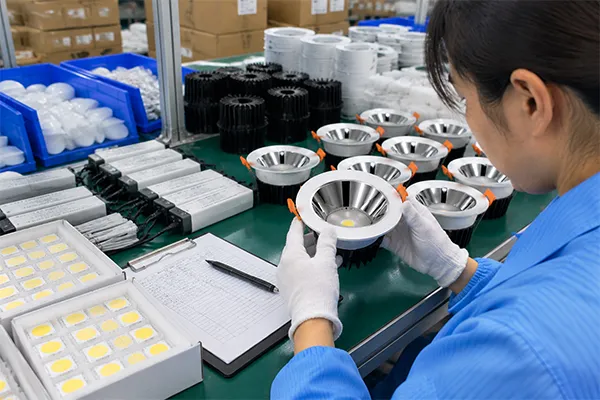
Quality Starts With Supplier and Material Consistency
An LED downlight is an assembled product. Its final performance and appearance depend on multiple supplied components working together. For that reason, our production perspective begins with materials rather than the finished carton.
At Upward Lighting, we manage incoming-material inspection and supplier/material consistency as part of our workflow. The exact checks depend on the product configuration and customer requirement, but the central objective stays the same: we need production materials to match the approved version of the product.
Critical items may include:
- LED light source components
- LED drivers
- Aluminum or other housing materials
- Reflectors, diffusers, lenses, and trims
- Heat-management-related structures
- Wiring, connectors, and mounting hardware
- Surface finish materials
- Inner boxes, master cartons, labels, and manuals
A material inconsistency may be easy to see, such as a different trim color or package label. Other differences may require closer review, such as an unexpected component version, a changed driver configuration, or a dimension that affects installation.
Why Final Inspection Alone Is Not Enough
Final inspection is important, but it should not be the first time a factory discovers that a key material is wrong. If an issue appears only after full assembly, the supplier may need to sort finished units, rework products, delay shipment, or make difficult commercial decisions.
Incoming checks create an earlier point of control. They support more orderly production by helping us identify questions before components move through the assembly process.
This does not mean incoming inspection can prove every long-term outcome in every application. It is a manufacturing control, not a universal field-performance guarantee. Still, it provides valuable evidence that the factory is managing the relationship between approved materials and mass production.
What Buyers Can Request Before Ordering
We recommend that buyers ask for a clear material-consistency discussion before confirming large or repeat orders. For private-label, OEM, and project work, this discussion becomes especially important.
Useful requests include:
- A confirmed product specification covering wattage, color temperature, beam angle, CRI, finish, and other requested parameters.
- A sample approval record or written confirmation of the approved version.
- Clarification on key components that affect the buyer’s purchasing decision.
- A process for proposed changes, especially for components, labeling, packaging, or finishes.
- Production photos or inspection records, where commercially appropriate and available.
Buyers should also verify any certification documents needed for their market. CE and RoHS documents can be relevant to market entry requirements3, but they do not by themselves demonstrate that every future batch will match the approved sample4. Process evidence remains important.
How Do LED Downlight Manufacturers Check Products During Assembly?
Assembly errors can occur even when incoming materials are acceptable. A correct driver can be fitted incorrectly. A cable can be poorly positioned. A trim can be scratched during handling. If these issues reach final packing, they can add sorting work and create avoidable shipment risk. We use assembly checks to identify issues while products are still moving through production.
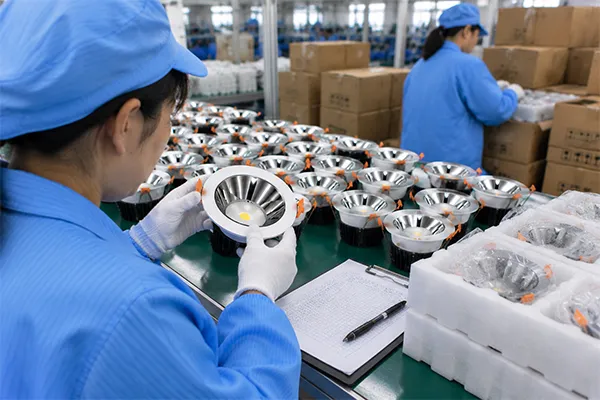
LED downlight manufacturers check products during assembly by reviewing workmanship, component fit, visible condition, and configuration at appropriate production stages. In-process inspection helps factories identify problems earlier than final inspection5, reducing the chance that incorrect or visibly defective units continue through packing and shipment preparation.
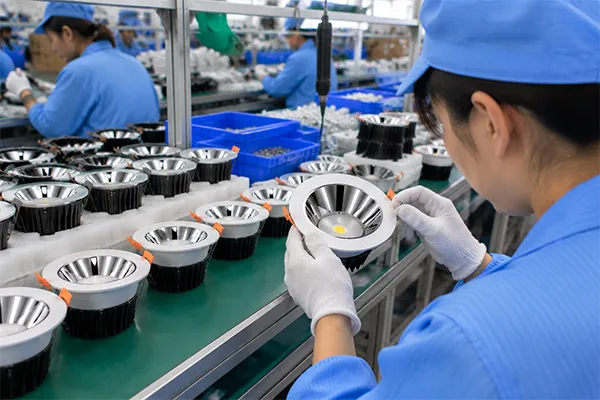
In-Process Checks Support Earlier Correction
In-process inspection is not one fixed checklist for every product. The appropriate checks depend on the downlight design, customer specification, production setup, and destination-market requirements. However, the idea is consistent: inspect relevant points during assembly rather than waiting until every unit is finished.
In our own work, assembly checks can focus on observable production details such as:
- Correct product configuration for the order
- General workmanship and physical appearance
- Housing and trim condition
- Fit of assembled parts
- Wiring and connection arrangement
- Required labels or marks
- Packaging preparation against the confirmed requirement
I have seen how small process questions can become large commercial problems when they are found too late. A wrong label may seem minor inside a factory, but it can affect warehouse receiving, distributor inventory, online listings, or site installation. A surface-finish mismatch may not stop a downlight from operating, yet it can still lead to rejection for a hospitality, retail, or residential project.
Nonconforming Products Need Clear Handling
Buyers should ask not only, “Do you inspect products?” They should also ask, “What happens when an inspection finds a problem?”
A useful control process separates questionable units from products that are ready for release.6 The supplier should have a practical method to identify, review, and handle nonconforming products before they are mixed into approved stock.
The exact internal workflow varies by factory, but buyers can look for evidence that the supplier can:
- Identify units that do not meet the confirmed requirement
- Separate those units from acceptable production
- Review whether rework is appropriate
- Reinspect units after corrective action, where applicable7
- Prevent unreviewed products from moving to shipment release
- Record or communicate material issues that affect the order
This matters because inspection is only meaningful if it leads to a controlled decision. A supplier that identifies defects but lacks segregation and review procedures may still allow inconsistent products to enter the shipment.
Assembly Inspection Is Not a Substitute for Application Review
A factory can inspect assembly quality, but it cannot decide every application-specific requirement without buyer input. Project contractors and technical teams should confirm suitability for the intended environment, installation method, electrical system, lighting design, and local regulations.
We recommend qualified professional evaluation for application-specific decisions. Manufacturing inspection supports product consistency. It does not replace lighting calculations, site assessment, installation compliance checks, or professional electrical judgment.
Why Are 100% Aging Tests Important for LED Downlights?
Buyers often ask whether every LED downlight is tested before shipment. This is a sensible question because functional screening can help identify units that show problems during controlled operation. Still, buyers should understand what aging tests can demonstrate and what they cannot. We treat aging as a shipment-screening and release step, not as a lifetime promise.
LED downlight manufacturers use 100% aging tests to screen finished units under operation before shipment8. At Upward Lighting, every product undergoes a 4–8 hour aging test before shipment, depending on the product and production arrangement. This practical control can identify certain early issues, but it cannot guarantee lifetime reliability in every installation condition9.
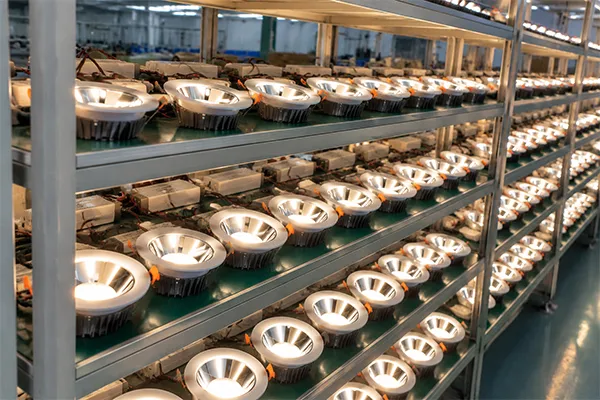
What Our Aging Test Process Covers
At Upward Lighting, we carry out a 100% aging test lasting between 4 and 8 hours before shipment. This is part of our production workflow for finished products. The duration may depend on the product and manufacturing arrangement.
The purpose is practical. We operate each unit as part of the pre-shipment process so that products can be screened before outgoing release. This step supports our effort to deliver products that meet the agreed production requirements and lumen-maintenance expectations used in our internal manufacturing process.
However, I believe buyers deserve a careful explanation. A 4–8 hour aging test is not the same as proving years of operation in every real-world condition. Field outcomes can depend on installation quality, operating hours, ventilation, electrical conditions, maintenance, environment, and application demands.10
Therefore, we do not present 100% aging as an absolute guarantee that no field failure will occur. Instead, we present it as a meaningful manufacturing control that can help screen products before dispatch.
How Buyers Should Evaluate Aging-Test Claims
When a supplier says that it performs aging tests, buyers can ask follow-up questions that reveal more than the claim itself.
| Buyer question | Why it matters |
|---|---|
| Is the aging test applied to all units or only sampling? | This clarifies the coverage of the test process |
| How long are products aged? | This provides context for the supplier’s screening routine |
| Does the factory inspect products after aging? | This shows whether the test connects to shipment release |
| How are failed units handled? | This indicates whether nonconforming products are controlled |
| Can the supplier explain the process for our product? | This helps buyers compare relevant, product-specific practices |
A supplier should answer accurately and avoid exaggerated language. A transparent answer may be more valuable than a broad promise.
Aging Is One Layer in a Larger Quality Chain
The strongest procurement approach does not treat any single control as sufficient. A downlight that passes aging may still be affected by a material change, an incorrect label, packaging damage, or a mismatch against the approved order. That is why we connect aging with incoming checks, assembly inspection, outgoing inspection, and supplier consistency management.
For buyers, the key question is not simply, “Do you have an aging test?” The better question is:
How does your aging test connect with your overall process for releasing a consistent batch?
What Should Buyers Audit Before Selecting LED Downlight Manufacturers?
Selecting a supplier based only on quotations, photos, certificates, or a single sample can leave important questions unanswered. Buyers need a practical audit mindset, especially when purchasing for distribution, branded resale, or project installation. We recommend evaluating observable controls and records rather than relying on broad claims.
Buyers should audit LED downlight manufacturers by reviewing their quality-control stages, material-change management, aging-test coverage, outgoing inspection process, and production records. The goal is to understand how the supplier maintains consistency between approved samples, mass production, and repeat orders while handling nonconforming units responsibly.
A Practical Supplier Evaluation Checklist
A buyer does not always need a complex factory audit to ask good questions. Even a structured quotation call, video meeting, document review, or pre-production discussion can reveal how a supplier thinks about quality.
I suggest using the following checklist when comparing suppliers:
1. Confirm the Approved Product Version
Ask the supplier to confirm the product configuration in writing. This can include:
- Model and appearance
- Wattage
- Input requirement as applicable
- Color temperature
- Beam angle
- CRI
- Finish color
- Packaging and label requirements
- OEM or private-label elements
This record creates a reference point for production and repeat orders.
2. Ask About Material and Supplier Controls
Buyers should ask which materials are considered important to the product configuration and how changes are managed. The goal is not to demand confidential supplier information. The goal is to understand whether the manufacturer recognizes the commercial importance of material consistency.
3. Review In-Process and Final Controls
Ask what checks happen:
- Before assembly
- During assembly
- During aging
- Before packing
- Before shipment release
A process map can be more useful than a generic quality statement.
4. Clarify Outgoing Inspection and Shipment Release
Outgoing inspection is the final opportunity to confirm that products, packaging, quantities, labels, and visible condition align with the order before dispatch.11 Buyers should ask who releases the shipment and what conditions must be met first.
5. Verify Relevant Certification Documents
We provide products with certifications such as CE and RoHS for applicable market-entry requirements. Buyers should verify that documentation is current, relevant to the product, and suitable for their destination market and sales channel.
Certification review should sit alongside production-control review. It should not replace it.
Build Quality Into the Commercial Relationship
Long-term quality management also depends on communication. Buyers should provide clear specifications and notify the supplier when their market, packaging, branding, or technical requirements change. Suppliers should respond quickly when they identify ambiguity before production begins.
At Upward Lighting, we support OEM/ODM customization for factors such as color temperature, wattage, beam angle, CRI, and surface finish colors. Customization can create stronger product differentiation, but it also makes written confirmation more important. The more customized the product, the more carefully both sides should control the approved version.12
For small-batch orders, the same principle applies. Small quantity does not remove the need for quality controls. It simply requires practical coordination between the buyer and supplier.
Frequently Asked Questions
Is a CE or RoHS certificate enough to prove LED downlight quality?
No. CE and RoHS documents can be important for applicable safety, environmental, and market-entry requirements, but they do not prove that every production batch will match an approved sample. Buyers should also review material controls, assembly inspection, aging tests, outgoing inspection, and shipment-release procedures.
Does 100% aging testing guarantee that LED downlights will never fail?
No. A 100% aging test is a useful pre-shipment screening control, but it cannot guarantee lifetime reliability in every installation environment. Field performance can also depend on installation conditions, electrical conditions, operating patterns, maintenance, and the specific application.
What is the most important quality question to ask an LED downlight supplier?
We believe the most useful question is: “How do you ensure that mass production matches the approved sample?” A strong answer should explain material consistency, production checks, aging-test coverage, nonconforming-product handling, outgoing inspection, and records for repeat orders.
How can importers reduce LED downlight batch inconsistency?
Importers can reduce inconsistency by approving clear specifications, documenting key product parameters, asking how material changes are controlled, reviewing testing processes, and checking shipment-release procedures. They should also keep records from each order to compare future batches against the approved reference.
Can OEM LED downlight customization affect quality control?
Yes. OEM customization can affect product configuration, labeling, finish, packaging, and component selection. Buyers should confirm each customized requirement in writing before production. Manufacturers should then use those approved details as a reference for material preparation, assembly checks, aging, and outgoing inspection.
Conclusion
LED downlight manufacturers manage production quality most effectively when they control the full chain, not only the final product appearance. Buyers should look for evidence of incoming-material inspection, supplier consistency management, assembly checks, 100% aging tests, outgoing inspection, and clear handling of nonconforming units. At Upward Lighting, we apply a 4–8 hour 100% aging process before shipment alongside these practical controls. Contact us to discuss your LED downlight specifications, OEM/ODM requirements, and quality-review expectations before your next order.
"Investigating the Impact of Standards-Based ...", https://nvlpubs.nist.gov/nistpubs/gcr/2016/NIST.GCR.15-1009.pdf. Quality-management standards require organizations to control externally provided products and services and to verify that purchased inputs meet specified requirements before use in production. Evidence role: mechanism; source type: institution. Supports: Quality-management guidance on controlling externally provided products and verifying incoming materials before their use in production.. Scope note: Such standards establish a recognized control principle; they do not quantify the share of defects attributable to incoming materials for LED downlights specifically. ↩
"Quality Management System Implementation", https://www.nist.gov/mep/successstories/2023/quality-management-system-implementation. Process-based quality-management frameworks emphasize controlling and monitoring production processes to prevent nonconformities, rather than depending exclusively on final inspection to detect them. Evidence role: expert_consensus; source type: institution. Supports: Recognized quality-management principles that emphasize process-based control, monitoring, and prevention of nonconformity rather than relying solely on final inspection.. Scope note: The principle supports the general argument but does not prescribe one identical inspection sequence for every lighting manufacturer. ↩
"CE marking", https://en.wikipedia.org/wiki/CE_marking. European Commission guidance explains that CE marking applies to product categories governed by relevant EU harmonisation legislation, while the RoHS Directive restricts specified hazardous substances in electrical and electronic equipment placed on the EU market. Evidence role: general_support; source type: government. Supports: European Commission guidance explaining CE marking obligations for covered products and the RoHS Directive's restrictions on hazardous substances in electrical and electronic equipment.. Scope note: Applicability depends on the precise product, applicable legislation, documentation, and market in which it is placed. ↩
"CE marking – obtaining the certificate, EU requirements", https://europa.eu/youreurope/business/product-rules-compliance/general-product-compliance/ce-marking/index_en.htm. EU CE-marking guidance describes the declaration of conformity and technical documentation as conformity evidence for applicable legal requirements; these documents do not, by themselves, establish continued equivalence to a purchaser's approved production sample. Evidence role: general_support; source type: government. Supports: Official CE-marking guidance describing declarations and technical documentation as evidence of conformity with applicable legal requirements, rather than evidence that every later commercial batch matches a buyer-approved reference sample.. Scope note: This is a distinction between regulatory conformity and contractual batch consistency, not a finding that compliant products are necessarily inconsistent. ↩
"In-process monitoring and non-destructive evaluation for ...", https://nvlpubs.nist.gov/nistpubs/ir/2024/NIST.IR.8538.pdf. Manufacturing quality-control literature describes in-process inspection as a means of detecting deviations during production, allowing correction or containment before products proceed to later stages. Evidence role: mechanism; source type: research. Supports: Manufacturing-quality literature explaining that inspection and monitoring during production can detect deviations before downstream operations or final release.. Scope note: The magnitude of benefit depends on the inspection method, defect type, product design, and effectiveness of corrective action. ↩
"Nonconforming Product", https://www.fda.gov/files/about%20fda/published/Nonconforming-Product---Printable-Slides.pdf. Quality-management standards call for nonconforming outputs to be identified and controlled so that their unintended use or delivery is prevented, with disposition actions documented as appropriate. Evidence role: general_support; source type: institution. Supports: Quality-management requirements for identifying and controlling nonconforming outputs to prevent their unintended use or delivery.. Scope note: The standard defines the control objective; individual factories may use different physical or digital segregation methods. ↩
"Nonconforming Product", https://www.fda.gov/files/about%20fda/published/Nonconforming-Product---Printable-Slides.pdf. Quality-management requirements state that when nonconforming outputs are corrected, they should be subject to verification to demonstrate conformity with requirements. Evidence role: mechanism; source type: institution. Supports: Quality-management requirements that corrected nonconforming outputs be verified for conformity after correction.. Scope note: The applicable verification method and sampling level depend on the product risk, defect, and quality plan. ↩
"Burn-in Testing?", https://accendoreliability.com/burn-in-testing/. Reliability engineering literature describes burn-in and operational screening as methods intended to expose some early-life failures or latent defects before products are released for service. Evidence role: mechanism; source type: research. Supports: Reliability-engineering evidence that burn-in or operational screening is used to reveal some early-life defects in electronic products or components.. Scope note: The effectiveness of screening depends on test duration, stresses, failure mechanisms, and test design; it is not proof of long-term reliability. ↩
"Reliability Estimation and Failure Analysis of LEDs with ... - PMC", https://pmc.ncbi.nlm.nih.gov/articles/PMC11886734/. Research on LED and electronic-system reliability finds that degradation and failure behavior depend on thermal, electrical, environmental, and operational stresses, so a limited pre-shipment operating test cannot establish lifetime performance under all service conditions. Evidence role: mechanism; source type: paper. Supports: Research showing that LED and electronic-product reliability is affected by temperature, electrical stress, operating conditions, and other use-environment factors.. Scope note: The exact relevance depends on the downlight design, driver, thermal environment, duty cycle, and installation conditions. ↩
"LED Adoption Report", https://www.energy.gov/cmei/ssl/led-adoption-report. LED-system reliability literature identifies operating temperature, electrical and driver conditions, duty cycle, thermal design, and environmental exposure as factors that can influence performance and service life in use. Evidence role: general_support; source type: research. Supports: Research or laboratory guidance identifying thermal management, driver and electrical conditions, operating duration, and environmental exposure as relevant influences on LED system performance and reliability.. Scope note: This general evidence does not establish the outcome of any particular installed downlight or isolate the effect of each factor. ↩
"ISO 9001 Clause 8.6 Release of products and services", https://wilkshireconsulting.com/blog/iso-9001-8-6-release-of-products-and-services. Quality-management standards require planned verification that product requirements have been met before release, providing a basis for final checks of order-specific attributes prior to dispatch. Evidence role: general_support; source type: institution. Supports: Quality-management requirements for verifying that product and service requirements have been met before release or delivery.. Scope note: The standard does not require every order attribute to be checked using the same method or at a single final-inspection stage. ↩
"5 FAM 860 SYSTEM CONFIGURATION MANAGEMENT", https://fam.state.gov/fam/05fam/05fam0860.html. Quality- and configuration-management frameworks emphasize defining customer requirements and controlling changes to product information, practices that become particularly important when products have order-specific configurations. Evidence role: general_support; source type: institution. Supports: Quality-management and configuration-management guidance requiring customer requirements, production information, and changes to be defined and controlled.. Scope note: The source supports the control principle but does not measure how much additional documentation any particular customization requires. ↩