LED downlight technology is improving because buyers can now match light output, visual comfort, installation dimensions, control options, and quality requirements more precisely to each application. Lumens and wattage still matter, but a technically attractive product can create problems if its beam angle, glare level, driver, cutout size, or certification documents do not fit the intended market or project.
LED downlight technology is not simply improving through brighter LEDs or lower power consumption. It is improving through better system-level choices: appropriate optics, color quality, thermal design, drivers, installation compatibility, quality-control processes, and customizable specifications. For importers, wholesalers, and lighting brands, the best downlight is the one that reliably fits the room, customer expectations, local requirements, and supply plan.
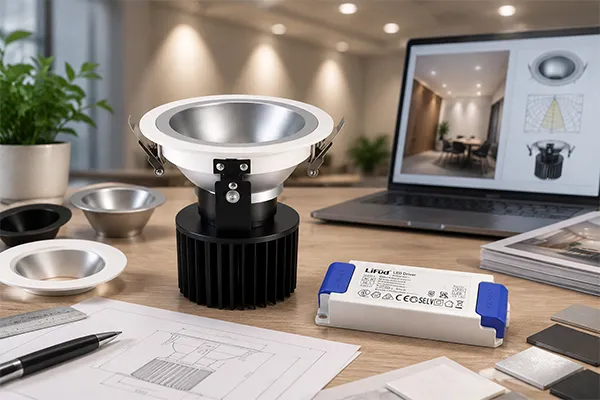
I have seen many buyers begin with a request for wattage and lumen output. Those two figures are useful, but they are only the starting point. When we discuss OEM/ODM specifications and pre-shipment quality checks, I find that the more important conversation is often about how the downlight will actually be installed, used, sold, and supported.
How Does LED Downlight Technology Improve Lighting Selection?
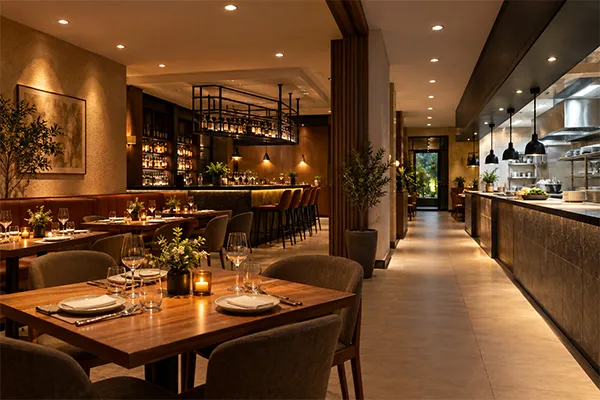
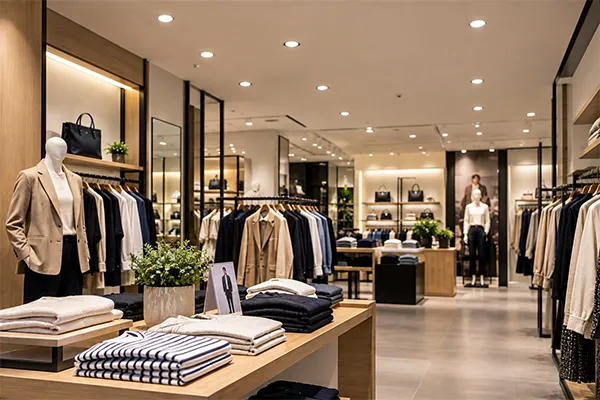
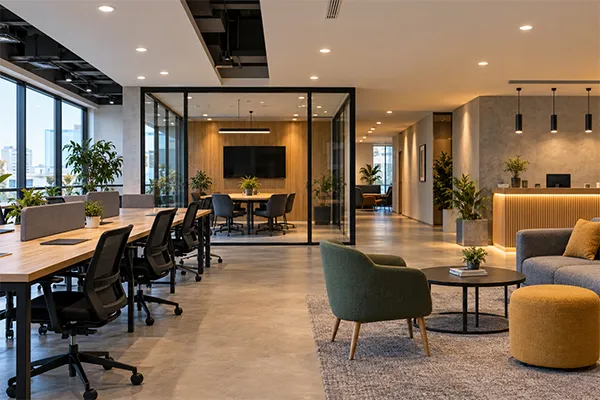
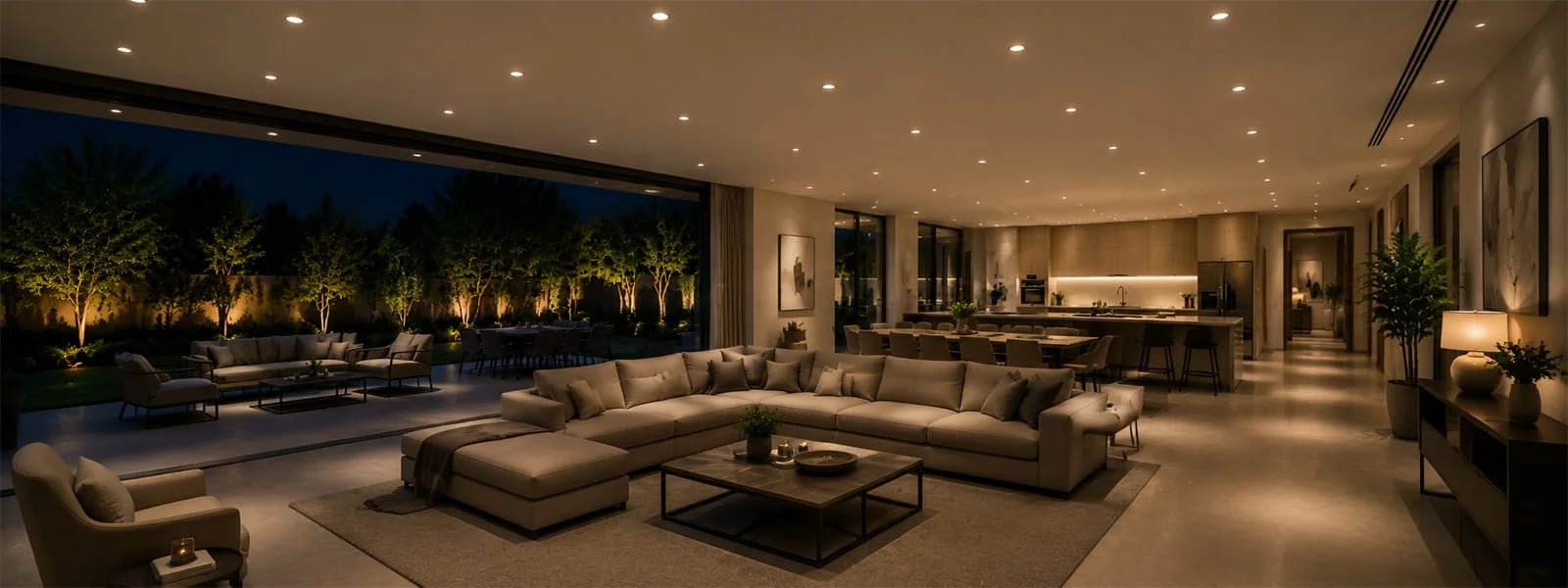
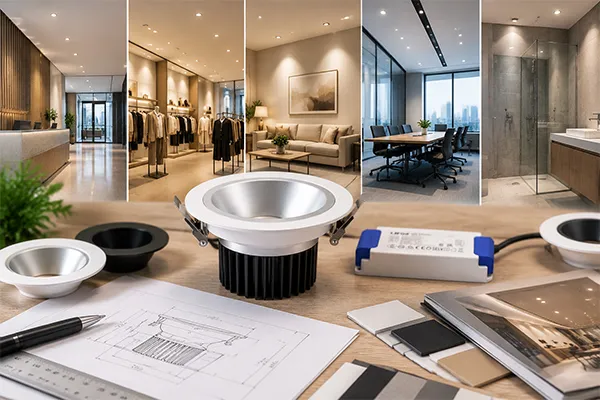
LED downlight technology can improve lighting selection when buyers start with the application rather than the product specification sheet. A downlight for a hotel corridor, retail display, residential ceiling, office reception area, or bathroom must solve different visual, installation, and maintenance needs.
The best way to evaluate LED downlight technology is to define the installation space, lighting task, ceiling condition, and visual target before comparing models. Buyers should then select beam angle, CCT, CRI, wattage, cutout, IP rating, driver type, and finish as a coordinated system rather than as isolated features.
Start With the Lighting Task
A downlight does not serve every room in the same way. I encourage buyers to identify whether the fitting will provide ambient lighting, accent lighting, task lighting, or a combination of these functions.
For example:
- A wide-beam recessed LED downlight may suit general lighting in a living room, corridor, or office.
- A narrower beam angle may be more suitable for highlighting shelves, wall textures, artwork, or retail merchandise.
- A high-CRI LED downlight can be relevant where color appearance affects customer perception, such as clothing stores, showrooms, food displays, and residential kitchens.
- A moisture-resistant model may be necessary for bathrooms, covered exterior areas, or other humid environments, subject to verification of the actual IP rating and installation conditions.
I once worked through a specification discussion where a buyer initially requested one downlight model for several commercial spaces. As we reviewed the intended layouts, it became clear that a single beam angle would not support both general corridor lighting and focused retail display lighting. The buyer could still keep a consistent exterior appearance across the range, but the optical configuration needed to change.
Consider the Ceiling Before the Catalog
Installation compatibility is one of the most practical advances in modern LED downlight technology. Slimmer housings, integrated drivers, adjustable cutouts, and different mounting structures can help buyers serve more ceiling types. However, each design also introduces selection limits.
Before sourcing, I recommend confirming:
- Ceiling cutout diameter and permitted tolerance.
- Ceiling thickness and spring-clip suitability.
- Available ceiling void depth.
- Driver placement space and access for future replacement.
- Insulation, ventilation, and heat conditions around the luminaire.
- Required trim appearance, including white, black, silver, gold, or custom surface finishes.
- Maintenance access, especially for commercial projects.
A compact fixture body may look convenient in a sample review. Yet the driver box, cable routing, insulation condition, or mounting spring force can affect actual installation. I believe procurement teams should request dimensional drawings, cutout requirements, installation instructions, and physical samples before finalizing a volume order.
Build a Product Range Instead of Chasing One “Best” Model
For wholesalers and local lighting brands, a product range often creates less commercial risk than relying on one highly specified model. A practical range can include several controlled variations:
| Buyer requirement | Downlight specification to evaluate | Procurement reason |
|---|---|---|
| General residential lighting | Medium or wide beam, common CCT options, standard cutout | Supports broad resale demand |
| Retail or display lighting | Higher CRI option, controlled beam angle | Helps support merchandise presentation |
| Low ceiling void | Slim body and suitable driver arrangement | Reduces installation conflicts |
| Hospitality projects | Consistent trim finish, glare management, multiple wattages | Supports a coordinated interior appearance |
| Bathroom or humid location | Appropriate IP-rated construction | Addresses environmental exposure risks |
| Private-label sales | Custom logo, packaging, CCT, finish, wattage | Differentiates the buyer’s product line |
This is where LED downlight technology becomes commercially useful. The improvement is not merely in the component. It is in the buyer’s ability to configure a product family around real market requirements.
Why Are Lumens and Wattage Not Enough for LED Downlight Technology?
Lumens and wattage can make product comparisons look simple, but they do not fully describe lighting quality or suitability.1 A downlight may appear efficient on paper while still producing uncomfortable glare, poor color appearance, uneven distribution, or an unsuitable beam pattern for the room.
LED downlight technology should be evaluated through a combination of lumen output, wattage, beam angle, CCT, CRI, glare control, and room geometry. Buyers should compare products under equivalent test conditions and request supporting technical documents rather than assuming that a higher lumen figure automatically creates a better result.
Optical Performance Is a System
A buyer can receive two downlight quotations with similar wattage and lumen claims, yet the installed results may look very different. The difference can come from the LED source, reflector or lens design, diffuser, driver behavior, thermal conditions, and production consistency.
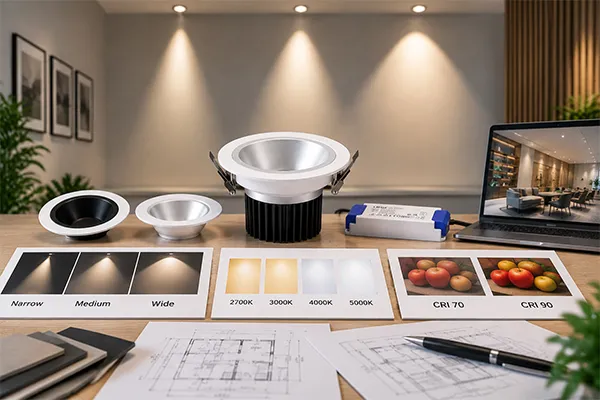
The core optical questions include:
- Beam angle: How broadly does the downlight distribute light?
- CCT: Does the specified color temperature fit the desired atmosphere?
- CRI: Does the product need more accurate color rendering?
- UGR or glare-related design considerations: Is visual comfort important for the room and user position?
- Light distribution: Does the product create smooth illumination or visible hot spots?
- Color consistency: Can the supplier define and control color tolerance expectations for the order?
For many buyers, 3000K, 4000K, and 6500K remain common requested CCT options. Still, I do not assume that any one CCT is universally correct. A warm residential interior, a neutral office environment, and a bright utility space may require different choices based on design intent, local preference, and the project brief.
Beam Angle Changes the Layout Decision
Beam angle is particularly important because it affects spacing and perceived brightness. A narrow beam can create stronger contrast and focused highlights. A wide beam can provide more general coverage but may need a different layout to avoid dark zones.2
I recommend that buyers review photometric data, lighting layouts, or qualified project lighting calculations when the project has defined illumination targets. A product datasheet alone cannot confirm that a complete installation will meet every application-specific requirement.3
The table below shows how buyers can frame the decision:
| Performance factor | What a buyer should ask | Risk if overlooked |
|---|---|---|
| Lumen output | Is output stated under comparable conditions? | Misleading product comparison |
| Wattage | Does the power level align with the intended design and thermal environment? | Incorrect energy or heat assumptions |
| Beam angle | Is the distribution suitable for ceiling height and spacing? | Uneven lighting or excessive contrast |
| CCT | Does the color temperature fit the intended atmosphere? | Inconsistent visual experience |
| CRI | Is color rendering appropriate for the merchandise or space? | Unattractive or inaccurate color appearance |
| Glare control | Will users look directly toward the fitting? | Visual discomfort and complaints |
| Dimming/control | Is driver compatibility confirmed with the selected control system? | Flicker, instability, or project delays |
Compare Like for Like
When buyers compare LED downlight technology, I suggest they avoid comparing only a headline lumen figure. They should ask whether the values refer to the complete luminaire or only a component, whether the CCT is the same, and whether the beam angle is comparable.
A lower-wattage downlight may be a good option in one setting, but it is not automatically better. The required illuminance, spacing, beam shape, color quality, and visual comfort still need to be considered. Likewise, a high-output fitting can be appropriate for a high ceiling or demanding task area, but it may be excessive for a low-ceiling residential room.
In our OEM/ODM discussions, buyers often request adjustments to wattage, CCT, beam angle, CRI, and finish color. I consider these parameters connected. A change in one specification can affect the overall product configuration, so the final combination should be reviewed before production.
How Does LED Downlight Technology Improve Reliability in Volume Supply?
LED downlight technology becomes more valuable when its performance can be repeated across batches, not just demonstrated in an initial sample. A good-looking sample can support a purchasing discussion, but drivers, heat management, components, assembly control, and inspection routines influence whether a product remains suitable for volume supply.
Reliable LED downlight technology depends on controlled components, thermal design, compatible drivers, consistent assembly, aging tests, and shipment inspection. Buyers should ask suppliers how they manage these steps and should define acceptable specifications, sample approval standards, packaging requirements, and batch checks before placing repeat orders.
The Driver and Thermal Path Matter
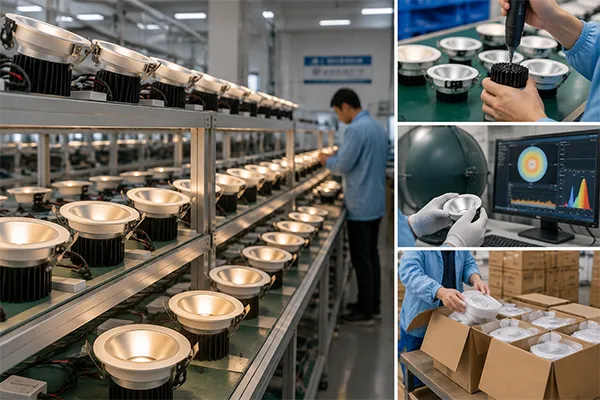
The LED chip receives much attention in product marketing. However, I have learned from production work that the complete luminaire matters more than any single component claim. The driver, heat sink, housing design, PCB arrangement, wiring, connectors, diffuser, and assembly process all contribute to the finished product.
Thermal management is especially important because heat can affect LED and driver operating conditions.4 A buyer does not need to become a manufacturing engineer, but the buyer should ask practical questions:
- What is the fixture housing material?
- How is heat transferred away from the LED module?
- Is the driver integrated or external?
- Which driver input range and dimming options are specified?
- Are component brands or approved component standards defined for the order?
- Does the installation environment create unusual heat or ventilation constraints?
- Can the supplier provide technical drawings and relevant test documentation for review?
I avoid presenting any one construction style as universally superior. Different product designs fit different price points, ceiling conditions, and market expectations. The important issue is whether the selected design is appropriate for the intended application and consistently produced.
What Aging Tests Can and Cannot Show
At Upward Lighting, we perform a 100% aging test before shipment, typically lasting between 4 and 8 hours, as part of our normal quality-control process. During production and pre-shipment quality checks, we focus on whether each unit operates as expected before it leaves our facility.
This process can help identify certain early operating issues. However, I do not describe an aging test as an absolute guarantee of long-term field performance.5 Real operating conditions vary. Installation quality, voltage conditions, ventilation, control compatibility, operating hours, and environmental exposure can all affect outcomes.
Buyers should ask suppliers to explain their inspection process clearly. A useful conversation may cover:
- Incoming component checks.
- In-process assembly checks.
- Aging-test duration and basic operating criteria.
- Visual inspection of trim, finish, labels, and wiring.
- Electrical and functional checks where applicable.
- Packaging inspection and carton markings.
- Sample retention or agreed batch-reference procedures.
Manage Consistency Through Written Specifications
For repeat procurement, I believe the most useful quality-control tool is a clear approved specification. This should not be limited to a product image or verbal confirmation.
A practical LED downlight specification file can include:
- Product model number and approved sample reference
- Wattage and input voltage
- CCT and CRI requirement
- Beam angle
- Cutout size, outer diameter, and height
- Driver type and dimming requirement
- Trim color and surface finish
- IP rating requirement, if relevant
- Labeling and packaging details
- Required documentation
- Order quantity and permitted production tolerance, where agreed
- Inspection method and acceptance criteria
I have found that this level of clarity is especially helpful for importers, distributors, and private-label lighting brands. It reduces the chance that a later quotation uses a similar-looking but differently configured product.
What Do Certifications and Specifications Mean for LED Downlight Technology?
Certifications and technical specifications are essential procurement inputs, but they do not automatically prove that a downlight fits every market, installation, or project. Buyers still need to verify documents, confirm the exact product configuration, and assess local regulatory and customer requirements.
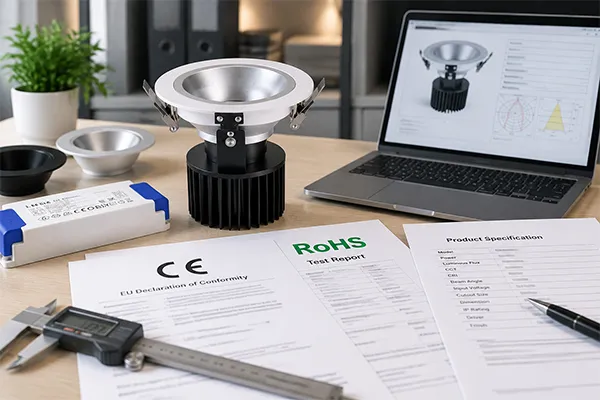
For LED downlight technology, buyers should verify that certification documents relate to the exact product or product family being purchased, remain valid where required, and support the intended market-entry process. CE and RoHS documentation can be relevant for many markets, but buyers should obtain qualified regulatory or technical guidance for application-specific compliance decisions.6
Verify Documents Against the Actual Product
At Upward Lighting, our products hold certifications such as CE and RoHS. These documents can support market-entry and environmental compliance discussions for relevant markets. Yet I encourage buyers to treat every certification as a document to verify, not as a generic label that resolves every project requirement.
A buyer should check:
- The legal entity named on the document
- The model number and whether it matches the quoted product
- The test standard or declaration scope
- The issue date and any validity conditions
- Whether customization changes the product configuration
- Whether destination-market rules require additional approvals, labeling, or documentation
- Whether the project owner has separate technical specifications
This is particularly important for OEM/ODM orders. A change to wattage, driver, enclosure, input requirement, IP construction, or other key parameter may require a buyer to confirm whether existing documents still apply.7
Compliance Is Only One Part of Supplier Selection
A strong supplier evaluation should include compliance documentation, but it should also cover production communication, lead time, sample control, packaging, and response speed.
| Supplier evaluation area | Questions for buyers |
|---|---|
| Product documentation | Can the supplier provide model-specific drawings and documents? |
| Sample process | Does the approved sample match the planned production configuration? |
| Customization | Can the supplier define CCT, wattage, beam angle, CRI, finish, and packaging changes clearly? |
| Quality control | What inspections occur before shipment? |
| Capacity and lead time | Can the supplier explain expected production timing and order planning? |
| Communication | Does the supplier respond quickly to technical and commercial questions? |
| Small-batch support | Can the supplier support trial orders or market testing? |
| Packaging | Is export packaging suitable for the intended sales channel and transport method? |
For buyers sourcing from China, the lowest quotation is not always the lowest total procurement cost. A low initial price can become expensive if the supplier cannot control specifications, provide clear documents, communicate changes, or support repeat-order consistency.
I recommend that buyers keep a written supplier-approval process. This process should include samples, specification sign-off, document review, packaging confirmation, and defined inspection expectations. When the product will be used in a sensitive or regulated application, buyers should consult qualified local professionals who understand the applicable installation and compliance requirements.
Frequently Asked Questions
Is higher lumen output always better for an LED downlight?
No. Higher lumen output is only beneficial when the room size, ceiling height, lighting layout, and visual task require it. Excessive output can create glare or over-lighting.8 Buyers should compare lumen output together with beam angle, CCT, CRI, and the intended installation environment.
What should I check before ordering custom LED downlights?
I recommend confirming wattage, lumen target, CCT, CRI, beam angle, cutout size, fixture dimensions, trim color, driver type, dimming needs, packaging, labels, and required documents. Buyers should approve a physical sample and written specification before volume production.
Does a 100% aging test guarantee long-term LED downlight performance?
No. A 100% aging test can help identify certain early functional issues before shipment, but it does not guarantee results under every field condition. Installation quality, voltage stability, heat, ventilation, usage hours, and environmental exposure can influence long-term performance.9
Are CE and RoHS certificates enough to sell LED downlights in every market?
No. CE and RoHS documents may be relevant to particular market-entry and environmental requirements, but requirements vary by destination, product configuration, customer, and installation. Buyers should verify model-specific documents and seek qualified local compliance guidance where necessary.
How can a lighting importer reduce LED downlight sourcing risk?
An importer can reduce risk by approving samples, documenting specifications, reviewing product drawings, checking certification documents, defining inspection criteria, confirming packaging, and evaluating supplier communication. Repeat orders should reference the same approved product configuration rather than only a general product image.
Conclusion
LED downlight technology is improving because buyers have more ways to align lighting performance with real commercial and installation needs. I believe the strongest purchasing decisions go beyond lumens and wattage. They consider beam angle, CCT, CRI, glare, dimensions, drivers, thermal design, batch consistency, aging checks, documents, and supplier communication. At Upward Lighting, we support importers, wholesalers, contractors, and lighting brands with OEM/ODM LED downlight options, small-batch support, and clear production communication. Contact us to discuss a downlight specification that fits your market and application.
"[PDF] LED Dimming: What you need to know - eere.energy.gov", https://www1.eere.energy.gov/buildings/publications/pdfs/ssl/dimming_webcast_12-10-2012.pdf. Lighting performance assessment includes more than luminous flux and input power: distribution, color characteristics, glare, controls, and the intended visual task affect the suitability of a lighting installation. Evidence role: general_support; source type: government. Supports: Lighting-quality guidance indicating that efficacy-related metrics must be considered alongside color, distribution, glare, and application conditions.. Scope note: The relative importance of these factors varies by application and cannot be inferred from product-level metrics alone. ↩
"[PDF] Understanding LM-79 Reports - Better Buildings Solution Center", https://betterbuildingssolutioncenter.energy.gov/sites/default/files/attachments/understanding_lm79_reports.pdf. Photometric distribution and mounting geometry determine the area illuminated by a luminaire and influence spacing, illuminance uniformity, and contrast in an installed lighting design. Evidence role: mechanism; source type: institution. Supports: Photometric guidance showing that luminaire beam distribution and mounting geometry affect illuminance patterns, spacing, and visual contrast.. Scope note: The appropriate beam angle and spacing remain application-specific and require project geometry and target illuminance values. ↩
"[PDF] The Impact of Circadian Lighting Design Strategies on Lighting and ...", https://www.energy.gov/sites/default/files/2023-01/ssl-2023_circadian-lighting-design-strategies-office-space.pdf. Lighting-design calculations use luminaire photometry together with room geometry, mounting conditions, surface properties, and layout; therefore, a product datasheet alone does not establish installed-project performance. Evidence role: general_support; source type: institution. Supports: Lighting-design guidance showing that compliance with task illuminance and uniformity targets is assessed using installation geometry and photometric calculations.. Scope note: The required calculation method and target criteria depend on the applicable project standard and jurisdiction. ↩
"[PDF] LED Luminaire Reliability: Impact of Color Shift - Department of Energy", https://www.energy.gov/sites/prod/files/2017/04/f34/lsrc_colorshift_apr2017.pdf. Thermal conditions influence LED junction temperature, light output, degradation rates, and the operating stress experienced by associated electronic components such as drivers. Evidence role: mechanism; source type: research. Supports: Research showing that elevated temperature affects LED optical output, degradation behavior, and electronic-driver operating reliability.. Scope note: Actual thermal performance depends on the specific luminaire construction, ambient conditions, operating current, and installation environment. ↩
"[PDF] A methodology for testing life-cycle performance of consumer products", https://nvlpubs.nist.gov/nistpubs/Legacy/IR/nbsir76-1157.pdf. Burn-in and aging procedures can screen units for certain early-life defects under defined test conditions, but they do not by themselves demonstrate reliability over all service environments or the full intended lifetime. Evidence role: mechanism; source type: paper. Supports: Reliability-engineering evidence that burn-in or aging tests can screen for some early-life failures but are not equivalent to long-term field-life demonstration.. Scope note: The screening value of an aging test depends on its duration, load conditions, failure mechanisms, and the production population tested. ↩
"CE marking – obtaining the certificate, EU requirements - Your Europe", https://europa.eu/youreurope/business/product-rules-compliance/general-product-compliance/ce-marking/index_en.htm. CE marking indicates that a product is declared to meet applicable European Union requirements, while the RoHS framework restricts specified hazardous substances in electrical and electronic equipment; each applies within defined legal scopes and conditions. Evidence role: historical_context; source type: government. Supports: Official EU information on the legal function of CE marking and the substance-restriction scope of the RoHS Directive.. Scope note: Whether a particular luminaire configuration may be placed on a market depends on the applicable legislation, technical documentation, and national implementation requirements. ↩
"CE marking – obtaining the certificate, EU requirements - Your Europe", https://europa.eu/youreurope/business/product-rules-compliance/general-product-compliance/ce-marking/index_en.htm. Conformity documentation and assessment are product-specific: when relevant design, electrical, or safety characteristics change, the manufacturer must determine whether the existing assessment and technical file remain valid for the modified product. Evidence role: general_support; source type: government. Supports: Conformity-assessment guidance establishing that technical documentation and compliance assessment must correspond to the product placed on the market.. Scope note: The effect of a modification depends on the applicable legislation, harmonized standards, and the nature of the change. ↩
"[PDF] Measuring Discomfort from Glare: Recommendations for Good ...", https://www.energy.gov/eere/ssl/articles/measuring-discomfort-glare-recommendations-good-practice. Visual discomfort glare is associated with excessive source luminance and contrast in the field of view, and lighting levels beyond task needs can increase glare risk and unnecessary energy use. Evidence role: mechanism; source type: research. Supports: Lighting research explaining that excessive luminance contrast and poorly controlled light can contribute to discomfort glare and unnecessary illumination.. Scope note: Whether a particular output level is excessive depends on the room, task, surface reflectances, fixture distribution, and observer position. ↩
"[PDF] LED Luminaire Reliability: Impact of Color Shift - Department of Energy", https://www.energy.gov/sites/prod/files/2017/04/f34/lsrc_colorshift_apr2017.pdf. The service reliability of LED lighting systems is affected by electrical stress, thermal management, operating time, environmental exposure, and the conditions created by installation and system integration. Evidence role: general_support; source type: paper. Supports: Research on how thermal, electrical, environmental, and operating stresses influence LED luminaire and driver reliability in service.. Scope note: The magnitude of each effect varies with component design, protection features, maintenance, and the actual duty cycle. ↩