LED downlights can look similar in a catalog, yet their real quality can vary significantly from batch to batch. Buyers often face unclear specifications, late delivery risks, and inconsistent light performance. We believe the solution starts by looking beyond a factory tour and examining the complete manufacturing control loop.
LED downlights are manufactured through a controlled sequence of specification confirmation, material sourcing, component inspection, assembly, aging, final testing, packaging, and shipment release.1 For importers and lighting brands, the key question is not whether a Chinese factory has a clean workshop, but whether it can repeat these controls consistently for the agreed wattage, CCT, beam angle, CRI, finish, and target-market requirements.
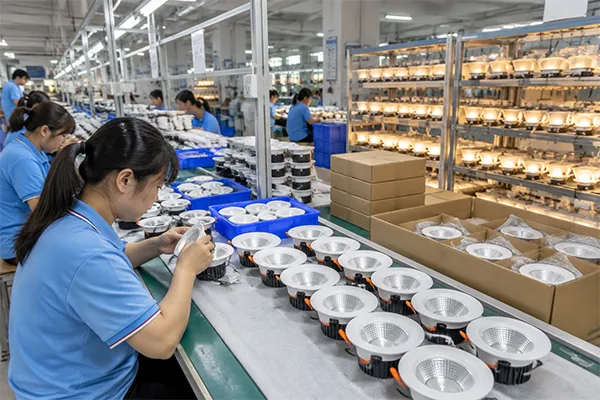
At Upward Lighting, we work with project contractors, importers, distributors, local brands, and electrical channel partners that need more than an attractive product photo. They need evidence that the specified product can be made repeatedly, packed correctly, and delivered according to a workable production schedule. This article explains the manufacturing workflow we use and the verification points we recommend buyers review.
How Do LED Downlights Start With a Frozen Product Specification?
Many purchasing problems begin before production starts. A buyer may request “a 12W warm white downlight,” but that description leaves too much room for interpretation. If the specification is incomplete, the factory may select different components, and the finished product may not match the original commercial expectation.
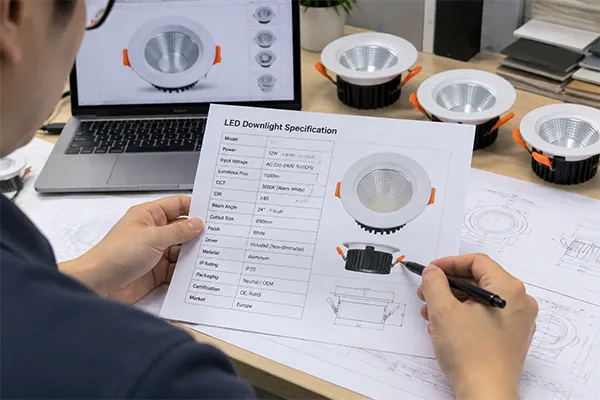
LED downlights should begin with a written, frozen specification that converts customer requirements into repeatable production instructions. The document should define electrical, optical, mechanical, finish, packaging, and market-entry requirements before materials are ordered or mass assembly begins.
Turning a Sales Request Into Production Requirements
We treat the specification handover as a bridge between the sales discussion and the production floor. A quotation alone is not a full manufacturing instruction. The quotation may state a wattage, unit price, and product name, but the production team needs a more detailed reference.
For a typical recessed LED downlight, the specification may include:
- Power consumption: such as 7W, 9W, 12W, or another agreed rating
- Input voltage and driver type: for example, constant-current driver requirements and regional voltage compatibility
- Color temperature: such as 3000K, 4000K, or 6500K
- Color rendering index: such as CRI 80 or CRI 90, where agreed
- Beam angle: for example, narrow, medium, or wide distribution
- Cutout size and overall dimensions
- Housing material and heat-sink design
- Trim or surface finish: white, black, silver, or customer-selected color
- LED source and driver configuration
- Dimming requirement: if any, including compatibility expectations
- Label, artwork, and packaging details
- Destination market requirements and requested compliance documents
A minor change can have a major effect. For example, a 3000K request instead of 4000K changes the LED source selection. A higher CRI requirement may affect the component configuration and commercial quotation.2 A black trim may require a different surface treatment process or a dedicated material order.
I have seen sample discussions where the product itself was correct, but the carton marking was not finalized early enough. That small omission can create avoidable delays near shipment. For this reason, we encourage buyers to confirm the product, label, inner box, outer carton, and shipping marks as one controlled package.
What Buyers Should Request Before Mass Production
A reliable handover should leave a clear record. Buyers can ask a supplier to provide or confirm:
| Control Document | Why It Matters to Procurement |
|---|---|
| Approved product specification | Reduces ambiguity in wattage, CCT, dimensions, and finish |
| Approved sample or sample record | Creates a physical reference for production comparison |
| Bill of materials or controlled component list | Helps maintain material consistency |
| Product drawing | Confirms dimensions, cutout, installation method, and appearance |
| Packaging artwork approval | Helps prevent market, branding, and labeling errors |
| Inspection criteria | Defines what the factory will check before release |
| Production schedule | Connects material readiness with delivery planning |
A frozen specification does not mean that customization becomes impossible. It means changes should be managed. If a buyer requests a revised beam angle, different trim color, or new branding after materials have been prepared, we recommend reviewing cost, MOQ, lead time, and sample approval again. That approach protects both the buyer and the supplier from preventable variation.
How Are Materials for LED Downlights Controlled Before Assembly?
A polished aluminum housing and a bright LED chip can create a good first impression. However, visual appearance alone does not show whether incoming materials are consistent. Material selection and incoming inspection have a direct influence on configuration accuracy, production continuity, and long-term commercial stability.3
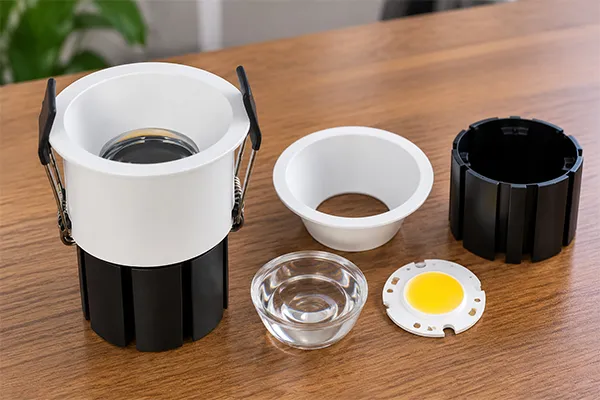
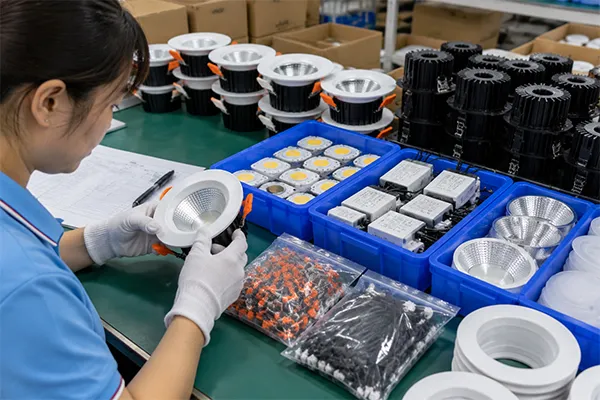
LED downlights depend on consistent incoming materials, including LED sources, drivers, housings, reflectors, diffusers, springs, cables, and packaging. Buyers should assess whether a supplier controls approved materials and incoming checks rather than assuming that a clean facility or automated equipment proves stable output.
The Main Components Behind a Downlight
An LED downlight is an assembly of several parts, and each part has a role in the final result.
| Component | Main Function | Buyer Evaluation Question |
|---|---|---|
| LED module or light source | Produces light output and color | Is the agreed CCT and CRI configuration controlled? |
| LED driver | Regulates current to the LED source | Does the driver match the voltage and dimming requirement? |
| Aluminum housing or heat sink | Dissipates heat and supports structure | Is the material and finish consistent with the approved sample? |
| Reflector or lens | Shapes the beam distribution | Does it match the agreed beam angle and visual appearance? |
| Diffuser | Reduces glare or changes light distribution | Is the optical material consistent from batch to batch? |
| Spring clips | Secures the fitting in the ceiling | Are dimensions and holding performance checked? |
| Cable and terminal | Supports safe installation and connection | Does the cable specification meet the agreed requirement? |
| Packaging | Protects goods and communicates product information | Can it withstand the planned shipping and handling process? |
At Upward Lighting, we use supply-chain coordination as part of our production preparation. We need materials to arrive in time and match the approved configuration. A strong supplier network can support faster quotation, flexible customization, and practical small-batch orders, but buyers should still ask how substitutions are handled.
Material Consistency Is More Important Than a Single Good Sample
A sample can be excellent while later batches differ if component control is weak.4 For this reason, we believe buyers should ask direct questions:
- Which components are fixed for this order?
- Can the supplier change an LED source, driver, or housing without written approval?
- What happens if an approved component is unavailable?
- Does the supplier conduct incoming checks against a defined requirement?
- Can the supplier retain a sample, photo record, or approved specification for future repeat orders?
We do not suggest that every LED downlight needs the most expensive component configuration. The correct configuration depends on the installation environment, target price, market expectations, and requested performance. A value-focused wholesale product may require a different design from a hospitality or retail project product.
The important point is transparency. A buyer should compare quotations against the actual component configuration and control process. A lower price may reflect a simpler driver, different housing, shorter aging time, basic packaging, or higher production volume. It does not automatically mean poor quality. However, buyers need enough detail to compare like with like.
How Are LED Downlights Assembled and Checked During Production?
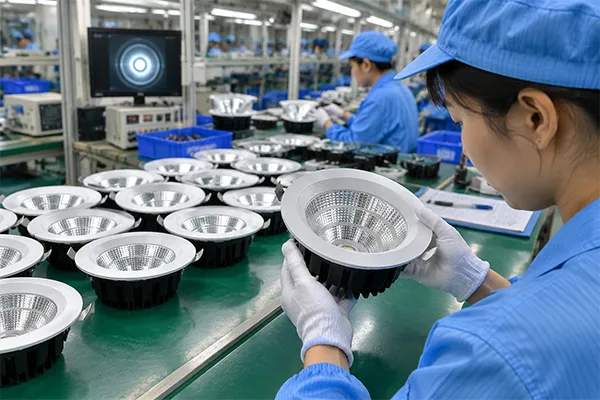
Assembly is where a specification becomes a physical product. Even when approved materials are available, inconsistent assembly can create issues with wiring, driver placement, trim alignment, optics, or final appearance. A supplier’s internal process discipline matters more than the number of people or machines visible in a workshop.
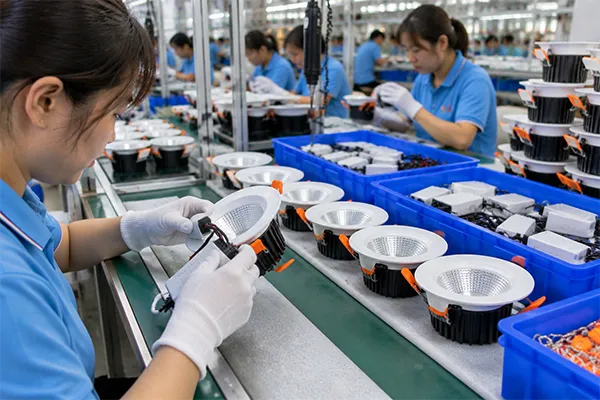
LED downlights are assembled by combining controlled components according to approved work instructions, then checking critical electrical, mechanical, and visual points during production.5 Effective in-process checks help identify configuration or assembly errors before products move to aging and final inspection.
A Typical Downlight Assembly Flow
The exact sequence differs by product design. A slim panel downlight, COB downlight, adjustable spotlight, and deep anti-glare downlight each require different operations. Still, a typical assembly flow may include:
-
Material preparation
Operators prepare the approved housing, LED module, driver, reflector, cable, spring clips, labels, and packaging materials. -
LED and thermal assembly
The LED module is fixed to the heat-dissipating body according to the product design. The contact between the light source and the heat-management structure is important because heat affects operating conditions.6 -
Optical component installation
Reflectors, lenses, or diffusers are installed to create the agreed visual effect and beam distribution. -
Driver and wiring connection
The driver, cable, terminal, and LED module are connected. The assembly team checks routing, connection security, and external appearance. -
Mechanical fitting
Spring clips, trim rings, brackets, and other mechanical components are installed. -
Initial function check
The product is powered to identify obvious non-lighting units, incorrect CCT, or basic assembly faults before it proceeds further.
Why Work Instructions Matter
Buyers sometimes see a bright workshop, organized work benches, or partial automation and assume that quality must be stable. Those items may be positive signs, but they are not conclusive proof. A well-organized facility still needs controlled instructions, trained operators, approved components, and documented inspection standards.
We use production records and approved references to help align assembly with the customer’s order. For customized orders, this is especially important. A black 3000K 9W model with a specific beam angle must not be mixed with a white 4000K model that looks broadly similar.
During a factory evaluation, buyers can ask to see how the production team distinguishes similar SKUs. Useful evidence may include:
- Product labels or work orders at assembly stations
- Approved sample references
- Material identification methods
- In-process inspection records
- Operator work instructions
- Nonconforming-product segregation areas
- Photo or video records from approved production runs, where available
A factory tour can support supplier evaluation, but a tour is only one piece of evidence.7 Buyers should connect what they see to documents, samples, test criteria, and repeat-order performance.
Balancing Customization With Repeatability
OEM and ODM downlight projects often require changes to CCT, wattage, beam angle, CRI, trim color, branding, or packaging. We can support these types of adjustments, subject to technical review and material availability. However, every variation creates additional control needs.
For example, a small-batch customized order may be commercially feasible, but the buyer should confirm whether the factory needs a new sample, special materials, revised artwork, or a separate production window. This is why fast quotation is valuable only when it is followed by careful specification confirmation.
Why Is Aging Important in LED Downlight Manufacturing?
Aging is one of the most visible quality-control stages in LED lighting production. Buyers often ask whether every unit is aged, how long the process lasts, and whether aging proves a product will achieve a certain lifetime. These are good questions, but they require a balanced answer.
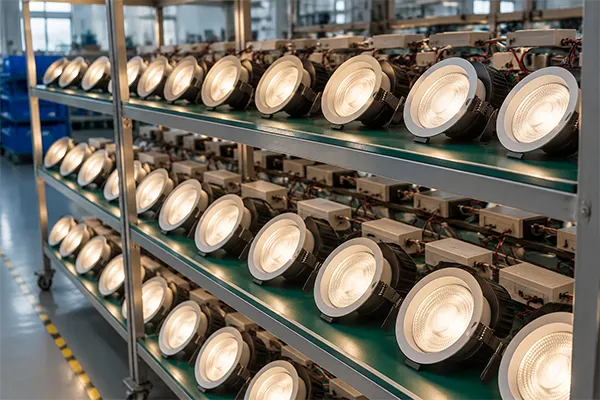
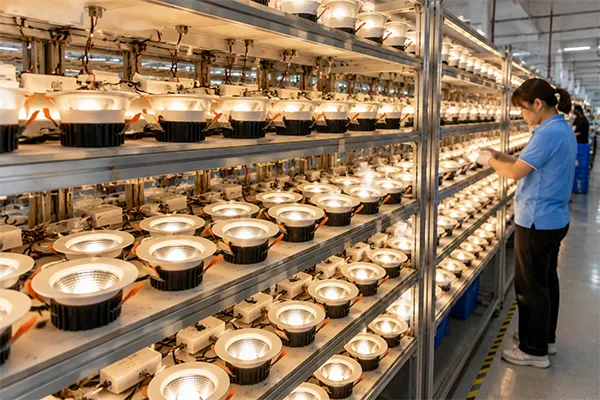
Aging helps screen LED downlights for early functional problems by operating products before shipment.8 At Upward Lighting, every product undergoes a 100% aging test for approximately 4 to 8 hours9, but buyers should understand that aging is a production checkpoint, not a complete guarantee of long-term reliability.
What a 100% Aging Test Can Do
During aging, products are powered under the factory’s defined process so that the team can identify obvious early-stage issues. Depending on the product and internal control method, this can help reveal:
- Units that do not light correctly
- Basic driver or wiring failures
- Visible flicker or unstable operation
- Incorrect color temperature mixing
- Obvious appearance or assembly concerns noticed during handling
- Products that require rework before final release
Our standard workflow includes 100% aging for 4 to 8 hours before shipment. The actual duration should be confirmed for the quoted product and order because requirements can vary with the product design, customer request, and production plan.
What Aging Cannot Prove
Aging is valuable, but it cannot replace good engineering and process control. It does not independently prove:
- A specific lifetime claim
- Performance under every installation temperature
- Compatibility with every dimmer or electrical system
- Long-term color consistency across years of use
- Protection against incorrect installation
- Compliance with all application-specific regulations
A buyer should be cautious if a supplier presents an aging rack as the only evidence of quality. The aging process should sit within a wider control loop that includes correct component selection, incoming material control, assembly checks, final inspection, and packaging verification.
Questions Buyers Can Ask About Aging
The following questions can make an aging claim more meaningful:
| Buyer Question | Procurement Purpose |
|---|---|
| Is aging performed on 100% of the order or by sampling? | Clarifies the scope of screening |
| What is the standard aging duration for this model? | Confirms the agreed process |
| What is checked before and after aging? | Links aging to documented inspection |
| How are failures recorded and handled? | Shows whether corrective action is controlled |
| Can the factory provide production photos or video from the order? | Provides order-specific evidence where appropriate |
| Does the product configuration match the approved sample? | Prevents a test from being applied to the wrong configuration |
I have found that customers respond well when we explain aging in practical terms rather than treating it as a marketing slogan. It is an important checkpoint. It supports shipment screening. Yet repeatable quality begins much earlier, with the specification and materials that enter the production process.
How Do Final Inspection, Packaging, and Scheduling Affect LED Downlight Delivery?
A downlight can pass assembly and aging yet still create commercial problems if the wrong label is applied, cartons are weak, accessories are missing, or the shipment is scheduled before materials are ready. The final release stage connects factory quality control with the buyer’s real delivery requirements.
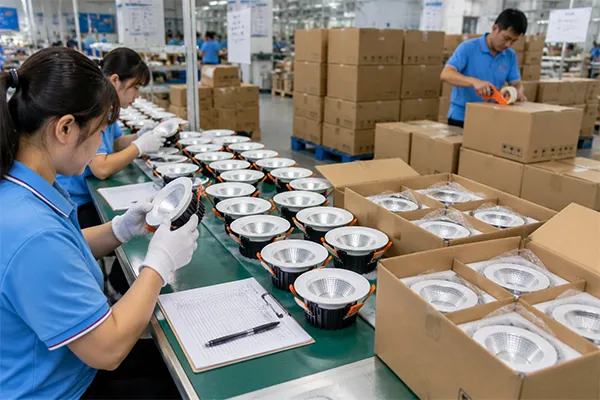
Final inspection for LED downlights should verify the agreed configuration, basic function, appearance, labeling, quantity, and packaging before shipment release. Delivery reliability also depends on material readiness, production scheduling, customization complexity, and clear communication between the buyer and supplier.
Final Release Should Check the Entire Order
Final inspection should not focus only on whether the light turns on. A complete release review may include:
- Correct model, wattage, CCT, beam angle, and trim finish
- Visual appearance against the approved sample
- Basic functional operation
- Product labels and customer branding
- Cable, spring clips, drivers, and required accessories
- Inner box, master carton, barcode, and shipping marks
- Quantity per carton and total shipment quantity
- Carton condition and packing arrangement
For export customers, packaging deserves careful attention. LED downlights may move through several handling stages before reaching a project site, warehouse, distributor, or retail channel. Packaging should reflect the product shape, order quantity, shipping method, and destination requirements.10
Scheduling Is Part of Manufacturing Control
Lead time is not simply the number of days the assembly line needs. It includes the time required for specification approval, material preparation, production planning, aging, inspection, packaging, and shipment coordination.
We recommend that buyers discuss these variables early:
- Is the order a standard configuration or a customized model?
- Are special trim colors, CRI requirements, drivers, or packaging involved?
- Are all labels and artwork approved?
- Does the order require samples before mass production?
- What quantity is needed, and does it meet the practical MOQ for customized materials?
- What shipment date is required, and what is the latest approval date?
A reliable production schedule should account for these dependencies. A supplier that promises an unusually short delivery time without confirming material readiness may create a risk later. At the same time, a supplier with an organized supply chain and clear internal coordination may be able to support faster turnaround for suitable models and quantities.
Certifications and Market Documents
Upward Lighting products hold certifications such as CE and RoHS for relevant market-entry requirements.11 However, buyers should verify the validity, scope, model coverage, and destination-market suitability of all certification documents for the specific product they intend to purchase.
CE and RoHS documents do not automatically answer every procurement question. A buyer may also need to confirm product labeling, electrical requirements, local installation rules, test reports, or project-specific documentation. We recommend qualified professional evaluation for application-specific decisions, especially where local regulations, dimming systems, emergency requirements, or demanding installation conditions apply.
Frequently Asked Questions
How long does it take to manufacture LED downlights in China?
The production timeline depends on the model, order quantity, approved materials, customization level, packaging, and production schedule. Standard configurations can be faster when materials are ready. Customized LED downlights usually require extra time for specification confirmation, sourcing, samples, artwork approval, and controlled production planning.
Does 100% aging mean LED downlights are guaranteed to last for years?
No. A 100% aging test helps screen products for early functional issues before shipment. It does not guarantee a specific lifetime under every installation condition. Long-term performance also depends on component selection, heat management, driver design, production consistency, electrical conditions, and correct installation.
What should I check when selecting a Chinese LED downlight manufacturer?
Buyers should review approved samples, written specifications, material consistency, assembly controls, aging procedures, final inspection criteria, packaging quality, lead-time planning, and communication speed. Buyers should also verify relevant certification documents and confirm that the quoted configuration matches the product they expect to receive.
Can LED downlights be customized for local lighting brands?
Yes, many manufacturers can support OEM or ODM requirements such as custom wattage, CCT, beam angle, CRI, trim color, logo, label, and packaging. Buyers should confirm the MOQ, sample process, material lead time, pricing impact, and approval steps before placing a customized production order.
Is a low-priced LED downlight always lower quality?
No. A lower quotation may result from higher order volume, a simpler configuration, standard materials, basic packaging, or efficient supply-chain planning. Buyers should compare the full product specification, component configuration, quality-control process, aging arrangement, and delivery terms rather than comparing unit price alone.
Conclusion
The manufacturing of LED downlights is not simply an assembly-line activity. It is a closed control loop that starts with a frozen specification and continues through materials, assembly, aging, final inspection, packaging, and scheduling. At Upward Lighting, we use this workflow to support repeatable production for global importers, contractors, distributors, and lighting brands. If you need a quotation, OEM/ODM review, or sample discussion for a downlight project, contact our team with your target specification and market requirements.
"The Latest in LED Lighting Test Method and Standards", https://www.energystar.gov/sites/default/files/asset/document/Lighting_Test_Methods_and_Standards-Jiao.pdf. LED-luminaire production commonly combines component assembly with electrical, photometric, and quality-control testing before products enter distribution. Evidence role: general_support; source type: research. Supports: That LED luminaires are typically produced through controlled component assembly and verified through testing and quality-assurance activities before distribution.. Scope note: Specific process sequencing and release procedures vary by manufacturer and product design. ↩
"2019 Solid-State Lighting R&D Opportunities", https://www.energy.gov/sites/prod/files/2020/01/f70/ssl-rd-opportunities2-jan2020.pdf. Research on LED spectral engineering shows that increasing color-rendering performance can entail trade-offs in luminous efficacy and package design, which may affect component selection. Evidence role: mechanism; source type: paper. Supports: That LED spectral designs optimized for higher color rendering may involve efficacy and component-design trade-offs.. Scope note: The resulting quotation impact depends on supplier sourcing, target CCT, performance binning, and order volume. ↩
"Model-Based Enterprise Summit Report", https://nvlpubs.nist.gov/nistpubs/technicalnotes/NIST.TN.1820.pdf. Quality-management guidance recognizes control and verification of externally supplied materials as important measures for ensuring that production inputs conform to specified requirements. Evidence role: general_support; source type: institution. Supports: That quality-management systems require organizations to control externally provided materials and verify their conformity to specified requirements.. Scope note: Such guidance supports the control principle but does not establish the performance of any individual supplier. ↩
"Engineering Change Management Concepts for Systems ...", https://tsapps.nist.gov/publication/get_pdf.cfm?pub_id=913323. Manufacturing quality research identifies uncontrolled changes in materials and processes as sources of unit-to-unit and batch-to-batch variation. Evidence role: mechanism; source type: research. Supports: That uncontrolled variation in production inputs and processes can produce variation between initial samples and subsequent manufactured units.. Scope note: The extent of variation depends on the design, process capability, supplier controls, and inspection regime. ↩
"Investigating the Impact of Standards-Based ...", https://nvlpubs.nist.gov/nistpubs/gcr/2016/NIST.GCR.15-1009.pdf. Quality-management standards describe controlled production conditions, documented work information, and monitoring activities as mechanisms for maintaining conformity during manufacture. Evidence role: general_support; source type: institution. Supports: That controlled production conditions, documented information, and monitoring are standard elements of quality-management systems.. Scope note: Conformance to these principles does not by itself demonstrate that a particular production line is consistently effective. ↩
"High Operating Temperature Interconnects for LED ...", https://energy.gov/sites/prod/files/2015/02/f19/bhatkal_interconnects_sanfrancisco2015.pdf. LED thermal-management literature shows that junction temperature and the effectiveness of the thermal path influence LED optical performance and reliability. Evidence role: mechanism; source type: government. Supports: That LED junction temperature and thermal-path design affect LED performance, efficacy, color behavior, and reliability.. Scope note: Thermal performance must be assessed for the complete luminaire, including ambient conditions, driver heat, and installation environment. ↩
"Vendor Visit Report Format", https://training.jacksonms.gov/Resources/VA63wi/272015/vendor-visit_report_format.pdf. Supplier-assessment guidance generally evaluates documented systems, process capability, quality records, and performance evidence in addition to observations made during site audits. Evidence role: expert_consensus; source type: institution. Supports: That supplier evaluation commonly considers documented quality systems, capability, records, performance, and audit evidence rather than relying solely on facility appearance.. Scope note: The appropriate depth of evaluation depends on product risk, regulatory obligations, and the buyer's purchasing controls. ↩
"Reliability of Manufactured Products", https://www.fda.gov/inspections-compliance-enforcement-and-criminal-investigations/inspection-technical-guides/reliability-manufactured-products. Reliability literature describes burn-in and related screening methods as tools for detecting some early-life electronic failures before field deployment. Evidence role: mechanism; source type: paper. Supports: That burn-in or environmental-stress screening can expose certain early-life failures in electronic products.. Scope note: The screening outcome depends on test duration, electrical and thermal stress conditions, failure mechanisms, and inspection criteria. ↩
"Screening Electronic Components", https://www.fda.gov/inspections-compliance-enforcement-and-criminal-investigations/inspection-guides/screening-electronic-components. Production aging records for the identified order or model should document the population tested, test duration, operating conditions, failures observed, and disposition of nonconforming units. Evidence role: case_reference; source type: other. Supports: That the stated 100% aging practice and duration are documented for the relevant production order or model.. Scope note: General reliability literature cannot verify this manufacturer-specific practice; verification requires contemporaneous factory records or independent audit evidence. ↩
"June 2005 Proper Packaging Required to Maintain ...", https://www.nist.gov/document/h-005pdf. Transport-packaging guidance evaluates package performance in relation to the packaged product and the handling, vibration, compression, and other hazards expected in distribution. Evidence role: general_support; source type: institution. Supports: That protective transport packaging should be designed and evaluated in relation to product characteristics and expected distribution hazards.. Scope note: Package adequacy must be validated for the actual product, pack configuration, transport route, and handling conditions. ↩
"EU WEEE_RoHS", https://www.trade.gov/eu-weeerohs. Under EU rules, CE marking indicates a manufacturer's declaration that a product meets applicable EU requirements, while RoHS sets restrictions on specified hazardous substances in electrical and electronic equipment. Evidence role: definition; source type: government. Supports: That CE marking is a manufacturer's conformity declaration for applicable EU requirements and that RoHS restricts specified hazardous substances in electrical and electronic equipment.. Scope note: This regulatory context does not verify the validity, model coverage, or destination-market applicability of any particular manufacturer's documents. ↩