LED downlight specifications often look simple on a quotation, yet choosing by wattage or lumen output alone can create uneven light, uncomfortable glare, poor color presentation, or dimming issues after installation. In our pre-sales conversations, we help project teams start with the space, task, mounting conditions, and system requirements before narrowing product parameters.
Lighting designers choose LED downlight specifications by first defining how the space will be used, what occupants need to see, the mounting height, and the fixture layout. They then evaluate beam angle, light distribution, color temperature, CRI, glare control, dimming compatibility, appearance, and installation constraints together. Wattage and lumens remain important, but neither figure alone predicts the final lighting result.1
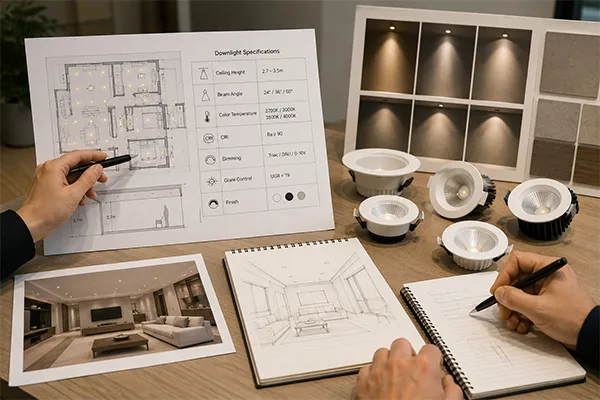
In our experience as an LED downlight manufacturer, many inquiries begin with a short request such as “Please quote 12W” or “We need 1,000 lumens.” Those are useful starting points, but they do not tell us where light needs to land or how the complete installation should perform. Better project inputs lead to more relevant, feasible quotations.
Why Should LED Downlight Specifications Start With the Space and Visual Task?
A project team can select an efficient-looking downlight and still face problems if the fixture does not support the activity in the room. The risk increases when the quotation begins with output only. We encourage buyers to define what people need to see and do before comparing product models.
The first step in selecting LED downlight specifications is to identify the space type, visual task, mounting height, ceiling condition, and preliminary fixture layout. These inputs help a project team assess whether a downlight’s distribution, output range, beam angle, and glare-control options are appropriate for the intended application.
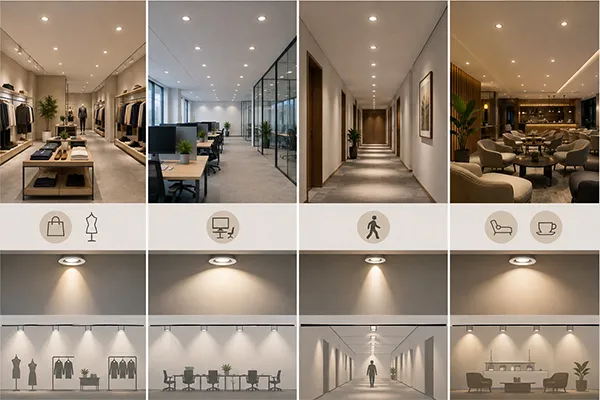
Start With the Activity, Not the Product Code
A downlight can serve very different purposes. It may provide general ambient light in a corridor, support product presentation in a retail area, contribute to a calm atmosphere in a hotel room, or supplement task lighting in an office. Each condition changes the questions that should be asked before purchase.
When our team receives a project inquiry, we usually need more than a requested wattage. We ask buyers to share the conditions behind the request:
- What is the room used for? Examples include a lobby, apartment, boutique, meeting room, corridor, restaurant, or bathroom.
- What must occupants see clearly? This may include merchandise, signage, work surfaces, food, architectural finishes, or circulation paths.
- What is the ceiling and mounting height? A recessed downlight installed in a low ceiling behaves differently from one installed at a greater height.
- Is the fixture intended for general lighting, accent lighting, or both?
- What is the initial spacing or grid arrangement?
- Are there reflective, dark, glossy, textured, or color-sensitive surfaces?
These questions are not a substitute for professional lighting design or lighting calculations. A qualified lighting designer or project engineer should evaluate application-specific layouts, photometric files, site conditions, and final compliance requirements. However, they make supplier communication much more precise.
Why Mounting Height Changes the Procurement Conversation
Mounting height affects where the beam reaches and how light is distributed across the space.2 A specification that appears suitable on a product sheet may need reconsideration when the actual ceiling height and spacing are known.
For example, a purchaser may ask us to quote the same LED downlight model for a reception area and a corridor. If the two areas have different ceiling heights, surface finishes, or fixture spacing, the same specification may not be the most suitable option for both locations. We do not assume that a single model is automatically the best answer across every room.
In our quotation discussions, the most productive question is often not “How many watts is it?” It is “Where will this downlight be installed, and what should the light do there?”
A Practical Pre-Quotation Brief
Before requesting pricing, we recommend that project contractors prepare a short brief. Even incomplete information is better than none.
| Project input | Why it matters for selection | Useful detail to share |
|---|---|---|
| Space use | Connects the fixture to the visual task | Lobby, office, retail, residential, corridor |
| Ceiling height | Influences distribution and beam evaluation | Finished floor to ceiling or fixture height |
| Layout and spacing | Helps evaluate where light may land | Ceiling drawing, reflected ceiling plan, rough grid |
| Ceiling type | Confirms installation feasibility | Gypsum board, concrete, metal, recessed depth |
| Surface finishes | Influences visual comfort and color perception | White wall, timber, dark stone, glossy tile |
| Required controls | Identifies dimming and driver needs | On/off, phase-cut, 0–10V, DALI, other system |
| Appearance requirements | Supports product consistency | Trim color, bezel style, cutout size, finish |
This approach helps us translate project requirements into configurable product options. It also helps buyers avoid comparing quotations that appear similar but are based on different assumptions.
How Do Beam Angle and Layout Affect LED Downlight Specifications?
Equal wattage and equal lumen figures do not guarantee equal lighting distribution. A fixture’s beam angle, optical design, mounting position, and spacing determine where the delivered light goes. Ignoring these factors can leave some areas overemphasized while others receive insufficient or inconsistent illumination.
Beam angle and layout are central LED downlight specifications because they influence the spread of light, the relationship between fixtures, and the visual balance of a ceiling plan. Buyers should assess beam distribution alongside mounting height, spacing, target surfaces, and photometric documentation rather than comparing lumen output alone.
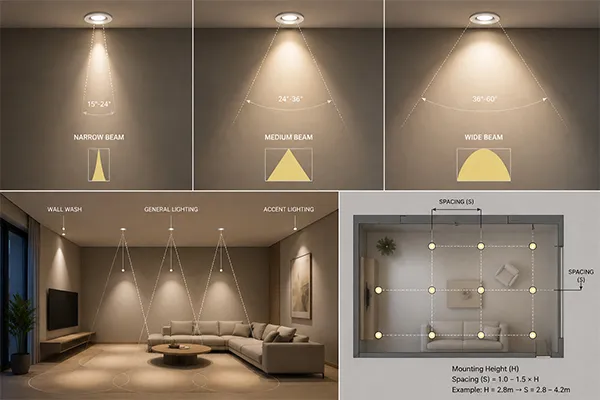
The Same Lumens Can Produce Different Impressions
Lumen output describes the quantity of visible light emitted by a source3, but it does not explain how the light is distributed in a real room. Two downlights can list similar output figures while producing a noticeably different visual effect because their optics direct light differently.4
A narrower beam may concentrate light within a smaller area. A wider beam may spread light across a broader area. Neither option is universally better. The appropriate choice depends on whether the project needs emphasis, general illumination, wall-related visual interest, or a combination of lighting layers.
In practical procurement, we see a recurring pattern: a buyer sends a wattage and lumen target but does not provide ceiling drawings, mounting height, or intended spacing. We can quote a product, but the quote is necessarily more generic. When the buyer later shares the layout, we may need to revisit beam-angle options, trim styles, or output configurations.
Evaluate Beam Angle as Part of a System
A useful discussion includes the interaction of several variables:
- Fixture output: The delivered light output should be assessed from product documentation, using the relevant test basis where available.
- Beam angle: This influences how concentrated or broad the light distribution may be.
- Mounting height: This changes the distance between the fixture and the illuminated plane or surface.
- Fixture spacing: This influences overlap, spacing impressions, and consistency across the installation.
- Surface characteristics: Dark, textured, reflective, or colored surfaces can change the visual perception of light.5
- Other luminaires: Track lights, linear lights, wall lights, daylight, and decorative fixtures may all affect the total lighting environment.
Ask for the Right Documentation
For project evaluation, buyers may request product documents that support technical review. Depending on the product and project, these can include:
- Dimensional drawings and cutout dimensions
- Datasheets covering power, CCT, CRI, beam angle, and input requirements
- Photometric information, where available and applicable
- Driver specifications and dimming details
- Installation instructions
- Product certification documents required by the destination market
We recommend that technical leads review these documents against the complete lighting plan. A manufacturer can provide product information and configurable options, but final lighting calculations, design approval, and site-specific suitability should remain with qualified project professionals.
Avoid the “Highest Lumen Wins” Shortcut
A higher headline output may look attractive during a quotation comparison. However, it can be the wrong purchasing criterion if the light is not directed appropriately, if glare becomes a concern, or if the product does not match the ceiling layout.
The stronger procurement question is: Which combination of output, beam angle, mounting condition, and spacing best supports the intended lighting design? This question is more demanding, but it reduces the risk of expensive changes after cutouts are made and fixtures are installed.
Which LED Downlight Specifications Should Be Decided Early for Visual Comfort?
Color temperature, CRI, glare control, and dimming are sometimes treated as optional upgrades after a fixture model has already been selected. That sequence can create avoidable compatibility and visual-quality risks. We find it is better to identify these needs early, while the fixture configuration remains flexible.
LED downlight specifications for CCT, CRI, glare control, and dimming should be confirmed early because they affect visual comfort, material and color presentation, atmosphere, and control-system compatibility. Buyers should connect each parameter to the intended use of the space and verify the full system before final procurement.
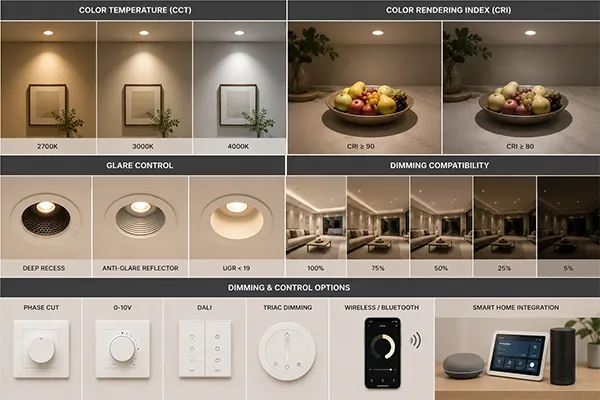
Color Temperature Should Support the Intended Atmosphere
Color temperature, commonly expressed in Kelvin (K), influences whether light appears warmer or cooler.6 A warm appearance may be preferred in hospitality or residential settings, while a more neutral or cooler appearance may be considered for other commercial environments. Yet there is no universal CCT for every project.
The important procurement point is consistency. Buyers should specify the required color temperature for each zone and confirm how it will be managed across the order. Mixed CCTs can be visually distracting when fixtures are installed together, especially in open ceilings or areas with continuous sightlines.
At Upward Lighting, we can discuss configurable color temperature requirements as part of an OEM/ODM inquiry. We ask buyers to confirm their required CCT before production rather than treating it as a late-stage detail.
CRI Matters When Color and Materials Matter
Color Rendering Index, or CRI, indicates how faithfully a light source may render colors compared with a reference source under the test conditions.7 It is particularly relevant where people evaluate merchandise, finishes, food, fabrics, skin tones, artwork, or branded color palettes.8
A buyer does not need to specify the highest available CRI for every application automatically. Higher color-rendering requirements may affect product selection, lead time, cost, and availability. The correct choice depends on the visual task and project standard.
| Specification area | Procurement question | Potential risk if delayed |
|---|---|---|
| CCT | What light appearance is required in each zone? | Mixed visual appearance across installed fixtures |
| CRI | Are merchandise, finishes, or color-sensitive materials involved? | Unsuitable color presentation |
| Glare control | Are users seated, looking upward, or exposed to direct views of fixtures? | Reduced visual comfort |
| Dimming | What control protocol and dimmer system will be used? | Flicker, limited dimming range, or incompatibility9 |
| Trim finish | Does the fixture need to blend into a specific ceiling design? | Mismatched visual appearance |
Glare Control Is a Comfort and Design Issue
Glare is not only a technical term. Occupants may experience it as discomfort, distraction, or harsh brightness when they look toward a luminaire.10 The risk can depend on viewing direction, ceiling height, beam distribution, fixture recess depth, reflector design, room finishes, and the presence of screens or seated occupants.11
We encourage buyers to state whether visual comfort is a priority in the project. For example, office, hospitality, residential, and education environments may have different glare-related expectations. A deep anti-glare design or a different optical configuration may be worth considering, subject to the overall design review.
Dimming Compatibility Must Be Verified Across the Full System
A “dimmable” label alone is not enough for a project specification. The driver, dimmer, control protocol, wiring approach, and installation conditions need to work together.12 Common requirements may include phase-cut dimming, 0–10V dimming, or DALI control, but compatibility depends on the specific components selected.
Buyers should provide the control requirement before quotation. They should also verify compatibility with the intended dimming system through appropriate technical review and testing. We can supply driver-related product information, but we do not assume compatibility without knowing the exact control conditions.
How Can Buyers Communicate LED Downlight Specifications to Suppliers?
Generic requests create generic quotations. This can slow down technical clarification and increase the chance that a selected fixture will need changes later. A clear specification brief gives suppliers enough context to propose feasible configurations and helps buyers compare quotations on a like-for-like basis.
Buyers can reduce sourcing risk by sending LED downlight specifications with project use, mounting height, layout, beam preference, CCT, CRI, dimming requirements, installation details, appearance needs, quantities, and destination-market documentation requirements. This lets suppliers quote a matched configuration rather than a generic downlight model.
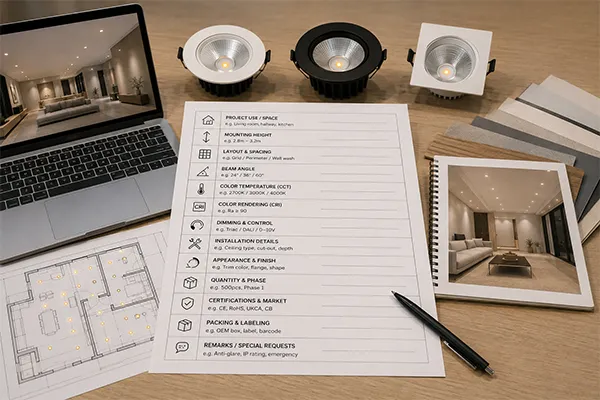
Build a Request for Quotation That Suppliers Can Use
We work with contractors, importers, distributors, local lighting brands, and project teams. The inquiries that move fastest are not always the longest. They simply provide the information needed to avoid assumptions.
A practical LED downlight request for quotation can include:
- Project location and destination market
- Application and space type
- Required quantities, including any pilot or small-batch order
- Product type: recessed, surface-mounted, trimless, adjustable, or another format
- Ceiling cutout, recess depth, and installation limitations
- Required wattage range or output target, if already defined
- Beam-angle preference or intended lighting purpose
- CCT and CRI requirements
- Driver and dimming protocol
- Housing and trim finish, such as white, black, or custom color
- IP requirement where the installation area requires it
- Target delivery date and packaging requirements
- Required technical documents and certification expectations
Separate Mandatory Requirements From Preferences
One of the most useful habits is to divide the brief into non-negotiable requirements and preferences. This helps the supplier identify where configuration is possible and where a requested combination may require a different product platform.
For example, a specific cutout size, dimming protocol, destination-market requirement, or ceiling depth may be non-negotiable. A trim finish or a preferred beam angle may have more flexibility, depending on the project. This distinction can prevent a quotation from being rejected simply because a supplier guessed incorrectly about priorities.
Use Samples and Documentation as Quality-Control Steps
For repeat procurement or a project with significant visual requirements, samples can support a more informed decision. A sample review does not replace a full lighting mock-up or professional project assessment, but it can help buyers check physical aspects such as:
- Trim finish and visible appearance
- Cutout fit and installation method
- Basic build quality and labeling
- CCT and perceived consistency relative to the project’s expectations
- Dimming behavior with the intended compatible system, where testing is possible
- Packaging and product identification
At Upward Lighting, we perform a 100% aging test before shipment, typically lasting 4 to 8 hours, as part of our production quality-control process. Buyers should still define their own inspection requirements and verify agreed specifications through samples, documentation, and pre-shipment checks appropriate to their project.
Verify Compliance Documents Rather Than Assuming
Our products may be supplied with documentation such as CE and RoHS certifications, depending on the product and market requirements. However, buyers should verify that the relevant documents apply to the exact model, configuration, destination market, and current project requirement. Certification needs can vary by location, installation type, importer responsibility, and customer specification.
This is why clear supplier communication is not only an administrative task. It is a form of procurement risk control. It helps align the product, documents, delivery expectation, and quality checks before production begins.
Frequently Asked Questions
Should I choose LED downlights by wattage or lumens?
I recommend using wattage and lumens as comparison points, not as the full selection method. The project team should also evaluate beam angle, mounting height, spacing, CCT, CRI, glare control, and dimming needs. Similar wattage or lumen figures can create different lighting distributions in different spaces.
What information should I send with an LED downlight quotation request?
I suggest sending the space use, ceiling height, layout or fixture spacing, cutout size, quantities, CCT, CRI, beam-angle preference, dimming protocol, trim finish, destination market, and delivery target. A reflected ceiling plan or room drawing can also help suppliers identify feasible options.
Why is beam angle important for recessed LED downlights?
Beam angle affects how broadly or narrowly a downlight distributes light. It should be considered with mounting height and fixture spacing, since these factors influence where light reaches. Buyers should review available photometric information and seek qualified design evaluation for final project decisions.
When should I specify CRI for a downlight project?
I recommend deciding CRI early when the space includes color-sensitive materials, retail merchandise, food, decorative finishes, artwork, or branding. The appropriate CRI depends on the application and project requirements. Buyers should avoid assuming that one CRI level is necessary for every room.
How do I confirm LED downlight dimming compatibility?
I recommend identifying the exact dimming method and control equipment before placing an order. The downlight driver, dimmer, protocol, wiring, and site conditions should be reviewed as one system. Product documentation and sample testing can support verification, but qualified technical evaluation remains important.
Conclusion
Choosing LED downlight specifications is not a matter of selecting the highest wattage or lumen figure on a product list. I recommend starting with the space, visual task, ceiling height, layout, and installation constraints. From there, buyers can assess beam angle, CCT, CRI, glare control, dimming, appearance, and documentation in a more controlled way. If you are sourcing configurable LED downlights for a project or product line, our team at Upward Lighting can help translate your project brief into a practical OEM/ODM quotation and sample discussion.
"[PDF] Understanding Fixture Design Tools", https://www1.eere.energy.gov/buildings/publications/pdfs/ssl/bair_msslc-boston2012.pdf. Lighting-design guidance explains that lumen output is only one input to installed lighting performance; luminaire distribution, mounting geometry, room surfaces, and layout affect the illumination and visual conditions produced in a space. Evidence role: general_support; source type: government. Supports: Lighting quantity and performance in a space depend on luminaire distribution and installation geometry in addition to lamp or luminaire light output.. Scope note: The guidance supports the general principle and does not determine the suitability of a particular downlight for a specific project. ↩
"[PDF] Understanding Fixture Design Tools", https://www1.eere.energy.gov/buildings/publications/pdfs/ssl/bair_msslc-boston2012.pdf. Photometric design principles show that changing mounting height changes the distance and angles between a luminaire and the task plane, thereby altering beam coverage, illuminance, and the spacing relationship between fixtures. Evidence role: mechanism; source type: institution. Supports: The distance between a luminaire and the illuminated plane affects illuminance, beam coverage, and spacing relationships.. Scope note: Actual results also depend on the luminaire’s photometric distribution, aiming, room geometry, and surface reflectance. ↩
"[PDF] Detector-based luminous-flux calibration using the Absolute ...", https://tsapps.nist.gov/publication/get_pdf.cfm?pub_id=841257. The lumen is the SI-derived unit for luminous flux, describing the quantity of light weighted according to human visual sensitivity emitted by a source. Evidence role: definition; source type: government. Supports: The lumen is the SI-derived unit used to express luminous flux, a measure of visible light output.. ↩
"Measurement of Solid-State-Lighting Products | NIST", https://www.nist.gov/publications/measurement-solid-state-lighting-products-0. Photometric practice distinguishes total luminous flux from luminous-intensity distribution: luminaires with similar lumen output can direct that flux into substantially different angular patterns through their optical systems. Evidence role: mechanism; source type: institution. Supports: Luminaires with the same total luminous flux may have different luminous-intensity distributions because of their optics.. Scope note: Different photometric distributions establish different potential lighting effects, while the final visual impression remains dependent on the installation and surrounding environment. ↩
"[PDF] Energy impact of human health and wellness lighting ...", https://www.energy.gov/eere/ssl/articles/energy-impact-human-health-and-wellness-lighting-recommendations-office-and. Lighting-design guidance recognizes that the reflectance and finish of room surfaces affect reflected light and luminance patterns, which in turn influence perceived brightness and visual conditions. Evidence role: mechanism; source type: government. Supports: Room-surface reflectance and finish influence reflected light, luminance patterns, and perceived brightness.. Scope note: Surface characteristics are one of several factors affecting perception; daylight, viewing direction, and luminaire distribution also matter. ↩
"Understanding LED Color-Tunable Products | Department of Energy", https://www.energy.gov/cmei/ssl/understanding-led-color-tunable-products. Correlated color temperature (CCT), reported in kelvin, is used to describe the chromatic appearance of white light, with lower CCTs generally perceived as warmer and higher CCTs as cooler. Evidence role: definition; source type: government. Supports: Correlated color temperature, measured in kelvin, characterizes the warm-to-cool chromatic appearance of white light sources.. Scope note: CCT describes chromatic appearance and does not by itself establish color-rendering quality, visual comfort, or application suitability. ↩
"The Color Quality Scale - NIST", https://www.nist.gov/publications/color-quality-scale. The CIE general color-rendering index (Ra) is a standardized measure comparing the color appearance of specified test samples under a test light source with their appearance under an appropriate reference illuminant. Evidence role: definition; source type: institution. Supports: The general color-rendering index compares the color appearance of test samples under a test source with their appearance under a reference illuminant using specified methods.. Scope note: CRI has recognized limitations and should not be treated as the sole predictor of color preference or the rendering of every material, object, or skin tone. ↩
"Purchasing Energy-Efficient Light Bulbs", https://www.energy.gov/cmei/femp/purchasing-energy-efficient-light-bulbs. Lighting guidance identifies color-rendering properties as relevant in applications where people need to discriminate, assess, or present the colors of objects, materials, merchandise, and finishes. Evidence role: general_support; source type: institution. Supports: Color-rendering properties are an important lighting-design consideration where accurate or appealing color discrimination is needed.. Scope note: The appropriate metric and performance level depend on the visual task, the objects viewed, the illuminance, and the project’s design objectives. ↩
"[PDF] Specifying LED in a World of Continuous Change", https://www.energy.gov/sites/prod/files/2014/11/f19/miller-hershman-yorgey-willcock_specifying_detroit2014.pdf. Industry technical guidance documents that incompatible LED drivers and dimming controls can lead to flicker, unstable operation, limited dimming range, dead travel, or failure of the system to operate as intended. Evidence role: general_support; source type: institution. Supports: Mismatched LED drivers and dimming controls can produce undesirable effects such as flicker, unstable operation, limited dimming range, or failure to dim.. Scope note: These outcomes are potential compatibility issues, not inevitable results in every installation, and diagnosis requires testing of the specific components. ↩
"Assessment of Discomfort Glare from Daylight in Buildings | CIE", https://cie.co.at/publications/assessment-discomfort-glare-daylight-buildings. Lighting terminology defines discomfort glare as visual discomfort or annoyance arising from excessive luminance, luminance contrast, or unsuitable luminance distribution within the observer’s field of view. Evidence role: definition; source type: institution. Supports: Discomfort glare is visual discomfort or annoyance caused by excessive luminance or luminance contrasts in the field of view.. Scope note: Individual glare response varies with observer position, adaptation level, task, age, and the geometry of the lighting installation. ↩
"Discomfort glare in interior lighting | CIE", https://cie.co.at/publications/discomfort-glare-interior-lighting. Established glare-evaluation methods account for the observer’s viewing geometry together with luminaire luminance, apparent size and position, background luminance, and characteristics of the surrounding space. Evidence role: mechanism; source type: institution. Supports: Glare evaluation considers observer position, viewing direction, luminaire luminance and geometry, background luminance, and room geometry.. Scope note: The listed design features may influence glare but do not alone yield a reliable glare rating without project-specific photometric and observer-position data. ↩
"[PDF] Specifying LED in a World of Continuous Change", https://www.energy.gov/sites/prod/files/2014/11/f19/miller-hershman-yorgey-willcock_specifying_detroit2014.pdf. Technical guidance on LED controls notes that dimming behavior depends on compatibility between the LED driver and the dimmer or control system, including the applicable control method and installation arrangement. Evidence role: mechanism; source type: government. Supports: LED dimming performance depends on the interaction between the LED driver and the selected control or dimmer system.. Scope note: Compatibility must be confirmed for the exact driver, dimmer, control topology, and electrical installation rather than inferred from a generic “dimmable” designation. ↩