

LED downlights can help lighting distributors grow when they are selected as a focused, repeatable product range rather than a large collection of low-priced SKUs. I see stronger commercial potential when distributors match products to their customer base, control inventory risk, quote quickly, verify compliance documents, and build dependable replenishment plans with qualified suppliers.

Many distributors feel pressure to offer more products, lower their prices, and compete with every local supplier. That approach can create slow-moving stock and price-only discussions. I believe LED downlights become a more practical growth category when distributors start with the needs of their existing contractors, wholesalers, and project customers.
Why Should Distributors Build a Focused LED Downlights Range?
A broad LED downlight catalog can look attractive during supplier selection, but every additional variant creates an inventory decision1. I often see buyers request many wattages, cutout sizes, finishes, and color temperatures before confirming which combinations their customers actually reorder.
Distributors should build a focused LED downlights range by selecting a small number of configurations that match their main customers, applications, and regional requirements. A core range can improve stock visibility, quotation speed, purchasing control, and replenishment planning2 before a distributor adds niche or project-specific variants.

Start With Existing Customer Demand
I recommend that distributors begin with their current sales channels rather than with the largest possible factory catalog. A building-material wholesaler may need simple, fast-moving recessed products for residential renovation. A project-oriented distributor may need a more controlled range with defined photometric requirements, installation details, and documentation support.
In our quotation discussions, I regularly find that buyers already have clues about their strongest opportunities. They may receive repeated inquiries for a particular cutout size, a common warm-white color temperature, or a certain IP-rated product for covered outdoor areas. These repeated requests are usually more useful than a supplier’s longest SKU list.
A practical first assortment often includes:
- Two to three wattage levels for common ceiling heights and room sizes
- One or two cutout sizes that match local installation practices
- Warm white and neutral white options where the market consistently requests both
- A standard white finish, with black or other finishes only when demand supports them
- A defined driver approach, such as fixed-output or dimmable models based on buyer needs
- Clear documentation for the target market, including certification documents that buyers should verify independently
The goal is not to make every customer request fit one product. A so-called universal downlight can create problems when its beam, output, color, installation method, or compliance documentation does not suit the actual application. The goal is to create a manageable group of products that sales teams can explain, stock, quote, and reorder with confidence.
Treat Every SKU as a Stock Commitment
Each additional LED downlight model can increase complexity across purchasing, warehousing, sales training, packaging, and after-sales handling.3 A variant might be technically interesting but commercially weak if it only sells once or twice each year.
I suggest that distributors review each product using a simple stock-risk framework:
| Evaluation question | Why it matters for distributors |
|---|---|
| Who is likely to buy this model? | It identifies the channel, customer type, and likely sales route. |
| Is the request recurring or project-specific? | It helps distinguish core stock from order-based supply. |
| Can the sales team explain the application? | It reduces incorrect quotations and unsuitable product recommendations. |
| Does the product share parts or packaging with other models? | It can simplify replenishment and reduce purchasing complexity. |
| Is there a realistic reorder pattern? | It supports more predictable inventory planning. |
| Does the product meet relevant local requirements? | It reduces avoidable compliance and market-entry risk. |
I view a focused assortment as a commercial discipline, not a limitation. It gives distributors a base for repeat business while keeping capital available for proven opportunities.
A distributor can still offer broader choices through project quotations or supplier-supported special orders. However, stock should normally follow demonstrated demand, not only supplier availability.
How Can LED Downlights Protect Margin Beyond Unit Price?
Low purchase cost is important, but it is not the same as higher channel profit. I have seen many purchasing conversations begin with a target price and later move toward delivery, specification changes, packaging, certification files, and replacement concerns because the original comparison was too narrow.
LED downlights can support healthier distributor margins when buyers evaluate total commercial cost rather than unit price alone.4 Product consistency, quote speed, suitable specifications, documentation availability, packaging, delivery reliability, and replenishment capability can all affect the cost of serving customers and protecting repeat-order opportunities.

Calculate the Commercial Cost of a Product
A lower-priced downlight may look favorable on a purchase order, but the initial saving can disappear if the model causes quotation delays, specification confusion, damaged packaging, inconsistent supply, or difficult customer communication.
I encourage buyers to compare suppliers with a broader view of commercial value:
| Cost or value factor | Potential channel consequence |
|---|---|
| Unit purchase price | Directly affects initial gross margin, but it is only one factor. |
| Quotation turnaround | Faster responses can help distributors answer contractor and project inquiries before competitors.5 |
| Specification consistency | Clear, repeatable parameters reduce the risk of selling a different version on later orders. |
| Packaging quality and labeling | Better identification can support warehouse efficiency and reduce handling confusion. |
| Documentation coordination | Accessible CE, RoHS, or other relevant documents can support market-entry review, subject to buyer verification. |
| Lead-time communication | Realistic delivery planning helps distributors manage customer expectations. |
| Replacement and after-sales process | A defined process can reduce uncertainty if an issue is reported. |
At Upward Lighting, I support customers through recurring quotation requests, specification confirmation, certification coordination, and delivery planning. I know that these activities are not separate from the product itself. For a distributor, they can affect how easily a product is sold and replenished.
Use Quote Speed as a Competitive Capability
In many electrical and building-material channels, a customer does not wait long for a response. Contractors may need a same-day indication of price, lead time, cutout size, color temperature, or available stock. Project buyers may need a more detailed response that confirms wattage, beam angle, driver type, finish, and documentation.
A distributor does not need to promise immediate answers to every technical question. However, the distributor should build a process that separates common requests from specialist requests.
For example:
- Core stock inquiries: Sales staff can quote standard LED downlights from an approved product sheet.
- Project inquiries: Sales staff can collect application details before confirming the specification.
- Special requests: The distributor can request factory review for non-standard finishes, branding, packaging, or electrical parameters.
- Compliance-sensitive requests: The buyer can review applicable regulatory requirements and verify supplier documents before committing.
I have seen this structure reduce unnecessary back-and-forth in quotation discussions. It also helps a distributor avoid treating every request as an urgent custom-development project.
Evaluate Quality Control With Appropriate Caution
Manufacturing controls matter, but buyers should assess them carefully. At our facility, each product undergoes a 100% aging test for approximately 4 to 8 hours before shipment6. I consider this a useful manufacturing control for identifying certain early issues before dispatch. It should not be treated as proof of long-term field performance in every installation, climate, electrical environment, or usage pattern.7
Distributors should ask suppliers practical questions such as:
- What incoming material checks are used?
- How are product specifications controlled between orders?
- What aging or functional tests are performed before shipment?
- How are production records and batch identification managed?
- What is the process if product concerns are reported?
- Can the supplier provide relevant certification documents for independent review?
This type of supplier evaluation helps buyers compare operational readiness, not simply product claims.
Which LED Downlight Specifications Matter Most for Sellability?
Technical specifications can be difficult to turn into a sales strategy. I often receive requests that list wattage, color temperature, CRI8, and beam angle without describing the application. Those numbers become more useful when distributors connect them to customer expectations, installation conditions, and stock planning.
The most important LED downlight specifications are the ones that affect application fit, buying decisions, installation compatibility, and reorder consistency. Distributors should select wattage, color temperature, beam angle, CRI, cutout size, IP rating9, driver options, and compliance documentation according to their target customers rather than treating every parameter as universally important.
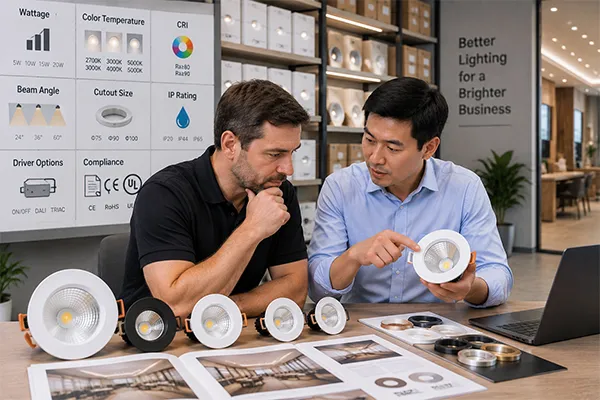
Match Specifications to Commercial Use Cases
A downlight for a residential renovation customer is not necessarily appropriate for a retail display, office corridor, hospitality project, or covered exterior area. The product may look similar, yet the commercial requirement can differ.
Here is how I translate common specifications into channel decisions:
| Specification | Practical meaning for distributors |
|---|---|
| Wattage and lumen output10 | These influence suitability for room size, mounting height, ambient light, and customer expectations. |
| Color temperature11 | This affects the visual feel of the space and can vary by country, project type, and end-user preference. |
| Beam angle | This affects light distribution, spacing, accent effects, and visual comfort. |
| CRI | Higher CRI may be more relevant where color appearance matters, such as retail, hospitality, or display areas. |
| Cutout size | This has a direct effect on installation compatibility and replacement-market sellability. |
| Trim finish | Standard finishes may be easier to stock; special finishes can support defined design-led opportunities. |
| IP rating | This affects suitability for locations exposed to moisture, dust, or outdoor conditions. |
| Dimming and driver type | These affect system compatibility and should be confirmed before product selection. |
Avoid the “One Product for Everything” Mistake
I do not recommend that distributors market one LED downlight as the answer to every project. A product with a narrow beam may work well for accent lighting but may not provide the desired general illumination. A high-output model may be unsuitable for a low ceiling. A specific color temperature may be welcomed in one region and less preferred in another.
Instead, I suggest creating application-led selling guides. These guides do not need to be highly technical. They can give sales teams a clear starting point.
For instance:
- Residential renovation range: common cutouts, straightforward wattages, warm or neutral white choices, accessible price positioning
- Commercial office range: consistent color appearance, glare-aware selection, project documentation, repeat supply planning
- Retail and hospitality range: color rendering considerations, beam-angle options, finish selection, visual presentation
- Project and contractor range: installation compatibility, specification confirmation, delivery schedule coordination
- Wet-area or semi-outdoor range: appropriate IP consideration, installation conditions, and application review
I sometimes share a simple example with buyers: if a contractor’s first question is “Will this fit the existing ceiling hole?” then cutout size is probably more commercially important than a marginal difference in product styling. If a retail customer asks how merchandise colors will appear, CRI and beam control may deserve more attention.
Confirm Before Quoting
A distributor can reduce avoidable problems by collecting a short list of details before finalizing a quotation:
- What is the installation location and ceiling type?
- What cutout size or fixture dimensions are required?
- Is the product for general, task, or accent lighting?
- What color temperature does the customer expect?
- Are dimming, emergency, sensor, or control-system features involved?
- What certification or market-entry requirements apply?
- Is this a one-time project or a repeatable product requirement?
This process supports better product fit. It also protects the distributor from holding a specialized product that has no clear next customer.
When Does OEM/ODM Make Sense for LED Downlights?
Customization can be valuable, but it is not automatically a growth strategy. I have seen distributors ask for private labeling or special specifications before they have confirmed a repeatable route to market. In that situation, custom packaging or unique product features can increase complexity without creating enough demand.
OEM/ODM for LED downlights makes the most sense when a distributor has a defined regional brand, customer segment, product gap, or repeat-order opportunity. Packaging, finish colors, color temperature, wattage, beam angle, CRI, and branding should support a clear channel strategy instead of adding customization for its own sake.
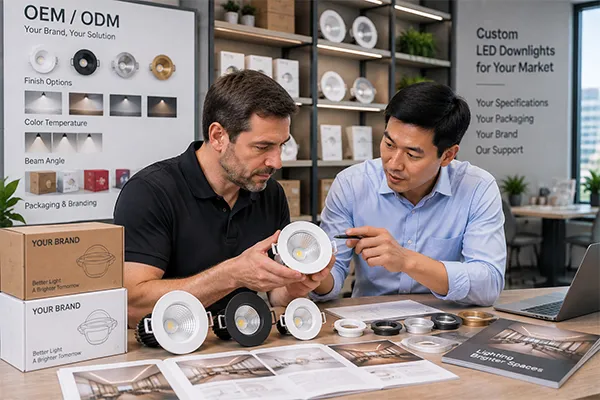
Identify a Clear Reason for Customization
A distributor may have a valid reason to customize when it wants to build a local brand, serve a regional design preference, or offer a product specification that its main competitors do not stock. The key is that the decision should connect to a known customer group.
Potential reasons include:
- A regional lighting brand needs branded retail packaging for a consistent market presence.
- A distributor serves architects who regularly request black, gold, or other finish options.
- A contractor network repeatedly requires a particular color temperature or cutout size.
- A market has a well-defined documentation or labeling expectation.
- A wholesaler has demonstrated recurring demand for a specific value-engineered range.
- A project customer needs a repeatable specification across several sites.
At Upward Lighting, I can support OEM/ODM requests involving parameters such as color temperature, wattage, beam angle, CRI, surface finish, and packaging. However, I believe customization works best after the distributor has clarified volumes, target users, approval requirements, and replenishment expectations.
Separate Core Products From Custom Programs
I recommend a two-level strategy:
| Product level | Purpose | Typical purchasing approach |
|---|---|---|
| Core LED downlights | Support routine sales and common customer needs | Stock in controlled quantities based on demand history |
| Project-specific models | Meet a confirmed application, tender, or customer requirement | Order against project confirmation where possible |
| Branded or customized models | Support a defined market position or recurring account | Plan with forecast, samples, artwork approval, and clear reorder expectations |
This approach helps distributors avoid locking too much capital into one-off variants. It also creates a more professional conversation with suppliers because both parties can distinguish between immediate stock requirements and development-based opportunities.
Plan the Customization Process
Customization needs discipline. I suggest that buyers document product requirements before approving a sample or placing a production order. The document should cover:
- Product model and dimensions
- Electrical parameters
- Color temperature and CRI
- Beam angle
- Trim color and material expectations
- Driver and dimming requirements
- Packaging artwork and labeling
- Certification documents required for review
- Target quantity and expected reorder plan
- Inspection and acceptance process
- Delivery timeline and shipping arrangement
I have learned through many product-specification discussions that verbal agreements can create confusion later. A clear specification sheet helps the distributor, supplier, sales team, and end customer work from the same reference.
Frequently Asked Questions
How many LED downlights should a distributor stock initially?
I recommend starting with a limited core range based on existing inquiries, customer types, and local installation habits. Many distributors can begin with a few proven wattage, cutout, and color-temperature combinations, then add variants after they see repeat demand rather than stocking every available option.
Are cheaper LED downlights always more profitable for distributors?
No. A lower unit price can improve initial margin, but it does not account for quote delays, inconsistent specifications, documentation gaps, packaging issues, delivery uncertainty, or slow-moving stock. I suggest evaluating total commercial cost and the supplier’s ability to support repeatable business.
What should distributors verify before importing LED downlights?
Distributors should verify applicable local safety, environmental, labeling, and market-entry requirements. They should also review supplier documentation, product specifications, packaging details, and shipping arrangements. Certifications such as CE and RoHS should be reviewed as documents relevant to the target market, not assumed to cover every regulatory obligation.12
Which LED downlight specification is most important?
There is no single most important specification for every sale. Cutout size may matter most for replacement work, while color temperature, CRI, beam angle, IP rating, dimming compatibility, or lumen output may matter more for other applications. I recommend matching specifications to the actual project and customer need.
Is OEM/ODM suitable for every lighting distributor?
OEM/ODM is not necessary for every distributor. It is most useful when a business has a clear brand plan, a defined customer segment, a product gap, or recurring demand that justifies customized packaging, finishes, or specifications. Standard products may be a lower-risk option for early market testing.
Conclusion
LED downlights can become a practical growth category when distributors make disciplined purchasing decisions instead of competing only on SKU quantity or unit price. I recommend building a focused range, connecting specifications to real applications, evaluating suppliers beyond cost, and using customization only where it supports a defined route to market. At Upward Lighting, I work with distributors, importers, and regional brands on quotations, OEM/ODM requirements, documentation coordination, and delivery planning. Contact us to discuss a downlight range that fits your customer base and purchasing model.
"Managing Product Variety: Supply Chain Segementation for Food ...", https://scm.mit.edu/news-and-events/managing-product-variety-supply-chain-segementation-for-food-and-beverage-retailers/. Operations-management research finds that expanding product variety can increase demand-planning and inventory-control complexity because each variant requires separate forecasting, replenishment, and stock decisions. Evidence role: mechanism; source type: paper. Supports: Research showing that greater product variety can increase forecasting, replenishment, and inventory-management complexity.. Scope note: The magnitude of the effect depends on demand correlation, replenishment arrangements, and the distributor's inventory system. ↩
"Assortment rationalization: Why retailers need to get it right", https://www.relexsolutions.com/resources/assortment-rationalization-why-retailers-need-to-get-it-right/. Supply-chain research indicates that SKU rationalization can simplify forecasting, purchasing, and replenishment by concentrating planning activity on a smaller set of regularly demanded items. Evidence role: general_support; source type: research. Supports: Evidence that reducing or rationalizing SKU assortments can simplify inventory planning and purchasing processes.. Scope note: This supports the operational rationale for a core range but does not establish that every reduced assortment improves quotation speed or sales outcomes. ↩
"How Competition, Customization, and Niche Markets Have ...", https://scholarcommons.sc.edu/cgi/viewcontent.cgi?article=1095&context=senior_theses. Studies of product proliferation describe how additional variants can create operational burdens in procurement, inventory storage, packaging control, service support, and product-information management. Evidence role: mechanism; source type: paper. Supports: Research linking product proliferation to added operational complexity in supply-chain and service processes.. Scope note: The literature generally addresses product variety across industries; the precise burden for LED downlights depends on standardization and distributor processes. ↩
"Analyzing Costs Using Total Cost of Ownership", https://psep.smeal.psu.edu/short-courses/supply-chain-accelerator/advanced-procurement-analyzing-costs-using-total-cost-of-ownership. Total-cost-of-ownership frameworks evaluate purchasing decisions using costs beyond the invoice price, including ordering, quality, logistics, service, and lifecycle-related costs that can affect overall commercial results. Evidence role: general_support; source type: education. Supports: Procurement guidance explaining that acquisition decisions should account for costs beyond the initial purchase price.. Scope note: A total-cost framework does not by itself show that a particular downlight supplier will yield higher margins. ↩
"Evaluating the drivers of B2B performance - PMC - NIH", https://pmc.ncbi.nlm.nih.gov/articles/PMC11244795/. Business-to-business service research identifies response timeliness as a component of supplier responsiveness that can influence customer satisfaction, perceived service quality, and purchase decisions. Evidence role: general_support; source type: research. Supports: Evidence that response timeliness affects customer evaluations and commercial outcomes in business-to-business settings.. Scope note: Such evidence supports the importance of responsiveness generally and does not prove that same-day quotations outperform competitors in every lighting market. ↩
"LED Vehicle Light Making Procedure - Burn-in Test", https://www.minhsiang.com/production/burn-in-test. Reliability literature describes burn-in or aging tests as screening methods intended to reveal certain early-life defects under controlled conditions before products enter service. Evidence role: mechanism; source type: paper. Supports: Research explaining the use of burn-in or aging tests to screen some early-life failures in electronic and LED products.. Scope note: This evidence explains the purpose of aging tests but cannot verify that the stated facility tests every product for 4 to 8 hours; that specific practice requires auditable factory records or third-party inspection. ↩
"Integration and Test > Accelerated Life Testing - S3VI - NASA", https://s3vi.ndc.nasa.gov/ssri-kb/topics/38/. Reliability engineering distinguishes production screening from field-reliability demonstration: a burn-in or functional test may detect some early defects but does not alone establish lifetime performance under all environmental, electrical, and usage conditions. Evidence role: mechanism; source type: paper. Supports: Reliability-engineering evidence that screening and accelerated tests do not fully predict performance in all real-world environments.. Scope note: The relevance of a given test depends on its duration, stress conditions, sample design, product design, and the intended field environment. ↩
"Color rendering of light sources - NIST", https://www.nist.gov/pml/sensor-science/optical-radiation/color-rendering-light-sources. The Color Rendering Index is a conventional metric describing how faithfully a light source renders test colors relative to a reference illuminant; color-rendering performance is therefore particularly relevant where accurate or appealing color appearance is important. Evidence role: definition; source type: institution. Supports: Authoritative explanation of the Color Rendering Index and its use in evaluating how a light source renders object colors.. Scope note: CRI has recognized limitations and should not be treated as the sole predictor of color preference or visual quality. ↩
"IP code", https://en.wikipedia.org/wiki/IP_code. IEC 60529 specifies the IP Code, whose digits classify the degree of protection provided by enclosures against ingress of solid foreign objects and water. Evidence role: definition; source type: institution. Supports: The IEC IP Code classification of protection against ingress of solid objects and water.. Scope note: An IP rating addresses enclosure ingress protection under specified test conditions; it does not by itself establish suitability for every outdoor, wet-area, corrosion, installation, or electrical-safety condition. ↩
"LED Basics - Department of Energy", https://www.energy.gov/cmei/ssl/led-basics. Lighting guidance explains that wattage measures electrical power while lumens measure emitted light; the illumination needed at a surface also depends on room geometry, mounting height, surface properties, and ambient light. Evidence role: mechanism; source type: government. Supports: Authoritative lighting guidance distinguishing electrical power from light output and relating required illumination to application conditions.. Scope note: Fixture selection additionally requires photometric data, layout calculations, and applicable local lighting requirements. ↩
"Color and Spectrum | Department of Energy", https://www.energy.gov/cmei/ssl/color-and-spectrum. Lighting guidance defines correlated color temperature as a descriptor of the apparent warm-to-cool character of white light, which can affect the perceived atmosphere of an illuminated space. Evidence role: definition; source type: government. Supports: Authoritative guidance defining correlated color temperature and its relationship to the perceived warm or cool appearance of white light.. Scope note: Preferences for particular color temperatures vary by application, culture, design intent, and individual perception. ↩
"European Union Reduction of Hazardous Substances ...", https://www.waru.edu/artifact/european-union-reduction-hazardous-substances-rohs-and-waste-electrical-and-electronic. European Commission guidance explains that CE marking indicates conformity with applicable EU requirements for a product, while the RoHS Directive addresses restrictions on specified hazardous substances in electrical and electronic equipment; compliance obligations depend on the product and market rules that apply. Evidence role: general_support; source type: government. Supports: Official EU guidance on CE marking obligations and the restricted-substances requirements of the RoHS Directive.. Scope note: EU guidance does not determine requirements in non-EU markets, and importers should assess the complete set of applicable national, product-specific, labeling, and documentation obligations. ↩