
LED downlight selection can become expensive when buyers focus on wattage, cut-out size, and unit price before considering regulations. A downlight that appears suitable in a catalogue may later require different labeling, documentation, driver specifications, or installation features. We help buyers reduce this risk by defining the destination market and application before confirming a configuration.
Lighting regulations affect LED downlight selection because compliance requirements may influence the product’s electrical design, driver, IP rating, installation method, labeling, test documentation, and approved configuration1. Buyers should first confirm where the downlight will be sold and installed, then verify the applicable requirements for the exact model and version with qualified local professionals, testing bodies, or relevant authorities.
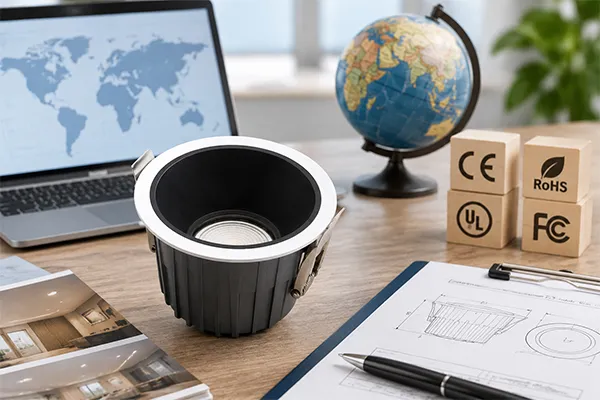
In our overseas sales and technical support work, we repeatedly receive drawings that list only a cut-out diameter, wattage, and finish color. Those details matter, but they do not create a complete compliance brief. The earlier a buyer connects product selection with market requirements, the less likely they are to face delays, redesigns, re-labeling, or document questions after production begins.
Why Do Lighting Regulations Change LED Downlight Selection?
Buyers often assume that regulations are a final paperwork task. This assumption can create problems when the selected downlight has already been quoted, sampled, or approved internally. A late compliance review may reveal that the driver, housing, IP protection, markings, or installation arrangement needs further evaluation.2
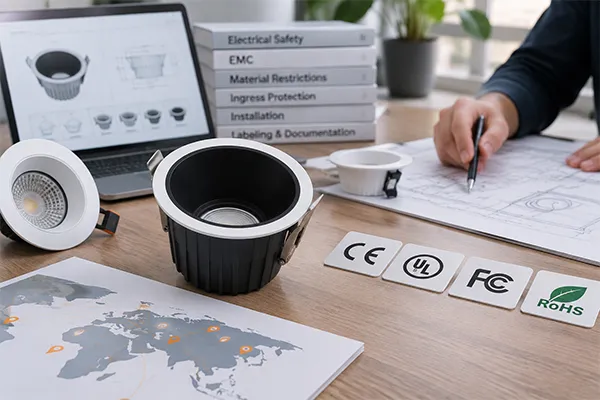
Lighting regulations change LED downlight selection because they may determine whether a particular product configuration is appropriate for the intended market and installation. Requirements can affect electrical safety, electromagnetic compatibility, material restrictions, ingress protection, installation instructions, labels, and supporting test documentation—not only the certificate attached to a quotation.
Regulations Can Influence the Physical Product
A buyer may see two recessed LED downlights with similar visible specifications:
- 10W power consumption
- 90 mm cut-out
- 3000K color temperature
- White trim
- Integrated LED module
- Dimmable or non-dimmable driver
However, the products may not be equivalent for a particular project. The technical details behind the faceplate can matter just as much as the visible dimensions.
For example, a project may require the buyer to review:
- Input voltage and frequency compatibility
- Driver insulation and electrical design
- Earthing or double-insulation arrangement
- IP rating for the installation environment
- Heat management in enclosed ceiling spaces
- Compatibility with insulation or ceiling materials
- Cable entry, terminal block, and wiring method
- Dimming control compatibility
- Product labels, traceability codes, and installation instructions
- Test reports relevant to the finished model
We have seen buyers initially request “the same downlight, only with a different driver.” That may sound like a simple sourcing change. Yet a driver can affect electrical characteristics, dimming behavior, thermal performance, markings, and the scope of existing supporting documents3. We do not assume that every driver change creates a compliance issue, but we do recommend an applicability review before the buyer treats the customized version as identical to the original version.
The Installation Scenario Matters
The same LED downlight may be considered for very different environments:
| Installation Scenario | Questions Buyers Should Clarify |
|---|---|
| Residential ceiling | Is the ceiling insulated? Is dimming required? What wiring system is used? |
| Hotel corridor | Is long operating time expected? Are emergency-lighting interfaces involved? |
| Retail store | Are glare control, color consistency, and track or recessed installation requirements relevant? |
| Bathroom or spa area | Is moisture exposure possible? What IP protection may be required for the location?4 |
| Office renovation | Does the project require specific flicker, UGR, efficiency, or documentation criteria? |
| Outdoor soffit | Is the luminaire exposed to rain, dust, temperature changes, or salt air? |
A wattage-and-cut-out drawing does not answer these questions. We encourage buyers to treat the installation environment as part of the product specification.
A downlight is not only a lighting product. It is also an electrical product installed inside a building system.
At Upward Lighting, we can discuss configuration options such as wattage, color temperature, beam angle, CRI, trim finish, and driver arrangement. However, the buyer should confirm final market and project applicability with qualified professionals or relevant authorities. Our factory quality control and 100% aging tests support shipment quality control, but they do not replace regulatory certification, local approval, or project-specific evaluation.
What Should Buyers Confirm Before LED Downlight Selection?
Many buyers send a reference image and ask for the “best price” immediately. Price is important, especially for wholesalers, contractors, and local lighting brands. Still, pricing a product before defining its market and application can lead to an inaccurate comparison between suppliers.
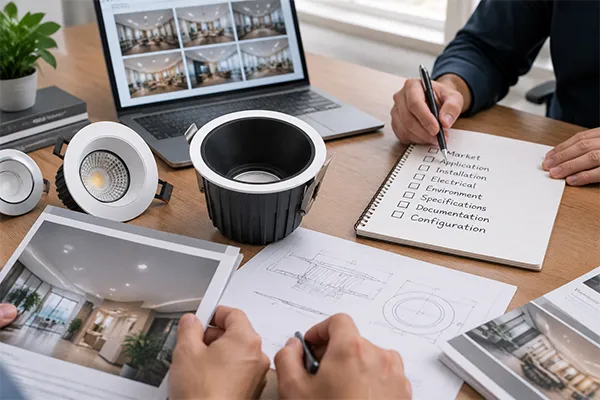
Before LED downlight selection, buyers should confirm the destination market, sales channel, installation location, electrical requirements, environmental exposure, project specifications, required documentation, and exact product configuration. These details create a clearer compliance brief and help suppliers quote a technically relevant model rather than a generic alternative.
Build a Practical Compliance Brief
We recommend that buyers prepare a short brief before requesting quotations or samples. The brief does not need to be legal language. It simply needs to give the supplier enough context to identify potential product-and-document questions early.
A useful LED downlight sourcing brief includes:
-
Destination market
State the country or region where the product will be sold or installed. If products will be distributed to several markets, list each market separately. -
Buyer type and sales channel
Clarify whether the product is for a contractor project, retail distribution, a private-label brand, e-commerce, or a building-material channel. -
Installation environment
Explain whether the downlight will be used in dry indoor spaces, bathrooms, covered outdoor areas, hospitality projects, offices, retail stores, or other locations. -
Electrical parameters
Include input voltage, frequency, dimming requirements, control system expectations, and plug or wiring preferences where relevant. -
Core product specifications
Provide wattage, cut-out size, outer diameter, color temperature, beam angle, CRI, body color, and target lumen output. -
Required documents
Identify whether the buyer, consultant, customer, tender, or authority has requested specific reports, declarations, labels, or supporting files. -
Customization scope
State whether the buyer needs a private label, custom packaging, a logo, a new housing color, a different driver, modified wattage, or another OEM/ODM change.
Avoid the “Dimensions Only” Request
A common pre-sales scenario looks like this: a buyer sends a technical drawing with “12W, 120 mm cut-out, white” and requests a quote. We can certainly begin with a preliminary recommendation, but we will usually ask follow-up questions.
The reason is simple. Two 12W, 120 mm cut-out downlights may differ in:
- Driver brand or driver type
- Input-voltage range
- Dimming capability
- IP rating
- Trim material and heat dissipation design
- Diffuser type
- CRI option
- Beam angle
- Packaging and labeling
- Test-report scope
In one past discussion, a buyer needed a standard recessed downlight for a commercial refurbishment. The initial request was only for size and wattage. Later, the project team introduced requirements related to dimming, project documentation, and installation conditions. The final configuration remained commercially workable, but the buyer needed additional time to align the product, labels, and documents. A more complete brief at the beginning would have reduced that back-and-forth.
For importers and distributors, this step also improves supplier comparisons. A low quotation may reflect a different driver, a different IP rating, a different material grade, or a different documentation scope. A consistent brief helps buyers compare like with like.
Are CE and RoHS Enough for LED Downlight Selection?
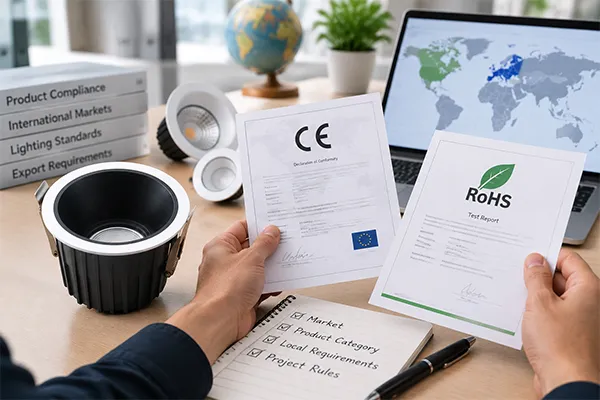
Buyers frequently ask us whether CE and RoHS documents are enough for every export destination. This question is understandable because these documents are widely recognized in sourcing conversations. Yet a document name alone does not confirm that a specific LED downlight can be sold or installed in every market or project.
CE and RoHS are not universal passports for LED downlight selection.5 Buyers should assess documentation against the destination market, product category, exact model, installation context, customer requirements, and applicable local or project rules. A qualified local professional, testing body, or relevant authority should confirm final applicability.
Understand What Documents Actually Support
A responsible document review involves more than checking whether a supplier can send a PDF. Buyers should look at the relationship between the document and the product they intend to buy.
We suggest reviewing the following points:
| Review Point | Why It Matters |
|---|---|
| Product model number | The document should relate to the model under consideration.6 |
| Product description | The described product should match the downlight type and key configuration. |
| Issue date and validity information | Buyers should understand whether the document remains relevant to the purchase. |
| Testing or issuing organization | Buyers should evaluate the credibility and scope of the organization. |
| Technical standards referenced | Standards should be relevant to the product and intended assessment. |
| Rated electrical parameters | Input voltage, frequency, wattage, and driver information should align. |
| Manufacturer information | The company details should be consistent with the supply arrangement. |
| Report scope and limitations | Buyers should check whether variants or components are included. |
We provide CE and RoHS documentation for relevant products in our range, but we encourage buyers to review documents for the exact model and market purpose. We do not present CE or RoHS as automatic approval for every country, every installation, or every project submission.
Documentation Is Not the Same as Project Acceptance
Some projects involve consultants, developers, electrical engineers, local authorities, or customer quality teams. These parties may request specific technical files, photometric information, installation instructions, product labels, declarations, or reports.7 They may also have their own acceptance criteria.
This is why buyers should ask early:
- What documents does the project require?
- Does the project specify a particular product standard or test basis?
- Are local language labels or instructions needed?
- Does the buyer need a specific declaration format?
- Will a consultant review the downlight before installation?
- Does the project require sample approval before mass production?
A buyer can reduce risk by treating documentation as part of supplier qualification, not as an attachment collected at the end. In our experience, this approach is especially useful for contractors and private-label lighting brands that need to submit products to multiple stakeholders.
How Can OEM Changes Affect LED Downlight Selection Documents?
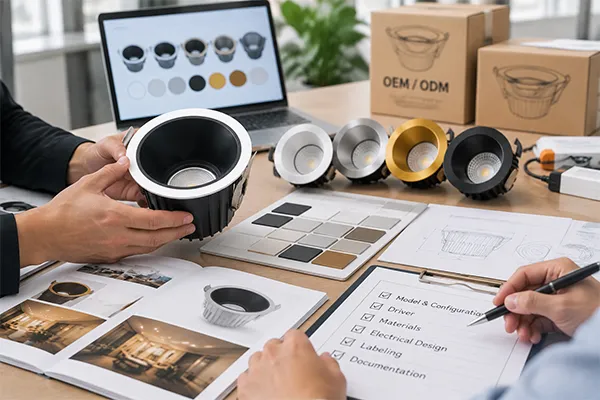
OEM and ODM flexibility helps buyers create differentiated lighting ranges. A local brand may want a special trim color, a preferred color temperature, customized packaging, or a specific driver solution. These changes can be commercially valuable, but buyers should not assume that all changes have the same effect on product documentation.
OEM or ODM changes may require a review of document applicability8 during LED downlight selection, especially when they affect wattage, driver, housing, materials, electrical design, labeling, or installation-related features. Not every customization automatically invalidates existing documentation, but buyers should verify whether the exact customized version remains within the relevant scope.
Classify Changes Before Production
We find it useful to divide requested changes into practical categories. This does not replace professional conformity assessment, but it helps buyers identify when additional questions are appropriate.
| Type of Change | Example | Why a Review May Be Needed |
|---|---|---|
| Cosmetic change | White trim changed to black or gold | Material, coating, label, or SKU traceability may need review. |
| Optical change | Different beam angle or diffuser9 | Light distribution and optical performance may differ. |
| Electrical change | New wattage or input specification | Electrical ratings, thermal behavior, and driver suitability may differ. |
| Driver change | Dimmable driver or alternate supplier | Electrical characteristics and document scope may need checking. |
| Mechanical change | Different housing or cut-out design | Installation, heat dissipation, and insulation-related issues may change. |
| Branding change | Private label or custom packaging | Markings, instructions, traceability, and market-facing information may need adjustment. |
Ask for Version Control
A buyer should be able to identify exactly what product version was sampled, tested, approved, and ordered. This is especially important for ongoing purchases and multi-market distribution.
We recommend keeping a simple version-control record that includes:
- Internal buyer SKU
- Supplier model number
- Wattage and voltage
- Driver specification
- CCT and CRI
- Beam angle
- Cut-out and outer diameter
- Housing and trim finish
- IP rating
- Dimming function
- Label artwork version
- Packaging version
- Related report or certificate reference
This record does not need to be complicated. A shared specification sheet can prevent confusion between a sample, a quotation, and a mass-production order.
At Upward Lighting, we support small-batch orders and OEM/ODM discussions for parameters such as color temperature, wattage, beam angle, CRI, and surface finish. When a buyer requests changes, we aim to translate those requests into a preliminary product-and-document review. We also encourage the buyer to involve qualified external professionals when the market or project has specific regulatory expectations.
Do Not Rely on Assumptions
We have seen buyers assume that one test report covers every version in a product family. Sometimes a document may cover defined variants, but that conclusion should come from the document scope and competent review—not from an assumption based on similar appearance.
A 9W downlight and a 12W downlight may share a housing design, but they may use different electrical components or generate different thermal conditions.10 Likewise, a dimmable version may have a different driver from a non-dimmable version. These differences do not automatically mean the product cannot be supplied. They simply mean the buyer should ask the right question: Does the existing documentation apply to this exact configuration?
How Should Buyers Evaluate LED Downlight Suppliers for Regulatory Readiness?
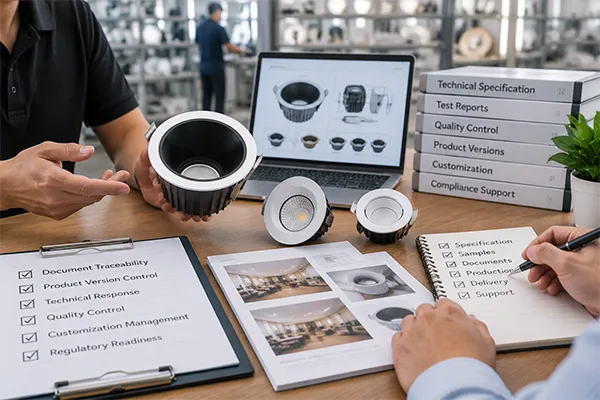
A supplier’s regulatory readiness is not measured only by the number of certificate logos shown on a website. Buyers need a supplier that can provide clear specifications, traceable documents, responsive communication, and realistic answers when a product or market requirement is unclear.
For effective LED downlight selection, buyers should evaluate suppliers on document traceability, product-version control, technical response speed, quality-control processes, customization management, and willingness to identify questions that require external verification. The best supplier relationship supports informed procurement rather than unsupported compliance promises.
Questions to Ask a Potential Supplier
Before placing a trial or mass order, buyers can ask practical questions such as:
- Can you provide the model-specific specification sheet?
- Can you identify the driver used in the quoted configuration?
- Can you explain whether the requested version differs from the documented version?
- Can you provide clear product labels and installation instructions?
- Can you support private-label packaging and required markings?
- Can you maintain consistent BOM and configuration control for repeat orders?
- Can you provide samples that match the intended production version?
- What quality-control checks occur before shipment?
- How do you handle product changes after sample approval?
- Can you respond quickly when our consultant requests clarification?
Evaluate Quality Control Separately From Compliance
Quality control remains important. At Upward Lighting, every product undergoes a 100% aging test of approximately 4 to 8 hours before shipment. This process helps us identify early performance issues and supports our internal shipment quality process.
However, we keep an important distinction clear:
Factory aging tests and production quality checks are not substitutes for regulatory certification, market authorization, or application-specific professional evaluation.11
Buyers should evaluate both areas:
-
Product quality consistency
This includes aging tests, incoming-material control, assembly inspection, appearance checks, functional checks, and packaging inspection. -
Regulatory and document readiness
This includes model-specific documentation, label accuracy, configuration traceability, and review of market or project requirements.
A supplier that understands this distinction is often easier to work with over the long term. The supplier can help the buyer move quickly without making unrealistic claims about universal compliance.
Frequently Asked Questions
Does CE certification allow an LED downlight to be sold anywhere?
No. CE documentation should not be treated as a universal passport for every market, project, or installation. Buyers should verify the destination market, product category, exact configuration, local rules, and project requirements with qualified professionals, testing bodies, or relevant authorities.
Can I select a downlight using only wattage and cut-out size?
No. Wattage and cut-out size are useful starting points, but they are not a complete LED downlight selection brief.12 Buyers should also confirm voltage, installation environment, IP needs, dimming requirements, driver type, labeling, documentation, and destination market.
Does changing the driver invalidate all existing documents?
Not necessarily. A driver change may require a review of document applicability because it can affect electrical characteristics, dimming function, thermal behavior, and the defined scope of reports. Buyers should verify the exact customized model instead of assuming automatic coverage or automatic invalidation.
Are factory aging tests proof of regulatory compliance?
No. Aging tests are manufacturing quality-control measures that can help identify product issues before shipment. They do not replace regulatory certification, product testing, market approval, or evaluation by qualified local professionals for a specific installation or destination.
What should I send a supplier when requesting a downlight quotation?
Buyers should send the destination market, installation scenario, required wattage, cut-out, voltage, color temperature, CRI, beam angle, IP rating, dimming needs, target quantity, branding needs, packaging requirements, and any requested documents or project specifications.
Conclusion
Lighting regulations should shape LED downlight selection from the first sourcing discussion, not after a buyer has chosen the lowest-priced model. We recommend that buyers define the destination market, installation environment, exact configuration, and required documents before comparing products. CE, RoHS, quality testing, and supplier documentation all have value, but buyers should verify their applicability to the specific model and project. Contact Upward Lighting to discuss your LED downlight specification, OEM/ODM requirements, sample needs, and preliminary product-and-document checklist.
"A guide to EU standards and conformity assessment", https://www.govinfo.gov/content/pkg/GOVPUB-C13-07a06d81c863b5241d6249891a51fb90/pdf/GOVPUB-C13-07a06d81c863b5241d6249891a51fb90.pdf. European product-conformity guidance and luminaire standards show that applicable requirements may extend beyond a product certificate to electrical safety, EMC, substance restrictions, marking, instructions, and technical documentation. Evidence role: general_support; source type: government. Supports: EU product-conformity guidance and luminaire standards identify electrical safety, electromagnetic compatibility, hazardous-substance restrictions, marking, instructions, and technical documentation as potentially relevant requirements.. Scope note: The exact obligations depend on the destination jurisdiction, product classification, and intended installation. ↩
"Recessed Lighting - Code Compliance Brief", https://basc.pnnl.gov/code-compliance/recessed-lighting-code-compliance-brief. Luminaire safety requirements commonly address construction, wiring, markings, installation information, and ingress protection; therefore, changes or omissions in these areas can require technical review. Evidence role: mechanism; source type: institution. Supports: Luminaire safety standards address construction, wiring and terminals, markings, instructions, and protection against ingress, making component and installation details relevant to product assessment.. Scope note: This does not establish that every listed feature requires reassessment for every downlight or jurisdiction. ↩
"Impact of Thermal Dissipation on the Lighting Performance ...", https://pmc.ncbi.nlm.nih.gov/articles/PMC8776062/. LED-system research describes the driver as a determinant of LED operating conditions and dimming behavior, with associated effects on electrical performance and thermal loading. Evidence role: mechanism; source type: research. Supports: Technical literature explains that LED drivers determine operating current or voltage and can influence dimming operation, electrical behavior, and thermal conditions in an LED system.. Scope note: Whether a particular driver replacement changes legal markings or the applicability of a specific report must be determined from the applicable requirements and document scope. ↩
"IP code", https://en.wikipedia.org/wiki/IP_code. IEC 60529 defines IP ratings by the degree of protection against solid-object ingress and water ingress, supporting the need to match a luminaire’s rating to anticipated environmental exposure. Evidence role: definition; source type: institution. Supports: IEC 60529 defines IP codes as classifications for protection against access, solid foreign objects, and water, which can be relevant when equipment is selected for exposed locations.. Scope note: The rating required in a particular location is set by applicable installation rules and project specifications, not by the IP code alone. ↩
"EU - EU Legislation and CE Marking", https://www.trade.gov/country-commercial-guides/eu-eu-legislation-and-ce-marking. European Commission guidance identifies CE marking and RoHS as EU-framework requirements for relevant products; neither designation by itself establishes acceptance in non-EU markets or under every project-specific installation rule. Evidence role: historical_context; source type: government. Supports: European Commission guidance states that CE marking is used for products placed on the European Economic Area market under applicable EU rules, while RoHS is an EU restriction on hazardous substances in covered electrical and electronic equipment.. Scope note: Some non-EU jurisdictions may recognize, reference, or separately require related documentation. ↩
"Complying with the resource requirements of ISO/IEC 17025 ...", https://pmc.ncbi.nlm.nih.gov/articles/PMC9579603/. Conformity-assessment and testing guidance emphasizes unambiguous identification of the assessed product, supporting verification that a document corresponds to the model and configuration under review. Evidence role: general_support; source type: institution. Supports: Conformity-assessment and laboratory-reporting guidance requires sufficient identification of the product or item assessed to connect evidence with the product placed on the market.. Scope note: The required level of model, variant, and component detail varies by regulation, standard, and report. ↩
"[PDF] 1 section 265000 – lighting - University of Pennsylvania", https://facilities.upenn.edu/sites/default/files/pdfs/265000_lighting_-_electrical_design_guide_3.pdf. Lighting-specification and procurement practices commonly rely on product data, photometric information, installation instructions, marking information, and conformity documentation during product review. Evidence role: general_support; source type: institution. Supports: Lighting procurement and specification practices commonly use product data, photometric information, installation instructions, labels, and conformity documentation to evaluate luminaires.. Scope note: Individual consultants, authorities, and project owners can require different documents or formats. ↩
"Division of Standards and Conformity Assessment", https://www.fda.gov/medical-devices/premarket-submissions-selecting-and-preparing-correct-submission/division-standards-and-conformity-assessment. Product-conformity guidance requires manufacturers to ensure and document the conformity of the product placed on the market; modifications that may affect compliance therefore warrant review of the supporting assessment and documentation. Evidence role: mechanism; source type: government. Supports: EU product-compliance guidance explains that manufacturers must assess conformity and maintain technical documentation for the product placed on the market, including when changes can affect compliance.. Scope note: A modification does not automatically require new testing or invalidate all prior evidence; the consequence depends on the change and applicable legal framework. ↩
"Report 21.2:", https://www.pnnl.gov/main/publications/external/technical_reports/PNNL-23366.pdf. Lighting-optics research shows that a luminaire’s optical elements shape its angular light distribution; changing a diffuser or beam-forming optic can therefore change photometric performance. Evidence role: mechanism; source type: research. Supports: Lighting-optics literature explains that luminaire optics, including diffusers and reflectors, shape the angular distribution of emitted light and measured photometric performance.. Scope note: The magnitude and direction of the change depend on the specific optical design and must be measured for the finished configuration. ↩
"2019 Solid-State Lighting R&D Opportunities", https://www.energy.gov/sites/prod/files/2020/01/f70/ssl-rd-opportunities2-jan2020.pdf. LED thermal-management literature establishes that input power and electrical operating conditions affect heat generation and component temperatures, so visually similar luminaires of different wattage can require different thermal assessment. Evidence role: mechanism; source type: research. Supports: LED thermal-management research shows that electrical input power and component operating conditions affect heat generation and temperatures within luminaires.. Scope note: A wattage difference alone does not prove that two particular downlights use different components or fail the same thermal criteria. ↩
"General Use Products: Certification and Testing | CPSC.gov", https://www.cpsc.gov/Business--Manufacturing/Testing-Certification/General-Use-Products-Certification-and-Testing. Product-conformity frameworks distinguish manufacturing quality control from conformity assessment and required technical documentation; internal aging or functional tests alone do not establish all regulatory or installation-specific conditions. Evidence role: definition; source type: government. Supports: Product-conformity frameworks distinguish internal production control from the legal conformity assessment, technical documentation, declarations, and any third-party procedures required for a product category.. Scope note: Production tests may form part of a manufacturer’s quality or conformity-control system when they are conducted under the applicable requirements. ↩
"Recessed Lighting - Code Compliance Brief", https://basc.pnnl.gov/code-compliance/recessed-lighting-code-compliance-brief. Luminaire safety and installation guidance considers electrical ratings, mounting conditions, wiring, thermal limitations, ingress protection, and instructions alongside physical dimensions; wattage and cut-out size alone are therefore incomplete selection criteria. Evidence role: general_support; source type: institution. Supports: Luminaire safety and installation guidance considers electrical ratings, mounting conditions, wiring, thermal constraints, ingress protection, and instructions in addition to physical dimensions.. Scope note: The relevant criteria and their priority vary with the luminaire design, installation environment, and local rules. ↩