LED downlights can look nearly identical on a quotation sheet while delivering very different results after installation. That creates a real procurement problem: buyers may focus on wattage, lumen output, or unit price, then face inconsistent light, difficult replacements, or project delays later. We balance cost and performance by building a configuration around the actual application.
Manufacturers balance cost and performance in LED downlights by selecting a fit-for-purpose combination of LED source, driver, heat-management structure, optics, housing, and quality-control process. The right choice depends on the installation environment, operating hours, required light quality, compliance needs, expected delivery schedule, and budget—not on maximizing every specification or simply choosing the lowest unit price.
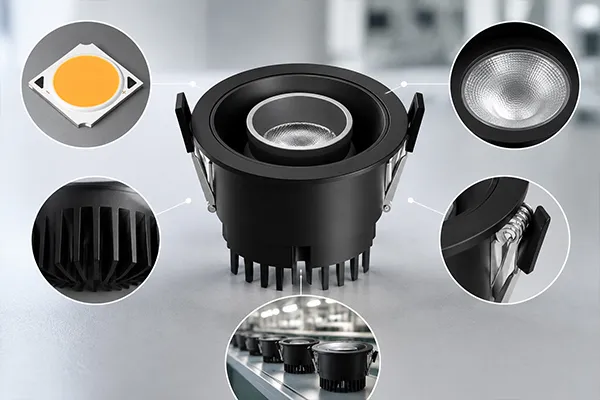
When we prepare a downlight quotation, we do not see it as a simple exercise in reducing material cost. We see it as a decision about product consistency and project suitability. The most useful comparison starts with the full luminaire configuration and the conditions in which the product will operate.
Why Can Similar LED Downlights Have Different Prices and Results?
Buyers often receive several quotations for LED downlights with the same wattage, shape, and stated lumen output. The price gap can be frustrating, especially when catalog images look similar. However, the visible housing is only one part of the product, and a low-level comparison can hide meaningful differences.
Similar LED downlights can produce different real-world results because their LED chips, drivers, thermal designs, optical parts, materials, assembly controls, and specification consistency may differ.1 Buyers should compare the complete configuration, intended application, and supporting documents instead of using wattage, appearance, or price as the only decision criteria.
A downlight is a complete system
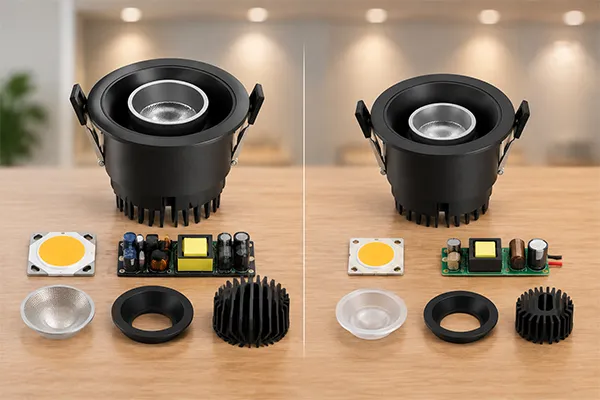
We generally encourage buyers to view a recessed downlight as a system rather than a single light source. Its final performance depends on how several parts work together:
- LED source: This affects light output, color consistency, color rendering, and efficiency.
- LED driver: This affects electrical stability, dimming compatibility where required, flicker behavior, and the operating conditions experienced by the LED module.
- Heat-management structure: This moves heat away from sensitive components under actual installation conditions.
- Optics or diffuser: This shapes the beam, controls glare to some extent, and affects light distribution.
- Housing and finish: These affect installation fit, appearance, corrosion considerations, and physical durability.
- Assembly and process control: These influence consistency from one production batch to another.
A 12 W model with a wide beam angle, moderate color rendering, and a standard driver may be an appropriate, cost-effective choice for a corridor, utility room, or high-volume wholesale program. A visually similar 12 W model intended for a hospitality lobby, boutique store, or premium residential space may need different optical control, tighter CCT consistency, higher CRI, or a different finish. Those needs can change the configuration and the price.
The quotation must describe what is included
We have seen that vague specifications create more purchasing risk than a slightly higher initial unit price. A quote that only states “12 W LED downlight” leaves major questions unanswered. For clearer supplier comparison, we recommend asking for a specification sheet that includes the following items.
| Comparison point | Why it matters for procurement |
|---|---|
| Rated wattage and input voltage | Confirms electrical compatibility and power target |
| Claimed lumen output | Supports brightness planning, but should be assessed with beam distribution |
| CCT and CCT tolerance approach | Helps protect visual consistency across a project |
| [CRI requirement | Determines whether color quality is appropriate for the space](https://www.energy.gov/cmei/femp/purchasing-energy-efficient-light-bulbs)%%%FOOTNOTE_REF_2%%% |
| Beam angle | Influences spacing, accent effect, and uniformity |
| Driver type and dimming option | Affects system compatibility and configuration cost |
| Cutout size and external dimensions | Reduces installation and replacement issues |
| Housing material and thermal structure | Supports application-specific heat management review |
| IP rating, where applicable | Matters for humid, dusty, or semi-outdoor locations |
| Certification documents | Should be verified for the intended market and model |
| Packaging and delivery requirements | Affect breakage risk, container planning, and schedule |
In our manufacturing work, component selection and supply-chain coordination influence price as much as the parts themselves. Standardized configurations, planned purchasing volumes, and stable component sourcing can reduce cost without automatically reducing suitability. At the same time, a highly customized configuration can require separate materials, additional confirmation, and longer preparation.
We do not treat the cheapest configuration as automatically poor, and we do not treat the highest-priced option as automatically best. We look for the configuration that matches the task with the fewest unnecessary compromises.
Which LED Downlight Specifications Should Buyers Prioritize?
A common purchasing mistake is trying to maximize every specification at the same time. Buyers may request high CRI, very high output, narrow beam control, excellent efficiency, premium materials, and the lowest possible price. Each target can be valid, but they may not all be equally important for every installation.
Buyers should prioritize LED downlight specifications according to the space and use case. Light quality, beam angle, brightness, operating hours, dimming needs, installation depth, and budget should be ranked before requesting a quote. A fit-for-purpose specification usually provides better value than pursuing maximum output, maximum CRI, and minimum price simultaneously.
Start with the lighting task
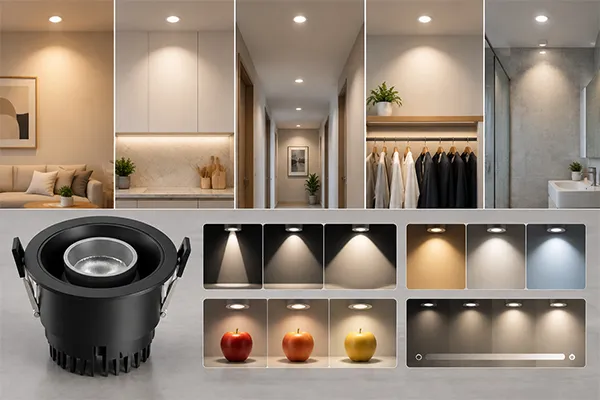
We begin by asking what the light needs to do. The answer changes the recommended configuration.
For example, a general lighting downlight in an office may require comfortable distribution, reasonable energy use, and consistent appearance across many fixtures. A retail display area may put greater emphasis on color rendering and beam control. A hotel corridor may prioritize uniformity, maintenance planning, and a cost structure that works across a larger quantity.
These questions help us define the project task:
-
What is the installation location?
Is it a home, office, retail shop, hotel, corridor, public area, or covered outdoor space? -
How many hours per day will the lights operate?
Long operating schedules can make driver selection, thermal design, and energy use more relevant.3 -
What is the ambient temperature?
Ceiling void conditions and local climate can affect operating conditions. -
What light effect is needed?
The buyer may need broad general illumination, focused accent lighting, wall washing, or a balance of both. -
Which visual specifications matter most?
CCT, CRI, beam angle, glare considerations, and trim color can all affect the final environment.
Understand the main trade-offs
The table below shows why a single “best” downlight configuration does not exist.
| Specification goal | Potential benefit | Practical trade-off to evaluate |
|---|---|---|
| [Higher CRI | More natural color appearance for merchandise, finishes, or interiors](https://www.energy.gov/cmei/ssl/understanding-led-color-tunable-products)%%%FOOTNOTE_REF_4%%% | May affect component selection and cost |
| Higher lumen output | More light from one fixture | Requires review of glare, spacing, heat, and energy targets |
| Narrower beam angle | Stronger accent effect | Can create bright spots if spacing is not planned |
| Wider beam angle | Broad general coverage | May reduce accent definition |
| Higher efficiency | Lower energy use for a given output | Must still be evaluated alongside light quality and system design |
| Lower unit cost | Helps meet budget targets | Requires confirmation of configuration, documentation, and batch consistency |
| Customized finish or trim | Supports brand and interior design requirements | Can increase complexity, lead time, or MOQ considerations |
At Upward Lighting, we can configure CCT, wattage, beam angle, CRI, and surface finish colors for OEM/ODM programs. However, customization should follow a defined project need. A custom request that improves installation, brand positioning, or lighting quality can be valuable. A custom request that adds cost without improving the end application may not be necessary.
I have found that the clearest buyer briefs are often short but specific. For example: “We need a 10 W recessed model for a retail chain, 3000 K, high color rendering, 36-degree beam, black trim, stable supply for phased deliveries, and samples before final approval.” That type of brief gives our team a practical starting point.
How Does Thermal Design Affect LED Downlights?
Heat dissipation is one of the most discussed aspects of LED downlights, yet it is also one of the easiest areas to oversimplify. Some buyers judge thermal capability by the weight of the heat sink. Others use the product price as a shortcut. Neither method gives a complete answer.
Thermal design in LED downlights should be evaluated as a relationship between wattage, housing structure, material design, driver matching, ambient temperature, ceiling conditions, and operating hours. A heavier heat sink may be appropriate in some designs, but weight alone does not prove that a downlight is suitable for every application.
Why heat must be assessed in context
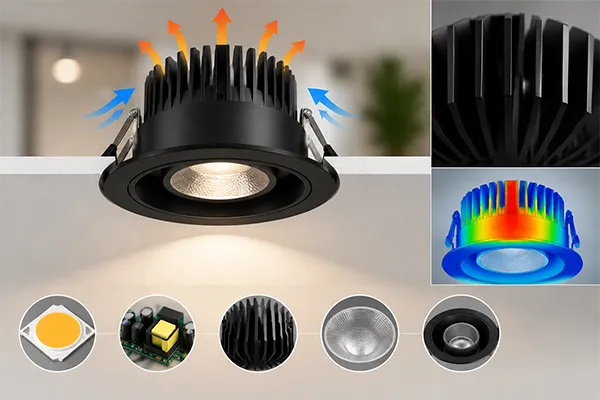
LEDs and drivers generate heat during operation.5 The luminaire structure must manage that heat within the conditions expected in service. The challenge is that installation conditions vary widely. A recessed fixture installed in a well-ventilated ceiling may operate differently from the same model installed in a shallow, insulated, enclosed, or high-temperature ceiling space.6
We therefore review thermal considerations alongside:
- Rated wattage and LED module loading
- Heat path from LED board to housing
- Housing geometry and available surface area
- Material selection and structural design
- Driver location and driver operating conditions
- Ceiling depth and ventilation
- Ambient temperature
- Daily operating schedule
- Insulation or other materials near the fixture
- Installation instructions and local project requirements
Avoid one-variable judgments
A large or heavy aluminum body can be part of a sound thermal strategy, but it is not a universal performance certificate.7 Structural design, contact quality between components, LED loading, and driver configuration all matter. Conversely, a compact standardized downlight can be an appropriate choice for a lower-power indoor application if its configuration matches the intended environment.
We recommend that project buyers avoid statements such as:
- “This one is heavier, so it must last longer.”
- “This model costs more, so its thermal design must be better.”
- “This low-cost downlight cannot be suitable.”
- “The same wattage always requires the same housing size.”
Each statement leaves out important variables.
Use samples and installation review
For larger orders, we believe a sample review is a practical procurement step. Buyers can check physical dimensions, trim appearance, cutout fit, light distribution, CCT, and compatibility with the planned installation. A qualified lighting professional or project engineer should evaluate application-specific requirements, especially where ceiling insulation, elevated ambient temperatures, dimming systems, emergency systems, or local codes may affect the decision.
Before shipment, we conduct a 100% aging test of approximately 4 to 8 hours as part of our pre-shipment process. We use this process as a screening step to identify certain early functional issues before goods leave our facility. It is not a laboratory lifetime test, and it does not guarantee zero failures in the field. Buyers should still evaluate samples, documentation, installation conditions, and appropriate quality requirements for their own project.
How Should Buyers Compare LED Downlight Suppliers and Quotations?
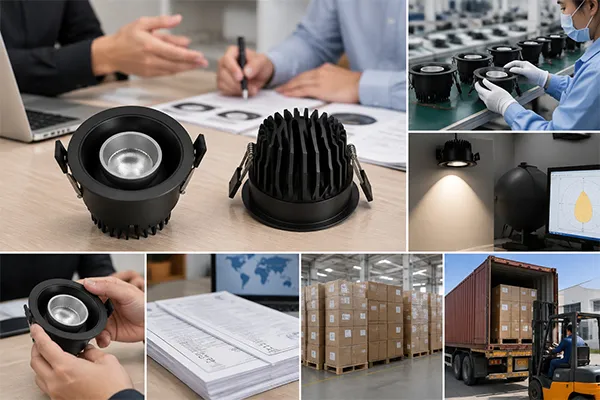
A good LED downlight purchase is not only about choosing a model. It is also about selecting a supplier that can deliver the agreed configuration consistently. This becomes more important for repeat orders, multi-phase projects, private-label programs, and markets with documentation requirements.
Buyers should compare LED downlight suppliers by reviewing configuration clarity, sample quality, documentation, response speed, production controls, customization capability, delivery planning, and batch-to-batch supply stability. The best supplier is not necessarily the lowest bidder; it is the supplier that can reliably support the buyer’s required product and purchasing process.
Build a quote request around the real project
We recommend that importers, contractors, distributors, and lighting brands prepare a structured request for quotation. This helps suppliers quote the same requirement rather than making assumptions.
A useful RFQ checklist includes:
- Product type, dimensions, and required cutout size
- Quantity for samples, first order, and estimated repeat orders
- Target market and applicable compliance requirements
- Required CCT, CRI, wattage, lumen target, and beam angle
- Trim color, finish, branding, and packaging needs
- Indoor, damp, or other installation environment details
- Daily operating hours and expected ambient conditions
- Dimming, driver, connector, or voltage requirements
- Target price range, if the buyer can share it
- Delivery deadline and destination port or address
- Required documents and sample approval process
When buyers share these details early, we can make more useful recommendations. We can also identify whether a standard model may meet the requirement or whether OEM/ODM changes are justified.
Verify documents and process controls
Certification requests should be handled carefully. We provide products with documents such as CE and RoHS for applicable market-entry, safety, and environmental requirements. However, buyers should verify that the documents relate to the exact product configuration, destination market, and current project requirement. A certificate name on a quotation is not a substitute for document review.
We also suggest asking practical supplier questions:
| Supplier question | What the answer can reveal |
|---|---|
| Can you provide a complete specification sheet? | Configuration clarity and technical communication |
| Can you supply samples before mass production? | Ability to support approval processes |
| Which items can be customized? | OEM/ODM flexibility for CCT, wattage, CRI, beam, and finish |
| How do you control pre-shipment quality? | Visibility into manufacturing practices |
| How do you manage component supply? | Potential support for repeat orders and stable configurations |
| What is the quotation turnaround time? | Commercial responsiveness |
| Can you support small batches? | Suitability for new product launches or phased projects |
| What is the expected lead time? | Delivery planning capability |
As a China-based LED lighting manufacturer, we coordinate component availability, production schedules, assembly, aging tests, packing, and shipment preparation. Our experience tells us that purchasing risk often appears at the handover points: unclear specifications, unapproved substitutions, incomplete documents, late confirmation of packaging, or a sample that does not match the final requirement. Clear communication reduces those risks.
Frequently Asked Questions
Are higher-wattage LED downlights always better?
No. Higher-wattage LED downlights may provide more light, but they can also affect glare, spacing, energy use, thermal requirements, and cost. We recommend selecting wattage based on the room, mounting layout, target illumination, beam angle, and operating conditions rather than choosing the highest available rating.
Is a heavier LED downlight heat sink always more reliable?
No. Heat-sink weight is only one visible factor. A suitable thermal design also depends on power level, structural design, material contact, LED and driver matching, ambient temperature, ceiling conditions, and operating hours. Buyers should review the full configuration and test samples in the intended application where possible.
What should I compare when reviewing LED downlight quotations?
You should compare wattage, lumens, CCT, CRI, beam angle, driver type, cutout size, housing structure, finish, IP rating where relevant, certifications, packaging, lead time, and customization terms. We also recommend reviewing samples and confirming batch consistency expectations before placing a larger order.
Do CE and RoHS documents guarantee LED downlight quality?
No. CE and RoHS documents address specific compliance and market-entry considerations, subject to verification for the relevant product and market.8 They do not independently guarantee exceptional lifetime, perfect installation results, or zero failures.9 Buyers should assess documents alongside samples, specifications, supplier processes, and project requirements.
What does a 100% aging test mean for LED downlights?
A 100% aging test means each unit is operated for a defined period before shipment to screen for certain early functional issues.10 At Upward Lighting, our typical aging period is 4 to 8 hours. This is a pre-shipment control step, not a universal lifetime guarantee or a replacement for application-specific evaluation.
Conclusion
Manufacturers balance cost and performance in LED downlights by defining the right complete configuration for the job. Wattage, lumen output, appearance, and unit price are useful starting points, but they do not tell the full story. Buyers should review optical requirements, CRI, beam angle, driver selection, thermal design, installation conditions, documentation, samples, and supplier stability together. If you are sourcing standard or customized LED downlights, we can help you build a clear, practical specification and quotation for your market, project, or private-label program.
"[PDF] 2019 Solid-State Lighting R&D Opportunities - Department of Energy", https://www.energy.gov/sites/prod/files/2020/01/f70/ssl-rd-opportunities2-jan2020.pdf. U.S. Department of Energy guidance explains that LED luminaires are integrated systems whose light output, color quality, efficiency, and reliability are influenced by component selection and thermal, optical, and electrical design. Evidence role: general_support; source type: government. Supports: That LED luminaire performance and reliability depend on the integrated design of LEDs, drivers, optics, thermal management, and other system components.. Scope note: General technical guidance does not establish the performance of any particular downlight model or manufacturer. ↩
"Purchasing Energy-Efficient Light Bulbs", https://www.energy.gov/cmei/femp/purchasing-energy-efficient-light-bulbs. U.S. Department of Energy lighting guidance defines the color rendering index (CRI) as a measure of color-rendering fidelity relative to a reference source and notes its use in specifying light-source color quality. Evidence role: definition; source type: government. Supports: That CRI is a standardized measure used to describe how a light source renders object colors relative to a reference illuminant.. Scope note: CRI is not a complete predictor of subjective color preference or of rendering for all colors; supplemental color-quality measures may be relevant. ↩
"[PDF] LED Luminaire Reliability: Impact of Color Shift - Department of Energy", https://www.energy.gov/sites/prod/files/2017/04/f34/lsrc_colorshift_apr2017.pdf. LED reliability research and energy guidance indicate that cumulative operating hours determine energy consumption and that elevated operating temperature and electrical stress can affect the lifetime behavior of LED lighting components. Evidence role: general_support; source type: research. Supports: That operating time affects cumulative electricity use and that LED and driver reliability are influenced by operating temperature and electrical stress.. Scope note: The relative importance of these factors depends on the specific product, duty cycle, controls, ambient environment, and electricity tariff. ↩
"Understanding LED Color-Tunable Products | Department of Energy", https://www.energy.gov/cmei/ssl/understanding-led-color-tunable-products. Lighting research shows that a source's color-rendering properties influence the perceived appearance and discrimination of object colors, making color-rendering specifications relevant for merchandise and interior finishes. Evidence role: general_support; source type: research. Supports: That color-rendering properties influence the perceived appearance of illuminated objects and are relevant in applications where color discrimination matters.. Scope note: A higher general CRI does not invariably produce a more preferred appearance, because spectral content, correlated color temperature, target colors, and observer preferences also matter. ↩
"[PDF] 2019 Solid-State Lighting R&D Opportunities - Department of Energy", https://www.energy.gov/sites/prod/files/2020/01/f70/ssl-rd-opportunities2-jan2020.pdf. U.S. Department of Energy LED guidance states that LEDs and their associated electronics require thermal management because a portion of the input electrical energy is dissipated as heat. Evidence role: mechanism; source type: government. Supports: That LEDs and associated electronic drivers convert only part of input electrical energy to visible light and dissipate the remainder as heat.. Scope note: The amount and location of heat dissipation differ with LED efficacy, driver efficiency, operating current, and luminaire construction. ↩
"Recessed Lighting - Code Compliance Brief", https://basc.pnnl.gov/code-compliance/recessed-lighting-code-compliance-brief. Building-energy and electrical-safety guidance notes that recessed luminaires can be affected by insulation contact and restricted airflow, conditions that may alter operating temperature and require compliance with the fixture's installation rating and instructions. Evidence role: mechanism; source type: government. Supports: That recessed lighting installation conditions, including insulation contact and restricted airflow, can affect fixture temperature and must be considered under applicable installation instructions and safety requirements.. Scope note: Applicable rules and allowable installation methods vary by jurisdiction, product safety listing, and the exact recessed-luminaire design. ↩
"[PDF] DOE Solid-State Lighting CALiPER Program 2009 Roundtable", https://www1.eere.energy.gov/buildings/publications/pdfs/ssl/2009_caliper_roundtableproceedings.pdf. Thermal-management research characterizes LED junction temperature through the complete heat-transfer path, including thermal interfaces, geometry, surface area, airflow, and applied power; heat-sink mass alone is therefore not a sufficient performance measure. Evidence role: mechanism; source type: research. Supports: That LED thermal performance is governed by total thermal resistance, including material properties, geometry, interfaces, heat path, airflow, and heat load, rather than mass alone.. Scope note: Mass can correlate with thermal capacity in some comparable designs, but it cannot establish thermal performance without measured conditions and design details. ↩
"CE marking – obtaining the certificate, EU requirements - Your Europe", https://europa.eu/youreurope/business/product-rules-compliance/general-product-compliance/ce-marking/index_en.htm. European Commission guidance explains that CE marking is applied where a product meets applicable EU harmonisation requirements, whereas the RoHS framework restricts specified hazardous substances in electrical and electronic equipment. Evidence role: definition; source type: government. Supports: That CE marking indicates conformity with applicable EU requirements, while the RoHS framework restricts specified hazardous substances in electrical and electronic equipment.. Scope note: The applicable directives, documentation, testing, and conformity-assessment route depend on the product category, intended market, and current legal requirements. ↩
"CE marking – obtaining the certificate, EU requirements - Your Europe", https://europa.eu/youreurope/business/product-rules-compliance/general-product-compliance/ce-marking/index_en.htm. European Commission descriptions of CE marking and RoHS define them as regulatory-conformity mechanisms tied to applicable legal requirements and hazardous-substance restrictions, not as independent warranties of service life, installation quality, or absence of field failures. Evidence role: general_support; source type: government. Supports: That CE marking and RoHS compliance address defined regulatory conformity matters rather than serving as independent warranties of product lifetime or installation outcomes.. Scope note: Conformity with applicable requirements can still be relevant to safety and market access; it should not be interpreted as evidence that compliance has no quality significance. ↩
"[PDF] A methodology for testing life-cycle performance of consumer products", https://nvlpubs.nist.gov/nistpubs/Legacy/IR/nbsir76-1157.pdf. Reliability-engineering literature describes burn-in and operational screening as methods intended to expose some early-life electronic failures before deployment, while distinguishing such screening from a complete demonstration of long-term field reliability. Evidence role: mechanism; source type: research. Supports: That burn-in or operational screening is used to detect certain early-life defects in electronic products but is not equivalent to a lifetime demonstration.. Scope note: Screening effectiveness depends on test duration, electrical and thermal stresses, defect mechanisms, sampling or unit coverage, and the subsequent operating environment. ↩