

LED downlights can look simple on a quotation, but export orders often become complicated when the target market, installation conditions, and required documents are unclear. A price may be based on the wrong voltage, cutout, color temperature, or labeling requirement. The practical solution is to confirm a complete, market-appropriate specification before samples, pricing, and production begin.
Manufacturers prepare LED downlights for global export by aligning the destination market, electrical and optical specifications, installation details, labels, packaging, and supporting documents before production starts. A CE or RoHS document alone does not confirm that a product suits every market or project.1 Buyers should provide a clear requirement sheet and verify applicable customer, project, and market-entry requirements before placing an order.
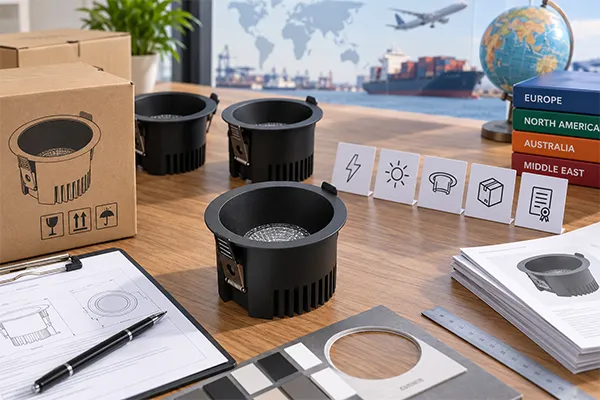
In my daily work with importers, contractors, distributors, and lighting brands, I often see inquiries that begin with only a product image and a target price. That is understandable, but it creates risk. The earlier we clarify the intended market and application, the more accurate the quotation, sample, approval process, and delivery plan can become.
Why Do LED Downlights Need Market-Specific Specifications?
When buyers source LED downlights without defining the destination and installation environment, they may receive products that appear suitable but do not match the actual project or customer requirement. This uncertainty can lead to revised quotes, rejected samples, packaging rework, or shipment delays. A market-specific specification gives both buyer and manufacturer a clearer starting point.
LED downlights need market-specific specifications because electrical systems, customer expectations, installation methods, labeling needs, and document requirements can vary by destination and project2. Buyers should confirm where the product will be sold or installed, then align voltage, driver type, dimensions, performance parameters, packaging, and documents with that use case before approving production.
A Product Is More Than Its Outer Appearance
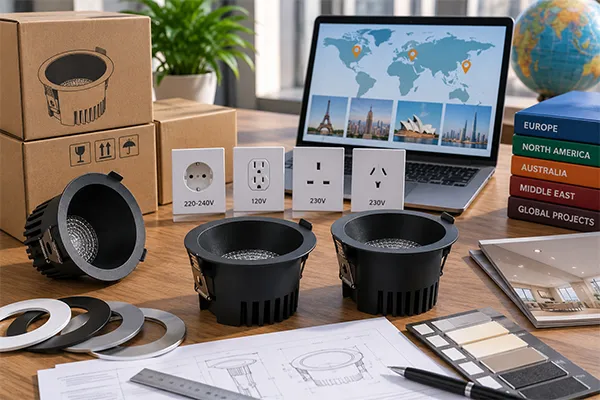
Two recessed products can have nearly identical trim designs while having very different internal configurations. One may use a constant-current external driver. Another may use an integrated driver.3 One may be designed for a 220–240V application, while another may be configured for a different electrical system. Their cutout sizes, dimming compatibility, beam angles, and packaging markings may also differ.
This is why I avoid treating the question “Can you supply this downlight?” as a simple yes-or-no question. I normally need to ask what the customer intends to do with it.
A useful export inquiry should identify:
- Destination country or region
- Sales channel, such as wholesale, retail, project supply, or private-label distribution
- Installation application, such as residential, hotel, office, retail, or corridor lighting
- Input voltage and frequency
- Wattage and lumen target
- Color temperature, such as 3000K, 4000K, or 6500K
- Beam angle
- CRI requirement
- Cutout size and ceiling conditions
- Trim color and surface finish
- Dimming or control expectations
- Branding, labeling, and packaging requirements
- Documents requested by the buyer, project owner, or local customer
Why “For Europe” or “For the Middle East” May Not Be Enough
A broad regional description can help start a conversation, but it is not always enough to freeze a product configuration. A distributor may have its own carton-marking rules. A contractor may need a certain cutout size to fit an existing ceiling plan. A retail customer may require a branded color box, installation instructions, or a barcode format.
In some cases, the buyer’s direct customer or project consultant sets requirements beyond the usual product configuration. That is why I recommend buyers treat certification documents, labels, and technical specifications as a connected package rather than separate requests.
A document can support a procurement review, but it should be checked against the actual product configuration, destination, customer requirement, and intended application.
At Upward Lighting, we can provide product configurations such as different color temperatures, wattages, beam angles, CRI options, and finish colors. However, customization works best when the buyer confirms the relevant requirements early. A configurable product is not automatically the same as an export-ready product for every market.
What Should Buyers Confirm Before Requesting a LED Downlights Quote?
An incomplete inquiry can create pressure for everyone involved. The buyer may need a quick budget figure, while the manufacturer may need more details to avoid pricing the wrong driver, trim, packaging, or performance level. A structured briefing process reduces uncertainty. It also helps both parties compare quotations on a like-for-like basis.
Before requesting a quote for LED downlights, buyers should confirm the target country, application, electrical input, wattage, CCT, beam angle, CRI, cutout, finish, quantity, packaging, branding, and required documents. These details allow manufacturers to quote the correct configuration instead of offering a generic product that may later need redesign or reapproval.
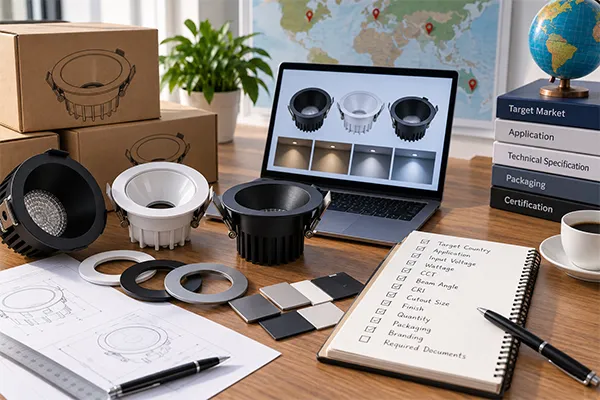
The Essential LED Downlight Requirement Sheet
I have seen many sourcing discussions improve quickly when a buyer provides even a basic specification sheet. It does not need to be overly technical at the first stage. It simply needs to capture the decisions that affect cost, suitability, and lead time.
| Item to Confirm | Why It Matters During Quotation | Example Buyer Input |
|---|---|---|
| Destination market | Helps identify the intended export context | UAE, UK, Canada, Australia |
| Product type | Defines housing and installation style | Recessed COB downlight, slim panel downlight |
| Wattage | Affects LED source, heat management, and driver selection | 7W, 12W, 18W |
| Color temperature | Affects LED configuration and sample approval | 3000K, 4000K, 6500K |
| CRI | Influences component choice and performance target | CRI 80 or CRI 90 |
| Beam angle | Affects optic selection and lighting distribution | 24°, 36°, 60°, 120° |
| Cutout size | Must suit the ceiling opening and installation plan | Ø75 mm, Ø90 mm, Ø120 mm |
| Input voltage | Must align with the intended electrical environment | AC 220–240V, 50/60Hz |
| Dimming requirement | May affect driver design and compatibility checks | Non-dimmable or specified dimming method |
| Trim finish | Supports project aesthetics or brand positioning | White, black, brushed finish |
| Packaging | Affects protection, retail readiness, and branding | Neutral box, color box, master carton |
| Documentation | Helps buyers plan internal and customer reviews | Test reports, declarations, manuals, labels |
Quantities Also Affect the Right Recommendation
Quantity is not only a commercial detail. It can influence the most practical product and packaging approach. A small trial order may use an established standard configuration with limited customization. A larger OEM order may justify custom trim colors, branded cartons, labels, or instruction materials.
For example, a lighting brand may request:
- A 12W recessed downlight.
- 3000K and 4000K options.
- CRI 90 for a retail environment.
- A black trim for one product series.
- Branded inner boxes and carton labels.
- A defined document set for its customer review process.
Each item affects the quote and approval workflow. If the buyer confirms only the wattage and quantity at the start, the initial quotation may not reflect the final product. That can create confusion later when extra packaging, a different driver, or a revised finish changes the cost.
I find that a good supplier should ask clarifying questions rather than simply provide the lowest possible number. A low quote based on undefined assumptions may look attractive at first. However, it may become less useful once the actual project details emerge.
How Do Installation Requirements Affect LED Downlights for Export?
A downlight may meet a buyer’s preferred appearance and still be unsuitable for the installation location. Problems often appear after the buyer checks ceiling cutouts, ceiling depth, insulation conditions, driver placement, glare expectations, or lighting layout. These issues can cause sample rejection even when the sample itself is well made.
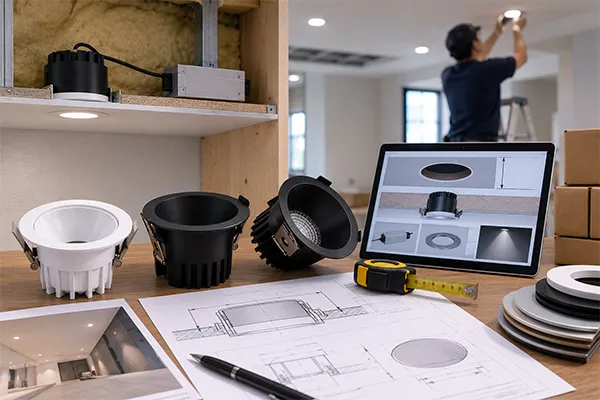
Installation requirements affect LED downlights because cutout size, ceiling depth, heat dissipation space, driver location, trim style, beam angle, and lighting performance must fit the actual site. Buyers should provide drawings, existing product samples, photos, or installation conditions whenever possible so the manufacturer can recommend an appropriate configuration.
Cutout Size Is Only One Part of Fit
Many buyers correctly begin by asking for a particular cutout diameter. However, a cutout dimension alone does not fully define installation compatibility4. The outer diameter, recessed depth, spring design, driver dimensions, cable arrangement, and ceiling material can all matter.
A product with the same nominal cutout size may still create installation challenges if:
- The ceiling cavity is shallow.
- The driver cannot fit above the ceiling.
- The existing opening has irregular edges.
- The spring clips do not suit the ceiling board thickness.
- The fixture trim does not cover the opening cleanly.
- The heat dissipation space is restricted.
- Insulation or other building materials sit close to the fixture.5
For renovation projects, I often suggest that buyers provide a physical sample of the existing fixture or clear measurements from the site. A few photographs with a ruler can prevent a great deal of uncertainty. For new projects, reflected ceiling plans and luminaire schedules are especially helpful.
Optical Performance Should Match the Space
The beam angle and color temperature of LED downlights can influence the visual result as much as the fixture’s physical size. A narrow beam may create focused accents in a retail display. A wider beam may suit general lighting in corridors, homes, or offices.6 The correct choice depends on ceiling height, fixture spacing, surface colors, and the desired lighting effect.
| Installation Consideration | Questions Buyers Should Ask | Possible Impact |
|---|---|---|
| Ceiling height | How far is the fixture from the working plane? | Influences beam angle and spacing |
| Lighting purpose | Is this general, task, or accent lighting? | Influences wattage and optic choice |
| Ceiling opening | What is the exact cutout and trim coverage needed? | Influences housing selection |
| Ceiling depth | How much space is available above the ceiling? | Influences fixture and driver dimensions |
| Existing layout | Is the product replacing another fitting? | May require matching cutout and appearance |
| Glare expectations | Is visual comfort important in the space? | May influence recessed design and beam angle |
| Interior finish | Are walls, shelving, or displays color-sensitive? | May influence CCT and CRI selection |
Samples Need a Defined Approval Method
A sample is valuable because it allows the buyer to inspect appearance, installation fit, light color, beam pattern, and general workmanship. Still, I do not consider a passed sample by itself to be proof that mass production is fully ready.
The buyer and manufacturer should define what the sample is approving:
- Product appearance
- Dimensions and cutout fit
- Color temperature
- Beam angle
- Driver configuration
- Dimming requirement, if applicable
- Packaging concept
- Label content
- Brand artwork
- Required supporting documents
Once those points are approved, they should be recorded in a specification sheet, sample confirmation form, purchase order, or other agreed document. This creates a reference for production. It also reduces the risk of a buyer approving one version while the factory receives different instructions later.
For application-specific decisions, buyers should involve qualified electrical, lighting design, or project professionals as appropriate. A manufacturer can help explain product parameters, but site safety, wiring conditions, and project compliance decisions need suitable professional evaluation.
How Should Manufacturers Align Labels, Packaging, and Documents for LED Downlights?
Many export orders encounter avoidable delays because labeling and packaging are treated as final-stage tasks. The product may be complete, but the carton artwork is not approved, the rating label lacks confirmed buyer information, or the requested documents do not match the finished configuration. These issues can interrupt shipment planning.
Manufacturers should align LED downlights, labels, packaging, and documents as one connected export package. Buyers should confirm product model details, electrical ratings, brand information, carton marks, manuals, barcode needs, and requested documentation before production. This approach reduces last-minute artwork revisions and document-product mismatches.
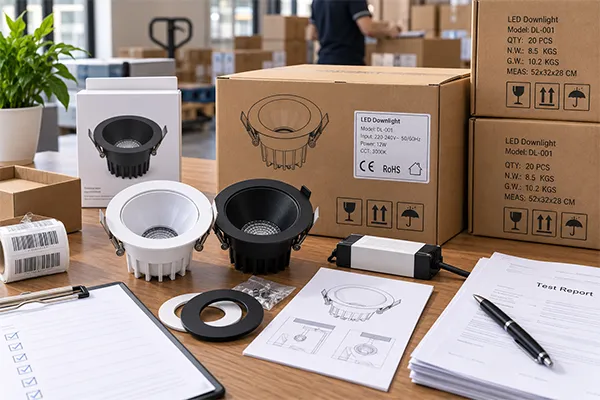
The Product Configuration Must Match the Paperwork
When a buyer requests supporting documents, I first try to confirm exactly which product version is being reviewed. This matters because an export order may include multiple wattages, color temperatures, finishes, or package formats. If a document refers to a different model, rating, or product family, it may not answer the buyer’s customer or project question.
Buyers should verify whether their requested documentation aligns with:
- The exact product model or defined product series
- Electrical rating and driver type
- Intended market and customer requirement
- Product label information
- User instructions and warning text
- Packaging marks
- Any private-label or importer information required by the buyer’s channel
At Upward Lighting, our products hold documents such as CE and RoHS that can support relevant market and customer review processes. However, I always recommend that buyers verify the documents against their own destination market, buyer requirements, and application. A CE or RoHS document should not be treated as an automatic guarantee of entry into every country, every tender, or every sales channel.7
Packaging Is a Quality-Control and Brand-Control Issue
Packaging has several jobs. It protects the product during handling, presents the brand, identifies the product, and helps the importer manage inventory.8 For project orders, outer carton marks may be especially important because they help warehouse teams distinguish wattages, CCTs, and locations.
A well-defined packaging brief may include:
- Inner box dimensions and artwork
- Product image and brand logo
- Model number
- Wattage and input rating
- CCT and beam angle
- Quantity per carton
- Gross and net weight
- Carton dimensions
- Barcode format
- Shipping marks
- Installation instructions
- Warning labels
- Country-of-origin wording, where requested by the buyer
I have handled orders where a buyer confirmed the product quickly but needed more time to approve the box design. In those cases, the packaging approval became the real schedule driver. That experience taught me that OEM packaging should be discussed alongside the product, not after the production plan has already been fixed.
Documentation Should Be Requested Early
Buyers should identify requested documents during the quotation or sampling stage. This allows the manufacturer to review availability and identify any gaps before production is underway.
A practical document request list may include:
- Product specification sheet
- Product drawing with dimensions
- Installation instructions
- Packing list format
- Commercial invoice requirements
- Requested declarations or test reports
- Product and carton label artwork
- Photo requirements for pre-shipment review
This is not a universal compliance checklist. Requirements can vary by market, customer, product configuration, and application. The point is to avoid discovering essential requests after goods are packed.
What Manufacturing Controls Support Consistent LED Downlights?
Buyers reasonably want evidence that the product supplied after sample approval will remain consistent through production. A strong production process can reduce variation, but it cannot correct an unclear specification. Quality controls are most useful when they measure production against an agreed product standard.9
Manufacturing controls support consistent LED downlights by checking incoming materials, assembly details, electrical performance, appearance, and aging performance against an approved specification. Controls such as 100% aging tests can improve confidence in production consistency10, but they do not replace market-specific compliance confirmation, installation review, or a complete buyer requirement sheet.

Quality Begins With a Frozen Specification
The phrase “same as sample” can become difficult if the sample was not clearly defined. For this reason, I believe the most important quality-control document is often the approved specification itself. It tells production teams what must remain consistent.
For LED downlights, that may include:
- Model and housing style
- Wattage
- Input voltage
- CCT
- CRI
- Beam angle
- Cutout and outer dimensions
- Trim color
- Driver type
- Branding and labels
- Packaging arrangement
- Approved sample reference
Once these points are frozen, the manufacturer can build inspection steps around them. Without them, production teams may have to interpret vague instructions, and buyers may compare finished goods against expectations that were never formally communicated.
Aging Tests Can Be Helpful, but They Have Limits
At Upward Lighting, each product undergoes a 100% aging test lasting approximately 4 to 8 hours before shipment11. This process is intended to support production consistency and help identify obvious early-stage issues before packing. It forms one part of our manufacturing quality-control approach.
However, I do not present aging as a substitute for every other form of verification. An aging test does not determine whether the buyer selected the correct cutout for a renovation project. It does not prove that a label meets every local customer expectation. It does not replace review of requested compliance documents or application-specific professional assessment.
A balanced buyer evaluation process should consider several areas:
| Evaluation Area | What Buyers Can Review |
|---|---|
| Specification control | Approved product sheet, drawings, and sample reference |
| Production consistency | Inspection process, aging process, and batch controls |
| Supplier communication | Speed and clarity of technical responses and revisions |
| Document alignment | Whether documents match the requested product configuration |
| Packaging control | Approved artwork, labels, carton marks, and packing method |
| Delivery planning | Lead time assumptions, quantity, packaging approval, and order status |
Select Suppliers for Clarification, Not Just Quotation Speed
Fast quotations are useful, especially when a buyer is responding to a tender or a customer request. Still, a good supplier should also identify missing details that could affect the quote.
I believe buyers should look for suppliers that can answer questions such as:
- Which specification points are still open?
- Which assumptions are included in the quoted price?
- Can the proposed model fit the stated cutout and ceiling depth?
- What product details need sample approval?
- Which packaging details affect lead time?
- Which documents are available for review?
- What changes would affect the price or production schedule?
A manufacturer that asks these questions is not necessarily making the procurement process slower. In many cases, that supplier is preventing rework that would otherwise appear later.
Frequently Asked Questions
Is CE and RoHS enough for exporting LED downlights?
CE and RoHS documents may be relevant to certain customer or market reviews, but they do not automatically prove that LED downlights are suitable for every country, project, or sales channel. Buyers should verify applicable destination-market requirements, customer specifications, product configuration, labeling, and supporting documents.
What information should I send when requesting a LED downlight quotation?
You should send the destination market, product photo or drawing, wattage, voltage, CCT, CRI, beam angle, cutout size, trim finish, quantity, packaging needs, branding details, and requested documents. Installation photos or ceiling drawings can also help manufacturers recommend a more suitable configuration.
Can a sample approval guarantee mass-production quality?
A sample approval does not guarantee mass-production readiness by itself. Buyers should use the sample together with an approved specification, product drawing, packaging artwork, labels, and quality expectations. The supplier should then control production against those agreed requirements.
Why do LED downlight cutout sizes need careful confirmation?
Cutout size affects whether the fixture can fit the ceiling opening, but it is not the only installation dimension. Buyers should also check trim diameter, recessed depth, driver dimensions, spring clip design, and available ceiling space. This is especially important for replacement and renovation projects.
When should OEM packaging be confirmed?
Buyers should confirm OEM packaging during quotation or sampling, not immediately before shipment. Box artwork, carton markings, barcode requirements, manuals, and labels can affect cost, approval time, and production scheduling. Early approval reduces the chance of packaging-related shipment delays.
Conclusion
Preparing LED downlights for global export starts well before shipment. Buyers should first define the destination market, installation conditions, electrical and optical requirements, cutout dimensions, branding, packaging, and document needs. Manufacturers can then provide more accurate quotations, more relevant samples, and more controlled production. At Upward Lighting, I encourage buyers to share a clear requirement sheet at the inquiry stage. Contact our team to discuss your LED downlight specification, OEM/ODM options, sample needs, and export-order packaging requirements.
"EU - EU Legislation and CE Marking", https://www.trade.gov/country-commercial-guides/eu-eu-legislation-and-ce-marking. European regulatory guidance states that CE marking demonstrates conformity with applicable EU harmonisation legislation for the relevant product and market, while the RoHS framework addresses restrictions on specified hazardous substances; neither designation by itself establishes compliance with all non-EU, project-specific, or contractual requirements. Evidence role: general_support; source type: government. Supports: The territorial and legal scope of CE marking and the product-substance scope of the EU RoHS Directive.. Scope note: Whether CE marking or RoHS obligations apply depends on the product, applicable legislation, and market in which it is placed. ↩
"Foreign Regulations - International Trade Administration", https://www.trade.gov/foreign-regulations. Official market-access guidance explains that electrical products may be subject to jurisdiction-specific conformity, labeling, and information requirements, supporting the need to identify the destination market before finalizing an export configuration. Evidence role: general_support; source type: government. Supports: Official market-access guidance showing that product conformity, labeling, instructions, and related requirements are jurisdiction-specific.. Scope note: The applicable requirements depend on the importing jurisdiction and product classification. ↩
"LED circuit", https://en.wikipedia.org/wiki/LED_circuit. Technical lighting guidance describes LED drivers as devices that regulate electrical power to LEDs, commonly using constant-current operation; drivers may be incorporated into a luminaire or supplied separately depending on product design. Evidence role: definition; source type: government. Supports: Technical guidance defining constant-current LED drivers and their role in regulating current to LED light sources.. Scope note: Driver placement and topology vary by luminaire model and are not determined by the driver definition alone. ↩
"Light Fixtures (Downlights)", https://www.energystar.gov/products/light_fixtures. Recessed-luminaire installation guidance requires assessment of more than the ceiling opening, including the luminaire's housing dimensions, mounting method, clearances, and any restrictions concerning insulation or adjacent building materials. Evidence role: general_support; source type: institution. Supports: Installation guidance showing that recessed luminaires require consideration of dimensions, mounting arrangements, clearances, and nearby insulation or building materials.. Scope note: Exact clearance and mounting requirements are model-specific and must follow the luminaire manufacturer's instructions and applicable installation rules. ↩
"Recessed Lighting - Code Compliance Brief", https://basc.pnnl.gov/code-compliance/recessed-lighting-code-compliance-brief. Electrical-safety guidance distinguishes recessed luminaires rated for insulation contact from those requiring separation because heat generated by the luminaire can make surrounding insulation and building-material clearances relevant to safe installation. Evidence role: mechanism; source type: institution. Supports: Safety guidance on the relationship between recessed luminaires, heat, and contact with insulation or combustible building materials.. Scope note: The required treatment depends on the fixture's listing, rating, installation instructions, and local electrical code. ↩
"Lighting Design: Techniques to Transform Interior Spaces", https://marymount.edu/blog/lighting-design-techniques-to-transform-interior-spaces/. Lighting-design instructional materials commonly associate narrow, directional beam distributions with accenting selected objects or areas and broader distributions with more uniform general illumination. Evidence role: general_support; source type: education. Supports: Lighting-design principles relating narrow directional distributions to accent lighting and broader distributions to general illumination.. Scope note: Appropriate beam selection remains dependent on geometry, target illuminance, mounting height, and the intended visual effect. ↩
"CE marking", https://en.wikipedia.org/wiki/CE_marking. European guidance treats CE marking as a conformity indication under applicable harmonisation legislation, while procurement specifications may require additional evidence or performance characteristics; consequently, a CE or RoHS-related document is not by itself proof of acceptance under every commercial or tender requirement. Evidence role: general_support; source type: government. Supports: The distinction between CE conformity obligations and additional technical specifications or documentary conditions that purchasers may set.. Scope note: Tender and customer requirements are set case by case and may exceed baseline regulatory obligations. ↩
"Branding/Labeling & Packaging - The Market Diversification Tool", https://beta.trade.gov/article?id=Branding-Labeling-and-Packaging. Export-packaging guidance identifies product protection during handling and distribution, together with clear identification and handling information, as core functions of packaging in supply chains. Evidence role: general_support; source type: institution. Supports: Export-packaging guidance describing packaging functions in product protection, identification, handling, and distribution.. Scope note: Brand presentation and inventory practices are commercial functions that vary with the buyer's distribution system. ↩
"NIST Quality System", https://www.nist.gov/nist-quality-system. Quality-management frameworks define conformity and quality control in relation to specified requirements, supporting the use of an approved specification as the reference against which production outputs are checked. Evidence role: expert_consensus; source type: institution. Supports: Quality-management principles that define quality assurance and control in relation to meeting specified requirements.. Scope note: A defined specification improves traceability and consistency but does not itself ensure that the specification is complete or suitable for the intended application. ↩
"Burn-in", https://en.wikipedia.org/wiki/Burn-in. Reliability literature describes burn-in and related screening as methods that can reveal some early-life defects or failures in electronic components and assemblies, which can provide limited evidence of process consistency. Evidence role: mechanism; source type: paper. Supports: Reliability-engineering evidence that burn-in or screening tests can expose certain early-life failures in electronic products.. Scope note: Burn-in duration and conditions do not predict all field failures, lifetime performance, installation suitability, or regulatory conformity. ↩
"ISO 9001 and 9002 Requirements by Section", https://faculty-web.msoe.edu/tritt/be4xx/iso9000sum.html. Quality-management guidance emphasizes documented, retained, and auditable records for production and inspection activities; such records are the appropriate evidence for a manufacturer-specific claim of 100% pre-shipment aging testing. Evidence role: general_support; source type: institution. Supports: Quality-system principles requiring documented and auditable records for claimed production inspection activities.. Scope note: A general quality-system source does not independently verify Upward Lighting's stated test coverage, duration, conditions, or shipment-by-shipment implementation. ↩