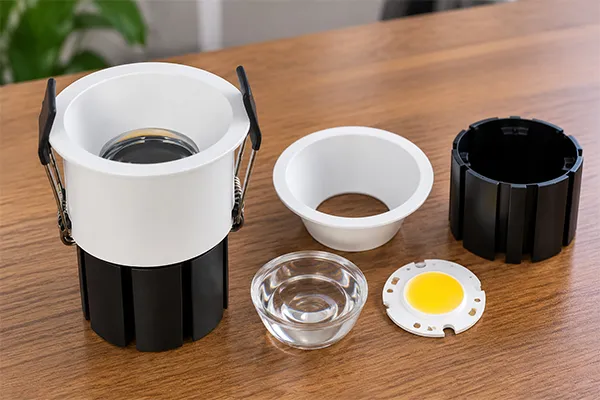

An LED downlight manufacturer can strongly influence whether a lighting brand builds a reliable product range or faces recurring quality, delivery, and positioning problems. When buyers focus only on the lowest quotation, they may overlook risks that appear later in sampling, certification review, repeat orders, and customer complaints. We believe a better supplier relationship supports controlled, differentiated growth.
An LED downlight manufacturer supports brand growth by helping buyers turn a clear market position into repeatable products with appropriate customization, verified market-entry documents, stable production communication, and consistent quality-control processes. The lowest unit price can be useful, but buyers should assess total supply risk, including specification alignment, lead-time reliability, batch consistency, and issue resolution.1

For emerging brands, importers, and channel businesses, the goal is rarely to buy one downlight model once. The goal is to create a product line that customers recognize, sales teams can explain, and procurement teams can reorder with confidence. That makes manufacturer selection a strategic purchasing decision rather than a simple price comparison.
Why Should Brands Evaluate an LED Downlight Manufacturer Beyond Unit Price?
A low quotation can look attractive when a brand is trying to protect margin or enter a competitive category. However, a low initial price can become frustrating if samples differ from production goods, communication slows down, or a supplier cannot maintain the agreed specification. We see this concern often when buyers compare several supply options.
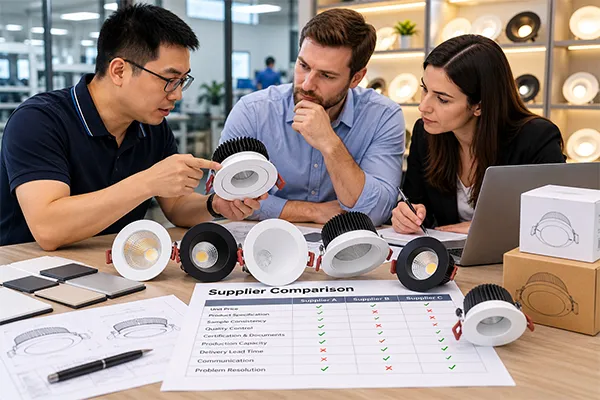
An LED downlight manufacturer should be evaluated on total supply value, not only the quoted price per unit. Buyers should compare how each supplier supports specification control, production consistency, documentation, delivery planning, and problem resolution. A competitive price matters, but it should match the product promise that a brand makes to its customers.
The Difference Between Unit Cost and Supply Risk
Every buyer has a budget. We understand that unit cost affects retail pricing, distributor margins, project bids, and inventory planning. A factory that offers a low price is not automatically a poor choice. In some cases, a basic product specification with limited customization may be exactly what a market needs.
The important question is whether the supplier’s offer matches the brand’s intended position.
For example, a value-focused electrical channel may prioritize a practical standard downlight with stable availability and a controlled price. A premium residential lighting brand may need stronger consistency in finish, color temperature, beam performance, packaging, and visual presentation. These buyers may both purchase LED downlights, but they are managing different commercial risks.
When we participate in manufacturer–brand discussions, we encourage buyers to look beyond the first quotation. A more complete evaluation can include the following areas:
- Specification clarity: Does the quotation clearly state wattage, input voltage, CCT, beam angle, CRI, finish, driver type, and mounting details?
- Sample-to-production alignment: Can the supplier confirm how production will match the approved sample?
- Quality-control process: Does the supplier explain inspection steps, aging procedures, and nonconformance handling?
- Documentation availability: Can the supplier provide relevant CE, RoHS, or other requested documents for buyer review?
- Communication responsiveness: Does the supplier answer technical and commercial questions clearly before an order?
- Lead-time planning: Does the supplier communicate realistic production timing instead of promising an unrealistic schedule?
- Repeat-order management: Can the supplier maintain agreed specifications when the buyer places future orders?
A Practical Supplier Comparison Framework
We recommend that buyers use a weighted scorecard rather than selecting only from a price list. The exact weighting should depend on the brand’s sales model and market.
| Evaluation Area | Questions for Buyers | Why It Matters |
|---|---|---|
| Product fit | Does the product match the intended customer segment? | A product that does not fit the market can create slow-moving inventory. |
| Quotation clarity | Are all critical specifications included in writing? | Clear documents reduce misunderstandings later.2 |
| Customization control | Can the supplier support only the changes that create market value? | Useful customization differentiates a brand without creating unnecessary SKUs. |
| Quality process | What checks occur before shipment? | Process visibility helps buyers assess production discipline. |
| Compliance documents | Which documents are available, and for which models? | Buyers need to verify market-entry requirements independently. |
| Delivery communication | How does the supplier manage updates and delays? | Transparent communication supports purchasing and customer commitments. |
| Commercial terms | Are MOQ, payment, packaging, and warranty terms clear? | Clear terms prevent avoidable disputes. |
We have seen buyers spend more time resolving unclear specifications than they spent negotiating the original price. A detailed quotation is often a useful early indicator of how a supplier will manage later production questions.
An LED downlight manufacturer does not need to be the cheapest option to be commercially useful. The supplier needs to help the buyer make a product promise that can be delivered repeatedly. That is the more relevant measure for a brand seeking long-term credibility.
How Can an LED Downlight Manufacturer Create Meaningful Product Differentiation?
Many lighting brands want products that look different from competing offers. The challenge is that too many variations can complicate inventory, increase purchasing risk, and confuse sales teams. We find that the most effective differentiation usually comes from a focused set of commercially relevant choices.
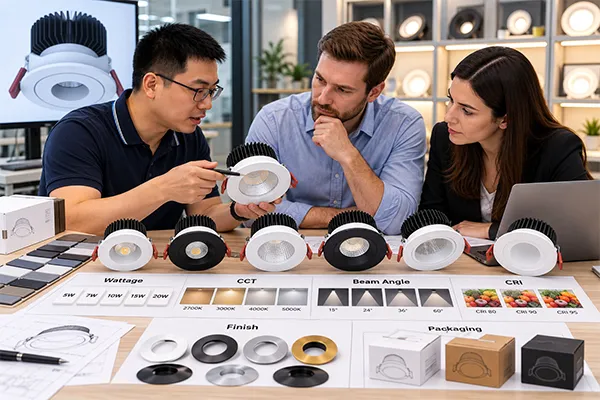
An LED downlight manufacturer can support meaningful differentiation by adapting product parameters that matter to the target market, such as wattage, CCT, beam angle, CRI, finish, and packaging. Buyers should avoid arbitrary SKU expansion and instead choose variations that support a clear customer need, application, or brand position.
Start With a Product Positioning Decision
Before discussing custom colors or special packaging, we suggest that buyers define the role of each product in their range. A downlight may be designed for entry-level residential renovation, premium hospitality interiors, retail display, office fit-outs, or distribution through electrical wholesalers.
That role should guide the specification.
For example, a buyer selling through a building-material channel may prioritize a flexible CCT range, familiar cut-out sizes, straightforward installation, and cost control. A brand serving interior designers may place more importance on finish options, glare management, beam angle selection, and higher color-rendering expectations. Neither position is universally better. Each requires a different product strategy.
Customization That Usually Has Commercial Value
In our OEM/ODM conversations, buyers most often focus on parameters that affect application suitability or product positioning:
| Customization Area | Buyer Decision It Supports | Potential Trade-Off |
|---|---|---|
| Wattage | Balances light output, energy use, and product tiering | More variants can complicate inventory planning. |
| CCT | Aligns products with regional preferences and application needs | Mixed CCT orders require careful labeling and production control. |
| Beam angle | Supports ambient, task, accent, or display lighting goals | A broader range may raise MOQ or sampling needs. |
| CRI | Helps position products for applications where color appearance matters | Higher CRI requirements may affect product cost and efficacy.3 |
| Surface finish | Supports interior style and brand identity | Custom finishes require approval standards and repeat-order controls. |
| Packaging and labeling | Improves shelf presentation and channel recognition | Artwork changes need careful proof approval. |
| Product positioning | Creates a clear “good, better, best” range | Too many tiers can confuse distributors and end users. |
Avoid Customization for Its Own Sake
Customization is valuable only when it helps a buyer sell, specify, stock, or explain a product more effectively. A brand does not necessarily need every wattage, every color temperature, and every finish.
I have seen discussions where a buyer initially requested many product variants because they wanted to cover every possible customer preference. After reviewing the intended sales channels, the buyer recognized that a smaller, better-defined range would be easier to launch and reorder. That type of decision can reduce product-line complexity without reducing market relevance.
A focused assortment often helps buyers:4
- Maintain clearer stock forecasts.
- Train sales teams more easily.
- Prepare cleaner catalogues and product sheets.
- Reduce the chance of ordering similar but non-interchangeable models.
- Concentrate marketing effort on the products with the strongest commercial role.
An LED downlight manufacturer should help a buyer understand these trade-offs during product development. We believe that responsible OEM/ODM support includes asking what the customization is intended to achieve. If a change does not support market fit, channel requirements, or brand identity, it may add cost and complexity without creating a meaningful advantage.
How Does an LED Downlight Manufacturer Reduce OEM/ODM Launch Friction?
Product launches can lose momentum when samples, specifications, quotations, artwork, and production details move slowly between teams. Buyers may have a strong concept, but unclear communication can turn a manageable launch into a difficult procurement process. We see this risk most often when responsibilities are not defined early.
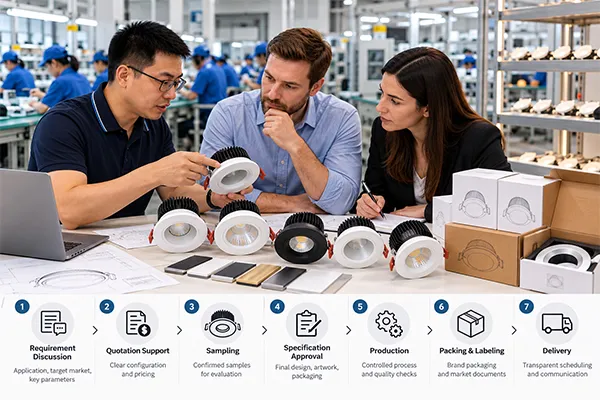
An LED downlight manufacturer reduces launch friction by providing clear specification alignment, responsive quotation support, controlled sampling, documented approvals, and transparent production communication. These steps do not remove all supply-chain risk, but they help buyers identify issues before products reach the market.
Build a Clear Path From Inquiry to Repeat Order
A good OEM/ODM process should not feel like a collection of disconnected emails. We recommend that buyers and suppliers establish a practical approval path from the first inquiry through repeat production.
At Upward Lighting, we support OEM/ODM discussions around parameters such as color temperature, wattage, beam angle, CRI, and surface finish. However, the value of these options depends on how well the buyer and manufacturer document the final decision.
A controlled launch process commonly includes these stages:
- Product brief: The buyer explains the target market, intended application, required features, and expected positioning.
- Preliminary recommendation and quotation: The supplier proposes an appropriate product configuration and identifies questions or limitations.
- Specification confirmation: Both parties align on key technical and commercial details in writing.
- Sample review: The buyer evaluates physical samples for appearance, installation suitability, light characteristics, labeling, and packaging where relevant.
- Approval documentation: The buyer confirms the approved sample, artwork, and specification before production.
- Production communication: The supplier provides realistic timing and communicates material or scheduling concerns promptly.
- Pre-shipment checks: The supplier follows its quality process and prepares agreed shipping documents.
- Repeat-order reference: Both parties use the approved specification as a reference for future orders.
Why Fast Quotations Matter, but Careful Quotations Matter More
Buyers often need fast pricing to respond to distributors, project opportunities, or internal planning deadlines. We understand this pressure. A quick quotation can support decision-making, but an incomplete quotation can cause later confusion.
For that reason, we believe quotation speed should be paired with quotation quality. A useful quotation should show enough detail for buyers to compare offers fairly. It should not hide important assumptions behind a single line item.
Buyers should ask whether the quoted LED downlight includes:
- The stated wattage and CCT
- The requested trim color or surface finish
- The expected driver arrangement
- Required packaging or labeling
- Applicable certification documents, where available
- Tooling, artwork, or sample charges, if relevant
- MOQ requirements for the proposed configuration
- Estimated production timing and shipping terms
Repeat-Order Consistency Is Part of Brand Protection
A brand’s reputation does not depend only on its first shipment. It also depends on whether the product that arrives later remains aligned with the product that customers approved previously.
This is why an LED downlight manufacturer should retain clear records for approved configurations. Buyers should also maintain their own version-controlled specification files, approved sample references, artwork files, and purchase-order details.
We recommend that buyers avoid relying only on product photos or informal chat messages. A photo can help explain a finish, but it may not show every technical or dimensional requirement. Written specifications create a more reliable reference point when personnel change or repeat orders occur months later.5
What Should Buyers Verify About Quality Control and Certifications?
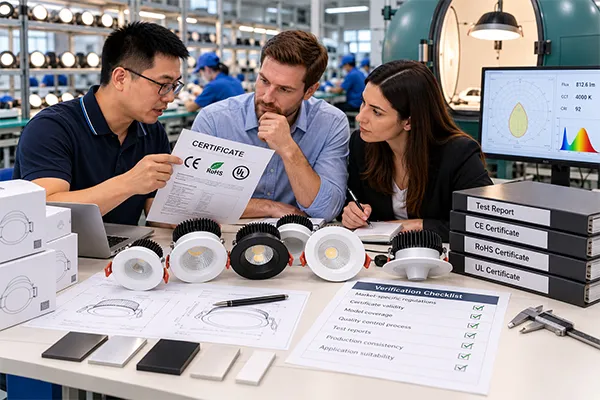
Certifications and factory quality statements can give buyers useful information, but they should not be treated as automatic proof that every shipment will meet every commercial expectation. A brand still needs to assess the supplier’s operating discipline, product documentation, communication, and suitability for the intended market.
An LED downlight manufacturer should provide relevant documentation and explain its quality-control practices, while buyers independently verify market-specific regulations, certificate validity, product-model coverage, and application requirements. Certifications support market access when applicable, but they do not replace product evaluation, batch checks, or qualified professional assessment.6
Certifications Are Important Documents, Not Complete Guarantees
For many markets, buyers need to consider CE, RoHS, and other applicable product, safety, environmental, or market-entry requirements.7 The necessary documents depend on the destination market, product design, intended use, and sales channel.
At Upward Lighting, our products hold certifications such as CE and RoHS. We provide these documents as part of the buyer’s evaluation process where applicable. However, buyers should verify that each document relates to the correct product model, version, destination market, and current regulatory requirement.
Buyers should also consult qualified compliance, testing, or legal professionals when their application or destination market requires specialized advice. We are a manufacturer, not a legal adviser or certification authority.
Evaluate the Quality Process Behind the Documents
Documents matter, but buyers should also ask how a supplier manages day-to-day production quality. In our own process, every product undergoes a 100% aging test before shipment, typically lasting between four and eight hours.8 This process is intended to support our internal quality-control practice and identify certain early issues before dispatch.9
However, we do not present aging as a complete guarantee of long-term performance, market success, or suitability for every installation. Buyers should evaluate the full product specification and application conditions.
A practical quality-control discussion can include:
- What incoming material checks does the factory perform?
- How does the factory confirm key assembly and appearance requirements?
- Does the supplier conduct aging or burn-in testing, and how is it documented?
- How are defective units identified and handled?
- What product records are retained for repeat orders?
- How does the supplier respond if a buyer identifies a batch concern?
- Can the supplier provide product samples for independent evaluation?
Look at Communication During Problems, Not Only During Sales
A supplier relationship is tested when something needs clarification or correction. Buyers should pay attention to how the manufacturer handles questions before the first order. That behavior can offer useful insight into future cooperation.
We suggest that purchasing leaders evaluate whether a supplier:
- Answers direct questions without avoiding technical details.
- Explains limitations instead of making unsupported promises.
- Provides realistic corrective actions when an issue occurs.
- Communicates schedule changes early.
- Distinguishes between confirmed information and assumptions.
- Maintains a clear contact person for commercial and technical coordination.
In our experience, transparent communication does not mean that every issue disappears. It means that buyers can make informed decisions sooner. This can protect delivery plans, customer relationships, and brand credibility.
How Can Buyers Build a Scalable LED Downlight Product Range?
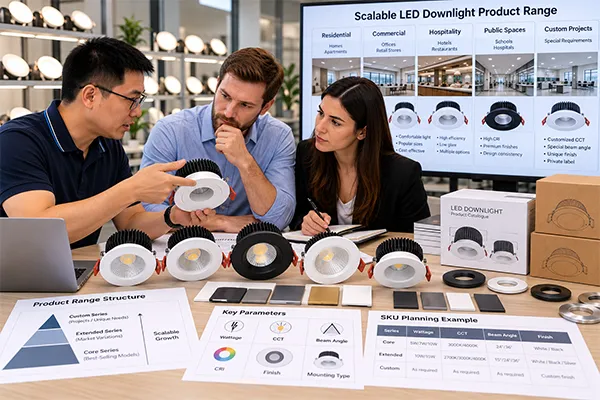
A growing brand can lose control when it adds products faster than it can manage specifications, inventory, and sales positioning. Buyers may feel pressure to offer every possible downlight option, especially when competitors display large catalogues. However, a scalable range needs structure before it needs volume.
An LED downlight manufacturer can help buyers build a scalable range by organizing products around clear application needs, controlled customization, and repeatable supply specifications. The best range is not always the largest range. It is the range that the brand can explain, stock, support, and reorder with confidence.
Create Product Families Instead of Unrelated SKUs
We recommend that buyers think in product families. A product family may share a common design language, installation approach, driver platform, or packaging format while offering selected variations for different applications.10
For example, a buyer might structure a range around:
- Essential downlights: Practical models for price-sensitive channels and common renovation needs.
- Comfort-focused downlights: Products positioned around visual comfort, finish choices, and residential interiors.
- High-color-rendering downlights: Models intended for applications where color appearance is commercially important.
- Project-oriented downlights: Configurations selected for planned commercial or hospitality applications, subject to professional project evaluation.
This structure can make sales materials clearer. It can also help buyers decide which products need stock support and which products should remain special-order items.
Use Supplier Input Without Giving Up Brand Control
The brand should own its market position, customer understanding, and final product decisions. The manufacturer can contribute practical production knowledge, including the likely effect of a requested change on cost, MOQ, production timing, or consistency.
That division of responsibility is healthy.
When buyers are comparing supply options, we find that the strongest discussions happen when both sides are clear about their roles:
| Brand or Buyer Responsibility | Manufacturer Responsibility |
|---|---|
| Define customer segment and product position | Explain feasible product configurations |
| Set commercial priorities | Quote clearly and identify assumptions |
| Approve samples and artwork | Produce to approved specifications |
| Verify destination-market obligations | Provide relevant available documents for review |
| Manage local sales claims and warranties | Communicate production status and quality processes |
| Forecast demand and reorder needs | Support repeat-order specification consistency |
A long-term relationship becomes more stable when neither party assumes the other will manage responsibilities outside its role.
Frequently Asked Questions
What should I ask an LED downlight manufacturer before placing an order?
We recommend that buyers ask about product specifications, sample approval, MOQ, lead time, customization limits, quality-control steps, packaging, repeat-order controls, and available compliance documents. Buyers should also ask how the supplier handles production changes, delivery delays, and reported quality concerns.
Can OEM customization help a lighting brand compete?
OEM customization can help when it supports a real market need, such as a preferred CCT, beam angle, CRI, finish, wattage, or packaging style. We suggest that buyers avoid unnecessary variations because they can increase inventory complexity, MOQs, and the risk of ordering errors.
Do CE and RoHS documents guarantee LED downlight quality?11
No. CE and RoHS documents may be relevant to market-entry and environmental requirements, but they do not guarantee batch consistency, customer satisfaction, long-term performance, or suitability for every application. Buyers should verify documentation and separately assess samples, quality processes, and supplier communication.
How can I compare LED downlight supplier quotations fairly?
Buyers should compare more than the unit price. We recommend comparing the exact specification, driver arrangement, finish, packaging, MOQ, documentation, delivery estimate, payment terms, quality process, and customization scope. A detailed comparison reduces the risk of selecting a quotation with hidden differences.
Why is sample approval important for repeat LED downlight orders?
A written sample approval creates a reference for appearance, specifications, labeling, packaging, and other agreed details.12 It helps both the buyer and the LED downlight manufacturer manage repeat orders more consistently and reduces reliance on memory, photos, or informal communication.
Conclusion
An LED downlight manufacturer supports brand growth when it helps buyers create products that are differentiated, commercially sensible, and repeatable across future orders. We believe that buyers should balance price with specification clarity, useful customization, quality-control visibility, documentation review, and communication reliability. Certifications can be important for market entry, but buyers should verify their relevance and assess the broader supply process. At Upward Lighting, we support brands, importers, distributors, and channel partners with OEM/ODM discussions designed to reduce avoidable launch and sourcing risk. Contact us to discuss your next LED downlight range.
"Supplier Selection Criteria and Methods in Supply Chains", https://www.academia.edu/103872437/Supplier_Selection_Criteria_and_Methods_in_Supply_Chains_A_Review. Supplier-selection research commonly treats price as one criterion among quality, delivery performance, technical capability, and supply-risk considerations. Evidence role: general_support; source type: paper. Supports: Research showing that supplier selection commonly evaluates price alongside quality, delivery, technical capability, and risk-related criteria.. Scope note: The literature supports a general procurement framework and does not establish the performance of any particular LED-downlight supplier. ↩
""Information Sharing, Buyer-Supplier Relationships and Firm ...", https://oasis.library.unlv.edu/mib_fac_articles/14/. Quality-management guidance emphasizes documented requirements and controlled information to ensure that relevant parties work from consistent specifications. Evidence role: general_support; source type: institution. Supports: Quality-management guidance supporting documented requirements and controlled information as tools for consistent communication and conformity.. Scope note: Such guidance supports the rationale for documentation but cannot guarantee that misunderstandings will not occur in an individual transaction. ↩
"2019 Solid-State Lighting R&D Opportunities", https://www.energy.gov/sites/prod/files/2020/01/f70/ssl-rd-opportunities2-jan2020.pdf. LED lighting guidance and technical studies describe a potential trade-off between color-rendering performance and luminous efficacy because spectral power distribution influences both measures. Evidence role: mechanism; source type: government. Supports: Technical evidence that LED spectral designs intended to improve color rendering can affect luminous efficacy.. Scope note: The magnitude of any efficacy or cost effect varies by LED package, driver, optical design, target CCT, and generation of technology. ↩
"Managing Product Variety: Supply Chain Segementation ...", https://scm.mit.edu/news-and-events/managing-product-variety-supply-chain-segementation-for-food-and-beverage-retailers/. Operations-management research finds that increased product variety can add forecasting, inventory, and process complexity, creating a rationale for disciplined assortment design. Evidence role: general_support; source type: paper. Supports: Operations research examining how product variety and SKU complexity affect forecasting, inventory, and operational management.. Scope note: The evidence concerns general product-assortment management; the optimal number of downlight variants depends on the buyer's channel, demand pattern, and service model. ↩
"managing the configuration of information systems with a", https://tsapps.nist.gov/publication/get_pdf.cfm?pub_id=909644. Configuration-management guidance uses documented, approved baselines and change control to preserve product requirements across production cycles and organizational changes. Evidence role: general_support; source type: government. Supports: Configuration-management principles requiring documented baselines and controlled changes for reproducible products.. Scope note: These principles support the value of written specifications but do not make a specification complete unless dimensions, tolerances, revisions, and approval status are adequately defined. ↩
"CE marking – obtaining the certificate, EU requirements", https://europa.eu/youreurope/business/product-rules-compliance/general-product-compliance/ce-marking/index_en.htm. European Commission guidance explains that CE marking signifies a manufacturer's declaration of conformity with applicable Union requirements; it is not a general quality endorsement or proof of suitability for every installation. Evidence role: definition; source type: government. Supports: Official explanation that CE marking indicates conformity with applicable EU requirements rather than a general certification of product quality or fitness for every use.. Scope note: Applicable legal requirements and conformity procedures depend on the product and the market in which it is placed. ↩
"CE marking – obtaining the certificate, EU requirements", https://europa.eu/youreurope/business/product-rules-compliance/general-product-compliance/ce-marking/index_en.htm. EU guidance describes CE marking as applicable to products covered by specified harmonisation legislation, while the RoHS Directive restricts certain hazardous substances in in-scope electrical and electronic equipment. Evidence role: definition; source type: government. Supports: Official descriptions of CE-marking obligations and the EU RoHS restrictions applicable to in-scope electrical and electronic equipment.. Scope note: Whether a particular downlight, configuration, or sales route is in scope must be determined against current law in the destination market. ↩
"Improved indoor lighting improved healthy aging at home - PMC", https://pmc.ncbi.nlm.nih.gov/articles/PMC6526775/. The manufacturer's quality-control records state that each listed unit is subjected to a documented pre-shipment aging test lasting four to eight hours. Evidence role: case_reference; source type: other. Supports: Auditable evidence of the manufacturer's stated pre-shipment aging-test procedure, coverage, duration, and recordkeeping.. Scope note: This company-specific procedure requires current, model-specific audit evidence; a general description of testing does not independently verify that every shipment received the stated treatment. ↩
"A Methodology for Testing", https://nvlpubs.nist.gov/nistpubs/Legacy/IR/nbsir76-1157.pdf. Reliability engineering literature describes burn-in and aging screens as methods that may reveal some early-life failures before products enter service. Evidence role: mechanism; source type: research. Supports: Reliability evidence that burn-in or aging screens may expose some early-life electronic failures before field use.. Scope note: Burn-in effectiveness depends on the test conditions and failure mechanisms and does not demonstrate long-term reliability for every unit or installation. ↩
"Platform-Based Product Design and Development", https://tsapps.nist.gov/publication/get_pdf.cfm?pub_id=822620. Product-platform research describes product families as related offerings that use shared components or architectures while accommodating selected market-specific variants. Evidence role: general_support; source type: paper. Supports: Product-platform research describing how shared components or architectures can support differentiated product variants.. Scope note: Platform commonality can introduce design constraints and does not itself establish that a particular downlight range will be commercially successful. ↩
"CE marking – obtaining the certificate, EU requirements", https://europa.eu/youreurope/business/product-rules-compliance/general-product-compliance/ce-marking/index_en.htm. CE-marking and RoHS materials address conformity with defined regulatory requirements; they do not constitute a guarantee of batch consistency, service life, customer satisfaction, or suitability for every application. Evidence role: definition; source type: government. Supports: Official clarification that CE marking and RoHS compliance concern specified legal conformity obligations rather than general product-quality guarantees.. Scope note: Additional product testing, installation assessment, and contractual quality controls may be required depending on the use case and jurisdiction. ↩
"U.S. Constitution - First Amendment | Library of Congress", https://constitution.congress.gov/constitution/amendment-1/. First-article and production-approval practices use an approved sample and documented requirements as a reference baseline for subsequent manufacturing. Evidence role: general_support; source type: institution. Supports: Quality-assurance practice in which approved first articles or samples document the agreed production baseline before continuing manufacture.. Scope note: An approved sample is most effective when it is tied to a controlled specification, revision level, acceptance criteria, and retained reference sample. ↩