OEM LED downlights can create a difficult planning problem for buyers who need product differentiation but want to avoid excessive initial inventory. I often see buyers ask for one simple MOQ figure, only to discover that their required specifications, branding, packaging, and compliance documents affect feasibility in different ways. I find that a clearer customization plan leads to a more practical quotation discussion.
OEM LED downlight MOQ is the minimum purchasing level that makes a requested combination of product specifications, branding, packaging, and production handling commercially workable for both buyer and supplier. It is not one universal number. Buyers can often reduce MOQ pressure by using standard product platforms and limiting custom elements to the features that matter most to their market.
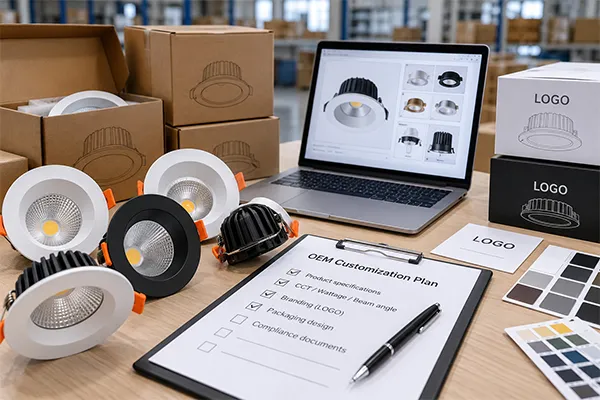
I approach MOQ discussions as a quote-readiness exercise rather than a simple price negotiation. When buyers explain what they need to customize and why, I can help separate shared components from dedicated requirements. That distinction makes it easier to evaluate small-batch feasibility, inventory exposure, and future replenishment plans.
Why Does MOQ for OEM LED Downlights Vary?
MOQ for OEM LED downlights varies because every request uses a different mix of standard and customized materials, assembly processes, testing requirements, and packaging arrangements. I do not view MOQ as an arbitrary threshold. I see it as a practical way to manage the risks created when a project requires items that cannot be readily shared with other production orders.
The MOQ for OEM LED downlights depends primarily on the scope of customization. A buyer using an existing downlight housing, driver arrangement, and standard carton may have more flexibility than a buyer requesting a dedicated finish, custom optical specification, private-label packaging, or market-specific documentation. Each requirement should be assessed separately before an MOQ can be evaluated.
MOQ begins with the product platform
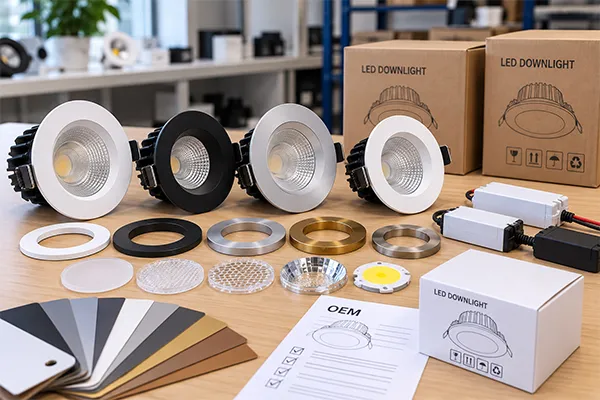
In my OEM/ODM quotation conversations, I first try to understand whether the buyer needs a completely new product concept or an adaptation of an existing LED downlight platform.
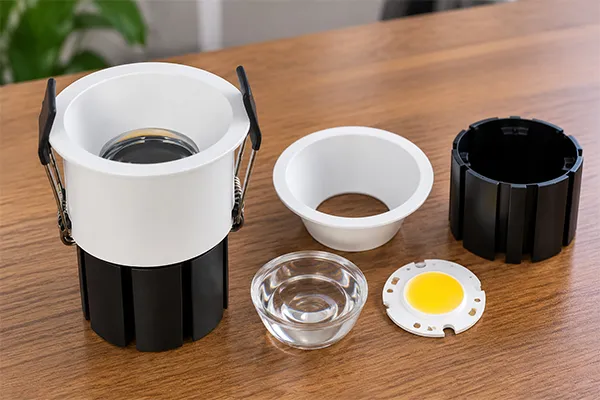
A standard platform may already have established options for:
- Cutout size
- Housing format
- Wattage range
- Color temperature
- Beam angle
- Surface color
- Dimming method
- Driver configuration
- Trim style
- IP rating, where applicable
When the requested configuration fits within an existing platform, the production process may be more straightforward. The buyer is not necessarily asking us to source or reserve entirely separate materials for one limited run.
However, a request that changes the physical structure can create a different situation. For example, a new mold, a special die-cast housing shape, a non-standard reflector, or a unique mounting design may require dedicated preparation.1 These requests can influence not only minimum quantities, but also development timing, sampling steps, quality-control planning, and future spare-part consistency.
I have found that the most useful early question is not “What is your MOQ?” It is “Which parts of this LED downlight must be different from your current model?”
That question helps buyers identify what truly supports their commercial position. A local lighting brand may need a recognizable trim finish and branded box, while the internal electrical arrangement can remain aligned with a standard product. A contractor may care more about lumen output, cutout compatibility, and delivery timing than retail packaging.
Different customization types create different MOQ conditions
Not all custom requests have the same operational effect. I recommend that buyers separate their requests into categories before requesting a quote.
| Customization area | Typical effect on OEM LED downlight MOQ | Buyer consideration |
|---|---|---|
| Standard color temperature or wattage option | Often lower impact when available on an existing platform | Confirm performance requirements and product labeling |
| Standard surface finish | May be easier if regularly produced | Check finish consistency across repeat orders |
| Custom logo marking | Can add process or material requirements | Confirm logo method, artwork format, and placement |
| Private-label retail packaging | Can require dedicated printed packaging inventory | Consider a neutral carton for the first phase |
| Custom beam angle or optics2 | May affect component sourcing and validation | Confirm application needs with a qualified lighting professional |
| New housing or trim design | Usually higher impact | Assess tooling, approval time, and volume commitment |
| Market-specific compliance needs | Depends on product and destination market | Verify applicable documents for the intended market |
I encourage buyers to avoid treating all customization as equally valuable. A well-prioritized OEM brief can protect product differentiation while reducing avoidable inventory commitments.
OEM LED downlights become easier to plan when buyers understand which elements can remain standard and which elements must be exclusive. Buyers may feel pressure to customize every visible or technical detail, but I find that selective customization often creates a stronger starting point for a new product line.
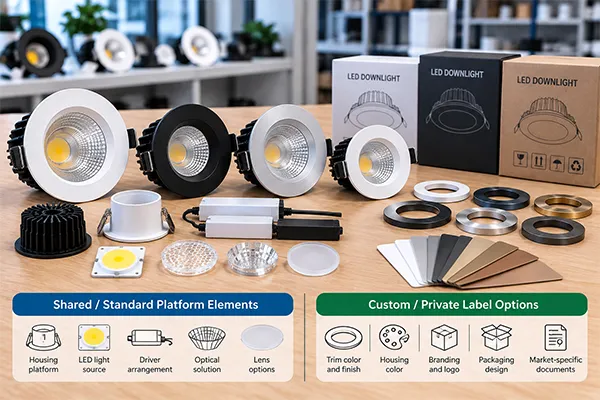
Shared elements are parts, materials, or processes that can be used across an existing LED downlight platform or multiple orders. Non-shared elements are dedicated to one buyer’s specification, identity, or market plan. Retaining shared components can reduce MOQ pressure, while exclusive items may require a larger commitment or a different purchasing approach.3
Shared components can support a more flexible launch
A shared component does not mean that the finished product lacks differentiation. It means that the underlying item is already part of a stable supply and manufacturing process.
For example, a buyer may choose an existing recessed LED downlight body and then specify:
- A preferred color temperature for the target market
- A suitable wattage selection
- A desired beam angle from available options
- A white, black, or other established finish
- A private logo on the product or label
- A product label with the buyer’s SKU system
- Outer carton markings for warehouse and distribution handling
This approach can preserve a branded market offer without requiring every part to be developed or stocked separately. I often suggest that new importers and local lighting brands begin by identifying the one or two details that customers will actually notice or require.
Non-shared elements require careful inventory planning
Non-shared items can include custom-printed color boxes, dedicated inserts, special labels, uncommon finishes, unique optics, or buyer-specific product structures. These elements can add value, but they can also create leftover-material risk if the initial order does not match future demand.4
For procurement teams, the key issue is not whether customization is “good” or “bad.” The key issue is whether the customization supports a clear sales or project objective.
I recommend asking these questions:
- Will this feature influence the end customer’s purchase decision?
- Is this feature required by the project specification or destination market?
- Can an existing option meet the same functional need?
- Will we place repeat orders for the same configuration?
- Can we accept inventory exposure if packaging or materials remain after production?
At Upward Lighting, we manufacture LED downlights and other LED lighting products for different international markets. In our discussions, we explain that buyers should verify applicable certification documents and market-entry requirements for their own destination and application. A CE or RoHS document, for example, should be reviewed against the product configuration and the market where the buyer intends to sell or install it.5
I believe this shared-versus-non-shared framework gives purchasing managers a more reliable way to compare supplier proposals. A low opening price does not always reflect the actual long-term cost of a highly fragmented product specification.
Can Small-Batch OEM LED Downlights Be Practical?
Small-batch OEM LED downlights can be practical in some situations, but I do not present them as automatic, low-risk, or suitable for every custom request. Buyers often need to balance the benefit of a smaller first purchase against unit pricing, available options, packaging choices, production scheduling, and the supplier’s ability to support repeat consistency.
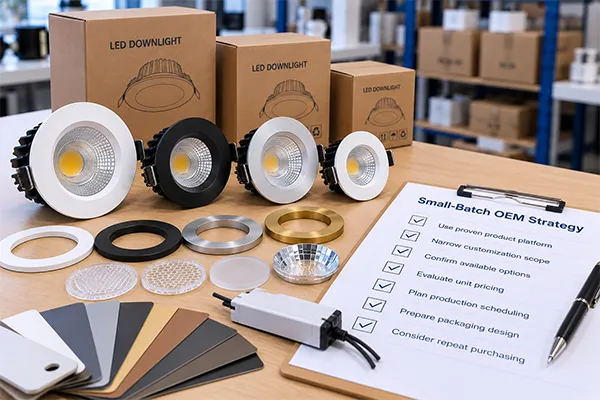
Small-batch OEM LED downlights are most feasible when buyers use a proven product platform, narrow the customization scope, and plan for repeat purchasing.6 A small initial order may be harder to support when it includes dedicated materials, extensive structural changes, or highly specific packaging. Buyers should evaluate the full commercial trade-off rather than focusing only on the first order quantity.
A phased approach can reduce launch risk
I often see buyers use phased purchasing when they are entering a new market, testing a private-label range, or preparing for a project with uncertain follow-on demand.
A phased plan may look like this:
- Phase one: Select an existing LED downlight model with standard mechanical and electrical options.
- Phase two: Add limited brand identification, such as a label or product marking.
- Phase three: Use practical transport packaging or a restrained carton customization approach.
- Phase four: Review sales feedback, installation feedback, defect reports, and replenishment patterns.
- Phase five: Consider more dedicated packaging, finishes, or model development after demand becomes clearer.
This method does not remove MOQ considerations. It simply helps the buyer make a better decision about where to accept standardization and where to invest in differentiation.
Small orders still need quality controls
I believe small-batch orders deserve the same level of specification clarity as larger programs. A smaller quantity does not reduce the consequences of receiving the wrong color temperature, cutout size, driver type, or carton marking.7
At Upward Lighting, we state that products undergo a 100% aging test before shipment, typically lasting 4 to 8 hours. Buyers should still define their own acceptance requirements in the quotation and purchase documentation. A practical quality-control plan may include confirmation of:
- Approved sample or reference image
- Model number and revision status
- Wattage and input-voltage requirements
- Color temperature and tolerance expectations
- CRI requirement
- Beam angle
- Cutout size and external dimensions
- Driver and dimming requirement
- Surface finish
- Product labeling and carton marking
- Required inspection or test documentation
- Packaging method and shipment terms
I recommend that buyers treat a small-batch OEM order as a controlled market test, not as a casual purchase. Clear documentation supports repeatability if the product later becomes a regular SKU.
For application-specific lighting decisions, I also recommend qualified professional evaluation. A lighting designer, electrical engineer, or project consultant may need to assess illumination levels, glare, heat management, installation conditions, and applicable local rules.8
What Should Buyers Prepare Before Requesting an OEM LED Downlight Quote?
A complete brief helps suppliers assess OEM LED downlights more accurately and helps buyers receive quotations that are easier to compare. I often receive early inquiries with only a photo and a request for a price. I understand why buyers begin there, but a few additional details can quickly make the conversation more productive.
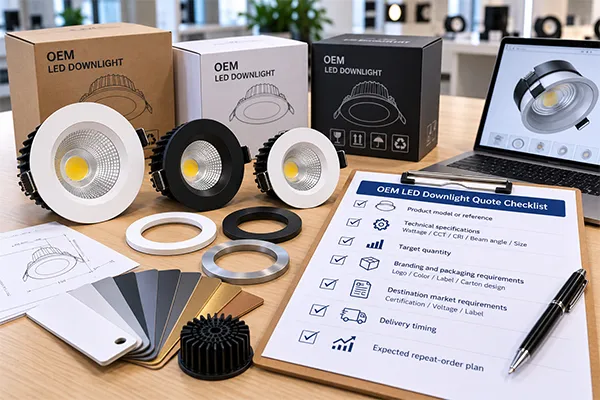
Before requesting an OEM LED downlight quote, buyers should prepare the required model or reference, technical specifications, target quantity, branding and packaging requirements, destination-market needs, delivery timing, and expected repeat-order plan. This information allows a supplier to identify which requirements use standard options and which may create dedicated MOQ conditions.
The essential pre-quotation checklist
I suggest that purchasing teams send the following information in one document or email whenever possible.
| Information to prepare | Why it matters |
|---|---|
| Product model, image, drawing, or sample reference | Helps us identify a suitable product platform |
| Application | Helps evaluate installation, IP rating, optical, and mounting needs |
| Wattage, voltage, CCT, CRI, and beam angle | Defines the core LED downlight configuration |
| Dimensions and cutout size | Prevents compatibility problems during installation |
| Target quantity | Supports a realistic review of production and packaging options |
| Logo and branding needs | Clarifies whether marking, labels, or dedicated artwork are required |
| Packaging requirements | Identifies potential custom carton, insert, or label requirements |
| Destination country or market | Helps buyers discuss relevant documents and market requirements |
| Required delivery date | Helps evaluate sampling, production, inspection, and shipping windows |
| Repeat-order forecast | Helps assess whether dedicated materials are commercially sensible |
Questions I would ask during clarification
In a typical OEM/ODM conversation, I would ask follow-up questions because terminology can mean different things to different buyers. “Dimmable,” for example, needs clarification.9 The buyer may require a specific dimming system, a particular driver compatibility, or simply a general dimming capability.
I would also ask whether the request is for:
- A project tender
- A retail lighting range
- A distributor stock item
- A replacement for an existing SKU
- A trial order for a new private label
- A recurring supply program
The answer changes the procurement logic. A project contractor may need delivery reliability and installation compatibility above all else. A distributor may prioritize stable SKU management and carton efficiency. A local lighting brand may place more value on product presentation and consistent branding.
I have learned that early transparency helps both sides. If a buyer expects repeat orders, I encourage them to say so, even when the first purchase is modest. That information does not guarantee a specific MOQ outcome, but it gives the supplier context for considering a phased OEM approach.
How Can Buyers Compare OEM LED Downlight Supplier Proposals?
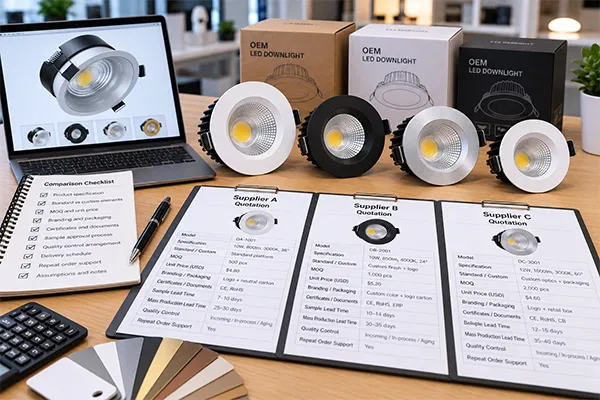
Supplier comparisons for OEM LED downlights should go beyond the quoted MOQ and unit price. I believe buyers should compare how clearly each supplier explains the product configuration, customization assumptions, quality controls, documentation scope, delivery schedule, and repeat-order process.
Buyers should compare OEM LED downlight proposals by reviewing the exact specification behind each quote, not just the quantity and price. A useful proposal identifies standard versus custom elements, document availability, sample approval steps, quality-control arrangements, packaging details, and the assumptions that could affect repeat orders.
Evaluate quotation clarity, not only price
A quote can appear competitive while leaving important variables undefined. For example, two proposals may list the same wattage, but they may not describe the same driver arrangement, CRI, finish, packaging, or inspection scope.10
I recommend comparing supplier offers line by line.
| Evaluation point | Questions to ask |
|---|---|
| Product specification | Does the quote clearly state wattage, CCT, CRI, beam angle, dimensions, and cutout? |
| Customization | Which features are standard, and which are dedicated to our order? |
| Documentation | Which certification documents are available for verification? |
| Quality process | What aging, inspection, and pre-shipment checks are described? |
| Samples | Is sample approval required before bulk production? |
| Packaging | Are labels, cartons, inserts, and shipping marks clearly defined? |
| Delivery | Does the timeline include artwork approval, sampling, production, and shipment? |
| Repeat orders | Can the supplier explain how configuration consistency will be managed? |
At Upward Lighting, we support OEM/ODM discussions around parameters such as color temperature, wattage, beam angle, CRI, and surface finish. We also support small-batch discussions where the selected product platform and scope of customization make them workable. However, I would always encourage buyers to confirm the final product details in writing before placing an order.
A good supplier should not oversimplify MOQ. Instead, the supplier should help the buyer understand the commercial choices behind it. That approach can support a more stable long-term relationship, especially for distributors, importers, and lighting brands that need dependable replenishment rather than a one-time transaction.
Frequently Asked Questions
Is there one standard MOQ for OEM LED downlights?
No. I do not recommend relying on one universal MOQ figure for OEM LED downlights. MOQ depends on the selected product platform, quantity, branding, packaging, technical specifications, dedicated materials, and expected repeat business. Buyers should request an assessment based on their complete requirement.
Can I add my logo to LED downlights with a small order?
A logo request may be possible in some cases, especially when the underlying LED downlight model remains standard. However, the marking method, artwork, label format, and packaging requirements can affect feasibility. I recommend submitting clear logo artwork and confirming placement before requesting a formal quotation.
Does custom packaging increase OEM LED downlight MOQ?
Custom packaging can affect MOQ because printed cartons, inserts, labels, and other packaging materials may be dedicated to one buyer. I suggest that buyers consider whether branded packaging is essential for the first launch or whether standard export packaging can support an initial market test.
What documents should I request from an LED downlight supplier?
Buyers should request product specifications, applicable test or certification documents, packing details, sample approval records, and inspection information relevant to their purchase. I recommend that buyers verify documents against the specific product configuration and destination-market requirements rather than assuming one document applies to every version.
How do I reduce MOQ risk for a new lighting brand?
I suggest using an established LED downlight platform, selecting standard technical options where possible, limiting dedicated packaging, and planning a phased launch. Buyers should also consider future replenishment demand before choosing unique materials or highly specialized features.
Conclusion
MOQ for OEM LED downlights is best understood as the result of customization choices, material-sharing opportunities, production planning, and inventory risk. I encourage buyers to define what truly needs to be unique before requesting a quote. Standard platforms, selective branding, and phased purchasing can make an initial program more manageable11 without removing the need for careful specification and quality review. If you are planning an OEM LED downlight range, I invite you to share your model requirements, target market, quantity, and branding needs with Upward Lighting so we can discuss a practical quotation path.
"Injection Mold Design", https://people.tamu.edu/~hsieh/ICIA/Richland-Injection-Molding-Web/Richland-Part-4-Mold-Design.pdf. Manufacturing references on molding and die casting describe tooling and process-development requirements for new geometries, supporting the view that a new housing or mounting design can require dedicated preparation before serial production. Evidence role: mechanism; source type: institution. Supports: An authoritative manufacturing source should describe how new part geometries commonly require tooling, design validation, and process preparation.. Scope note: The specific tooling requirement depends on the selected manufacturing method and whether an existing tool can be modified. ↩
"Understanding LM-79 Reports", https://betterbuildingssolutioncenter.energy.gov/sites/default/files/attachments/understanding_lm79_reports.pdf. Lighting-engineering guidance treats beam distribution as an optical and photometric characteristic of a luminaire; changing optical components can therefore require sourcing review and photometric validation. Evidence role: mechanism; source type: institution. Supports: Lighting-engineering guidance should establish that luminaire optics determine beam distribution and are evaluated through photometric measurement.. Scope note: This supports the need for technical validation, not a particular MOQ consequence for every optical change. ↩
"Understanding the Dynamics of Value-Driven Variety ...", https://sloanreview.mit.edu/article/understanding-the-dynamics-of-valuedriven-variety-management/. Supply-chain research on component commonality finds that sharing components across products can pool demand and reduce inventory and production complexity, whereas dedicated components concentrate demand and increase exposure to residual stock. Evidence role: mechanism; source type: paper. Supports: Research should show that component commonality pools demand and reduces inventory or production complexity relative to dedicated components.. Scope note: The magnitude of any MOQ reduction is contingent on supplier capacity, demand forecasts, and the particular component. ↩
"Total", https://www.sec.gov/Archives/edgar/data/1087294/000119312512347942/R11.htm. Inventory-management literature identifies demand uncertainty and product-specific materials as drivers of excess and obsolete inventory, supporting the risk that unused dedicated packaging or components remain after an initial production run. Evidence role: mechanism; source type: research. Supports: Inventory-management research should support the relationship between demand uncertainty, dedicated materials, and excess or obsolete inventory risk.. Scope note: The source supports the inventory-risk mechanism; it cannot establish that leftover materials will occur in a particular buyer's order. ↩
"European Union Reduction of Hazardous Substances ...", https://www.waru.edu/artifact/european-union-reduction-hazardous-substances-rohs-and-waste-electrical-and-electronic. European regulatory guidance states that CE marking follows conformity assessment under the applicable Union legislation and requires technical documentation for the product concerned; RoHS obligations likewise depend on whether the electrical or electronic equipment falls within the directive's scope. Evidence role: definition; source type: government. Supports: Official regulatory guidance should explain that CE conformity assessment and supporting technical documentation apply to products within relevant legislation, while RoHS restricts specified substances in covered electrical and electronic equipment.. Scope note: The applicable rules vary by destination market, product category, and legal status of the economic operator. ↩
"Economies of Scale: Definition, Types, and Strategies", https://online.hbs.edu/blog/post/economies-of-scale. Product-platform and mass-customization research indicates that reuse of established architectures and limitation of unique variants can reduce development and operational complexity, making low-volume customized offerings more manageable. Evidence role: general_support; source type: paper. Supports: Research should support the proposition that product platforms and reduced variety lower development and production complexity for low-volume offerings.. Scope note: Feasibility remains supplier- and product-specific and is not proof that a given small-batch downlight order will be accepted. ↩
"Lighting Specification Guidance for Schools", https://www.energy.gov/sites/default/files/2024-12/lighting-spec-guidance-school_nov24.pdf. Electrical-product and lighting guidance recognizes that rated electrical characteristics, installation compatibility, and product identification are material to intended use, safety, and traceability, so errors in these specifications can affect orders of any size. Evidence role: general_support; source type: government. Supports: Authoritative lighting and product-compliance guidance should establish that electrical ratings, installation dimensions, and labeling are relevant to safe installation, intended performance, and traceability.. Scope note: The practical consequence of a specific error depends on the installation, jurisdiction, and contractual acceptance criteria. ↩
"Purchasing Energy-Efficient Commercial and Industrial ...", https://www.energy.gov/cmei/femp/purchasing-energy-efficient-commercial-and-industrial-led-luminaires. Professional lighting guidance evaluates illumination levels, glare, luminaire performance, and application conditions as interrelated design considerations, supporting the need for qualified review in application-specific installations. Evidence role: expert_consensus; source type: institution. Supports: Professional lighting guidance should show that lighting design considers illuminance, glare, application conditions, and luminaire performance, including thermal and installation constraints.. Scope note: This does not mean every purchase legally requires a lighting designer or engineer; professional involvement depends on project complexity and local rules. ↩
"LED Dimming: What you need to know", https://www1.eere.energy.gov/buildings/publications/pdfs/ssl/dimming_webcast_12-10-2012.pdf. LED-lighting research notes that dimming performance depends on compatibility among the LED driver, control type, and dimming protocol, so a general request for a “dimmable” product may not define the required configuration. Evidence role: mechanism; source type: research. Supports: Lighting research should explain that LED dimming performance depends on the compatibility of drivers, controls, and dimming protocols.. Scope note: Compatibility must be verified for the named driver and control combination rather than inferred from a generic dimmable label. ↩
"REA Refrigerated Display Case LED Lighting Performance ...", https://www.energy.gov/sites/prod/files/2014/04/f14/rea_refrig_display_spec.pdf. Lighting-technology guidance distinguishes input wattage from other luminaire characteristics, including color rendering, driver and control behavior, photometric distribution, construction, and verification testing; equal wattage therefore does not establish equivalent product configuration. Evidence role: general_support; source type: education. Supports: Lighting education resources should establish that wattage is only one luminaire attribute and that color rendering, driver characteristics, photometry, construction, and testing also affect the product specification.. Scope note: Packaging and inspection scope are commercial terms that must be compared in the individual quotations rather than inferred from technical guidance. ↩
"Market Uncertainty and Dynamic New Product Launch Strategies", https://www.academia.edu/57567333/Market_Uncertainty_and_Dynamic_New_Product_Launch_Strategies_A_Systems_Dynamics_Model. Research on staged product introduction and platform reuse describes how firms can manage demand uncertainty by limiting early irreversible commitments, learning from initial market feedback, and expanding differentiation after evidence of demand emerges. Evidence role: general_support; source type: paper. Supports: Research should support staged launches and platform reuse as approaches for managing uncertainty and limiting irreversible commitments.. Scope note: A phased approach can reduce exposure but does not eliminate MOQ, compliance, quality, or supply-continuity risks. ↩